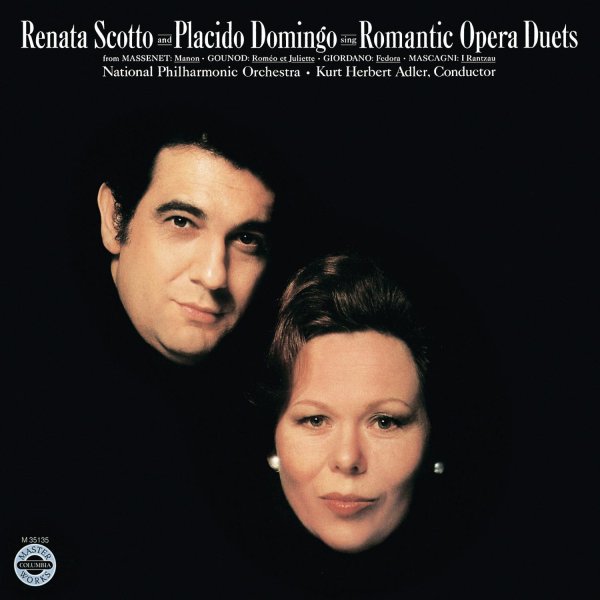
Romantic Opera Duets – Placido Domingo & Renata Scotto

Domingo recorded quite a few duet recitals in the 1970s, with Sherrill Milnes (1970), with Katia Ricciarelli (1972), with LeontynePrice (1974) and this one, with Renata Scotto, in 1978, which is, in many ways, the most successful.  For a start, the material is refreshingly unhackneyed, and, although we are vouchsafed only four excerpts, they are quite long (the shortest 8’52”), which makes for a more satisfying listening experience than lots of shorter pieces. The original LP had the French items, which are no doubt better known on the first side and the Italian ones on the second.

Scotto was at the high watermark of what was often referred to as her second career. In the 1960s she had recorded for EMI and DG, but signed to CBS/Sony in the 1970s appearing on many complete sets and recording recitals of Verdi and verismo. The voice was never a conventionally beautiful one and by this time could turn squally and shrill on top notes, but the compensations were many and included her superb musicality, her dramatic involvement, her attention to the text and her natural, unforced, excellent diction. As you can hear here, her French was less idiomatic than her Italian but you can at least hear the words clearly, and it is the French items I enjoyed most on this recital, though that could possibly reflect my preference for the material in question. I’ve never been a big fan of verismo.

Domingo is his reliable self, the voice in good shape, but at this time in his career his performances could seem a little generic, and there is not much difference between his Roméo and his Des Grieux, his Loris and his Giorgio, however musical his actual singing.

Both singers are attentive to the different styles required of the composers in question, but it is Scotto who is better at vocal characterisation, adopting an appropriately more seductive tone for Manon than she does for the girlishly innocent Juliette.  Her Fedora also sounds more mature and commanding than her Luisa in the Mascagni opera, which is a sort of verismo mirror piece to Gounod’s Roméo et Juliette.

All in all, this is a very enjoyable duet recital, both in terms of the singing and the music tackled, and it is an excellent showcase for both singers.
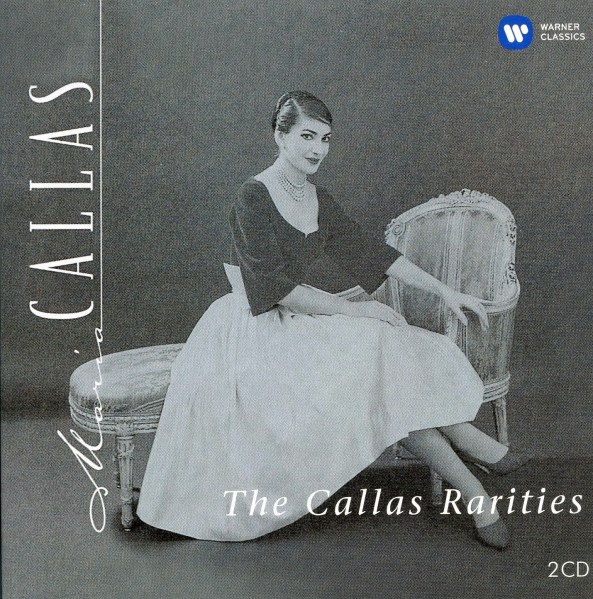
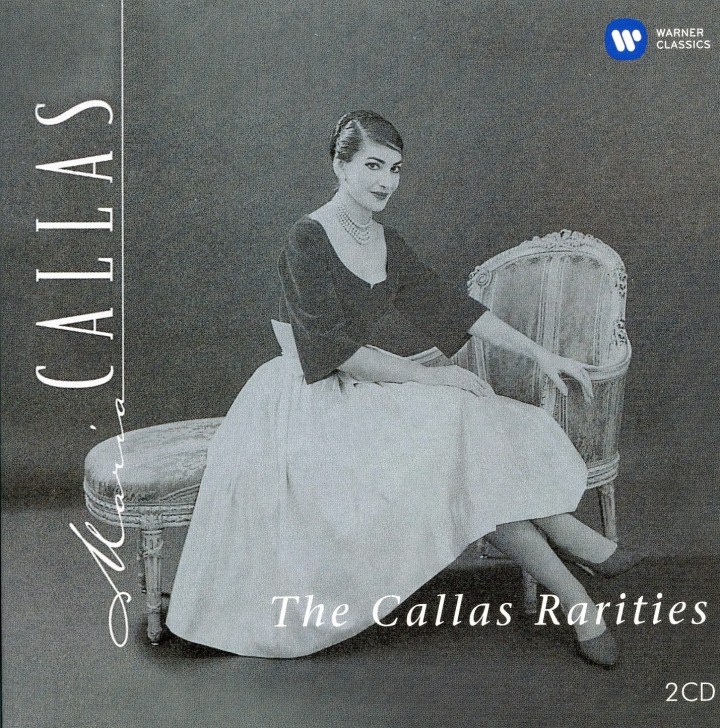
The Callas Rarities

912yodnhq2bl-_sl1500_

The Callas Rarities covers recordings made for EMI between 1953 and 1969. Apart from the mono version of the Sleepwalking Scene from Macbeth and the Scena from Il Pirata, none of these items were approved for release by Callas, so it is important to remember that when listening.

We start with two test recordings of Donna Anna’s Non mi dir made in Florence before her first complete opera recording for EMI (Lucia di Lammermoor), and so that Legge and the engineers could get a feel for her voice. She sails through the aria as if it’s the easiest thing in the world (it isn’t), but the second take is noticeably more relaxed than the first. Though the recordings were simply in the nature of a “run-through”, Callas is incapable of being dull. She reminds us that this aria is an appeal to Don Ottavio, caressing the phrases. Her breath control is astounding and there is a moment of pure magic as she phrases through into the second statement of Non mi dir, the voice almost suspended in mid air.

We move onto the Sleepwalking Scene from Macbeth, one of Callas’s most psychologically complex pieces of singing, which most of us will know better from the stereo version. This one has the added advantage of hearing Callas disappear into the distance as she sings her last melismata up to the top Db, and as is part of the stage instructions.

The Tonini sessions of 1961 and 1962 form the largest body of unreleased material, and were made primarily as “working” sessions for Callas to retrain her voice after the vocal problems that started to beset her at the end of the 1950s. One thing I immediately noticed, listening to these and the older recordings that follow, is that the voice is much more comfortable to listen to in these new re-masters. I didn’t make direct comparisons, but I remember the sound generally being much more harsh before. Both orchestra and voice seem to have more space around them. None of this material is without interest, but there is an unfinished air, about them, which is hardly surprising, given their provenance. Her voice is generally, but not always, fresher sounding than on the ones that were finally issued (conducted by Rescigno). She adopts a suitably imperious tone as Semiramide, but she chooses not to add a cadenza, nor add much ornament, leaving it all sounding a bit dry. It is no match for Sutherland’s brilliantly decorated version on her early Art of the Prima Donna recital. That said, as in all this material, Callas’s  phrasing is wonderfully musical.

The biggest surprises for me came with the later material, recorded in 1964, 1965 and 1969. The Aida duet sounds much better here than in its previous incarnation, the miking more flattering, Callas and Corelli responding brilliantly to each other. Corelli adored Callas. Too bad he isn’t on her complete recording of Aida, and why not on the EMI La Gioconda recorded just before Norma? A mystery indeed.

The 1969 sessions too sound much better than I remember them, the performance of Elena’s Arrigo, ah parli much more beautiful than my recollection of it, the final chromatic scale with its plunge down to a low F# quite breath-taking.

Of course all these late performances expose marked vocal problems, but I was amazed at just how beautiful much of the singing is. Her musical instincts are never in doubt, and we still hear this amazing ability she had to capture the mood of an aria in just a few notes, how she could match the timbre of her voice to the orchestral introduction. The sighing loneliness she brings to Mathilde’s Selva opaca, from Rossini’s Guglielmo Tell being a perfect example. It may be a voice in crisis, but it remains the voice of a great artist.