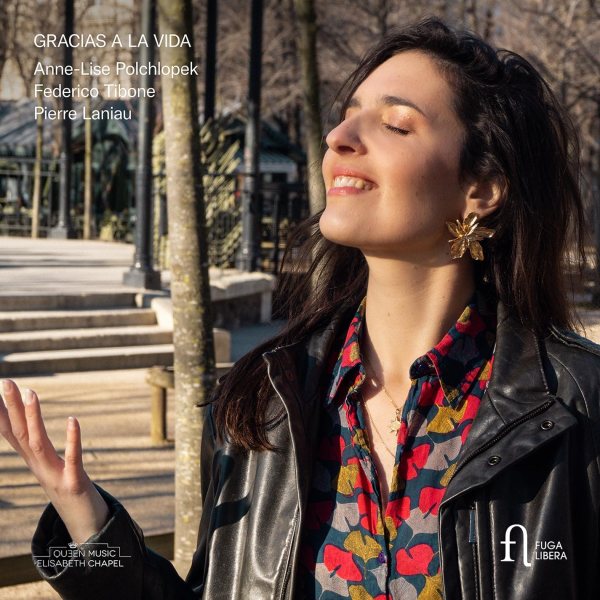
Gracias a la vida – Anne-Lise Polchlopek

It seems not a month goes by without a new recital record from a young artist making an impression. Recently I’ve welcomed recital records from Benjamin Appl, Fatma Said, Harriet Burns, Rachel Fenton and Eva Zalenga , and July saw a recommendation for Julieth Lozano-Rolong’s new disc from Dominy Clements. To this list can now be added the name of French mezzo-soprano, Anne-Lise Polchlopek, a winner of several song competitions, and now an associate artist of the Queen Elizabeth Music Chapel, where this recording was made.

This recital may at first glance appear to be a hotchpotch of different styles, embracing classical Lied, folk and popular music, but Polchlopek somehow integrates these different musical styles into a satisfying whole, and the recital benefits from being listened to at one sitting. It doesn’t get off to the best of starts with her somewhat over-articulated and over-acted singing of Bernstein’s Old Lady Tango (I am easily assimilated) from Candide, but she then sings a beautiful version of Strauss’s Wiegenlied, with a lovely legato line, her mellifluous mezzo wrapping the child in its warm embrace.

From Germany we travel to Spain and France, where we stay for the remainder of the recital. Toldrá is followed by Chaminade, then we switch to guitar accompaniment for Hubert Giraud’s La tendresse, staying with the guitar for an extremely effective performance of Falla’s Nana, from his Siete canciones populares españolas.

We go back to the piano for Fauré’s Les berceaux, in which she builds nicely to the climax, and then we have Messiaen’s early Trois melodies, where she captures to perfection the ecstasy of the writing, especially in the final song, la fiancée perdue.

 These are followed by three songs in a lighter vein by Chaminade, Pauline Viardot and Gerónimo Giménez, all wonderfully characterised. Perhaps incongruously (but somehow it works) Voi che sapete from Mozart’s Le nozze di Figaro acts as a bridge to Michel Polnareff’s Mes regrets, a beautiful song about lost love, which is followed by Fauré’s Toujours.

This in turn is followed by Gérard Jouannest’s La chanson des vieux aimants, with lyrics by Jacques Brel, a song I had previously only known in a version by Judy Collins. Suffice it to say that Polchlopek’s intensely moving performance put any thoughts of Collins out of my mind completely.

Throughout the piano accompaniments of Federico Tibone contribute wonderfully to the success of the disc, as do the guitar accompaniments of Pierre Laniau, who accompanies her on Tamás Méndez’s charming Cucurrucucu paloma, which I seem to remember was a favourite of Nana Mouskouri. He also accompanies her on the Habanera from Bizet’s Carmen and Satie’s La diva de l’empire, though I did feel the Bizet was slightly out of place here, coming, as it did, after the piano accompanied Poulenc Les métamorphoses and before the Satie.

We return to piano accompaniment for Montsalvatge’s Canto negro, which she sings with charm and spirit, relishing the yambambós, as Victoria De Los Angeles did before her.

All three participants come together for the final song, Violetta Parra’s Gracias a la vida, a fitting end to a journey on which Anne-Lise Polchlopek has proved to be a most musical guide. Throughout she clearly and meaningfully enunciates the text, and it is clear she has a rare gift for communication that makes her an ideal recitalist.

Unfortunately, though the notes accompanying the disc are in English, the online texts are only in the original language, French, Spanish, German, or in the case of the Bernstein, English, and translations would have helped for a total appreciation of Polchlopek’s art. However, I thoroughly enjoyed this disc, and I look forward to hearing more of Anne-Lise Polchlopek.
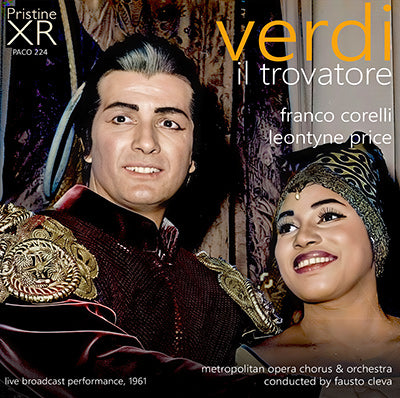
Il Trovatore from the Met with Price and Corelli

If I were to use one word to describe this performance of Il Trovatore from the Met, it would be aggressive. The house was in a high state of excitement as, a few days earlier, Price and Corelli had made their extremely successful house debuts in these same roles to fantastic acclaim, and the audience is ready with its applause from the get-go. The pace is fast and furious, especially in the choruses, which results in them occasionally becoming unstuck.

The singing too is extremely competitive, with little room for subtlety. I don’t know whether it is the recording, or the transfer but the soloists seem to be closely miked, which picks up a vibrato in Price’s voice I hadn’t been aware of before, and for much of the performance she sounds to me as if she is forcing her essentially lyric instrument. Corelli was never the most subtle of artists, but the general air of competitiveness encourages him to belt out his high notes for all he is worth and, it has to be said, the audience go wild for him.

This generally aggressive atmosphere extends to the other soloists too, who, in any case, are less vocally entitled than Price and Corelli. Irene Dalis is perfectly acceptable, and you’d go a long way to hear her like today, but she is honestly second rung, as is Mario Sereni. They are no match for Giulietta Simionato and Ettore Bastianini, who appear on another live recording from the following year, which also features Price and Corelli. This was from the 1962 summer Salzburg Festival, and is no less exciting, but is conducted much more stylishly by Herbert von Karajan. It was enthusiastically reviewed by Simon Thompson, when first issued and is still available from DG as a download, though the CDs have been withdrawn. If you want Price and Corelli in this opera, then it is definitely the one to go for, and Price sounds glorious here and much more relaxed than she was at the Met. With Simionato, arguably the greatest Azucena of her age and Bastianini in fantastic form, this is a set that should be in every Verdi lovers collection.

No doubt others will just get caught up in the excitement of the performance under review from the Met, but I’m afraid I found it rather vulgar, for which the blame should be left squarely on the shoulders of Fausto Cleva, who, time and again, mistakes speed for excitement.

My preference for the opera would still be Karajan’s first studio recording with Callas a non pareil of a Leonora, but the live Salzburg recording is almost as good, if without the precision of the studio one, with all the principals, including Price and Corelli, in fabulous voice. Truly that one was the night to remember.

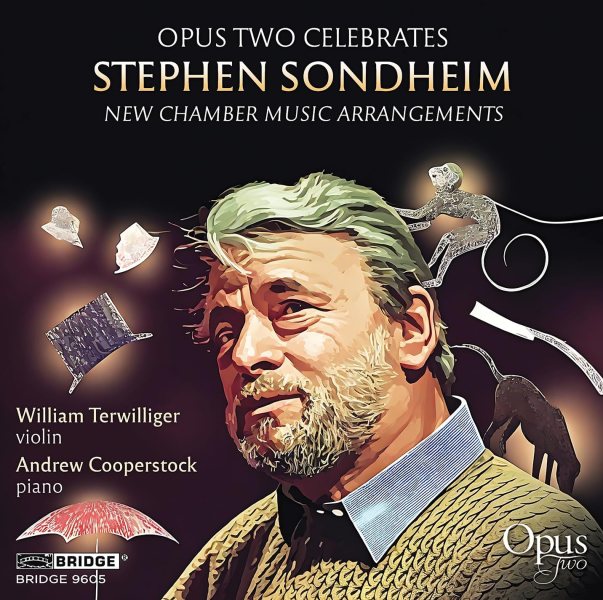
Opus Two celebrates Stephen Sondheim

I’ve loved the music of Stephen Sondheim ever since I was introduced to the LP of the Broadway recording of A Little Night Music by an old friend, my musical mentor, back when I was in my early twenties. Though Sondheim is known for his lyrics, it was the swirlingly Romantic score that I first responded to, and it is fitting that the first piece  on this disc is the Suite from that musical, in an arrangement, like the other pieces on this disc, by Eric Stern, who worked closely with Sondheim on the 1984 revival of Pacific Overtures. Since then, Stern has conducted the second year of Sunday in the Park with George, and also worked on Into the Woods, several productions of Follies, a revival of Merrily We Roll Along at the Kennedy Centre, and many more concerts and birthday celebrations around the world. His last conversation with Sondheim was about the Little Night Music suite, which Sondheim enthusiastically endorsed, though unfortunately the rest were written after his passing.

Opus Two are violin and piano duo, William Terwilliger on the violin and Andrew Cooperstock on the piano. They are joined by soprano Elena Shaddow for I remember, from the TV musical Evening Primrose, and by baritone Andrew Garland for Finishing the Hat, from Sunday in the Park with George, though, truth to tell, neither performance eclipsed memories of other performances of these songs, and I wondered at their inclusion. On the other hand, the addition of Beth Vandeborgh’s cello to the arrangement of Every Day a Little Death from A Little Night Music adds a certain expressive depth to the song. I found it one of the most successful pieces on the disc.

For those who know and love Sondheim’s scores, I would suggest that this disc is self-recommending. The arrangements are brilliantly done, though there is just the whiff of Palm Court about them. I could imagine them being played at the Waldorf Hotel, whilst enjoying tea, not that there is anything wrong with that, of course, and I found the disc hugely enjoyable. In some cases, I know the lyrics so well I could sing along in my mind’s ear, which no doubt added to my enjoyment of them.

It has often been said that Sondheim’s lyrics take precedence over the music, but here, I think, we get the chance to concentrate on Sondheim the composer, and we find how lyrical, in the musical sense, his music is. The only piece I didn’t know was the main title from Alain Resnais’s 1974 film, Stavisky, a short evocative piece, but it too has a tune which lingers in the memory for some time afterwards.

Terwilliger shines in Sorry/Grateful from Company, which is here arranged for solo violin, whilst Cooperstock is given the jazzy Now You Know from Merrily We Roll Along as a piano solo. Then they come together again for the final work, the Fleet Street Suite, which combines themes from Sweeney Todd and closes the recital with the beautifully poetic Johanna, which, in the show, is a moment of calm and pure beauty amidst the turbulence of the rest.

Contents:

Suite from A little Night Music

Not while I’m around (from Sweeney Todd)

Broadway Baby (from Follies)

I remember (from Evening Primrose)

Main Title from Stavisky

Every Day a Little Death (from A little Night Music)

Sorry/Grateful (from Company)

Finishing the Hat (from Sunday in the Park with George)

Now You Know (from Merrily We Roll Along)

Fleet Street Suite (from Sweeney Todd)

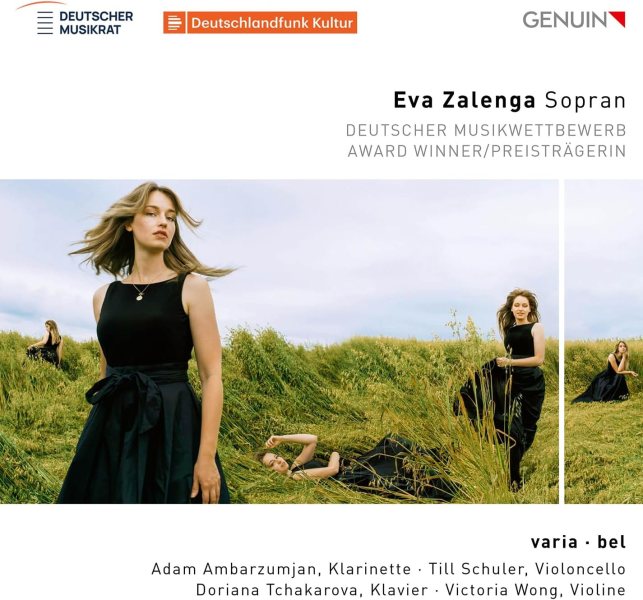
Eva Zalenga – Varia bel

Last month I was welcoming a disc of Lieder with various accompaniments by Fatma Said and here we have another for various forces, which, coincidentally, also includes Schubert’s Der Hirt auf dem Felsen.

In April 2024, I welcomed Zalenga’s debut recital on the Hänssler label, and this new recital on the Genuin label is, if anything, even more successful. Variety is the key note of the disc, in the variety of music (from the 18th to the 21st centuries), the variety of styles from the intimate to the more extrovert, and the variety of instruments accompanying the voice, that nonetheless add up to a convincing whole.

We start with a world premiere recording of Ignaz Lachner’s An die Entfernte (In die Ferne) for soprano, violoncello and piano, in which Zalenga charmingly intertwines with the cello of Till Schuler. We stay with the combination of cello and piano for Schubert’s Auf dem Strom. There is just the suspicion of strain in the upper reaches of the song here, a slight impurity that obtrudes on the silvery beauty of the sound, but it is fleeting, and soon evaporates during the next song, Meyerbeer’s haunting Des Schäfers Lied, in which the cello is swapped for Adam Ambarzumjan’s clarinet.

We stick with this combination for Schubert’s more famous Der Hirt auf dem Felsen, which, whilst not plumbing the deeper meanings of the text, as Said and Meyer do in their version, is nonetheless a delightful and charming performance.

In their earlier recital, Zalenga and Tchakarova championed women composers and it is good to see that they do so here too, first with a lovely song by Pauline Viardot-Garcia, in which we return to the combination of soprano, cello and piano, and then, jumping ahead around 100 years to Rebecca Clarke’s arrangement for soprano and violin of Three Irish Folk Songs. The tricky violin part is played by Victoria Wong. These are sung in English, and we stick with English for Arthur Bliss’s Two Nursery Rhymes, the first for soprano, clarinet and piano and the second for soprano and clarinet. Zalenga sings in perfectly accented English, and seems equally at home in French, which is the language of the next group of songs, four miniatures for soprano and violin by Darius Milhaud, Quatre Poèmes de Catulle.   

Finally all the forces come together for the last item, a new arrangement of contemporary composer Isabelle Aboulker’s Je t’aime, which Zalenga brings off with incredible wit, panache and style to bring this excellent recital to a riotous conclusion.

In all, Zalenga proves herself to be a most musical and intelligent singer and I look forward to seeing where her next enterprise will take us. Highly recommended.

Lines of Life – Schubert and Kurtág


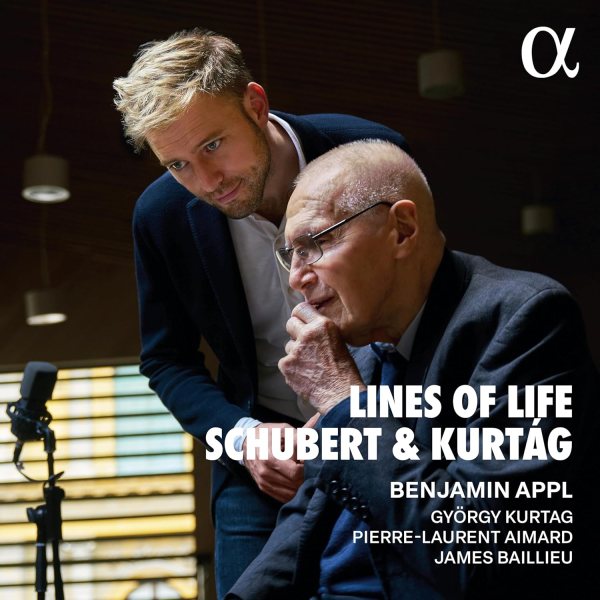
“I believe that Benjamin is currently the most authentic interpreter of my Hölderin Gesänge.” So writes György Kurtág in the notes accompanying this disc and, as he is also credited as recording producer, I think we can lay claim to their authenticity. Kurtág attended all the sessions, which took place in Budapest, apparently producing over 1,300 recording takes and countless repetitions.

The majority of the Kurtág songs on this disc are a capella. Their range, both vocal and emotional, is wide and they are brilliantly performed by Appl, whose range of expression and ability to meld the wide-ranging melismas in the vocal writing are superb. Indeed the very first song, Circumdederunt, which is in Latin and reminiscent of plainchant, homes in directly on the voice, a peculiarly expressive instrument, capable of harshness when required, as in the words et in trubulatione mea, returning to a beautiful, consoling richness for the remainder of the song. All but one of the Hölderin Gesänge are also unaccompanied and the one that isn’t, unusually has a sort of obligato accompaniment for trombone and tuba. The four Ulrike Schuster songs have an atonal piano accompaniment, which is played here by Pierre-Lauent Aimard.

As an interpreter of contemporary song, then, Appl proves himself to have few equals, but he is also a fine interpreter of Schubert and Brahms, as witness the beautiful versions of the Schubert and Brahms songs included on the disc. As befits a student of Fischer-Dieskau, expression is paramount, but never at the expense of a fine legato line and the beauty of the voce is well caught.

James Baillieu is the fine accompanist for most of the Schubert songs, but in the final two songs, Schubert’s Der Jüngling an der Quelle and Brahms’s Sonntag, Appl is touchingly accompanied by György Kurtág himself, though, it must be admitted, with rather too much pedal.

I found this disc an absorbing and challenging experience and would recommend it to anyone with an adventurous appetite.

The disc finishes with a fascinating eighteen-minute interview in German between Appl and Kurtág, for which an English translation is provided in the accompanying booklet.

.

Glen Cunningham’s Heart is in the Highlands

An interesting programme of Scottish inspired songs, but Cunningham’s tenor is a little too much on the dry side for my liking.

My Heart’s in the Highlands

Glen Cunningham (tenor)  Anna Tilbrook (piano)

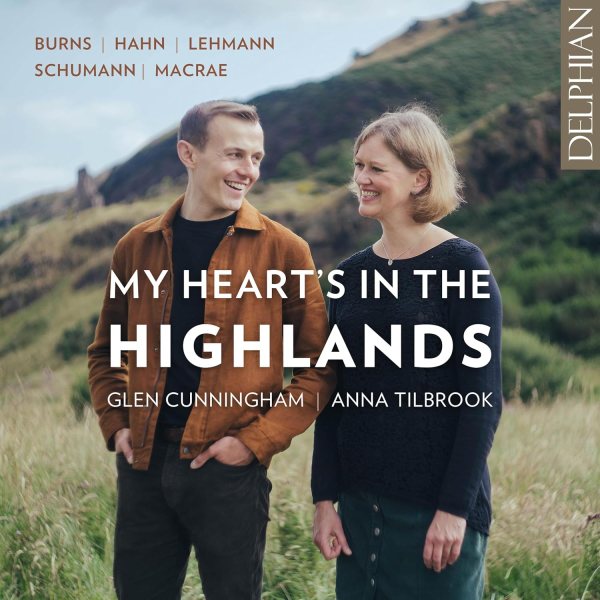
The young tenor, Glen Cunningham, and his pianist, Anna Tilbrook, celebrate their Scottish heritage in a programme of music connected to Scotland, not only in the folk orientated songs of Robbie Burns, but also in settings of Burns by Schumann, and Robert Louis Stevenson by Liza Lehmann and Reynaldo Hahn. To these are added a completely new song cycle, also to texts by Robert Louis Stevenson, by the Scottish composer, Stuart MacRae.

It makes for an interesting programme, with the folk song settings framing the songs by Schumann, Lehmann, MacRae and Hahn. Thus, we start with a setting of Burns’s Ca’ the yowes to the knows in an arrangement by Claire Liddell, which segues into the eight songs from Schumann’s Myrthen, which set texts by Burns in German translation. They are possibly less well known than other songs from Myrthen, like Widmung or Der Nussbaum, and I doubt anyone would guess the Scottish provenance of these Schumann songs. Nor, I wager, would anyone guess that the  song Dem Roten Röslein Gleicht Mein Lieb from Schumann’s Opus 27 Lieder und Gesänge is actually a setting in German of the famous My love is like a red, red rosewhich follows it.

Liza Lehmann is less well represented in the catalogue than Schumann, though a selection of the songs from The Daisy-Chain have been recorded by mixed voices and are available on the Naxos label. Cunningham selects four of the five songs to texts by Robert Louis Stevenson. These are children’s songs to be performed by skilled adults, and the vocal writing is often taxing, Stars, for instance, requiring the sort of lyrical outpouring that Cunningham’s rather dry tenor is not quite capable of. Toby Spence manages it slightly better on the above Naxos recording, but it really needs a fuller voice than either of these two tenors can provide.

Two of the texts are also set by Reynaldo Hahn in his Five Little Songs, written while Hahn was a private in the French army during World War I, where he saw action on the front line. These too are settings of Robert Louis Stevenson, ‘children’s songs’, though it is unlikely that any child could sing or play them. They are quite charming, though, yet again, there is nothing particularly Scottish about them.

Not surprisingly, I suppose, the most Scottish sounding of the songs are those by Stuart MacRae, particularly For age an’ youth, which sets a Scots style vocal line against a sort of imitation bagpipe in the piano accompaniment. Cunningham is at his best in these songs, but even here I wanted more of tonal beauty. He compensates with the intelligence of his delivery, but throughout I’m afraid I found his vibrato intrusive and the sound he makes unpleasantly hard and uningratiating.

I should just mention that Anna Tilbrook is a most sensitive accompanist and adapts brilliantly to the style of each composer.

The recital ends with the title song, My heart’s in the Highlands, in an arrangement by Michael Barnett (and supplemented by Tilbrook) that was transcribed from a 1962 Kenneth McKellar recording. I just wish that Cunningham sang it with some of McKellar’s beauty of tone.

Turandot from the Met with Nilsson and Corelli

La principessa Turandot – Birgit Nilsson (soprano)
Calaf – Franco Corelli (tenor)
Liù – Licia Albanese (soprano)
Ping – Frank Guarrera (baritone)
Pang – Robert Nagy (tenor)
Pong – Charles Anthony (tenor)
Timur: Ezio Flagello (bass)
L’imperatore Altoum – Alessio De Paolis (tenor)
Un mandarino – Calvin Marsh (baritone)
Chorus and Orchestra of the Metropolitan Opera/Kurt Adler
rec. live radio broadcast, 24 February 1962, Metropolitan Opera House, New York City, USA

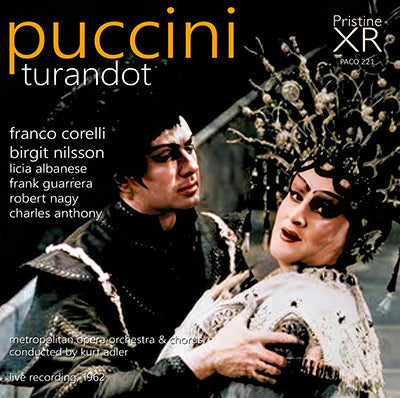
Well, let’s get this straight. This is an exciting performance of Puccini’s last opera, which puts you in a good seat at the old Metropolitan Opera House on a night when two of its greatest stars were singing two of their greatest roles. You can sense the excitement in the house from the moment the radio announcer, Milton Cross, introduces the opera with the words, “We’ll have the loud, crashing chords, then the curtain will open on the walls of the oriental Imperial palace of Peking.” Indeed the set is loudly applauded by the audience.

After the excitement of those opening chords and the chorus which follows, it is something of a disappointment to be confronted with the Liu of Licia Albanese, who was approaching 53, but quite frankly sounds even older. She compensates by loudly over-singing and over-emoting, and I derived very little pleasure from her performance. Her days at the Met were evidently numbered and she left the company in 1966, following a dispute with Sir Rudolf Bing.

For the rest, we have a sonorous Timur from Ezio Flagello, but the Ping, Pang and Pong tend to over-characterise their music and consequently I found their scenes irritating, as I often do.

However, the main reason for hearing this set remains the splendid singing of Nilsson and, especially Corelli. I am not one of those who think Corelli can do no wrong, but in the right role, and Calaf is undoubtedly the right role for him, he is unbeatable. First of all, there is the sheer splendour of that sound, the thrill of his top notes, which he can fine down to almost a whisper in places. He is absolutely thrilling and the audience go wild after Nessun dorma, with Adler abruptly stopping the orchestral postlude until the pandemonium has died down.

So too, of course, is Nilsson, throwing out those top notes like laser beams. The punishing tessitura holds no terrors for her at all and it is all very exciting, if not particularly subtle. Nor is the conducting of Kurt Adler, for that matter, but he certainly knows how to whip up the excitement.

According to Lee Denham in his exhaustive survey of the opera, there are, or have been, available seven other recordings featuring Nilsson, three of them with Corelli, so how necessary is this particular recording? I’m pleased to have heard it, but I’m not sure I’d want it as my one representation of Nilsson and Corelli in the opera. For that, I’d probably stick with the EMI recording under Molinari-Pradelli, which also has the benefit of including the Act III aria Del primo pianto, which is omitted from all Nilsson’s live accounts. It also has the benefit of the young Renata Scotto as Liu.

I would also not want to be without the Mehta recording with Sutherland, Pavarotti and Caballé, nor the Serafin with Callas, Fernandi and Schwarzkopf, but this one is a great reminder of a thrilling afternoon at the old Met.

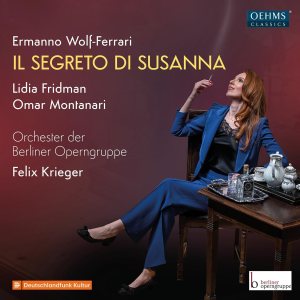
Wolf-Ferrari’s Il segreto di Susanna

I see from Wolf-Ferrari’s Wikpedia page that he composed no less than fifteen operas, though they have been rarely performed, and only one of them, Il segreto di Susanna, has been recorded with any frequency. Indeed, this live performance is one of five recordings at present listed on the Presto website, whilst a sixth, and perhaps most famous recording, featuring Renata Scotto and Renato Bruson under Sir John Pritchard, is no longer available.

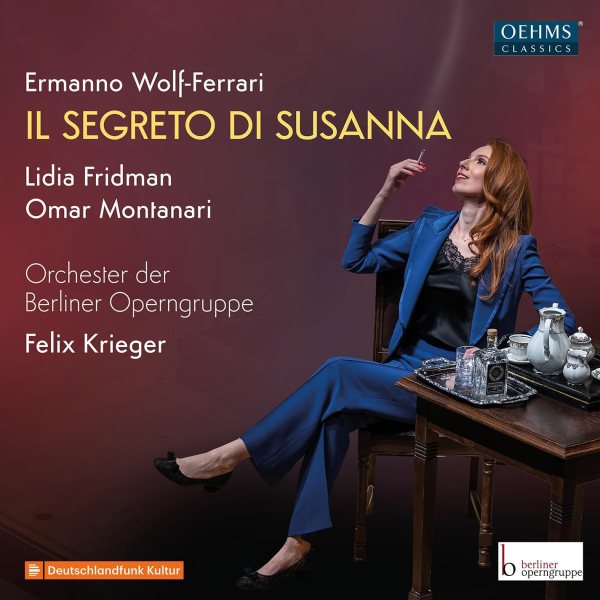
The plot is slight and concerns the Count Gil, who suspects his wife, the Countess Susanna of having an affair, when in fact she is simply a secret smoker. All ends happily when he finally discovers the truth, and he joins his wife in enjoying a cigarette. I suppose you would say that it is not particularly politically correct these days, but it is harmless enough and the music is enjoyably tuneful, in fact in places gloriously, swirlingly lyrical and romantic. I enjoyed it immensely.

The present performance, which credits even the silent character of the servant, Sante, evidently stems from a live performance in June 2022, and there is occasional stage noise and laughter from the audience, who are otherwise remarkably well-behaved. The sound is excellent, and Felix Krieger sets the scene brilliantly with the beautifully played short Sinfonia. The first voice we hear is that of the baritone, Omar Montanari. He has a nice, lyrical instrument and characterises well as the Count, who vacillates between suspicion and devotion to his young wife. She is played by Lidia Fridman, a Russian soprano active in Italy, with an attractive, soft-grained voice. Between them, under Krieger’s expert baton, they present a nicely paced and vividly characterised performance of the piece.

However, curiosity led me to stream a 1976 Decca recording under Lamberto Gardelli, featuring Bernd Weikl and Maria Chiara as the Count and Countess, which is available as a download, and which turns out to be more vivid still. I then turned to a Scotto recital I have, which included a couple of excerpts from the Pritchard set on Sony, which were even better, and would suggest that it is definitely due a re-issue.

In its absence, if you want the opera on CD, then the present issue will do very nicely. Unfortunately, as is the general practice these days, no libretto is included, though we do get a brief synopsis of the plot.

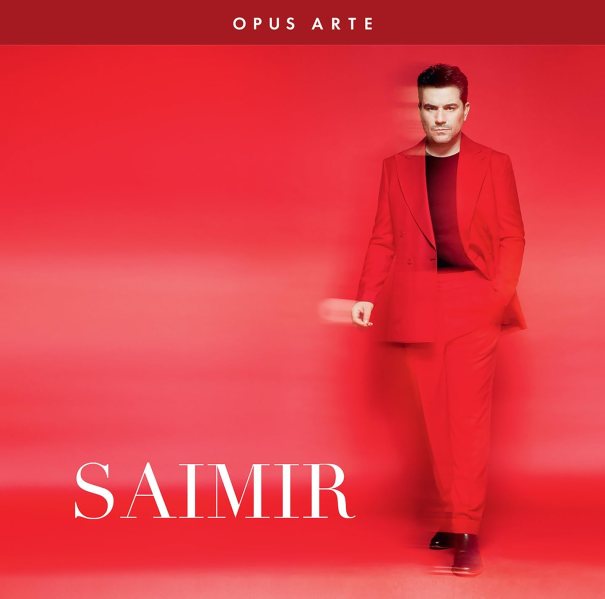
Saimir Pirgu sings operatic arias

Ten years ago I saw Saimir Pirgu as the Duke in the Royal Opera House’s David McVicar production of Rigoletto. Though he looked splendid and dashing, he was utterly charmless and I found his singing stiff and monochromatic. Since then, he seems to have ventured into more dramatic repertoire, and this recital of mostly verismo arias comes as a follow-up to a 2015 album of more lyrical fare, which I haven’t heard.

The present recital was very well received by my colleague, Göran Forsling in October of last year (review) but I’m afraid I can’t join in with his praise. For a start, Pirgu’s basic production is terribly ingolata, so much so that his singing was giving me a sore throat. There is no freedom to the sound and, when I compare him to the greats of the past, from Caruso to Björling to Pavarotti, all I hear is his struggle to get the sound out. There is no ring at the top and the middle voice is forced, resulting in a distressing vibrato. Indeed, he sounds a good deal older than his forty-two years.

Added to that, he doesn’t really do anything with the music and here his conductor, Antonio Fogliani, must take some of the blame, for his conducting is dull and prosaic. Most of the arias on the disc are well known but, with so many other versions out there, this just isn’t competitive.

I tried listening to the recital several times, thinking that maybe it had something to do with my mood, but, no, each time my reactions were the same. I just couldn’t get past Pirgu’s basic vocal production and I found it difficult to relax and enjoy the music. I hate to be so negative, but this is a disc for fans of Pirgu only, if indeed they exist.

Contents.

  1. Puccini: Manon Lescaut – “Indietro!… Guardate, pazzo son” 
    2. Puccini: Tosca – “E lucevan le stelle”
    3. Leoncavallo: Chatterton – “Non saria meglio… Tu sola a me” 
    4. Giordano: Andrea Chénier – “Colpito qui m’avete… Un dì all’azzurro spazio” 
    5. Puccini: Le villi – “Ecco la casa… Torna ai felici dì”
    6. Puccini: Manon Lescaut – “Donna non vidi mai” 
    7. Cilea: Adriana Lecouvreur – “L’anima ho stanca”
    8. Wagner: Lohengrin – “In fernem Land”
    9. Berlioz: La Damnation de Faust – “Nature immense”
    10. Tchaikovsky: Eugene Onegin – “Introduction”
    11. Tchaikovsky: Eugene Onegin – “Kuda, kuda, kuda vi udalilis”
    12. Puccini: Il tabarro –  “Hai ben ragione” 
    13. Bizet: Carmen – “La fleur que tu m’avais jetée”
    14. Puccini: Turandot – “Non piangere, Liù”
    15. Jakova: Skenderbeu – “Kjo zemra ime”
    16. Puccini: Tosca – “Recondita armonia” (with Vito Maria Brunetti (bass))
    17. Giordano: Andrea Chénier – “Come un bel dì di maggio” 
    18. Puccini: Madama Butterfly – “Addio, fiorito asil” 
    19. Giordano: Fedora – “Amor ti vieta”
    20. Sorozábal: La taberna del puerto – “No puede ser”
    21. Puccini: Turandot – “Nessun dorma!”


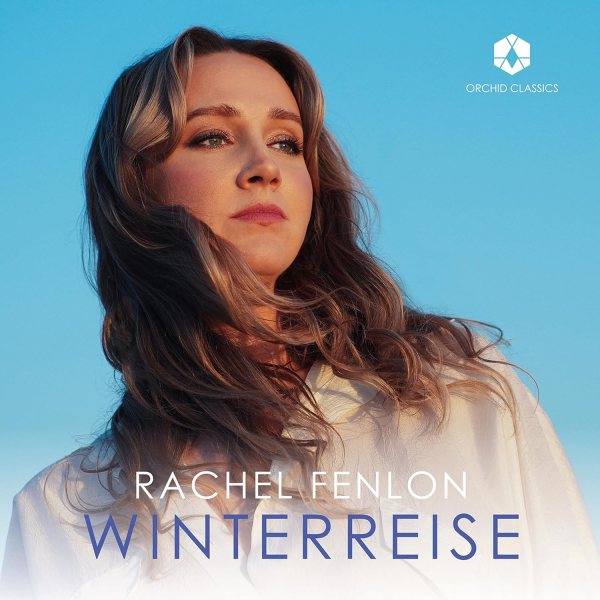
Rachel Fenlon sings and plays Schubert’s Winterreise

81ngosghckl._ac_sl1500_

Now here is an extraordinary recording debut. Recordings by female singers of Schubert’s most haunting cycle have been few and far between, those by Lotte Lehmann, Christa Ludwig and Brigitte Fassbaender being the most noteworthy. However, what sets this performance apart from all others is that Rachel Fenlon accompanies herself on the piano in what is surely the first self-accompanied version ever to be recorded.  

According to the notes accompanying this disc, Fenlon bought her first score of Winterreise in the Winter of 2020, when she was living alone in a house at the foot of a large forest outside of Berlin. This was during the dark days of lockdown. She  would often go days and weeks without seeing anyone and over the next two years she learned the work methodically, but also allowing its loneliness, solitude, passionate love and grief to permeate her very soul; and indeed what emerges is a very personal journey, a single-minded vision of the work, if you like, which is not strictly comparable to any other I’ve heard.

Initially, I felt the tempo of the opening Gute Nacht was a little fast (though at 5.38 it clocks in at exactly the same tempo as Fischer-Dieskau’s with Jörg Demus), but thereafter her tempi seemed just right to me. At 74’ Fenman’s is one of the slower recordings out there, though certainly not the slowest. In any case, I was little concerned with questions of tempo, as I became involved in her singular vision of the piece.

It is hard to pin down what makes it so different from any of the many two-handed performances available, but different it undoubtedly is. It is a young person’s interpretation, reminding me that the protagonist is indeed young, and that the pain and disillusionment at the heart of the cycle are those of a young man. Certainly, Fenlon piles on the intensity as the cycle progresses with a performance that is entirely compelling.

I can hear you asking, “Yes, but how does she sing? How does she play?” Well, the answer to that is very well indeed. The voice is naturally a light, bright soprano, but she is not afraid to darken the colour, with occasional plunges into a rasping chest voice and her playing is well up to the task, though it is difficult to separate the playing from the singing, the two being so intrinsically intertwined. I am not saying this is how I would always like to hear the cycle, but this is an impressive recording debut and much more than a gimmick.

What a great work this is and how fascinating it is that it can take such a wealth of different interpretations. In February last year I reviewed a very interesting version in an arrangement for baritone, choir and two accordions, and I recently reacquainted myself with Jonas Kaufmann’s harrowing version with Helmut Deutsch. Rachel Fenlon’s equally harrowing version is quite a different experience, but she is clearly someone to watch.