Go Lovely Rose – The songs of Roger Quilter

91aupp0ckgl._ac_sl1500_

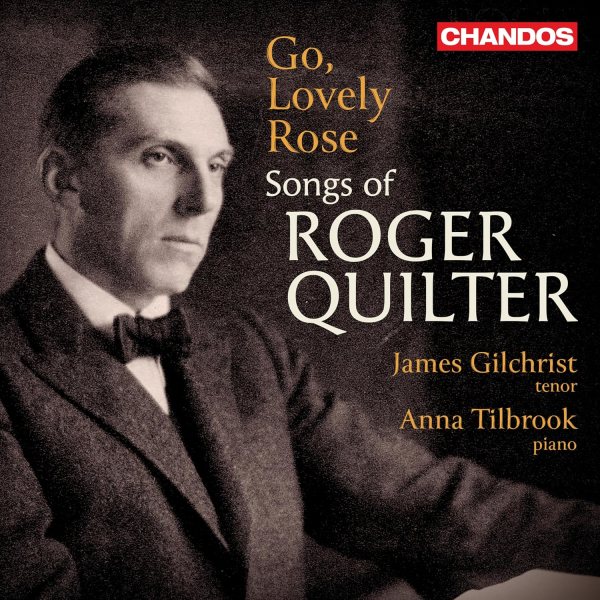
James Gilchrist (tenor) Anna Tilbrook (piano)

The songs of Roger Quilter are not performed as often these days as they once were, which is a shame, because they are beautifully crafted and, though perhaps they don’t probe as deeply into the texts as those of Finzi, Delius and Warlock, they are very rewarding for performers and listeners alike. Quilter had a wonderful gift for melody, but it was always melody put at the service of the poetry and the text is sung more or less as if it were spoken. Having performed many of the songs myself in my youth, I can attest to the fact that they are a gift to the performer.

Rather than give us whole opus numbers, Gilchrist and Tilbrook have chosen songs from his complete oeuvre, with the songs grouped into themes. Thus, we have six Shakespeare songs, drawn from the Op. 6, Op. 23 and Op. 32 sets of Shakespeare settings, five songs associated with flowers (A Floral Tribute), four Folk Song settings (all taken from The Arnold Book of Old Songs), four songs associated with the graveside, and four Songs of Love. The only songs performed as a set are the early German songs, written when Quilter was studying in Frankfurt. These are charming, but slight and give little indication of Quilter’s later, more mature style.

Initially alienated by the rather gruff sound of Gilchrist’s voice in the opening robust Blow, blow, thou winter wind (we are at once aware that this is not the voice of a young man, and indeed Gilchrist was approaching sixty at the time of the recording), I was drawn in by his elegiac delivery of Come away, death, and thereafter, I was less aware of any failing resources. Indeed, in the more gently reflective songs, with which the disc proliferates, Gilchrist is often spellbindingly beautiful, spinning out some lovely pianissimi in such songs as Fear no more the heat of the sun, the famous Now sleeps the crimson petal and the song which gives the collection its name, Go lovely rose. He is admirably supported by Anna Tilbrook, who is an excellent accompanist.

I would not be doing my job as a reviewer if I didn’t point out that there is another similar collection of songs available on the Hyperion label. This was recorded in 1996 by the then much younger John Mark Ainsley with Malcolm Martineau at the piano. Some may prefer Ainsley’s much more forthright manner and fresher timbre, as indeed I occasionally do, especially in songs like Blow, blow, thou winter wind and the ebullient Love’s philosophy, but Gilchrist’s more reflective style has its own rewards, and this is a welcome addition to the Quilter discography

Contents
Shakespeare Songs
Blow, blow, though winter wind, from Three Shakespeare Songs (First Set) Op 6, No 3 (1905)
Come away, death, Op 6 No 1 from Three Shakespeare Songs (First Set) (1905, rev 1906)

Fear no more the heat o’ the sun. from Five Shakespeare Songs (Second Set) Op.23 No 1
Orpheus with his lute. from Two Shakespeare Songs (Fourth Set) Op.32 No 1(1919-20)
O mistress mine, from Three Shakespeare Songs (First Set) Op 6 No 2 (1905, rev 1906)

Under the greenwood tree, from Five Shakespeare Songs (Second Set) (1919)
A Floral Tribute
The Fuchsia Tree, Op.25 No.2 (1923)
Go, Lovely Rose, from Five English Love Lyrics Op.24 No.3 (1922)
A last year’s rose, Op 14 No.3 (1909-10)
Now sleeps the Crimson Petal, Op 3 No 2 91897)
To Daisies from To Julia, Op.8 No 3 (1905)
Folksongs
From The Arnold Book of Old Songs
Barbara Allen, No 13 (c 1921)
Drink to me only with thine eyes, No 1 (c 1921)
My Lady’s Garden, No 10 (c 1942)
The Ash Grove, No 16 (c 1942)
At the Graveside
Autumn Evening Op.14 No.1 (1909-10)
Dream Valley, from Three Songs of William Blake, Op.20 No.1 (1917)
Drooping Wings (1943)
Music, when soft voices die, from Six Songs, Op 25 No.5 (1926)
German Songs
Four Songs of Mirza Schaffy, Op 2 (bef. 1903, rev. 1911)
Songs of Love
Love’s Philosophy, from Three Songs, Op 3 No 1 (1905)
Julia’s Hair from To Julia Op 8, No 5 (1905)
The Maiden Blush from To Julia Op 8, No 2 (1905)
It was a lover and his lass, from Five Shakespeare Songs (Second Set), Op
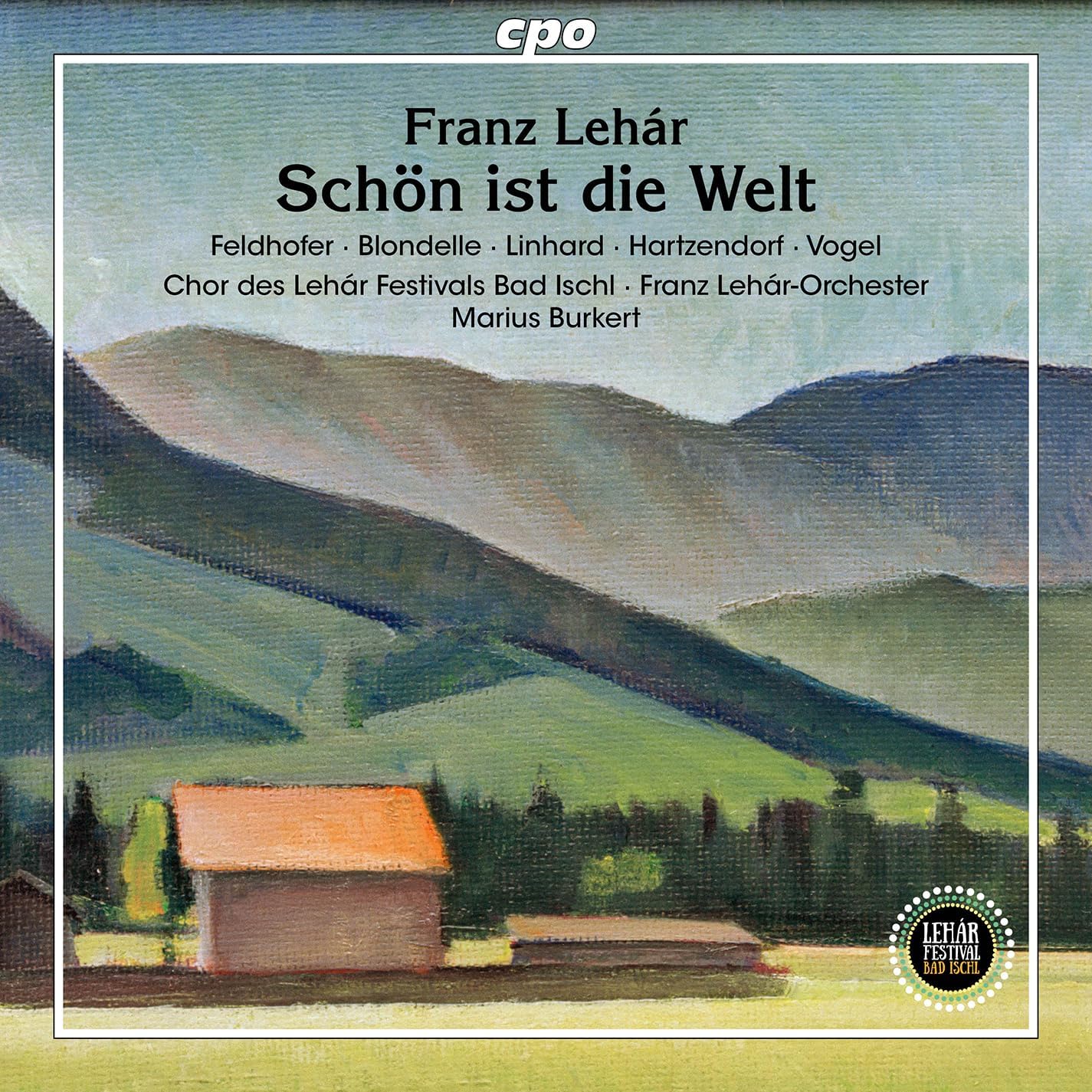
Schön ist die Welt on CPO

813sjdal._ac_sl1425_

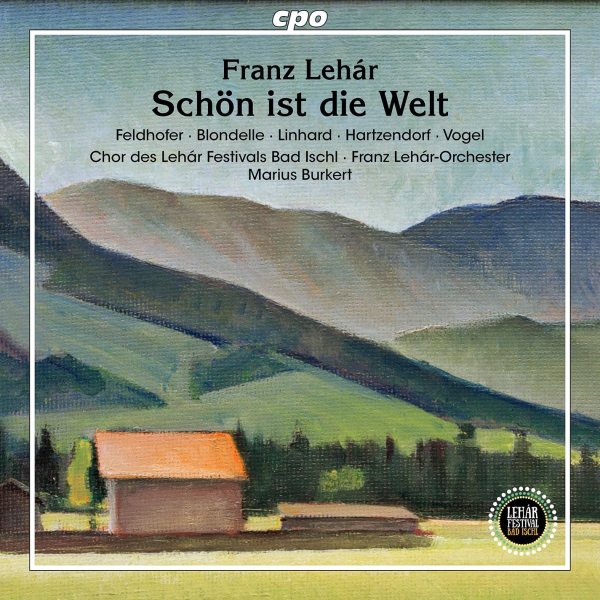
Schön ist die Welt was the last in a series of Lehár’s operettas that were premiered in Berlin. Paganini, had met with a somewhat lukewarm reception in Vienna, but had triumphed in Berlin in 1926 , due to the participation of Richard Tauber, and thereafter Lehár wrote the majority of his operettas for Berlin with Tauber in mind for the leading role. Not that Shön ist die Welt, which premiered in 1930, was an entirely new work, it being a re-working of an earlier operetta, Endlich allein, originally performed twelve years earlier, the second act of which Lehár had been particularly proud, as it was more or less through composed with minimal dialogue. This second act, with the addition of a Tauber-lied, is pretty much lifted from the earlier operetta, but the outer acts underwent substantial revisions.

The action takes place in the Swiss Alps, where Crown Prince Georg arrives at an Alpine resort to meet for the first time his fiancée, Princess Elisabeth. However, on the way he stopped to help a girl, whose name he did not discover, mend a puncture and fell madly in love with her. He announces to his father that he will not marry Elisabeth because he loves another. All turns out well when our unwitting hero and heroine go on a hike and get trapped by an avalanche at an Alpine hut and have to spend the night together. Returning the hotel the next morning, Georg discovers that the girl he helped with the puncture is in fact Princess Elisabeth. There is also a sub plot involving Count Sascha and a Brazilian dancer, called Mercedes della Rossa, which gives Lehár the excuse for some Latin American influenced music in the first and third acts. It’s all pretty insubstantial, but it does give rise to some gloriously lyrical music, especially in the second act, which involves just the two leads.The present recording would seem to derive form stage performances as we hear occasional stage noise, though there is precious little sign of any audience. There was a previous recording, also on CPO, (review), which I see is still available as a download. That was on a single CD, but included none of the dialogue, whereas here we get quite a lot of it, which could prove tedious for all but fluent German speakers, and even they could find it a little too much for repeated listening.That said, the sound is excellent and the playing of the Franz Lehár Orchestra under Marius Burkert most stylish. I also enjoyed the contributions of Katharina Linhard and Jonathan  Hartzendorf as the secondary couple, and of Jospeh Terterian as the Jazz Singer. Where I had a problem was with the contributions of the two leads. Thomas Blondelle as Crown Prince Georg has a pleasing light tenor, but he is no Richard Tauber and he is not really up to the operatic demands of Act II. Nor is Sieglinde Feldhofer as the Princess Elisabeth. She has rather too much vibrato for my taste and tends to lunge at her high notes. I couldn’t help thinking what a difference a Schwarzkopf or a Rothenberger would have made.  Elena Mosuc and Zoran Todorovich who sing the roles of Elisabeth and Georg on the other CPO recording I mentioned above, improve on the present two, but they, rather confusingly, sing the secondary couple as well, so there is no doubt that this present recoding is more cohesive.

Nor would I like to give the impression that I didn’t enjoy the set. I did. Very much indeed, despite the less than stellar contributions of the two main leads. Lehár was such a prolific tunesmith, some of the songs were rattling around in my head for days afterwards. It gets a qualified recommendation from me.

Prinzessin Elisabeth – Sieglinde Feldhofer (soprano)

Kronprinz Georg – Thomas Blondelle (tenor)

Der König – Gerd Vogel (baritone)

Mercedes della Rizza – Katharina Linhard (soprano)

Graf Sascha Karlowitz – Jonathan Hartzendorf (tenor)

Herzogin Maria Brankenhorst – Klára Vincze (soprano)

Ein Jazzsinger – Jospeh Terterian (tenor)

Hoteldirektor – Johannes Hubmeir (tenor)

Chor des Lehár Festivals Bad Ischil

Franz Lehár Orchestra/ Marius Burkert

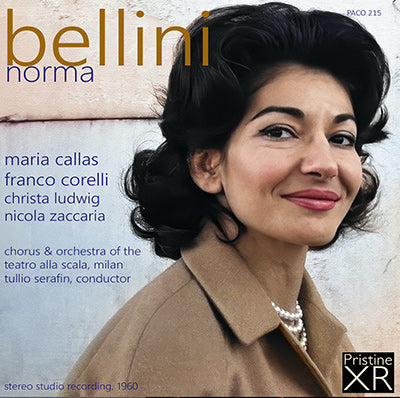
A reappraisal of Callas’s second studio Norma

paco215_530x

The Pristine XR remaster gives us the chance to reappraise a set which is slightly controversial in that it captures Callas in late career with occasional flaps on top notes. Nonetheless it was Ralph Moore’s overall top choice in his opera survey and he had no problem recommending it when he reviewed this Pristine issue in July of this year (review).

For my part, I’ve known the set for over sixty years now. It was actually the first opera set I ever owned, and, for quite a few months, the only opera set I owned, so I got to know it pretty well. Since then of course, I have heard a fair amount of other Normas, Sutherland, Caballé, Scotto, Sills, Eaglen, Bartoli (please, never again), Sass live at Covent Garden (disastrous) and plenty more by Callas herself; the live 1952 Covent Garden, the 1954 studio, the 1955 Rome broadcast and, best of all, the live 1955 La Scala, as well as excerpts from many others, right up to her final performances in the role in Paris in 1964.

So how does it hold up? Well, pretty well actually. Sonically, it was always pretty good, and, if I’m honest, I can’t hear that much difference between the most recent Warner version and the Pristine version. Perhaps there is a bit more space around the voices in the Pristine version, but it is the difference is slight.

As for Callas’s voice, it is true, notes above the stave have taken on a metallic edge, and they don’t always fall easily on the ear, but the middle and lower timbres have a newfound beauty, and a characterisation that was always complex and multi-faceted has taken on an even greater depth, parts of it voiced more movingly here than anywhere else.

There are other gains too. The cast here is a vast improvement on the earlier studio one, Corelli in particular being a shining presence. Fillipeschi was a liability on the earlier set, but, whilst not quite a paragon, and chary of some of the coloratura in his role (Serafin making a further cut in the great In mia man duet to accommodate his lack of flexibility), Corelli’s is a notable presence, and his clarion voice is ample compensation. Zaccaria may be less authoritative than the woolly voiced Rossi-Lemeni, but his tones are distinctly more buttery. Ludwig is an unexpected piece of casting, but she too is an improvement on Stignani, who, great singer though she was, was beginning to sound a bit over the hill by the time of the first Callas recording (she was 50 to Callas’s 30). Ludwig sounds, as she should, like the younger woman. Her coloratura isn’t always as accurate as one would like, certainly no match for Callas, but she sings most sympathetically in duet with her older colleague, and Mira o Norma is, for me, one of the greatest performances on disc. After Ludwig states the main theme, Callas comes in quietly almost imperceptibly and at a slightly slower tempo with an unbearably moving Ah perche, perche, her voice taking on a disembodied pathetic beauty. When Ludwig joins her for the section in thirds, she perfectly matches Callas’s tone on her first note, before Callas joins her in harmony, a real example of artists listening to each other in a sense of true collaboration.

One should I suppose mention the losses from the earlier recording. Yes, some of Callas’s top notes are shrill, and we lose some of the barnstorming heroics that were a part of Callas’s Norma right up to 1955. This Norma is more feminine, more vulnerable, if you like. How much this had to do with interpretive development, and how much with declining vocal resources is a moot point, but there is no doubt Callas is still a great singer, doing the best she can with what she has. Some sections are more moving here than in any of her other performances. I’ve already singled out Mira o Norma but the earlier duet is its equal, with Callas wistfully recalling her own awakening to first love.

The beginning of Act II always brought out the best in her, and here she is sublime. Dormono entrambi is an unusual piece which alternates passages of recitative with arioso, rather like Rigoletto’s Pari siamo. Callas draws on all the colours in her palette to express Norma’s contrasting emotions. You can almost feel the chill that comes over her at un gel me prende e in fronte si solleva il crin followed by the choked emotion of I figli uccidi! The arioso of Teneri figli is couched in a tone of infinite, poignant sadness, but then her tone hardens with her resolve at Di Pollion son figli, before, with a cry she drops the knife (and we can almost hear the precise moment), crying out Ah no, son miei figli! Operatic singing and acting on the highest level.

Serafin’s conducting is much as it was in the first set. He has the virtue of not conducting the opera as if it were Verdi, as so many do. Sometimes I’d like him to get a move on a bit, but his pacing of the final two duets (one in public, one in private) is superb, and he perfectly judges the climaxes in the Grand Finale, one of the greatest in all opera.

I wouldn’t want to be without Callas’s 1955 live La Scala account (also available from Pristine) with Del Monaco and Simionato, which is where voice and art find their greatest equilibrium, but for a studio set, this is now clearly the one to go for. One thing is for sure, Callas remains the quintessential Norma. No singer has yet challenged her hegemony in the role.


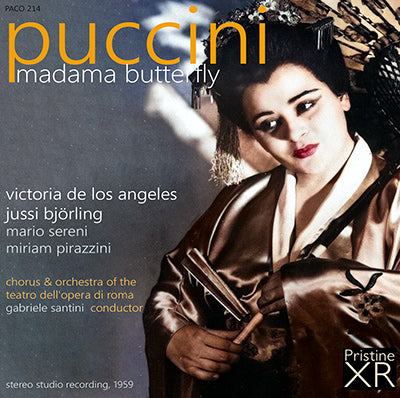
De Los Angeles and Björling in Madama Butterfly

paco214_530x

This Pristine XR Remastering of De Los Angeles’ second 1959 recording of Madama Butterfly has already been favourably reviewed twice before on MusicWeb International, once by Ralph Moore (review) and once by Morgan Burroughs (review), and I can add little to what they have said. We have De Los Angeles in one of her best and most conducive roles and Björling singing with golden tone. In Pristine’s newly re-mastered transfer of the stereo original, surely this is self-recommending, and who am I to disagree? However, I should mention that there is an earlier 1955 De Los Angeles recording, in mono sound, with Di Stefano as Pinkerton, Gobbi as Sharpless and conducted by Gianandrea Gavazzeni, which, in some ways, surpasses the performance we have here. It is available at super bargain price from the Regis label and was favourably reviewed by Christopher Howell here.

That earlier recording’s chief asset is the conductor, Gavazzeni, who makes far more of the score than the rather dull and prosaic Santini, and it makes me realise how important the role of the conductor is in Puccini. Indeed, all the best sets have benefited from a great conductor; Karajan, for both Callas and Freni, Serafin for Tebaldi, Barbirolli for Scotto and Pappano for Gheorghiu. And, if Santini has at his disposal an excellent cast, Gavazzeni’s is just as good, and in some respects even better. Björling, for Santini, sings with golden tone, but is just a trifle stiff. This was to be Björling’s last recording, and the heart condition, which would end his life at the early age of 49, was already apparent. Indeed, he collapsed during one recording session of the Act I love duet and needed several days to recover before he was able to continue. This could account for his relative stiffness. Di Stefano, on the other hand creates a real character. Carelessly charming in his exchanges with Sharpless and genuinely seductive in the love duet, he is suitably devastated by what he has done in the last act. I don’t see Pinkerton as a villain or an out and out cad. He is just an impulsive young man, who gives little thought to his actions at the beginning of the opera. Young men like him are ten a penny on any American college campus and Di Stefano portrays him to the life.

Sereni is a sympathetic Sharpless for Santini, but Gobbi, for Gavazzeni, surpasses him in verbal acuity and De Los Angeles is in slightly fresher voice in the earlier recording, though the difference is marginal.

What is not in doubt is the improved sound picture in the later stereo recording, especially in Pristine’s remastering, which opens up the sound quite a bit. I should also mention that Pristine as usual provide downloads of the full score and libretto, whereas the Regis issue of the earlier recording just comes with notes and a synopsis. Whichever version you go for, you will get one of the most touching Butterflies on disc.


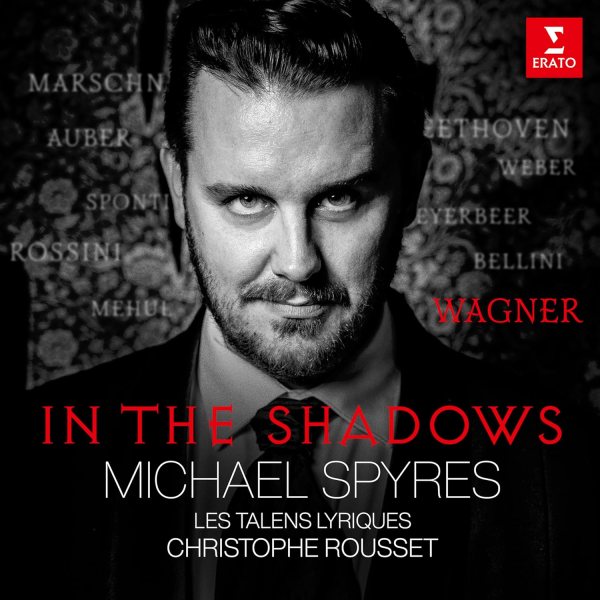
Michael Spyres – In The Shadows

81cea-b2zrl._ac_sl1500_

This is a luxury recital indeed. Over 84 minutes, we are presented with twelve operatic scenes, performed complete with chorus when required and another soloist (in the shape of tenor Julien Henric) who plays Flavio in the scene for Pollione from Norma. Furthermore, we are vouchsafed sung texts and translations into English, French and German, which is important as many of the scenes are not exactly familiar. Clearly all concerned have taken their task seriously.

In the accompanying notes, Spyres talks of his journey towards Wagner and states that the album “endeavours to illuminate the composers who languish in Wagner’s shadow: those who formed the foundation of the compositional aesthetic and sculpted the framework of vocal writing that would become the Wagnerian tenor.”

Thus, we start with Joseph Méhul (1763-1817) and work our way forward roughly chronologically via Beethoven, Rossini, Meyerbeer, Weber, Spontini, Bellini and Marschner to Wagner himself in the shape of arias from his early Die Feen and Rienzi, finishing up with Lohengrin. Of the arias chosen, only those from Fidelio, Norma and Lohengrin could be called in any way familiar, so the recital is certainly valuable for introducing us to some little heard music.

The disc has been reviewed in these pages by Göran Forsling (review) and was even a recording of the month back in April, and I largely agree with that review with one or two caveats.

I actually heard Spyres live at a Prom in 2017, in a performance of Berlioz’s La damnation de Faust with the Orchestrre Révolutionnaire et Romantique under Sir John Eliot Gardiner and, whilst impressed with his interpretation and musicality, I didn’t think the voice was particularly large. Now of course this was seven years ago, and there is a good chance that the voice has grown since then, but I’m not so taken with his singing in those roles that require a bit more dramatic thrust, like Florestan and Pollione. I hear a somewhat artificial darkening of the timbre, which results in a rather throaty sound. He sounds as if he is forcing his lyrical voice, and his tone lacks squillo. Comparisons with Vickers in the former and Corelli in the latter find Vickers singing with a deal more intensity and Corelli, whom I had just recently been listening to in the second Callas recording, much freer on top.

When we get to Wagner himself, Mein Lieber Schwann from Lohengrin is sensitively sung, but there is no ring to his tone when he opens out in the more dramatic parts. GF makes comparison with Gedda, who sang Lohengrin a couple of times in his native Sweden. Ultimately Gedda thought it an unsuccessful experiment, and he never sang the role again, evidently thinking the role too heavy for his essentially lyrical voice. However, as can be heard in his recording of the aria, Gedda’s tone had a good deal more squillo. That said, I heard Gedda live in the Verdi Requiem towards the end of his career and his voice had a great deal more cutting power than Spyres.

With his three albums, Batitenor, Contra-Tenor and now In The Shadows, Spyres is showcasing his versatility, but I just wonder how much of that versatility is a product of the gramophone. Given the encomiums he has been receiving of late, I hate to be the one dissenting opinion, but I do wonder if his voice is being forced into places it shouldn’t necessarily go.

Contents
Etienne-Nicolas Méhul (1763 -1817)
1. Joseph en Égypte, « Vainement Pharaon… Champs paternels
Ludwig van Beethoven (1770 – 1827)
2. Fidelio, « Gott! Welch Dunkel hier!… In des Lebens
Gioacchino Rossini (1792 – 1868)
3. Elisabetta, regina d’Inghilterra, « Della cieca fortuna… Sposa amata… Saziati, o sorte ingrata ?
Giacomo Meyerbeer (1791 – 1864)
4. Il crociato in Egitto – « Suona funerea
Carl Maria von Weber (1786 – 1824)
5. Der Freischütz – « Nein, Länger Trag Ich Nicht
Daniel François Esprit Auber (1782 -1871)
6. La muette de Portici- « Spectacle affreux …
Gaspare Spontini (1774 – 1851)
7. Agnes von Hohenstaufen, « Der Strom wälzt ruhig seine dunklen Wogen
Vincenzo Bellini (1801 – 1835)
8. Norma – « Meco all’altar di Venere…Me protegge, me difende (with Julien Henric (tenor))
Heinrich Marschner 1795 – 1861)
9. Hans Heiling op. 80 – “Gonne mir ein wort der Liebe” 
Richard Wagner (1813 – 1883)
10. Die Feen WWV 32 – « Wo find ich dich, wo wird mir Trost?
Richard Wagner
11. Rienzi, der letzte der Tribunen WWV 49, « Allmächt’ger Vater, blick herab
Richard Wagner
12. Lohengrin WWV 75, « Mein lieber Schwan


Pristine’s Re-master of Björling’s Cav and Pag.

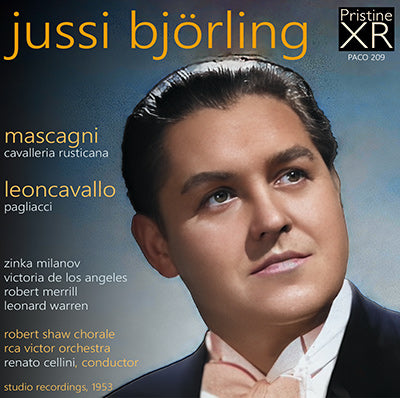
paco209_fdbcae84-e953-4879-bd72-570e6effee64_530x

A photo of Jussi Björling graces the cover of this Pristine issue, and he is without doubt the main reason to hear these recordings. It is always a pleasure to hear his beautiful voice, musical phrasing and ringing top notes, though I’m not sure he would ever have been perfectly cast in either role. But before coming to Björling himself, it might be instructive to consider other elements of the recordings.

Both operas were recorded in 1953 in New York with the RCA Victor Orchestra and the Robert Shaw Chorale under Renato Cellini and sound remarkably good in these Pristine transfers, so good, I almost thought they were in stereo. I hadn’t heard either performance before, so I have nothing to compare the Pristine transfers to, but they are admirably clear and spacious and a good deal better than the contemporaneous Serafin recordings with Di Stefano and Callas. The Serafin Pagliacci is in reasonable mono sound, but unfortunately the Cavalleria Rusticana suffers from overload and distortion, which no amount of re-mastering would seem to be able to overcome. Still, I wish that these Cellini performances were half as exciting.

Cellini’s conducting is at least idiomatic, his tempi well chosen, but neither opera really catches fire and they both remain somewhat studio bound. The professional Robert Shaw Chorale sing in both operas. They are faultless in execution, but I couldn’t help picturing them all in prim white shirts and blouses, standing, score in hand, in choir banks. They don’t for one second conjure up the sound of lusty Sicilian peasants or excited Italian village folk. The La Scala Chorus on the Serafin set, may not be so polished, but they have this music in their blood and are much more convincing.

I suppose I should preface my discussion of the solo singers with a confession that I have never much liked Zinka Milanov, or at least not on any of the recordings I have heard, which were all made quite late in her career. From the outset she sounds far too mature, almost indistinguishable from Mamma Lucia in her initial exchanges and completely uninvolved in poor Santuzza’s plight. Björling, who could sometimes be accused of being a little cool, is at his most impassioned in their duet, but she remains phlegmatic and stolid. She is no better in the duet with Robert Merrill’s Alfio, who, in any case, is a bit too jovial and avuncular. Björling’s Turiddu is beautifully sung and, as I mentioned, he does try to inject some passion into his exchanges with Santuzza, but there is something about the inherent nobility in his tone that makes him not quite right for the caddish Turiddu. As always, his singing gives great pleasure, but I can’t quite believe in him.

That said, I find his Turiddu more convincing than his Canio. Yet again, the role is beautifully sung, Vesti la giubba heart-breaking and deeply felt, but can anyone really believe that this is a man who would be driven to double murder? I certainly can’t. I have much the same problem with the Nedda of Victoria De Los Angeles. She is in her best voice, warm and feminine and, like Björling, has the virtue of always being supremely musical. She sings quite beautifully, especially in her Ballatella, but, as with her Carmen, she sounds altogether too ladylike. I don’t necessarily want Nedda to be portrayed as a heartless minx, as was often the case in days gone by, but I need to believe that she has the mettle to defy a bully of a husband and have an affair behind his back.

Nor is there any menace in the Tonio of Leonard Warren, who, in the prologue, could be singing about anything at all really. Gobbi, on the Serafin set, does not have such a beautiful voice, nor such easy top notes, but he makes every word tell. Merrill has here been given the secondary role of Silvio, but his Silvio doesn’t sound much different from his Alfio. Compare Panerai, who sings both roles on the Serafin recordings, utterly menacing as Alfio and ardently seductive as Silvio.

Jussi Björling was, without doubt, one of the greatest tenors of the last century and I always take pleasure in the sheer beauty of his voice, his musical phrasing and his wonderfully free and ringing top notes, so it was a pleasure to hear him here, even if these two roles are not ones to which I think he was really suited. For the rest I derived the most pleasure from De Los Angeles’s beautiful and musical singing as Nedda, even if she too is caught in a role that was not particularly suited to her gifts.

Not a top choice for either of these two operas then. For all that they are in better sound than Serafin’s recordings of the two operas, I would still place the Serafin performances ahead of them. Di Stefano can be a bit wayward, but he is better at expressing the caddish side to Turiddu and the unhinged side of Canio that turns him into a killer. Callas is, as usual, hors concours, both as a wonderfully impassioned Santuzza and a free-spirited and mettlesome Nedda, and she is in fine voice on both recordings. Gobbi is equally brilliant as Tonio and their confrontation bristles with drama. There are also better choices amongst more recent recordings, such as Karajan’s sumptuously recorded La Scala set for DG, which no doubt remains a first choice for many.

As always, Pristine should be commended for including with the CDs a package of downloadable items, which includes a copy of the same recording as an MP3 download, together with full scores, both piano and orchestral, and a full libretto in PDF format. Most major companies these days don’t even include an online link to a libretto.

Pietro Mascagni (1863-1945)
Cavalleria Rusticana (1890)
Turiddu: Jussi Björling (tenor)
Santuzza: Zinka Milanov (soprano)
Alfio: Robert Merrill
Mamma Lucia: Margaret Roggero (mezzo)
Lola: Carol Smith (mezzo)

Ruggero Leoncavallo (1857-1919)
Pagliacci (1892)
Canio: Jussi Björling (tenor)
Nedda: Victoria De Los Angeles (soprano)
Tonio: Leonard Warren (baritone)
Silvio: Robert Merrill (baritone)
Beppe: Paul Franke (tenor

Robert Shaw Chorale
RCA Victor Orchestra/Renato Cellini
Rec. 1953, Manhattan Centre, New York
Full scores and libretto included as downloads
Pristine Audio PACO209 (2 CDs 141)


Eilika Wünsch – Romantic Songs

71okpmqmsql._ac_sl1425_

There are times when one wonders how a record came to be released.

According to the accompanying notes, the premise for this album would appear to be “a completely new approach to our lieder recital repertoire … in which voice and piano are enhanced by another melody instrument”. Whether this enhancement is either desirable or necessary is a moot point, but I suppose the idea of the cello taking over the second vocal line in the adaptation of duets is one solution to the non-availability of a second singer. The accompanying notes would also seem to suggest that these arrangements improve in some way on the originals, even of the two songs from Strauss’s Vier letzte Lieder, which of course were written for full orchestra.  I can assure you they do not.

However, the greatest impediment to enjoyment is not the arrangements themselves but the solo singer. According to the biographical notes, Eilika Wünsch has been active since around 2010, when she worked with Jörg Demus. She would appear to have a fairly extensive discography, though I can’t find a single review on the internet for any of her discs, or for any of her public appearances. We are also told that she has sung the roles of Butterfly, Konstanze, Donna Anna, Violetta, Gilda and the Queen of the Night, about all of which I am faintly incredulous.  The first few notes of the opening song, Nacht und Träume, are sung in a white, vibrato-less tone, but thereafter any single sustained note emerges unfocused and unsteady. She struggles so much with the execution of the notes that any attempt at interpretation is completely absent. The cover photo shows us an attractive young woman, but the sounds coming from the speakers are those of a (very) old soprano. I am sorry to be so negative, but I really can’t find anything positive to say about this recital. Listening all the way to the end proved quite a trial, but listen I did, right through to the final song, which is a vocalise arrangement of Schubert’s famous Impromptu, Op.90, no.3. The arrangement takes her well up above the stave, where the sound that emerges is somewhere between a whistle and a theremin and quite unpleasant – to my ears at least.

This is one of those cases where comparisons are irrelevant. One to be avoided, I’m afraid.

Contents, in case anyone is interested.

  1. Schubert: Nacht und Träume
  2. Brahms: Wie Melodien zieht es mir
  3. Reger: Nachts
  4. Schumann: Wenn ich ein Vöglein wär
  5. Brahms: Am Strande
  6. Schumann: In der Nacht
  7. Liszt: O komm im Traum
  8. R. Strauss: Im Abendnrot
  9. Reger: Abendlied
  10. R. Strauss: Beim Schlafengehen
  11. Schumann: Mondnacht
  12. Schubert: Auf dem Strom
  13. Impormpti, Op. 90 no. 3 (as Vocalise)

Love’s Lasting Power – Schubert Lieder

61suv-xl5ul._ac_sl1000_

The English soprano, Harriet Burns, still in her early 30s, has been getting some great reviews in the music press of late, some of them for this recital of Schubert Lieder, and indeed there is a great deal to celebrate here. She and her accompanist, Ian Tindale, were recent winners of the Contemporary Song Prize in the International Vocal Competition at ‘s-Hertogenbosch and this is their debut recital. They have put together a group of Schubert Lieder on the subject of love in all its guises, from, as the notes tell us, “many-splendoured and joyous to tragic and rejected.” Some of the songs will be familiar, some maybe less so, but it is a very well-considered and thoughtful programme.

First impressions are of the sheer beauty of Burns’ voice, which is a full, lyric soprano. Its creamy richness would no doubt be perfect for Strauss’s soaring soprano lines, and I see she is soon to add the Vier letzte Lieder to her repertoire, though initially in a recital with piano accompaniment. I would also highlight her musicality and her thoughtful response to the text, though here I would appreciate crisper diction. Sometimes the words are not clear enough. However, all in all, there is a great deal of pleasure to be derived from this recital and I thoroughly enjoyed it.

That said, when getting a little more specific in my listening, one or two doubts started to creep in. Take for example the longest song on the disc, Viola. This song, which is almost 13 minutes long, is in the nature of a mini-scena, its many  changes of attitude signposted by the accompaniment and masterfully managed by Tindale. These changes of mood cry out for a change of colour or attitude from the singer but Burns rarely responds accordingly and when one turns to the same song as sung by Anne-Sophie von Otter, it is to hear a much more specific response to the text and the accompaniment.

Comparisons are invidious, but perhaps inevitable, and it was the same story with most of the other songs I sampled in different performances. I would like more characterisation and personality in Die Männer sind méchant and that is what we get from, for instance, Lotte Lehmann and Janet Baker. There is also much more complexity to be found in Suleika I. Though the sounds of nature depicted in the poem are gentle and reassuring they don’t quell the anxiety in the poet’s heart in the absence of his lover. We hear this in the accompaniment, and we hear it in the voice of Janet Baker, but not in the voice of Burns.

I sampled a few more versions of one of the most well-known songs here Der Jüngling and der Quelle and it was to find that Elisabeth Schumann, Lottle Lehmann, Elisabeth Schwarzkopf, Elly Ameling and Lucia Popp are all more communicative with the text and much more specific in their response to it. Burns is beautiful, expressive, but more generalised and this is the only criticism I have of a recital which is, in all other respects, more than promising from an artist, who is no doubt still developing.

The final song is Seligkeit, one of those songs which is often taken much too fast, but for which she and Tindale find the perfect tempo here.  Burns is delightful, responding well to its note of blithely carefree happiness. A perfect way to end a highly enjoyable recital. Both soprano and accompanist are clearly ones to watch.

Callas’s 1959 Lucia di Lammermoor gets the Pristine treatment

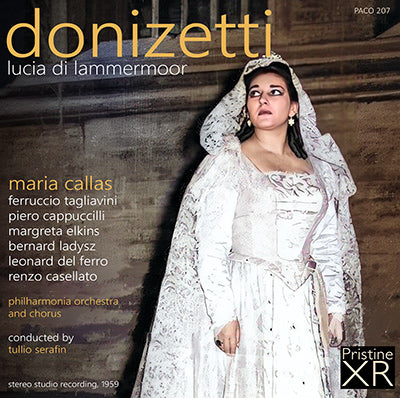
paco207_9735ee11-e251-4de3-a757-19c9b4ae597a_530x

Callas’s second stereo recording of Lucia di Lammermoor, which I reviewed when it was reissued by Warner , has always been considered one of her best from a sonic point of view, so, as someone who has not always been totally convinced by some of Andrew Rose’s re-mastering methods, I wondered how, if at all, the sound could be improved upon. Let me say straight away that I found this latest addition to Pristine’s Callas catalogue totally convincing. Using the Warner remaster of 2014 for comparison, I found the sound altogether warmer and much more comfortable to listen to, closer in fact to how I remember the LPs that I used to own (a German EMI Electrola issue, bought as an import). The Warner is perhaps slightly clearer, but the digitalisation tends to add glare to Callas’s top register. Often one is prepared to flinch before the topmost notes, but I had no such problems when listening to this Pristine pressing. I couldn’t say which is the more truthful, but I can say that the Pristine is much more comfortable to listen to and this, in turn, affected my impressions of the set, a recording I have known since my youth and was in fact my introduction to the opera.

Lucia was one of the cornerstones of her repertoire, and she first sang it in 1952 in Mexico. The following year she sang the role again in Florence, where she made her first recording of the role under Serafin. It was also the first recording she made for EMI. Back in those days, the opera wasn’t taken very seriously and was most likely considered a silly Italian opera in which a doll-like coloratura soprano ran around the stage showing off her high notes and flexibility. Callas returned a proper tragic dimension to the role, that most hadn’t even suspected was there. There is a touching story of Toti Dal Monti, an erstwhile famous Lucia herself, visiting Callas in her dressing room after a performance of the opera with tears running down her face and confessing she had sung the role for years with no idea of its dramatic potential.

When Callas first sang  Lucia in Mexico and recorded it in Florence, she was at the peak of her vocal plenitude, as she was when she first sang it under Karajan at La Scala in 1954, but by the time she sang the role in Berlin in 1955 post weight loss, when Karajan took the La Scala company there, her voice had started to lighten and her conception of the role had become more inward. We can hear this in the famous live recording of one of the Berlin performances, but, for this 1959 recording, she appears to have taken this approach one step further. This may have had something to do with her by now fading vocal resources, but it results in a particularly touching portrayal of the innocent, young, impressionable girl. She has also trimmed away some of the showier variations in the cadenza in the Mad Scene, and the decorations are in consequence somewhat more modest. Am I alone in preferring it sung this way? Personally, I’d prefer to do without all that duetting with the flute altogether, as happens in the complete recording of the opera with Caballé and when Sylvia Sass sings it on one of her recital records. In any case, apart from a few of Callas’s topmost notes, she is in remarkably good voice and the filigree of the role is brilliantly executed with fluid and elegant ease. All in all, I prefer her performance in this set to the one on the 1953 Florence studio recording, not least because of the improved Pristine sound picture.

However, when it comes to her colleagues on this set, I am a little less well disposed towards them than Göran Forsling in his review of the digital download. Ferrucio Tagliavini was 45 at the time of this recording, but he sounds much older, more like an elderly roué than the Byronic Romantic figure of Scott’s and Donizetti’s imaginings. No amount of elegant phrasing can make up for his lack of sheer physical passion and I find myself longing for Di Stefano’s youthful ardour. As for Cappuccilli, he was at the very beginning of his considerable career, and he has yet to find a way of creating character in pure sound. He is just rather dull and no match for Gobbi on the earlier recording or for Panerai in Berlin. Bernard Ladysz makes very little impression at all and both Rafaele Arie and Nicola Zaccaria are preferable.

Serafin, as always, though he may not make any startling revelations, shapes the score with a perfect sense of its dramatic shape, albeit with the cuts that were traditional at the time. Karajan opened up some of those in his performances, and I would still place the 1955 Berlin performance at the top of all Callas’s recorded Lucias, especially in Divina Records latest remastering, but I enjoyed re-visiting this set and I have a feeling I’ll be reaching for this one more regularly than the earlier 1953 recording, not least because of the superior quality of Pristine’s remastering.

My only criticism is of the cover art, which has a photograph of Callas as Lucia in Florence in 1953, when she was still a rather large lady. One could be forgiven for thinking, at first glance, that this was the earlier recording. Surely a photo of the svelte Callas as Lucia would have been more appropriate. There are plenty of them, after all.

Callas’s Studio Medea gets the Pristine XR treatment

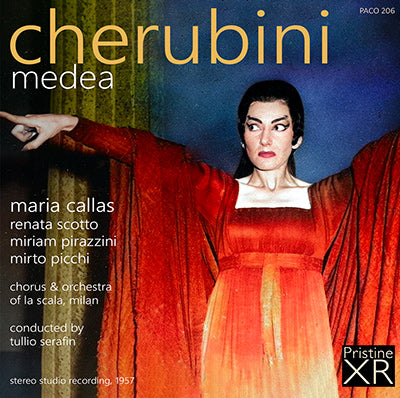
paco206_b39e453c-db98-4327-9fcb-cf071ccd980b_530x

Pristine, having applied their XR method of remastering to many of Callas’s mono recordings and to some of her live ones, now turn to the stereo studio ones. Oddly enough, this was the first of Callas’s complete operas to be recorded in stereo in Milan, though it wasn’t actually recorded by Walter Legge and her Columbia recording team, and all her other Milan recordings that year were mono. Apparently, EMI had no interest in the enterprise and the recording was made by Mercury for Ricordi in September 1957, a few weeks after her performances of La Sonnambula in Edinburgh, when she had not been in her best voice. It was originally issued by Ricordi in Italy, Mercury in the US and Columbia in the UK and since then has appeared on various different labels, including Everest and even Deutsche Gramophon, as well, of course, as Warner when they re-mastered all the Callas studio recordings for their 2014 release.

Considering it was recorded by Mercury, one would have expected the sound to be pretty good, but it has always sounded a bit dry and constricted. I was listening to the Pristine CDs and made comparisons with the 2014 Warner release. To my ears, the differences between the two are fairly slight. Pristine’s XR sound opens up the sound picture a bit and solo voices in particular do sound as if they have a bit more air around them. I also tried listening both through my speakers and through headphones and, oddly, found I preferred the Pristine through my headphones and the Warner through my speakers, though this could have something to do with my equipment. It might also have something to do with the fact that the Pristine release is transferred at a much lower level than the Warner.

Whichever version you go for, there is no doubt this is the best sounding of all Callas’s recorded Medeas, but what about the performance? Apart from this studio recording, we have five live recordings: Florence and La Scala 1953, Dallas 1958, London 1959 and La Scala 1961. Of these, one can safely discount the 1961 La Scala performance. I would also discount the 1959 London performance, a recording that has also been issued by Pristine, though I see that it is Ralph Moore’s first choice in his Medea survey. I feel that it pales in comparison to the Dallas performance, which, though it suffers from poor sound, is blisteringly dramatic, having been recorded just after Bing had “sacked” Callas from the Met. That event seems to have galvanised the whole company to produce a performance of extraordinary dramatic concentration, with Callas in fabulous, secure voice. This Dallas performance is my first choice for the opera, though I wouldn’t want to be without the two 1953 performances either.

This studio recording operates on an altogether lower level of intensity than any of those. However, when I first got to know this opera, and this recording, I had no other point of reference, and it seemed pretty good to me. It was only later, when I heard those barnstorming performances from Florence, La Scala and Dallas, that I found anything lacking, and it is only in comparison with herself that she fails. She is still a good deal better in the part than any other who attempted it, certainly a lot better than Gwyneth Jones and Sylvia Sass, who also made studio recordings of this Italian version. In other hands, Cherubini’s music can seem staid and formulaic, but Callas breathes life into it like no other.

Serafin’s conception is essentially Classical, but his conducting varies from the somnolent to the dramatic. After a tautly conceived overture, the first scene up to Medea’s entrance drags on interminably. I understand the necessity to establish a pastoral air of peace and calm, into which the Colchian Medea bursts, but, quite frankly, at this pace it just becomes a bore. On LP I often used to miss out the first side completely and set the needle down part way through the second LP, when Medea makes her entrance.

Without foreknowledge of other performances by Callas, this is still a great performance of a difficult role. We lose some of the power and ferocity, but there are gains too. Ricordi il giorni tu la prima volta quando m’hai veduta? is couched in the most melting tones, as is the ensuing aria. There is no doubt that it is love, not revenge, that first brings Medea to Corinth. Her duplicity in the scene with Creon, and also in the following duet with Jason, is brilliantly charted, and the scene with the children movingly intense. Vocally, for all that she is not in her best voice, she manages its angular lines and wide leaps with consummate skill, her legato still wondrously intact. Note also how, in this Classical role, her use of portamento is more sparing.

When it comes to the supporting cast, Scotto is less of an advantage than you might expect, Pirazzini rather more (though not quite a match for Barbieri in Florence and at La Scala or Berganza in Dallas). Picchi, who sang Pollione to Callas’s Norma in London in 1952, is rather good, though Vickers is even better in Dallas. Modesti makes a good Creon too, though not as good as Zaccaria in Dallas.

One should of course point out that this is not Médée, as Cherubini imagined it, which was an opéra-comique with spoken dialogue. The version Callas sang is a hybrid, an Italian translation of a German version with recitatives by Franz Lachner, first performed in 1909. It works very well, though, and it is interesting to note that, even in this age of preference for historical authenticity, this was the version that Sondra Radvanovsky sang when the opera was revived for her at the Metropolitan Opera recently.

If you are looking for a studio recording of the opera, then there is little doubt that this is the one to go for.