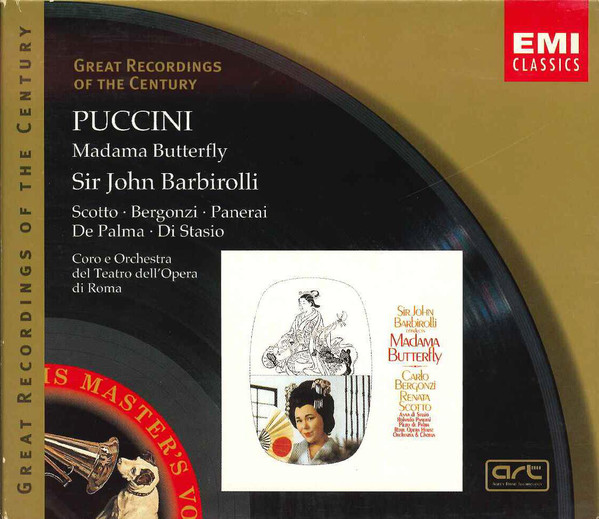
The Scotto/Barbirolli Madama Butterfly

r-6997709-1431339478-8972.jpeg

This has always been one of my three favourite recordings of Madama Butterfly (the others being Callas/Karajan and De Los Angeles/Gavazzeni), and listening to it again today has been a most moving experience.

Though Sir John Barbirolli conducted a good deal of opera during his career, this and the Otello with James McCracken are, I think, the only studio examples of his work in the field, and I’ve always thought of this recording as being as much his as Scotto’s, which is not quite the case with the two aforementioned Callas and De Los Angeles sets. Barbirolli’s love for the score is evident in every bar, and he reveals many incidental details that sometimes get lost in more opulent readings, whilst he never loses track of the score’s ebb and flow. The Rome orchestra, though not quite on the level of those in Vienna and Milan, nonetheless play brilliantly for him.

He has at his disposal a uniquely Italianate cast, who all sing wonderfully off the words. Scotto, 32 at the time (oddly enough about the same age as Callas and De Los Angeles at the time of their recordings) is a superb Butterfly and presents from start to finish a fully rounded character. The microphone placing doesn’t always flatter her, and, just occasionally, one is aware of the intellect behind the characterisation, but she is still one of the most pathetically moving Butterflies on disc, even if she lacks a little of De Los Angeles’s natural charm.

Bergonzi is an ardently lyrical Pinkerton, maybe not quite as charming as Di Stefano with De Los Angeles, but singing with glorious, golden tone, and less stiff than Bjoerling who sings Pinkerton on De Los Angeles’s second recording. Panerai, who was a late replacement for Peter Glossop, is a superbly inciteful and sympathetic Sharpless and there is terrific support from the likes of Anna Di Stasio as Suzuki, Paolo Montarsolo as the Bonze and Piero de Palma as Goro.

Ultimately my favourite recording would still be Callas/Karajan but I find it so emotionally, so intensely shattering, that I can only take it once in a while (rather like Vickers’s Tristan). On the other hand, sonically, the stereo sound here is a great improvement on the boxy mono of that recording, though, in turn, not quite on the level of the glorious sound afforded Karajan on his second Decca recording with Freni and Pavarotti, which remains a first choice for many, I know.

There are other superb recordings, not least the early one with Dal Monte and Gigli, Tebaldi with Serafin, and Gheorghiu with Pappano. The opera has certainly been very lucky on disc, but my top three remain unchallenged.

Wunderlich in La Traviata

91b3-3eyhsl._ss500_

This recording was taped at a performance in Munich in March 1965. It was a new production by August Everding, and, judging by the audience reaction, it was a tremendous success.

Teresa Stratas’s shattering Violetta  is of course well known from the Zeffirelli film, brilliantly acted, if vocally stressed. Here she is  just a few months short of her twenty-seventh birthday and making her debut in the role, and, if the photos in the booklet are anything to go by, she looked absolutely stunning. Vocally though, and divorced from her powerful stage presence, she has her problems, especially in the first act. She has to transpose down Sempre libera and, even then, it taxes her to the limit. There are other places too where her voice doesn’t quite do what she wants it to, though, in intention at least, it has the seeds of a great performance. For instance the moments leading up to Violetta’s outpouring of love at Amami, Alfredo are urgently and sincerely felt, though she can’t quite swell the tone at Amami, Alfredo itself. In the last act she delivers a telling letter reading and a moving Addio del passato, but the performance doesn’t yet add up to a complete whole.

No challenge then for Callas, whose Violetta is hors councours, and whose 1958 Covent Garden performance remains my all time favourite. In Zeffirelli’s film, though vocally not much more comfortable, Stratas surpasses what she does here, where we are also able to see her touchingly vulnerable acting.

Hermann Prey, 36 at the time and only a year older than Wunderlich, sounds too young and tends to oversing, possibly in an attempt to sound more Italianate. Though there is pleasure to be derived from the voice itself, I don’t get any sense of a real character.

No, the chief reason for hearing this set is the chance to hear Wunderlich sing a complete role in Italian. The language suits him well and he is an ardently lyrical Alfredo, singing with honeyed tone, but with plenty of heft in the outburst at Flora’s party. Very very occasionally he overplays his hand (mostly in recitative) but there is much that is treasurable; Dei miei bollenti spiriti has a lovely lilt and he and Stratas make a wonderfully touching moment out of their brief moment of happiness in the last act,  Parigi, o cara. Later perhaps he would have played down slightly the histrionics in his contribution to Gran Dio, morir si giovane, but it is already a treasurable performance and reason enough to hear this live recording.

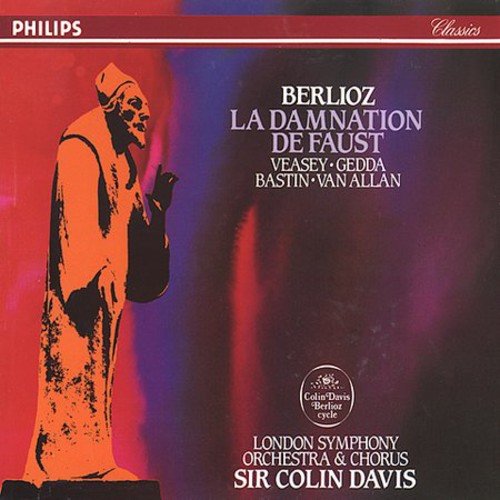
Colin Davis conducts La Damnation de Faust

51uqyihlall

Davis’s classic Philips recording of La Damnation de Faust, better cast I think than his later LSO Live version, is still one of the most recommendable versions of Berlioz’s non-opera. This tragédie-lyrique was never intended to be staged and therefore is particularly well suited to the gramophone, which leaves one’s imagination clear to fill in the stage set and scenery.

Gedda is a great Faust. He may have been just a little past his vocal best but he still manages a gorgeous pianissimo top C sharp in the duet with Marguerite, which no other Faust can quite pull off, added to which his singing is always stylish and intelligently thought through. There are better Margeurite’s on disc than Veasey (Baker, Von Stade and Von Otter come to mind); the difficult Roi de Thulé doesn’t quite come off, but she is better in the duet and sings a fine Romance. Bastin makes a superb Méphistophélès, mercurial, sardonic and ultimately evil and Richard Van Allan puts in one of his best recorded performances as Brander.

Davis, as so often in Berlioz, has a wonderful sense of structure and paces the score just right, and the LSO play brilliantly for him, the brass powerful, woodwind and strings deliciously light in the Menuet des Follets, plus some wonderfully sensitive cor anglais playing in the introduction to D’amour l’ardente flamme.

Every time I listen to this piece, I am struck by its originality. Berlioz was and is unique, with an unmistakable voice. No other composer is remotely like him.

Ricciarelli in Luisa Miller

r-9910923-1488394480-3768.jpeg

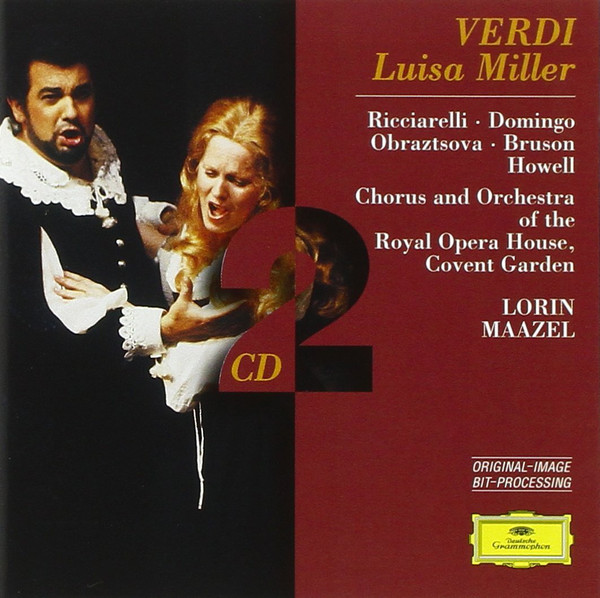
The front runners for this opera are probably Maag with Caballé and Pavarotti and Cleva with Moffo and Bergonzi, but this one has its attractions too, not least the affecting Luisa of Katia Ricciarelli. Vocally she is a little more fallible than either Caballé or Moffo, but she is very much inside the character and makes a vulneraby moving Luisa, no doubt helped by the fact that this recording was made during a highly successful run of performances at Covent Garden (actually a revival of a production that had been new the previous year). Much as I admire the two aforementioned ladies, I think ultimately I’d prefer Ricciarelli.

For the rest, honours are about even. Of the conductors, Maag is often revelatory and Cleva, whilst less imaginative, in the best Italian lyric tradition, but Maazel can be somehwat brash and vulgar. All three tenors are excellent and in their best form, as are the three baritones, Milnes, MacNeil and Bruson, so choice will depend on personal preference.

Federica was sung by Elizabeth Connell in the Covent Garden performances, but for some reason it was deemed necessary to bring in Obraztsova for the recording, who oversings and overpowers the role. The best Federica is Verrett on the Cleva; Reynolds on the Maag is completelyel anonymous. Richard Van Allan was Wurm in the stage performances but he is replaced by Ganzarolli, presumably because he had already recorded the role for Maag.

Still, for the three principals, this is a recommendable version of the opera and I’d be hard pressed to make a choice between it, Maag and Cleva.

De Los Angeles in La Traviata

51ust0qa2nl._ac_

Victoria De Los Angeles has long been a favourite singer of mine and her Violetta satisfies on so many levels. She is a little strained by the tessitura of the first act, but the voice is generally clear and beautiful, her singing always musical and deeply felt. As in everything she did, the sensitivity and sincerity of the performance are most affecting and she is without doubt one of the best Violettas on disc. What I miss is that sense of desperation and impulsiveness inherent in the character. Her Violetta is touching, but not overwhelmingly tragic as it is with Callas, who does tend to spoil me for all comers.

She has a good supporting cast with Carlo Del Monte a manly and forthright Alfredo and Sereni a sympathetic Germont, as he is in Callas’s Lisbon performance.

I sometimes feel Serafin’s virtues are rather underestimated. He paces the score brilliantly, particularly good in the choruses, which can sometimes outstay their welcome. If I’m honest, I rather prefer his approach to the more interventionist Kleiber. The cuts traditional at the time are observed, so no cabalettas to Alfredo’s and Germont’s arias.

If Callas, particularly in London, remains my yardstick for this opera, this is nevertheless one of my favourite studio sets and I might even place it just above Cotrubas/Kleiber.

Dawn Upshaw – The World So Wide

r-2563268-1290619230.jpeg

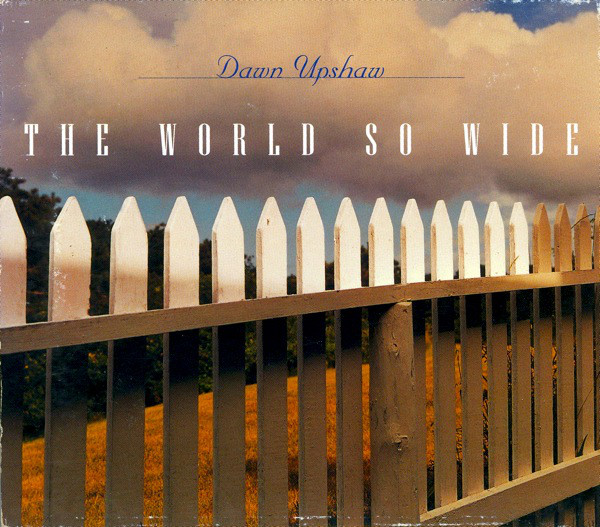
A few weeks ago I reviewed Renée Fleming’s excellent disc of American opera arias and today I turn to Dawn Upshaw’s disc, which takes its title, The World So Wide, from the first item in the recital, Laurie’s Song from Aaron Copland’s The Tender Land. It makes a lovely opener and Upshaw is perfectly cast as the young girl who yearns to escape and see the world.

At about 45 minutes, the disc is quite short measure, however, and not everything is as good as the first track. The piece from Tanía León’s Scourge of Hyacinths is tediously declamatory and afforded me the least enjoyment on the disc. I’d also suggest that Upshaw’s is not the right voice for Barber’s Cleopatra, a role that was written for the much more opulent voice of Leontyne Price. Upshaw’s lighter, brighter sounds do not conjure up the woman of whom Enobarbus says,

Age cannot wither her, nor custom stale
Her infinite variety. Other women cloy
The appetites they feed, but she makes hungry
Where most she satisfies, for vilest things
Become themselves in her, that the holy priests
Bless her when she is riggish.

I enjoyed the excerpt from John Adams Nixon in China rather more than the Gramophone reviewer, who found it “tediously protracted”, and I suppose you either like Adams’s style or you don’t. Whatever your feelings, Upshaw delivers Pat Nixon’s This is prophetic brilliantly. She is also superb in the more Broadway influenced What a movie from Bernstein’s Trouble in Tahiti, but I thought her singing of Lonely house (an aria sung by the male character of Sam Kaplan in Street Scene) just a little too overtly operatic. Teresa Stratas manages it better on her second disc of Weill songs and arias.

After the Copland and Benstein, the most successful item on the disc is Willow Song from Douglas Moore’s The Ballad of Baby Doe, which responds well to her charming, uncomplicated manner. So too, one would think, does the final item (and the only item she shares with Fleming on her disc), Ain’t it a pretty night from Carlisle Floyd’s Susannah, but here I have to admit I prefer the rather more sensuos tones of Fleming, who suggests a far more highly charged eroticism behind the apparent simplicity of the music.

A mixed bag, then, and not so successful as her disc of Broadway songs entitled I Wish It So, but worth a listen for the unusual repertoire and for some excellent performances.

A Spanish Songbook – Jill Gomez

516xghgdgjl._sx355_

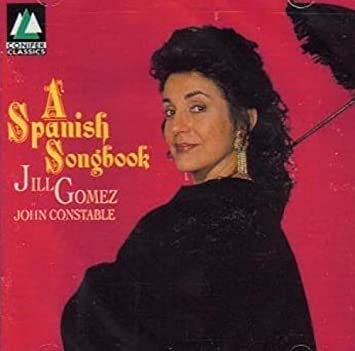
What an utterly charmng and delightful disc this is, cleverly planned and beautifully executed.

With her distinctive timbre and wonderfully expressive voice, Gomez’s personality fairly bursts through the speakers and she is superbly supported here by John Constable on the piano, who unerringly captures the mood of the songs. You feel as if these two artists really enjoy making music together, and indeed their association is a long one, having first appeared on disc together twenty years earlier. Gomez would have been in her early fifties when the present disc was recorded but the voice has hardly changed in the intervening years.

What we have here is a compendium of Spanish inflluenced songs by German, French and English composers, as well as songs by Spanish composers, covering a wide range of styles and eras. The programming is eminently sensible and makes for very satisfying listening.

We start with a group of sixteenth century Villancios from the courts of Charles V and Philip II in piano arrangements by Graciano Tarragó, which encourage the kind of decoration and improvisation of the 16th century vilancico. Fuenllana’s De los alamos vengo, madre is no doubt better known from Rodrigo’s orchestral arrangement, but Gomez sparkles quite as much here.

From thence we turn to a group of Spanish influenced songs by Wolf and Schumann, in which Gomez captures perfectly the deep melancholy of Schumann’s Tief im Herzen trag’ ich Pein as well as the girlish coquettishness of Wolf’s In dem Schatten meiner Locken. Spain has always provided a deep vein of inspiration for French composers, so we are next treated to a group of songs by Bizet, Ravel, Saint-Saëns and Délibes in which Gomez’s sense of style is impeccable.

Next come the three Granados Tornadillas, in which we are probably more used to hearing the fuller, chestier sound of someone like Conchita Supervia. Gomez intelligently, rather than copy her style, is more languorous. I might prefer Supervia’s vibrancy, but Gomez’s way is just as valid.

The two Walton songs, both taken from Façade, find Gomez pointing Edith Sitwell’s lyrics deliciously and lead us into the final group, which Gomez calls “Seven Other Popular Songs”. The first three songs are by Roberto Gerhard, who, as an exile from Franco’s Spain, had relocated to Cambridge in the UK in 1942, where he lived until his death in 1970. These are his versions of folk-songs collected by his teacher, Felipe Pedrell. bittersweet souvenirs of a composer in exile. The others are by Tarrago, Rodrigo, Guridi and Obradors. Gomez is yet again a wonderful guide through this musical journey of Spain, brilliantly capturing the mood of each song.

An excellent recital that should be a lot better known than it is.

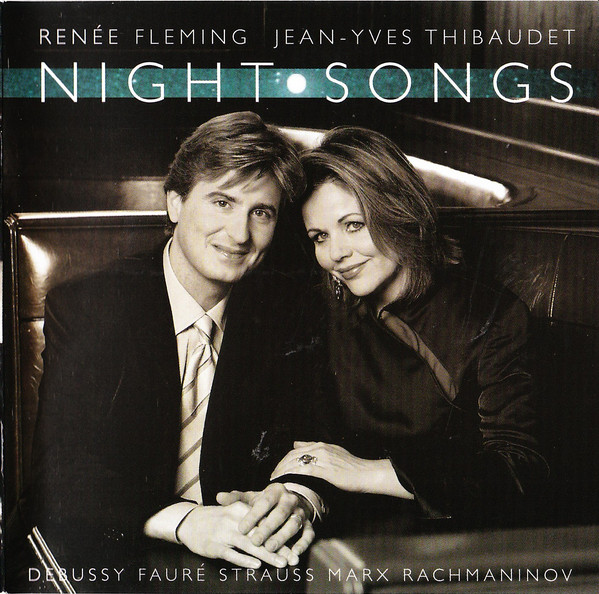
Renée Fleming – Night Songs

r-4527951-1426190336-3065.jpeg

Where does the time go? I can’t believe it is almost twenty years since I worked with Renée Fleming when the London Symphony Orchestra put on a semi-staged production of Previn’s A Streetcar Named Desire at the Barbican Hall with Previn himself conducting. I only had a very minor role, but I found Fleming to be a very gracious lady, an arch professional and a conscientious artist. The rehearsals and performances are amongst my fondest memories and I will never forget the experience of hearing that voice close to, with her literally singing into my ear on occasion. The final Korngold-like aria Blanche sings before being taken away to the asylum was possibly one of the most beautiful things I have ever heard.

I mention this to put into context my reactions to listening to this recital, which I wanted to like much more than I did. The recording was made in 2001 when the voice had acquired a new richness in the middle and lower ranges whilst retaining its beauty and ease up on high, even throughout its compass and admirably firm, with no trace of hardness when singing at full tilt. As it seems now we have said goodbye to Fleming, the classical arists it is good to be reminded that this was one of the most ravishing instruments of the last thirty years or so. She has always had a fairly eclectic repertoire which embraced both opera and song, covering a wide range of different composers and styles, but I’ve always thought her best suited to the music of Mozart and Strauss.

Hence it is the songs by Strauss and Joseph Marx which make the stongest impression, especially Cäcilie, its radiant close easily and ravishingly voiced. The Marx songs suit her well too, their sensuous expressivity responding well to the heady beauty of Fleming’s voice. Thibaudet is also superb in the tricky accompaniments, tossing off their difficulties as if they are the easiest things in the world.

Elsewhere I am not so sure this operatic vocal effulgence is what I want to hear. I found myself longing for the greater simplicity and cleaner vocal production of a Victoria De Los Angeles in the Fauré, the slight touch of irony and cool detachment brought to Debussy’s Chansons de Bilitis by a Régine Crespin. The Rachmaninov, with their heavier accompaniments, perhaps respond better to this operatic treatment, but I find it just too sophisticated and even here I prefer a slightly simpler, more direct approach.

However enjoyable it is to hear one of the most beautiful voices of recent times whatever the circumstances, ultimately there are other discs I would pull out first when wanting to sample Fleming at her best.

Dame Janet Baker – The Great Recordings

51yyk-hlf7l._sy400_ml2_

This exhaustive twenty disc box was, when it was first released on EMI, more properly called The Great EMI Recordings. The deletion of the word EMI from the title has something to do with the conditions of the sale, of EMI to Warner but the original title is more representative of the contents, as Dame Janet also made “great” recordings  for Decca, Philips and Hyperion. Aside from Ottavia’s Lament and Farewell from Monteverdi’s L’Incoronazione di Poppea, and the final scenes from Berlioz’s Les Troyens, this set includes no opera. Still, the range is wide, covering music from Monteverdi to Schoenberg and, as it also includes excerpts from various complete recordings of orotorios, covers just about everything she ever recorded for EMI and later Virgin Classics. The quality is extrordinarily high and it is safe to say that she never made a bad record and many of them are out and out classics.

The lay out is mostly logical, starting with early music and moving forward in time, but cramming shorter LP recordings onto twenty well-filled CDs has inevetably led to the occasional odd juxtaposition. Most of the recordings cover her vocal prime, from 1966 through the 1970s. Shortly after she retired she made a few recordings with Richard Hickox in 1989 and 1990 and only these show a slight decline in her vocal resources, though the artistry remains undimmed.

Disc one starts with a 1969 recording of music by Monteverdi, Alessandro and Domenico Scarlatti with the English Chamber Orchestra under Raymond Leppard rounded off by excerpts from a duet recital with Dietrich Fischer-Dieskau, recorded live at the Royal Festival Hall in 1970. Leppard’s souped up arrangements of the Monteverdi might seem anachronistic now, but Baker’s impassioned singing of Arianna’s Lament and Ottavia’s Lament and Farewell from L’Incoronazione di Poppea transcends any matters of style. The duet items (music by Schütz, Schein and Lilius) have continuo realisations by George Malcolm, who plays the organ with Kenneth Heath on the cello and are delightful in every way.

Disc two gives us the first side of an LP called A Pageant of English Song, which had songs by Dowland and Campion accompanied on the lute, and by Purcell, Monro (I can’t think of his My lovely Cecilia without having Baker’s smiling tone in my head) Boyce and Arne, with accompaniments by Martin Isepp on harpsichord. More duets with Fischer-Dieskau round off the disc, some of these taken from a 1969 Queen Elizabeth Hall recital with Barenboim on the piano.

From here we move to Bach for the next two discs, the wonderful performance of Ich habe genug under Menuhin being particularly noteworthy. A Bach recital, which she recorded with the Academy of St Martin in the Fields under Neville Marriner is spread over the two discs, which finished with the alto arias from Klemperer’s 1967 recording of the Mass in B minor. What a superb Bach singer she was.

We move onto Handel, a composer with whom Baker was particularly associated. Mackerras’s recording of Messiah was one of the first to make a stab in the direction of HIP. It was also the first one I ever owned, Baker’s contribution being particularly memorable. Her version of He was despised is incredibly moving. The two Handel cantatas are listed as arr. Leppard, but I’m not sure what those ‘arrangements’ involve. Baker is, as always, a superb Handelian.

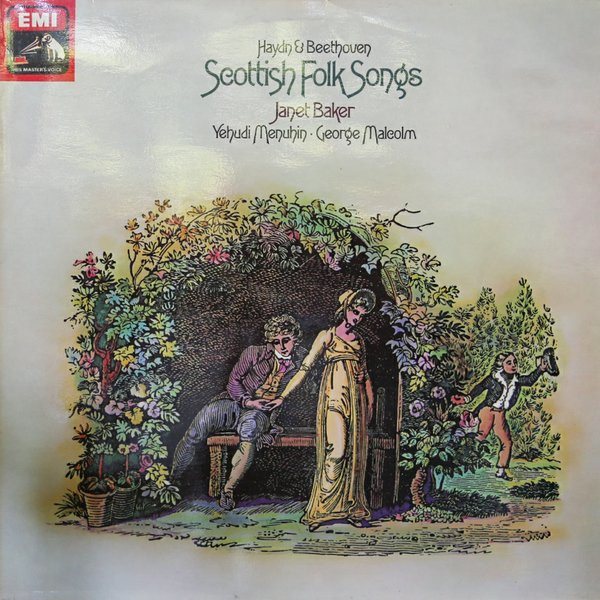
The Haydn and Beethoven Folk Song Arrangements, which follow on the next disc, rather outstay their welcome, for me anyway, even in performances as special and imaginative as these, which means that the ensuing Schumann and Brahms duets from the QEH concert come as something of a relief.
mi0xnzg4lmpwzwc

Discs seven and eight are all Schubert, taken, for the most part, from a two disc set she recorded with Gerald Moore in 1971, which included quite a few rarities and a 1980 recital with Geofrrey Parsons of more popular fare. Baker’s control of dynamics is extraordinary and her breath control stupendous, her legato line beyond reproach. Amongst so many great performances, it’s hard to name favourites, but I doubt I’ve ever heard a better performance of Du bist die Ruh, which is not only deeply felt but also displays the perfection of her tehcnique and her superb breath control.

A few more Schubert songs start the ninth disc, which then continues with a Mendelssohn recital with Geofrrey Parsons and Schumann’s Frauenliebe und Leben with Daniel Barenboim. One of the first records Janet Baker ever made was of the Schumann cycle, for the Saga label before she was contracted to EMI. It was released to much acclaim, but this one delves that much deeper and is indeed one of the greatest recordings of Schumann’s cycle in the catalogue. The Mendelssohn songs are perhaps not so memorable or so wide ranging as Schubert’s but Baker makes the best case for them, but the Schumann cycle is the real prize of this disc.

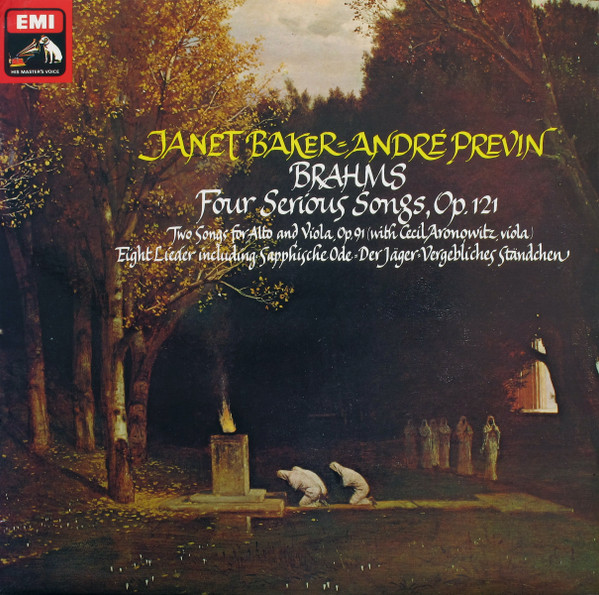
The tenth disc gives us the second side of her Schumann LP with Barenboim, a wonderful performance of the Opus 39 Liederkreis, and the whole of an all Brahms programme with Previn at the piano, the two songs for alto and viola (Cecil Aronowitz) and the Vier ernste Gesänge are deeply felt and wonderfully accompanied.
my03otc4lmpwzwc

A Liszt recital (with Geoffrey Parsons) starts disc eleven, an excellent selection of songs, which are not performed as often as they should be. Baker and Parsons make the very best case for them. These are followed by a small selection from Wolf’s Spanisches Liederbuch and a couple of Mahler’s youthful songs.

Disc twelve is something of a mixed bag and brings together recordings from the beginning and end of Dame Janet’s career, a selection of Strauss songs from an early EMI recital disc, the Song of the Wood Dove from Ferencsik’s 1968 recording of Gurrelieder and Respighi’s La Sensitiva from recording sessions made for Virgin Classics in 1990, a gap of some twenty-three years. I suppose you can detect a slight loosening of the vibrations, but the voice is still very firm and the artistry undimmed. Some may hear a slight lack of spontaneity in the 1967 Strauss songs (absent from the 1973 recording of Ständchen) and I’d have to admit I prefer the sound of a soprano in these songs, but I’d still rather too much care than too little. The Schoenberg might seem an unexpected piece for Dame Janet, but she is absoutely superb here, wonderfully intense and dramatically involved and the Respighi, recorded just after she had retired from the concert platform, is a lovely performance, warmly sung and senisitively phrased.

Disc thirteen is all of song with orchestra. The Brahms Alto Rhapsody was originally used as a filler for Boult’s Brahms Symphony cycle, then reissued as a makeweight for Wagner’s Wesendonck Lieder and a selction of Strauss songs Baker and Boult recorded in 1975. The Alto Rhapsody and the Wagner are absolutely superb, indeed among the most recommendable versions of these songs. The Strauss songs suit her less well, but I’m still glad to have them. Then comes the legendary recording of Elgar’s Sea Pictures, which has never been equalled. It was originally issued with Du Pré’s equally legendary recording of Elgar’s Cello Concerto and is one of the best selling classical records of all time. the original LP was an EMI best seller for as long as I remember, and a record we had on permanent weekly order, when I worked at MDC in London.The disc finishes, fittingly enough with Dame Janet’s wonderfully consoling and radiant singing of the closing pages of The Dream of Gerontius.

Now if I were allowed just one Janet Baker record on that proverbial desert island, I’d be hard pressed to choose between her Mahler and her Berlioz and  the next two discs are dedicated to these two composers.

Disc fourteen gathers together all the Mahler recordings she made with Barbirolli and adds Urlicht from Rattle’s acclaimed recording of the Second Symphony. All three cycles are amongst the best recordings of these songs ever made. The Rückert Lieder were originally issued on the fourth side of Barbirolli’s famous recording of the 5th Symphony with the New Philharmonia, the other two cycles having been recorded a couple of years earlier with the Hallé. Ich bin der Welt abhanden gekommen was recorded at the same time and used as a fill-up, which explains why they recorded the song twice. If I were to use one piece of music to illustrate the genius of Janet Baker, then it would undoubtedly be one of these two versions of Ich bin der Welt abhanden gekommen. The song is not so much sung as experienced and you can really feel the connection between singer and conductor. To be honest, there is very little to choose between the two performances; maybe the later one is even more withdrawn, even more self-communing. When I listen to either I feel as if I too am lost to the world.

Disc fifteen is also one of the most desirable discs in this set. Baker was a great Berlioz singer and it has always been a huge cause for regret that she never recorded the role of Didon, making these excerpts more treasurable than ever and these final scenes are devastating in their impact. She recorded La mort de Cléopâtre again for Philips under Davis, another superbly impassioned and dramatic performance, but she is in slightly fresher voice here.

This Barbirolli recording of Les nuits d’été is, I think, her finest and indeed one of the greatest performances of the songs ever committed to disc. In his survey of the then available recordings for Song on Record 2, David Cairns makes it a top recommendation alongside Steber/Mitropoulos. She is possibly a little stiff in Villanelle but all is glorious after that and, with the inestimable help of Barbirolli, she unerringly captures the mood of each of the four middle songs especially. Le spectre de la rose is taken slowly but never drags, and the tempo gives her ample time to fill out the phrases, its climax gorgeously radiant.

Ravel’s Shéhérazade, which opens disc sixteen, was recorded at the same time as Baker’s superb Les nuits d’été and is wonderfully sung, though I’d say she misses that hint of inuendo in the last song that you get from Crespin. Nonetheless this is a beautiful performance of the cycle. The Chausson and Duparc were recorded ten years later, and there is a slight detioration in the quality of the voice, the vibrations have loosened a bit and there is a slight feeling of strain. She sings the Chausson with a greater sense of freedom in a live performance under Svetlanov only a few years earlier, but this is still a great performance with Previn and the LSO offering superb support as they do in the Duparc.

D’amour l’ardent flamme from La Damnation de Faust, which closes the disc, is one of the greatest ever recorded and it’s too bad that it is taken from a not very recommendable performance of the work under Georges Prêtre. If only Baker had been the Marguerite on Davis’s Philips recording of 1973, in which Gedda got to reprise his Faust under much happier circumstances. Baker joins Callas and Verrett as my favourites for this piece.

Baker was also a renowned interpreter of French song with piano and the lion’s share of disc seventeen is given over to A French Song Recital, which she recorded with Gerald Moore in 1969, songs by Duparc, Fauré and Debussy. It was logical to add the French items from a mixed bag recital of a couple of years later. These songs by Hahn, Massenet, Chabrier and Gounod demonstrate Baker’s prowess in a lighter vein. The Berlioz orchestral songs were originally coupled to her final recording of Les nuits d’été, recorded right at the end of her career. The voice is not quite the same as it was twenty years earlier, admittedly, but to be honest, very few allowances have to be made for the passing years.

One of the first discs Baker ever recorded was a recital of British songs, for the Saga label, and English song would often be a part of her concert recitals. This eighteenth disc brings together the second side of A Pageant of English Song (you might remember the first side was included on Disc 2). This time the composers are Parry, Stanford (a superbly impassion performance of La belle dame sans merci), Vaughan Williams, Quilter, Ireland , Gurney and Warlock, and the English items from her Favourites album. She was also much associated with the music of Benjamin Britten, but all her recordings were made for Decca, so it is good to have this one excerpt from Previn’s recording of his Spring Symphony.

When Walton’s Troilus and Cressida was revived at Covent Garden in 1976, Walton re-wrote the role for a mezzo, specifically so that Baker could sing it. The performances were recorded and the disc is filled out with three excerpts from that recording.

The penultimate disc starts with the remaining item from her 1972 Favourites album (Mendlessohn’s Auf Flügeln des Gesanges) and continues with two arias from the 1968 Frühbeck de Burgos recording of Elijah, her singing of O rest in the Lord sung with a sincerity and compassion that enfolds you in its warm embrace.

It was perhaps an unfortunate idea to present the Mendelssohn Psalm of twenty years later straight after, for she sounds uncharacteristically tentative and strained in the solos, which are, in any case, designated for soprano. The concert aria that follows fares a little better as the tessitura lies slightly lower, but these are not performances I would want to listen to often. On the other hand, the Brahms Alto Rhapsody, recorded the same year, is rather wonderful and probably the gem of these late sessions. It lies a lot lower of course, so the sounds a great deal more comfortable, and it is a wonderful memento of the moving performance I heard these same artists give of the work at the Barbican round about the time of this recording and shortly before she retired. As in the live performance, the moment when the music shifts from the minor to the major is a moment of pure magic. This is definitely the prize of these late recording sessions.

It is perhaps unfortunate that the final disc in this wonderful set is the only one I would call dispensable, though I was actually pleasantly surprised by this 1990 performance of Berlioz’s Les nuits d’été. She takes a little less time over the songs now, and this performance comes in around three minutes shorter than the Barbirolli. She still has an innate understanding of Berlioz and the way to shape and mould the phrases, but there is also a slight feeling of her husbanding her resources where the Barbirolli (and the live Giulini) find her in full vocal plenitude. They are still the ones I would reach for when wanting to hear Baker in this work.

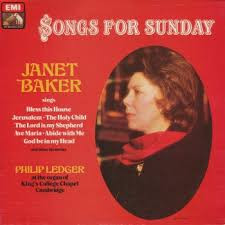
The remaning items are from a 1980 disc called Songs for Sunday which will no doubt be more to some people’s taste than to mine. It’s not a record I ever paid much attention to, though I did buy a copy for my mother when it came out. I am not religious, but Dame Janet’s, singing with  with her customary sincerity and generosity of spirit, completely won me over.
ms00mjy5lmpwzwc

These twenty discs have confirmed for me Baker’s place as one of the greatest singers of the latter half of the twentieth century. Her records continue to educate and enthral. There is something so personal about Baker’s art, a sense of total identification with the composer in question and an innate ability to capture the right mood of each song. This goes hand in hand with a gift for communication which is vouchsafed to only a few. Just occasionally one can be aware of the huge amount of thought that has gone into each interpretation, but I’d rather too much intelligence than too little. It has been  interesting too to hear her collaborations with so many different musicians. For me she is the last of the true greats. How lucky we are that she left behind her such a rich and varied legacy.

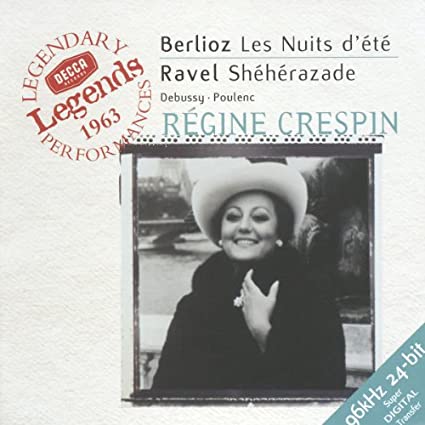
Crespin’s Shéhérazade

513oqn2fqcl._sx425_

Crespin’s recording with Ansermet of Ravel’s Shéhérazade and Berlioz’s Les Nuits d’été is now so famous, so universally acclaimed that there can surely be no more to say about it. Even today, almost 60 years since they were recorded, the performances are still cited by many as a first choice in both works and for many they were no doubt their first exposure to the works, so maybe that is all that needs to be said about them, but is it really so simple?

Both Shéhérazade and, especially, Les nuits d’été are great favourites of mine and I now have ten different recordings of the Berlioz, six of the Ravel. Let us then start with the Ravel. From the thrice repeated call of Asie at the beginning, the third sung with the equivalent of a flirtatiously arched eyebrow, we are in her thrall. She makes a bewitching storyteller, drawing us in with her thrillingly colourful descriptions of the Orient. As I often feel with Crespin, there is a slight air of detachment but here it suits the narrative superbly. She is suitably languid in La flûte enchantée and deliciously ambiguous in L’indifférent. There have been finer versions of the orchestral score (not least the New Philharmonia under Barbirolli for Janet Baker), but Crespin at her best is still a prime recommendation. There is something just so inevitably right about her singing and it places her (just) ahead of the other versions I own, (Teyte, Baker, De Los Angeles, Berganza and Hendricks).

That air of detachment I mentioned also makes her an ideal interpreter of the songs of Poulenc and also Debussy’s Trois chansons de Bilitis with John Wustman on the piano, from a 1967 recording, which are here included as a makeweight, and very welcome they are too. However it works against her in the Berlioz, which requires a degree of involvement and passion that I find lacking in Crespin’s delivery. However musical and tasteful her singing, however elegant her phrasing, she remains aloof and uninvolved. There is no sense of mounting rapture at the arrival of the rose from paradise, no sense of longing in Absence. She is at her best in the final song, L’île inconnue which is blithely insouciant and responds better to her air of suave sophistication. I have no idea why she decided to place Sur les lagunes after Absence but it upsets the balance of the work too.

No, for the Berlioz my prime recommendations would be Baker either with Barbirolli or live with Giulini, Hunt Lieberson with McGegan, Steber with Mitropoulos or De Los Angeles with Munch, Crespin trailing quite a way in their wake.

Essential I would say for Shéhérazade and the Debussy and Poulenc, but look elsewhere for the Berlioz.