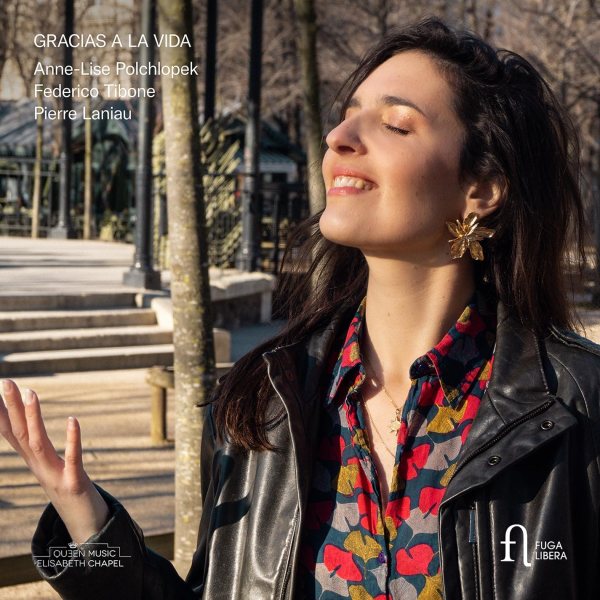
Gracias a la vida – Anne-Lise Polchlopek

It seems not a month goes by without a new recital record from a young artist making an impression. Recently I’ve welcomed recital records from Benjamin Appl, Fatma Said, Harriet Burns, Rachel Fenton and Eva Zalenga , and July saw a recommendation for Julieth Lozano-Rolong’s new disc from Dominy Clements. To this list can now be added the name of French mezzo-soprano, Anne-Lise Polchlopek, a winner of several song competitions, and now an associate artist of the Queen Elizabeth Music Chapel, where this recording was made.

This recital may at first glance appear to be a hotchpotch of different styles, embracing classical Lied, folk and popular music, but Polchlopek somehow integrates these different musical styles into a satisfying whole, and the recital benefits from being listened to at one sitting. It doesn’t get off to the best of starts with her somewhat over-articulated and over-acted singing of Bernstein’s Old Lady Tango (I am easily assimilated) from Candide, but she then sings a beautiful version of Strauss’s Wiegenlied, with a lovely legato line, her mellifluous mezzo wrapping the child in its warm embrace.

From Germany we travel to Spain and France, where we stay for the remainder of the recital. Toldrá is followed by Chaminade, then we switch to guitar accompaniment for Hubert Giraud’s La tendresse, staying with the guitar for an extremely effective performance of Falla’s Nana, from his Siete canciones populares españolas.

We go back to the piano for Fauré’s Les berceaux, in which she builds nicely to the climax, and then we have Messiaen’s early Trois melodies, where she captures to perfection the ecstasy of the writing, especially in the final song, la fiancée perdue.

 These are followed by three songs in a lighter vein by Chaminade, Pauline Viardot and Gerónimo Giménez, all wonderfully characterised. Perhaps incongruously (but somehow it works) Voi che sapete from Mozart’s Le nozze di Figaro acts as a bridge to Michel Polnareff’s Mes regrets, a beautiful song about lost love, which is followed by Fauré’s Toujours.

This in turn is followed by Gérard Jouannest’s La chanson des vieux aimants, with lyrics by Jacques Brel, a song I had previously only known in a version by Judy Collins. Suffice it to say that Polchlopek’s intensely moving performance put any thoughts of Collins out of my mind completely.

Throughout the piano accompaniments of Federico Tibone contribute wonderfully to the success of the disc, as do the guitar accompaniments of Pierre Laniau, who accompanies her on Tamás Méndez’s charming Cucurrucucu paloma, which I seem to remember was a favourite of Nana Mouskouri. He also accompanies her on the Habanera from Bizet’s Carmen and Satie’s La diva de l’empire, though I did feel the Bizet was slightly out of place here, coming, as it did, after the piano accompanied Poulenc Les métamorphoses and before the Satie.

We return to piano accompaniment for Montsalvatge’s Canto negro, which she sings with charm and spirit, relishing the yambambós, as Victoria De Los Angeles did before her.

All three participants come together for the final song, Violetta Parra’s Gracias a la vida, a fitting end to a journey on which Anne-Lise Polchlopek has proved to be a most musical guide. Throughout she clearly and meaningfully enunciates the text, and it is clear she has a rare gift for communication that makes her an ideal recitalist.

Unfortunately, though the notes accompanying the disc are in English, the online texts are only in the original language, French, Spanish, German, or in the case of the Bernstein, English, and translations would have helped for a total appreciation of Polchlopek’s art. However, I thoroughly enjoyed this disc, and I look forward to hearing more of Anne-Lise Polchlopek.
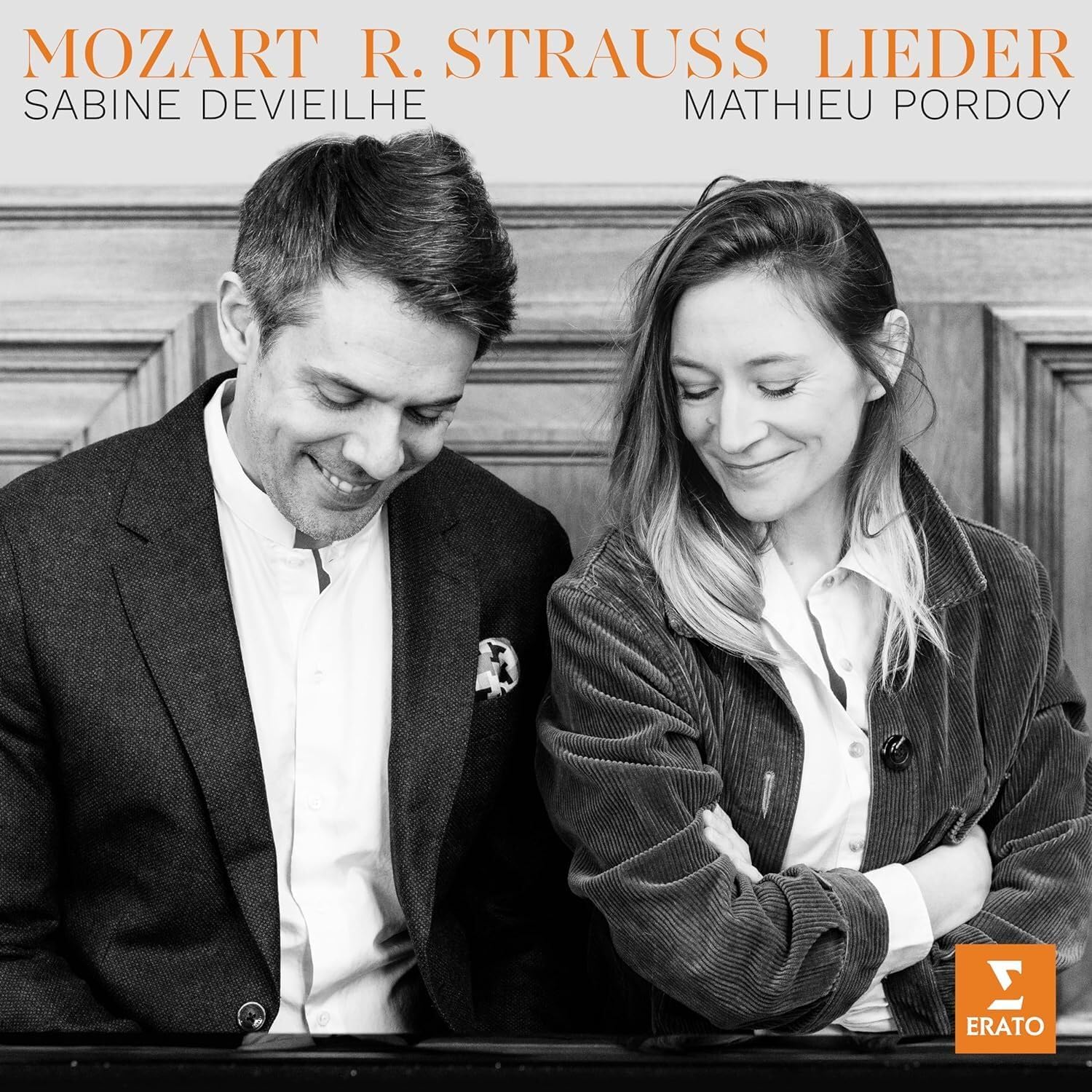
Sabine Devieilhe sings Mozart and Strauss Lieder

81rjnmb3ukl._ac_sl1500_

I listened to this recital quite a few times before setting down my thoughts, and, on each occasion, I reacted differently to it. I was looking forward to hearing it having hugely enjoyed Sabine Devieilhe in the theatre, as a wonderfully tomboyish Marie in Donizetti’s La fille du Régiment, but the recording made me aware of a problem with Devieilh’s vocal production, which I hadn’t noticed in the theatre, namely her tendency to use what I can only describe as a squeeze-box method of production which impedes a natural legato. It is particularly noticeable in songs like Strauss’s Die Nacht and Morgen, but once noticed, I found it hard to ignore. I listened to the recital several times and my impressions changed from one listening to the next. I am sure that there are those who will not be bothered by it at all, but, once noticed, it began to grate.

Which is a pity, because this is a well put together programme and for the most part well executed by Devieilh and her brilliant accompanist, Mathieu Pordoy.

For once we get no catchy title for this disc of Mozart and Strauss Lieder, and Devieilhe tells us in the notes that their two instruments are “pared back and at the service of illuminating the lieder of Mozart and Strauss.” So far so good, and it was a nice idea to intersperse the songs with each other rather than giving us a group of Mozart songs, followed by a group of Strauss. For the most part, the juxtapositions work well, but I did wonder why, at the beginning of the recital, Strauss’s Die Nacht was placed rather uncomfortably between Mozart’s Komm, Zither, komm and his Das Kinderspiel, on which Devieilhe’s son charmingly contributes a few lines in his boy soprano. If the Strauss exposes Devieilhe’s weakness, in the Mozart songs one notes the bright, forwardly placed tone and her communicative way with the text.

The next Strauss group plays to her strengths and weaknesses with both Nichts and Ständchen nicely done, but the following three songs require the kind of seamless legato she appears not to be capable of and where the squeeze is most noticeable.

We return to Mozart with a heartfelt performance of An die Einsamkeit. The voice is lovely, but, yet again, it needs a better legato, which we hear in performances by Barbara Hendricks and Elly Ameling. Still, she has bags of charm in Mozart’s Oiseaux, si tous les ans and bags of personality for Strauss’s Schlagendes Herzen, as well as being well up to the Zerbinetta-like demands of Strauss’s Amor, though her tone becomes a little pinched at the very top. I note that I am noticing less and less the peculiarities of her vocal production and concentrating more on the music. Maybe I am just getting used to it, or maybe it is becoming less pronounced.

Whatever the reason, I was able to relax and enjoy the music making more in the second part of the recital, whilst noting that Allerseelen really needs a richer tone than Devieilhe can muster and that there was a return to the squeeze-box in Das Velichen.

I should also commend the excellent pianist, Mathieu Pordoy, whose playing is pellucidly clear and who supports his soloist brilliantly in a true collaboration. If I have equivocal feelings about some of the singing, I am sure that others will find otherwise and will find this a thoroughly enjoyable and rewarding disc.

Elisabeth Schumann’s Swan Song

91ry4lbyuzl._ac_sl1500_

Born in 1888, Elisabeth Schumann’s first recordings were acoustics, made in 1915, although it is probably for her later, electrical recordings that she is better known. She had an illustrious operatic career, famous for such roles as Sophie in Der Rosenkavalier and Eva in Die Meisteringer, also excelling in Mozart with roles such as Pamina, Susanna, Zerlina and Blonde. She was a favourite of Richard Strauss, who even tried to persuade her to sing the role of Salome, creating an edition in which he reduced the size of the orchestra to accommodate her light, lyrical soprano, though she never took up the offer.

She was also highly regarded as a singer of Lieder and Lotte Lehmann, who was perhaps her greatest rival in the field, once said she represented the purest singing style of German Lieder. She has a large discography and many of her recordings, both acoustic and electrical were once issued in a six disc EMI box set, which now appears to be available as a Warner download.

The present recordings were made somewhat later in her home in Manhattan in 1950, when she would have been in her early sixties, and this appears to be the first time the sessions have been issued in their entirety. The accompanying notes are sketchy and inadequate. Included are brief biographies of Schumann herself and of George Schick and George Reeves, who I assume are the accompanists, but there is no indication as to which songs they play, nor which items are completely new to the catalogue.

Being late recordings, this is not a disc to which I would direct anyone interested in hearing “the purest singing style of German Lieder”. Though the bell-like purity of Schumann’s top notes remains more or less intact, quite frankly, in the middle and lower register, she sounds all of her sixty odd years. Certainly, the voice has aged less well than some other sopranos, who also made recordings into their sixties, such as her contemporary Maggie Teyte or, of more recent singers, Renée Fleming. Some of the Wolf songs now clearly stretch her to the limit and I find myself wondering if this is the reason they were not issued before. One should probably make allowances for the way these songs were recorded (probably on a 7.5ips home recorder, according to the notes) but to my ears  she sounds effortful and unsteady for much of the time.

She redeems herself in the final three bonus tracks, first in two acoustic Odeons of her singing Wolf’s Frage und Antwort and Straus’s Morgen (date and accompaniment unknown), followed by a later recording of her delivering in English a master class on Morgen, this time with Ernest Lush on the piano. No date is given, and I wonder if this was from one of her lecture tours of 1950 and 1951. If it was, then she sounds in much better voice here than she does on the home recordings.  and she gives invaluable advice on singing the song, recollecting working on it with Strauss himself.

I hate to be negative about a much-loved artist, but this disc, I would suggest, is for completists only. Anyone wanting to discover the voice and art of this great soprano, will be much better served by the six-disc set detailed above.