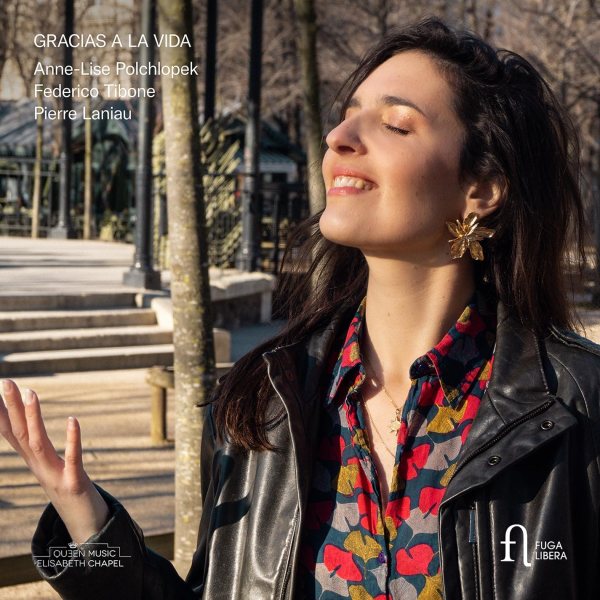

Gracias a la vida – Anne-Lise Polchlopek

It seems not a month goes by without a new recital record from a young artist making an impression. Recently I’ve welcomed recital records from Benjamin Appl, Fatma Said, Harriet Burns, Rachel Fenton and Eva Zalenga , and July saw a recommendation for Julieth Lozano-Rolong’s new disc from Dominy Clements. To this list can now be added the name of French mezzo-soprano, Anne-Lise Polchlopek, a winner of several song competitions, and now an associate artist of the Queen Elizabeth Music Chapel, where this recording was made.

This recital may at first glance appear to be a hotchpotch of different styles, embracing classical Lied, folk and popular music, but Polchlopek somehow integrates these different musical styles into a satisfying whole, and the recital benefits from being listened to at one sitting. It doesn’t get off to the best of starts with her somewhat over-articulated and over-acted singing of Bernstein’s Old Lady Tango (I am easily assimilated) from Candide, but she then sings a beautiful version of Strauss’s Wiegenlied, with a lovely legato line, her mellifluous mezzo wrapping the child in its warm embrace.

From Germany we travel to Spain and France, where we stay for the remainder of the recital. Toldrá is followed by Chaminade, then we switch to guitar accompaniment for Hubert Giraud’s La tendresse, staying with the guitar for an extremely effective performance of Falla’s Nana, from his Siete canciones populares españolas.

We go back to the piano for Fauré’s Les berceaux, in which she builds nicely to the climax, and then we have Messiaen’s early Trois melodies, where she captures to perfection the ecstasy of the writing, especially in the final song, la fiancée perdue.

 These are followed by three songs in a lighter vein by Chaminade, Pauline Viardot and Gerónimo Giménez, all wonderfully characterised. Perhaps incongruously (but somehow it works) Voi che sapete from Mozart’s Le nozze di Figaro acts as a bridge to Michel Polnareff’s Mes regrets, a beautiful song about lost love, which is followed by Fauré’s Toujours.

This in turn is followed by Gérard Jouannest’s La chanson des vieux aimants, with lyrics by Jacques Brel, a song I had previously only known in a version by Judy Collins. Suffice it to say that Polchlopek’s intensely moving performance put any thoughts of Collins out of my mind completely.

Throughout the piano accompaniments of Federico Tibone contribute wonderfully to the success of the disc, as do the guitar accompaniments of Pierre Laniau, who accompanies her on Tamás Méndez’s charming Cucurrucucu paloma, which I seem to remember was a favourite of Nana Mouskouri. He also accompanies her on the Habanera from Bizet’s Carmen and Satie’s La diva de l’empire, though I did feel the Bizet was slightly out of place here, coming, as it did, after the piano accompanied Poulenc Les métamorphoses and before the Satie.

We return to piano accompaniment for Montsalvatge’s Canto negro, which she sings with charm and spirit, relishing the yambambós, as Victoria De Los Angeles did before her.

All three participants come together for the final song, Violetta Parra’s Gracias a la vida, a fitting end to a journey on which Anne-Lise Polchlopek has proved to be a most musical guide. Throughout she clearly and meaningfully enunciates the text, and it is clear she has a rare gift for communication that makes her an ideal recitalist.

Unfortunately, though the notes accompanying the disc are in English, the online texts are only in the original language, French, Spanish, German, or in the case of the Bernstein, English, and translations would have helped for a total appreciation of Polchlopek’s art. However, I thoroughly enjoyed this disc, and I look forward to hearing more of Anne-Lise Polchlopek.
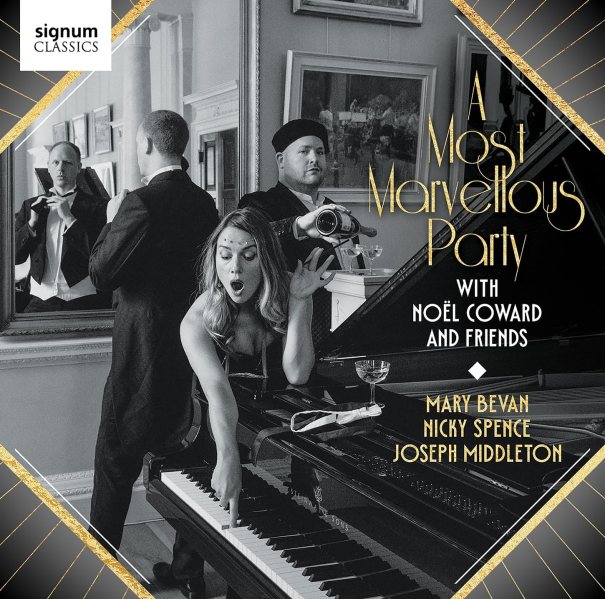
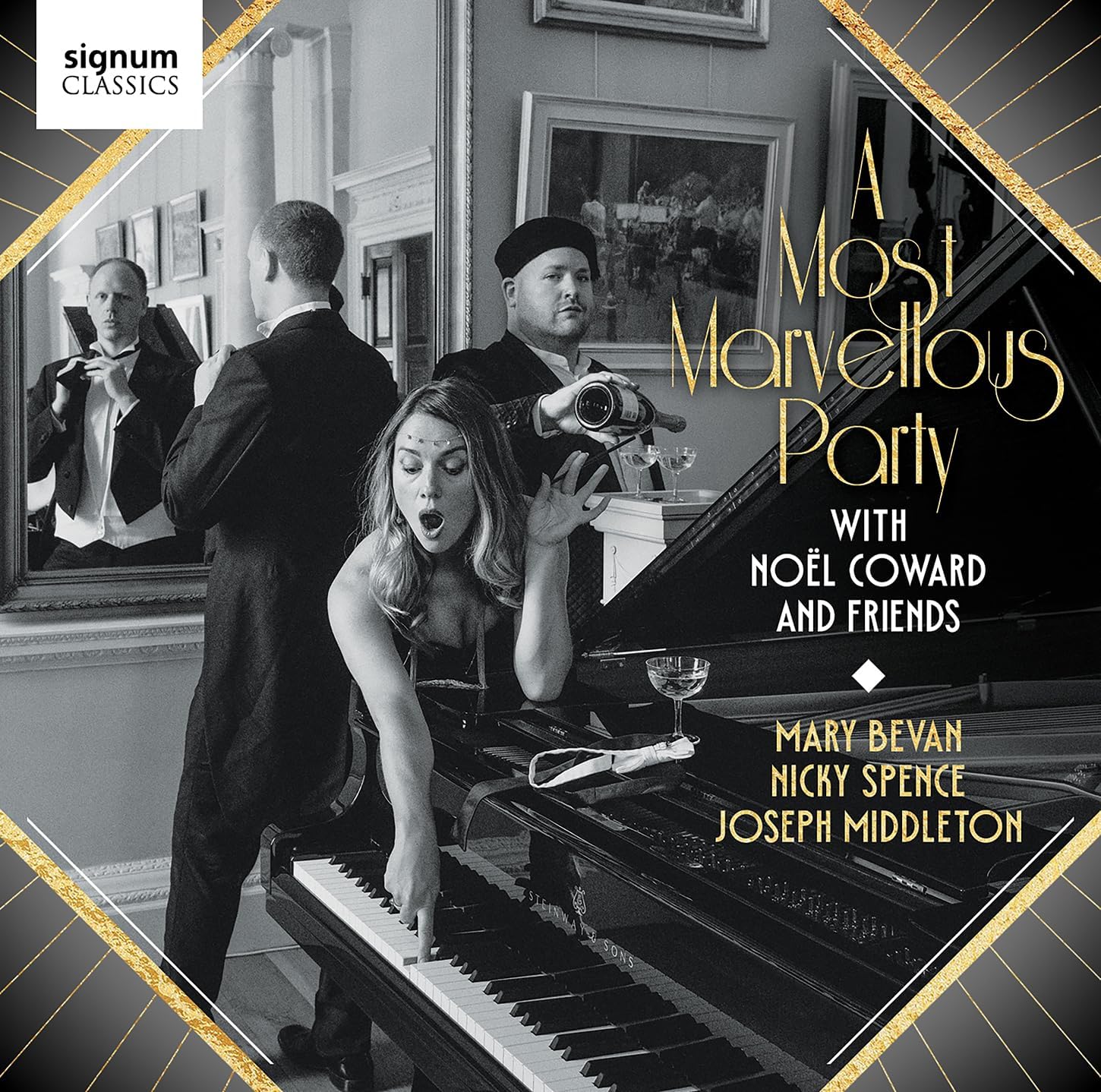
A Most Marvellous Party

81wftltatgl._ac_sl1450_

This highly entertaining programme is the sort of thing that would go down well at a country house or in a small hall, and indeed I see that these artists performed it at the Leeds Conservatoire in March this year, shortly before making this recording. Mary Bevan should not be confused with her sister, Sophie, also a soprano with quite a career herself, nor Nicky Spence with tenor Toby Spence, to whom he is not related. Both singers are active on the operatic stage as well as on the concert platform and here let their hair down in some lighter music.

The “party” seeks to place Noel Coward among other contemporary composers, all of whom have a connection with Coward, however slight. Thus, the other guests turn out to be Ned Rorem, who claimed to have once had a one-night stand with Coward, Poulenc for whom Coward once did the narration on a recording of his Babar, the elephant and Stravinsky, who apparently once asked Coward to collaborate with him. Gershwin’s music Coward had known for some time and even played snatches of it on stage in the first production of his play, The Vortex. The connections with Satie, Messager, Britten and Walton would seem to be a little more tenuous, but I’m nonetheless delighted that they came along. It’s also good to encounter some songs by Roger Quilter and Liza Lehmann, especially given Bevan’s rapturous account of Lehmann’s gorgeous Love, If You Knew The Light, and Spence’s lovely singing of Quilter’s famous setting of Tennyson’s Now Sleeps The Crimson Petal, which is nicely contrasted to Ned Rorem’s sparer, but equally valid setting of the same poem sung by Bevan, a song that was new to me. It slightly reminded me of Britten’s version, which he eventually cut from the Serenade for Tenor, Horn and Strings.

Both Bevan and Spence are rather better in the more lyrical songs by Coward than they are at the patter songs, and there are a couple of misses in the sequence. Spence can’t resist the temptation to overplay the comedy in Don’t Put Your Daughter on The Stage, Mrs Worthington and I have a feeling this rendition would become rather triresome on repeated listening. One only has to compare the Master, with his brilliantly understated and clipped delivery to hear how it should be done. Nor can Bevan quite cast off the slightly jolly-hockey-sticks quality she has adopted in the opening Coward medley when she turns to Kurt Weill’s Complainte de la Seine, a song which is absolutely harrowing when sung by Teresa Stratas. I also rather wish that Spence, rather than Bevan, had been allowed to sing Mad About The Boy, given that we now know the song was written by Coward about a man he had fallen in love with. However, Spence does get to sing If Love Were All, a song that was originally written for the character of Manon in Coward’s operetta Bitter Sweet, but which Coward himself later made very much his own.

Britten is represented by two early W, H, Auden settings, one of which, As it is, plenty, sounded strangely like something by Stephen Sondheim, though it was written only a few years after Sondheim was born. I wonder if he knew it. I rather wish room had been found for Bevan to sing Coward’s Zigeuner from Bitter Sweet and that perhaps it would have been better to close the recital with the gently wistful The party’s over now rather than the slightly over-rumbustious I went to a marvellous party, but apart from these and a few other minor reservations expressed above, the two singers acquit themselves very well and the pianist, Joseph Middleton is a wonderful collaborator, both as accompanist and when playing solo in pieces by Poulenc, Satie, Stravinsky and Gershwin.

All in all, this is a highly enjoyable disc and one which I will definitely be returning to from time to time.

Full programme

  1. Coward Medley (all three artists)
  2. Coward: Mad about the boy (Bevan)
  3. Rorem: Early in the morning (Spence)
  4. Rorem: For Poulenc (Spence)
  5. Poulenc: Pastorale calme et mystérieux (Middleton)
  6. Poulenc: Hotel (Bevan)
  7. Coward: Parisian Pierrot (Spence)
  8. Weill: Complainte de la Seine (Bevan)
  9. Messager: De ci, de là (Bevan and Spence)
  10. Satie: Gnossiene No. 1 (Middleton)
  11. Coward: Any little fish ((spence and Bevan)
  12. Stravinsky: Valse pour les enfants (Middleton)
  13. Coward: Something to do with Spring (Spence and Bevan)
  14. Quilter: Love calls through the summer night (Bevan and Spence)
  15. Quilter: Now sleeps the crimson petal (Spence)
  16. Rorem: Now sleeps the crimson petal (Bevan)
  17. Coward: World weary/Twentieth century blues (Bevan and Spence)
  18. Gershwin: The man I love (Middleton)
  19. Coward: If love were all (Spence)
  20. Gershwin: By Strauss (Bevan)
  21. Coward: Don’t put your daughter on the stage, Mrs Worthington (Spence)
  22. Britten: When you’re feeling like expressing your affection (Bevan)
  23. Walton: Popular Song (Spence)
  24. Britten: As it is, plenty (Bevan)
  25. Lehmann: Love, if you knew the light (Bevan)
  26. Coward: The party’s over now (Bevan and Spence)
  27. I went to a marvellous party (Bevan and Spence)

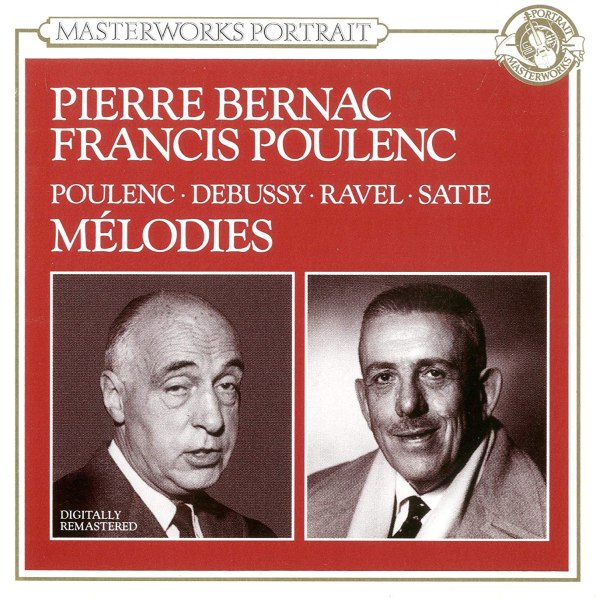
Pierre Bernac & Francis Poulenc – Mélodies

91khamjrtvl._sl1500_

Poulenc:
Banalités
Chansons villageoises
Quatre poèmes de Guillaume Apollinaire
Tu vois le feu du soir
Main dominée par le coeur

Debussy:
Beau soir
L’écheonnement des haies
Le Promenoir des deux amantes

Ravel:
Histoires naturelles
Mélodies hébraïques

Satie:
Trois mélodies

Pierre Bernac and Francis Poulenc had a long and fruitful working relationship, going back to 1926 when Bernac gave the first performance of Poulenc’s Chansons gaillardes (not included on this disc). They first appeared in recital together in 1934 and continued to do so until Bernac retired from public performing in 1960. In fact the majority of Poulenc’s songs were written for Bernac and I suppose one could say that they enjoyed a similar relationship to that of Britten and Pears, without the emotional attachment, apparently always using the polite ‘vous’ with each other at all times.

Bernac’s voice was evidently not large but he had an enormously varied tonal palette which enabled him to capture every shift in mood, every emotion, implied or overt, in each song. Though the voice was not of itself of great natural beauty, its range was wide and Poulenc exploited this to great effect. Bernac was also a great teacher, numbering Gérard Souzay, Elly Ameling and Jessye Norman among his pupils, and he wrote with great insight about the art of singing. His The Interpretation of French Song is an absolute must for anyone interested in performing this repertoire.

Bernac and Poulenc left behind quite a legacy of recordings, most of them recorded for EMI and RCA in 1947. However these Columbia sessions took place in 1950. The Poulenc selection is self recommending, but he is equally at home in the songs of Debussy, Ravel and Satie, embracing the lyricism of Debussy’s Beau soir, the slightly detached irony of Ravel’s Histoires naturelles or the parodic wit of the Satie songs.

Anyone who enjoys the subtle art of French song should definitely hear them.

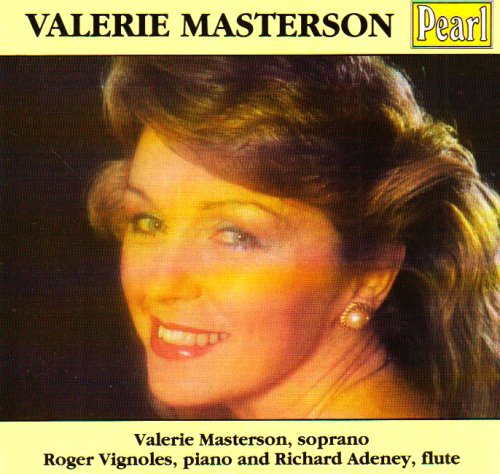
Valerie Masterson – Song Recital

51vle4ved5l

  1. Arne – O ravishing delight
  2. Arne – Under the greenwood tree
  3. Arne – The soldier tir’d
  4. Handel – Nel dolce del’oblio
  5. Bishop – Lo! Here the gentle lark
  6. Gounod – Le premier jour de mai
  7. Gounod – L’absent
  8. Gounod – Sérénade
  9. Bizet – Vieille chanson
  10. Bizet – Pastel
  11. Bizet – Tarantelle
  12. 12 – Satie – La diva de l’empire

The English soprano Valerie Masterson was a mainstay of my early opera going life and I saw her on stage quite a few times. A light lyric soprano with great flexibility and an immediately recognisable voice, she was also much admired in France, having made her French debut in Toulouse in the role of Manon. The following year she created quite a stir at the Aix-en-Provence Festival singing the role of Matilde in Rossini’s Elisabetta, Regina d’Inghilterra opposite Montserrat Caballé. She was an arrestingly beautiful woman with a charming stage presence and I well remember her Semele at Covent Garden which was both vocally and visually stunning. Unfortunately I didn’t get to see her ravishing Cleopatra in ENO’s production of Handel’s Julius Caesar (sung of course in English) with Janet Baker, but at least it was filmed. I did however see her as Manon, Juliette, Margeurite, the Governess in Britten’s Turn of the Screw and as the Marschallin, a role she took into her repertoire quite late in her career, having had enormous success as Sophie when she was younger.

Recorded in 1986 when Masterson was approaching 50, this recital probably catches her just past her best. There is just the suspicion that the lovely voice is thinning out, a trace of a slight taint on its silvery purity. Nevertheless the recital is something of a treasure, especially considering Masterson was so little recorded.

With piano accompaniment provided by Roger Vignoles, it splits neatly into two halves, the first being of music from the baroque era (Arne, Handel and Thomas Bishop), where she is joined by Richard Adeney on the flute, and the second of songs by Gounod, Bizet and Satie. The baroque items display her neat and deft coloratura as well as her ability to shape the long line. When she sings O ravishing delight in Arne’s song, the words mirror exactly the sounds coming from the speakers. It is good also to have the Handel cantata, reminding us of her many successes in his works.

The French items are all fairly light. They are a sung with elegance and style but a little more variety in the material might have been welcome here. She finishes with a delightful performance of Satie’s La Diva de l’Empire which captures a coquettish smile in the voice.

A lovely reminder of a lovely singer.