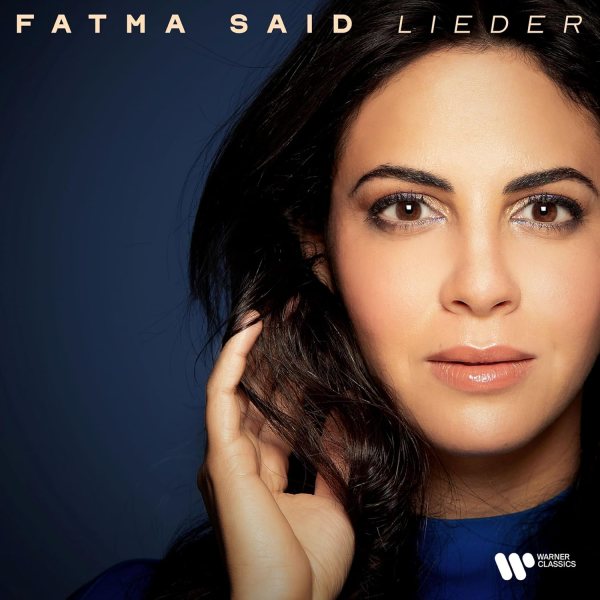
Fatma Said – Lieder

Fatma Said follows up her award winning debut recital, El Nour, and her equally successful second album, Kaleidoscope, with a more conventional album of German Lieder, except that with this gifted artist, it isn’t quite that simple. For a start, she has collaborated with an array of different musicians, bringing in clarinettist Sabine Meyer for Schubert’s Der Hirt auf dem Felsen, the men’s choir, Walhalla zum Seidlwirt, for his Ständchen, harpist Anneleen Lenaerts for four of the Brahms songs, the Quator Arod for Brahms’s Ophelia-Lieder, baritone Huw Montague Rendall for some duets and three different pianists in Malcolm Martineau, Yonathan Cohen and Joseph Middleton. In the notes accompanying the disc, Said says that all of these artists were friends or became friends during the sessions, and, in a positive way it would seem so, as there is a real sense of joy and discovery in the music making.

In a disc of so many delights, it is difficult to highlight specific performances, and for once I found myself not making comparisons with other singers, so compelling is the artistry on display here. Said has a surpassingly beautiful voice, but she uses it for expressive ends and is not afraid to make the occasional ugly sound, as in the vividly characterised Hexenlied by Mendlessohn, and in Schubert’s Der Zwerg. The nocturne Ständchen is delivered as a dramatic dialogue between Said and the men’s chorus, with a touch of breathless excitement, which perfectly captures the meaning of the words, and the words are evidently very important to Said. Her diction is excellent, and indeed, in the notes accompanying the disc, Said states that she wanted there to be a strong emphasis on the text. This she has achieved, whilst maintaining a lovely legato line.

The harp accompaniment brings a touch of delicacy to the Brahms songs and his Ophelia- Lieder are performed in Aribert Reimann’s arrangement for string quartet, which somehow contrives to make the songs sound more archaic. Sabine Meyer plays with great beauty of tone in Der Hirt auf dem Felsen, which here receives a performance of ineffable longing, which is totally dispelled in the joyful final measures.

I can’t close without mentioning the terrific contributions of her three pianists, Malcolm Martineau, Yonatan Cohen and Joseph Middleton, nor Huw Monatgue Rendall’s wonderful contribution to the duets, his voice blending beautifully with Said’s, particularly in the final song on the disc, Schumann’s In der Nacht, where his mellifluous tones blend beautifully with Said’s – a fitting end to a disc that had me spellbound throughout.

Highly recommended and, I know it’s early days yet, but likely to be one of my discs of the year.
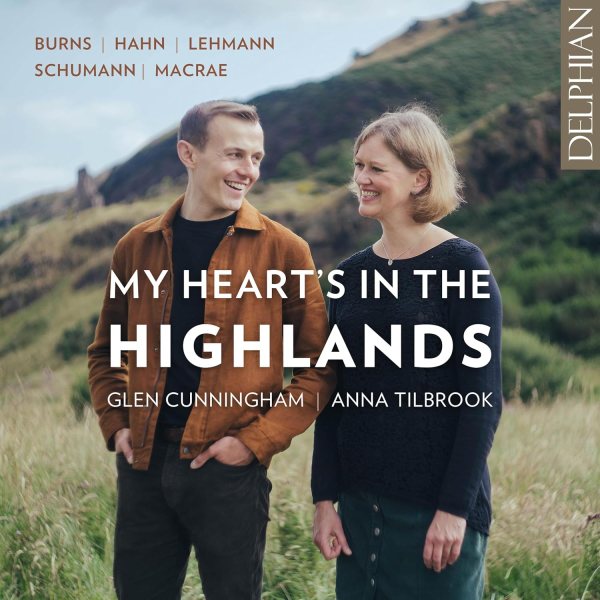
Glen Cunningham’s Heart is in the Highlands

An interesting programme of Scottish inspired songs, but Cunningham’s tenor is a little too much on the dry side for my liking.

My Heart’s in the Highlands

Glen Cunningham (tenor)  Anna Tilbrook (piano)

The young tenor, Glen Cunningham, and his pianist, Anna Tilbrook, celebrate their Scottish heritage in a programme of music connected to Scotland, not only in the folk orientated songs of Robbie Burns, but also in settings of Burns by Schumann, and Robert Louis Stevenson by Liza Lehmann and Reynaldo Hahn. To these are added a completely new song cycle, also to texts by Robert Louis Stevenson, by the Scottish composer, Stuart MacRae.

It makes for an interesting programme, with the folk song settings framing the songs by Schumann, Lehmann, MacRae and Hahn. Thus, we start with a setting of Burns’s Ca’ the yowes to the knows in an arrangement by Claire Liddell, which segues into the eight songs from Schumann’s Myrthen, which set texts by Burns in German translation. They are possibly less well known than other songs from Myrthen, like Widmung or Der Nussbaum, and I doubt anyone would guess the Scottish provenance of these Schumann songs. Nor, I wager, would anyone guess that the  song Dem Roten Röslein Gleicht Mein Lieb from Schumann’s Opus 27 Lieder und Gesänge is actually a setting in German of the famous My love is like a red, red rosewhich follows it.

Liza Lehmann is less well represented in the catalogue than Schumann, though a selection of the songs from The Daisy-Chain have been recorded by mixed voices and are available on the Naxos label. Cunningham selects four of the five songs to texts by Robert Louis Stevenson. These are children’s songs to be performed by skilled adults, and the vocal writing is often taxing, Stars, for instance, requiring the sort of lyrical outpouring that Cunningham’s rather dry tenor is not quite capable of. Toby Spence manages it slightly better on the above Naxos recording, but it really needs a fuller voice than either of these two tenors can provide.

Two of the texts are also set by Reynaldo Hahn in his Five Little Songs, written while Hahn was a private in the French army during World War I, where he saw action on the front line. These too are settings of Robert Louis Stevenson, ‘children’s songs’, though it is unlikely that any child could sing or play them. They are quite charming, though, yet again, there is nothing particularly Scottish about them.

Not surprisingly, I suppose, the most Scottish sounding of the songs are those by Stuart MacRae, particularly For age an’ youth, which sets a Scots style vocal line against a sort of imitation bagpipe in the piano accompaniment. Cunningham is at his best in these songs, but even here I wanted more of tonal beauty. He compensates with the intelligence of his delivery, but throughout I’m afraid I found his vibrato intrusive and the sound he makes unpleasantly hard and uningratiating.

I should just mention that Anna Tilbrook is a most sensitive accompanist and adapts brilliantly to the style of each composer.

The recital ends with the title song, My heart’s in the Highlands, in an arrangement by Michael Barnett (and supplemented by Tilbrook) that was transcribed from a 1962 Kenneth McKellar recording. I just wish that Cunningham sang it with some of McKellar’s beauty of tone.

Elisabeth Schumann’s Swan Song

91ry4lbyuzl._ac_sl1500_

Born in 1888, Elisabeth Schumann’s first recordings were acoustics, made in 1915, although it is probably for her later, electrical recordings that she is better known. She had an illustrious operatic career, famous for such roles as Sophie in Der Rosenkavalier and Eva in Die Meisteringer, also excelling in Mozart with roles such as Pamina, Susanna, Zerlina and Blonde. She was a favourite of Richard Strauss, who even tried to persuade her to sing the role of Salome, creating an edition in which he reduced the size of the orchestra to accommodate her light, lyrical soprano, though she never took up the offer.

She was also highly regarded as a singer of Lieder and Lotte Lehmann, who was perhaps her greatest rival in the field, once said she represented the purest singing style of German Lieder. She has a large discography and many of her recordings, both acoustic and electrical were once issued in a six disc EMI box set, which now appears to be available as a Warner download.

The present recordings were made somewhat later in her home in Manhattan in 1950, when she would have been in her early sixties, and this appears to be the first time the sessions have been issued in their entirety. The accompanying notes are sketchy and inadequate. Included are brief biographies of Schumann herself and of George Schick and George Reeves, who I assume are the accompanists, but there is no indication as to which songs they play, nor which items are completely new to the catalogue.

Being late recordings, this is not a disc to which I would direct anyone interested in hearing “the purest singing style of German Lieder”. Though the bell-like purity of Schumann’s top notes remains more or less intact, quite frankly, in the middle and lower register, she sounds all of her sixty odd years. Certainly, the voice has aged less well than some other sopranos, who also made recordings into their sixties, such as her contemporary Maggie Teyte or, of more recent singers, Renée Fleming. Some of the Wolf songs now clearly stretch her to the limit and I find myself wondering if this is the reason they were not issued before. One should probably make allowances for the way these songs were recorded (probably on a 7.5ips home recorder, according to the notes) but to my ears  she sounds effortful and unsteady for much of the time.

She redeems herself in the final three bonus tracks, first in two acoustic Odeons of her singing Wolf’s Frage und Antwort and Straus’s Morgen (date and accompaniment unknown), followed by a later recording of her delivering in English a master class on Morgen, this time with Ernest Lush on the piano. No date is given, and I wonder if this was from one of her lecture tours of 1950 and 1951. If it was, then she sounds in much better voice here than she does on the home recordings.  and she gives invaluable advice on singing the song, recollecting working on it with Strauss himself.

I hate to be negative about a much-loved artist, but this disc, I would suggest, is for completists only. Anyone wanting to discover the voice and art of this great soprano, will be much better served by the six-disc set detailed above.

In Relations – Eva Zalenga and Doriana Tchakarova

0881488220506

The back page of the booklet that comes with this CD has a complicated diagram, which attempts to display and unravel the various connections between the composers and poets featured in this recital. We all know about the friendship that existed between Mendelssohn and Schumann, but did you know that Loewe, who also made music with Mendelssohn, taught the composer Emilie Mayer, who set poems by Heine, as of course did Loewe and Schumann? So did Meyerbeer, though his only connection with Mendelssohn and Schumann is that they both were vocal in disparaging his music.

The aim is evidently to bring some unity to what is essentially a recital of nineteenth century Romantic songs by both male and female composers, most of which are not exactly regular visitors to the concert platform. It’s a nice idea and it can be fun trying to trace the connections between the various personages represented in this recital, though certainly not necessary for the enjoyment of it.

We begin with Meyerbeer, who is better known for his large-scale operas, none of which have ever held much interest for me. The three songs we get here are rather charming and tuneful, though they don’t quite escape the epithet of parlour music. These are followed by a couple of songs by Loewe, the first a setting of Meine Ruh ist hin, a poem better known to us as Schubert’s Gretchen am Spinnrade. Loewe’s setting is less grippingly intense but it does tell the story well.. Loewe’s accompaniments are worth noting and they are brilliantly played by Doriana Tchakarova, who supports her soloist at every turn.

Mendelssohn’s Hexenlied is better known than the songs we have heard so far and it really calls for a little more variety of timbre than Zalenga has yet at her disposal.  On the other hand Zalenga’s bright, youthful soprano is perfectly apt for the Suleika songs that follow. The Schumann songs go well too, though I would have preferred a little more sense of breathless excitement in Aufträge, such as we hear in older versions by Elisabeth Schumann and Elisabeth Schwarzkopf.

For the rest we are given some rarities by women composers, both of whom were entirely new to me. Emilie Mayer, who died in 1883 (not 1833 as the booklet has it) was the first woman to have her symphonies performed all over Europe. The two songs included here no doubt had an eye on the popular publication market and, like the Meyerbeer, have more than a whiff of the salon about them. Nonetheless I was pleased to make their acquaintance. That said, I found the Heine settings of the English composer, Frances Illitsen, even more interesting. All three are worth investigating, in particular the setting of Heine’s Katherine, which is a glorious outpouring of lyrical melody.

This recital would appear to be the recording debut of the young soprano Eva Zalenga. She has a lovely, light soprano which faintly reminded me of the young Lucia Popp. I see from her website that her operatic roles are Papagena, Barbarina, Susanna, Ännchen, and also Sophie in Werther, all of which would seem right for her at the moment. I can also imagine her making an excellent Sophie in Der Rosenkavalier. As yet the voice doesn’t have a great range of colour at its disposal, but this does not mean she sings without feeling. Throughout she is a most musical singer and keenly responsive to the poetry. You really feel she connects with each of the songs

I wish Hänssler had vouchsafed us translations of the German texts, but, nonetheless, I thoroughly enjoyed this journey through some of the byways of nineteenth century Romantic song. An auspicious recording debut for Eva Zalenga.

Contents:

Giacomo Meyerbeer (1791-1864)

Komm

Meerestille

Suleika

Carl Loewe (1796 – 1869)

Meine Ruh’ ist hin, Op. 9, no. 2

Die verliebte Schläferin, Op. 9, no. 3

Ihr Spaziergang, Op. 9, no.4

Die Schneeflocke, Op. 63, no. 1

Felix Mendelssohn (1809-1847)

Hexenlied, Op 8, no. 8

Suleika, Op. 57, no.3

Suleika, Op. 34, no. 4

Die Nonne, Op. 9 no. 12

Robert Schumann (1810 – 1856)

Liebeslied, Op. 5, no. 5

Aufträge, Op. 77, no. 5

Viel Glück zur Reise, Schwalben! Op. 104, no. 2

Die letzten Blumen starben, Op. 104, no. 6

Aus den östlichen Rosen, Op. 25, no. 5

Singet nicht in Trauertönen, Op. 98a

Emilie Mayer (1812 – 1883)

Du bist wie eine Blume, Op. 71 no. 1

Das Schlüsselloch im Herzen

Frances Allitsen (1848 – 1912)

Katherine

Mag, da draußen Schnee sich thürmen

Die Botschaft

Eilika Wünsch – Romantic Songs

71okpmqmsql._ac_sl1425_

There are times when one wonders how a record came to be released.

According to the accompanying notes, the premise for this album would appear to be “a completely new approach to our lieder recital repertoire … in which voice and piano are enhanced by another melody instrument”. Whether this enhancement is either desirable or necessary is a moot point, but I suppose the idea of the cello taking over the second vocal line in the adaptation of duets is one solution to the non-availability of a second singer. The accompanying notes would also seem to suggest that these arrangements improve in some way on the originals, even of the two songs from Strauss’s Vier letzte Lieder, which of course were written for full orchestra.  I can assure you they do not.

However, the greatest impediment to enjoyment is not the arrangements themselves but the solo singer. According to the biographical notes, Eilika Wünsch has been active since around 2010, when she worked with Jörg Demus. She would appear to have a fairly extensive discography, though I can’t find a single review on the internet for any of her discs, or for any of her public appearances. We are also told that she has sung the roles of Butterfly, Konstanze, Donna Anna, Violetta, Gilda and the Queen of the Night, about all of which I am faintly incredulous.  The first few notes of the opening song, Nacht und Träume, are sung in a white, vibrato-less tone, but thereafter any single sustained note emerges unfocused and unsteady. She struggles so much with the execution of the notes that any attempt at interpretation is completely absent. The cover photo shows us an attractive young woman, but the sounds coming from the speakers are those of a (very) old soprano. I am sorry to be so negative, but I really can’t find anything positive to say about this recital. Listening all the way to the end proved quite a trial, but listen I did, right through to the final song, which is a vocalise arrangement of Schubert’s famous Impromptu, Op.90, no.3. The arrangement takes her well up above the stave, where the sound that emerges is somewhere between a whistle and a theremin and quite unpleasant – to my ears at least.

This is one of those cases where comparisons are irrelevant. One to be avoided, I’m afraid.

Contents, in case anyone is interested.

  1. Schubert: Nacht und Träume
  2. Brahms: Wie Melodien zieht es mir
  3. Reger: Nachts
  4. Schumann: Wenn ich ein Vöglein wär
  5. Brahms: Am Strande
  6. Schumann: In der Nacht
  7. Liszt: O komm im Traum
  8. R. Strauss: Im Abendnrot
  9. Reger: Abendlied
  10. R. Strauss: Beim Schlafengehen
  11. Schumann: Mondnacht
  12. Schubert: Auf dem Strom
  13. Impormpti, Op. 90 no. 3 (as Vocalise)

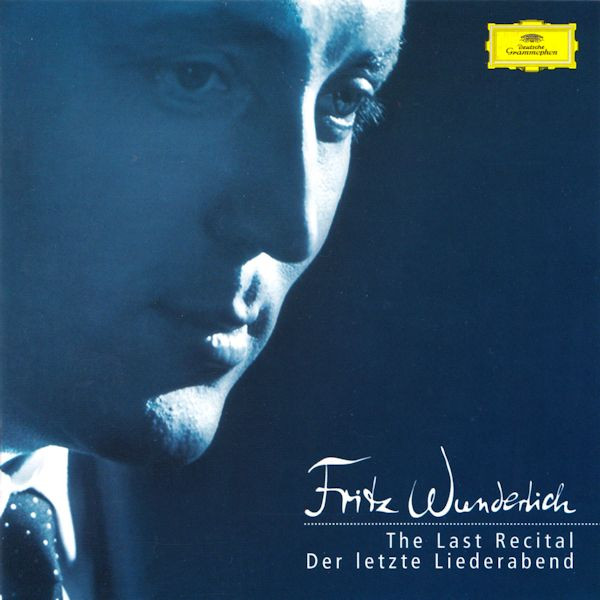
Fritz Wunderlich – The Last Recital

ns04mtk3lmpwzwc

This CD was released in 2003 and was, I think, the first time this Edinburgh recital was being released in toto. The only known extant recording of it was a BBC recording, a second or third generation mono copy and DG have attempted to correct the pitch which, in previous issues of parts of the concert, was too slow and fluctuated substantially. They were not able to eliminate wow and flutter, which was probably introduced in the first copying process. Nevertheless this is an important document of the last ime Wunderlich ever sang in public and, for anybody used to listening to historical live recordings, the sound won’t be an impediment to enjoyment.

We should of course be careful of attaching too much valedictory significance to this recital. We listen to the final recordings of such as Ferrier and Hunt Lieberson, with the added knowledge that they were aware of their mortality and knew that their time was limited. Wunderlich, on the other hand, was at the height of his powers and his international career was just taking off. He was a few months away from his Met debut as Don Ottavio, and he was finding the performance of Lieder recitals so fulfilling that he wanted to do more in that area. In fact, after this concert, he told Hubert Giesen that they should start working on Winterreise. He had absolutely no reason to think that his life would be prematurely cut short.

Wunderlich was apparently very happy with how the recital went, and Giesen told him after the concert that he thought he had achieved perfection. He had only recently turned to Lieder, making his first studio recordings of Lieder by Beethoven, Schubert and Schumann the previous year for DG, performances that have sometimes been criticised for lacking emotional depth. He evidently took these criticisms to heart for this recording of Dichterliebe is profoundly moving and in a different world of interpretation from his studio recording. It is now my preferred recording of the cycle.

The programme is similar to the one he sang in Sazlburg the previous year, but he is now a much more experienced Lieder singer and his singing now has much more significance and specificity. The first half of the recital consists of Lieder by Beethoven and Schubert, with Adelaide and Nachtstück showing of his superb legato line. His diction is well-nigh perfect throughout, showing that you don’t need to sacrifice verbal clarity to achieve a smoothly lyrical line. The second half, as in his Sazlburg recital of 1965, is taken up with the complete Dichterliebe. This is an extremely intense reading, with the young man  seeming much akin to Goethe’s Werther. True, we as listeners, knowing that he was only to live a couple more weeks, no doubt give some of he lyrics a significance that Wunderlich could not have intended. Nevertheless it adds to the appreciation of this performance.

The encores, as so often at a live recital, are when the performer relaxes most. Thus we get an ebulliently joyful Ungdeduld and a gorgeously sustained Ich trage meine Minne by Richard Strauss, which would surely have changed Strauss’s attitude towards the tenor  voice, though unfortuantely the BBC recording fades out just before the end of the song.

Finally, after a charming bit of banter with the audience, Wunderlich sings his heartfelt tribute An die Musik. Call me sentimental, but I find it impossible to listen to it without tears in the eyes. Though he didn’t know it and his audience didn’t know it, this was the last time the golden voice would  ever be heard in public.

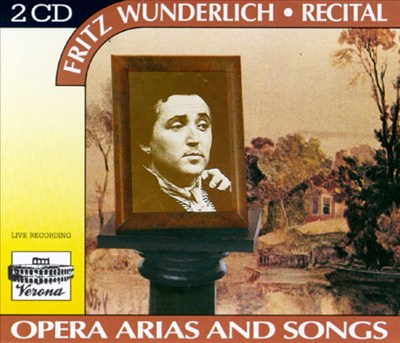
Fritz Wunderlich – Opera Arias and Songs

image

I doubt this two disc set is available any longer, but it offers some interesting live performances and unusual repertoire spanning twelve years of Wunderlich’s career, the earliest performance being from 1954, when he would have been just 23 and the last from his final concert in Edinburgh in 1966, recorded shortly before the accident which claimed his life. The insert is missing in my copy and the track listing on the back isn’t quite accurate, for instance it credits Hilde Güden as the Violetta in the excerpts from the 1965 Munich La Traviata under Patané, when the role was actually taken by Teresa Stratas. (I have the complete performance on the Orfeo label.)

Disc 1 starts off with Handel. First we have a couple of excerpts from a 1959 performance of Messiah in German. Comfort ye is nicely done, but a tendency to aspirate his runs is notable in the ensuing Every valley. He must have been aware of this fault, because by the time he sings in Judas Maccabeus, conducted by Rafael Kubelik in 1963, that tendency has virtually vanished. Although this is also sung in German, he is now a much more confident singer and his rendition of Sound an alarm is absolutely stunning. Next we have a couple of excerpts from a 1965 radio performance of Iphigénie en Tauride (also in German) again under Kubelik, with brief contributions from Hermann Prey and Sena Jurinac. More and more of the assured artist is emerging.

Next comes Mozart, and we again go back in time, first to some delightful excerpts from Zaïde from 1956, followed by a performance of the short concert aria Con ossequio, con rispetto. The listing gives no indication of the date, but a little digging reveals that it was probably from 1963 and, again, the mature artist is beginning to emerge. This is followed by six extracts from a 1959 performance of Schubert’s Fierrabras. The other soloists were unknown to me. They are all competent enough but Wunderlich’s superior voice and musicianship are immediately apparent. The disc finishes with three songs from his final concert in Edinburgh in 1966, to which I will return at the end of this review.

Another rarity begins the second disc; Cherubini’s comic opera Les deux journées, sung in German and given the title Der Wasserträger. Wunderlich sings two duets with Hildegard Hillebrecht. The music reminds me rather of Weber’s Abu Hassan, charming and lightweight and Wunderlich is perfectly attuned to its style. Next he makes a perfect Alfredo in the 1965 performance of La Traviata, mentioned above. All Wunderlich’s recordings of Italian opera excerpts were in German and it is amazing how he can still make the music sound italilanate even in the wrong language. Here in the right language, his legato is superb and he is the ardent young Alfredo to the life. He is not quite so impressive in a 1960 performance of Verdi’s Requiem. He tends to slightly oversing, maybe in what he thought was the Italianate method. There is the merest hint of a sob and the occasional aspirate, but I do wonder what he might have made of the part had he been engaged for the 1964 Giulini recording with Schwarzkopf. With Legge and Giulini to guide him, he might just have been the perfect tenor for that enterprise, however good Gedda is in it.

A 1959 exceprt from Strauss’s Die schweigsame Frau would surely have reconciled Strauss to the tenor voice. Strauss’s tenor writing can sound quite torturous, but Wunderlich sings with great beauty, soaring over the orchestra. Unexpected items follow with an exceprt from The Cunning Little Vixen (in German), one from Pfitzner’s Von Deutscher Seele and a short extract from Franz Schmidt’s Das Buch mit Sieben Sieglen, conducted by Dimitri Mitropoulos in 1959, both pieces completely new to me.

The final item is a 1954 recording of hin singing an aria from Robert Stolz’s Venus in Seide. Wunderlich would have been just 23 and, though a little diffident, the golden voice is imediately recognisable. It is instructive, then, to return to the final items on the first disc, the last recordings we have of Wunderlich’s voice, made at a concert in Edinburgh shortly before his untimely death. Before a live audience, he sings Schumann’s Die Lotusblume and Schubert’s Ungeduld with greater senisitivity and freedom than he does on his DG Studio recitals, recorded the previous year, and when it comes to his final encore, Schubert’s An die Musik, he delivers a beautiful, heartfelt rendering, vastly superior to the rather stiff one we hear in the studio. Nobody knew it at the time of course, but this touching tribute to music was the last song he ever sang in public. Two weeks later he tripped on loosely tied shoelaces and fell down the stone staircase at a friend’s hunting lodge in Oberderdingen. He had been due to make his Metropolitan Opera debut in Don Giovanni a few weeks later.

Wunderlich left behind a vast catalogue of studio recordings, of operetta, of opera and of Lieder. He was obviously still developing as an artist. How sad to think that he was only really beginning his international career.

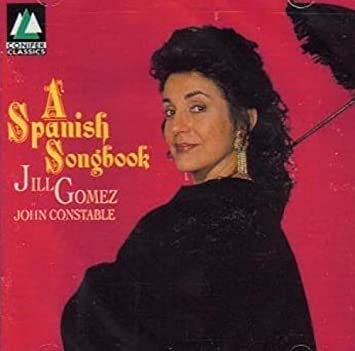
A Spanish Songbook – Jill Gomez

516xghgdgjl._sx355_

What an utterly charmng and delightful disc this is, cleverly planned and beautifully executed.

With her distinctive timbre and wonderfully expressive voice, Gomez’s personality fairly bursts through the speakers and she is superbly supported here by John Constable on the piano, who unerringly captures the mood of the songs. You feel as if these two artists really enjoy making music together, and indeed their association is a long one, having first appeared on disc together twenty years earlier. Gomez would have been in her early fifties when the present disc was recorded but the voice has hardly changed in the intervening years.

What we have here is a compendium of Spanish inflluenced songs by German, French and English composers, as well as songs by Spanish composers, covering a wide range of styles and eras. The programming is eminently sensible and makes for very satisfying listening.

We start with a group of sixteenth century Villancios from the courts of Charles V and Philip II in piano arrangements by Graciano Tarragó, which encourage the kind of decoration and improvisation of the 16th century vilancico. Fuenllana’s De los alamos vengo, madre is no doubt better known from Rodrigo’s orchestral arrangement, but Gomez sparkles quite as much here.

From thence we turn to a group of Spanish influenced songs by Wolf and Schumann, in which Gomez captures perfectly the deep melancholy of Schumann’s Tief im Herzen trag’ ich Pein as well as the girlish coquettishness of Wolf’s In dem Schatten meiner Locken. Spain has always provided a deep vein of inspiration for French composers, so we are next treated to a group of songs by Bizet, Ravel, Saint-Saëns and Délibes in which Gomez’s sense of style is impeccable.

Next come the three Granados Tornadillas, in which we are probably more used to hearing the fuller, chestier sound of someone like Conchita Supervia. Gomez intelligently, rather than copy her style, is more languorous. I might prefer Supervia’s vibrancy, but Gomez’s way is just as valid.

The two Walton songs, both taken from Façade, find Gomez pointing Edith Sitwell’s lyrics deliciously and lead us into the final group, which Gomez calls “Seven Other Popular Songs”. The first three songs are by Roberto Gerhard, who, as an exile from Franco’s Spain, had relocated to Cambridge in the UK in 1942, where he lived until his death in 1970. These are his versions of folk-songs collected by his teacher, Felipe Pedrell. bittersweet souvenirs of a composer in exile. The others are by Tarrago, Rodrigo, Guridi and Obradors. Gomez is yet again a wonderful guide through this musical journey of Spain, brilliantly capturing the mood of each song.

An excellent recital that should be a lot better known than it is.

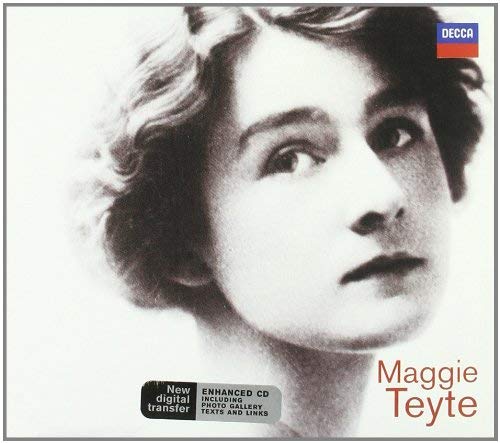
Maggie Teyte – The Singers

These recordings were all made in the 1930s and so pre-date the two disc set of French song I reviewed a few months ago here, with the second part of the disc being taken from a 1937 radio broadcast. One of the songs (Armstrong Gibbs’ The fields are full of summer still) was newly discovered in 2001 and first published on this CD.

We start with one of Dame Maggie’s most famous performances, that of Périchole’s Tu n’es pas beau, sung with great affection, a twinkle in the eye and with that wonderful dip into her inimitably glorious chest voice. Though a light soprano with pure, firm top notes, Teyte’s lower register was admirably rich and full in a manner we rarely hear today, more’s the pity. The orchestra here sounds like a palm court orchestra at a tea dance, but the singing is another matter entirely and alone well worth the price of the disc. The two excerpts from Messager’s Véronique, which follow are almost as good.

Teyte was particularly renowned for her interpretations of French song, but we are vouchsafed only two (very well known) songs from that field, Fauré’s Après un rêve and Hahn’s Si mes vers avaient des ailes. The Fauré is much better than the one on the French song disc mentioned above, where I felt she fussed with the song too much making it lose its natural flow, and the Hahn is as lovely as the later recording with Gerald Moore. These are followed by two Dvorak songs, Christina’s Lament, which turns out to be his Humoresque arranged for voice and piano, and the ubiquitous Songs my mother taught me, both beautifully sung.

These are followed by a group of songs from light musicals, mementoes of her days spent in British Music Hall. They may be musically slight, but Deep in my heart, dear from Romberg’s The Student Prince was actually one of Dame Maggie’s favourite recordings. It crests with a high B, which she thought the most beautiful note she had ever recorded. Certainly the note rings out clear and clean as a bell.

The lion’s share of the disc, however, is given over to a 1937 BBC broadcast recital, which couples popular songs by Schumann and Brahms to a group of English songs by turn of the century composers Quilter, Bridge, Delius, Armstrong Gibbs and (completely new to me) Amherst Webber and Graham Peel. As ever, the voice is bright and pure, her manner direct and disarming, her diction and intonation well-nigh perfect. Admittedly, there are aspects of her singing which some might find quaint and old fashioned today, but her technique is superb and her voice remained firm and clear well into her sixties.

Perhaps because of some of the material, this is not quite so recommendable as the EMI two disc set of French songs, but I would never want to be without it, if only for the wonderful aria from La Périchole.

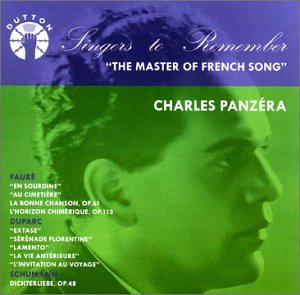
Charles Panzéra – The Master of French Song

41hz08b4rwl

One of the greatest interpreters of French song, Chalres Panzéra was actually Swiss, born in Geneva in 1896. Although he did perform in opera and was particularly renowned for his Pelléas, he became ever more in demand as a recitalist, especially for his performances of French song, and Fauré dedicated his last song cycle, L’horizon chimérique to him. His repertoire extended to Monteverdi, Lully, Schubert and Schumann and, included here is his recording of Dichterliebe with Alfred Cortot a highly individual accompanist at the piano. Panzéra was married to the pianist Magdaleine Baillot, and they had a long and fruitful partnership, all of the French songs on this disc beng accompanied by her.  Aside from the Dichterliebe, this disc includes complete performances of Fauré’s La bonne chanson, L’horizon chimérique and a selection of songs by Duparc.

After World War II, he taught at the Juilliard School in New York and at the Paris Conservatoire, and wrote invaluable works on the interpretation of French song.

He had a voice of great beauty, admirably firm and seamless from top to bottom, allied to a wonderful sensitivity and refinement of style, and many of his performances are deservedly considered classics. Everything he does sounds totally spontaneous and yet one knows the amount of care that has gone into each interpretion. This is surely the art that conceals art.

Both the Fauré cycles are superbly sung, as are the Duparc songs, though his wife’s spreading of the chords in Lamento won’t be to everyone’s taste. He totally avoids the tendency to over-sentimentalise a song like the Wagnerian inspired Extase and delivers a marvellously detailed but unselfconscious L’Invitation au voyage.

Panzéra’s German sounds as natural as his French and his recording of Duchterliebe has long been considered a classic, though Cortot’s playing is highly idiosycratic. It may not delve as deeply as some more recent versions by the likes of Fischer-Dieskau or Schreier, but it captures beautifully something of the essence of Schumann.

A wonderful disc well worth seeking out.