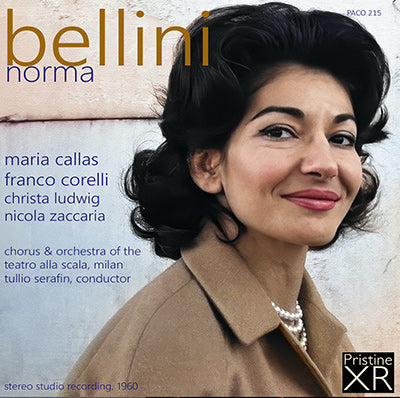
A reappraisal of Callas’s second studio Norma

paco215_530x

The Pristine XR remaster gives us the chance to reappraise a set which is slightly controversial in that it captures Callas in late career with occasional flaps on top notes. Nonetheless it was Ralph Moore’s overall top choice in his opera survey and he had no problem recommending it when he reviewed this Pristine issue in July of this year (review).

For my part, I’ve known the set for over sixty years now. It was actually the first opera set I ever owned, and, for quite a few months, the only opera set I owned, so I got to know it pretty well. Since then of course, I have heard a fair amount of other Normas, Sutherland, Caballé, Scotto, Sills, Eaglen, Bartoli (please, never again), Sass live at Covent Garden (disastrous) and plenty more by Callas herself; the live 1952 Covent Garden, the 1954 studio, the 1955 Rome broadcast and, best of all, the live 1955 La Scala, as well as excerpts from many others, right up to her final performances in the role in Paris in 1964.

So how does it hold up? Well, pretty well actually. Sonically, it was always pretty good, and, if I’m honest, I can’t hear that much difference between the most recent Warner version and the Pristine version. Perhaps there is a bit more space around the voices in the Pristine version, but it is the difference is slight.

As for Callas’s voice, it is true, notes above the stave have taken on a metallic edge, and they don’t always fall easily on the ear, but the middle and lower timbres have a newfound beauty, and a characterisation that was always complex and multi-faceted has taken on an even greater depth, parts of it voiced more movingly here than anywhere else.

There are other gains too. The cast here is a vast improvement on the earlier studio one, Corelli in particular being a shining presence. Fillipeschi was a liability on the earlier set, but, whilst not quite a paragon, and chary of some of the coloratura in his role (Serafin making a further cut in the great In mia man duet to accommodate his lack of flexibility), Corelli’s is a notable presence, and his clarion voice is ample compensation. Zaccaria may be less authoritative than the woolly voiced Rossi-Lemeni, but his tones are distinctly more buttery. Ludwig is an unexpected piece of casting, but she too is an improvement on Stignani, who, great singer though she was, was beginning to sound a bit over the hill by the time of the first Callas recording (she was 50 to Callas’s 30). Ludwig sounds, as she should, like the younger woman. Her coloratura isn’t always as accurate as one would like, certainly no match for Callas, but she sings most sympathetically in duet with her older colleague, and Mira o Norma is, for me, one of the greatest performances on disc. After Ludwig states the main theme, Callas comes in quietly almost imperceptibly and at a slightly slower tempo with an unbearably moving Ah perche, perche, her voice taking on a disembodied pathetic beauty. When Ludwig joins her for the section in thirds, she perfectly matches Callas’s tone on her first note, before Callas joins her in harmony, a real example of artists listening to each other in a sense of true collaboration.

One should I suppose mention the losses from the earlier recording. Yes, some of Callas’s top notes are shrill, and we lose some of the barnstorming heroics that were a part of Callas’s Norma right up to 1955. This Norma is more feminine, more vulnerable, if you like. How much this had to do with interpretive development, and how much with declining vocal resources is a moot point, but there is no doubt Callas is still a great singer, doing the best she can with what she has. Some sections are more moving here than in any of her other performances. I’ve already singled out Mira o Norma but the earlier duet is its equal, with Callas wistfully recalling her own awakening to first love.

The beginning of Act II always brought out the best in her, and here she is sublime. Dormono entrambi is an unusual piece which alternates passages of recitative with arioso, rather like Rigoletto’s Pari siamo. Callas draws on all the colours in her palette to express Norma’s contrasting emotions. You can almost feel the chill that comes over her at un gel me prende e in fronte si solleva il crin followed by the choked emotion of I figli uccidi! The arioso of Teneri figli is couched in a tone of infinite, poignant sadness, but then her tone hardens with her resolve at Di Pollion son figli, before, with a cry she drops the knife (and we can almost hear the precise moment), crying out Ah no, son miei figli! Operatic singing and acting on the highest level.

Serafin’s conducting is much as it was in the first set. He has the virtue of not conducting the opera as if it were Verdi, as so many do. Sometimes I’d like him to get a move on a bit, but his pacing of the final two duets (one in public, one in private) is superb, and he perfectly judges the climaxes in the Grand Finale, one of the greatest in all opera.

I wouldn’t want to be without Callas’s 1955 live La Scala account (also available from Pristine) with Del Monaco and Simionato, which is where voice and art find their greatest equilibrium, but for a studio set, this is now clearly the one to go for. One thing is for sure, Callas remains the quintessential Norma. No singer has yet challenged her hegemony in the role.


Callas’s 1959 Lucia di Lammermoor gets the Pristine treatment

paco207_9735ee11-e251-4de3-a757-19c9b4ae597a_530x

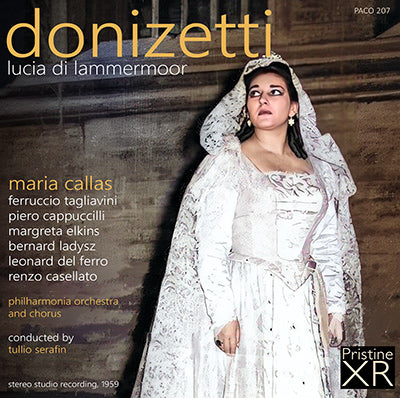
Callas’s second stereo recording of Lucia di Lammermoor, which I reviewed when it was reissued by Warner , has always been considered one of her best from a sonic point of view, so, as someone who has not always been totally convinced by some of Andrew Rose’s re-mastering methods, I wondered how, if at all, the sound could be improved upon. Let me say straight away that I found this latest addition to Pristine’s Callas catalogue totally convincing. Using the Warner remaster of 2014 for comparison, I found the sound altogether warmer and much more comfortable to listen to, closer in fact to how I remember the LPs that I used to own (a German EMI Electrola issue, bought as an import). The Warner is perhaps slightly clearer, but the digitalisation tends to add glare to Callas’s top register. Often one is prepared to flinch before the topmost notes, but I had no such problems when listening to this Pristine pressing. I couldn’t say which is the more truthful, but I can say that the Pristine is much more comfortable to listen to and this, in turn, affected my impressions of the set, a recording I have known since my youth and was in fact my introduction to the opera.

Lucia was one of the cornerstones of her repertoire, and she first sang it in 1952 in Mexico. The following year she sang the role again in Florence, where she made her first recording of the role under Serafin. It was also the first recording she made for EMI. Back in those days, the opera wasn’t taken very seriously and was most likely considered a silly Italian opera in which a doll-like coloratura soprano ran around the stage showing off her high notes and flexibility. Callas returned a proper tragic dimension to the role, that most hadn’t even suspected was there. There is a touching story of Toti Dal Monti, an erstwhile famous Lucia herself, visiting Callas in her dressing room after a performance of the opera with tears running down her face and confessing she had sung the role for years with no idea of its dramatic potential.

When Callas first sang  Lucia in Mexico and recorded it in Florence, she was at the peak of her vocal plenitude, as she was when she first sang it under Karajan at La Scala in 1954, but by the time she sang the role in Berlin in 1955 post weight loss, when Karajan took the La Scala company there, her voice had started to lighten and her conception of the role had become more inward. We can hear this in the famous live recording of one of the Berlin performances, but, for this 1959 recording, she appears to have taken this approach one step further. This may have had something to do with her by now fading vocal resources, but it results in a particularly touching portrayal of the innocent, young, impressionable girl. She has also trimmed away some of the showier variations in the cadenza in the Mad Scene, and the decorations are in consequence somewhat more modest. Am I alone in preferring it sung this way? Personally, I’d prefer to do without all that duetting with the flute altogether, as happens in the complete recording of the opera with Caballé and when Sylvia Sass sings it on one of her recital records. In any case, apart from a few of Callas’s topmost notes, she is in remarkably good voice and the filigree of the role is brilliantly executed with fluid and elegant ease. All in all, I prefer her performance in this set to the one on the 1953 Florence studio recording, not least because of the improved Pristine sound picture.

However, when it comes to her colleagues on this set, I am a little less well disposed towards them than Göran Forsling in his review of the digital download. Ferrucio Tagliavini was 45 at the time of this recording, but he sounds much older, more like an elderly roué than the Byronic Romantic figure of Scott’s and Donizetti’s imaginings. No amount of elegant phrasing can make up for his lack of sheer physical passion and I find myself longing for Di Stefano’s youthful ardour. As for Cappuccilli, he was at the very beginning of his considerable career, and he has yet to find a way of creating character in pure sound. He is just rather dull and no match for Gobbi on the earlier recording or for Panerai in Berlin. Bernard Ladysz makes very little impression at all and both Rafaele Arie and Nicola Zaccaria are preferable.

Serafin, as always, though he may not make any startling revelations, shapes the score with a perfect sense of its dramatic shape, albeit with the cuts that were traditional at the time. Karajan opened up some of those in his performances, and I would still place the 1955 Berlin performance at the top of all Callas’s recorded Lucias, especially in Divina Records latest remastering, but I enjoyed re-visiting this set and I have a feeling I’ll be reaching for this one more regularly than the earlier 1953 recording, not least because of the superior quality of Pristine’s remastering.

My only criticism is of the cover art, which has a photograph of Callas as Lucia in Florence in 1953, when she was still a rather large lady. One could be forgiven for thinking, at first glance, that this was the earlier recording. Surely a photo of the svelte Callas as Lucia would have been more appropriate. There are plenty of them, after all.

Callas’s Studio Medea gets the Pristine XR treatment

paco206_b39e453c-db98-4327-9fcb-cf071ccd980b_530x

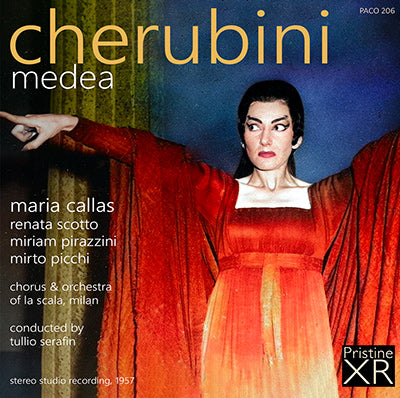
Pristine, having applied their XR method of remastering to many of Callas’s mono recordings and to some of her live ones, now turn to the stereo studio ones. Oddly enough, this was the first of Callas’s complete operas to be recorded in stereo in Milan, though it wasn’t actually recorded by Walter Legge and her Columbia recording team, and all her other Milan recordings that year were mono. Apparently, EMI had no interest in the enterprise and the recording was made by Mercury for Ricordi in September 1957, a few weeks after her performances of La Sonnambula in Edinburgh, when she had not been in her best voice. It was originally issued by Ricordi in Italy, Mercury in the US and Columbia in the UK and since then has appeared on various different labels, including Everest and even Deutsche Gramophon, as well, of course, as Warner when they re-mastered all the Callas studio recordings for their 2014 release.

Considering it was recorded by Mercury, one would have expected the sound to be pretty good, but it has always sounded a bit dry and constricted. I was listening to the Pristine CDs and made comparisons with the 2014 Warner release. To my ears, the differences between the two are fairly slight. Pristine’s XR sound opens up the sound picture a bit and solo voices in particular do sound as if they have a bit more air around them. I also tried listening both through my speakers and through headphones and, oddly, found I preferred the Pristine through my headphones and the Warner through my speakers, though this could have something to do with my equipment. It might also have something to do with the fact that the Pristine release is transferred at a much lower level than the Warner.

Whichever version you go for, there is no doubt this is the best sounding of all Callas’s recorded Medeas, but what about the performance? Apart from this studio recording, we have five live recordings: Florence and La Scala 1953, Dallas 1958, London 1959 and La Scala 1961. Of these, one can safely discount the 1961 La Scala performance. I would also discount the 1959 London performance, a recording that has also been issued by Pristine, though I see that it is Ralph Moore’s first choice in his Medea survey. I feel that it pales in comparison to the Dallas performance, which, though it suffers from poor sound, is blisteringly dramatic, having been recorded just after Bing had “sacked” Callas from the Met. That event seems to have galvanised the whole company to produce a performance of extraordinary dramatic concentration, with Callas in fabulous, secure voice. This Dallas performance is my first choice for the opera, though I wouldn’t want to be without the two 1953 performances either.

This studio recording operates on an altogether lower level of intensity than any of those. However, when I first got to know this opera, and this recording, I had no other point of reference, and it seemed pretty good to me. It was only later, when I heard those barnstorming performances from Florence, La Scala and Dallas, that I found anything lacking, and it is only in comparison with herself that she fails. She is still a good deal better in the part than any other who attempted it, certainly a lot better than Gwyneth Jones and Sylvia Sass, who also made studio recordings of this Italian version. In other hands, Cherubini’s music can seem staid and formulaic, but Callas breathes life into it like no other.

Serafin’s conception is essentially Classical, but his conducting varies from the somnolent to the dramatic. After a tautly conceived overture, the first scene up to Medea’s entrance drags on interminably. I understand the necessity to establish a pastoral air of peace and calm, into which the Colchian Medea bursts, but, quite frankly, at this pace it just becomes a bore. On LP I often used to miss out the first side completely and set the needle down part way through the second LP, when Medea makes her entrance.

Without foreknowledge of other performances by Callas, this is still a great performance of a difficult role. We lose some of the power and ferocity, but there are gains too. Ricordi il giorni tu la prima volta quando m’hai veduta? is couched in the most melting tones, as is the ensuing aria. There is no doubt that it is love, not revenge, that first brings Medea to Corinth. Her duplicity in the scene with Creon, and also in the following duet with Jason, is brilliantly charted, and the scene with the children movingly intense. Vocally, for all that she is not in her best voice, she manages its angular lines and wide leaps with consummate skill, her legato still wondrously intact. Note also how, in this Classical role, her use of portamento is more sparing.

When it comes to the supporting cast, Scotto is less of an advantage than you might expect, Pirazzini rather more (though not quite a match for Barbieri in Florence and at La Scala or Berganza in Dallas). Picchi, who sang Pollione to Callas’s Norma in London in 1952, is rather good, though Vickers is even better in Dallas. Modesti makes a good Creon too, though not as good as Zaccaria in Dallas.

One should of course point out that this is not Médée, as Cherubini imagined it, which was an opéra-comique with spoken dialogue. The version Callas sang is a hybrid, an Italian translation of a German version with recitatives by Franz Lachner, first performed in 1909. It works very well, though, and it is interesting to note that, even in this age of preference for historical authenticity, this was the version that Sondra Radvanovsky sang when the opera was revived for her at the Metropolitan Opera recently.

If you are looking for a studio recording of the opera, then there is little doubt that this is the one to go for.

The Callas Turandot revisited

9172j0czwml-_sl1467_

A short while ago I listened to the Mehta and Karajan recordings of Puccini’s last opera, both of which have a great deal to commend them, though the Mehta is the most obvious recommendation, with a superb cast headed by Sutherland, who is surprisingly convincing in what is surely an uncharacteristic role. The Mehta is the recording I usually recommend to anyone wanting a single recording of Turandot.

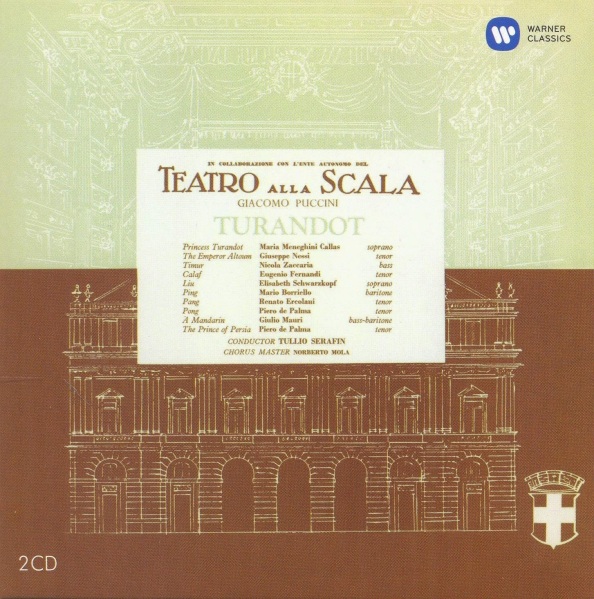
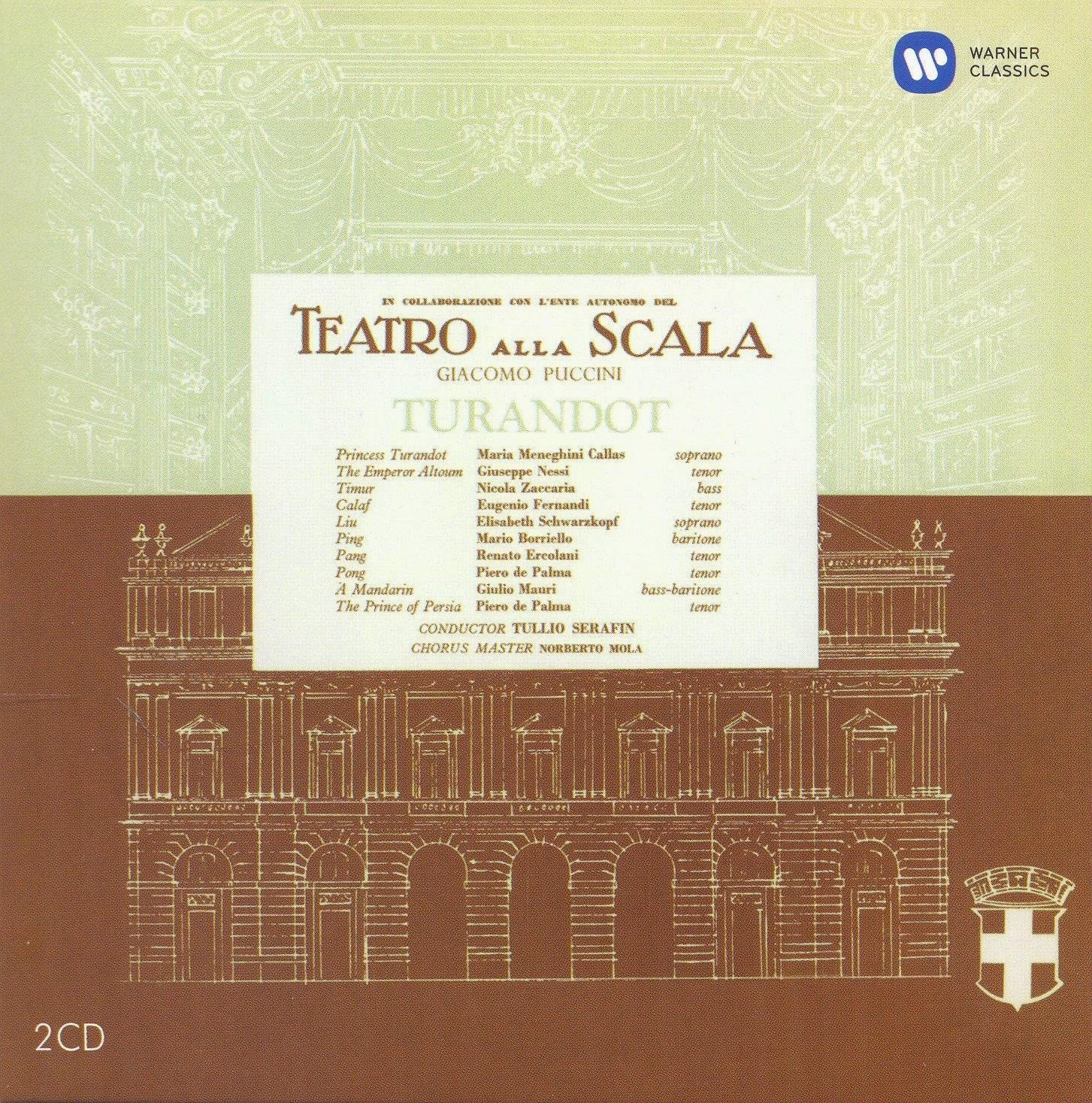
I then decided to revisit the Callas recording, which I hadn’t listened to in quite some time. Now common opinion (and memory) tells us that Callas, having recorded the role of Turandot a little late in her career, is wobbly and vocally unstable, that Schwarzkopf is out of her element, Fernandi a complete non-entity, Serafin reliable but uninspired and the mono recording not up to the demands of this aurally spectacular opera.

Well memory, and therefore common opinion, turned out to be rather faulty on this occasion.

In one respect, that regarding the recording, memory was correct. The mono sound is boxy and this, of all operas, cries out for the kind of aural spectacular we get in the Mehta and Karajan performances. It is a great shame for the performance, led with a wonderfully natural sense of rhythm and balance by Serafin fully deserves a better aural soundscape. The lead up to the finale of the first act is particularly thrilling and Serafin even manages to make much more musical sense of Alfano’s ending, which becomes much less of an anti-climax than usual. However no amount of re-mastering can disguise the fact that the mono sound cannot contain the splendours of the performance.

So what about the singers?

Schwarzkopf might not sound quite Italianate, it is true, but her Liu is gorgeously sung and phrased right from the first moments when she sings that breathtaking piano top note on Perché un dì…nella reggia, mi hai sorriso. . Then in Signore, ascolta, she manages a perfect mesa di voce on the final note, as intrsucted in the score. Another highlight is the little mini aria before Tu che di gel sei cinta, again beautifuly shaded and shaped. It’s a performance full of veiled sighs and tears and I like it very much.

Fernandi, who appears to have done little else on disc, makes much more of an impression than I remembered, with a fine ring to his voice. His phrasing is occasionally a little four square, but, taken on his own terms, it is a thoroughly acceptable performance, if without the personality of a Bjoerling, Corelli or Pavarotti. Zaccaria is a sonorous, warmly sympathetic Timur.

As for Callas, well of course I might have wished that she’d recorded the role even three years earlier, when she sang a vocally resplendent In questa reggia on her Puccini Recital, and certainly there are times when the role is obviously stretching her to her limits, but her voice is a lot more secure than she is usually given credit for, and indeed we’ve heard much wider vibratos and more wobbly singing from many of the singers who have followed, especially from some of the ones who are around now. What we also get is the most psychologically penetrating traversal of Turandot’s psyche as you are likely to hear. This Turandot is not just a mythical creature with splendid top notes, she is a real person. We understand that it is Turandot’s insecurity and fear that make her so cruel. We also understand why so many princes could have fallen under her spell. One might argue that Turandot is after all just a fairy tale, and doesn’t require such a degree of psychological complexity, and it’s certainly a valid point. However I, for one, find the insights Callas brings to the role make it so much more interesting.

So, in all but matters of sound, I would call this a great Turandot.

If anyone is interested you can read my original review of the set here.

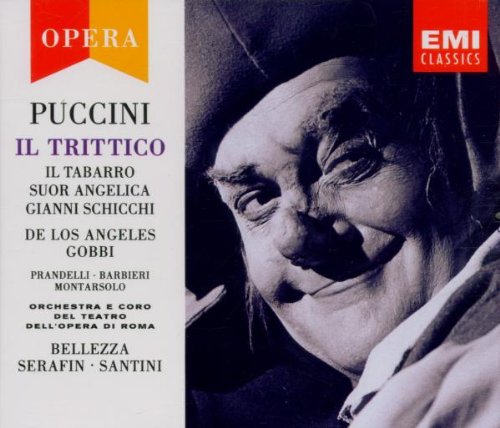
Il Trittico with Gobbi and De Los Angeles

This isn’t a complete recording of Il Trittico. Admittedly all the operas use Rome forces, but each opera is led by a different conductor, and they were all originally issued at different times. The first two, released respectively in 1956 and 1958 are mono, but Gianni Schicchi, released in 1959 is stereo. The only unifying element is that De Los Angeles and Gobbi both appear in two out of the three operas. Still, it was useful and inevitable that the individual releases would eventually be grouped together and, as far as I’m aware, they have not been available singly since.

115770328

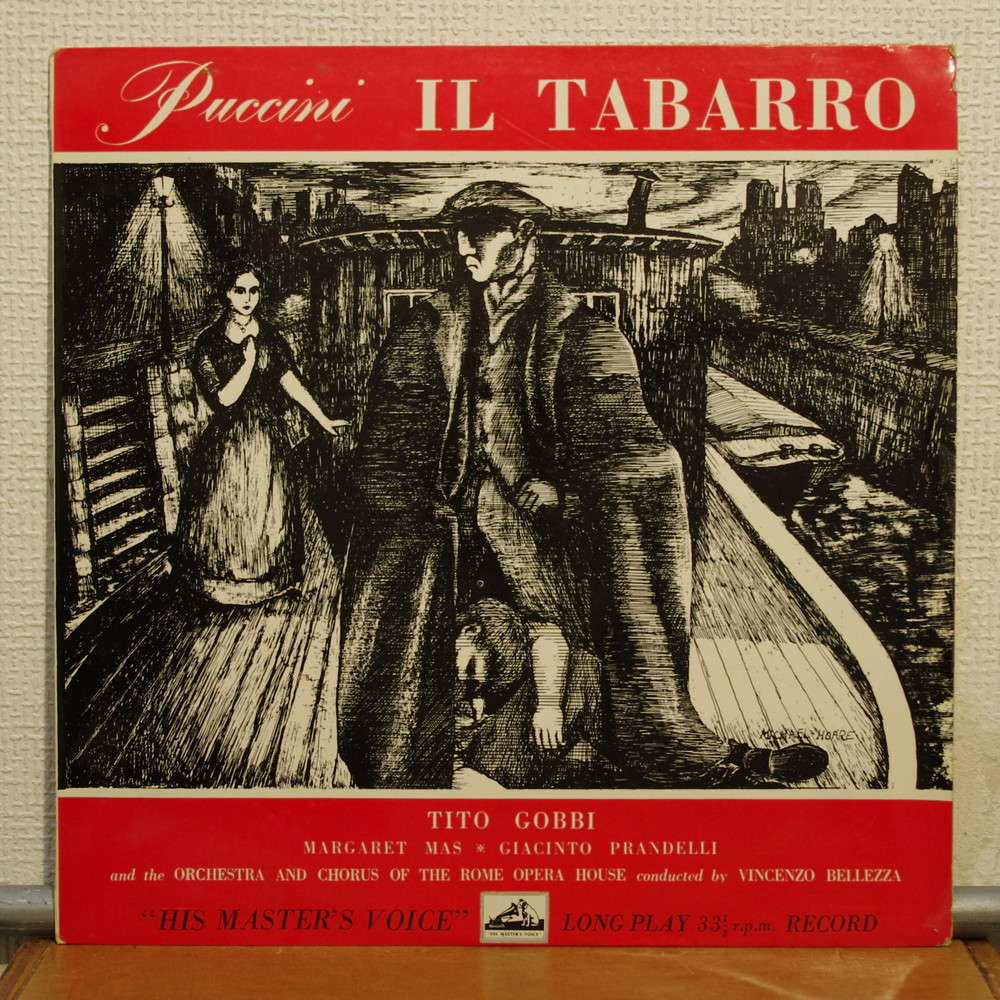
Bellezza’s conducting is efficient rather than inspired and the recording is a bit muddy, but this recording of Puccini’s terse piece of grand guignolIl Tabarro, has at its heart one towering performance in the Michele of Tito Gobbi, a characterisation fit to set next to his Scarpia and Rigoletto. Not only is the role powerfully sung, but we see deep into the man’s tortured soul, the violence bubbling beneath. In no other studio performance of the opera do we feel Michele’s pain with quite such terrifying immediacy.

None of the other singers is on his level, but they are apt enough for their roles. Margaret Mas, a singer who appears to have done nothing else on record, sounds a bit mature, but that suits the role of Giorgetta well enough, as does the slightly raw tone of Giacinto Prandelli’s Luigi. The smaller roles are all well characterised, but it is Gobbi who puts the seal on this recording.

r-15484063-1592553930-2863.jpeg

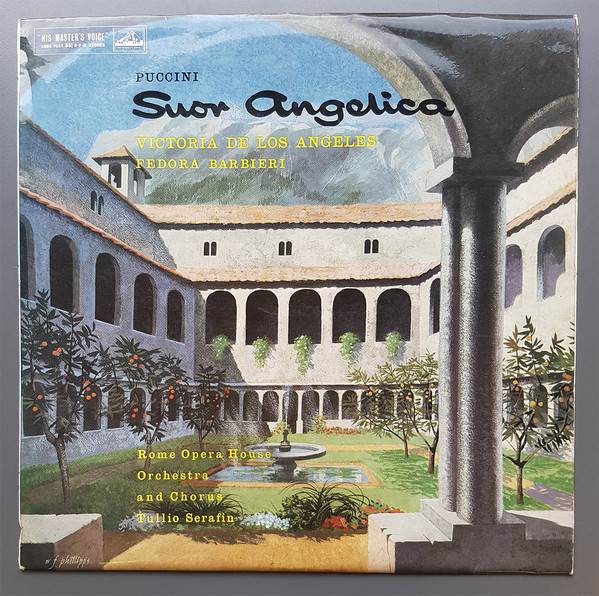
This has always been my least favourite of the triptych, as I find its over-sentimentalised quasi religiosity a bit too much for my taste. However it is difficult not to resist such generous hearted sincerity as we get here from the adorable Victoria De Los Angeles, superbly supported by the veteran Tullio Serafin, who doesn’t overdo the sentimentality. Fedora Barbieri presents a truly magisterial and implacable Zia Principessa, aristocratic, cold and dispassionate in her treatment of Angelica.

However even in a performance as committed as this, the ending stretches my suspension of disbelief just a bit too far and ultimately I prefer the sense of repressed passion and sexuality implied in the Scotto/Maazel version, which plays out almost like a scene from Powell and Pressburger’s Black Narcissus. In their hands, Angelica’s final vision comes across more as a drug-fueled hallucination, which helps to ameliorate my problems with the piece.

On the other hand I wouldn’t want to be without De Los Angeles’ beautifully sung and characterised Angelica. She is a little stretched by the highest reaches of the role, but in general the voice sounds absolutely lovely and her singing is as musical as ever.

r-3214102-1320768570.jpeg

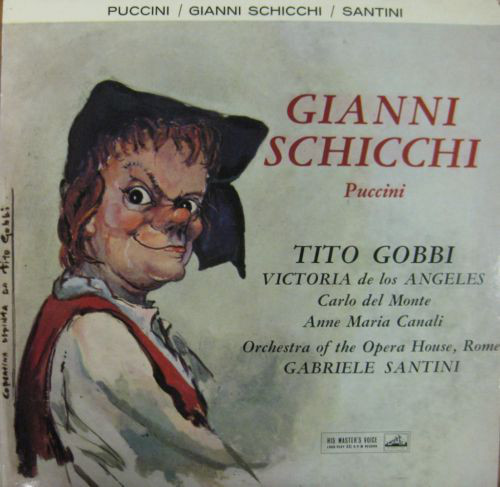
Verdi had his Falstaff and Puccini had his Gianni Schicchi, though Puccini’s comedy is a lot blacker and more cruel than Verdi’s.

Gobbi was brilliant in both comic roles of course, but he presents two very different characters. His Falstaff was all genial bluster, a lovable rogue, where his Schicchi is a clever schemer, with more than a touch of the venal tempered by a genuine love and affection for his daughter.

This is probably one of the best things Santini did for the gramophone, and the performance is superbly paced, with wonderfully pointed characterisations from the supporting cast, the libretto so crisply delivered that you can all but taste the words. I find myself chuckling out loud quite a few times. Carlo Del Monte might seem a bit light of voice, but for once Rinuccio sounds like the young man he is supposed to be, and Victoria De Los Angeles is simply adorable as Lauretta – none better on disc.

Gobbi recorded the role again towards the end of his career (under Maazel, with Domingo as Rinuccio and Cotrubas as Lauretta), but this one, the only one of the operas in this set to be recorded in stereo, remains my first choice.

De Los Angeles in La Traviata

51ust0qa2nl._ac_

Victoria De Los Angeles has long been a favourite singer of mine and her Violetta satisfies on so many levels. She is a little strained by the tessitura of the first act, but the voice is generally clear and beautiful, her singing always musical and deeply felt. As in everything she did, the sensitivity and sincerity of the performance are most affecting and she is without doubt one of the best Violettas on disc. What I miss is that sense of desperation and impulsiveness inherent in the character. Her Violetta is touching, but not overwhelmingly tragic as it is with Callas, who does tend to spoil me for all comers.

She has a good supporting cast with Carlo Del Monte a manly and forthright Alfredo and Sereni a sympathetic Germont, as he is in Callas’s Lisbon performance.

I sometimes feel Serafin’s virtues are rather underestimated. He paces the score brilliantly, particularly good in the choruses, which can sometimes outstay their welcome. If I’m honest, I rather prefer his approach to the more interventionist Kleiber. The cuts traditional at the time are observed, so no cabalettas to Alfredo’s and Germont’s arias.

If Callas, particularly in London, remains my yardstick for this opera, this is nevertheless one of my favourite studio sets and I might even place it just above Cotrubas/Kleiber.

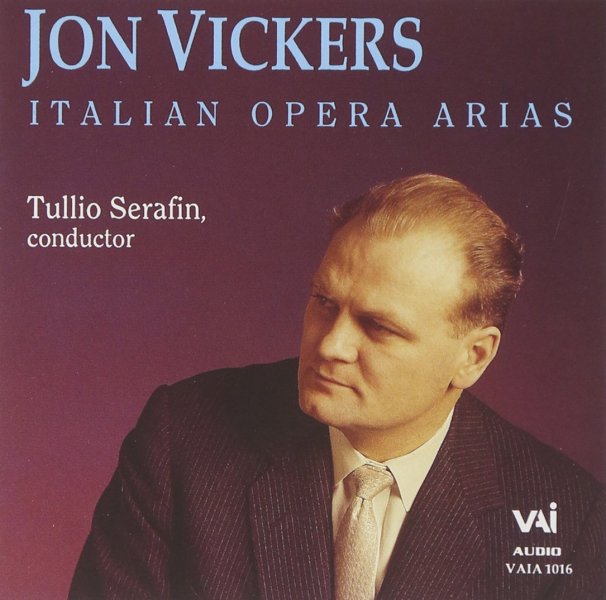
Jon Vickers – Italian Opera Arias

713njx42iel._sl1085_

Now this is great singing.

In the 1993 notes that accompany this re-issue of the one recital record Jon Vickers ever made, Vickers says,

At the time of the Italian Arias recording the field of opera was a totally different world than today. One sought to prove oneself worthy of association with the opera houses, general administartors, conductors, producers and singers one admired – even was in awe of. There was a humbling consciousness of the great history of places like the Metropolitan Opera, the Royal Opera House, Covent Garden, La Scala, Bayreuth, Vienna and Salzburg. Emphasis was upon delving as deeply as possible into the psychological depths of the text illuminated by the genius of the composer’s music. To dare to indulge any particular personal ability was to invite derision from colleagues and thunderous disapproval by public and press alike as being in bad taste and imposing of oneself upon a great work of art.

To be honest, I’ve listened to plenty of live performances from those days when bad taste and personal indulgence brings the house down, but his statement does give you a snapshot into the way the man worked, of his seriousness and dedication to his art.

This recital disc was recorded at the same time as his first recording of Otello under Tullio Serafin, when his only Wagnerian role was Siegmund, and you were more likely to hear him as Riccardo in Un Ballo in Maschera, Radames, Canio or Don Carlo. Later of course he want on to tackle Tristan and Parsifal, though he never sang Siegfried, and he dropped out of scheduled performances of Tannhäuser at Covent Garden, due to his religious scruples, saying he could not empathise with the character and that, in any case, the opera was blasphemous in character.

First impressions when listening to this disc are of the sheer size of the voice, and the power – a power that can be reined back to a merest pianissimo, then unleashed at will, like an organist pulling out all the stops. The other is intensity. Whether singing gently or loudly, there is a concentration and intensity that makes each short aria into a mini monodrama, and an ability to focus in on the meaning of each word and note. Nothing is taken for granted, nothing thrown away.

From a purely vocal point of view, it was still a very beautiful instrument back in 1961, and an aria like Cielo e mar is sung not only with golden tone, but with a true sense of wonder, and a way of pulling in and out of full voice that never destroys the long legato line.

Where many Italian tenors will add extraneous sobs and aspirates to indicate emotion, particularly in an aria like Federico’s Lament from L’Arlesiana, Vickers achieves an even deeper vein of emotion by never straying from the written notes, but simply (as if it was simple) intensifying his sound. In this he ressembles Callas, whom he revered so much having been Giasone to her Medea on many occasions.

One of the stand out tracks on this recital for me is Chénier’s Un di all’azzurro spazio delivered with mounting passion, but also somehow giving us a sense of the intellectual in the man. Canio suffers like no other, and yet he doesn’t have to break down in sobs at the end to make us feel it. His Otello developed into one of the towering creations of his, or any other, age, but even here, with the arias taken out of context, he conveys all the man’s pain and suffering.

Listening to this recital today at a distance of some years has been a peculiarly emotional experience. Jon Vickers was, and remains, unique, and we are unlikely to hear his ilk again.

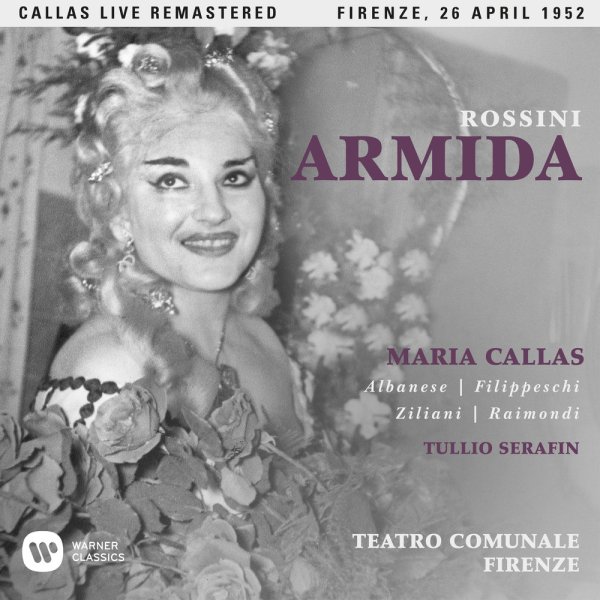
Callas in Armida – Florence 1952

1498830639973

With this set, I was able to make a direct comparison between the new Warner transfer and that by Divina Records, and have to say I prefer Divina. Neither version can eliminate the overloading and distortion at tutti climaxes, but to my ears the voices are much more clearly captured in the Divina version. The Warner isn’t bad, but possibly in an attempt to provide a more comfortable listening experience, they have removed some of the presence of the voices. Other ears and other equipment may have a different reaction of course, but I quickly abandoned Warner and continued listening on Divina. Furthermore Divina includes about 12 minutes of music, omitted by Warner, where you can hear a speaking male voice overlaid onto the music. Though admittedly irritating, it means we lose some of Callas’s singing. Divina also includes fuller notes, fuller documentation, photos and a libretto. I suppose you might see it as the luxury compliment to Warner’s cheaper offering. Personally I prefer Divina’s warts and all approach. Divina is of course more expensive, and others may have different priorities, so choice will reside with the individual listener.

But choice must be made, for this has to be some of the most astonishing dramatic coloratura singing ever committed to disc, and it is a great shame that Callas never sang the role again, nor felt able to take on any more of the roles written specifically with Isabella Colbran in mind.

In 1952 Callas undertook a punishing schedule. In January she sang her final performance of Elena in I Vespri Siciliani in Milan, followed it with I Puritani in Florence, then her first Normas at La Scala. February saw more performances of Norma at La Scala, with a few concerts sandwiched between. In March she gave three performances of Violetta in Catania, whilst rehearsing for a new production of Il Ratto del Seraglio (the first ever at La Scala). This opened at the beginning of April, and this production of Armida on April 26th after a further performance of Norma at La Scala. Incredibly, though you’d never guess it from her confident delivery, she learned the role of Armida in 5 days!

Astonishing though the vocal pyrotechnics are, Callas not only sings the role with consummate ease, but makes musical sense of its difficulties, so it becomes much more than a vocal showcase. She is by turns, imperious, commanding, sensuous, elegant and powerful, cascading up and down two-octave chromatic scales with fluent ease. A critic of the Giornale delle Due Sicilie described Colbran’s singing of the aria D’amore al dolce impero thus.

She proves herself superior to any other singer in some variations in which she embellishes a delightful tune of Rossini’s with all the graces of the art of song, now running through chains of triplets of extraordinary and …insuperable difficulty, now giving a vocal imitation of the most difficult arpeggios of stringed instruments, and finally, with superb nonchalance, executing a formidable ascending and descending scale of two octaves.

The critic might well be talking of Callas’s performance, which is absolutely electrifying, as it is throughout the opera.

Unfortunately, none of the other singers is anywhere near her achievement and Serafin heavily cuts the opera, presumably to accommodate their deficiencies. All of the tenors have trouble with the florid writing, aspirating the runs in what’s left of it, and their singing is clumsy and effortful.

Essential listening, none the less, for Callas’s superbly commanding singing of the title role. There are of course more modern recordings out there, more textually accurate and more complete, but nowhere else will you hear such a thrilling portrayal of the title role, nor one so brilliantly sung. The cumulative power of the finale is simply staggering, where, with a voice of massive power, Callas peals forth vengeful coloratura flourishes with insouciant ease, capping it with a top Eb of huge proportions. You have to hear it to believe it, indeed, were it not for recorded evidence, you would not believe it possible.

dvn016_l

Verdi’s Aida – a comparative review of 5 different recordings

I’m not quite sure how I’ve ended up with five different recordings of Verdi’s Aida. It’s not my favourite Verdi opera by a long chalk. Though it has magnificent music, the characters always seem more like human archetypes than flesh and blood people and I admire it rather than love it. Three of my recordings feature Callas, and, though I never think of Aida as a Callas role, she brings more meaning to it than most. Two of the Callas recordings (the ones that find her in the best voice) are live, but the sound on both is, at best tolerable, so the studio one is also a necessity, though the 1955 mono sound on that can’t hope to compare with the fabulous sound accorded the new Pappano set that was recorded in 2015.

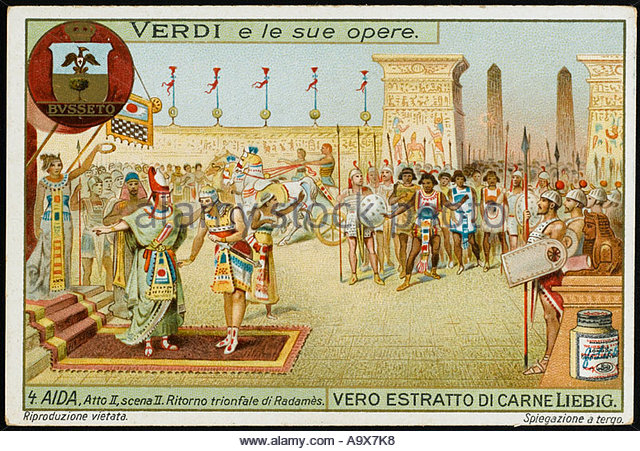
Aida is of course the quintessential grand opera, famed throughout the world for extravagant stagings at the Arena di Verona, but actually, aside from the great Triumphal Scene, many of its scenes are played out in private, behind closed doors.

I started my journey with the famous live 1951 performance from Mexico, with Callas, Del Monaco, Dominguez and Taddei, conducted by Oliviero de Fabritiis.

20170209_120338515_iOS

Well let’s get over the caveats. The sound is pretty atrocious; it crumbles and distorts and the balances are all over the place. The voices come through reasonably well, but you do have to listen through the sound, as it were. But what a performance! And a memento of what was undoubtedly a thrilling evening in the theatre.

Callas is in superb voice throughout, and makes more of the somewhat placid character of Aida than any other singer I have come across. The power she was able to summon at this point in her career has to be heard to be believed, a power that goes right up to that unwritten, but absolutely stunning top Eb in alt in the Triumphal Scene, a phenomenal sound, that excites the Mexicans so much you can almost hear them rip the seats apart. Ritorna vincitor is absolutely thrilling, the duet with Dominguez’s Amneris also superb, but, as always with Callas, it is the Nile Scene that provokes her most moving singing.

O patria mia is not her best moment. She seems momentarily preoccupied with the exposed top C at the end, a solid if not exactly dolce as marked note, but once past the aria, she is on more congenial ground, and, with Taddei a worthy partner, alternately stentorian, implacable, insinuating and relentless, runs the gamut of emotions in an exciting Nile Scene. In the ensuing duet with Radames, she finds a wealth of colour as she seduces and cajoles him.

Del Monaco, as usual, is not particularly subtle, but there is the clarion compensation of the voice itself, and, like all the Radames Callas sings with in the three recordings, makes a better hero than lover.

Dominguez is very impressive. This was her debut in the role, and occasionally she overplays her hand, but her singing is very exciting and the Mexicans give her a rousing reception.

De Fabritiis conducts a dramatic, but not particularly subtle, version of the score. Nowhere does he find the delicacy of Karajan or Pappano, or even Serafin, but subtlety is not really what this performance is about.

I next moved onto another live Callas performance; this one from Covent Garden in 1953, with Kurt Baum, Giulietta Simionato and Jess Walters, conducted by Sir John Barbirolli.

51M08G0ND7L._SY300_

Unfortunately Barbirolli turned out to be something of a disappointment. More subtle than De Fabritiis in Mexico admittedly, the performance lacks excitement and many of his tempi are unaccountably slow. Maybe his approach was more suited to the reserved Londoners than the excitable Mexicans, but the latter has a thrilling vitality completely missing in London.

There is no thrilling Eb in the Triumphal Scene, but Callas is still in superb voice. However Barbirolli’s slow tempi vitiate against some of her more dramatic moments. The I sacri numi section of Ritorna vincitor lacks the bite Callas usually brings to it, though she is able to spin out the final Numi pieta to even more heavenly lengths at Barbirolli’s slower tempo.

Baum is not quite as bad as his reputation, but he hardly ever phrases with distinction and he sobs and aspirates in what he evidently thought was the Italian manner. He also has a tendency to hold on to every top note as if his life depended on it, so that his duets, both with Callas and Simionato, become somewhat combative. That Callas manages to sing the final duet with the grace and delicacy she does is little short of miraculous, given Baum’s determination to bawl his way to his death.

Simionato, a more experienced Amneris than Dominguez, is magnificent and Barbirolli does finally wake up for her final scene, though you sense Simionato propelling the music forward and they almost become unstuck. Am I being picky, though, when I wonder if a little too much of Azucena creeps into Simionato’s interpretation? Amneris is after all a young princess, but more on that subject later.

Somewhat disappointed with Barbirolli, I moved on to the second Karajan recording, recorded in Vienna with Mirella Freni, Jose Carreras, Agnes Baltsa and Piero Cappuccilli.

41V5vkkW6hL._SY300_

Karajan’s speeds in this, his second recording, of the opera are also spacious but much more vital. I’ve always found his first effort, with Tebaldi and Bergonzi, a little too self-consciously beautiful. This one is far more alive to the drama. It goes without saying that the Vienna Philharmonic Orchestra play superbly and the sound is excellent analogue stereo, though the voices are a little too recessed for my liking, and are often submerged by the orchestra. Given that Karajan uses lighter, more lyrical voices than we have become used to, this does seem a somewhat perverse decision.

If singers of  Radames tend to break down into the heroic and poetic, Carreras is more in the latter camp. His voice is doubtless a notch too small for the part, but it was still a beautiful instrument at that time, and his is the most attractive Celeste Aida we have heard so far, though he doesn’t manage the pianissimo top B at the end. He is at his best in the final duet, his piano singing a welcome relief from the overloud Del Monaco and Baum.

Freni is very attractive, if a little lacking in personality. Her voice might also be considered a little light for the role, but she never forces and sings within her means, phrasing sensitively and singing cleanly off the text. She does nothing wrong, but set next to Callas, she just isn’t that interesting.

The best of the soloists is, without doubt, Agnes Baltsa. Here at last we have a believably young, spoiled princess, a plausible rival for Aida. Seductively sexy and driven to distraction by jealousy, she is convincingly remorseful at the end of the opera, nor does she sound like an Azucena in disguise. She is superbly effective in her duets with Radames and Aida, and gorgeous in the first scene of Act II. She is my favourite of all the Amnerises.

Cappuccilli I find efficient rather than inspired. He doesn’t stamp his authority on the role of Amonasro the way Taddei and Gobbi do, though, as usual, his breath control is exemplary. In a star studded cast, both Ramfis and the King (Ruggero Raimondi and Jose Van Dam) are excellent and we even get the silken voiced Katia Ricciarelli in the role of the Priestess.

From Karajan I turned to the latest addition to the Aida discography. Recorded in the studio, a rarity for opera recordings these days, it is conducted by Antonio Pappano, and stars Anya Harteros, Jonas Kaufmann, Ekaterina Semenchuk and Ludovic Tezier with Orchestra and Chorus of the Saint Cecilia Academy.

cd-ver_kauf_pappano_2

As one might expect, the sound in this new digital recording is superb, much more naturally balanced than the Karajan, with the voices coming through beautifully. Pappano exerts a superb grip on the opera, and his might just be the best conducted version of the lot, in the best lyric Italian tradition of conductors like Serafin, more of whom below.

Best of the soloists is definitely Jonas Kaufmann, who might just be the best Radames ever to be recorded. He has both the heroics and the poetry (a deliciously ppp close to Celeste Aida) and is vocally the equal of all that Verdi throws at him. Throughout he phrases with sensitivity and imagination, and achieves miracles of grace in the final duet, with some genuine dolce singing. This is a great performance.

Harteros is in the Freni mould, vocally not quite as secure, but a little more interesting. She goes for a dolce top C in O patria mia, but it is a little shaky. She does not erase memories of Caballe (on the Muti recording) in the same music, but hers is nevertheless an attractive performance.

Semenchuk I don’t like at all. She has a typically vibrant Eastern European voice, with a tendency to be squally. She reminded me most of Elena Obrasztsova and sounds a good deal older than she looks in the photographs accompanying the recording. All the other Amnerises under consideration bring something more specific to the role, where she is more generalised, and consequently the big Act IV scene lacks tension.

If not quite in the Gobbi or Taddei class, when it comes to verbal acuity, Ludovic Tezier is a fine Amonasro and together he and Harteros, with Pappano’s inestimable help, deliver a fine Nile Duet. The basses are not quite in the same class as those on Karajan and Serafin.

Which brings me to Serafin and Callas’s studio recording of the opera.

cd_callas_aida_1_1

By the time this recording was made in 1955, Callas had given up the role of Aida, singing her last performances in Verona just a few months after the 1953 Covent Garden performances under Barbirolli.

Callas’s voice has thinned out quite a bit, and she sings a much more refined performance of the role, perhaps more in line with conventional interpretations, except of course that Callas can never be conventional. When Tebaldi sings Numi pieta at the end of Ritorna vincitor, she sings a pure lyrical line and it’s very pretty, but Callas reminds us that she is asking the Gods to take pity on her suffering. Time and time again she will illuminate a phrase here, a word there. The duet with Amneris abounds with contrast as the two women play off against each other, but it is the duet with Amonasro in the Nile Scene that holds the heart of this performance, the scene where Aida must choose country before love. Gobbi is at his incisive best as Amonasro, and I doubt I will ever hear this duet done better. Note too how eloquently Serafin makes the strings weep when Aida finally gives in, first with the climbing phrase on the cellos and then in the way he accentuates those stabbing violin figures, when Callas sings O patria, patria quanto mi costi. This is the real stuff of drama.

Tucker isn’t in Callas and Gobbi’s class I’m afraid. He has the right sound for the role, virile and forthright, but for every phrase delivered with just the right degree of slancio, there is another ruined by his tendency to aspirate and sob.

Barbieri is very fine, in the Simionato mould, and, with Serafin letting go a veritable storm in the orchestra, produces a thrillingly dramatic Act IV scena.

Both basses (Giuseppe Modesti as Ramfis, and especially Nicola Zaccaria as the King) are splendid, and Serafin, as you might have gathered, conducts a wonderfully dramatic version of the score, in the best Italian tradition.

So conclusions then. No doubt there will be some wondering why I didn’t include Solti and Muti. Well, Solti I’ve never taken to. I just can’t stand his bombastic, un-Italianate, unlyrical conducting, good though his cast is (though I’ve never quite joined in the general enthusiasm for Gorr’s Amneris). I know the Muti but don’t own it. Until Pappano came along I usually used to recommend it as the safest bet, and Caballe gives one of her finest performances as Aida, and it is still, if memory serves me correctly, worth considering.

From the five under consideration then, I’d say De Fabritiis in Mexico is essential listening, if only as a memento of a historical occasion and a truly thrilling evening in the theatre. It could never be a library version though because of the intransigent sound. From the point of view of a library choice, then the new Pappano would probably be the safest bet, even though it has the weakest Amneris. Forced to choose but one recording, though, I’d go for Serafin, with a rather regretful glance over my shoulder towards Baltsa’s Amneris. The mono sound is sometimes a bit boxy and not a patch on either Karajan or Pappano, but its studio acoustic is a good deal better than either De Fabritiis or Barbirolli, who, in any case, surprisingly trails in last place in this survey, despite the presence of both Callas and Simionato.

Callas’s vocal splendour is best caught in Mexico in 1951, but, the sound is a problem, so it’s Serafin for me, if only for the Amonasro/Aida Nile duet, the most thrilling on all these sets.


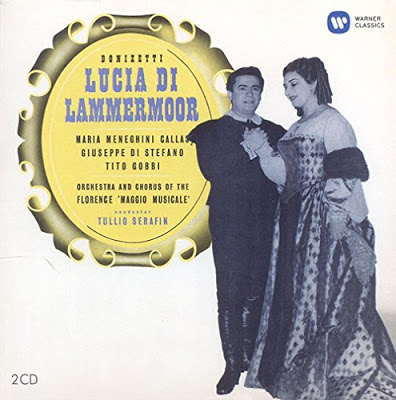
Callas’s 1953 Studio Lucia di Lammermoor

51252bkyvtf8al

Recorded 29-30 January, 3, 4 & 6 February 1953, Teatro Comunale, Florence

Producer: Dino Olivieri, Balance Engineer: Osvaldo Varesca

Of all the roles Callas sang, it was probably Lucia which created the biggest furore. Back in the early 1950s, nobody took the opera very seriously. It was considered a silly Italian opera in which a doll-like coloratura soprano ran around the stage showing off her high notes and flexibility. There is a hilarious description of the characters in E.M. Forster’s Where Angels Fear To Tread attending a provincial performance of Lucia di Lammermoor. Here he describes the prima donna’s first entrance.

Lucia began to sing, and there was a moment’s silence. She was stout and ugly; but her voice was still beautiful, and as she sang the theatre murmured like a hive of happy bees. All through the coloratura she was accompanied by sighs, and its top note was drowned in a shout of universal joy.

For anyone who loves opera or Italy, I heartily recommend this self-mocking tale of the English abroad.

But back to Callas, who first sang the role of Lucia on stage in Mexico  in 1952. A few months earlier she had sung the first part of the Mad Scene at a concert in Rome. After Mexico, she would sing it in Florence, Genoa, Catania and in Rome before appearing in Karajan’s legendary production at La Scala at the beginning of 1954, a production that subsequently travelled to Berlin (one of her most famous recorded live performances) and Vienna.  It was also one of the roles she chose for her U.S. debut in 1954 in Chicago and at the Met in 1956. Her last performances of the role were in Dallas in 1959 (in the same Zefirelli production that made Sutherland a star at Covent Garden) and she made two recordings of the opera;  this one in 1953 in Florence, shortly after stage performances there and the second in 1959 in London. After Norma, Violetta and Tosca it is the role she sang most often, so it is hardly surprising that she is so much associated with it.

Back in the 1950s it must have seemed unthinkable that such a large voice could tackle the role, and not only sing it, but sing it with such accuracy and musicality, giving the opera back a tragic intensity that people had forgotten, or didn’t even know,  was there.  There is a touching story of Toti Dal Monte, an erstwhile famous Lucia herself, visiting Callas in her dressing room after a performance, tears streaming down her face, and confessing she had sung the role for years without really understanding its dramatic potential.

From Callas’s very first notes, she presents a highly-strung, nervous character, but sings with impeccable legato, all the scales and fioriture bound into the vocal line, the tone dark, but plangent, expressive but infinitely subtle. Regnava nel silenzio is a model of grace, but she still manages to invest the words di sangue roseggio with a kind of horror, whilst never resorting to glottal stops or other verismo tricks. She understands that with bel canto it is the arc of the melody, of the musical line that is paramount.

And so it continues, with her consolatory Deh ti placa in the duet with Di Stefano’s Edgardo, a duet of musical contrasts, in which Callas’s Lucia is at its most feminine. The duet with Gobbi, their first encounter on disc together, is also full of contrasts, and Gobbi makes a much more interesting villain than Cappuccilli in her second recording, finding a range of insinuating colour that his younger colleague doesn’t even hint at.

The Mad Scene is a miracle of long breathed phrases, with such lines as Alfin son tua heartbreakingly expressed, and of course here there are none of the problems with the top Ebs that we get in the second recording.

Di Stefano is more suited to Edgardo than he would be to Arturo in I Puritani, which was recorded soon after, and he is much to be preferred to the over-the-hill Tagliavini on the second recording. Serafin conducts a tautly dramatic version of the score.

The sound on this Warner issue still tends to distort and crumble in places. I guess that must be on the master, but the voices ring out with a little more truth.

Of course both Callas and Di Stefano can be heard together in the famous 1955 Berlin performances under Karajan, in sound which is not much worse than this, and that recording would still be my first choice amongst Callas’s Lucias, for all that she eschews the first Eb in the Mad Scene. Under Karajan’s baton and in a live situation she sings with effortless spontaneity, almost as if she is extemporising on the spot.

Still this first Callas studio recording is the one that got people talking and the one that quite possibly changed opinions about bel canto for many years to come. As such it has a historical significance which should never be forgotten.