Callas in I Puritani

r-12800357-1542200837-6181.jpeg

Recorded 24-30 March 1953, Basilica di Sant’Eufemia Milan

Producer: Dino Olivieri, Balance Engineer: Osvaldo Varesca

I Puritani, Callas’s second opera for EMI was the first recorded under the imprimatur of La Scala, an association which would result in eighteen further opera sets over a period of seven years.

No doubt because of the circumstances surrounding her first Elvira (she learned it in 3 days to replace an ailing Margherita Carosio whilst still singing Brunnhilde in Die Walkure) and because of her famed recording of the Mad Scene, one would expect the role to have played a greater part in her career, but in fact after those first performances in Venice in 1949, it figured rarely in her repertoire.

She sang it again in Florence, in  Rome and  in Mexico in 1952, and in her second season in Chicago in 1955, then never again, though the Mad Scene did occasionally appear in her concert programmes, even as late as 1958 at  a Covent Garden Gala. A recording of her rehearsing the scene for her Dallas inaugural concert in 1957 exists, and shows her still singing an easy, secure and full-throated high Eb.

Maybe the reason she sang it so little is that Elvira offers less dramatic meat than Lucia or even Amina. The libretto is something of a muddle and Elvira seems to spend the opera drifting in and out of madness. Of course she gets some wonderful music to sing, and Callas certainly breathes a lot more life into her than most singers are able to do. She also gives us some of her best work on disc, her voice wonderfully limpid and responsive, the top register free and open. No doubt this is the reason it has remained one of the top choices for the opera since its release over 6o years ago.

We first hear her in the offstage prayer in Act I Scene I, and straight away there is that thrill of recognition as her voice dominates the ensemble. Then in the scene with Giorgio, she finds a wide range of colour, a weight of character, that we don’t normally hear. Her voice, laden with sadness for her first utterances, then defiant when she thinks she is to be wed to someone she doesn’t love, is fused with utter joy when she realises that it is Arturo she is going to marry. She skips through the florid writing with lightness and ease, but invests it with a significance that eludes most others. One moment that stood out in relief for me was her cry of Ah padre mio when Arturo arrives, which bespeaks the fullness of heart that is the main characteristic of this Elvira. Son vergin vezzosa is a miracle of lightness and grace, Ah vieni al tempio heartbreakingly real, though her voice does turn a little harsh when she doubles the orchestral line an octave up.

The Mad Scene needs little introduction. It is one of the most well-known examples of her art out there, the cavatina moulded on a seemingly endless breath; and where have you ever heard such scales in the cabaletta? Like the sighs of a dying soul. The top Eb at its climax is one of the most stunning notes even Callas ever committed to disc, held ringingly and freely without a hint of strain. Words fail me.

She has less to do in the last act, which mostly belongs to the tenor, and this is where I have a problem with the set. Di Stefano is nowhere near stylish enough in a role that was written for the great Rubini, and he lurches at every top note as if his life depended on it. Sometimes the notes sound reasonably free, at others he almost sounds as if he’s holding onto them with his teeth. Mind you, who else was there around to sing it any better at that time? The recording was made too early for Kraus, though Gedda might have been a good idea. After all, he was already singing for EMI by then, and would sing Narciso on Callas’s recording of Il Turco in Italia, which was recorded the following year..

Rossi-Lemeni  is less woolly-toned than I remember him and sings with authority, especially good in the first act duet with Callas; Panerai is a virile presence as Riccardo. Serafin conducts with his usual sense of style, but also invests some drama into the proceedings.

The orchestra and voices sound really good, but the recording of the chorus is a bit muddy. Presumably that was also the case on the original LPs.

I do have a few problems with I Puritani. To my mind the libretto is plain silly, and even Callas’s wonderful singing can’t quite rescue it. That said, as singing qua singing, it’s some of the most amazing work she ever committed to disc, and for that reason it will always be a permanent part of gramophone history. I would never be without it.

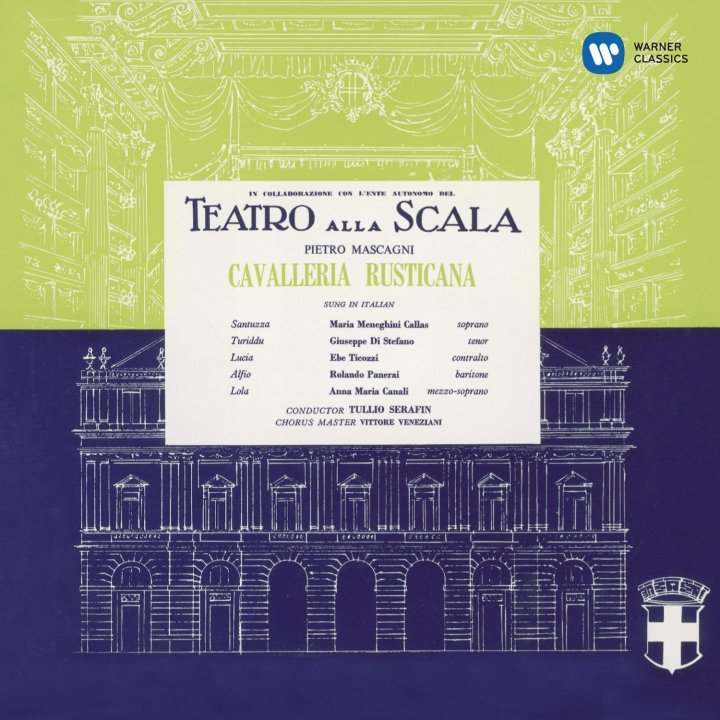
Callas in Cavalleria Rusticana

81rypabsull-_sl1500_

Recorded 16-25 June, 3-4 August 1953, Basilica di Sant’ Eufemia, Milan

Producer: Dino Olivieri, Balance Engineer: Osvaldo Varesca

According to the notes accompanying this recording, Callas actually replaced the scheduled singer for it, a famous mezzo who was having trouble with her top notes. Does anyone know who this might have been? Could it have been Stignani? She ducks some of the top notes in Callas’s Norma the following year, and she was getting on a bit by this time, so it’s possible I suppose.

Whoever it was, we should be pleased that Callas was around to fill the breach, because her Santuzza is superb. Unbelievably she had only previously sung the role in her student days, when only 15 and also a couple of times with the Athens Opera, but, apart from this recording, never again, and yet, in fabulous voice, she inhabits the role of poor, hapless Santuzza as no other.

At this stage in her career her voice was as responsive in verismo as it was only a few weeks before, when she was recording Bellini (I Puritani). She uses none of the tricks of the verismo soprano, no glottal stops, no aspirates, no sobs, but sings with a pure musical line. When she sings io piango at the end of Voi lo sapete, she is able to suggest tears without actually sobbing.

Furthermore her characterisation has been thoroughly thought out. This is a young woman at the end of her tether with nothing left to lose. Her very first utterances are full of weariness and hopelessness, that first little dialogue with Mamma Lucia full of despair. Quale spina ho in core, she sings, and her singing of those few words rends the heart, as do her thrice repeated cries of O Signor in the Easter Hymn. Left alone with Mamma Lucia, she pours out her sad story.  Voi lo sapete is not only heartrendingly poignant, but beautifully sung, and we note how economically she uses her chest voice. Intensity is not achieved at the expense of musical line.

Nor is it in the duet with Turiddu, which bristles with contrast and drama. Here it is not just a stock operatic duet, but a full scale Sicilian row between a young couple. Callas pleads, rails, cajoles and, finally, when she can take no more, hurls her curse at Turiddu. Alfio serendipitously turning up at just that moment gives her the opportunity to vent her spleen, but, yet again, her singing is full of subtle little details and the solo that leads into the duet is sung with a sustained, if tragic beauty. Note how skilfully she shades the line at the end when she takes the pressure off the voice, moving from chest to head and ending quietly on lui rapiva a me. The closing section has both Panerai and Callas pulling out all the stops. It is absolutely thrilling.

A few words then about the rest of the cast. Di Stefano  sings with his own brand of slancio and presents a caddish, if ultimately remorseful Turiddu. Panerai is a splendidly virile Alfio, and Anna Maria Canali a sexy, minx-like Lola, superbly bitchy in her short exchange with Callas’s Santuzza. Serafin’s speeds are sometimes a bit slow in the choruses, but he paces the meat of the drama really well.

The recording still overloads occasionally at climaxes, so I assume that is a problem that exists on the master, but otherwise the sound is quite open and Callas’s voice fairly leaps out of the speakers.

Not for nothing has this remained one of the top recommendations for Cavalleria Rusticana for over 50 years, and I don’t see that changing any time soon. For first-rate recorded sound and orchestral splendour one would go to Karajan, for characterful full-throated singing to Serafin.

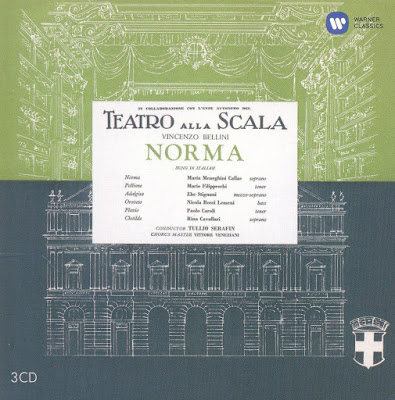
Callas’s 1954 Studio Norma

91q5ogwsokl-_sl1458_

Recorded 23 April & 3 May 1954, Cinema Metropol, Milan

Producer: Walter Legge, Balance Engineer: Robert Beckett

Callas’s greatest role was Norma, the one that she sang more than any other, and one of three operas she recorded twice.

Though I did have this version on LP (when it was reissued in the 1970s), I never had it on CD. The 1960 version was one of the first LP opera sets I ever owned, and, not surprisingly, became one of the first I owned on CD. Later I acquired an Arkadia issue  of the live 1955 La Scala, which I eventually replaced with the Divina Edition one of the same performance. As this was the Norma I most often pulled down off the shelf, I decided I didn’t really need another, so never got round to getting this 1954 recording on CD.

First impression on this set was the sheer presence of the voice. When Callas commandingly sings Sediziose voce she could almost be in the room with you and in fact the sound all round, orchestra and voices, is a lot better than some of the later operas; much less boxy with a real sense of presence. The second (in stereo) is better still of course, but the difference is relatively slight.

So how else does this compare to the second set, which I have already lavished such praise on? Well let’s start with the rest of the cast. Fillipeschi is, let’s face it, second-rate, and nowhere near as good as Corelli, his basic tone is thin and whiney and anything that requires any rapid movement finds him lacking, not that Corelli is much better in this respect, mind you, but there is the clarion compensation of his actual voice. Also I’m afraid I find it hard to join in the general round of praise for Stignani. Though the voice retains its firmness, she sounds too mature by this stage in her career, more like Callas’s mother than the innocent, young priestess she is supposed to be. Considering she was 20 years Callas’s senior at the time, it’s hardly surprising. Nor is her voice anywhere near as responsive as Callas’s, or as accurate, but then whose is? Not Ludwig’s, certainly, but I much prefer her more youthful timbre and her voice blends remarkably well with that of Callas; an unlikely piece of casting that paid off. Rossi-Lemeni’s tone tends to be woolly, but he is an authoritative Oroveso, more so than Zaccaria, whose tones are, however, more buttery.

As for Callas, there is no doubt that she is much more able to encompass the role’s vocal demands in this recording than the later one. I do miss certain more tender moments in the 1960 recording. Her entrance into Mira o Norma (Ah perche, perche), beautifully and touchingly understated is more moving than it is here, and in fact the whole duet works better with Ludwig, but when clarion strength and security are required then this set wins hands down. One might say we get more of the warrior in this one and more of the woman in the second. Given the security and power she evinces here, it seems strange that she does not take the high D at the end of Act I, as she did at previously preserved live performances, and as she would do again the following year in both Rome (also under Serafin) and Milan. It might seem a relief that she doesn’t attempt the note in 1960, but here I missed it.

Both recordings are essential of course. No other Norma in recorded history has come within a mile of her mastery of this role, the most difficult in the repertory according to Lilli Lehmann, and the one she sang more than any other. I am willing to believe that Pasta and Malibran were every bit as great, but I cannot believe they would have been better. I am indebted to John Steane yet again for putting things in a nutshell when he suggested that for Norma with Callas, one should go for the second recording, but for Callas as Norma, the first. Personally I’d want both, as the second, for all its vocal fallibility, searches deeper. I would also add the live 1955 from La Scala, the one in which voice and art find their purest equilibrium, and the one I would no doubt  be clinging to if ever shipwrecked on that proverbial desert island.

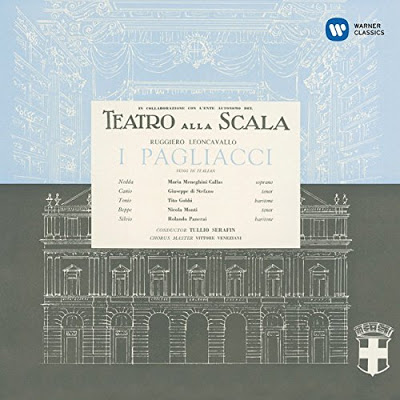
Callas as Nedda in Pagliacci

51hyylyexul

Recorded 12-17 June 1954, Teatro alla Scala, Milan

Producer: Walter Legge, Balance Engineer: Robert Beckett

Nedda was the first of four roles Callas recorded in the studio, but never sang on stage, the others being Mimi, Manon and Carmen. Pagliacci is really the tenor’s opera, and one can imagine the role would have held little interest for her on stage, though, as is her wont, she makes a great impression in a role one wouldn’t readily associate with her.

Back in the 50s, Nedda was usually played by a light-voiced soubrette, who, if she provided any characterisation at all, would play her as a two-dimensional heartless little minx, so how like Callas that she should look inside the music and find more facets to Nedda’s personality.

Her very first words Confusa io son strike a note of fear, justified  when she sings of Canio’s temper (brutale com egli’e) and note the accent she gives to the word brutale. She shrugs off her fear, but in her singing of the ensuing aria, with its paean to freedom, it is not difficult to understand that here is a young woman bursting with life but trapped in a loveless marriage with a man prone to violence.

The scene with Tonio, like all Callas’s collaborations with Gobbi, bristles with drama and life. Here it would seem is another man trying to subjugate her to his will, but her relationship with Tonio is different. Here she has the upper hand. At first mockingly dismissive, she taunts him until he responds with violence; but here too she retains the upper hand, lashing out both vocally (Miserabile!) and physically with the whip. Left alone she expresses her distaste with a voice dripping with loathing, only to change in an instant when she lovingly sings the single word Silvio as her lover makes his appearance.

The duet with Silvio is erotically charged, suffused with warmth and passion, then in the ensuing confrontation with Canio, defiant in the face of fear, her voice hardens again.  Is there a suggestion here that this is ground they have been over before?

Also masterful is the way she uses a different, whiter sound for Colombina, and only in the final stages of the opera in her ultimate refusal to submit to Canio does she return to full voice, riding the orchestra with a defiance that goads Canio into his final act of murder. There are parallels here with Callas’s Carmen.

Di Stefano does well as Canio, though I can’t help feeling that such a Nedda really needed a more psychologically complex foil, along the lines of someone like Vickers, or Domingo in his later portrayals, not that either of them were around at the time of the recording of course. Nonetheless, though some might think him a shade light-voiced for the role, Di Stefano is a very effective Canio, singing brilliantly off the words, his diction, as usual, exemplary.

Gobbi, on the other hand is superb as Tonio, as is Panerai as an ardent Silvio, and Monti, much more than a comprimario, makes an excellent Beppe. Serafin is a relatively unassuming presence. He doesn’t do anything wrong, but nowhere is his conducting as revelatory as it often was in Verdi.

Pagliacci probably wouldn’t rank high on any list of essential Callas recordings (certainly not on mine) and I’d have to be honest and admit it’s not one of my favourite operas. Neither the character nor the music really call on Callas’s greater musical gifts, yet, without stage experience,  she creates a rounded character, and, with a superior cast, this recording has held its own for over 50 years now.

Callas in La Forza del Destino

813aggbmzzl-_sl1500_

Recorded 19-21, 23-25, 27 August 1954, Teatro alla Scala, Milan

Producer: Walter Legge, Balance Engineer: Robert Beckett

Oh my, oh my, oh my! Having spent an afternoon with this recording, I emerged thinking it was the greatest, most moving of Verdi’s operas, that this was its greatest recording, and that Leonora was Callas’s greatest Verdi role, to paraphrase the late John Steane’s review of the Callas Madama Butterfly.

Having now slightly recovered from its emotional impact, I am of course reminded of Callas’s Violetta, the Trovatore Leonora and Amelia, but, I would still place this recording very high in the Callas canon.

Leonora was actually Callas’s first Verdi role. She sang it in 1948 in Trieste, then in Ravenna in 1954 a few months before making this recording, but no more after that.

Verdi’s two Leonoras have some marked similarities and a singer who is successful in one will often be successful in the other (Leontyne Price springs to mind). On the other hand, the Forza role lies quite a bit lower, which is no doubt why Tebaldi is more comfortable in it than she is in Il Trovatore, which she never sang on stage, only on record. If the Trovatore Leonora’s bel canto roots are often glossed over, they are usually completely ignored in La Forza Del Destino, particularly in Act I, which requires a lot more vocal dexterity than it usually gets.

Listen to the aria Me pellegrina ed orfana and note how Callas marks the semi-quaver rests at Ti lascia ahime whilst still maintaining her impeccable legato, observing the downward portamento on the word sorte, the whole phrase sung in a single sweep. As usual the music is rendered with uncanny accuracy, as it is when she brilliantly articulates dotted notes in the cabaletta of the following duet with Alvaro (only too noticeable when Tucker comes galumphing after her, aspirating and puffing in an attempt to keep up).

But, as usual with Callas, she goes beyond accurate observation of the score to reveal the meaning behind the notes. Her very first words (oh angosica) tell us of the conflict in Leonora’s heart, her voice suffused with melancholy. Other sopranos may have given us a more beautifully poised sustained pianissimo top Bb in Pace pace, or drawn a firmer line in La vergine degli angeli, and those for whom such vocal niceties are paramount should probably look elsewhere, but that would be a pity for they would miss, according to Lord Harewood in Opera on Record,

an unparalleled musical sensibility and imagination, subtle changes of tonal weight through the wonderfully shaped set-pieces, and a grasp of the musico-dramatic picture which is unique.

Central to the role, and the opera, is the monastery scene, starting with the glorious Madre, pietosa vergine and finishing with La vergine degli angeli. This whole section, with Rossi-Lemeni a wonderfully sympathetic, if woolly-voiced Padre Guardiano, is a locus classicus of Callas’s art, her voice responsive to every conflicting emotion in Leonora’s heart, her darkly plangent tone absolutely perfect for the character. I doubt you will ever hear it more movingly or truthfully conveyed.

For the rest, Tucker is a strong, virile presence, but often mars his singing with unstylish aspirates and sobs, as if he is trying to do an impression of an Italian tenor. Tagliabue was in his late 50s and sounds it, but Capecchi makes an excellent Melitone and Clabassi a firm voiced (far firmer than Rossi-Lemeni) Calatrava. Elena Nicolai makes little of the somewhat thankless character of Preziosilla, but she is at least more than adequate.

And Serafin is at his very best, dramatically incisive (just listen to those stabbing chords when Leonora is mortally wounded in the last act) and sweepingly lyrical in the best Italian tradition.

The Warner reissue sounds very good to me, and gains on my previous version in containing the whole of Acts I and II on the first disc, which means there is no break in Leonora’s great Act II scena, leaving Act III and IV with a disc each.

A superb set, and one of Callas’s greatest recordings. Too bad she never sang the role again.

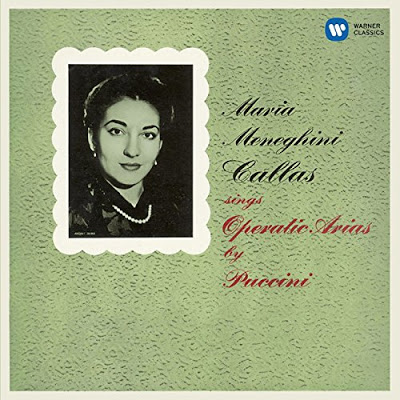
Callas sings Puccini Arias

61qclfmrmgl

Recorded 15-18, 20-21 September 1954, Watford Town Hall, London

Producer: Walter Legge, Balance Engineer: Robert Beckett

This is the first recital record I ever owned , and for some time the only recital record I owned. As such it has quite a lot of sentimental value for me. Most of the music was new to me at that time and I played it constantly. I got to know it so well that I can even now listen without libretto and mime the words. However, as I got older, my tastes changed. I got to love the music of Verdi, Bellini and Donizetti. I felt Callas’s gifts were wasted on Puccini, and so my first love got rather pushed aside. I tended not to listen to this recital quite so often.

To listen to it again now, in this fantastic new re-mastering from Warner (one almost feels as if Callas were in the room with you), was a moving experience and, from the first note, she had me riveted.

Most Puccini recitals tend to the samey, but Callas presents us with a different voice character in each opera. Of the roles represented here, she had at that time only sung Turandot on stage, though she would go on to sing Butterfly in Chicago in 1955. She also went on to record complete performances of Madama Butterfly, La Boheme, and Manon Lescaut, as well as Turandot (though a little too late in her career.

As usual Callas is the mistress of vocal characterisation. Manon, Butterfly, Mimi, Angelica, Lauretta, Liu and Turandot all emerge as completely different characters, but, even within a single aria, she can reveal some hidden depth within the character. Manon, tenderly regretful in In quelle trine moribide, gives way to passion and despair in Sola perduta abbandonata, a despair already hinted at in her voicing of un freddo che m’agghiaccia in the first aria. Butterfly’s wistful imagining of the return of Pinkerton is brilliantly charted, her death scene almost unbearably intense. Mimi is shy and withdrawn, but the warmth which Callas brings to the Ma quando vien lo sgelo section reveals Mimi’s capacity for selfless love.  Angelica’s resigned sadness gives way to a surprisingly sweet and cajoling Lauretta.

Quite the biggest contrast comes when she sings both Liu and Turandot. Liu’s arias are sung feelingly, but possibly with a bit too much muscle, and the ending of Signore ascolta doesn’t eclipse memories of Caballe or Schwarzkopf in the same piece, but Turandot’s In questa reggia is surely one of the best ever recorded. Callas at this time still had the power and security on top to ride its high-lying phrases; and please note she actually sings the words Gli enigmi sono tre on the phrase that takes her up to a top C. Most sopranos, Eva Turner included, reduce them to a vocalise. Furthermore the aria is filled with little details overlooked by most; the almost mystical way she launches the section beginning Principessa Lou-u- Ling, singing with mounting ardour until she vocally points her finger at Calaf with the phrase Un uomo como te. Almost regretful on the section O principe che a lunghe carovane, she strengthens her resolve again at io vendico su voi till her voice cries out with conviction at quell grido e quella morte. Would that she had recorded her complete Turandot at the same time. This is the greatest prize on the recital.

The one uncomfortable moment I remember from the recital (Angelica’s final floated high A) for some reason sounds far less wobbly here than it ever did before, and the voice in this re-mastering has enormous presence. Serafin, as ever, provides invaluable support.

A classic of the gramophone.

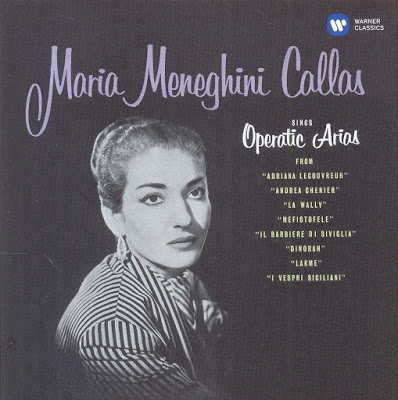
Maria Meneghini Callas Sings Operatic Arias

91epg5zapfl-_sl1465_

Recorded 17-18, 20-21 September 1954, Watford Town Hall, London

Producer: Walter Legge, Balance Engineer: Robert Beckett

This recital, the second Callas recorded for EMI, was designed to show off her versatility, so we get one side of verismo, and one of coloratura, with Boito’s L’altra notte from Mefistofele bridging the gap. It caused quite a stir at the time. The coloratura side was of material more associated with singers like Galli-Curci and Pagliughi; the verismo items more likely to be the preserve of Ponselle and Muzio, or Callas’s contemporary, Tebaldi. There is no doubt that Tebaldi could not have attempted any of the coloratura items on the disc and the gauntlet was effectively laid down. The range too is phenomenal, and takes her up to a high E natural (in the Vespri aria, and the Bell Song), a note unthinkable from a soprano who could bring the power she does to an aria like La mamma morta.

Of the operas represented, Callas had only sung Mefistofele and I Vespri Siciliani on stage at that time, though she would go on to sing Rosina in Il Barbiere di Siviglia (and make a very successful studio recording) and Maddalena in Andrea Chenier. But, as is her wont, even in isolation, Callas is able to enter fully into the character and sound world of each character that she is singing.

She starts with two of Adrianna’s solos from Adrianna Lecouvreur, a role that would no doubt have suited her dramatic gifts down to the ground, though, truth to tell, the opera is pretty tawdry stuff. I have the recording with Scotto and Domingo, who make the very best case for it, but I still have little time for it. That said, Callas is brilliant at conveying Adrianna’s humility in the first aria, her pain and sadness in the second. Her recording of La mamma morta is well known, and became quite a hit after it was featured in the Tom Hanks Oscar winning movie Philadelphia. Notable is the way Callas’s tone colour matches that of the cello in the opening bars, and the way she carefully charts its mounting rapture. Some may prefer a richer, fuller sound. None have sung it with such intensity.

Ebben ne andro lontana, a glorious performances, is full of aching loneliness, its climax solid as a rock, but the prize of this first side is without doubt the crepuscular beauty of Margherita’s L’altra notte from Boito’s Mefistofele, a sort of mini mad scene, which Callas fills with a wealth of colour and imagination. One notes the blank, colourless tone at L’aura e fredda, even more drained and hopeless on its repeat, the baleful sound of her chest voice on E la mesta anima mia; and does any other singer so accurately encompass those coloratura flights of fancy as her soul takes wing on Vola, vola? This is the stuff of genius.

The second side also has its attractions. Rosina’s Una voce poco fa is a mite slower than it was to become in the studio set, but Callas’s ideas on the character are perfectly formed, and she already uses that explosive Ma to underline Rosina’s less than docile temperament. Her runs, scales and fioriture are as elastic as ever, and the little turns on the final faro giocar have to be heard to be believed.

The Dinorah aria is a rather empty piece and I sometimes wonder why she even bothered with it. There are some magical echo effects and her singing is wonderfully fleet and accurate, but it’s not a favourite of mine. I’m not a big fan of the Bell Song either, to be honest. Callas lavishes possibly more attention on it than it’s worth, but in so doing at least makes it a little more interesting than the birdlike warblings we usually get. The opening has a mesmeric , almost improvisational air about it, and the bell imitations are clear and true. I remember once playing this track at a friend’s place one summer evening, the window open, while a bird (I have no idea what it was) sang for all its worth on a branch just outside.  It was as if the bird was singing in response. The high E she sings at its climax is clean as a whistle, but it does sound like the very extreme of her range. Best of all the coloratura items is her breezy, elegantly sung Merce, dilette amiche from Verdi’s I Vespri Siciliani, which is lovely in every way and ends on another epic high E.

Callas at La Scala

51fx5yefo1l

Recorded 9-12 July 1955, Teatro alla Scala, Milan

Producer: Walter Jellinek, Balance Engineer: Robert Beckett

Though recorded in 1955, release of this disc was delayed until 1958. Callas did not approve the arias from La Sonnambula for release and, when the recital was finally issued, it was made up with arias from the complete sets of I Puritani and La Sonnambula. EMI did eventually issue the Sonnambula arias, but not until 1978, on an LP called The Legend which included other unreleased material.

It’s true, there is a slightly studied air about the performances of them (and a chorus would no doubt have done much to enliven the proceedings), but her singing is unfailingly lovely. One misses that stunning cadenza between the two verses of Ah non giunge, with its stupendous ascent to a high Eb, which we get in both the studio and Cologne performances, and both cabalettas are over simplified, completely free of the flights of fancy Bernstein encouraged her to indulge in at La Scala. Serafin had apparently refused to let her do them. Maybe that is the reason she eventually rejected them. I’m glad I’ve heard them, but her Amina is better represented in the various live performances and the complete studio performance.

The Medea and La Vestale arias are more successful. Medea, of course, became one of her greatest stage successes. The opera was almost completely unknown when she first sang it in Florence in 1953 under Gui, but such was her success in the role that La Scala scotched plans for a revival of Scarlatti’s Mitridate Eupatore later that year and replaced it with the Cherubini opera.  Callas’s singing of Dei tuoi figli la madre abounds in contrasts, reminding us that this is an appeal to Giasone. Callas reminds us that it is love, not revenge, that brings Medea to Corinth; notable here the softening of her tone at the repeated pleas of Torna a me, the pain in the cries of Crudel.

The arias from La Vestale are reminders of her one traversal of the role of Giulia at La Scala in 1954, in a stunning production by Visconti, which marked the emergence of the new, slim Callas, and the start of a whole new era, which resulted in the acclaimed Visconti productions of La Traviata, La Sonnambula and Anna Bolena.  Tu che invoco is notable for its long legato line, and the intensity she brings to the turbulent closing section, where her voice rides the orchestra with power to spare. O nume tutelar brings back memories of Ponselle, but Callas in no ways suffers by the comparison, her legato as usual superb, and the aria sung with a classical poise and sure sense of the long line. O caro ogetto has the same virtues.

There exists a complete recording of that La Scala La Vestale, but it is in such wretched sound, that this recital is valuable for Giulia’s arias alone. Her Medea and Amina are better represented elsewhere.

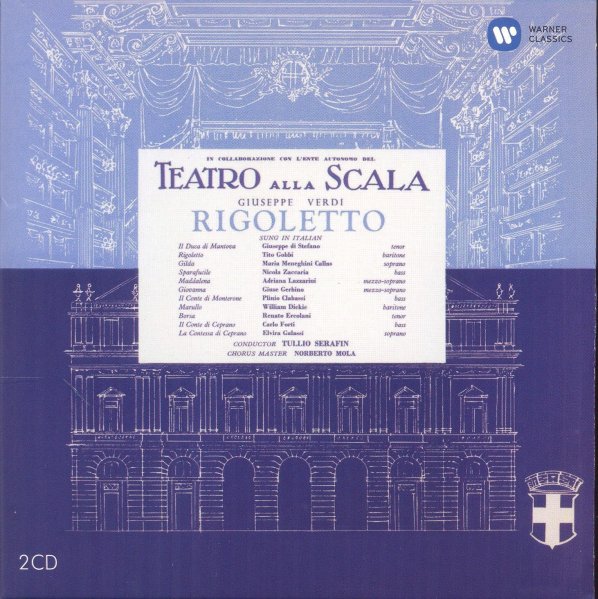
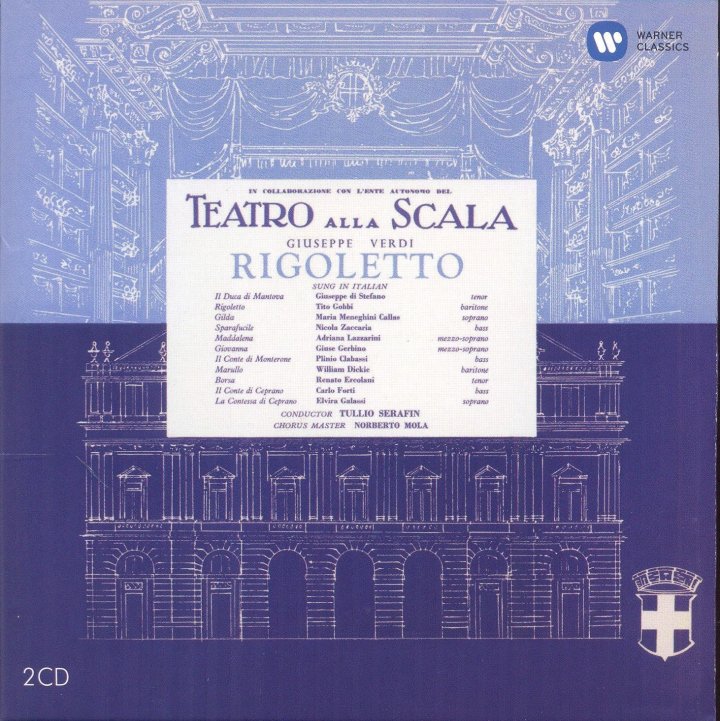
Callas and Gobbi in Rigoletto

91km0olq4ul-_sl1466_

Recorded 3-16 September, 1955, Teatro alla Scala, Milan

Producer: Walter Legge, Balance Engineer: Robert Beckett

Gilda is another role one would not readily associate with Callas. She did sing it on stage for two performances in Mexico in 1952, but, unhappy with her performance, never sang it again except for this recording made in 1955. The Mexico performances are a bit of a mess and sound under-rehearsed, but Callas is superb, and one notes how it is often she who keeps the ensemble together, even though she was so blind on stage she could never see the conductor. It is actually something of a tragedy that she didn’t sing the role more often. If she had, then people may have rethought the role of Gilda, as they did that of Lucia. It is usually sung by a light voiced lyric coloratura, who manages Caro nome well enough, but can’t really muster the power to dominate the ensembles in the last two acts, as she should. It’s something I’ve noticed myself. Not so long ago I saw the opera at Covent Garden with Aleksandra Kurzak as Gilda. She looked ideal, convincingly acted the ingénue, sang a wonderful Caro nome, but tended to be drowned out in the final act, especially in the storm scene.

No problem there for Callas of course, but the miracle is not that she can sing out with a but more power when needed, but that she remains in vocal character when she does. She doesn’t suddenly sound like Norma or Tosca, but continues to think upwards in a voice somehow cleansed of all those heavier associations.

I often think it odd that when people talk about Verdi sopranos, it is the voices of Tebaldi and Leontyne Price they have in mind, but could either of those sopranos have sung Gilda, or Lady Macbeth, or any of Verdi’s early roles? Tebaldi may have sung Violetta, but it wasn’t a natural for her, the coloratura in Sempre libera smudged (and transposed down in live performances). Nor did Tebaldi sing the Trovatore Leonora on stage, as the role lay too high for her. Price did of course, and she was an appreciable Leonora, though she doesn’t sing with the same degree of accuracy as Callas. Callas, on the other hand, sang with equal success Gilda and Lady Macbeth, Abigaille and Elisabeth de Valois, Elena and Aida, both Leonoras, Amelia and Violetta, all on stage not just in the studio, and one regrets that she didn’t get the chance to sing more of Verdi’s early operas. What a superb Luisa Miller she might have made, or Odabella in Attila, Griselda in I Lombardi, or virtually any of those early Verdi heroines. Maybe, after all, it is Callas who is the ideal Verdi soprano.

But back to this Rigoletto, in which Callas yet again completely inhabits an uncharacteristic role. In the first two acts, she presents a shy, innocent young girl, with a touch of wilfulness that explains her disobedience to her father. In the duet with Rigoletto, we feel the warmth of her love for him, and in the one with the Duke, the shy young girl awakening to passion. You can almost see her blushes when the Duke first appears to her. She was asked once why the single word uscitene resounded with such a strange colour. “Because Gilda says go, but wants to say stay,” was her simple answer. Actors might be used to such psychoogical distinctions but it is rare indeed to find it in singers. Caro nome is not just a coloratura showpiece, but a dreamy reverie, and ends on a perfect rapturous trill as she exits the stage. In Act III her voice takes on more colour (Ah, l’onta, padre mio) and it is Tutte le feste that becomes the focal point of her performance, her voice rising with power to the climax (nell’ansia piu crudel) as  she describes the horror of what happened, and note how at the opening she matches her tone to that of the cor anglais introduction. She has the power to ride the orchestra in the storm scene in the last act, and the final duet with Gobbi is unbelievably touching. As usual her legato is superb, phrases prodigious in length, shaped and spun out like a master violinist. It is a great pity she didn’t sing Gilda more often, for it is a considerable achievement.

There are other reasons to treasure this performance of course, chief among them being Gobbi’s superbly characterful, endlessly fascinating and heartrending performance of the title role. Gobbi and Callas always had a striking empathy, and the three duets for father and daughter in this opera, gave that relationship full rein. Some have remarked that Gobbi’s voice was not a true Verdi baritone (whatever that means), but, like Callas, he was successful in a range of different Verdi baritone roles, his most famous probably being Rigoletto. Who has ever matched Gobbi in tonal variety and vocal colour, and psychological complexity? None that I can think of. Pari siamo is superbly introspective and then in Cortigiani! he lashes out like a wounded animal, before breaking down in accents that are pathetically heartrending. To those who say he could not sing with beauty of tone, I would say there are plenty of moments in the score which refute that assertion,  the Piangi section of the Act II duet, where he spins out a pure legato which is both musical and shatteringly moving, being a case in point.

Di Stefano may not be quite in their class, and there are certainly more elegant Dukes on record, but he sings with enormous face and charm. One can imagine why Gilda would be captivated by this Duke. He can be musically inexact (some of the tricky rhythms in Act I go a bit awry), but his voice is in fine shape, and he sounds both charming and sexy, which is as it should be. Nor does he play down the casual cruelty that lies at the heart of his character. I’d say it’s one of his best recordings.

Serafin’s conducting is in the best Italian tradition, both lyrical and dramatically incisive. He is totally at one with Callas and Gobbi in the duets, giving them ample time to make their dramatic points, but whips up quite a storm in the finale to Act II.

The sound is truthful and clear, the voices wonderfully present, and, as in all the Warner sets so far, sounds excellent on my system.

Years ago I remember an acquaintance, not really a voice fan (or a major opera fan, for that matter), asking me which recording of Rigoletto I recommended. He had the Giulini, and quite enjoyed it, but thought there was something missing. I warned him that some were allergic to Callas’s voice, but lent him my set anyway. A couple of days later he excitedly returned it to me, having ordered the recording for himself. “Fantastic,” he said, “Exactly what I was looking for. Suddenly the whole opera came to life.” Well you can’t ask for much more than that.

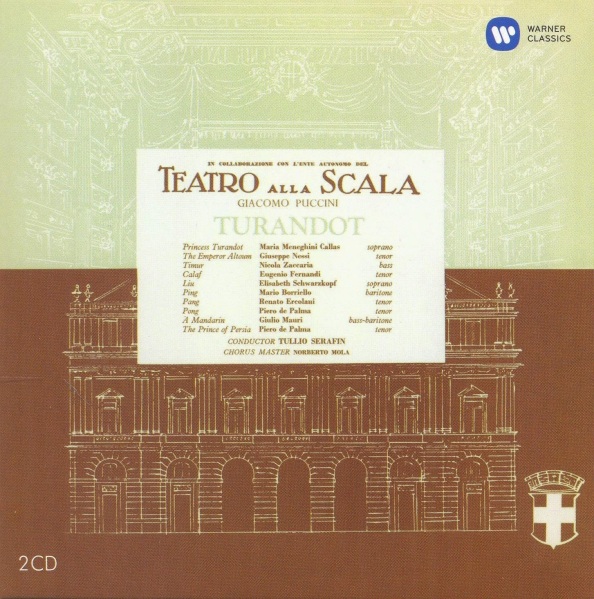
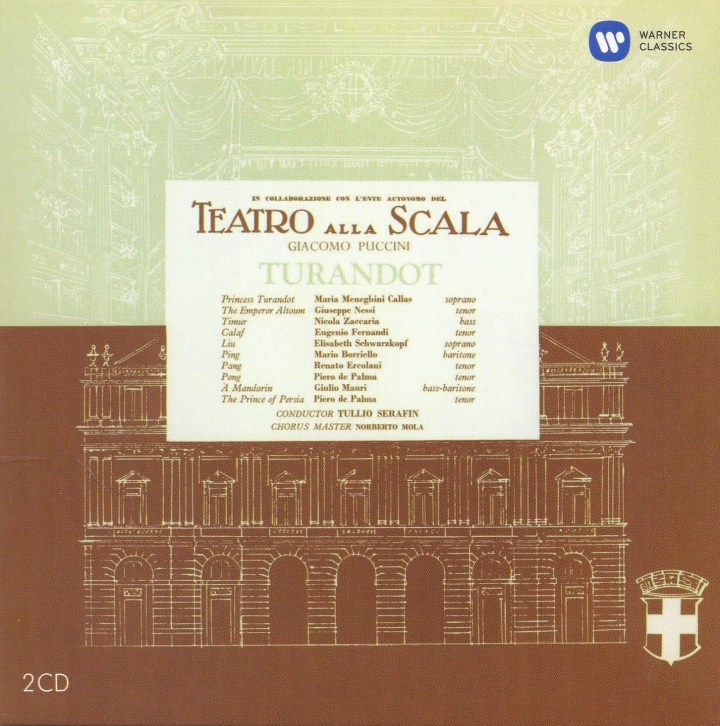
Callas as Turandot

9172j0czwml-_sl1467_

Recorded 9-13, 15 July 1957, Teatro alla Scala, Milan

Producers: Walter Legge and Walter Jellinek, Balance Engineer: Robert Beckett

1957 started well for Callas. She made two of her best recordings (Il Barbiere di Siviglia and La Sonnambula) and had a huge success as Anna in Anna Bolena at La Scala. The Iphigenie en Taurdie which followed may have been more of a succès d’estime but, though her colleagues were decidedly under par, she was superb and in good voice, as she was when La Scala took their production of La Sonnambula to Cologne in Germany.

She then records two operas far less suited to her gifts (Turandot and Manon Lescaut), goes on to sing a concert in Athens, when she is decidedly not in her best voice, sings Amina again with the La Scala company in Edinburgh, where she sounds thoroughly exhausted, and then  compounds the problem by recording Medea. The cracks are definitely beginning to show. After a few week’s rest, she is back on form for a Dallas Opera Inaugural concert (or appears to be on a recording of the rehearsal), and finishes the year well with a stupendous performance of Amelia in Un Ballo in Maschera at La Scala.

Turandot figured quite heavily in Callas’s early career. In 1948 and 1949 she sang it in Venice, Rome Caracalla, Genoa, Verona, Naples and Buenos Aires. She once said in interview that she dropped it as soon as she could, “because it’s not really good for the voice, you know.” All that exists from any of these performances are a couple of short extracts from the Buenos Aires performance, in which her voice is massive and free-wheeling, as far as one can tell through the execrable sound. By 1957 her voice has considerably pared down, and one might wish that she had recorded the role even a few years earlier when she sings a vocally secure and thoroughly commanding version of In questa reggia on the Puccini recital of 1954.

That said, I find the voice less wobbly and ill-supported than I do in the Manon Lescaut, which followed, on which, to my ears, she sounds exhausted, for all her customary musical imagination and insights. She is more secure in this Turandot but she doesn’t really disguise the effort it costs her. Where Nilsson and Sutherland, and Eva Turner before them, soar, Callas is more earth bound. That said, she makes a psychologically more complex heroine than any of them, her singing more subtly layered than we have come to expect from a Turandot. Hear how she vocally points the finger at Calaf in In questa reggia when she sings Un uomo come te, the almost mystical recounting of the story of Lou-u-ling. The first signs of Turandot’s vulnerability come in the Riddle Scene, anxiety creeping into her voice at Si la speranza che delude sempre, and her pleading to her father is almost in the voice of Butterfly, suddenly a daughter trying to get round her father. There are signs of her vulnerability too in the brief scene with Liu, when she asks,  Che posa tanta forza nel tuo core, mirroring Liu’s response with her repetition of the word L’amore. Even the last scene is less of an anti-climax than it usually is. When she sings Che e mai di me? Perduta, we know that she is conquered, and her final aria Del primo pianto is sung with a wealth of detail. For all the evident strain the role makes on her resources, it is a great performance, and she is far less stressed by its demands than Ricciarelli is on Karajan’s recording.

The rest of the cast is interesting. Many have opined that Schwarzkopf sounds as if she had wandered in from the wrong opera, but I like her finely nuanced and beautifully shaded Liu. She is particularly impressive in her exchanges with Turandot and in the mini aria Tanto amore, effecting a wonderful diminuendo on the line Ah come offerta suprema del mio amore. What a pity this is the only time the two most intelligent sopranos of the post war period ever sang together. Fernandi, a strange choice considering he was very little known at the time, and hardly at all since, is rather better than his lack of reputation suggests. Not as exciting as a Corelli (why on earth was he not engaged?) he nevertheless sings a valid Calaf, often phrasing with distinction. Not the best Calaf on record certainly, but not the worst either. Zaccaria is a sympathetic presence as Timur, Ping, Pang and Pong all characterful. There is also a connection with the first ever performance as Nessi, who sings the Emperor, created the role of Pang.

Serafin’s conducting is excellent, urgent and well-paced. What a pity that he doesn’t have the benefit of modern stereo sound, which this of all operas really cries out for. The sound here is, to my ears anyway, less boxy than the sound for Manon Lescaut, though it is not as open as, say, the De Sabata Tosca, which was recorded four years earlier. This Warner pressing sounds a good deal better than my 1997 Callas Edition, with Callas’s voice far less shrill in the upper reaches. It may never be anyone’s library choice for the opera, but I would not want to be without the insights Callas brings to the role. It is, in many respects, a more thoughtful rendering of the score than we often hear.