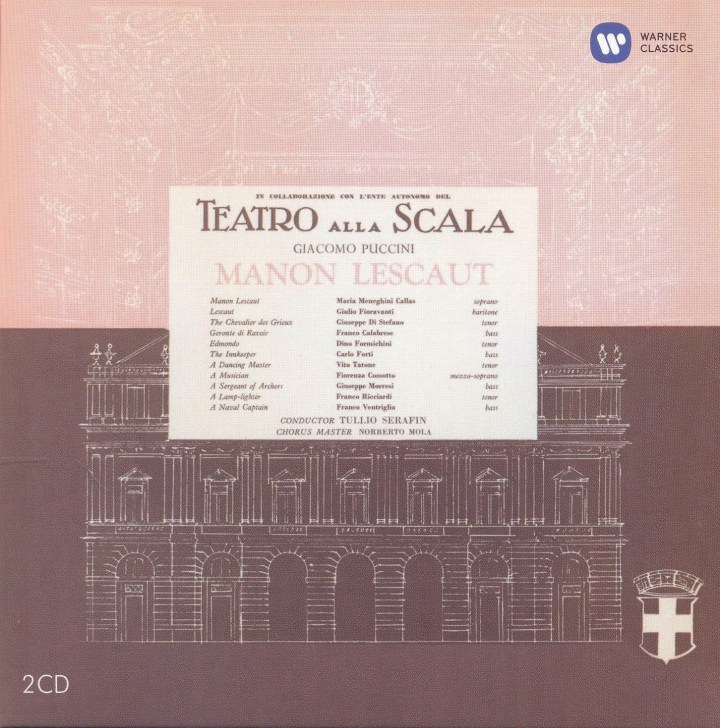
Callas in Manon Lescaut

91nkir4mq2bl-_sl1470_

Recorded 18-27 July 1957, Teatro alla Scala, Milan

Producer: Walter Legge, Balance Engineer: Robert Beckett

Manon Lescaut has never been a favourite opera of mine, and to my mind pales in comparison to Massenet’s work, which is a truer representation of L’Abbe Prevost’s novel, for all that he ends the opera in Le Havre rather than America; nor does this recording rank particularly high in my roll call of Callas recordings. Though recorded in 1957, it waited 3 years before it was released, so presumably Legge and Callas had their doubts too.

For much of the first two acts, the recording itself has a curiously flat sound to it, and though we hear a fair amount of orchestral detail, both strings and voices sound undernourished. I don’t know whether it was me becoming more involved, but things do seem to improve in the last two acts, where Callas also sounds more comfortable vocally.

To my ears, she has always sounded utterly exhausted in this set. It was recorded shortly after Turandot, which she really ought not to have been singing at that stage in her career anyway. She manages Turandot surprisingly well, but the effort it must have cost her shows in the parlous state of her top in much of this Manon Lescaut. She is actually in much better voice in the later complete recordings of La Gioconda, Lucia di Lammermoor and Norma, even the Medea, which followed it, but then in all those she was singing repertoire more suited to her gifts. I’m not sure it was ever the right voice for Puccini, for all her success in the role of Tosca. Not long after this, she sang Amina in Edinburgh and made the studio recording of Medea, neither of which find her in her best form, and it is not until the Dallas Inaugural Recital in November that she recovers form. She is also in stupendous voice for the live La Scala Un Ballo in Maschera in December, so presumably she had benefited from some rest. Even in the middle and lower registers here, much of the velvet is missing from the voice, and even in quieter passages she doesn’t seem to have sufficient energy to support the voice.

Of course, there are, as always, musical compensations aplenty. In the first act, Callas sings with a lightness and purity that mirrors Puccini’s con semplicita markings. Later, her In quelle trine morbide is even more finely nuanced than on the recital disc of 1954, sung more as a reflection to herself than to Lescaut; and the trills and grace notes in L’ora o Tirsi are sung with a lightness and accuracy that eludes most singers of the role; the duet with Des Grieux is full of restrained passion. In Act III she has less to do, but her few exchanges have a weariness and dull despair that is most affecting. However it is in the often anti-climactic final act, where vocally and dramatically she is at her best, with a harrowing Sola perduta and a chillingly moving death scene.

Di Stefano’s singing is variable, occasionally disturbingly tight on top and at other times admirably free, but he does bring personality and face to his singing. Full of youthful joie de vivre in Act I, he becomes a man consumed with love and literally at the end of his tether for Guardate, pazzo son. It’s an appreciable performance, if not the best sung Des Grieux you’ll ever here.

No complaints about the rest of the cast. Fioravanti I have never come across before or since, but he makes an excellent Lescaut and we also get a nice cameo from Fiorenza Cossotto as the madrigal singer.

Serafin, as so often, gets the pacing just right. So much about his conducting is just so unobtrusively right, and in Act III he builds the ensemble leading up to Des Grieux’s outpouring at Guardate, pazzo son in masterly fashion.

Not an opera or a recording that I want to listen to that often, (why oh why didn’t Legge record her in more of the repertoire for which she became famous?) but it certainly has its moments.

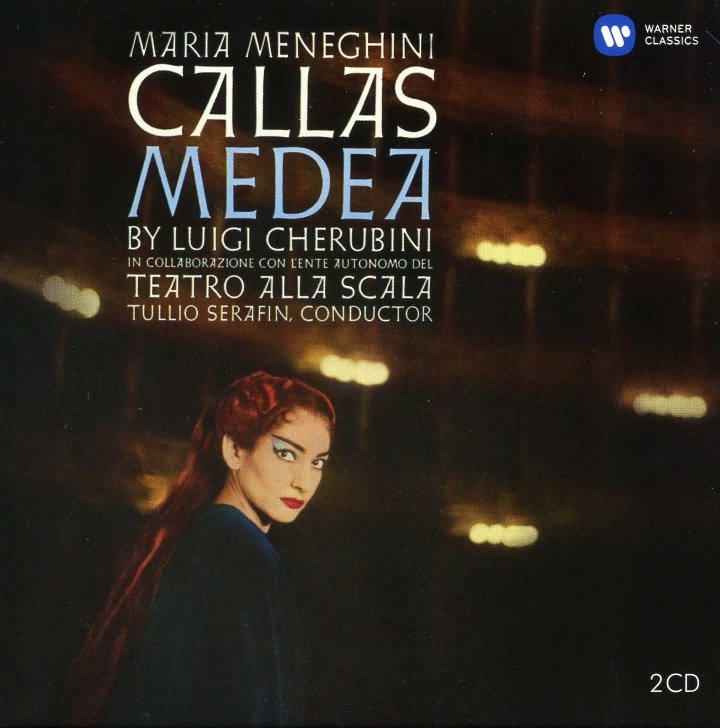
Callas’s Studio Medea

81xwlszwrml-_sl1456_

Recorded 12-19 September 1957, Teatro alla Scala, Milan

Producer: Wilma Cozart. Balance Engineer: Robert Fine

This recording of Medea has an unusual history. Medea had become a seminal Callas role, and she desperately wanted to record it. The opera was revived specially for her first in Florence in 1953, and she subsequently sang it in new productions in Milan (under Bernstein), Rome, Dallas, London, Epidaurus in Greece, and again at La Scala for the last time in 1961. Like much of her stage repertoire, Legge had little interest in it and agreed to release her from her contract, when Ricordi, who were launching a new label, approached her about recording it. EMI, no doubt finally realising its importance in the Callas canon, did eventually release it, but it has also been released by Mercury, Everest, and no doubt others.

However she was probably unwise to record it when she did, right after the Edinburgh performances of La Sonnambula when she was in ill health. Her voice isn’t exactly wobbly above the stave here, but it does lack power, a power that she recovers when she sings the role in Dallas the following year.

That said, when I first got to know this opera, and this recording, I had no other point of reference, and it seemed pretty good to me. It was only later, when I heard those barnstorming performances from Florence, La Scala and Dallas, that I found anything lacking, and it is only in comparison with herself that she fails. She is still a good deal better in the part than any other who attempted it, certainly a lot better than Gwyneth Jones and Sylvia Sass, who also made studio recordings of this Italian version. In other hands, Cherubini’s music can seem staid and formulaic. Callas breathes life into it like no other.

The version of Medea that Callas sang is actually a hybrid. Medée was originally an opera-comique in French with spoken dialogue. It was later translated into Italian, then recitatives were written by Franz Lachner for a German production. The version Callas performed was an Italian translation of the Lachner version, premiered at La Scala in 1909, over a hundred years after its first performance and 60 years after Cherubini’s death. Even so, each conductor Callas worked with (Gui, Bernstein, Rescigno, Serafin, Schippers) prepared their own version of the score, and made their own cuts. Consequently no two Callas performances are the same.

Serafin’s conception is essentially Classical, but his conducting varies from the somnolent to the dramatic. After a tautly conceived overture, the first scene up to Medea’s entrance drags on interminably. I understand the necessity to establish a pastoral air of peace and calm, into which the Colchian Medea bursts, but, quite frankly, at this pace it just becomes a bore. On LP I used to miss out the first side completely, and set the needle down part way through the second LP, when Medea makes her entrance.

Without foreknowledge of other performances by Callas, this is still a great performance of a difficult role. We lose some of the power and ferocity, but there are gains too. Ricordi il giorni tu la prima volta quando m’hai veduta? is couched in the most melting tones, her duplicity in the scene with Creon, and the following duet with Jason brilliantly charted, and her scene with the children movingly intense. Vocally, for all that she is not in her best voice, she manages its angular lines and wide leaps with consummate skill, her legato still wondrously intact. Note also how, in this Classical role, her use of portamento is more sparing.

When it comes to the supporting cast, Scotto is less of an advantage than you might expect, Pirazzini rather more (though not quite a match for Barbieri in Florence and at La Scala or Berganza in Dallas). Picchi, who sang Pollione to Callas’s Norma in London in 1952, is rather good, though Vickers is even better in Dallas. Modesti makes a good Creon too, though I would prefer Zaccaria in Dallas.

So, all in all, still probably the best studio Medea you’re likely to hear, and the sound (stereo, but still rather boxy) is a lot better than what you will hear in Florence, Milan or Dallas. Nevertheless all three of those performances are preferable, regardless of sound quality, for the white hot intensity Callas brings to the role.

Callas’s 1959 Studio Lucia di Lammermoor

9145da2b4z5l-_sl1500_

Recorded 16-21 March 1959, Kingsway Hall, London

Producer: Walter Legge, Balance Engineer: Christopher Parker

Popular opinion holds that Callas’s Lucia is best represented by her earlier commercial recording made in 1953, and by the live Karajan performance from Berlin.

So why would anyone bother with this remake, made in 1959? Surely, apart from much better sound, it can’t have much to commend it, given the problems Callas was beginning to have with her voice, especially in the upper register, in the late 1950s. In addition the other soloists on both the 1953 studio and live Karajan are much better than the ones we get here. Cappuccilli is nowhere near as menacing as either Gobbi or Panerai, and consequently there is a loss of drama in the first act and in his confrontation with Lucia. Tagliavini may have seemed like a good idea at the time, a lyric tenor in the old style, but by 1959, even though only 45, he was beginning to sound old. One misses Di Stefano’s youthful ardour, even if Tagliavini is more stylish. As for Bernard Ladysz, just why? As far as I’m aware, the only other recording he made was of Penderecki’s  The Devils of Loudon. Who on earth thought he might be any good in Donizetti? He is no match for either Arie on the earlier recording or Zaccaria in Berlin.You might therefore think that this set is  only for the die-hards, only I’m not so sure it’s that simple.

Listening to it again for the first time in a few years, I was actually astonished at just how good she sounds, and it reminded me that in fact I first really got to know Callas’s voice from post weight- loss records.  This set was my first exposure to Lucia di Lammermoor, and I don’t remember the state of Callas’s voice bothering me too much back then. I was just overwhelmed by the truth of the interpretation, and the beauty, yes beauty, of much of her singing. Ok, the top Ebs are not exactly things of beauty, and she shortens the cadenza in the Mad Scene substantially, but the filigree of the role is stunningly executed. If she is strained by its upper reaches, then it seems a pity the bel canto revival hadn’t moved on enough for her to be able to record the version Caballe recorded, in generally higher keys, but without the stratospheric top notes. It might well have suited the Callas of 1959 a lot better.

There is no doubt this Warner re-master is a vast improvement on the Callas Edition CDs. Most of the shrillness on high seems to have faded away. In some ways, and though she sounds no more secure, the voice in general falls far more easily on the ear, and she has peered even deeper now into Lucia’s psyche. From the word go, this Lucia is highly strung, a romantically inclined dreamer, completely lost in the cruelty of a man’s world. There is desperation in her Ah, no…rimanga nel silenzio sepolto per or l’arcano affetto. Already she sounds slightly unhinged. It is not difficult to understand that it would take very little to tip her over the edge. Later in the scene with Enrico, Ahi. La folgore piombo pierces one’s very soul, and the ensuing Soffriva nel panto is sung with heart-wrenching sorrow.

In the Wedding Scene, she sounds almost in a trance, and even in the few solo lines she has, she manages to convey Lucia’s utter despair. As an assault on women, Lucia di Lammermoor must be one of the cruellest operas in the repertory. As for her singing, her legato line is as usual superb, the coloratura has a lovely finish and in the Mad Scene, her singing has almost an improvisatory air about it. This is surely the art that conceals art.

I have a fondness for it. It was not recorded at La Scala, but at Kingsway Hall with the superb Philharmonia orchestra, and the sound is very good indeed. The 1955 Berlin performance would still be my desert island choice, the sound much better than most of her live recordings, but both studio recordings also have a lot to commend them, and, as I’ve already pointed out, this one does enjoy much improved sound.

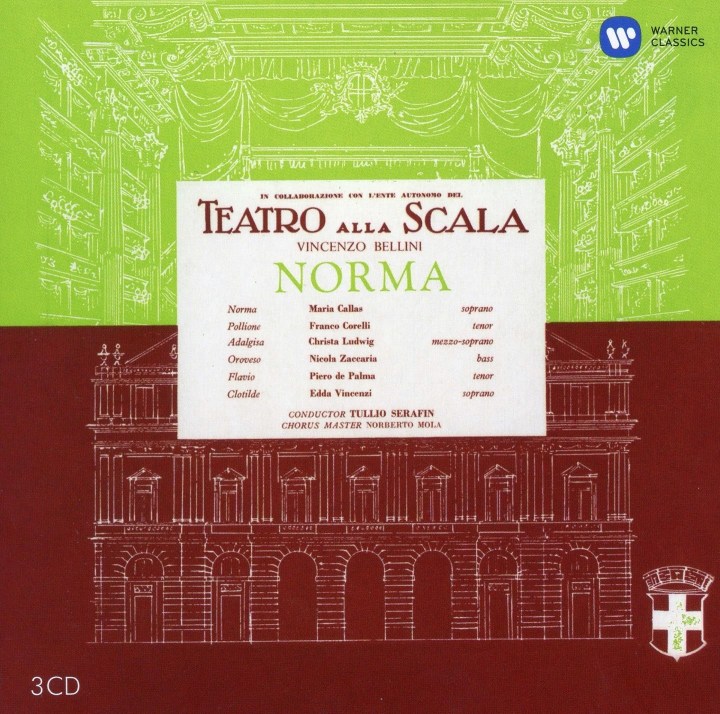
Callas’s 1960 Studio Norma

91pj158binl-_sl1500_

Recorded 5-12 September 1960, Teatra alla Scala, Milan

Producers: Walter Legge & Walter Jellineck, Balance Engineer: Robert Gooch

This was actually the first opera set I ever owned, and, so it comes with a host of memories. I was only 18. Why Norma for a first opera, you might ask. Well I had recently discovered Callas, and at that time very little of her recorded repertoire was available. I knew that Norma was considered her greatest role, so I thought it would be a good place to start. Collecting opera was expensive in those days, and my older brother, who was working by this time, bought the set for me for Christmas. I was unbelievably excited, my excitement only slightly tempered by the discovery that no libretto was included, only a synopsis, and that I would have to send off for it, not of course that I waited for its arrival before sampling the set.

It being my one and only opera set for a good few months, I got to know the opera pretty well, and of course Callas’s unique inflections will for ever be part of that knowledge. Since then of course, I have heard a fair amount of other Normas, Sutherland, Caballe, Eaglen, Bartoli (please, never again), Sass live at Covent Garden (disastrous) and plenty more by Callas herself; the live 1952 Covent Garden, the 1954 studio, the 1955 Rome broadcast and, best of all, the live 1955 La Scala, as well as excerpts from many others, right up to her final performances in the role in Paris in 1964.

So how does it hold up? Well, pretty well actually. True, notes above the stave have taken on a metallic edge, and they don’t always fall easily on the ear, but the middle and lower timbres have a new found beauty, and a characterisation that was always complex and multi-faceted has taken on an even greater depth, parts of it voiced more movingly here than anywhere else.

There are other gains too. The cast here is a vast improvement on the earlier studio one, Corelli in particular being a shining presence. Fillipeschi was a liability on the earlier set, but, whilst not quite a paragon, and chary of some of the coloratura in his role (Serafin making a further cut in the great In mia man duet to accommodate his lack of flexibility), Corelli’s is a noble presence, and his clarion voice is ample compensation. Zaccaria may be less authoritative than the woolly voiced Rossi-Lemeni, but his tones are distinctly more buttery. Ludwig is an unexpected piece of casting, but she too is an improvement on Stignani, who, great singer though she was, was beginning to sound a bit over the hill by the time of the first Callas recording (she was 50 to Callas’s 30). Ludwig sounds, as she should, like the younger woman. Her coloratura isn’t always as accurate as one would like, certainly no match for Callas, but she sings most sympathetically in duet with her older colleague, and Mira o Norma is, for me, one of the greatest performances on disc. After Ludwig states the main theme, Callas comes in quietly almost imperceptibly and at a slightly slower tempo with an unbearably moving Ah perche, perche, her voice taking on a disembodied pathetic beauty. When Ludwig joins her for the section in thirds, she perfectly matches Callas’s tone on her first note, before Callas joins her in harmony, a real example of artists listening to each other in a sense of true collaboration.

One should I suppose mention the losses from the earlier recording. Yes, some of Callas’s top notes are shrill, and we lose some of the barnstorming heroics that were a part of Callas’s Norma right up to 1955. This Norma is more feminine, more vulnerable, if you like. How much this had to do with interpretive development, and how much with declining vocal resources is a moot point, but there is no doubt Callas is still a great singer, doing the best she can with what she has. Some sections are more moving here than in any of her other performances. I’ve already singled out Mira o Norma but the earlier duet is its equal, Callas wistfully recalling her own awakening to first love.

The beginning of Act II always brought out the best in her, and here she is sublime. Dormono entrambi is an unusual piece which alternates passages of recitative with arioso, rather like Rigoletto’s Pari siamo. Callas draws on all the colours in her palette to express Norma’s contrasting emotions. You can almost feel the chill that comes over her at un gel me prende e in fronte si solleva il crin followed by the choked emotion of I figli uccidi! The arioso of Teneri figli is couched in a tone of infinite, poignant sadness, but then her tone hardens with her resolve at Di Pollion son figli, before, with a cry she drops the knife (and we can almost hear the precise moment), crying out Ah no, son miei figli! Operatic singing and acting on the highest level.

Serafin’s conducting is much as it was in the first set. He has the virtue of not conducting the opera as if it were Verdi, as so many do. Sometimes I’d like him to get a move on a bit, but his pacing of the final two duets (one in public, one in private) is superb, and he perfectly judges the climaxes in the Grand Finale, one of the greatest in all opera.

I’ve always found it difficult to choose between Callas’s studio recordings of Norma. I wouldn’t want to be without either. Nor would I want to be without her 1955 live La Scala account, with Del Monaco and Simionato, which is where voice and art find their greatest equilibrium. One thing is for sure, Callas remains the quintessential Norma. No singer has yet challenged her hegemony in the role.