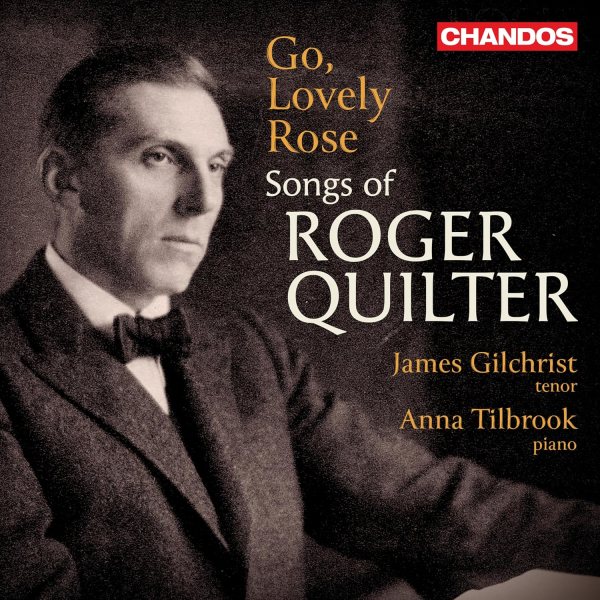
Go Lovely Rose – The songs of Roger Quilter

91aupp0ckgl._ac_sl1500_

James Gilchrist (tenor) Anna Tilbrook (piano)

The songs of Roger Quilter are not performed as often these days as they once were, which is a shame, because they are beautifully crafted and, though perhaps they don’t probe as deeply into the texts as those of Finzi, Delius and Warlock, they are very rewarding for performers and listeners alike. Quilter had a wonderful gift for melody, but it was always melody put at the service of the poetry and the text is sung more or less as if it were spoken. Having performed many of the songs myself in my youth, I can attest to the fact that they are a gift to the performer.

Rather than give us whole opus numbers, Gilchrist and Tilbrook have chosen songs from his complete oeuvre, with the songs grouped into themes. Thus, we have six Shakespeare songs, drawn from the Op. 6, Op. 23 and Op. 32 sets of Shakespeare settings, five songs associated with flowers (A Floral Tribute), four Folk Song settings (all taken from The Arnold Book of Old Songs), four songs associated with the graveside, and four Songs of Love. The only songs performed as a set are the early German songs, written when Quilter was studying in Frankfurt. These are charming, but slight and give little indication of Quilter’s later, more mature style.

Initially alienated by the rather gruff sound of Gilchrist’s voice in the opening robust Blow, blow, thou winter wind (we are at once aware that this is not the voice of a young man, and indeed Gilchrist was approaching sixty at the time of the recording), I was drawn in by his elegiac delivery of Come away, death, and thereafter, I was less aware of any failing resources. Indeed, in the more gently reflective songs, with which the disc proliferates, Gilchrist is often spellbindingly beautiful, spinning out some lovely pianissimi in such songs as Fear no more the heat of the sun, the famous Now sleeps the crimson petal and the song which gives the collection its name, Go lovely rose. He is admirably supported by Anna Tilbrook, who is an excellent accompanist.

I would not be doing my job as a reviewer if I didn’t point out that there is another similar collection of songs available on the Hyperion label. This was recorded in 1996 by the then much younger John Mark Ainsley with Malcolm Martineau at the piano. Some may prefer Ainsley’s much more forthright manner and fresher timbre, as indeed I occasionally do, especially in songs like Blow, blow, thou winter wind and the ebullient Love’s philosophy, but Gilchrist’s more reflective style has its own rewards, and this is a welcome addition to the Quilter discography

Contents
Shakespeare Songs
Blow, blow, though winter wind, from Three Shakespeare Songs (First Set) Op 6, No 3 (1905)
Come away, death, Op 6 No 1 from Three Shakespeare Songs (First Set) (1905, rev 1906)

Fear no more the heat o’ the sun. from Five Shakespeare Songs (Second Set) Op.23 No 1
Orpheus with his lute. from Two Shakespeare Songs (Fourth Set) Op.32 No 1(1919-20)
O mistress mine, from Three Shakespeare Songs (First Set) Op 6 No 2 (1905, rev 1906)

Under the greenwood tree, from Five Shakespeare Songs (Second Set) (1919)
A Floral Tribute
The Fuchsia Tree, Op.25 No.2 (1923)
Go, Lovely Rose, from Five English Love Lyrics Op.24 No.3 (1922)
A last year’s rose, Op 14 No.3 (1909-10)
Now sleeps the Crimson Petal, Op 3 No 2 91897)
To Daisies from To Julia, Op.8 No 3 (1905)
Folksongs
From The Arnold Book of Old Songs
Barbara Allen, No 13 (c 1921)
Drink to me only with thine eyes, No 1 (c 1921)
My Lady’s Garden, No 10 (c 1942)
The Ash Grove, No 16 (c 1942)
At the Graveside
Autumn Evening Op.14 No.1 (1909-10)
Dream Valley, from Three Songs of William Blake, Op.20 No.1 (1917)
Drooping Wings (1943)
Music, when soft voices die, from Six Songs, Op 25 No.5 (1926)
German Songs
Four Songs of Mirza Schaffy, Op 2 (bef. 1903, rev. 1911)
Songs of Love
Love’s Philosophy, from Three Songs, Op 3 No 1 (1905)
Julia’s Hair from To Julia Op 8, No 5 (1905)
The Maiden Blush from To Julia Op 8, No 2 (1905)
It was a lover and his lass, from Five Shakespeare Songs (Second Set), Op

Sir Bryn Terfel – Sea Songs

91war9hkol._ac_sl1500_

It’s been a few years since Sir Bryn visited a recording studio and here he lets his hair down in a programme of sea songs, shanties and maritime folk songs. In the notes he explains that, as a North Wales farmer’s son, he has always been somewhat obsessed with the 360-mile coastline of northern Wales. However, his journey takes him much further than the shores of Wales, with songs originating from the Shetlands, New Zealand and the Bahamas (Sloop John B, which no doubt most people will probably know in the version recorded by The Beach Boys in the 1960s).

Along the way, Terfel is joined by friends and colleagues, Sir Simon Keenlyside, Sting, singer-songwriter Eve Goodman, the folk group Calan and the male vocal group Fisherman’s Friends from Cornwall. Arrangements are by Patrick Rimes, who also plays a variety of different instruments, from piano to fiddle to whistle. The whole disc has an atmosphere of companionship, as if a group of friends just got together to reminisce and make music, almost as if they’d gathered in a portside pub one evening, though I doubt one would ever come across quite such accomplished music making by chance. The songs range from the rumbustious to the gently nostalgic and, whether singing in Welsh, Breton, Norn or English, Terfel’s diction is so crisp you can all but taste the words. Terfel’s bass-baritone may have acquired a slightly rougher edge when singing out full voice, but in the quiet songs, he can still spin out a gently caressing legato line of great beauty, and, in any case, that touch of roughness is not out of place in songs like Whisky, Johnny and The Green Willow Tree on which he duets with Sting. A word of praise too for all the various musicians and backing singers not mentioned by name in the recording details above.

I suppose one would call this a crossover album, not a genre I particularly enjoy opera singers doing but, like Agnes Baltsa singing the songs of her native Greece, Terfel makes no concessions to the music and sings with a sincerity and a big open-hearted personality that I found thoroughly disarming. In some of the gentler songs, like Codi angor or the plaintive Unst Boat Song, this time accompanied simply by piano and melodeon, I found it hard to suppress a tear. Though this is not a disc I would probably have considered buying if I were not reviewing it, I was very pleasantly surprised and I enjoyed it immensely.

Surely a disc to be enjoyed by all but the most curmudgeonly, but beware. These songs are purposefully catchy. I had several ear worms rattling round in my head for days after just a couple of listens.

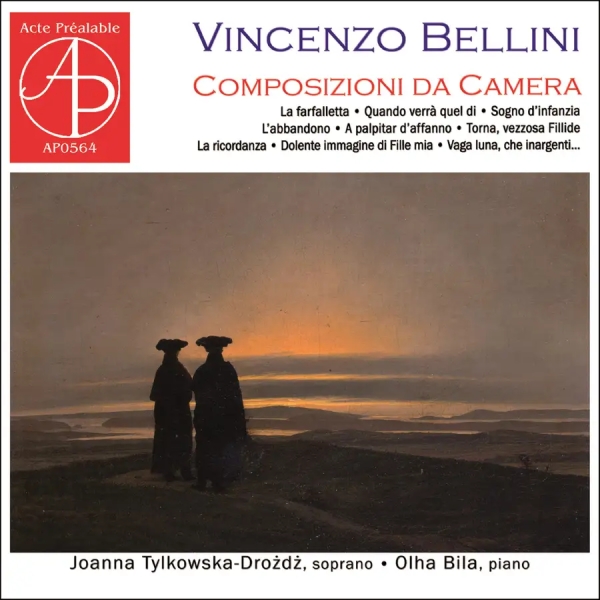
Bellini – Composizione da Camera

An enterprising collection of Bellini songs is unfortunately let down by less than ideal performances.

BelliniSongs

Bellini’s songs are not performed that often and indeed this is only the second recording of his Composizioni da Camera I’ve come across. Veronica Kincses recorded the complete set for Hungaroton back in 1982, though a few of the songs have appeared on various recital discs over the years.

They were probably written some time in the 1820s and it is unlikely that Bellini intended them all to be performed together; in fact, they were not published as a set until 1935, by the Milan publisher Ricordi. The Kincses disc includes all the songs in the Ricordi edition, in the order in which they appear in the score, whereas the present issue substitutes one or two other songs from a different source, such as La ricordanza, which turns out to be the tune of Qui la voce from I Puritani. Texts and translations are provided, some being by Metastasio, but the majority are anonymous.

Most of the songs are quite short, though the longest Torna, vezzosa Fillide,runs to almost eight minutes and is in the style of a mini operatic scena. It is the most complex of the songs and closer in style to the music of Bellini’s operas. However , for the most part, the songs are tuneful and undemanding, and it is not surprising that a few of them have made it into recital programmes of more famous singers, like Pavarotti, Bartoli, Tebaldi and even David Daniels, all of whom have made recordings of the most famous song, Vaga luna, che inargenti, the tune of which kept reminding me of the English folk song, The foggy, foggy dew. 

Any of the above singers would be preferable to the Polish soprano, Joanna Tylkowska-Drożdż, who has a rather hard, bright voice and tends to sing at an unrelenting mezzo-forte throughout, any refinement or tonal nuance only being offered by the pianist Ohla Bila. Nor is she particularly imaginative in her phrasing or her response to the poetry. Listening to the disc in one sitting proved something of a trial. The somewhat reverberant acoustic also tends to exaggerate the hardness of Tylkowska-Drożdż’s timbre.

As it happens, Veronica Kinkses’ Hungaroton recording of the fifteen songs in the 1935 Ricordi edition is still available to stream or as a download and is infinitely preferable if you are looking for a single disc of Bellini’s songs. However, I have a feeling most of us would be content to find the odd song on a mixed recital by a favourite artist. It should be noted that five of the songs appear on a 1997 disc by Cecilia Bartoli, called An Italian Songbook, on which she sings songs by Donizetti, Bellini and Rossini.

Contents

Vincenzo Bellini (1801-1835)

  • La farfaletta (anonymous)
  • 2. Quando verrà quell di (anonymous)
  • Sogno d’infanzia (anonymous)
  • L’abbandono (anonymous)
  • A palpitar d’affanno (anonymous)
  • Torna, vezzosa Fillide (anonymous)
  • La ricordanza (Carlo Pepoli, Conte)
  • Dolente imagine di Fille mia (anonymous)
  • Vaga luna, che inargenti (anonymous)
  • Malinconia, Ninfa gentile (Ippolito Pindemonte)
  • Vanne, o rosa fortunate (Pietro Antonio Domenico Bonaventura Trapassi as Metastasio)
  • Bella nice, che d’amore (anonymous)
  • Alme se non poss’io (Pietro Antonio Domenico Bonaventura Trapassi as Metastasio)
  • Per pietà, bell’ idol mio (Pietro Antonio Domenico Bonaventura Trapassi as Metastasio)
  • Ma rendi pur content (Pietro Antonio Domenico Bonaventura Trapassi as Metastasio)