A Most Marvellous Party

81wftltatgl._ac_sl1450_

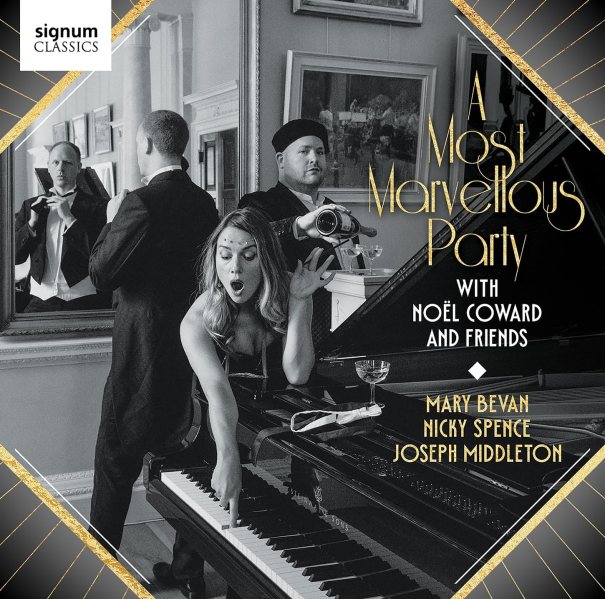
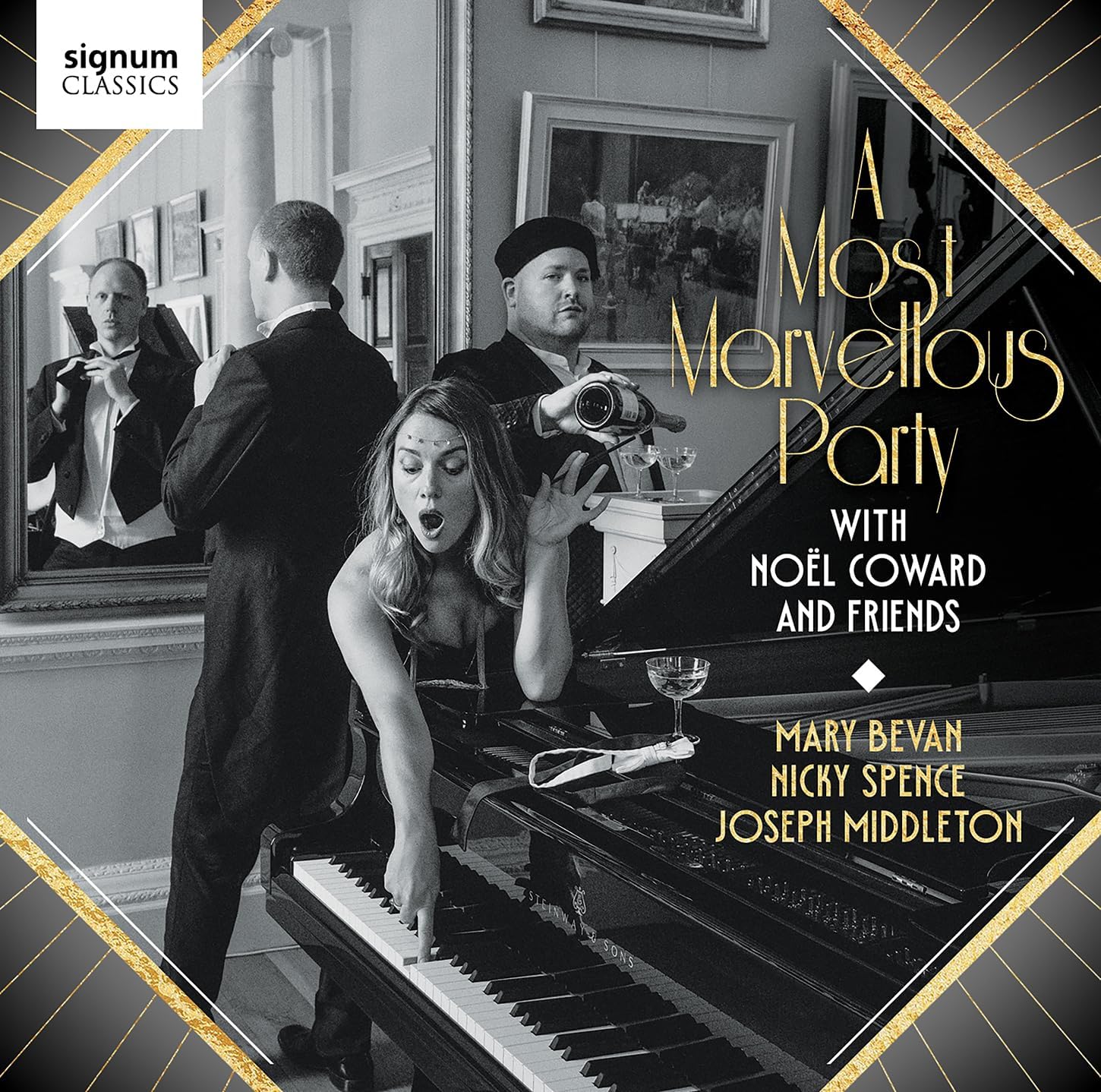
This highly entertaining programme is the sort of thing that would go down well at a country house or in a small hall, and indeed I see that these artists performed it at the Leeds Conservatoire in March this year, shortly before making this recording. Mary Bevan should not be confused with her sister, Sophie, also a soprano with quite a career herself, nor Nicky Spence with tenor Toby Spence, to whom he is not related. Both singers are active on the operatic stage as well as on the concert platform and here let their hair down in some lighter music.

The “party” seeks to place Noel Coward among other contemporary composers, all of whom have a connection with Coward, however slight. Thus, the other guests turn out to be Ned Rorem, who claimed to have once had a one-night stand with Coward, Poulenc for whom Coward once did the narration on a recording of his Babar, the elephant and Stravinsky, who apparently once asked Coward to collaborate with him. Gershwin’s music Coward had known for some time and even played snatches of it on stage in the first production of his play, The Vortex. The connections with Satie, Messager, Britten and Walton would seem to be a little more tenuous, but I’m nonetheless delighted that they came along. It’s also good to encounter some songs by Roger Quilter and Liza Lehmann, especially given Bevan’s rapturous account of Lehmann’s gorgeous Love, If You Knew The Light, and Spence’s lovely singing of Quilter’s famous setting of Tennyson’s Now Sleeps The Crimson Petal, which is nicely contrasted to Ned Rorem’s sparer, but equally valid setting of the same poem sung by Bevan, a song that was new to me. It slightly reminded me of Britten’s version, which he eventually cut from the Serenade for Tenor, Horn and Strings.

Both Bevan and Spence are rather better in the more lyrical songs by Coward than they are at the patter songs, and there are a couple of misses in the sequence. Spence can’t resist the temptation to overplay the comedy in Don’t Put Your Daughter on The Stage, Mrs Worthington and I have a feeling this rendition would become rather triresome on repeated listening. One only has to compare the Master, with his brilliantly understated and clipped delivery to hear how it should be done. Nor can Bevan quite cast off the slightly jolly-hockey-sticks quality she has adopted in the opening Coward medley when she turns to Kurt Weill’s Complainte de la Seine, a song which is absolutely harrowing when sung by Teresa Stratas. I also rather wish that Spence, rather than Bevan, had been allowed to sing Mad About The Boy, given that we now know the song was written by Coward about a man he had fallen in love with. However, Spence does get to sing If Love Were All, a song that was originally written for the character of Manon in Coward’s operetta Bitter Sweet, but which Coward himself later made very much his own.

Britten is represented by two early W, H, Auden settings, one of which, As it is, plenty, sounded strangely like something by Stephen Sondheim, though it was written only a few years after Sondheim was born. I wonder if he knew it. I rather wish room had been found for Bevan to sing Coward’s Zigeuner from Bitter Sweet and that perhaps it would have been better to close the recital with the gently wistful The party’s over now rather than the slightly over-rumbustious I went to a marvellous party, but apart from these and a few other minor reservations expressed above, the two singers acquit themselves very well and the pianist, Joseph Middleton is a wonderful collaborator, both as accompanist and when playing solo in pieces by Poulenc, Satie, Stravinsky and Gershwin.

All in all, this is a highly enjoyable disc and one which I will definitely be returning to from time to time.

Full programme

  1. Coward Medley (all three artists)
  2. Coward: Mad about the boy (Bevan)
  3. Rorem: Early in the morning (Spence)
  4. Rorem: For Poulenc (Spence)
  5. Poulenc: Pastorale calme et mystérieux (Middleton)
  6. Poulenc: Hotel (Bevan)
  7. Coward: Parisian Pierrot (Spence)
  8. Weill: Complainte de la Seine (Bevan)
  9. Messager: De ci, de là (Bevan and Spence)
  10. Satie: Gnossiene No. 1 (Middleton)
  11. Coward: Any little fish ((spence and Bevan)
  12. Stravinsky: Valse pour les enfants (Middleton)
  13. Coward: Something to do with Spring (Spence and Bevan)
  14. Quilter: Love calls through the summer night (Bevan and Spence)
  15. Quilter: Now sleeps the crimson petal (Spence)
  16. Rorem: Now sleeps the crimson petal (Bevan)
  17. Coward: World weary/Twentieth century blues (Bevan and Spence)
  18. Gershwin: The man I love (Middleton)
  19. Coward: If love were all (Spence)
  20. Gershwin: By Strauss (Bevan)
  21. Coward: Don’t put your daughter on the stage, Mrs Worthington (Spence)
  22. Britten: When you’re feeling like expressing your affection (Bevan)
  23. Walton: Popular Song (Spence)
  24. Britten: As it is, plenty (Bevan)
  25. Lehmann: Love, if you knew the light (Bevan)
  26. Coward: The party’s over now (Bevan and Spence)
  27. I went to a marvellous party (Bevan and Spence)

Renée Fleming – I Want Magic


Renée Fleming was at her peak when this recital was recorded and this is, without doubt, one of her most successful records. The programme is a varied one too, with familiar items like Gershwin’s Summertime and Bernstein’s Glitter and be gay rubbing shoulders with items from more rarely performed works like Hermann’s Wuthering Heights and Floyd’s Susannah. The inclusion of Anne’s No word from Tom from Stravinsky’s The Rake’s Progress rather stretches the subtitle American Opera Arias a bit, but is possibly justified as Auden, Kallman and Stravinsky were all resident in the US at the time of its composition.

The disc opens with a short extract from Bernard Herrmann’s Wuthering Heights, which was written in 1943 but never staged in Herrmann’s lifetime. In fact it was only premiered in 1982 by Portland Opera, but with the ending changed to one Julius Rudel had proposed several years earlier. It wasn’t performed in full until 2011, by Minnesota Opera. I have dreamt, lusciously sung here by Fleming, woud suggest the opera might be worth further investigation.

The excerpts from Douglas Moore’s The Ballad of Baby Doe and Menotti’s The Medium are both lovely in every way, but the Gershwin items from Porgy and Bess suffer from a lack of spontaneity. Fleming introduces all sorts of jazzy slides and glottal attacks which simply sound affected. Leontyne Price sings this music much more simply and allows it to blossom on its own.

The considerable difficulties of Bernstein’s Glitter and be gay are tossed off with ease and here she captures the irony in the piece marvellously. It’s a piece that, unsurprisingly, many opera singers have added to their repertoire but few of them challenge the original interpreter, Broadway star Barbara Cook, who created the role and whose diction is a good deal more clear. To be honest, the only “operatic” version I’ve heard that does is Dawn Upshaw’s, but Fleming’s is certainly amongst the best.

Next we have two pieces from Carlisle Floyd’s Susannah, which brought back happy memories of seeing Fleming in the role at the Met shortly after she recorded these exceprts. She is at her considerable best here, flooding the gratefully lyrical lines with gorgeous tone, but also capturing the character’s longing for adventure in the first, her loneliness in the second.

Finally we have a reminiscence of her Anne Trulove, which she sang at the Aspen Music Festival in 1987 and a taster of her Blanche Dubois in Previn’s A Streetcar Named Desire, which she premiered soon after making this recording. She has a richer voice than most Annes, but negotiates its complexities with ease and her Blanche is simply hors concours. The aria I want magic was an obvious high spot when she sang the role in London with the LSO, but I rather wish they had also included the final aria, I can smell the sea air, which had a huge effect on me each time I heard it whilst waiting in the wings to make my entrance as the doctor. It was one of the most beautiful things I’ve ever heard.

Sandwiched between the Stravinsky and the Previn we have Vanessa’s passionate Act I aria from Barber’s opera, which left me wondering why nobody had thought to revive the opera with Fleming in the title role. It would have suited her perfectly.

If I have any reservations, aside from those I mentioned about the Gershwin pieces, I’d have to say that her diction could be clearer. Other than that, this is an absorbing and rewarding programme stunningly sung and beautifully executed. Don’t hesitate.

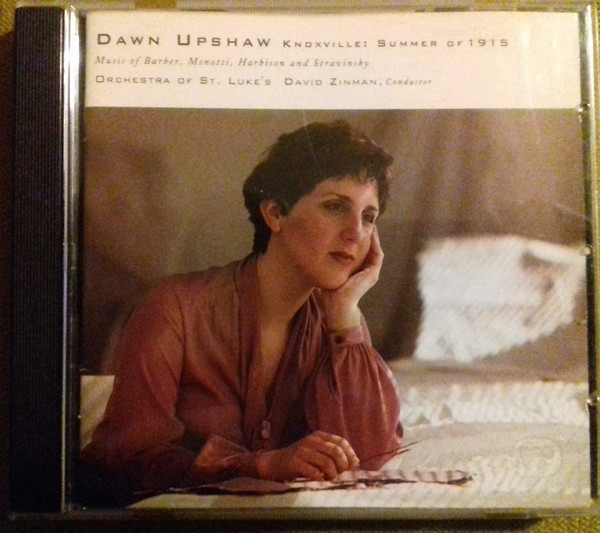
Knoxville: Summer of 1915 – Dawn Upshaw

r-12665160-1539626691-5475.jpeg

It seems incredible now that this disc was released over 30 years ago, but there it is, clearly written in the insert, “Recorded August 1988 at Manhattan Center Studios, New york”, though, IIRC, it had a different cover on its first release.

Barber’s wonderfully nostalgic Knoxville, Summer of 1915, a setting of James Agee’s prose-poem has now, it would seem, become quite popular. It was first recorded by its dedicatee, Eleanor Steber in 1950, a couple of years after its premiere, but had to wait another eighteen years before being recorded again, though very successfully by Leontyne Price. It had to wait a further twenty years for this version by Dawn Upshaw, but its success has led to a spate of others by the likes of Barbara Hendricks, Sylvia McNair, Roberta Alexander, Kathleen Battle, Jill Gomez, Karina Gauvin and, most recently, Renee Fleming.

Steber was a wonderful singer, and her version is very fine, but for me it misses the essential childlike quality of the piece and she can sound a bit mature, even a trifle prim. Price, on the other hand, is surprisingly successful at scaling down her rich velvety voice to the needs of the writing, and her version is deservedly well known. Dawn Upshaw, on the other hand, has by nature what Price had to strive for. She has exactly the light voice and direct manner the piece needs and there is no need for her to characterise; she simply has to be herself, her diction natural and unforced. David Zinman’s tempi are also just right, and it is no surprise to find that this version has been a top recommendation since it was first issued.

The rest of the programme is also attractive, its centrepiece being John Harbison’s Mirabai Songs, originally written for piano, but here given in his chamber orchestra version. The songs are settings of 16th century devotional Indian poems by Mirabai, who, after her husband died, devoted her life to the God Krishna. The texts are alternatively erotic, ecstatic and devotional, the orchestrations colourful, the vocal range wide and Upshaw is fully up to their demands.

The interesting but quite short programme is rounded off with a couple of operatic pieces, a short extract from Menotti’s radio opera The Old Maid and the Thief, and Anne Trulove’s No word from Tom from Sravinsky’s The Rake’s Progress, and Upshaw would seem perfectly cast in both.

Like most of Upshaw’s records the material chosen is refreshingly different and well worth investigating.