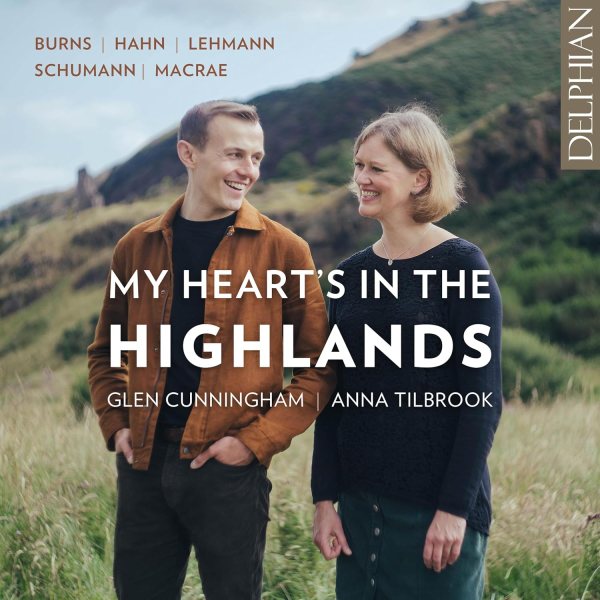
Glen Cunningham’s Heart is in the Highlands

An interesting programme of Scottish inspired songs, but Cunningham’s tenor is a little too much on the dry side for my liking.

My Heart’s in the Highlands

Glen Cunningham (tenor)  Anna Tilbrook (piano)

The young tenor, Glen Cunningham, and his pianist, Anna Tilbrook, celebrate their Scottish heritage in a programme of music connected to Scotland, not only in the folk orientated songs of Robbie Burns, but also in settings of Burns by Schumann, and Robert Louis Stevenson by Liza Lehmann and Reynaldo Hahn. To these are added a completely new song cycle, also to texts by Robert Louis Stevenson, by the Scottish composer, Stuart MacRae.

It makes for an interesting programme, with the folk song settings framing the songs by Schumann, Lehmann, MacRae and Hahn. Thus, we start with a setting of Burns’s Ca’ the yowes to the knows in an arrangement by Claire Liddell, which segues into the eight songs from Schumann’s Myrthen, which set texts by Burns in German translation. They are possibly less well known than other songs from Myrthen, like Widmung or Der Nussbaum, and I doubt anyone would guess the Scottish provenance of these Schumann songs. Nor, I wager, would anyone guess that the  song Dem Roten Röslein Gleicht Mein Lieb from Schumann’s Opus 27 Lieder und Gesänge is actually a setting in German of the famous My love is like a red, red rosewhich follows it.

Liza Lehmann is less well represented in the catalogue than Schumann, though a selection of the songs from The Daisy-Chain have been recorded by mixed voices and are available on the Naxos label. Cunningham selects four of the five songs to texts by Robert Louis Stevenson. These are children’s songs to be performed by skilled adults, and the vocal writing is often taxing, Stars, for instance, requiring the sort of lyrical outpouring that Cunningham’s rather dry tenor is not quite capable of. Toby Spence manages it slightly better on the above Naxos recording, but it really needs a fuller voice than either of these two tenors can provide.

Two of the texts are also set by Reynaldo Hahn in his Five Little Songs, written while Hahn was a private in the French army during World War I, where he saw action on the front line. These too are settings of Robert Louis Stevenson, ‘children’s songs’, though it is unlikely that any child could sing or play them. They are quite charming, though, yet again, there is nothing particularly Scottish about them.

Not surprisingly, I suppose, the most Scottish sounding of the songs are those by Stuart MacRae, particularly For age an’ youth, which sets a Scots style vocal line against a sort of imitation bagpipe in the piano accompaniment. Cunningham is at his best in these songs, but even here I wanted more of tonal beauty. He compensates with the intelligence of his delivery, but throughout I’m afraid I found his vibrato intrusive and the sound he makes unpleasantly hard and uningratiating.

I should just mention that Anna Tilbrook is a most sensitive accompanist and adapts brilliantly to the style of each composer.

The recital ends with the title song, My heart’s in the Highlands, in an arrangement by Michael Barnett (and supplemented by Tilbrook) that was transcribed from a 1962 Kenneth McKellar recording. I just wish that Cunningham sang it with some of McKellar’s beauty of tone.
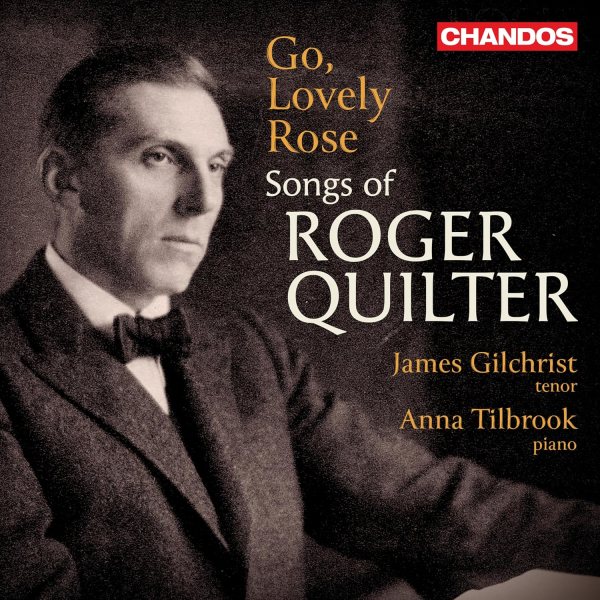
Go Lovely Rose – The songs of Roger Quilter

91aupp0ckgl._ac_sl1500_

James Gilchrist (tenor) Anna Tilbrook (piano)

The songs of Roger Quilter are not performed as often these days as they once were, which is a shame, because they are beautifully crafted and, though perhaps they don’t probe as deeply into the texts as those of Finzi, Delius and Warlock, they are very rewarding for performers and listeners alike. Quilter had a wonderful gift for melody, but it was always melody put at the service of the poetry and the text is sung more or less as if it were spoken. Having performed many of the songs myself in my youth, I can attest to the fact that they are a gift to the performer.

Rather than give us whole opus numbers, Gilchrist and Tilbrook have chosen songs from his complete oeuvre, with the songs grouped into themes. Thus, we have six Shakespeare songs, drawn from the Op. 6, Op. 23 and Op. 32 sets of Shakespeare settings, five songs associated with flowers (A Floral Tribute), four Folk Song settings (all taken from The Arnold Book of Old Songs), four songs associated with the graveside, and four Songs of Love. The only songs performed as a set are the early German songs, written when Quilter was studying in Frankfurt. These are charming, but slight and give little indication of Quilter’s later, more mature style.

Initially alienated by the rather gruff sound of Gilchrist’s voice in the opening robust Blow, blow, thou winter wind (we are at once aware that this is not the voice of a young man, and indeed Gilchrist was approaching sixty at the time of the recording), I was drawn in by his elegiac delivery of Come away, death, and thereafter, I was less aware of any failing resources. Indeed, in the more gently reflective songs, with which the disc proliferates, Gilchrist is often spellbindingly beautiful, spinning out some lovely pianissimi in such songs as Fear no more the heat of the sun, the famous Now sleeps the crimson petal and the song which gives the collection its name, Go lovely rose. He is admirably supported by Anna Tilbrook, who is an excellent accompanist.

I would not be doing my job as a reviewer if I didn’t point out that there is another similar collection of songs available on the Hyperion label. This was recorded in 1996 by the then much younger John Mark Ainsley with Malcolm Martineau at the piano. Some may prefer Ainsley’s much more forthright manner and fresher timbre, as indeed I occasionally do, especially in songs like Blow, blow, thou winter wind and the ebullient Love’s philosophy, but Gilchrist’s more reflective style has its own rewards, and this is a welcome addition to the Quilter discography

Contents
Shakespeare Songs
Blow, blow, though winter wind, from Three Shakespeare Songs (First Set) Op 6, No 3 (1905)
Come away, death, Op 6 No 1 from Three Shakespeare Songs (First Set) (1905, rev 1906)

Fear no more the heat o’ the sun. from Five Shakespeare Songs (Second Set) Op.23 No 1
Orpheus with his lute. from Two Shakespeare Songs (Fourth Set) Op.32 No 1(1919-20)
O mistress mine, from Three Shakespeare Songs (First Set) Op 6 No 2 (1905, rev 1906)

Under the greenwood tree, from Five Shakespeare Songs (Second Set) (1919)
A Floral Tribute
The Fuchsia Tree, Op.25 No.2 (1923)
Go, Lovely Rose, from Five English Love Lyrics Op.24 No.3 (1922)
A last year’s rose, Op 14 No.3 (1909-10)
Now sleeps the Crimson Petal, Op 3 No 2 91897)
To Daisies from To Julia, Op.8 No 3 (1905)
Folksongs
From The Arnold Book of Old Songs
Barbara Allen, No 13 (c 1921)
Drink to me only with thine eyes, No 1 (c 1921)
My Lady’s Garden, No 10 (c 1942)
The Ash Grove, No 16 (c 1942)
At the Graveside
Autumn Evening Op.14 No.1 (1909-10)
Dream Valley, from Three Songs of William Blake, Op.20 No.1 (1917)
Drooping Wings (1943)
Music, when soft voices die, from Six Songs, Op 25 No.5 (1926)
German Songs
Four Songs of Mirza Schaffy, Op 2 (bef. 1903, rev. 1911)
Songs of Love
Love’s Philosophy, from Three Songs, Op 3 No 1 (1905)
Julia’s Hair from To Julia Op 8, No 5 (1905)
The Maiden Blush from To Julia Op 8, No 2 (1905)
It was a lover and his lass, from Five Shakespeare Songs (Second Set), Op