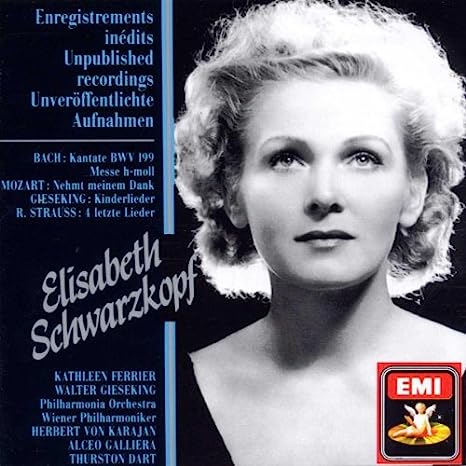
Elisabeth Schwarzkopf – Unpublished Recordings


51zdj0yf6wl._ac_sx466_

An interesting release of material discovered in the EMI vaults and released in 1990.

We start with a really lovely performance of Bach’s Cantata, Mein Herze schwimmt im Blut, which is followed by surviving excerpts from a rehearsal for a performance of Bach’s Mass in B Minor under Karajan, with Ferrier partnering Schwarzkopf in the Christe eleison and Et in unum Dominum. Schwarzkopf sings the Laudamus te.

A charming performance of Mozart’s Nehmt meinen Dank comes next, recorded in 1955 with the Philharmonia under Alceo Galliera.

The Gieseking Kinderlieder were recorded as a favour to the great pianist, recorded at the same time they made their album of Mozart Lieder. Undemanding music perhaps, but Schwarzkopf characterises them brilliantly. I’m sure Gieseking was delighted.

Finally we have a live performance of Strauss’s Vier lerzte Lieder with the Philharmonia under Karajan at the Royal Festival Hall in 1956. It is certainly interesting to hear Schwarzkopf singing them live, but I wouldn’t place this above either of her two studio recordings under Ackermann and Szell. Inexplicably, Karajan places September last, which makes a less satifactory end, especially given the rather fast tempo he takes it at, though it has slowed down a bit by the end. (I assume the wonderful horn playing is by Dennis Brain.) Im Abendrot also starts out rather fast, but again has slowed down towards the end of the song. Schwarzkopf is in wonderful voice and has no trouble riding the orchestra, but it doesn’t replace the recording she made ten years later with George Szell. For me it catches the autumnal glow of these songs like no other. The prize of this version would be Frühling, with Schwarzkopf’s voice soaring out over the orchestra with a bit more ease than it does in 1965.
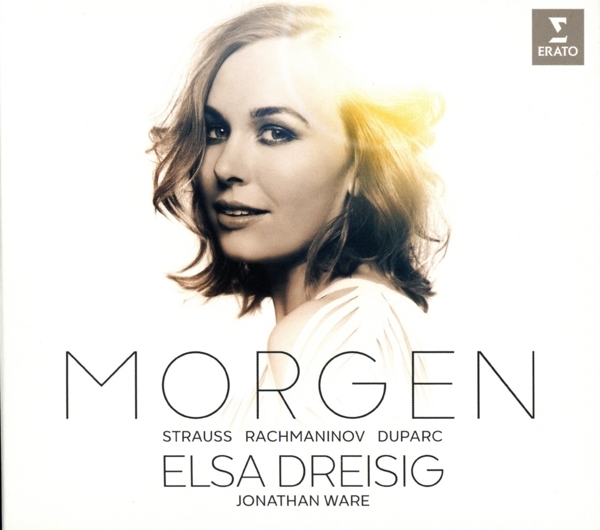
 

Elsa Dreisig’s Morgen

morgen

Now this is rather special. The young French/Danish soprano Elsa Dreisig follows up her excellent debut album of operatic excerpts with this beautifully compiled recital of songs for voice and piano, showing that she is equally at home in the more intimate surroundings of the recital room. The programme is an interesting one with the piano accompanied versions of Strauss’s Vier letzte Lieder (plus his final ever song Malven) split up and inserted into different points of the recital. The songs weren’t orginally planned as a cycle in any case, and this makes for some fascinating juxtapositions. The rest of the programme is made up of songs by Rachmaninov and Duparc and leads us on a most satisfying journey, “an inner journey across the seasons of the soul,” as Dreisig writes in the accompanying notes.

The North Star, our guide, is Strauss with these Four Last Songs (or five if we count Malven, his final song), in conversation with Duparc and Rachmaninov. Starting at the dawn of Spring and of youth, we visit Summer and its passions then, by way of Autumn nights and the dreamlike world of sleep, we come face to face with the unknown and with passing time. A journey of initiation, one that allows us to contemplate loss and death, thinking all the while of tomorrow: morgen.

Save for Rachmaninov’s The Pied Piper the mood is generally dreamy and Dresig and her accompanist, the superb Jonathan Ware, create spell bindng magic, drawing us in to their carefully crafted programme. Dreisig’s voice is a lovely, lyric soprano with a pearly, opalescent radiance that suits all these songs perfectly, but she is much more than a lovely voice. What is unusual is her rare gift for communication, her innate musicality and the specificity of her response to all these songs.

The highlights for me are her languidly dreamy and erotic rendition of Duparc’s Phidylé and Extase, Rachmaninov’s At Night In My Garden, and all the Strauss items gorgeously sung, yet with due attention to the text. I do hope Dresig will soon get to record the orchestral version of his Vier letzte Lieder. Ware plays magnificently, probably the best version of the piano accompaniment I have ever heard, but I do miss Strauss’s glorious orchestration. A total contrast is afforded  when she follows it with her superbly suggestive singing of Rachmaninov’s The Pied Piper, which shows off admirably her brilliant gift for characterisation, but really there isn’t a dud in the whole recitial

This is a wonderful disc and one of the best soprano song recitals I have heard in a very long time. Start the disc from the beginning and allow these artists to take you along on their journey. One listen quickly became two. Dreisig turns thirty this year. Let us hope that the pandemic has not stimmied a career that was just starting to get going. Warmly recommended.