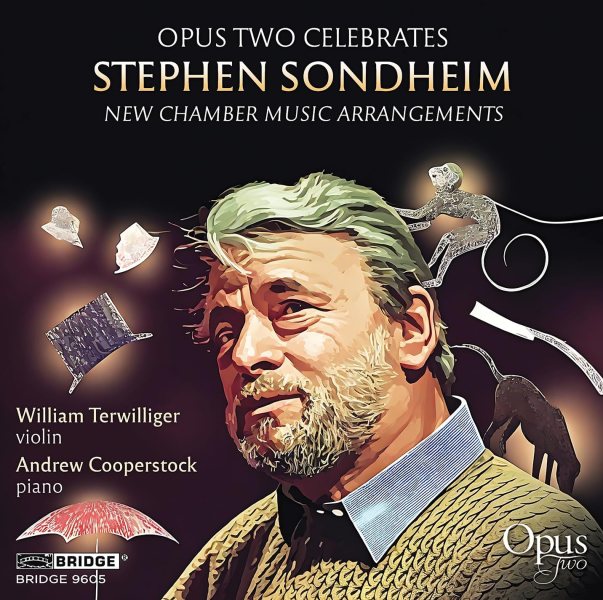
Opus Two celebrates Stephen Sondheim

I’ve loved the music of Stephen Sondheim ever since I was introduced to the LP of the Broadway recording of A Little Night Music by an old friend, my musical mentor, back when I was in my early twenties. Though Sondheim is known for his lyrics, it was the swirlingly Romantic score that I first responded to, and it is fitting that the first piece  on this disc is the Suite from that musical, in an arrangement, like the other pieces on this disc, by Eric Stern, who worked closely with Sondheim on the 1984 revival of Pacific Overtures. Since then, Stern has conducted the second year of Sunday in the Park with George, and also worked on Into the Woods, several productions of Follies, a revival of Merrily We Roll Along at the Kennedy Centre, and many more concerts and birthday celebrations around the world. His last conversation with Sondheim was about the Little Night Music suite, which Sondheim enthusiastically endorsed, though unfortunately the rest were written after his passing.

Opus Two are violin and piano duo, William Terwilliger on the violin and Andrew Cooperstock on the piano. They are joined by soprano Elena Shaddow for I remember, from the TV musical Evening Primrose, and by baritone Andrew Garland for Finishing the Hat, from Sunday in the Park with George, though, truth to tell, neither performance eclipsed memories of other performances of these songs, and I wondered at their inclusion. On the other hand, the addition of Beth Vandeborgh’s cello to the arrangement of Every Day a Little Death from A Little Night Music adds a certain expressive depth to the song. I found it one of the most successful pieces on the disc.

For those who know and love Sondheim’s scores, I would suggest that this disc is self-recommending. The arrangements are brilliantly done, though there is just the whiff of Palm Court about them. I could imagine them being played at the Waldorf Hotel, whilst enjoying tea, not that there is anything wrong with that, of course, and I found the disc hugely enjoyable. In some cases, I know the lyrics so well I could sing along in my mind’s ear, which no doubt added to my enjoyment of them.

It has often been said that Sondheim’s lyrics take precedence over the music, but here, I think, we get the chance to concentrate on Sondheim the composer, and we find how lyrical, in the musical sense, his music is. The only piece I didn’t know was the main title from Alain Resnais’s 1974 film, Stavisky, a short evocative piece, but it too has a tune which lingers in the memory for some time afterwards.

Terwilliger shines in Sorry/Grateful from Company, which is here arranged for solo violin, whilst Cooperstock is given the jazzy Now You Know from Merrily We Roll Along as a piano solo. Then they come together again for the final work, the Fleet Street Suite, which combines themes from Sweeney Todd and closes the recital with the beautifully poetic Johanna, which, in the show, is a moment of calm and pure beauty amidst the turbulence of the rest.

Contents:

Suite from A little Night Music

Not while I’m around (from Sweeney Todd)

Broadway Baby (from Follies)

I remember (from Evening Primrose)

Main Title from Stavisky

Every Day a Little Death (from A little Night Music)

Sorry/Grateful (from Company)

Finishing the Hat (from Sunday in the Park with George)

Now You Know (from Merrily We Roll Along)

Fleet Street Suite (from Sweeney Todd)

Sonic Alchemy – How do we measure time?

00a34add

YuEun Kim (violin), Mina Gajić (piano), Coleman Itzkoff (Cello)

How do we even measure time?

This is the question asked at the beginning of the booklet accompanying this absorbing disc. It supposes that time is a construct of man and that time, as we understand it, has not always been the same. To quote from the booklet again, “Our ideas on time have changed throughout the centuries and will probably continue to do so. The works on Sonic Alchemy are of composers who offer a new perspective on how we can perceive time, each in their own way.”

Mozart may seem a strange bedfellow for the two contemporary composers we have here, but there is an obvious link with Pärt’s Mozart-Adagio for piano trio, a re-working of the slow movement from Mozart’s Sonata in F major, K. 280, in which Pärt seeks to subtly blend the styles of the two composers into a single natural whole. It is framed by Mozart’s two Piano Fantasias K.397 and K. 480, which are both performed as written.  

The disc opens with Vasks’ Balta Ainava (White Scenery) for solo piano, an evocative piece which is written sensa misura. There is no tempo written into the score, the performer is instructed to play “very sweetly and softly”. Gajić responds with an unsentimental approach, which perfectly allows the music to speak for itself, her tone clear and pellucid. This is followed by Pärt’s Fratres in the version for piano and cello, in which the composer’s method is based on a fixed relation between two voices. This is where I noticed a tendency for Gajić to overuse the pedal, which somewhat muddies the textures of her part. This is a shame because Coleman Itzkoff is wonderfully lucid in his part. This overuse of the pedal also creeps into her playing of the Mozart Fantasias, which are a bit heavy and a little too rigid, lacking in, well, fantasy. No competition here for the likes of a Mozart spécialiste, like the wonderfully sensitive Maria João Pires. Still, they do not feel out of place in this programme, their juxtaposition with the other works on this disc bringing them forward out of their own time and into the twentieth century.

The other Vasks piece is Castillo Interior, a duet for violin and cello, which contrasts long hymn-like, somewhat devotional  phrases with rapid, almost aggressive sections, which perhaps remind us that the bustle and violence of the outside world is never far away. It is brilliantly performed here by YuEun Kim and Itzkoff.

Finally, we come to the most well-known piece on the disc, Pärt’s ubiquitous Spiegel im Spiegel, which, clocking in at 10:24, must be one of the slowest on record. Tamsin Little only takes 8:14 over it, but listening to it after this performance, Little seemed a little rushed to me. Kim’s tone here is ethereal, almost insubstantial and she and Gajić sustain the slow tempo brilliantly. I found myself hanging on to each note and just for these ten minutes it felt as if time really did stand still.

I should just mention that the recording quality is first rate. Despite my reservations about the performance of the Mozart Fantasias, I found this an absorbing disc, and one that I shall certainly return to from time to time.

Contents.

Peteris Vasks (b.1946) : Balta Ainava (White Scenery)

Arvo Pärt (b. 1935): Fratres

Wolfgang Amadeus Mozart (1756-1791): Fantasia in D Minor, K.397

Arvo Pärt: Mozart-Adagio (after Sonata K. 280)

Wolfgang Amadeus Mozart: Fantasia in C Minor, K. 475

Vasks: Castillo Interior (Interior Castle)

Pärt: Spiegel im Spiegel