Frederica Von Stade sings Berlioz and Debussy

odqtodm0os5qcgvn

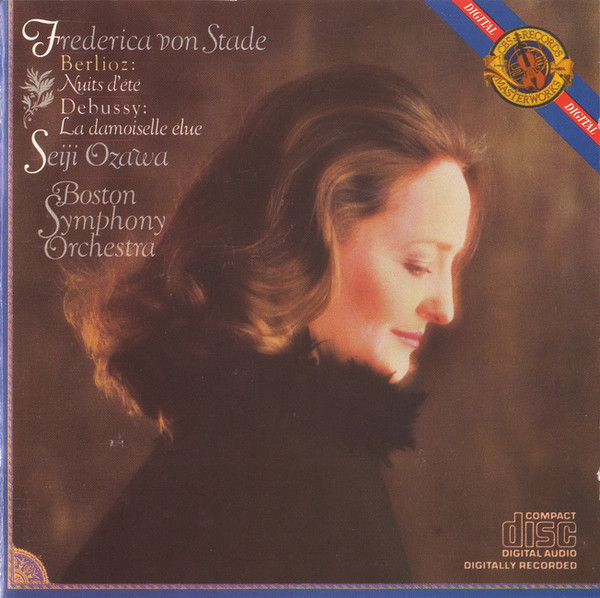
This is a wonderful disc and if it had been in my collection when I did my mini survey of recordings of the Berlioz (Berlioz’s Les Nuits d’Eté – a comparative review of ten recordings) it would no doubt have jostled for top position with my top three of Baker/Barbirolli, Hunt Lieberson/McGegan and Steber/Mitropoulos. My personal favourite would still be the Baker and, like Baker, I would suggest that Von Stade has the perfect voice for this group of songs. Though Berlioz had originally wanted the songs to be sung by different voices, a single voice does bring a certain homogeneity to the cycle, even if few can encompass its demands. Von Stade’s mezzo, with its soprano-ish top and firm lower register (down to a beautifully sounded low F# in Sur les lagunes) seems to me to be the perfect instrument for it. Furthermore she captures the gaiety of the outher songs as easily as she does the deeper emotions of the middle songs. There is a real sense of yearning in Absence, profound despair in Sur les lagunes and a resigned sadness in Au cimetière. Le spectre de la rose is very beautiful, rising to a gorgeous climax before sinking back gently to its bittersweet ending.

The Boston Symphony Orchestra play beautifully for Ozawa, much better than, say, the Suisse- Romande for Crespin and Ansermet or the Philharmonia Baroque for Hunt Lieberson and McGegan and, all in all, this is for me one of the very best versions in the catalogue.

The coupling of Debussy’s La damoiselle élue is equally fine, though I find the timbre of Susanne Mentzer’s Récitant a little too similar to Von Stade’s. Still, Von Stade captures a sort of visionary faith in her singing which is most attractive. Orchestra and chorus are likewise superb and, though the work is not the best of Debussy, it almost seems so in a performance as fine as this one.

A lovely disc.

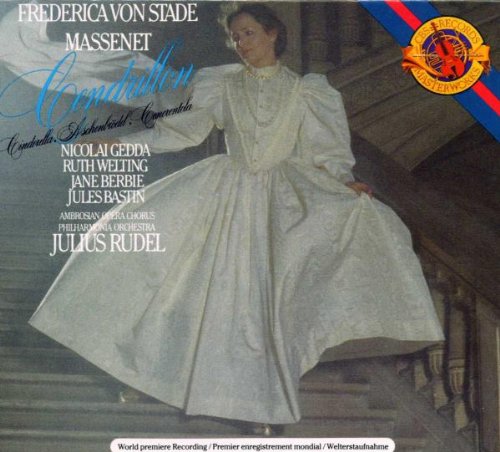
Massenet’s Cendrillon

510skn2bvg9l

A lovely recording of a gorgeous score, which is all but ruined by a monumental piece of miscasting. Massenet wrote the role of Le Prince Charmant for a mezzo-soprano (performed at the premiere by Marie-Louise van Émelen), but here it is given to the tenor, Nicolai Gedda. Stylishly though he sings, he cannot disguise the fact that he is singing in the wrong octave and the substitution seriously damages the sound of the duets. The booklet actually states,

In order to suggest the prince’s youth and grace, and to enhance the tender, ethereal quality of his love scenes with Cendrillon, Massenet composed the part for a falcon, …. Moreover, to prevent fashionable prime donne of the buxom kind from being miscast in the part, Massenet also stipulated in the score that the falcon should possess an appropriate physique du costume.

This makes the substitution doubly puzzling.

On the other hand the role of Cendrillon might almost have been written with Frederica Von Stade in mind, radiant of voice and charming of manner. Her performance is reason enough to have the set, but Ruth Welting makes a delightful Fairy and there are characterful performances from Jane Berbié as Madame de la Haltière and Jules Bastin as Pandolfe, as well as Teresa Cahill and Elizabeth Bainbridge as the step sisters.

Julius Rudel conducts the Philharmonia Orchestra and the Ambrosian Opera Chorus.

Frederica Von Stade – French Opera Arias

710yvtzhbil._sl1500_

This 1976 recital was, I believe, Von Stade’s first recital disc. In 1970, at the age of 25 she had secured a comprimario contract at the Met, debuting there as one of the Three Boys in Die Zauberflöte, and international acclaim followed in 1973, when she appeared as Cherubino at Glyndbourne in a Peter Hall production that was also televised. Von Stade’s winningly boyish Cherubino catapulted her to stardom alongside Kiri Te Kanawa and Ileana Cotrubas, who played the Countess and Susanna. I remember seeing it on TV, and the impression they all made.

Though American born, Von Stade spent a good deal of her youth in Europe, and later spent some years in France, and so is completely at home in the French language. Indeed French opera and song became a staple of her repertoire though, at this early stage of her career, she doesn’t always use the words to her advantage, and some of the arias could be more clearly characterised. That said, the voice itself, a clear lyric mezzo, is always beautiful and her use of it unfailingly musical. She is best at winning charm and bittersweet sadness, and the least successful item here is Charlotte’s Va, laisse couler mes larmes from Werther, which doesn’t compare to what she achieves in the complete recording under Davis (recorded in 1980).

My favourite performances are of Mignon’s Connais- tu le pays?, which captures to perfection Mignon’s wistful longing for her homeland (I always think it a pity that Von Stade wasn’t the Mignon on the Almeida recording, on which she plays Frédéric) and the aria from Cendrillon, and it is no surprise to find that she went on to have a great success in the complete role. Her natural charm also comes across well in the Offenbach arias and in Urbain’s aria from Les Huguenots.

The aria from Berlioz’s Béatrice et Bénédict for the most part goes well, though her responses are a little less vivid than Janet Baker’s on the complete Davis recording, and the Allegro lacks a little in joyfulness. Her natural plaintiveness is more suited to Marguerite’s D’amour l’ardente flamme, though, here too, there is a sameness of vocal colour which misses the urgency of the middle section.

A very enjoyable recital disc then, the beauty of the voice and her winning personality well caught, if with the proviso that she doesn’t yet quite convey the complete range of emotions required by the music. Nevertheless it always a pleasure to hear such beautiful and musical singing.