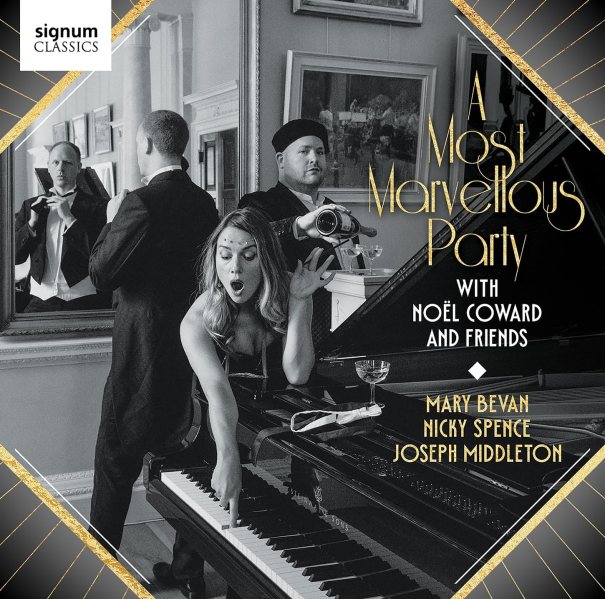
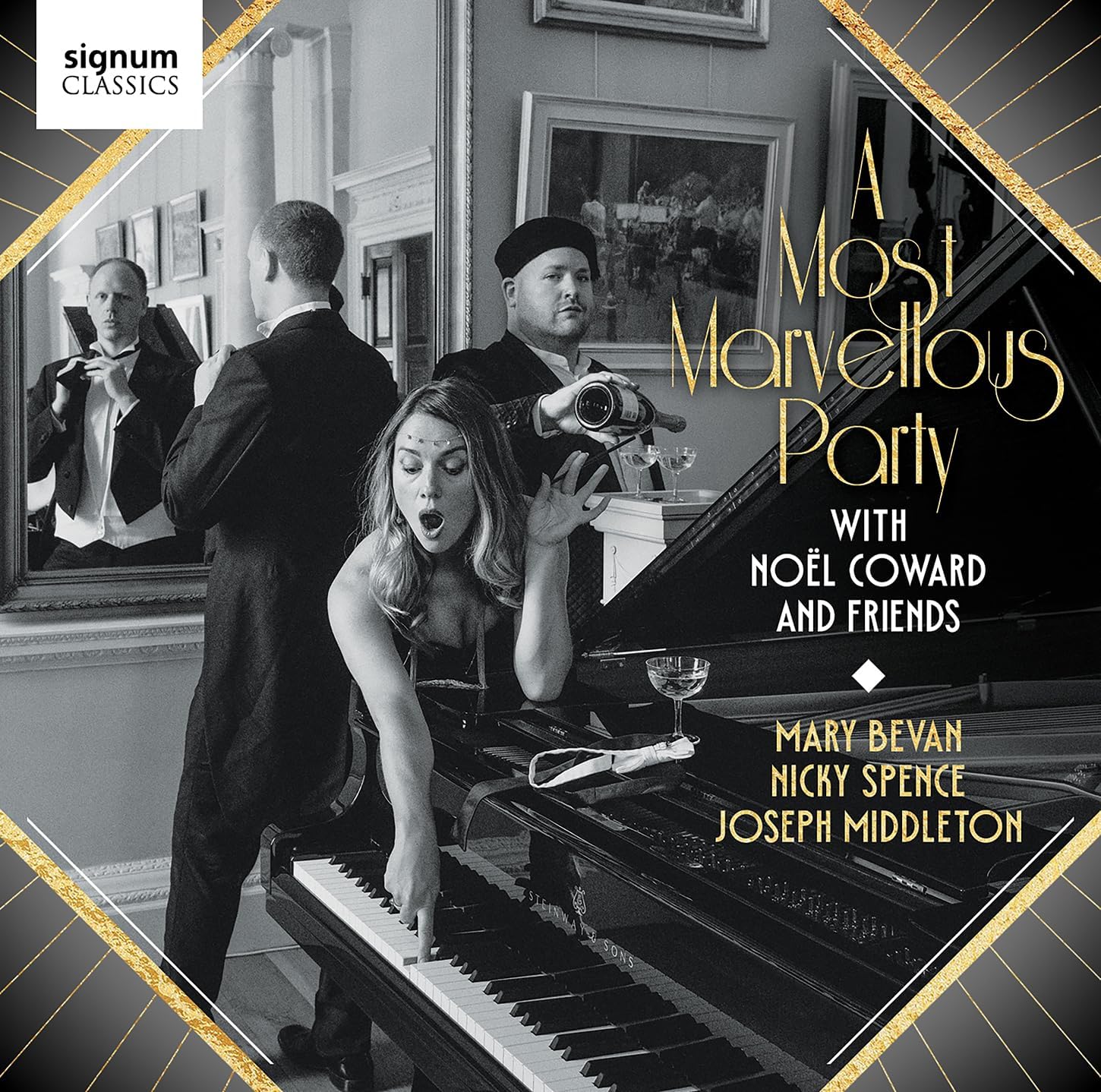
This highly entertaining programme is the sort of thing that would go down well at a country house or in a small hall, and indeed I see that these artists performed it at the Leeds Conservatoire in March this year, shortly before making this recording. Mary Bevan should not be confused with her sister, Sophie, also a soprano with quite a career herself, nor Nicky Spence with tenor Toby Spence, to whom he is not related. Both singers are active on the operatic stage as well as on the concert platform and here let their hair down in some lighter music.
The “party” seeks to place Noel Coward among other contemporary composers, all of whom have a connection with Coward, however slight. Thus, the other guests turn out to be Ned Rorem, who claimed to have once had a one-night stand with Coward, Poulenc for whom Coward once did the narration on a recording of his Babar, the elephant and Stravinsky, who apparently once asked Coward to collaborate with him. Gershwin’s music Coward had known for some time and even played snatches of it on stage in the first production of his play, The Vortex. The connections with Satie, Messager, Britten and Walton would seem to be a little more tenuous, but I’m nonetheless delighted that they came along. It’s also good to encounter some songs by Roger Quilter and Liza Lehmann, especially given Bevan’s rapturous account of Lehmann’s gorgeous Love, If You Knew The Light, and Spence’s lovely singing of Quilter’s famous setting of Tennyson’s Now Sleeps The Crimson Petal, which is nicely contrasted to Ned Rorem’s sparer, but equally valid setting of the same poem sung by Bevan, a song that was new to me. It slightly reminded me of Britten’s version, which he eventually cut from the Serenade for Tenor, Horn and Strings.
Both Bevan and Spence are rather better in the more lyrical songs by Coward than they are at the patter songs, and there are a couple of misses in the sequence. Spence can’t resist the temptation to overplay the comedy in Don’t Put Your Daughter on The Stage, Mrs Worthington and I have a feeling this rendition would become rather triresome on repeated listening. One only has to compare the Master, with his brilliantly understated and clipped delivery to hear how it should be done. Nor can Bevan quite cast off the slightly jolly-hockey-sticks quality she has adopted in the opening Coward medley when she turns to Kurt Weill’s Complainte de la Seine, a song which is absolutely harrowing when sung by Teresa Stratas. I also rather wish that Spence, rather than Bevan, had been allowed to sing Mad About The Boy, given that we now know the song was written by Coward about a man he had fallen in love with. However, Spence does get to sing If Love Were All, a song that was originally written for the character of Manon in Coward’s operetta Bitter Sweet, but which Coward himself later made very much his own.
Britten is represented by two early W, H, Auden settings, one of which, As it is, plenty, sounded strangely like something by Stephen Sondheim, though it was written only a few years after Sondheim was born. I wonder if he knew it. I rather wish room had been found for Bevan to sing Coward’s Zigeuner from Bitter Sweet and that perhaps it would have been better to close the recital with the gently wistful The party’s over now rather than the slightly over-rumbustious I went to a marvellous party, but apart from these and a few other minor reservations expressed above, the two singers acquit themselves very well and the pianist, Joseph Middleton is a wonderful collaborator, both as accompanist and when playing solo in pieces by Poulenc, Satie, Stravinsky and Gershwin.
All in all, this is a highly enjoyable disc and one which I will definitely be returning to from time to time.
Full programme
- Coward Medley (all three artists)
- Coward: Mad about the boy (Bevan)
- Rorem: Early in the morning (Spence)
- Rorem: For Poulenc (Spence)
- Poulenc: Pastorale calme et mystérieux (Middleton)
- Poulenc: Hotel (Bevan)
- Coward: Parisian Pierrot (Spence)
- Weill: Complainte de la Seine (Bevan)
- Messager: De ci, de là (Bevan and Spence)
- Satie: Gnossiene No. 1 (Middleton)
- Coward: Any little fish ((spence and Bevan)
- Stravinsky: Valse pour les enfants (Middleton)
- Coward: Something to do with Spring (Spence and Bevan)
- Quilter: Love calls through the summer night (Bevan and Spence)
- Quilter: Now sleeps the crimson petal (Spence)
- Rorem: Now sleeps the crimson petal (Bevan)
- Coward: World weary/Twentieth century blues (Bevan and Spence)
- Gershwin: The man I love (Middleton)
- Coward: If love were all (Spence)
- Gershwin: By Strauss (Bevan)
- Coward: Don’t put your daughter on the stage, Mrs Worthington (Spence)
- Britten: When you’re feeling like expressing your affection (Bevan)
- Walton: Popular Song (Spence)
- Britten: As it is, plenty (Bevan)
- Lehmann: Love, if you knew the light (Bevan)
- Coward: The party’s over now (Bevan and Spence)
- I went to a marvellous party (Bevan and Spence)
 Philip's Assortment Box