Elisabeth Schumann’s Swan Song

91ry4lbyuzl._ac_sl1500_

Born in 1888, Elisabeth Schumann’s first recordings were acoustics, made in 1915, although it is probably for her later, electrical recordings that she is better known. She had an illustrious operatic career, famous for such roles as Sophie in Der Rosenkavalier and Eva in Die Meisteringer, also excelling in Mozart with roles such as Pamina, Susanna, Zerlina and Blonde. She was a favourite of Richard Strauss, who even tried to persuade her to sing the role of Salome, creating an edition in which he reduced the size of the orchestra to accommodate her light, lyrical soprano, though she never took up the offer.

She was also highly regarded as a singer of Lieder and Lotte Lehmann, who was perhaps her greatest rival in the field, once said she represented the purest singing style of German Lieder. She has a large discography and many of her recordings, both acoustic and electrical were once issued in a six disc EMI box set, which now appears to be available as a Warner download.

The present recordings were made somewhat later in her home in Manhattan in 1950, when she would have been in her early sixties, and this appears to be the first time the sessions have been issued in their entirety. The accompanying notes are sketchy and inadequate. Included are brief biographies of Schumann herself and of George Schick and George Reeves, who I assume are the accompanists, but there is no indication as to which songs they play, nor which items are completely new to the catalogue.

Being late recordings, this is not a disc to which I would direct anyone interested in hearing “the purest singing style of German Lieder”. Though the bell-like purity of Schumann’s top notes remains more or less intact, quite frankly, in the middle and lower register, she sounds all of her sixty odd years. Certainly, the voice has aged less well than some other sopranos, who also made recordings into their sixties, such as her contemporary Maggie Teyte or, of more recent singers, Renée Fleming. Some of the Wolf songs now clearly stretch her to the limit and I find myself wondering if this is the reason they were not issued before. One should probably make allowances for the way these songs were recorded (probably on a 7.5ips home recorder, according to the notes) but to my ears  she sounds effortful and unsteady for much of the time.

She redeems herself in the final three bonus tracks, first in two acoustic Odeons of her singing Wolf’s Frage und Antwort and Straus’s Morgen (date and accompaniment unknown), followed by a later recording of her delivering in English a master class on Morgen, this time with Ernest Lush on the piano. No date is given, and I wonder if this was from one of her lecture tours of 1950 and 1951. If it was, then she sounds in much better voice here than she does on the home recordings.  and she gives invaluable advice on singing the song, recollecting working on it with Strauss himself.

I hate to be negative about a much-loved artist, but this disc, I would suggest, is for completists only. Anyone wanting to discover the voice and art of this great soprano, will be much better served by the six-disc set detailed above.

To My Friends – Elisabeth Schwarzkopf

odktndm3nc5qcgvn

So now I come to the end, the very last recording Schwarzkopf made, not, as it happens, for EMI, but for Decca. Walter Legge’s rift with EMI was now complete and Ray Minshull of Decca approached Legge, saying he would like at least one Schwarzkopf recording in their catalogue. It was recorded at sessions in London and Vienna in 1977 and 1979, by which time, Schwarzkopf would have been 63.

It was called simply, To my friends., and Schwarzkopf had this to say about it, “In that there is already the excuse that it’s only for you who like me. Others may find great fault in it and rightly so, but maybe you like me enough to have it.”

Well I do like Mme Schwarzkopf and, having listened almost exclusively to her for the last month, I can safely say the overused description of her singing as ‘mannered’ has never been so far off the mark. What I do hear is a superior intelligence and musicality, allied to an attention to detail, which brings music alive in a way that other more penny plain interpretations do not. Very occasionallly, the intellect gets in the way of the song. One misses, for instance, the natural simplcity of, say, Elisabeth Schumann, but in Lieder, and in Wolf in particular. her quest to find just the right inflections is what makes me keep coiming back. It’s also interesting to note how her interpretations can vary from one performance to another.

The voice on this last record is certainly not the voice of a young woman, but it remains within its slightly reduced range and dynamic, a voice mercifully free of wobble or excessive vibrato. It may not be the disc I would choose to demonstrate Schwarzkopf at her greatest, but I can safely say I am very pleased to have it in my collection as a fitting end to a great career on disc. In songs by Wolf, Loewe, Grieg and Brahms, she still demonstrates her ability to embrace and convey a wide range of emotions.

The record was completed in January 1979 and she gave her last performance at a recital in Zurich the following March. Three days later, Legge died and she abruptly cancelled all further engagements. The voice fell silent without Legge’s constant encouragement. ‘”You can do it, meine Schwatz, you can do it, you sing that – you’ll do it better.” He was wrong there, I wouldn’t have been better than people in full bloom of the voice. He thought there would be some moments which would be more memorable. But if you don’t have the voice you cannot put over what you would like to – you make ways round it technically, and by that time it has already vanished.’ Schwarzkopf was nothing if not pragmatic.

It was often said of her, disparagingly, that she was ‘her master’s voice.’ Maybe, in some ways she was. It was an extraordinary partnership and it is no wonder that the performance side of her life also ended with Legge’s death.

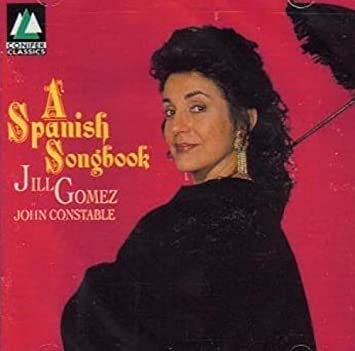
A Spanish Songbook – Jill Gomez

516xghgdgjl._sx355_

What an utterly charmng and delightful disc this is, cleverly planned and beautifully executed.

With her distinctive timbre and wonderfully expressive voice, Gomez’s personality fairly bursts through the speakers and she is superbly supported here by John Constable on the piano, who unerringly captures the mood of the songs. You feel as if these two artists really enjoy making music together, and indeed their association is a long one, having first appeared on disc together twenty years earlier. Gomez would have been in her early fifties when the present disc was recorded but the voice has hardly changed in the intervening years.

What we have here is a compendium of Spanish inflluenced songs by German, French and English composers, as well as songs by Spanish composers, covering a wide range of styles and eras. The programming is eminently sensible and makes for very satisfying listening.

We start with a group of sixteenth century Villancios from the courts of Charles V and Philip II in piano arrangements by Graciano Tarragó, which encourage the kind of decoration and improvisation of the 16th century vilancico. Fuenllana’s De los alamos vengo, madre is no doubt better known from Rodrigo’s orchestral arrangement, but Gomez sparkles quite as much here.

From thence we turn to a group of Spanish influenced songs by Wolf and Schumann, in which Gomez captures perfectly the deep melancholy of Schumann’s Tief im Herzen trag’ ich Pein as well as the girlish coquettishness of Wolf’s In dem Schatten meiner Locken. Spain has always provided a deep vein of inspiration for French composers, so we are next treated to a group of songs by Bizet, Ravel, Saint-Saëns and Délibes in which Gomez’s sense of style is impeccable.

Next come the three Granados Tornadillas, in which we are probably more used to hearing the fuller, chestier sound of someone like Conchita Supervia. Gomez intelligently, rather than copy her style, is more languorous. I might prefer Supervia’s vibrancy, but Gomez’s way is just as valid.

The two Walton songs, both taken from Façade, find Gomez pointing Edith Sitwell’s lyrics deliciously and lead us into the final group, which Gomez calls “Seven Other Popular Songs”. The first three songs are by Roberto Gerhard, who, as an exile from Franco’s Spain, had relocated to Cambridge in the UK in 1942, where he lived until his death in 1970. These are his versions of folk-songs collected by his teacher, Felipe Pedrell. bittersweet souvenirs of a composer in exile. The others are by Tarrago, Rodrigo, Guridi and Obradors. Gomez is yet again a wonderful guide through this musical journey of Spain, brilliantly capturing the mood of each song.

An excellent recital that should be a lot better known than it is.