My fave teenage pop albums

Loads of people seem to be doing lists of their favourite/most played albums, and showing themselves to be pretty cool in the process. Looking at mine, I was obviously not that cool as a teenager. The first single I owned was Johnny Leyton singing Johnny Remember Me and the second was Doris Day singing Move Over Darling. Definitely not cool.

The first LP I ever owned was Dusty Springfield’s A Girl called Dusty(it cost 32/6 or around £1.65) but that was supplanted by some of her later albums, particularly Ev’rything’s Coming Up Dusty,

This was a real deluxe affair and came in a hard back cover with several pages of  photos of Dusty inside. The track listing above is for a CD reissue. Side 1 of the original LP ended with Doodlin’. There isn’t a dud on the album, but favourites included the gently reflective I had a talk with my man and the rip-roaring account of the Gerry Goffin/Carole King classic I can’t hear you.

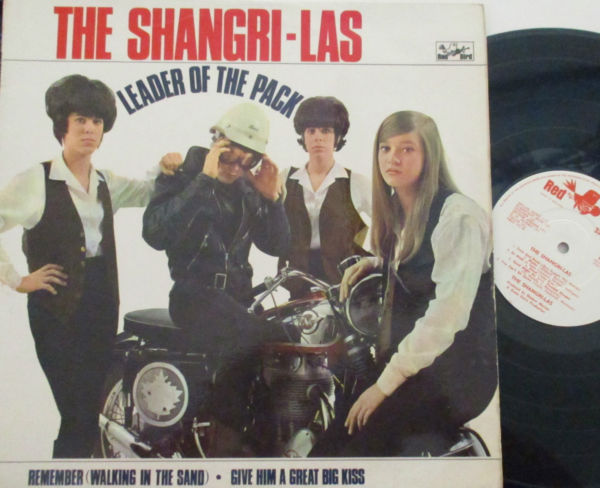
The Shangri- Las never quite made it in this country, but I was hooked from the first time I heard their debut single, Remember (walkin’ in the sand) and the following single Leader of the pack (banned by the BBC, believe it or not), I liked even more. It has since become a classic of course. Their debut album had on it both singles and their B sides, plus their next hit, Give him a great big kiss, on Side 1, and a live concert (with added audience noise) on Side 2. It was hardly ever off my turntable.

The Beatles were unavoidable back then. I’d love to say that the album I played most was The White Album or Sergeant Pepper’s Lonely Hearts Club Band, but truth to tell, it was much later that I learned to appreciate them. My favourite album, at least in my early teens was With the Beatles.

with_the_beatles_album

Should I be ashamed to admit I had a bit of a crush on Paul McCartney back then? In my defence, he was pretty cute when he was young. Favourite tracks were All my loving and Please Mister Postman.

The latter was covered by the Carpenters and their third album called simply Carpenters was another regular visitor to my turntable. The first time I ever heard Karen’s voice was on the radio singing Rainy days and Mondays and I was hooked from the outset. She had a voice of velvet, which she used with consummate skill, never seeming to breathe, with a vein of melancholy that tinged every song she sang. I still rate her as one of the greatest female singers of all time.

f0109989_1635553

It was my brother who first became a fan of French chanteuse, Francoise Hardy. I think we first saw her on Ready Steady Go singing Et même. Pencil thin, with her long straight hair and fringe shading her eyes, she was the very epitome of sixties chic. I had loads of her albums, but the one that stood out for me was one she brought out in 1968, called Il n’y a pas d’amour heureux, which had on it what is still one of my favourite ever tracks, Il est trop loin. One of the great things about her, for a French student anyway, was that she had perfect diction. Even with my schoolboy French I could understand what she was singing about, and even used to write down the words. I remember one of our student teachers at school using her albums in class to get us more engaged with the language.

franc387oise_hardy_ilnyapasdamourheureux-453480

I think it was the summer of 1965 when Sonny and Cher made it big, with their seminal hit I got you babe. I’ve been a fan of Cher ever since, and one has to admit that the woman has had the most extraordinary career. I had most of Sonny and Cher’s early albums, as well as Cher’s solo efforts, my favourite of which was her third album, called simply Cher.

0

Aside from the opening track, Sunny, this included Cher’s rendition of the Bacharach/David penned Alfie, which was the theme song for the film that made Michael Caine a star. I also really liked her version of Buffy St Marie’s Until it’s time for you to go. That said, there is no doubt that Cher is a much better singer now than she was then.

The Mamas and the Papas swept to fame with their single California Dreamin’ and subsequently had a stream of hits including Monday Monday and Creeque Alley, which basically told the story of the group. I only ever owned one of their albums, but it is rather special, my one big favourite being the folk inspired Dancing Bear. Great vocals from, especially, Mama Cass and Denny Doherty, with fantastic renditions of Dancing in the street and Words of love, amongst others.

the-mamas-and-the-papas-no-salt-on-her-tail-dunhill

In the early 60s I had been a big fan of The Walker Brothers and had even seen them live in Stockton-on-Tees. Scott Walker’s rich baritone was at the centre of some major hits, including Make it easy on yourself, My ship is coming in and The sun ain’t gonna shine anymore, and it seemed inevitable that Scott would eventually leave the group to go solo. His first two albums mixed pop standards with more esoteric fare by Jacques Brel and Scott himself, but the third album was dedicated almost exclusively to material by Scott, apart from three Jacques Brel songs at the end of side 2. For me he reached his peak with Scott 4, which was the first album of songs only penned by Walker. Maybe not coincidentally it was the first of his albums not to chart and was soon deleted, though it has now achieved something like classic status. Walker was finding it harder and harder to balance the creative and the commercial. However I’ll go for Scott 3 as the album I listened to most in my teens, with its progression of vignettes of sad, lonely individuals. Stand out tracks for me were Big Louise and the opening It’s raining today, not to mention the best ever version of Jacques Brel’s If you go away.

Just creeping into my teenage years is Carole King’s Tapestry, which is surely an all time classic. I’d known Carole King mostly from the many hit songs she penned with her then husband Gerry Goffin during the 60s, many of them sung by Dusty Springfield. I was unaware of her as a singer until the release of the single It’s too late, which also appeared on the album Tapestry, which has since become one of the best selling albums of all time. Every track is a winner and most of them have been covered by artists as diverse as James Taylor and Barbra Streisand.

carole_king_-_tapestry

And finally there was Barbra Streisand herself. I was knocked out by her performance in Funny Girl, and subsequently bought every single one of her albums, but I think the one that first did it for me was My name is Barbra, which John Morton originally leant to me, then finally gave to me. I couldn’t get enough of that voice and I used to go around the house emulating her singing style. How on earth didn’t anyone, least of all I, know I was gay? The album has some of Barbra’s best vocal performances on it, I can see it, He touched me, Jenny Rebecca, Where is the wonder and of course My Man, which had ended the movie version of Funny Girl.

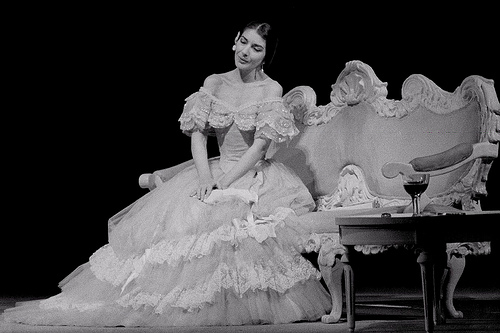
Maria as Cover Girl (6) + An Utterly Special Discovery: Opera Magazine’s Review of La Traviata at Covent Garden in June 1958 (August 1958 Issue) + Very Rare Filmed Footages of La Divina at Covent Garden

This provides a great opportunity for Callasiana to present an utterly W-O-N-D-E-R-F-U-L and E-X-T-R-A-O-R-D-I-N-A-R-Y discovery, shared on facebook by Signore Jose Luna, who met Divina in the 1970…

Source: Maria as Cover Girl (6) + An Utterly Special Discovery: Opera Magazine’s Review of La Traviata at Covent Garden in June 1958 (August 1958 Issue) + Very Rare Filmed Footages of La Divina at Covent Garden

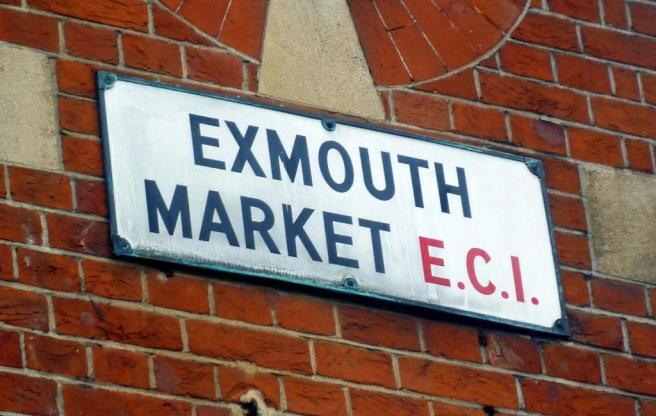
The Changing Face of Clerkenwell

I noticed today that one of my favourite haunts, Café Pistou, has closed down permanently.

cafe-pistou-exmouth-market

When it first opened, it was a great place to enjoy a relaxed evening. Not cheap, but not excessively priced, it was a place you could enjoy a coffee or a bottle of wine, a full lunch or dinner, or work your way through the many small plates. I always enjoyed the food, though, to judge by Fay Maschler’s review in the Standard towards the end of 2014, quality could be variable, and, where once you could take time and stay late over a bottle of wine, the policy seemed to have beome roll ’em on up, roll ’em on out. Still, I’ll be sad to see it go. It was an independently run establishment, whereas its replacement, Grind, which originated in Shoreditch (where else?) is now a London chain of seven eateries. They also have a coffee roastery and a couple of music studios, so they are very hipster, very edgy, or whatever other word is current these days. (Don’t ask me. I’m getting on after all). I have never been to any of their establishments, so I will reserve judgement till their new place has opened, but I will miss Café Pistou, though it was only around for a couple of years.

The other place that has closed recently had been around a lot longer than that, famed for providing very good bistro food at a very reasonable price. It was called Little Bay, and had branches in Kilburn (the first one, I believe), Brighton, Croydon and possibly elsewhere. For a long time it was extremely popular, mostly because it was so cheap, and the food amazingly good at the price. One wondered how on earth they were able to do it. Quite often I would stop off on my way home, as eating there could be cheaper than a trip to the supermarket.

That said, standards had dropped off in the last few years, and I hadn’t been for quite some time.

It has been replaced by a place called Hammer and Tongs, which tries to reproduce indoors an outdoor South African braii, albeit at swanky London West End prices (a T-Bone sharing plate will set you back £56 and most of the wines sell at over £30 a bottle). I haven’t sampled it yet, and I’m not sure I’ll ever be able to on my budget.

Two other favourite restaurants have also disappeared in recent years. Both of them closed at the same time, priced out by a new landlord who whacked up the rent beyond their means. One of them, Sade, another restaurant providing excellent food at very low prices, and one I used to go to on a regular basis, remains closed and boarded up. The other, the Gulshan Tandoori, a family run Indian restaurant, which had been trading for over 30 years, has been replaced by two fast food establishments, Dirty Burger and Pizza Pilgrims. The Gulshan was a really good Indian restaurant, and a favourite haunt of mine when I was appearing at Sadler’s Wells in Bless the Bride. I was also a regular takeaway customer. I miss it.

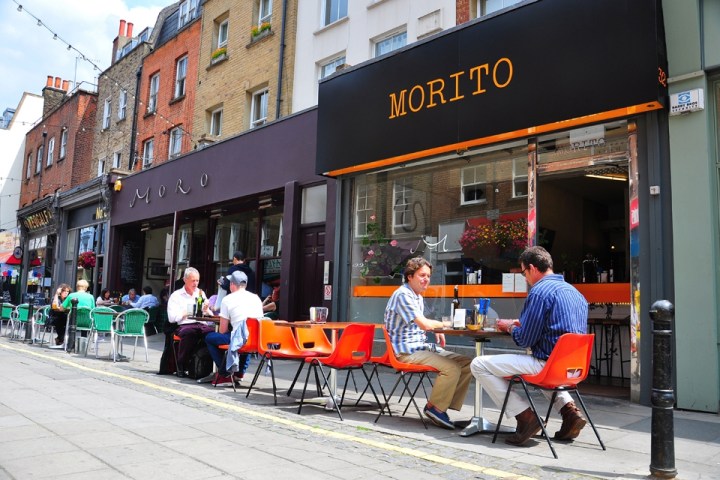
Quite a few places came and went before I got a chance to sample them, but it appears the excellent and well established Moro, with its cheaper, smaller tapas bar, Morito, is still going strong.

morito-morito_menu_image-1335517314922571184

Moro has been here 20 years now, and unfortunately I’ve only been once. I don’t know whether it’s still the case, but you always had to book ages in advance, and I was never that organised. The food, on that one occasion, was absolutely fantastic, and it appears to be pretty packed every time I pass by, so I would assume that the quality is still excellent. At one time I thought it quite expensive. Nowadays, comparing their prices with others in the area, it seems quite reasonable, but I suppose that’s a sign of the times too.

With Crossrail about to go through the station, Farringdon is set to become one of the busiest, if not the busiest station in London. Uniquely, it will have direct connections to Heathrow, Gatwick and Luton, with St Pancras and Eurostar just one stop away. There is so much development and building work going on that it’s hard to keep track. The old Guardian offices, an ugly 60s block on Farringdon Road, have been razed to the ground, to be replaced by yet another luxury office and apartment block. The old St Martins School of Art has suffered the same fate.

The old Guardian Newspaper office is right next door to Piano Works, a fairly recent addition to Clerkenwell’s night life. It’s a lively and popular live music bar and my niece, Abi, is now one of the resident singers there. It has a great vibe and we love it there. I just hope that gentrification , that terrible word which is ripping the heart out of so many parts of London doesn’t mean its demise.

I’ve lived in Clerkenwell for a long time now, long before it was trendy, when most of the area south of Rosebery Avenue was commercial office space. At one time my nearest supermarket was at the Barbican or Angel, Islington, and it was like a ghost town at weekends. Now I have a Waitrose less than five minutes’ walk from my flat, dozens of restaurants to choose from, design shops and clothes shops opening up everywhere. What once was Turnmills night club, home to the notorious Trade, as well as other clubs is now home to another Shoreditch export, Albion. I like it. They do a great all day breakfast, but I do hope that Clerkenwell doesn’t become, well, just a suburb of Shoreditch. It has its own character, almost like an inner city village, and I hope it retains something of that character.


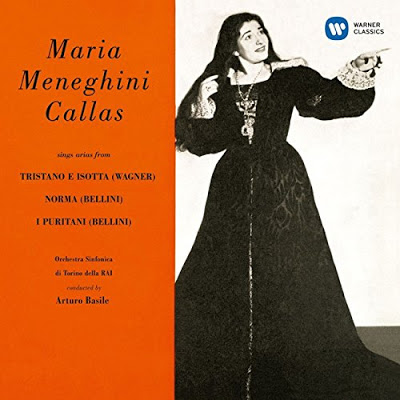
Callas’s First Recordings

51fvbzc5ijl

Recorded 8-10 September 1949, Auditorium RAI, Turin

Producer & Balance Engineer unknown

So finally I come to the end and find myself, after many hours of fantastic listening, at the beginning, Callas’s first commercial recordings and the 78s that introduced the world to the voice of Maria Callas. The recordings followed a radio concert of the same material (plus Aida’s O patria mia) and were obviously intended to showcase Callas’s versatility, a pattern which was to follow in some of her EMI recitals, like Lyric and Coloratura and the first French recital.

Callas was only 25 when these recordings were made, but they display an artistic and vocal maturity far beyond her years. She first sang the role of Isolde under Serafin in 1947 in Venice, literally sight singing the role at her audition. Serafin, who had conducted her in her Italian debut as Gioconda, was suitably impressed and hired her immediately.

The Liebestod is of course sung in Italian, but it is more than just a curiosity. This is a warm, womanly Isolde who rides the orchestra with power to spare. Note too how easily she articulates the little turns towards the end of the aria. Her legato is, as usual, impeccable, and the final note floats out over the postlude without a hint of wobble.

Norma’s Casta diva and Ah bello a me are sung without the opening and linking recitatives, but the long breathed cavatina is quite possibly the most beautiful she ever committed to disc, and the cabaletta, though it lacks some of the light and shade she would later bring to it, is breath taking in its accuracy and sweep.

But what caused the biggest sensation at the time was the Mad Scene from I Puritani. What was considered a canary fancier’s showpiece suddenly took on a tragic power nobody suspected was there. Qui la voce is sung with a deep legato, the long phrases spun out to extraordinary lengths, but with an intensity that never disturbs the vocal line. Vien diletto almost defies belief. No lighter voiced soprano has ever sung the scale passages with such dazzling accuracy, nor invested them with such pathos, emerging, as they do, as the sighs of a wounded soul. And to cap it all, this large lyric-dramatic voice rises with ease to a ringing top Eb in alt. I have played this to doubting vocal students before now, and they have sat in open-mouthed disbelief. I remember one opera producer friend of mine once telling me that listening to it made him profoundly sad. “I know I will never hear live singing of that greatness in my lifetime,” he confided to me. If ever confirmation were needed of the greatness, the genius of Maria Callas, it is here in these, her very first recordings, and especially in this astonishing recording of the Mad Scene from I Puritani.

For my part, I have enjoyed every moment of my journey from those late recordings, where the genius would flash through to offset the evident vocal problems to these earlier ones where the voice had an ease and beauty that deserted her all too soon. Callas is and remains the pre-eminent soprano of the twentieth century. I know of no other singer who has made music live the way she did. A post on Talk Classical recently discussed underrated singers. I’d be tempted to add the name of Maria Callas, because, to my mind, her genius was inestimable. None of the accolades she has received seem eloquent enough, and I certainly can’t add to them.

50 years after she last sang on the operatic stage, she is still causing controversy, and no doubt always will. Her career may have been short, but was it Beverly Sills who once said, “Better 10 years like Callas than 20 like anyone else?”

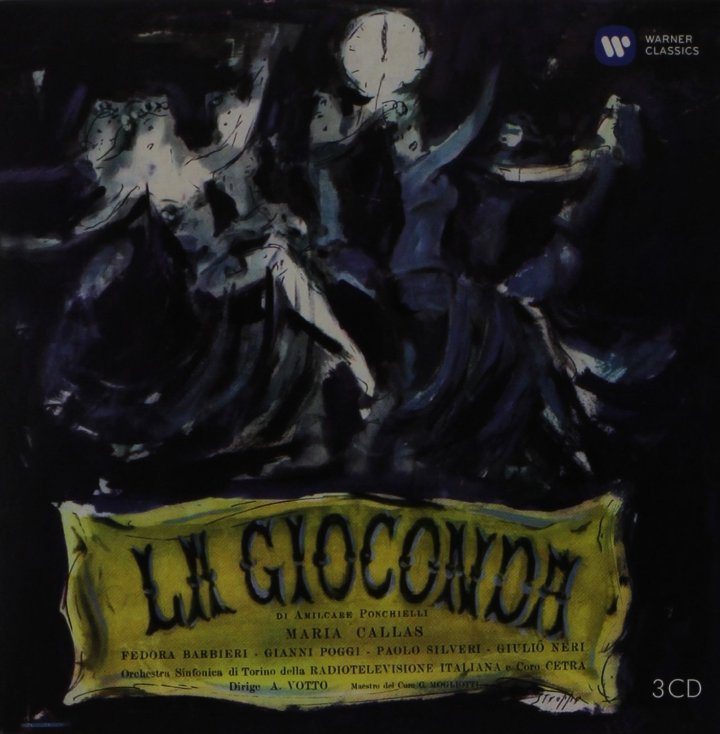
Callas’s 1952 La Gioconda

71rm8ukuydl-_sl1500_

Recorded 6-10 September 1952, Auditorium RAI, Turin

Producer & Balance Engineer unknown

Callas’s first ever complete studio recording was made for the Italian firm Cetra in 1952, before she had signed with EMI. The role of Gioconda had furnished her with her Italian debut in 1947, and was the occasion she met two of the most important men in her life, her mentor Tullio Serafin and her future husband Battista Meneghini. Paradoxically she would make her second recording of the opera at the time of her affair with Onassis, and when she was separating from Meneghini.

When Callas recorded La Gioconda for Cetra she was still a large lady and at her vocal peak. It was recorded just a couple of months before she made her spectacular debut at Covent Garden in Norma and shortly before her only series of performances as Lady Macbeth at La Scala, a role one wishes had figured more in her career. She then went on to sing Gioconda at La Scala, her last performances in the role until the EMI recording in 1959.

Given the sheer animal power and massive, freewheeling brilliance she could command at this stage in her career, you would think this Cetra recording would, in all but matters of sound, win hands down over the later one, recorded seven years after when her vocal powers were failing, but I’m not sure it’s that simple, and, whilst listening to this one, there were quite a few passages where I found myself hankering after the later recording. True, the singing is often magnificent, and it is easy to be swept away by the coruscating force of her delivery, but I find myself missing some of the refinements she has made by the time of the second recording. This may be a controversial opinion, but this one seems to me to be a series of thrilling highlights, whereas the characterisation on the EMI set feels more of a piece, with a cumulative power I don’t get here, for all the added security of her voice; and actually there are certain, purely vocal moments, she manages better on EMI than she does on Cetra (the pitfalls of Ah come t’amo, the E un di leggiadre section from Suicidio, the whole of the section after she gives Laura the sleeping draught, for instance).

As against that, I should also state that her performance of Suicidio here completely floored me when I first heard it. I had no idea a female voice, a soprano at that, could sing with such passion, could have such powerful chest notes. It was absolutely staggering and one of the things that first turned me on to the genius of Callas in the first place. If I later got to know the opera better from the EMI recording and place that at a slightly higher level of achievement, it is none the less  a close-run thing.

The Warner engineers have done a great job of the re-mastering and it sounds much better than I remember it from my previous CDs, though obviously not so good as the stereo EMI set. One also misses the greater refinement of the La Scala orchestra and chorus.

As for her colleagues, it is largely a case of swings and roundabouts. Barbieri is a much more positive presence than the young Cossotto as Laura, but none of the men on either of the sets are particularly good. Ferraro on EMI isn’t very subtle, but he certainly makes a pleasanter sound than the awful Poggi. Honours are about equal between Silveri and Cappuccilli, Neri and Vinco. Votto’s conducting isn’t much different in the two sets, and remains some of his best work on disc.

One thing is for sure, Callas as Gioconda is an absolute must, and, regardless of any reservations surrounding her colleagues or recording quality, eclipses every other performance of the role on disc.

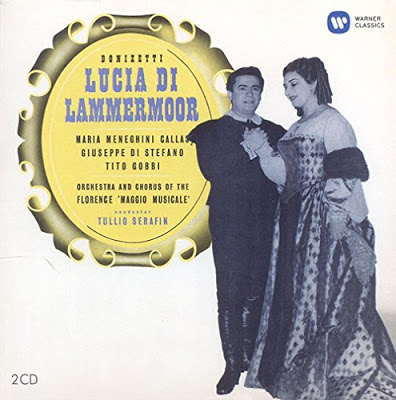
Callas’s 1953 Studio Lucia di Lammermoor

51252bkyvtf8al

Recorded 29-30 January, 3, 4 & 6 February 1953, Teatro Comunale, Florence

Producer: Dino Olivieri, Balance Engineer: Osvaldo Varesca

Of all the roles Callas sang, it was probably Lucia which created the biggest furore. Back in the early 1950s, nobody took the opera very seriously. It was considered a silly Italian opera in which a doll-like coloratura soprano ran around the stage showing off her high notes and flexibility. There is a hilarious description of the characters in E.M. Forster’s Where Angels Fear To Tread attending a provincial performance of Lucia di Lammermoor. Here he describes the prima donna’s first entrance.

Lucia began to sing, and there was a moment’s silence. She was stout and ugly; but her voice was still beautiful, and as she sang the theatre murmured like a hive of happy bees. All through the coloratura she was accompanied by sighs, and its top note was drowned in a shout of universal joy.

For anyone who loves opera or Italy, I heartily recommend this self-mocking tale of the English abroad.

But back to Callas, who first sang the role of Lucia on stage in Mexico  in 1952. A few months earlier she had sung the first part of the Mad Scene at a concert in Rome. After Mexico, she would sing it in Florence, Genoa, Catania and in Rome before appearing in Karajan’s legendary production at La Scala at the beginning of 1954, a production that subsequently travelled to Berlin (one of her most famous recorded live performances) and Vienna.  It was also one of the roles she chose for her U.S. debut in 1954 in Chicago and at the Met in 1956. Her last performances of the role were in Dallas in 1959 (in the same Zefirelli production that made Sutherland a star at Covent Garden) and she made two recordings of the opera;  this one in 1953 in Florence, shortly after stage performances there and the second in 1959 in London. After Norma, Violetta and Tosca it is the role she sang most often, so it is hardly surprising that she is so much associated with it.

Back in the 1950s it must have seemed unthinkable that such a large voice could tackle the role, and not only sing it, but sing it with such accuracy and musicality, giving the opera back a tragic intensity that people had forgotten, or didn’t even know,  was there.  There is a touching story of Toti Dal Monte, an erstwhile famous Lucia herself, visiting Callas in her dressing room after a performance, tears streaming down her face, and confessing she had sung the role for years without really understanding its dramatic potential.

From Callas’s very first notes, she presents a highly-strung, nervous character, but sings with impeccable legato, all the scales and fioriture bound into the vocal line, the tone dark, but plangent, expressive but infinitely subtle. Regnava nel silenzio is a model of grace, but she still manages to invest the words di sangue roseggio with a kind of horror, whilst never resorting to glottal stops or other verismo tricks. She understands that with bel canto it is the arc of the melody, of the musical line that is paramount.

And so it continues, with her consolatory Deh ti placa in the duet with Di Stefano’s Edgardo, a duet of musical contrasts, in which Callas’s Lucia is at its most feminine. The duet with Gobbi, their first encounter on disc together, is also full of contrasts, and Gobbi makes a much more interesting villain than Cappuccilli in her second recording, finding a range of insinuating colour that his younger colleague doesn’t even hint at.

The Mad Scene is a miracle of long breathed phrases, with such lines as Alfin son tua heartbreakingly expressed, and of course here there are none of the problems with the top Ebs that we get in the second recording.

Di Stefano is more suited to Edgardo than he would be to Arturo in I Puritani, which was recorded soon after, and he is much to be preferred to the over-the-hill Tagliavini on the second recording. Serafin conducts a tautly dramatic version of the score.

The sound on this Warner issue still tends to distort and crumble in places. I guess that must be on the master, but the voices ring out with a little more truth.

Of course both Callas and Di Stefano can be heard together in the famous 1955 Berlin performances under Karajan, in sound which is not much worse than this, and that recording would still be my first choice amongst Callas’s Lucias, for all that she eschews the first Eb in the Mad Scene. Under Karajan’s baton and in a live situation she sings with effortless spontaneity, almost as if she is extemporising on the spot.

Still this first Callas studio recording is the one that got people talking and the one that quite possibly changed opinions about bel canto for many years to come. As such it has a historical significance which should never be forgotten.

Callas in I Puritani

r-12800357-1542200837-6181.jpeg

Recorded 24-30 March 1953, Basilica di Sant’Eufemia Milan

Producer: Dino Olivieri, Balance Engineer: Osvaldo Varesca

I Puritani, Callas’s second opera for EMI was the first recorded under the imprimatur of La Scala, an association which would result in eighteen further opera sets over a period of seven years.

No doubt because of the circumstances surrounding her first Elvira (she learned it in 3 days to replace an ailing Margherita Carosio whilst still singing Brunnhilde in Die Walkure) and because of her famed recording of the Mad Scene, one would expect the role to have played a greater part in her career, but in fact after those first performances in Venice in 1949, it figured rarely in her repertoire.

She sang it again in Florence, in  Rome and  in Mexico in 1952, and in her second season in Chicago in 1955, then never again, though the Mad Scene did occasionally appear in her concert programmes, even as late as 1958 at  a Covent Garden Gala. A recording of her rehearsing the scene for her Dallas inaugural concert in 1957 exists, and shows her still singing an easy, secure and full-throated high Eb.

Maybe the reason she sang it so little is that Elvira offers less dramatic meat than Lucia or even Amina. The libretto is something of a muddle and Elvira seems to spend the opera drifting in and out of madness. Of course she gets some wonderful music to sing, and Callas certainly breathes a lot more life into her than most singers are able to do. She also gives us some of her best work on disc, her voice wonderfully limpid and responsive, the top register free and open. No doubt this is the reason it has remained one of the top choices for the opera since its release over 6o years ago.

We first hear her in the offstage prayer in Act I Scene I, and straight away there is that thrill of recognition as her voice dominates the ensemble. Then in the scene with Giorgio, she finds a wide range of colour, a weight of character, that we don’t normally hear. Her voice, laden with sadness for her first utterances, then defiant when she thinks she is to be wed to someone she doesn’t love, is fused with utter joy when she realises that it is Arturo she is going to marry. She skips through the florid writing with lightness and ease, but invests it with a significance that eludes most others. One moment that stood out in relief for me was her cry of Ah padre mio when Arturo arrives, which bespeaks the fullness of heart that is the main characteristic of this Elvira. Son vergin vezzosa is a miracle of lightness and grace, Ah vieni al tempio heartbreakingly real, though her voice does turn a little harsh when she doubles the orchestral line an octave up.

The Mad Scene needs little introduction. It is one of the most well-known examples of her art out there, the cavatina moulded on a seemingly endless breath; and where have you ever heard such scales in the cabaletta? Like the sighs of a dying soul. The top Eb at its climax is one of the most stunning notes even Callas ever committed to disc, held ringingly and freely without a hint of strain. Words fail me.

She has less to do in the last act, which mostly belongs to the tenor, and this is where I have a problem with the set. Di Stefano is nowhere near stylish enough in a role that was written for the great Rubini, and he lurches at every top note as if his life depended on it. Sometimes the notes sound reasonably free, at others he almost sounds as if he’s holding onto them with his teeth. Mind you, who else was there around to sing it any better at that time? The recording was made too early for Kraus, though Gedda might have been a good idea. After all, he was already singing for EMI by then, and would sing Narciso on Callas’s recording of Il Turco in Italia, which was recorded the following year..

Rossi-Lemeni  is less woolly-toned than I remember him and sings with authority, especially good in the first act duet with Callas; Panerai is a virile presence as Riccardo. Serafin conducts with his usual sense of style, but also invests some drama into the proceedings.

The orchestra and voices sound really good, but the recording of the chorus is a bit muddy. Presumably that was also the case on the original LPs.

I do have a few problems with I Puritani. To my mind the libretto is plain silly, and even Callas’s wonderful singing can’t quite rescue it. That said, as singing qua singing, it’s some of the most amazing work she ever committed to disc, and for that reason it will always be a permanent part of gramophone history. I would never be without it.


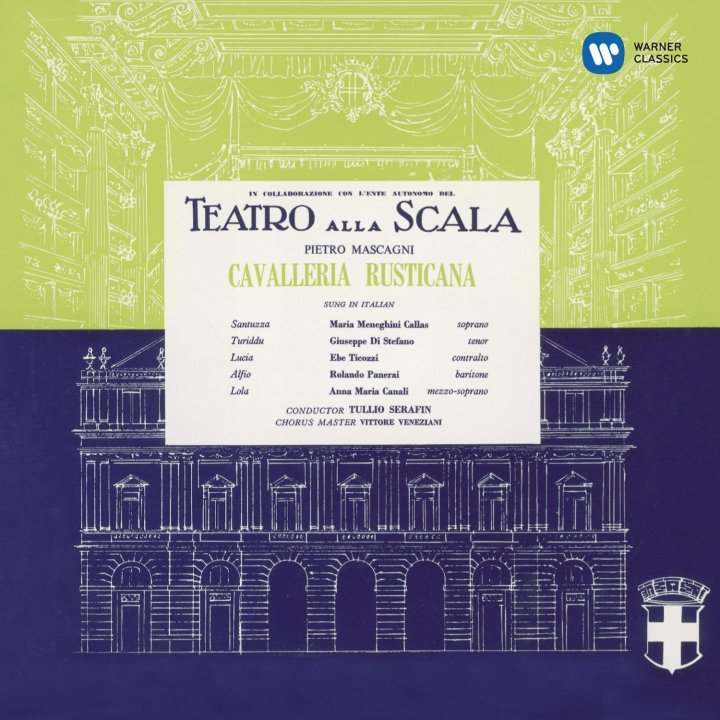
Callas in Cavalleria Rusticana

81rypabsull-_sl1500_

Recorded 16-25 June, 3-4 August 1953, Basilica di Sant’ Eufemia, Milan

Producer: Dino Olivieri, Balance Engineer: Osvaldo Varesca

According to the notes accompanying this recording, Callas actually replaced the scheduled singer for it, a famous mezzo who was having trouble with her top notes. Does anyone know who this might have been? Could it have been Stignani? She ducks some of the top notes in Callas’s Norma the following year, and she was getting on a bit by this time, so it’s possible I suppose.

Whoever it was, we should be pleased that Callas was around to fill the breach, because her Santuzza is superb. Unbelievably she had only previously sung the role in her student days, when only 15 and also a couple of times with the Athens Opera, but, apart from this recording, never again, and yet, in fabulous voice, she inhabits the role of poor, hapless Santuzza as no other.

At this stage in her career her voice was as responsive in verismo as it was only a few weeks before, when she was recording Bellini (I Puritani). She uses none of the tricks of the verismo soprano, no glottal stops, no aspirates, no sobs, but sings with a pure musical line. When she sings io piango at the end of Voi lo sapete, she is able to suggest tears without actually sobbing.

Furthermore her characterisation has been thoroughly thought out. This is a young woman at the end of her tether with nothing left to lose. Her very first utterances are full of weariness and hopelessness, that first little dialogue with Mamma Lucia full of despair. Quale spina ho in core, she sings, and her singing of those few words rends the heart, as do her thrice repeated cries of O Signor in the Easter Hymn. Left alone with Mamma Lucia, she pours out her sad story.  Voi lo sapete is not only heartrendingly poignant, but beautifully sung, and we note how economically she uses her chest voice. Intensity is not achieved at the expense of musical line.

Nor is it in the duet with Turiddu, which bristles with contrast and drama. Here it is not just a stock operatic duet, but a full scale Sicilian row between a young couple. Callas pleads, rails, cajoles and, finally, when she can take no more, hurls her curse at Turiddu. Alfio serendipitously turning up at just that moment gives her the opportunity to vent her spleen, but, yet again, her singing is full of subtle little details and the solo that leads into the duet is sung with a sustained, if tragic beauty. Note how skilfully she shades the line at the end when she takes the pressure off the voice, moving from chest to head and ending quietly on lui rapiva a me. The closing section has both Panerai and Callas pulling out all the stops. It is absolutely thrilling.

A few words then about the rest of the cast. Di Stefano  sings with his own brand of slancio and presents a caddish, if ultimately remorseful Turiddu. Panerai is a splendidly virile Alfio, and Anna Maria Canali a sexy, minx-like Lola, superbly bitchy in her short exchange with Callas’s Santuzza. Serafin’s speeds are sometimes a bit slow in the choruses, but he paces the meat of the drama really well.

The recording still overloads occasionally at climaxes, so I assume that is a problem that exists on the master, but otherwise the sound is quite open and Callas’s voice fairly leaps out of the speakers.

Not for nothing has this remained one of the top recommendations for Cavalleria Rusticana for over 50 years, and I don’t see that changing any time soon. For first-rate recorded sound and orchestral splendour one would go to Karajan, for characterful full-throated singing to Serafin.

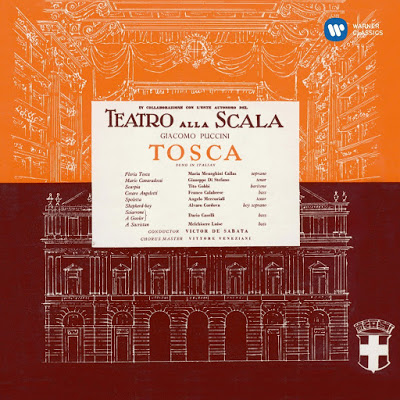
Callas’s 1953 Studio Tosca

91ntirq8gdl-_sl1500_

Recorded 10-21 August, 1953, Teatro alla Scala, Milan

Producer: Walter Legge, Balance Engineer: Robert Beckett

What can one say about this famous recording of Tosca that hasn’t been said before? It regularly appears in lists of the greatest recordings ever made, and it seems now that its legendary status is confirmed.

Because of it, Tosca has often been considered the quintessential Callas role, but, though she sang it a fair amount in her early career, she pretty much ignored the role after this recording, until it became the vehicle for her operatic comeback in London in 1964. Indeed she never sang it, or any other Puccini role, at La Scala, which was her cultural home at the height of her career. A few months after making this recording she sang the role at a couple of performances in Genoa, then promptly ignored it, except for her two seasons at the Met in 1956 and 1958. In 1964, Zeffirelli managed to get her to choose it as the vehicle for her comeback, but, typically for her, she would only agree if they could do Norma as well, which he staged for her in Paris.

The Zeffirelli production, which was shared by Paris and London, became one of the most famous in operatic history (and in fact Covent Garden only retired it a few years ago). Indeed one could say the photos of Callas in that red velvet dress she wore in Act II have since become iconic, even though Callas herself often voiced her disdain for both the opera and the role.

True, it may not have offered her the vocal challenges of Norma or Medea, of Violetta or Lady Macbeth, but in 1953 her voice was an amazingly limpid and responsive instrument, enabling her to easily encompass its demands, whilst rendering the score with an accuracy the likes of Tebaldi and Milanov could only dream of. Take, for instance, the lightness and grace with which she sings a line like le voce delle cose in Non la sospiri la nostra casetta. Most Toscas are clumsy here, but Callas sings it with elegant ease. Furthermore at this stage in her career, she can swell the tone to a refulgent climax at Arde in Tosca un folle amor, which she can’t quite manage by the time of the second recording, which was recorded around the same time as the London and Paris performances.

Interestingly, though, in terms of interpretation, there are not that many differences between Callas’s Tosca of 1953 and 1964; a few minor details here and there, but for the most part the character of Tosca is as musically finished here as it was to be histrionically in Covent Garden. Though Zeffirelli may have helped her with odd bits of stage business, it seems sure that her conception of the character had changed little in the intervening years. The main differences are vocal, and here she rides the orchestra with power to spare, the top Cs, that emerged as little more than shrieks in 1964, full throated and solid as a rock. Vissi d’arte (which Callas used to say should be cut as it held up the action) is both beautiful and heart-rending. So it is in 1964, but the ending taxes her to the limit there, whereas here it is full throated and easy.

Of course there are other reasons why this set has retained its place as the best of all Tosca recordings. Gobbi is also in fuller, securer voice here than he was in 1964, and his loathsome, reptilian Scarpia is a towering achievement. As usual, he and Callas strike sparks off each other, their confrontations bristling with tension. Di Stefano, who also appears on the first Karajan recording, is here in his best voice, an ardent, youthful and passionate Cavaradossi. Both duets with Callas are erotically charged affairs, as they should be.

Then of course, there is De Sabata on one of his rare excursions to the studio. The La Scala orchestra play superbly for him, and he unerringly paces the score just perfectly, with a sure sense of the work’s inner impetus, his use of rubato  brilliantly controlled. In a performance such as this, the one true winner is Puccini.

Sonically it is surely the best of all Callas’s studio mono sets from La Scala. One hardly notices the lack of stereo; voices are perfectly placed and the orchestra sounds richer and more full-bodied than was often the case. This transfer has also corrected some of the errors that crept into previous CD incarnations, not least the terrible GROC version.

Still the Tosca to have, and blow stereo digital sound.

Callas’s Studio La Traviata

81bx7aswvql-_sl1500_

Recorded September 1953, Auditorium RAI, Turin

Producer & Balance Engineer: Unknown

In one sense it’s a shame this Cetra recording of La Traviata was ever made. Had it not been, Callas would have been the Violetta on the Serafin La Scala recording with Di Stefano and Gobbi instead of Stella. Her contract stipulated that she could not re-record the role for 5 years. Legge presumably felt he couldn’t wait any longer to add a recording of such a central Italian classic to his catalogue.

Whatever the reasons, Callas was furious with Legge for engaging Stella and with Serafin for conducting it without her. For a while she and Serafin didn’t speak and he is notably absent from her recording schedule for the following year, 1956.

In retrospect maybe Legge should have waited till Callas was free to record Violetta again in 1958, the year of Callas’s most searchingly complex stage performances in the role (Lisbon and London). Had he done so EMI would no doubt have had the best-selling La Traviata of all time. As it is, the Stella recording was never a big seller, and only received a CD issue, when Testament unearthed it some years ago. Bad call, Walter.

Of all the roles in Callas’s repertoire, it was Violetta that went through the greatest transformation from her debut in the role in 1950, through the famous Visconti production at La Scala in 1955 to those last, movingly poetic performances in 1958 in Lisbon and London. It was the role she sang most often after Norma, and the role she most often considered for a comeback. There were discussions of a recording for EMI even as late as 1969, when, vocally, it would have been out of the question. Callas considered it very much her role, that of the woman who gave up everything for love. Maybe there was a parallel here with her own life. Didn’t she give up everything for love?

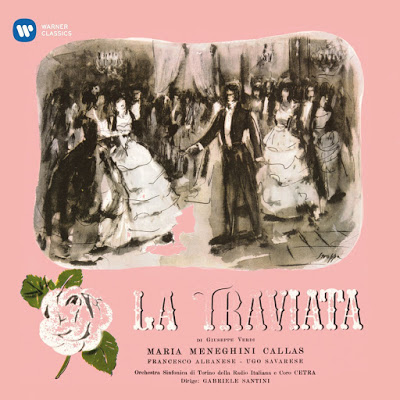
This recording of La Traviata was the first one I owned and the first of her Violettas I heard. It wasn’t that easy to get hold of, and my copy was a reissue on Pye Ember. I had no idea of the existence of any of the live recordings, and, had I never heard any of them, I would no doubt have been happy enough with her Violetta, as recorded here, though not necessarily with its surroundings. Compared to her EMI releases, this is a decidedly provincial affair. Santini’s conducting is leaden and neither Albanese as Alfredo nor Savarese as Germont are in the first rank. But at least we have Callas, and, if not as subtle or as heart-rending as she was to become, she is still a great Violetta, and still better than anyone else in the role.

The demands of the first act are more easily encompassed here than they were to become in later performances, though the top Cs in Sempre libera seem slightly tense, as does the concluding Eb. Still it’s freer and more open here than it is in any of the later sets and scale passages are wonderfully fluid. She is tremendously affecting in the duet with Germont, and fails here only in comparison to her later self. Other than this, her traversal of the role is not as complete as it is later to become. There are plenty of affecting moments to be sure, some in the duet with Germont, (the desperation with which she sings Non sapete, for instance) and especially the farewell to Alfredo with the lead up to Amami, Alfredo which seethes with that intensity so peculiar to her. In the second scene the great arching phrase, Che fia? Morir mi sento is too much of an outward sentiment as is Alfredo, Alfredo, di questo core, beautifully though they are sung.

Act III has its moments too. Addio del passato ends on a much more secure pianissimo high A than we get at Covent Garden, but how much more moving is that thread of tone with which she ends the aria in London. Parigi o cara is saddled with  Santini’s leaden conducting, but Gran Dio morir si giovane strikes the right note of despair and Prendi quest’e l’immagine is eloquently moving, if not so eloquent as it was to become.

In short, if no other recording of Callas as Violetta existed, this would be my first choice for the opera. But the fact of the matter is that by 1958, she had refined her interpretation so much that this 1953 performance seems unfinished beside it, almost like a rehearsal for the main event.

Furthermore, in both Lisbon and London, she has a better supporting cast and conductors, and the sound, in London at least, is excellent. I was pleased to hear this performance again, and delighted to have it once more in my collection. Callas’s Violetta, in any of its incarnations is a major achievement after all, but I know it is still to Covent Garden that I will most often return.

I might just add that Warner have done wonders with the sound compared to what I remember of my rather muddy Pye Ember LP version.