Rossini’s Elisabetta Regina d’Inghilterra in Wildbad

818f5oblspl._ac_sl1500_

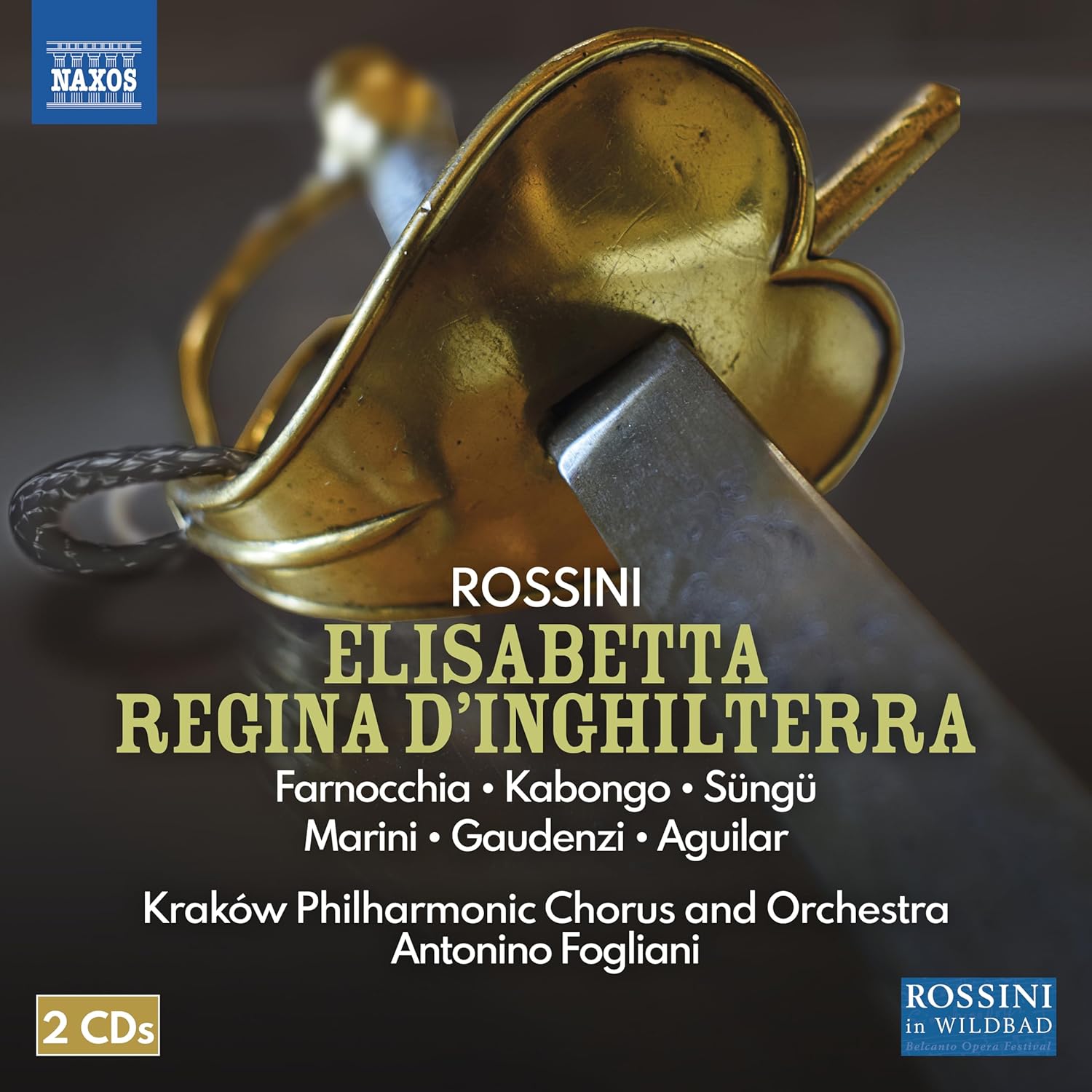
Premiered in 1815, Elisabetta, Regina d’Inghilterra was the first of nine operas Rossini wrote for the San Carlo, Naples. It is based on a play by Carlo Federice, which in turn had been based on a novel by Sophia Lee, called The Recess. Dealing with Elisabeth’s leniency in forgiving Leicester and his secret wife Matilde, it is highly probable that its subject was also meant to celebrate Ferdinand IV, who had recently returned from exile and his ‘leniency’ in not carrying out reprisals against his renegade subjects. At the premiere the roles of Elisabetta and Leicester were sung by Isabella Colbran and Andrea Nozzari, with the role of the villainous Norfolc (sic) going to Manuel Garcia, who would later go on to create the role of Lindoro in Il Barbiere di Siviglia. As is usual with Rossini, there were a lot of self-borrowings in the score. Much of it is from Sigismondo and some from Aureliano in Palmira, including the overture, which would eventually find it’s permanent home as the overture to Il Barbiere di Siviglia. Rosina’s Una voce poco fa in that opera is also a re-working of Elisabetta’s entrance aria.

The opera was a huge success at the time, but, like most of Rossini’s serious operas, fell out of the repertoire until the bel canto revival of the second half of the last century precipitated a spate of revivals.  The present set derives from performances in 2021 in Kraków, Poland and at the Wildbad Rossini festival in Bad Wildbad. However much a rarity on stage, the opera is well represented in the catalogue. We have a 1976 Philips recording, featuring Montserrat Caballé and José Carreras, which was based on performances at the Aix-en-Provence festival and there is also a recording on Opera Rara, with Jennifer Larmore and Bruce Ford, a performance which is absolutely note-complete, though in fact only runs a few minutes longer than the Philips. I haven’t heard the Opera Rara set, nor a live one featuring Leyla Gencer, but I used to own the Philips set on LP and re-listened to some of it on Spotify before writing this review.

Unfortunately, this Naxos set is nothing to write home about. The Kraków Philharmonic Orchestra & Chorus can’t compare to the Ambrosian Singers and the London Symphony Orchestra and Antonio Fogliani whizzes through the score, as if he can’t wait to get it over with. Given what we hear on stage, one can hardly blame him. There is very little of tonal beauty or real vocal accomplishment to be heard. At no point do any of the soloists rival those on the Philips set, where Caballé is in fine voice and has all the grandeur the role of Elisabetta requires. She is in a completely different class from the efficient, but dull Serena Farnocchia, who plays Elisabetta on Naxos. Then on Philips we have the young Carreras. He may not get round the notes quite as easily as Patrick Kabongo, but there is the compensation of the sheer beauty of his voice at that time. Kabongo’s voice becomes thin and wiry as he goes above the stave. That said, Kabongo’s Leicester is at least acceptable but Mert Süngü’s  Norfolc is not. I know the character is extremely unpleasant, but I’m not sure he needs to sound so awful. Ugo Benelli on Philips is much better.

 As Matilde, Philips have the lovely Valerie Masterson, who had played the role in Aix, her bright, light, lyric soprano contrasting well with Caballé’s richer more refulgent tones. You could never mistake one for the other, whereas the voices of Farnocchia and Veronica Marini, who plays Matilde on the Naxos set, aren’t particularly dissimilar.

The tepid applause, which occasionally reminds us that this is a live performance, sounds more dutiful than enthusiastic. One wonders why Naxos decided to issue it unless it were just to complete the Rossini Wildbad series. Unless you absolutely must have CDs, then the old Philips recording, now available as a download and warmly reviewed by Ralph Moore in his Rossini survey, is far preferable.
Two Turandots

51ojajptqql

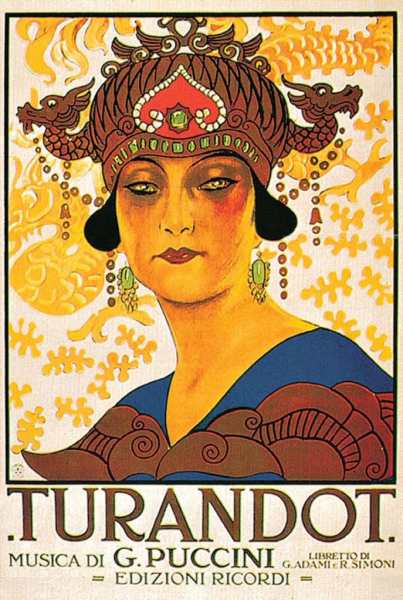
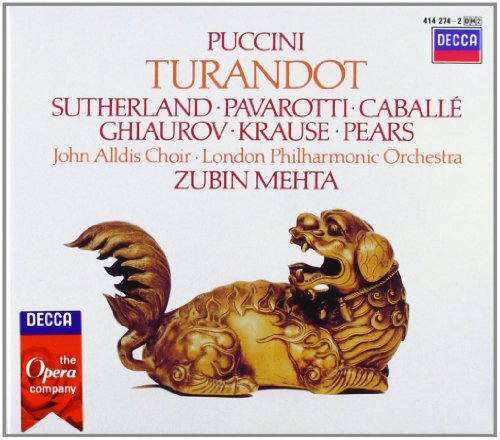
Not having listened to this set for some time, it was good to be reminded that it certainly justifies its reputation. I even found the Ping Pang Pong episodes less irritating than I usually do.

Sutherland seemed strange casting at the time (and she never sang the role on stage) but it’s a casting decision that definitely paid off. Her diction is better here than it usually is, though she doesn’t make as much of the text as Callas does. On the other hand, by the time Callas came to record the complete role in 1957, she couldn’t disguise the strain the role made on her resources. (Too bad she didn’t record it a few years earlier, when she recorded a stunningly secure, and subtly inflected version of In questa reggia for her Puccini recital.) Anyway for my money, Sutherland has much more vocal allure in the role than Nilsson, and surely Turandot has to have allure if one is to make any sense at all out of the plot.

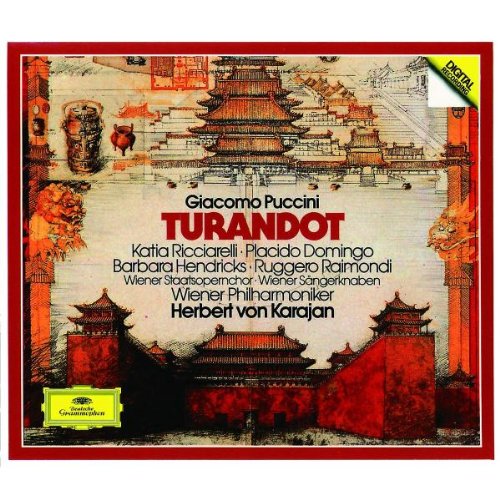
Pavarotti is caught at his mid career best and Caballé sings beautifully, spinning out her fabulous pianissimi to glorious effect. If I’m absolutely honest, I prefer a slightly lighter voice in the role, like, say, Moffo, Freni, Scotto or Hendricks, who is the Liu of the Karajan set reviewed below. Caballé sounds as if she could sing Turandot, which indeed she did, but there’s no doubting her class, even if there is something of the grande dame about her. The rest of the cast is superb and Mehta conducts a splendidly dramatic and viscerally beautiful version of the score. On balance, it’s probably still the best recording of the opera around.

61era2s-csl

It was interesting then to turn to Karajan’s 1981 digital set, and this, I would say, is definitely the conductor’s opera. Sonically it is absolutely gorgeous. Karajan’s speeds tend to the spacious, allowing him to reveal beauties in the orchestration I’d never heard before, not even in the superb Mehta.

When it comes to the cast, Barbara Hendricks’s Liu sounds just right, a lovely lyric soprano, perfectly suited to the demands of the role, as she was when J heard her sing the role in concert at the Barbican. By contrast Caballé sounds too grand, Schwarzkopf too much the Princess Werdenberg, though both of them sing divinely. Domingo makes a most interesting, more psychologically complex Calaf than Pavarotti, but I do miss Pavarotti’s ringing top notes. Domingo is taxed by the upper reaches of the part.

The set’s biggest stumbling block however remains Ricciarelli. Truth to tell, this time round I didn’t find her casting quite as disastrous as I once thought. A most intelligent and musical singer, she adapts the role to suit her basically lyric soprano. She sings the opening of In questa reggia with a white, vibrato-less sound which is most effective, but she can’t really disguise the fact that, even in the recording studio, her voice is a couple of notches too small. As I intimated above, she has to use all her intelligence to survive the role’s treacherous demands, where Sutherland sounds as if she was born to sing it, and the Mehta remains a much safer choice.

This set is certainly worth hearing though for Karajan’s superb realisation of the score, for Hendricks’s wonderful Liu, and, apart from at the very top of the voice, Domingo’s musical Calaf.

Così fan tutte – ROH 27.01.1981

51v5sqbhfyl

I don’t know if I was actually at this performance, but I was definitely at one of the series this recording was taken from.

My memory hasn’t failed me and it really is as good as I remember.

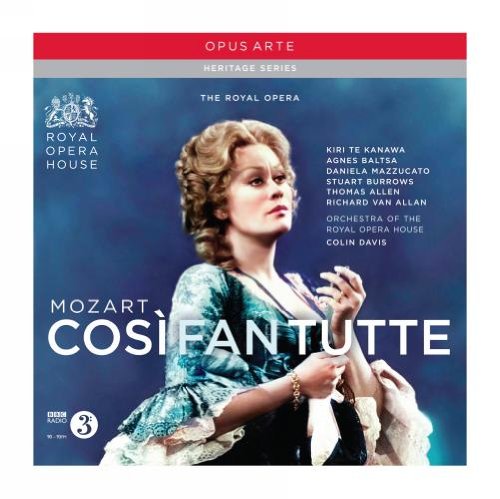
Sir Colin Davis already had a famous studio recording to his credit and common to both are the saturnine Alfonso of Richard Van Allan. Other than that, his cast here is easily equal to that on the studio set, and, as far as the men are concerned, possibly surpasses it, with Stuart Burrows a more mellifluous, if les characterful, Ferrando than Gedda and Thomas Allen absolutely splendid as Guglielmo, indeed one of the best on record.

On the distaff side, I find it hard to choose between the two casts. Caballé was a glorious Fiordiligi in the studio, but Te Kanawa is hardly less so, and she is a much more volatile performer here than she often was, possibly spurred on by the vividly acted and sung Dorabella of Agnes Baltsa. Baker, in the studio set, is less histrionic, more gently lovable. I love both performances. Mazzucato is a sprightly Despina, delightfully knowing in her exchanges with Alfonso, but yields something in individuality to Cotrubas in the studio set.

This is 1981, and speeds are occasionally a little slower than we are used to these days, and one should note that, being live, there is a fair amount of stage noise, audience laughter and applause. Otherwise the sound is fine, if not as well balanced as a studio production.

I really enjoyed re-acquainting myself with this wonderful performance, and, though I won’t be throwing away my studio Davis or Böhm/EMI recordings, it sits quite happily on the shelf beside them.

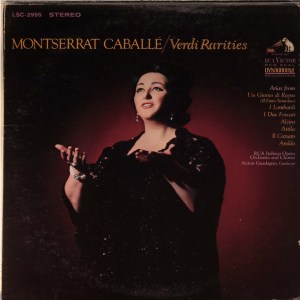
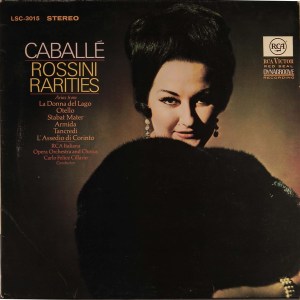
Montserrat Caballé – Rossini, Donizetti and Verdi Rarities

r-14007043-1565960472-8916.jpeg

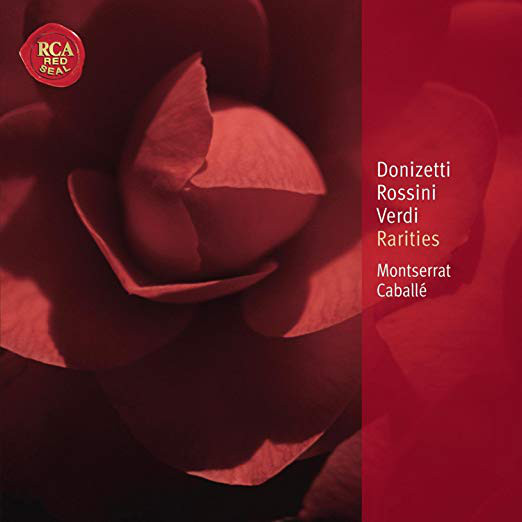
Rossini: Arias from La Donna Del Lago, Otello, Stabat Mater, Armida, Tancredi and L’assedio di Corinto
Donizetti: Arias from Belisario, Parisina d’Este. Torquato Tasso, Gemma di Vergy
Verdi: Arias from Un Giorno di Regno, I Lombardi, I due Foscari, Alzira, Attila, Il Corsaro and Aroldo

These two discs bring together the three LPs of bel canto Rarities Montserrat Caballé recorded shortly after she rocketed to stardom singing Lucrezia in Lucrezia Borgia at Carnegie Hall in 1965, a last minute replacement for an ailing Marilyn Horne. Each record was devoted to a different composer. The first two, Rossini and early Verdi, were recorded in Italy in 1967 with the RCA Italiana Chorus and Orchestra and the Donizetti with the London Symphony Orchestra and Ambrosian Opera Chorus in 1969. Carlo Felice Cillario was the conductor for the Rossini and Donizetti, Anton Guadagno for the Verdi and the luxury presentation included other singers in the various comprimario roles.

The material was even rarer back then than it is now as vary few of the works represented had ever been recorded, Caballé herself being one of the singers who spearheaded the bel canto revival that occurred after Callas had opened the doors to this repertoire in the previous decade.

These were the years of Caballé’s absolute peak and the voice is in superb condition, without a trace of the hardness that coud afflict her loud high notes in later years. Her breath control is prodigious, but she doesn’t over-exploit her fabulous high pianissimi, which she tended to do in later years, and her singing has an energy and attack which you might find surprising if you only know her from her later recordings, when she tended to slow everything down until it practically came to a halt. If she has a fault, it is that her trills are a little sketchy and occasionally one hears the slight suspicion of an aspirate, but the singing is surpassingly beautiful throughout its range, her legato excellent and the voice even from top to bottom. Characterisation might not be her strong point, but she is always alive to the dramatic situation and her singing is both involved and involving.

The arias on each disc are well chosen and the whole enterprise exudes class. I really can’t think of any singer today who could match her in this repertoire, maybe DiDonato in the Rossini and Donizetti, though she lacks Caballé’s arrestingly beautiful sound. As for Verdi, well we do seem to be experiencing a dearth of good Verdi singers today.

These two discs are a superb memento of a great singer at the height of her powers and should be in the collection of any vocal connoisseur. This particular release comes with full notes, texts and translations which are hardly to be taken for granted these days. Highly recommended.