José Carreras – My Barcelona

Well this is something of a hotch potch, no doubt explained by its provenance – music included in the 1991 documentary film made after his recovery from leukemia My Barcelona, a celebration of the unique relationship between the man and the city of his birth.

What we get is a mixture of operatic arias, popular song and excerpts from Ramirez’s Navidad Nuestra and Misa Criola, which, surprisingly perhaps, makes for a pleasantly varied disc.

No great revelations, I suppose. Carreras is at his honeyed best in Cavaradossi’s E lucevan le stelle from the 1976 Davis recording of Tosca, a performance of poetic beauty, made before some of the heavier repertoire he essayed took a toll on his essentially lyric tenor, but most of the selections give pleasure. I particularly enjoy his version with piano of Mompou’s haunting Damunt de tu només los flors and the Ramirez pieces are also great fun.

An undemanding but enjoyable disc.

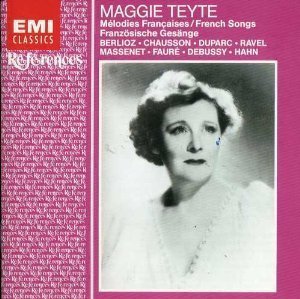
Maggie Teyte – Mélodies Françaises

41lhudrbaxl

The first time I heard Maggie Teyte was when I was just starting to enjoy French song. I was learning Duparc’s Chanson triste and a friend played me her recording of the song with Gerald Moore at the piano. I was absolutely entranced and it has remained my yardstick ever since. First of all the flowing tempo they adopt is aboslutely right (so many take it too slowly) and she responds perfectly to all Duparc’s markings – floating the tone beautifully on the mon of mon amour (it is marked doux by Duparc) an effect I have tried, not too successfully, to emulate myself. Her high A is clear, clean and true, but she takes the lower option on the words de tes bras, dipping down into that gloriously rich lower register she had. As you listen, you feel the song is addressed to you personally and you want to just lie back in the warm embrace of her comforting words. The French christened her L’Exquise Maggie Teyte, and the adjective suits her perfectly.

She was born in 1888 in Woverhampton, but went to Paris in 1903 to study with the famous tenor Jean De Reszke. She made her first public appearanc in 1906, singing Cherubino and Zerlina under Reynaldo Hahn, making her first professional appearance in Monte Carlo the following year. She then joined the company at the Opéra-Comique in Paris and was shortly after chosen to replace Mary Garden in the role of Mélisande, for which she was coached by Debussy himself. She is the only singer ever to have been accompanied in public by Debussy himself, and she is an invaluable link to so many musicians of the past. Despite her early success however, she didn’t really establish herself with the main opera houses, and went into semi-retirement after her second marriage (to Canadian millionaire Walter Sherwin Cottingham) in 1921.

In 1930 she tried to resuscitate her career, but ended up singing in variety and music hall (24 performances a week!) until, in 1930, she made some recordings of Debussy songs with Alfred Cortot, which were so successful that she then became known as the leading French song interpreter of her time. She also sang at Covent Garden in such roles as Butterfly, Hänsel and Eurydice in Gluck’s opera, as well as Manon in English (with Heddle Nash).

The present set concentrates on recordings of French song with orchestra and piano made between 1940 and 1948, making her 60 when she recorded Ravel’s Schéhérazade, not that you would ever suspect it. The voice is still absolutely firm with no trace of wobble or excessive vibrato, top notes pure and true (a thrilling top B flat in Asie), the inimitable lower register gloriously rich.

It starts with a rather hectic recording of Berlioz’s Le spectre de la rose. The fast tempo was presumably adopted so that they could fit the song onto a single 78, but it does remind us that it is in waltz time and she brings a peculiarly intimate touch to the closing lines,which are sung with an ineffable sadness. Absence is sweetly touching.

Occasionally her attention to the meaning of the words can get in the way of the music, and the tempo fluctuations in Fauré’s Après un rêve are just too much, rather too slow at the beginning, with an unwritten accelerando on Reviens, reviens. I’d also suggest that Duparc’s Extase is taken far too slowly throughout. On the other hand the tempo for Fauré’s Clair de lune is absolutely spot on with a moment of pure magic as she infuses her tone with warmth at Au calme clair de lune and Gerald Moore switches to a more free flowing style in the accompaniment.

Over the two discs there is scarcely a performance that doesn’t warrant attention, but I single out for special consideration Duparc’s gorgeous Phidylé, which is lazily erotic as it should be (note her telling observation of the diminuendo on baiser – most singers miss it completely) and the aforementioned Chanson triste, the former with the LSO under Leslie Heward, the latter with Gerald Moore on the piano. Also on disc 1 is a superb performance of Chausson’s Chanson perpétuelle, whilst she breathes new life into Hahn’s popular Si me vers avaient des ailes on Disc 2.

In all she remains inimitable and individual, though, it seems these days, only known to connoisseurs. This set is no longer available, nor are the Debussy songs she recorded with Cortot. John Steane says in his wonderful book The Grand Tradition,

But basically the point about Maggie Teyte is the very simple one, that her singing is so good: that is, her voice is so clear, its production so even, its intonation so faultless, its movement in big upward leaps so clean and athletic, and its excellence was so well preserved for so long.

Not only is her actual singing so good, but she has something personal to say in all she does, and voice and style are instantly recognisable.

There are other examples of her art more readily available on other lablels but this old EMI set is a treasure and I urge Warner to reissue it along with the Debussy songs with Cortot. It should be in the collection of anyone who is interested in French song.

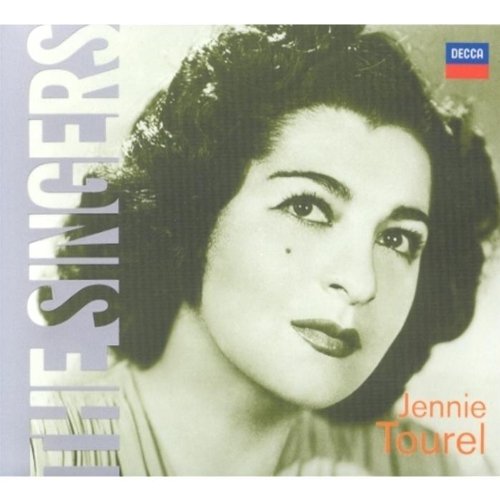
Jennie Tourel – The Singers

Jennie Tourel was born in Russia in 1900 of Jewish parents, but she and her family left just after the Revolution, temporarly settling in Danzig before moving to Paris. She fled to Lisbon just before the Nazis occupied France and from there to the USA, becoming a naturalised Amercian in 1946.

She had an illustrious career both in the opera house and on the recital stage, and was the creator of the role of Baba the Turk in Stravinsky’s The Rake’s Progress. She was still active when death ended her career in 1973, in fact in the middle of performances of Donizetti’s La Fille du Régiment in Chicago. The longevity of her career is testament to her sound technique, but if the years were kind to her voice, she was also careful never to overtax it. She knew what suited her and stuck to it.

The dates of the recordings on this disc are unknown, but the Italian and French items are stereo, which would place them at least from the early to mid 1950s. Her voice is still admirably firm, with no trace of wobble or excessive vibrato. Her legato isn’t always perfect, and her runs can be lightly aspirated, which mars her performance of the Rossini items, and also of Bizet’s Adieux de l’hotesse arabe, though she sings it with more personality and drama than many.

Berlioz’s Absence is sung with piano, and is notable for the firmness of the line, though personally I prefer a more inward display of longing. Tourel is too loud in places and she rushes the pharse la fleur de ma vie. Much better are Poulenc’s Violon and Liszt’s Oh! Quand je dors and I particularly enjoyed Ravel’s Kaddish, which exploits her rich lower register.

The Russian items are all worth hearing, beginning with a mournful Tchaikovsky None but the lonley heart, the cello obligato adding to the pervading sense of melancholia. As befits the general mood of the Russian items, she uses a bigger, more dramatic sound, but she can also be lightly high-spirited in a song like Dargomizhsky’s Look darling girls. In all she displays a strong personality and superb musicianship.

Song texts and translations are provided on the disc itself, which doubles as a CD-ROM, though, annoyingy, if you want to read them at the same time as listening to the disc, you will have to print them out before playing the disc on a CD player.


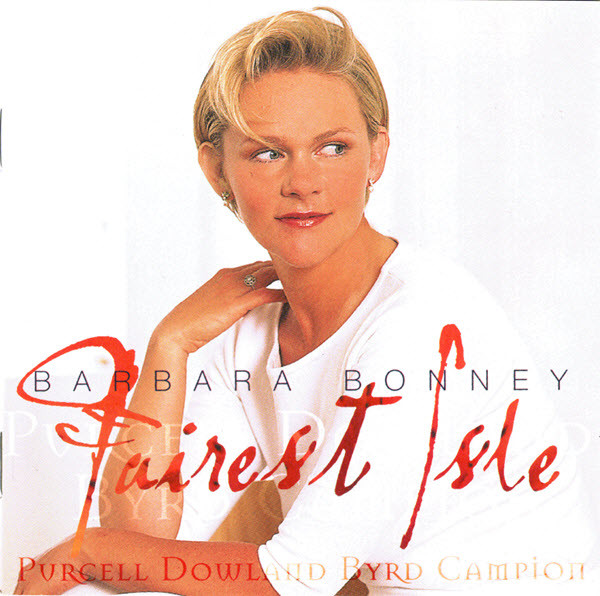
Barbara Bonney – Fairest Isle

r-8615652-1465200442-8858.jpeg

“Come again, sweet love doth now invite,” sings Barbara Bonney at the beginning of this recital, and the invitation is so beguiling that it would be hard to resist.

What follows is just over an hour of pure delight. We start with a selection of lute songs by Dowland, Campion, Morley and Byrd, all accompanied by Jacob Heringman. Bonney’s pure tone and natural, unaffected manner might suggest a lack of personality and yet she has something personal to say about each song, with a lovely smile in the voice for the quirky Away with these self-loving lads, and a deeper vein of melancholy for the famous Flow my tears which in turn is followed by a delightfully charming It was a lover and his lass.

She is joined by the viol quartet Phantasm for Byrd’s O Lord, how vain are all our frail delights, who also provide an instrumental interlude between this and the other Byrd piece Though Amaryllis dance in green with John Jenkins’s Fantasy no 3.

More variety is accorded when, for the Purcell items, Bonney is accompanied by The Academy of Ancient Music under Christopher Hogwood, with Andrew Manze suppling violin obligato in the lovely Plaint from The Fairy Queen, which preceded by couple of instrumental items here (two Airs from Abdelazar) is not taken too slowly for once.

Fairest Isle, both the song and the disc it gives its name to, might possibly be considered a tribute by this American soprano to the land she has made her home, and she finishes with one of the most well known English arias in the repertoire, Dido’s wonderful Lament from Dido and Aeneas. It is perhaps not so powerfully intense as versions by Dame Janet Baker and Lorraine Hunt Lieberson in their complete sets, but, taken out of context, it makes a fitting conclusion to a recital that affords nothing but pleasure.

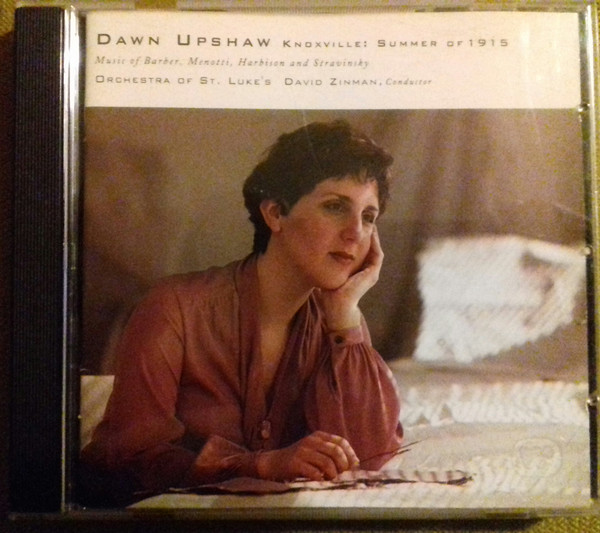
Knoxville: Summer of 1915 – Dawn Upshaw

r-12665160-1539626691-5475.jpeg

It seems incredible now that this disc was released over 30 years ago, but there it is, clearly written in the insert, “Recorded August 1988 at Manhattan Center Studios, New york”, though, IIRC, it had a different cover on its first release.

Barber’s wonderfully nostalgic Knoxville, Summer of 1915, a setting of James Agee’s prose-poem has now, it would seem, become quite popular. It was first recorded by its dedicatee, Eleanor Steber in 1950, a couple of years after its premiere, but had to wait another eighteen years before being recorded again, though very successfully by Leontyne Price. It had to wait a further twenty years for this version by Dawn Upshaw, but its success has led to a spate of others by the likes of Barbara Hendricks, Sylvia McNair, Roberta Alexander, Kathleen Battle, Jill Gomez, Karina Gauvin and, most recently, Renee Fleming.

Steber was a wonderful singer, and her version is very fine, but for me it misses the essential childlike quality of the piece and she can sound a bit mature, even a trifle prim. Price, on the other hand, is surprisingly successful at scaling down her rich velvety voice to the needs of the writing, and her version is deservedly well known. Dawn Upshaw, on the other hand, has by nature what Price had to strive for. She has exactly the light voice and direct manner the piece needs and there is no need for her to characterise; she simply has to be herself, her diction natural and unforced. David Zinman’s tempi are also just right, and it is no surprise to find that this version has been a top recommendation since it was first issued.

The rest of the programme is also attractive, its centrepiece being John Harbison’s Mirabai Songs, originally written for piano, but here given in his chamber orchestra version. The songs are settings of 16th century devotional Indian poems by Mirabai, who, after her husband died, devoted her life to the God Krishna. The texts are alternatively erotic, ecstatic and devotional, the orchestrations colourful, the vocal range wide and Upshaw is fully up to their demands.

The interesting but quite short programme is rounded off with a couple of operatic pieces, a short extract from Menotti’s radio opera The Old Maid and the Thief, and Anne Trulove’s No word from Tom from Sravinsky’s The Rake’s Progress, and Upshaw would seem perfectly cast in both.

Like most of Upshaw’s records the material chosen is refreshingly different and well worth investigating.

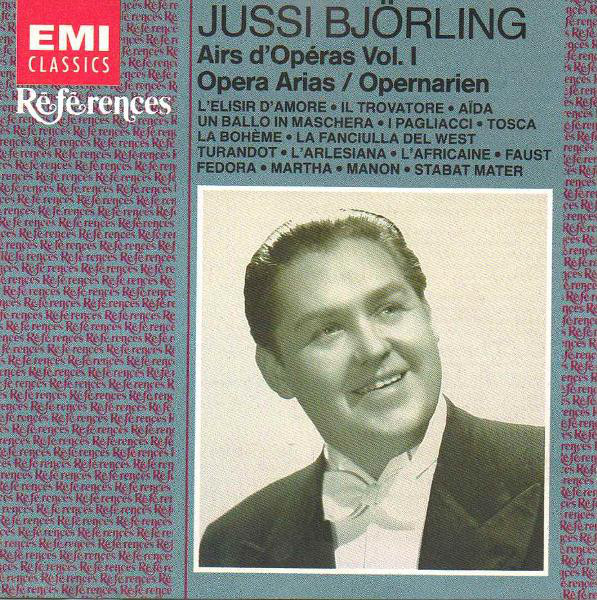
Jussi Björling – A collection of Swedish 78s.

These two CDs gather together most of the 78s the young Björling made in his native Sweden between 1933 and 1949, the earliest made when he was a budding tenor of twenty-two.

Most are vocal gems, but one or two (the rather loud and penny plain Je crois entendre encore, and the unpoetic duet from La Boheme with Anna- Lisa Björling on the second disc, for instance) are less than great.

The voice itself was a magnificent one, no doubt about it, with a silvery purity throughout its range, the high notes free and easy; just listen to his joyfully ebullient 1938 performance of Offenbach’s Au mont Ida from La belle Hélène, sung in Swedish, but with terrific swagger, the top notes flying out like lasers. From a few years ealier we have a plaintively sensitive performance of Valdimir’s Cavatina from Borodin’s Prince Igor, the legato line beautifully held, his mezza voce finely spun out. Also from 1938 we have a thrilling performance of the Cujus animam from Rossini’s Stabat mater, with a free and easy top D flat at the end, and it is prinicpall for Italian and French opera that Bjørling will be remembered and there are plenty of examples here of his wonderfully musical performances in that genre.

We find him ideal in Verdi, Donizetti and Puccini alike, in Myerbeer, in Massenet and in Gounod (a glorious rendering of Faust’s Salut, demeure). Some regret the absence of a true Italianate tone in the Italian items, but he will never resort to sobs and aspirates to express emotion, and, personally, I find his comparative restraint very attractive. It is true, he is not always imaginative with his phrasing, and nowhere will you get the kind of psychological introspection you would hear in a performance by someone like Vickers, but his singing is always musical, and of course there is a great deal of pleasure to be had from the voice itself, which Italianate or not, is a thing of great beauty.

Some of the very best of these 78 recordings are included on Volume 1, stand out items for me being the aforementioned Faust aria, his wonderfully musical and sensitive Ah si, ben mio from Il Ttovatore, and his poetic, but thrilling version of Nessun dorma from Turandot.  There is also plenty to treasure in Volume 2, which includes the Offenbach and Borodin, but also a sensitvely prayerful  Ingemisco from the Verdi Requiem, Des Grieux’s lovely Dream from Manon sung with liquid, honeyed tone (his ardent Ah, fuyez is on the first disc), and his  poetic Cielo e mar, from La Gioconda.

The second disc finishes with a couple of unexpected examples of his work in Lieder, a gorgeously lyrical Beethoven Adelaide, and a beautifully restrained and rapt account of Strauss’s Morgen.

Anyone who loves the tenor voice and gloriously musical and sensitive singing (not always the same thing) should have these recordings in their collections.

Fritz Wunderlich – a DG box set

wunderlichcollectiondg4351452

Before his untimely death at the age of 35, Fritz Wunderlich made a lot of recordings for both DG and EMI, mostly for the German market, hence the reason why all the excerpts from French, Italian and Russian opera are sung in German.

That said, regardless of language, Wunderlich’s gorgeous, lyric, golden-voiced tenor gives us a glimpse of a near ideal Rodolfo, Duke of Mantua, Lensky, Cavaradossi and Elvino.

This 5 disc set gives us 2 discs of operatic fare from Handel and Mozart to Verdi and Puccini, 2 discs of Lieder (complete recordings of Die schöne Müllerin and Dichterliebe and various other Lieder by Schubert, Schumann and Beethoven) and a final disc of popular Italian and German songs, such as Lara’s Granada and Sieczynski’s Wien, Wien, dur du allein.

One of the most disarming elements of Wunderlich’s singing is that sense of pure joy in the act of singing itself, and it’s a quality that is hard to resist. True, there have been deeper, more probing versions of the Schubert and Schumann cycles (even by Wunderlich himself, when captured in concert a year later), but few sung with such consistent beauty of tone.

Stand out tracks for me are the Mozart items (arias from the Böhm Die Zauberflöte, and the Jochum Die Entführung aus dem Serail, Lensky’s Kuda, kuda from Eugene Onegin. His opening lines in the Act IV duet for Rodolfo and Marcello from La Boheme (sung with Hermann Prey) are sung with a poetic beauty of such sorrowful radiance, that questions of language are totally forgotten, and this carries through to Cavaradossi’s great E lucevan le stelle from Tosca. As Elvino (a lovely Prendi, l’anel ti dono from La Sonnambulawith a somewhat quavery Erika Köth) he sings with a shy diffidence that is thoroughly charming, and what Gilda would not be conquered by the seductve tones of this Duke?

My once critcism would that be he occasionally aspirates fast moving moving music, most in evidence in the Lortzing excerpts, but in all he displays a strong personality, and, once heard, there is no mistaking him.

The popular items might not be to everyone’s taste, but it is here that his gift of communication is most in evidence, singing with sheer uninhibited pleasure. One of my favrourite tracks is his performance of Lara’s Granada. You get the feeling that he arrived in the studio feeling pretty good that day, and the golden outpouring of tone, right up to a couple of glorious top Cs, is infectiously enjoyable. It’s hard not to listen with a smile on your face.

In the grand scheme of things, Wunderlich would have gone on to have a great career, no doubt feted as one of the greatest tenors of his day, but it wasn’t to be and he was killed in an accident just a few weeks short of his 36th birthday. How lucky we are that these recordings exist to remind us of what the world lost.

Dame Janet Baker – Philips & Decca Recordings 1961 – 1979

r-10064800-1491163322-4375.jpeg

Dame Janet Baker is without doubt one of the greatest singers of the latter part of the twentieth century, known throughout the world from her recordings and international recitals. Though her range was quite wide, taking in operatic roles from Monteverdi to Richard Strauss, and even embracing the Verdi Requiem and Schoenberg’s Gurrelieder, she was never tempted to sing outside her fach and retired, first from the operatic stage and then from recital work, whilst still at her peak, so that we never saw the slow vocal decline we often hear from great singers. Her Yorkshire firmness of mind and pragmatism also meant that she refused to join the international operatic circus, and in fact only once sang in opera outside the UK (when the Royal Opera took their hugely successful production of La Clemenza di Tito to La Scala, Milan).

This 5 disc set brings together some of the recordings Dame Janet Baker made for Decca, Argo and Philips during the 1960s and 1970s. Though contracted to EMI (and Warner have a pretty exhaustive twenty disc box set of her work for that label, called The Great Recordings), she made a few recordings for Decca/Argo (including her famous recording of Dido and Aeneas) in the early 60s, and then a tranche of recitals for Philips in the 1970s. The range of material here is not quite as wide as that on the aforementioned Warner set, but takes us from 17th century arie through to Britten.

Disc 1 is a selection of what most vocal students would know as Arie Antiche (called here Arie Amorose), accompanied by the Academy of St Martin in the Fields under Sir Neville Marriner. Whilst the somewhat souped-up arrangements can sound somewhat anachronistic today, Baker’s wonderfully varied singing brings each song winningly to life. The disc is rounded off with a couple of arias from Cavalli’s La Calisto recorded shortly after her great success in the role of Diana/Jove at Glyndebourne.

Some of Baker’s greatest early successes were in Handel and Disc 2 is mostly taken up by a superb 1972 Handel recital she made with the English Chamber Orchestra under Raymond Leppard. How brilliantly she charts the changing emotions in the cantata Lucrezia and also in the arioso-like Where shall I fly from Hercules,but each track displays the specificity of her art, the way she can express, on the one hand, the despair in an aria like Scherza infida and, on the other, the joy in Dopo notte, both from Ariodante. The disc is rounded off by a superb 1966 recording of Bach’s Vergnügte Ruh and her incomparable When I am laid in earth from her 1961 recording of Dido and Aeneas.

Disc 3 has excerpts from a 1973 Mozart/Haydn recital and a 1976 Beethoven/Schubert disc, both made with Raymond Leppard, with the addition of arias from her complete recordings of La Clemenza di Tito and Cosí fan tutte under Sir Colin Davis. The two Haydn cantatas (one with piano and one with orchestra) are very welcome, but we do miss her stunning performance of Sesto’s two big arias from La Clemenza di Tito, and her gently intimate performance of Mozart’s Abendempfindung. Fortunately these have been included in a superb selection taken from the same two recitals on the Pentatone label, which includes all the missing Mozart and Schubert items. This disc also includes her recording of Beethoven’s Ah perfido!, a little smaller in scale than some, but beautifully judged none the less. It doesn’t have Callas’s ferocity, it is true, but it is much more comfortably vocalised.

Disc 4 is of music by Rameau (excerpts from her 1965 recording of Hippolyte et Aricie, which well display her impassioned Phèdre), Gluck (arias for Orfeo and Alceste taken from her 1975 Gluck recital) and Berlioz (1979 performances of Cléopâtre and Herminie and Béatrice’s big scene from Davis’s complete 1977 recording of Béatrice et Bénédict). The biggest loss here is of the majority of the Gluck recital, which included many rare items, though the complete reictal was at one time available on one of Philips’s budget labels. Baker is without doubt one of the greatest Berlioz exponents of all time, and the two scènes lyriques are especially welcome. These are fine examples of her dramatic intensity and the range of expression in both is fully exploited.

Disc 5 is of late nineteenth and twentieth century French song and Benjamin Britten; the whole of a disc of French song made with the Melos Ensmble in 1966, excerpts from the composers own recordings of The Rape of Lucretia and Owen Wingrave and the cantata, Phaedra, which was composed specifically for her. The Melos disc includes Ravel’s Chansons Madécasses and Trois poèmes de Stéphane Mallarmé, Chausson’s Chanson perpétuelle and Delage’s Quatre poèmes hindous and is a fine example of Baker’s felicity in French chanson, particularly ravishing in the wordless melismas of Lahore from Quatre poèmes Hindous. The Britten excerpts remind us of her sympathetic portrayal of Lucretia and her unpleasant Kate in Owen Wingrave. The Britten cantata is a great example of her controlled intensity.

Remarkable throughout is the care and concentration of her interpretations. Nothing is glossed over, nothing taken for granted, and she was one of those artists who could bring the frisson of live performance into the studio. Nor do I think she ever made a bad record. I heard her live on many occasions. Hers was not a big voice, but it was one that coud carry to the furthest recesses of a large hall, even when singing pianissimo. Furthermore there was a concentration, and intensity and a gift of communication, vouchsafed to just a few. One of my all time favourite singers.