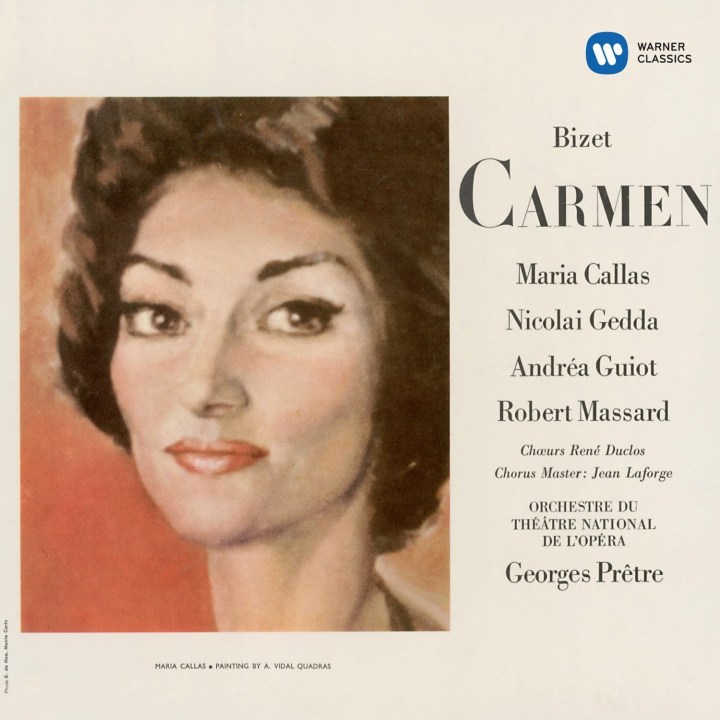
The Callas Carmen

81kl4jlqt0l-_sl1500_

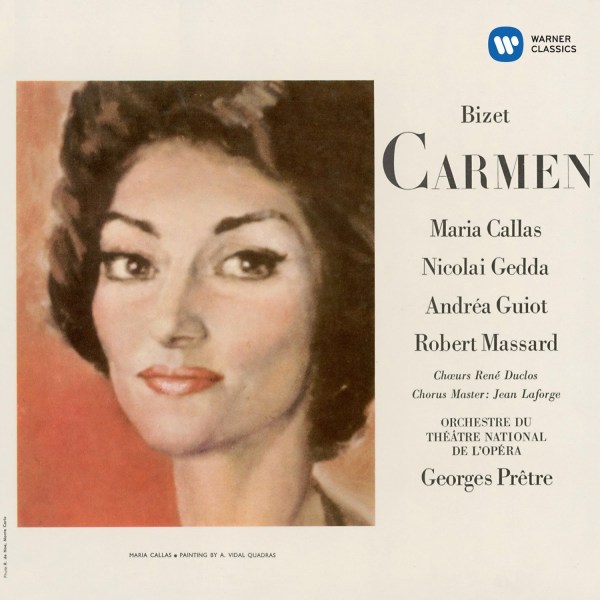
Recorded July 1964, Salle Wagram, Paris

Producer: Michel Glotz, Recording Engineer: Paul Vavaseur

And so, still moving chronologically backwards through this set, we come to the last of the four roles Callas recorded without ever singing them on stage. This Carmen has always been controversial, the most controversial element being Callas herself, so, let me deal with the rest first.

The edition used wouldn’t bear scrutiny. We are of course back in the days of the old Guiraud recitatives, but there’s no point complaining about that. This is how everyone was doing Carmen back then. The sound is excellent early 1960s stereo and sounds better than ever in this new re-master.

This is a very French Carmen. Aside from Callas and Gedda, everyone else involved is French, and Gedda was, in any case, the best “French” tenor around in those days. Pretre’s conducting is swift, sometimes maybe too much so, and deliciously light in places, but his speeds make dramatic sense and it works very well. The orchestra and chorus, again French, sound idiomatically right to me. The Escamillo of Robert Massard sounds authentic too, if not so characterful as someone like Jose Van Dam. Andrea Guiot’s Micaela I like a lot. She does not display the creamy beauty of a Te Kanawa or a Sutherland, but she is much more convincing than them at playing the plucky, no-nonsense village girl. We must not think of Micaela as a wilting violet; she is actually quite a strong character. Not only is she able to hold her own with the soldiers in the first act, she has the strength to confront Carmen and the gypsies in the third act. Her voice is firm, clear and very French. She sounds just right to me.

Gedda of course had already recorded the role under Beecham with De Los Angeles. He does not have the heroic sound of a Domingo, a Vickers or a Corelli  but, as always he sounds totally at home in French opera. In any case, is a big heroic voice what is required? Don Jose is basically a nice young man, somewhat repressed, who gets caught up with the wrong woman. A young man, who, once his passions are aroused, does not know how to control them.  Gedda is superb at charting Jose’s gradual disintegration. He sings a beautifully judged Flower Song, with a lovely piano top Bb, is gently caring in his duet with Micaela, and suitably shamed when he meets her again. In the last act he is a man at the end of his tether, dangerous because he has nothing left to lose. As a performance I think it has been seriously underestimated. I find him entirely convincing, much more so than, say, Corelli, with his execrable French, in Karajan’s first recording of the opera.

And so we come to Callas. Many of the objections when the set first came out were not so much about her singing as about her characterisation, one critic opining that she was closer to Merimee than Meilhac and Halevy. But that’s an objection that makes no sense at all. Meilhac and Halevy may have watered down Carmen’s indiscretions with other men while still with Jose, but they still make it clear she is a free spirit, not to be tied down. In the 1960s, women were still fighting for equality (they still are). Much of the debate about the contraceptive pill in the 1960s centred around the fact that it would encourage promiscuity. People, especially men, were not comfortable with the idea of a sexually promiscuous woman, so Carmen’s character was often played down. The De Los Angeles recording with Beecham had been highly praised, but, love De Los Angeles though I do, can anyone really imagine her Carmen pulling a knife on a fellow worker in a cat fight? She is altogether to ladylike to even think of such a thing. But Callas is exactly what she is described in the text, dangereuse et belle, in Micaela’s words. This is a true free spirit. As she tells Jose in the last act, Libre elle est nee et libre elle moura! When she admits to her friends Je suis amoureuse, Callas gives the line an ironic twist, even more so on the following amoureuse a perdre l’esprit. We know absolutely, as her friends do, that this is the whim of the moment; the mood of the day, and that there will be others. Earlier her seduction of Jose is brilliantly charted too. Ou me conduirez-vous? she asks Jose, as he is about to take her to prison, and the little girl lost tone she uses is just what’s needed to draw him in. Later on when Jose comes to the inn and they end up arguing, some have found her rage too over the top, but there is justification for this too. When Jose tells her he has to go back to the barracks, that could be the moment she realises that maybe she is not in love with this milksop after all. Have a row, send him packing. That’s the best way to get rid of him. Only things don’t quite work out that way; her cry of Au diable le jaloux! is quite matter of fact. Finally she realises she is saddled with him, but is quite pragmatic. In fact, now that I think of it, the whole plot only works if you accept that Carmen was never in love with Jose in the first place; that he was first a challenge, then a convenience. Escamillo is much more up her street (for a while anyway); when he comes looking for her and Micaela comes looking for Jose, this is just the way out she is looking for. Unfortunately, Jose turns out to be even more unhinged than she had imagined, but defiant to the last, she refuses to give in to him, and staring death in the face, asserts her freedom from all men. No doubt this is what commentators found so disturbing. Some no doubt still do. It doesn’t make for comfortable listening.

Apart from a few squally top notes in the ensembles (which she didn’t need to sing anyway), her voice was absolutely right for the role at this stage in her career and the performance is full of miraculous detail. I notice something different in it each time I hear it.

When it was reissued, Richard Osborne in Gramophone wrote, “Her Carmen is one of those rare experiences, like Piaf singing La vie en rose, or Dietrich in The Blue Angel, which is inimitable, unforgettable, and on no account to be missed.”

I couldn’t have put it better myself.
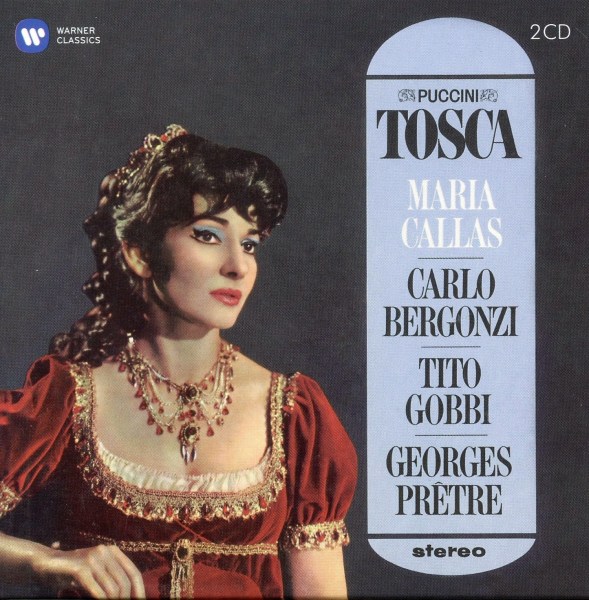
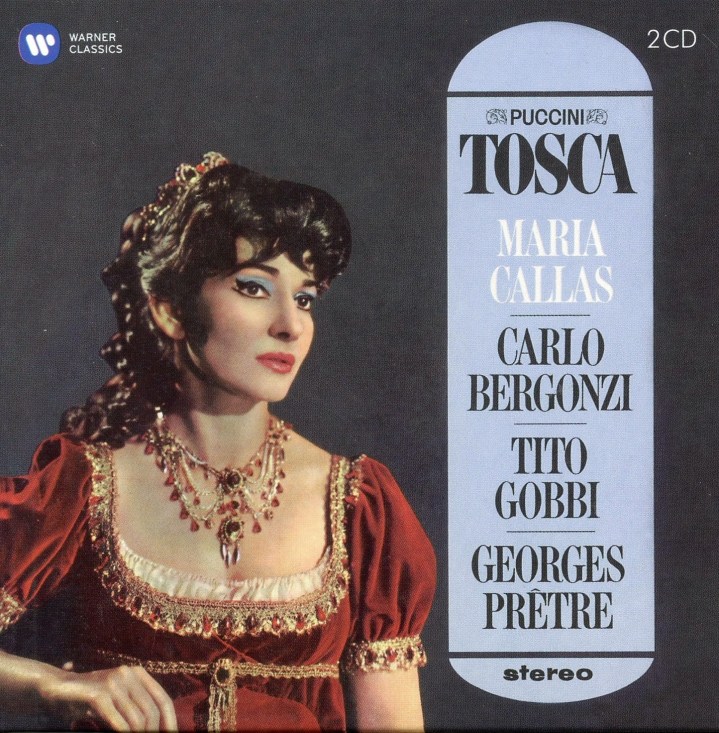
Callas’s 1964 studio Tosca

91idlbhid5l-_sl1500_

Recored July 1964 and January 1965, Salle Wagram, Paris.

Producer: Michel Glotz, Balance Engineer: Paul Vavaseur


I hadn’t heard this set in maybe 20 years. It was actually one of the first complete opera sets I owned, the renowned 1953 De Sabata recording being unavailable when I first started collecting in the late 1960s. According to Zeffirelli, the recording was originally intended to be the soundtrack of a film, a project that unfortunately fell through, but, in any case, EMI obviously wanted to cash in on the success of Callas and Gobbi’s performances together in 1964 and 1965 in London, Paris and New York. Considering how closely they are associated with their respective roles, it is a surprise to find that before the Zeffirelli production at Covent Garden, they had only once before played opposite each other in the opera, and then only in a performance of Act II at a Paris Opera Gala, and yet they cast their shadows over the opera as no others do.

Let’s first get the caveats out of the way. Pretre doesn’t have De Sabata’s grip on the score, but he has his moments, and the torture scene is particularly thrilling; Callas’s voice is considerably trimmed down from the first recording and some of the top Cs are closer to screams than actual notes, though, in this new pressing, they don’t seem anywhere near as bad as I remember them; Gobbi too has lost some of his vocal sheen, but is as authoritative as ever.

However, we should remember that this recording was made at about the same time as Callas and Gobbi were appearing on stage. Even without seeing them, you sense their deep rapport. The producer John Copley was Zeffirelli’s assistant on the Covent Garden production, and he once told me that rehearsing with Callas and Gobbi was not like rehearsing with opera singers at all. Zeffirelli would let them run a whole scene, improvising their moves as you would with actors. They would then sit down and discuss what had worked, what hadn’t and go back over the scene incorporating any new ideas that came up. In all his career, he said, he has never come across such complete actor-singers. This ability to play off each other comes across in all their scenes on disc.

I do miss Callas’s ability to soar and swell the tone at a line such as Egli vedi ch’io piango, but their are compensations. When she cries Non posso piu in Act II, this is literally the sound of a woman at the end of her tether, and her chest tones in son io che cosi torturata rend the heart. In the last act, her recounting of the murder lacks the power of the De Sabata, though she manages Io quella lama gli piantai nel cor better than expected with an exciting plunge into chest voice. Here too the top C sounds better than I remember; I assume this must be something to do with the improved sound picture. Her Tosca on this set is more feminine, more vulnerable, if you like, with dozens of lovely touches in the love duets, if not the ability to ride the orchestra that she had in the first recording.

Gobbi still sounds superb. I doubt I will ever hear another Scarpia to rival him. His Scarpia is a gentleman and a thug and more interesting because of that. A man of impeccable manners, who never gets his hands dirty, making sure he has minions to do his dirty work for him. His performance, too is full of detail. From the unconcerned way he sings La povera mia cena fu interrotta, cruelly feigning surprise at Tosca’s distress, to the ironic tone he adopts at violenza non ti faro, this is a man completely in control.

Cavaradossi? Well Bergonzi sings beautifully, but I missed Di Stefano’s ardour, his winning personality, and he is in especially good voice in the De Sabata recording. Beside him Bergonzi sounds a bit anonymous.

The orchestra play well for Pretre, but they are not the equal of the La Scala players, and of course this set will never replace the classic De Sabata Tosca, which is considered one of the classic opera recordings of all time. This one isn’t entirely without merit, though, and Callas completists will definitely want to have it in their collection.

Callas sings Verdi Arias III

91sppqa2pml-_sl1500_

There never actually was a Verdi Arias Vol III, though one had been planned. Warner here use the cover of an album issued in 1972, of material which had been sitting around in the vaults, and which Callas eventually agreed to have issued. The original album coupled  the Act I Scena from Il Pirata (now on Rarities) with Amelia’s Act Il Scena from Un Ballo in Maschera, O madre dal cielo from I Lombardi, Arrigo, ah parli a un core from I Vespri Siciliani, Liberamente or piangi from Attila and Aida’s Ritorna vincitor. The Il Corsaro arias, Amelia’s Morro, ma prima in grazia and Leonora’s Tacea la notte placida appeared on a later album called The Legend, coupled to some unissued 1955 arias from La Sonnambula, none of which were cleared for release by Callas.

That 1972 album was actually one of the first Callas LPs I owned. It seems unbelievable now, but in the early 1970s, most of Callas’s back catalogue had been deleted by EMI, who presumably thought that the advent of stereo rendered it obsolete. At that time I had only heard a few of her recordings and I remember sampling a couple of arias from this disc in Windows, the local classical music store in Newcastle-upon-Tyne. Initially alienated by the harsh sounds I heard coming from the listening booth, I left the shop without buying the disc. However somehow those tones carried on resonating in my mind’s ear, and eventually I went back and bought the LP. It was a decision I never regretted, as I learned to listen not just to the voice itself, but what she was doing with it. It also introduced me to some Verdi I’d never heard before, namely the arias from I Lombardi, Attila and I Vespri Siciliani. I knew absolutely then that Verdi was to become one of my favourite composers.

Taking first the arias not on that original LP, we find the arias from Il Corasaro recorded in 1969, really remarkably good. Her legato line is better than both Caballe and Norman on the Philips studio recording of the opera, and she unerringly captures the mood of each aria. The Trovatore has some magical moments, but at no place challenges her superb recording with Karajan. Amelia’s Morro, ma prima in grazia is very good indeed, with a superb, firm top B leading into a perfectly shaped final cadenza.

Swings and roundabouts on the rest. The tone at the beginning of the I Lombardi aria (the first track I listened to in the record shop) is indeed somewhat uningratiating, but once past the opening statement, she is in securer form, and moulds the line beautifully. Both the Attila and I Vespri Siciilani arias go well, the legato line beautifully held, and with Rescigno conjuring up some gorgeous sounds from the orchestra for the Sospendi o rive section of the Attila aria. I’d certainly sooner hear this version than Deutekom’s pallidly voiced one on the Philips complete recording. Amelia’s grand Act II Scena is full of passion, drama and fantasy. Though the ascent to top C is hard won, she grandly phrases on and through the note, so that it does not become the focal point of the aria. Still this does not challenge her performance on the complete set of 1956, nor the superb live performance from 1957.

The one incontrovertibly great performance on the disc is Aida’s Ritorna vincitor. This was not originally planned, but sessions had been getting a bit tense and Callas and the orchestra took a break. During the break Michel Glotz, the recording producer played a performance of Crespin singing the aria, which had been recorded the previous day. Callas was incensed, finding the performance completely antithetical to her sensibilities, lugubrious and slow. “I could hardly get the words out, when I did this with Maestro Serafin.” On learning that the parts were still there, she said, “Come on, Nicola, let’s do it!” and this is what they did – in one take! As always Callas loved a challenge, and this was as if someone had laid down the gauntlet. Somehow she recovers much of her old security, and the aria is brim full of drama and passion. Just listen to the anguish she pours out in Ah! non fu in terra mai da più crudeli angosce un core affranto, the desperation of Ah, sventurata che dissi?, with the final plea to the Gods heart wrenchingly poignant. This is Callas at her best.

The Callas Rarities

912yodnhq2bl-_sl1500_

The Callas Rarities covers recordings made for EMI between 1953 and 1969. Apart from the mono version of the Sleepwalking Scene from Macbeth and the Scena from Il Pirata, none of these items were approved for release by Callas, so it is important to remember that when listening.

We start with two test recordings of Donna Anna’s Non mi dir made in Florence before her first complete opera recording for EMI (Lucia di Lammermoor), and so that Legge and the engineers could get a feel for her voice. She sails through the aria as if it’s the easiest thing in the world (it isn’t), but the second take is noticeably more relaxed than the first. Though the recordings were simply in the nature of a “run-through”, Callas is incapable of being dull. She reminds us that this aria is an appeal to Don Ottavio, caressing the phrases. Her breath control is astounding and there is a moment of pure magic as she phrases through into the second statement of Non mi dir, the voice almost suspended in mid air.

We move onto the Sleepwalking Scene from Macbeth, one of Callas’s most psychologically complex pieces of singing, which most of us will know better from the stereo version. This one has the added advantage of hearing Callas disappear into the distance as she sings her last melismata up to the top Db, and as is part of the stage instructions.

The Tonini sessions of 1961 and 1962 form the largest body of unreleased material, and were made primarily as “working” sessions for Callas to retrain her voice after the vocal problems that started to beset her at the end of the 1950s. One thing I immediately noticed, listening to these and the older recordings that follow, is that the voice is much more comfortable to listen to in these new re-masters. I didn’t make direct comparisons, but I remember the sound generally being much more harsh before. Both orchestra and voice seem to have more space around them. None of this material is without interest, but there is an unfinished air, about them, which is hardly surprising, given their provenance. Her voice is generally, but not always, fresher sounding than on the ones that were finally issued (conducted by Rescigno). She adopts a suitably imperious tone as Semiramide, but she chooses not to add a cadenza, nor add much ornament, leaving it all sounding a bit dry. It is no match for Sutherland’s brilliantly decorated version on her early Art of the Prima Donna recital. That said, as in all this material, Callas’s  phrasing is wonderfully musical.

The biggest surprises for me came with the later material, recorded in 1964, 1965 and 1969. The Aida duet sounds much better here than in its previous incarnation, the miking more flattering, Callas and Corelli responding brilliantly to each other. Corelli adored Callas. Too bad he isn’t on her complete recording of Aida, and why not on the EMI La Gioconda recorded just before Norma? A mystery indeed.

The 1969 sessions too sound much better than I remember them, the performance of Elena’s Arrigo, ah parli much more beautiful than my recollection of it, the final chromatic scale with its plunge down to a low F# quite breath-taking.

Of course all these late performances expose marked vocal problems, but I was amazed at just how beautiful much of the singing is. Her musical instincts are never in doubt, and we still hear this amazing ability she had to capture the mood of an aria in just a few notes, how she could match the timbre of her voice to the orchestral introduction. The sighing loneliness she brings to Mathilde’s Selva opaca, from Rossini’s Guglielmo Tell being a perfect example. It may be a voice in crisis, but it remains the voice of a great artist.


Callas’s studio recordings – an introduction

Released in September 2014, Warner, the new owners of the EMI catalogue, re-mastered all the Callas EMI and Cetra studio recordings and released them in a luxury box on 70 CDs with a hardback book of photos and articles about the re-mastering process, and a CD-Rom iincluding all the opera libretti and texts of the recital discc. Each disc is in a separate paper envelope, each opera or recital in a harder card envelope with a booklet containing an essay on the recording, by either Tony Locantro or Ira Siff.

Truth to tell, these essays are mere puffs and one regrets Warner’s decision not to use John Steane’s essays that accompanied the original EMI issues.

The re-masters have been well managed and, for the most part, sound better than any of the previous issues, and a good deal better than the disastrous 1997 EMI Callas Edition versions, though one or two still sound best in their 1980s EMI incarnations. Sound aficionados will no doubt tell you that the best sound is to be had on the original LP pressings, and they may well be right, but I no longer have the room for a record player and vinyl, so CDs will do fine for me, and a lot better than the majority of internet downloads.

Over a period of several months, I listened to the complete set in reverse chronological order, reviewing each one in turn, and I have decided this would be a good place to collate all the reviews.

There are 26 complete operas and thirteen recital discs.