Karita Mattila – German Romantic Arias


The programme is an interesting one, though including Beethoven in a recital called German Romantic Arias might be thought to be stretching the definition a bit, and it’s good to see some rarer items are included amongst the well-known. Accompaniments are in the safe hands of the Staatskapelle Dresden under Sir Colin Davis and Mattilla might be considered to be at her mid-career peak when the disc was recorded in 2001, eighteen years after she was the first winner of the Cardiff Singer of the World at the age of 23.

Unfortunately the recital doesn’t really satisfy. I enjoyed most the scene from Euryanthe and Mendelssohn’s concert aria Infelice!, but this might have more to do with their unfamiliarity than anything else as I had little else to compare them to . In the more familiar items I found myself constantly thinking of versions by other artists. One or two moments of smudged coloratura apart, Mattila gets round the notes easily enough, but her singing can be a bit rigid and lacking in colour and her legato is not always perfect, nor does she ever illuminate a phrase or bring something personal to the piece she is singing in the way the greatest of the past have done. There is no sense of desperation in Leonore’s Abscheulicher! or radiance in the Komm, Hoffnung section, no real appreciation of the contrasting emotions in Ah perfido!. Agathe fares no better. There is no real poise and serenity, such as that achieved by Schwarzkopf, Grümmer or Janowitz. When Schwarzkopf sings Er ist’s in Leise, leise we register the change of expression, the quickening of the pulse, where here the moment passes almost unnoticed.

Commendably she sings Rezia’s Ocean, though mighty monster in English. It is more comfortably vocalised than Callas’s late recording, also in English, but Callas fills its pages with significance where Mattila just sings the notes. She conquers its tehcnical challenges, but makes little impression dramatically.

Something of a disappointment then and a disc that is probably making for the jettison pile

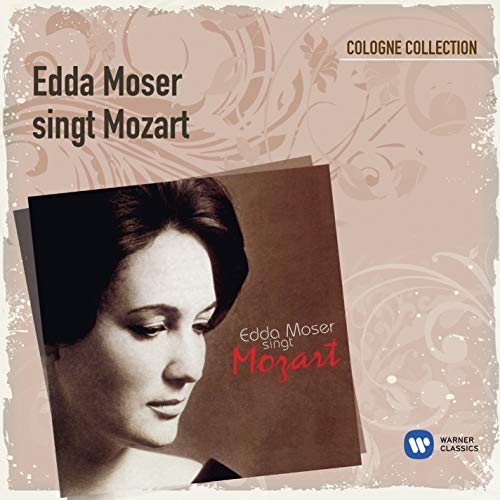
Edda Moser sings Mozart

Edda Moser, who was active on the operatic stage during the 1970s and early 1980s, should probably be better known than she is, though many will no doubt remember her from the Joseph Losey film of Don Giovanni in which she played Donna Anna.

Not strictly a recital, this is a collection of excerpts from various Mozart recordings Edda Moser made during the 1970s. Many would no doubt pick Moser for their favourite Queen of the Night, a role she sings on the patchy Sawallish recording, and indeed one notes that most of the music chosen here is for Mozart’s fierier characters.

It starts appropriately enough with the Queen of the Night’s arias and they really are splendid. First of all the coloratura flourishes and high notes are tossed off with ease and yet she also chracterises the music brilliantly. There is authority in her O zittre nicht, rage in her Der hölle Rache. Where many coloraturas sound merely pretty, Moser sounds regal and dangerous.

Next comes Konstanze’s Martern aller Arten which is properly defiant, the coloratura not only accurately executed but filled with affronted contempt. Donna Anna’s Non mi dir displays Moser’s fine legato and she also has the technique to do justice to the coloratura section.

The qualities that make her an excellent Queen of the Night and Konstanze stand her in good stead for Elettra, which she sang on Hans Schmidt-Isserstedt’s recording and she embraces both the lyricism of Idol mio and the fury of D’Oreste, d’Ajace.

The range is exceptional too and during the course of this disc, Moser not only has to sing a low G in Vitellia’s Non piu di fiori but a G in alt in the concert aria Popoli di Tessaglia, an aria Moser herself describes as “Unperformable, written without intelligence, not one beautiful note”. Well I might not go that far, but the high lying flights make impossible demands on the singer, which Moser manages incredibly well. On the other hand the low lying phrases in Vitellia’s aria tax her more and the notes below the stave emerge colourless, almost as if from a different singer.

To finish up we have a couple of examples of her contributions to some of Mozart’s sacred music, which showcase her deep legato and firm line. The voice may not have the creamy beautfy of a Te Kanawa or a Fleming, but it is still a very attractive instrument and she is more responsive to the emotional core of the music than Te Kanawa at least.

This is, without doubt, one of the best Mozart vocal compilations I have come across and is definitely worth hearing.


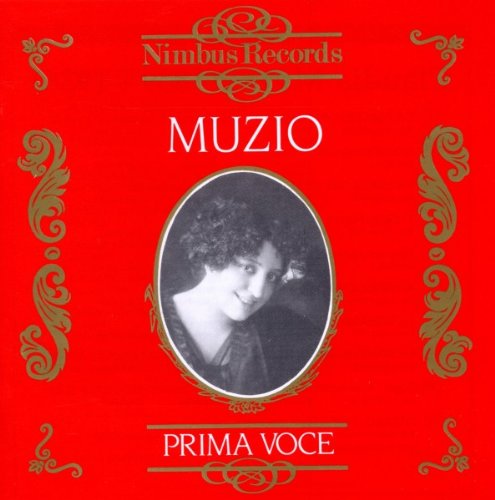
Claudia Muzio – Arias

Claudia Muzio had a patchy recording career. She made her first recordings in 1911 when she was around 21 (there is some doubt as to her year of birth), an aria and a duet, then from 1917 to 1918 she recorded plentifully for Pathé. In the early 1920s she made recordngs for Edison, but then there was nothing between 1924 and 1934 when she made what are her most famous recordings for Columbia. It would seem that the years of her greatest glory were probably when she was performing in Chicago in the early 1930s, and this is precisely the time she was silent to the gramophone. The Columbias were made a couple of years before her early death from an unspecified illness in 1936, when she was not in the best of health or in very happy circumstances.

Save for the 1911 recording of Si, mi chiamano Mimi (the first recording made by Muzio) this issue concentrates on the recordings on the Columbias. Occasionally we are aware this is not a voice in perfect health, of a shortness of breath and the inability to swell the tone at climaxes, but the voice is still unfailingly lovely and, in any case, what really singles her out is her interpretive ability. She brings something personal to all that she does. One sees the face and every fleeting change of expression. These are the qualities that make Muzio special.

Even in that very first recording of Mimi’s Si mi chiamano Mimi, though the artistry is still unformed, one registers a change of expression when she sings the phrase ma quando vien lo sgelo. Already she is doing more than simply singing the notes. That said, coming, as it does, at the end of all the later recordings, one also notes how much she developed in the interim, as we actually have a direct comparison with her 1935 version of the aria, an altogether more detailed and moving rendition.

Lauri-Volpi described her voice as one “made of tears and sighs and restrained inner fire” and certainly some of the most famous tracks here are the tearfully emotional ones, like her Addio del passato, the letter reading almost unbearably moving, the aria almost more felt than sung, though, as noted by Callasinanaplus below, a little too much of the verismo soprano’s emphasis on external declamation, creeps into her delivery. A true bel canto soprano, like Callas, creates as great an effect by working within the musical framework.

Predictably then it, is the tragic verismo arias that make the greatest effect, but she could also smile and charm, as she proves in the the delightful Bonjour, Suzon and Les filles de Cadiz. But hardly a track passes without some distinction. I only wish room had been found for Donaudy’s O del mio amato ben, a Muzio speciality, sung without sentimentality or mawkishness, but beautfully shaded and phrased so that the song emerges as a mini masterpiece.

If you don’t know Muzio’s work, I urge you to right that wrong.

Jarmila Novotna -The Great Soprano’s Own Selection of her Finest Recordings

31ntbjmgwwl

The Czech soprano Jarmila Novotna made few recordings but had a long and illustrious career. She made her debut in 1925 at the age of 17, in no less a role than that of Violetta and retired in 1956 at the age of 49. No doubt some will remember her for her appearance in the Hollywood movie The Great Caruso in which she played the diva Maria Selka.

This disc collects together recordings selected by Novotna herself and taken from her own collection, and shows the voice still firm and true in 1956, when the recording of Rusalka’s Song to the Moon (with piano) was recorded.

The disc doesn’t, however, get off to the best of starts as, to my ears, the voice sounds strained in the upper reaches of Smetana’s Lark Song from The Kiss (also with piano), which was recorded in 1926. Nor do I find her Cherubino particularly characterful, though the voice itself is quite lovely here and sounds more comfortoble in this tessitura, as it is in Pamina’s arias, though she dosen’t quite find the pathos needed for Ach ich fühls.

For me the most treasurable items are the piano accomapanied Songs of Lidice (Czech Folk Songs) which exploit her rich middle voice. The voice is also beautifully captured in a 1945 recording of the the folk song, Umrem, umrem, this time with orchestra and chorus, but arguably best of all is the vocal arrangement of Fibich’s Poème, a piece I know from my teenage years, when I used to play it on the piano, which is deeply felt and eloquenty performed.

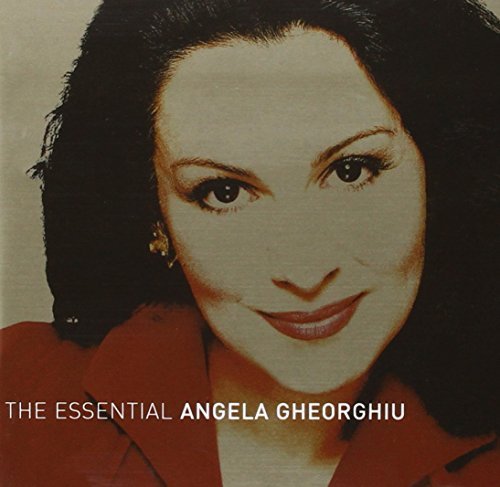
The Essential Angela Gheorghiu

51cj4h3nbtl

Is it churlish to point out that, though this collection includes much that is desirable, there is also a great deal of material one might consider “essential” on EMI, for whom Gheorghiu recorded for the lion’s share of her career? First contracted to Decca, she soon switched to EMI in order to be with the same label as her husband, Roberto Alagna, with whom she made many now well known complete opera sets. However it was Decca who first signed her up after her sensational debut as Violetta at the Royal Opera House, Covent Garden, and here they pay tribute to her with a well filled disc of excerpts from the few recordings she made for the label before she left them.

There are two excerpts from that 1994 Covent Garden La Traviata, a reflective Ah, fors è lui, technically assured Sempre libera and an affecting Addio del passato. Solti’s conducting is, as always in Verdi, a bit rigid but it is easy to understand why Gheorghiu had such a success in the role.

Next chronologically are five arias from her first recital disc made in 1995; Wally’s Ebben? Ne andro lontana, Marguerite’s Jewel Song from Faust, Il est doux, il est bon from Massenet’s Hérodiade and Vive amour qui rêve from his Chérubin. The Wally piece is beautifully sung, though she doesn’t quite capture its aching loneliness and the Jewel Song sparkles lightly as it should. The Aubade from Chérubin is also lovely, and I am reminded that I first saw her in the secondary role of Nina in the production of the opera which the Royal Opera, Covent Garden mounted with Susan Graham in the title role. She made quite an impression too. Probably the best of all these selections is the aria from Hérodiade, which is both gorgeous and gorgeously sung.

From the 1996 Lyon production of L’Elisir d’Amore we have Adina and Nemorino’s Chiedi all’aura lusinghietta, in which I find her, as I did in the theatre, just a mite too sophisticated.

There are so many good recordings of La Boheme that Chailly’s 1999 recording with Gheorghiu and Alagna is quite often forgotten, which is a pity as it’s actually very good indeed. From this set we have Gheorghiu’s touchingly sincere Si, mi chiamano Mimi through to the end of the act, and also her moving rendition of Donde lieta usci.

Perhaps most impressive of all are the items taken from her Verdi recital with Chailly. She might not quite match the breezy insouciance of Callas or Sutherland in Elena’s Merce, dilette amiche, but she seems almost perfectly cast as Amelia in her Come in quet’ora bruna. Both Leonoras are beautifully sung too, and there is a dark loveliness to her tone, which reminds me, surprisingly perhaps, of Leontyne Price.

The disc finishes, fittingly enough, with the fifth take from her first album, a piece from Romanian composer George Grigoriu’s Muzika, slight in musical value, but charmingly delivered.

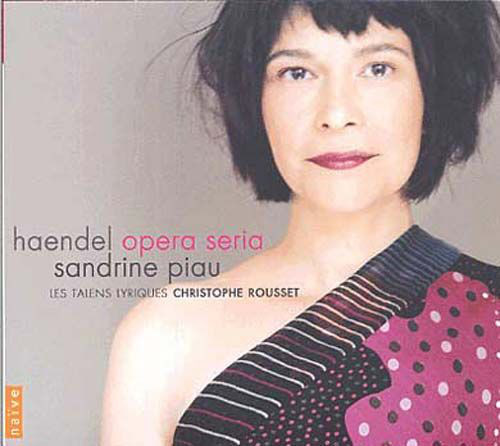
Sandrine Piau – Handel Opera Seria

r-13865292-1562864332-2077.jpeg

Although we may seem to be suffering a dearth of great Verdi and Wagner singers in recent years, Handel singing has gone from strength to strength over the last twenty years or so. However, even amongst the wealth of excellent Handel recital discs that have appeared, this one, recorded in 2004, stands out.

The programme itself is varied, with a nice sprinkling of arias from lesser known works amongst the more well known excerpts from such as Giulio Cesare in Egitto, Rodelinda and Orlando, whilst there is a good selection of different moods represented.

Sandrine Piau is the equal of everything Handel throws at her. The needle-fine precision with which she executes the florid music is breathtaking, as she tosses off stratospheric pyrotechnics with insouciant ease, but she is also adept at sustaining the long lyrical line. Furthermore she encompasses the full range of mood from quiet introspection to dramatic declamation. This is a real tour de force of Handel singing.

She is wonderfully supported by Christophe Rousset and Les Talens Lyriques and the recording cannot be faulted.

Warmy recommended.

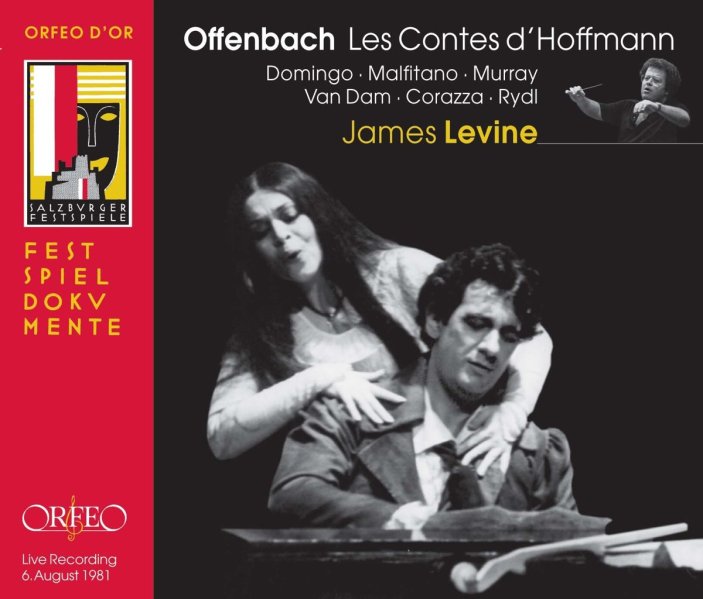
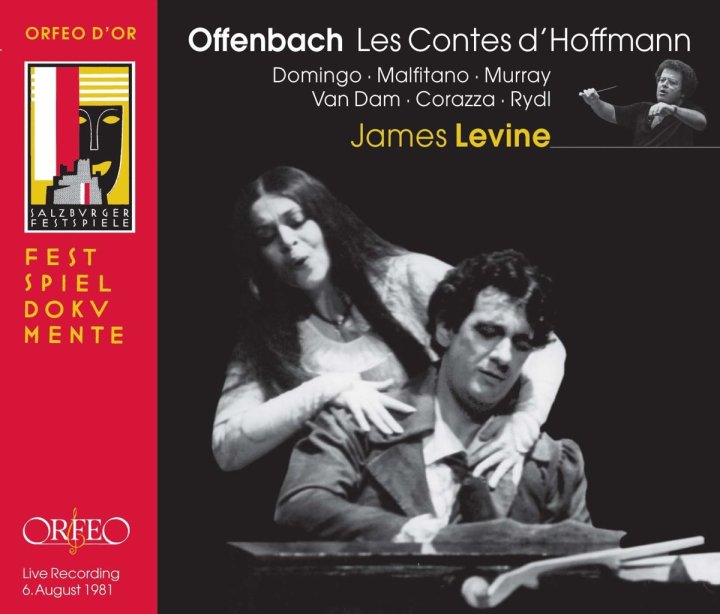
Les Contes d’Hoffmann from the Salzburg Festival 1981

71svq0cjidl._sl1200_

I was keen to hear this set after it was the reviewer’s first choice for the opera in BBC’s Building a Library programme, and it is very good indeed, though the sound of this live recording, made at the Salzburg Festival in 1981, rather lets it down. The solo voices are well recorded, but the sounds becomes boomy and congested when orchestra and chorus are at full tilt. Furthermore there are quite a few bangs and thuds associated with live performance.

That said the performance itself is thrilling with Domingo in superb voice and even more inside the role than he is on the Bonynge set. That of course has Sutherland in the female roles and it has to be said that Malfitano doesn’t command her beauty of tone. On the other hand, she is a much more convincing vocal actress. For all that Offenbach intended the roles to be sung by the same singer, the demands of each are quite different, and I often prefer to hear them sung by different singers as they are in the superb John Schlesinger Covent Garden production with Domingo again as Hoffmann, but with Luciana Serra as Olympia, Ileana Cotrubas as Antonia and Agnes Baltsa (a mezzo) as Giulietta. Malfitano rises to the challenge superbly however and reconciles me to the casting of the same singer.

The rest of the cast is also excellent with Ann Murray superb in the dual role of Niklausse/The Muse and Van Dam perfection in the roles of the four villains, vocally more resplendent than Bacquier on the Bonynge recording. Rémy Corazza is also excellent in the comic roles, if not quite erasing memories of Hugues Cuénod on the Bonynge set.

James Levine, whom I sometimes find too bombastic in Verdi, surprised me, his conducting both exciting and lyrical and the Vienna Philharmonic play superbly.

The Bonynge profits from superb Decca sound of course, but, in all other respects, I think I prefer this one.

Great Moments of Nicolai Gedda

“Great Moments” is the title of this three disc compilation, issued in 2000, and EMI certainly had a great deal to choose from. Nicolai Gedda must be one of the most recorded tenors in history. I suppose one should point out that the “moments” here are all purely operatic. To get a more rounded view of Gedda’s output, both as to range and repertoire, one would have to include his work in orotorio and song, embracing music from Bach to the present day, as well as some operetta. But this is a sensible conflation of music from the eighteenth and nineteenth centuries, covering twenty years of recording from 1952 to 1974.

Gedda was a keen linguist and sang virtually without accent in French, German, Italian, Spanish, Russian, English and his native Swedish. This linguistic ability no doubt also informed the vast range of music and styles he was able to embrace. It certainly makes for a pleasingly varied selection of excerpts.

Disc one is made up, mostly, of the earliest material, hence we have excerpts from his splendid Dimitri on the 1952 Dobrowen recording of Boris Godunov (with Eugenia Zareska) and the whole of his first recital for EMI, recorded in 1953. A further excerpt from Boris Godunov from a 1969 recital is included, along with an aria from Rimsky-Korsakov’s May Night which shows the voice virtually unchanged in seventeen years, though the style is possibly a little more assertive.

The 1953 recital is a real treasure-trove of delights, opening with a version of Lensky’s Act II aria, which is so beautiful that it bears comparison with Sobinov. He sings it as an inner monologue, the pianissimo reprise spun out in mastery fashion. Also wonderful are his honeyed performance of Du pauvre seul ami fidèle from Auber’s La Muette de Portici and the glorious mezza voce legato of Nadir’s Je crois entendre encore. The other French items are just as desirable, but he also delivers an ardently poetic Cielo e mar from Ponchielli’s La Gioconda and his sad, restrained performance of Federico’s Lament from Cilea’s L’Arlesiana. Some may prefer a more overtly passionate rendering in the manner of Corelli, but personally I find Gedda’s vocal restraint quite refreshing and not in the least bit unemotional. This first disc ends with a joyfully ebullient version of Mes amis, écoutez l’histoire from Adam’s Le postillon de Lonjumeau, sung in Swedish and recorded live in 1952.

Disc 2 is also wide ranging, starting with music by Rousseau, Gluck (Gedda coping superbly with the high tessitura of Gluck’s tenor version of Orphée et Eurydice) and Mozart, before moving on to the German Romantic repertoire. Taken from a 1957 recital disc, Don Ottavio’s arias and Tamino’s Dies Bildnis ist bezaubernd schön are much better than on the complete Klemperer recordings, with a lovely smile in the tone for Tamino’s aria. Belmonte’s Ich baue ganz, recorded in 1967 with the Bath Festival Orchestra under Sir Yehudi Menuhin and sung in impeccable English, is brilliantly done. Exciting performances of Huon’s arias from Oberon lead us into the German Romantics. Gedda only once sang Lohengrin on stage, but decided that Wagner wasn’t for him. His lyrical approach to In fernem Land and Mein lieber Schwann is very beautfiful nonetheless.

Best of all on this second disc is a magical performance of Magische Töne, sung in a ravishing mezza voce of ineffable sweetness, the long legato line beautifully and firmly held. This is great singing, no doubt about it.

Disc 3 is of French and Italian arias and duets. It starts with a superb performance of La gloire était ma seule idole from Berlioz’s Benvenuto Cellini, a role Gedda made very much his own and of course later recorded complete under Sir Colin Davis. Next comes a dramatic version of Un autre est son époux from Werther, the joyful Aubade from Lalo’s Le Roi d’Ys, and the Raoul/Marguerite duet from Les Huguenots (with Mady Mesplé). Arnold’s Asil hérèditaire from Rossini’s Guillaume Tell, with its fabulously ringing top notes, leads us into the Italian bel canto items.

Mirella Freni joins him for duets from La Sonnambula, Lucia di Lammermoor and Don Pasquale whilst alone he sings Edgardo’s Tombe degli avi miei and Ernesto’s Cercherò lontana terra. The Bellini had me wishing he had been engaged for Callas’s studio recording of La Sonnambula rather than the ineffectual Monti. After all he had already sung Narciso in her recording of Il Turco in Italia.

Freni, who had yet to venture into more dramatic repertoire, blends well with Gedda in the duets, but back in 1966 she had yet to learn how to project personality in a recording. Her singing is lovely but a little anonymous. Both the solo items could be considered models of bel canto style but are also sung with appreciation of the dramatic situation, the recitatives vividly delivered.

To finish we have a clutch of encores, including Lara’s Granada and the lovely Berceuse from Godard’s Jocelyn, which give us a glimpse of Gedda’s prowess in lighter fare and remind us of that Gedda also recorded a lot of operetta.

Given Gedda was such a prolific recording artist, there was a lot to choose from when compiling a set of Great Moments, and no doubt the set could have extended to many more discs. There is no doubt, though, that EMI have chosen some plums from his discography and there isn’t a dud performance on the whole set. Extravagantly recommended.

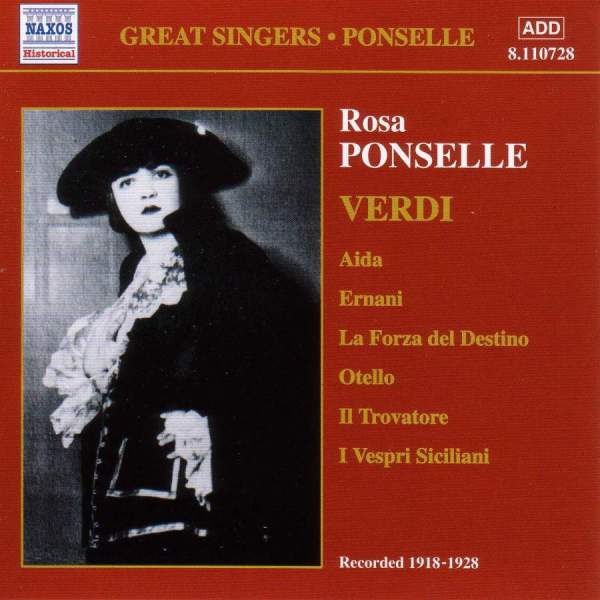
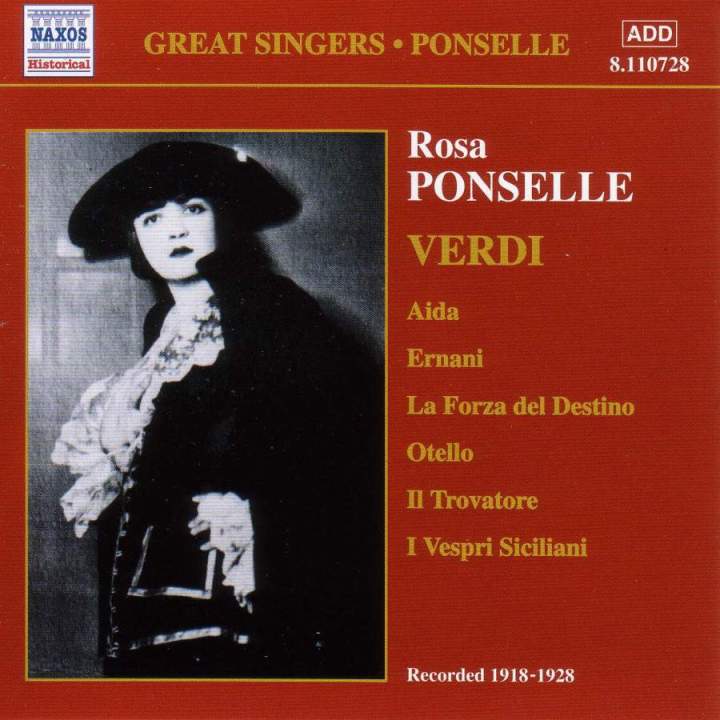
Rosa Ponselle sings Verdi

636943172827

Rosa Ponselle is known for having one of the most extraordinary voices ever to be recorded. Along with Caruso and Ruffo, she was one of Serafin’s “three miracles” and had a voice of unparalleled richness and power. According to Walter Legge, the voice was “majestic, enormously rich in overtones. Her legato was perfect with a breath control that only makes the listener breathless with amazement.”

Her career was not long, and she retired relatively early at the age of 40. Some say her withdrawal from the stage was precipitated by adverse criticisms for her Carmen, but it could just as well have been put down to her shrinking top register. The rest of the voice remained admirably secure and rich however, and recordings made at her villa in the 1950s reveal it still to be firm as a rock, though she hadn’t sung in public for many years.

Her first recordings were acoustics made for Columbia, but she switched to Victor in 1923, when from 1925, her recordings were made using the electrical process, and all the recordings here have been produced by Ward Marston. The collection gathers together just one recording of every Verdi extract Ponselle recorded, so there are no duplications and, where she did record an extract twice, Marston has chosen whichever he considered to be the best, regardless of whether it was acoustic or electrical.

If we are to think of the ideal Verdi soprano, then Ponselle is undoubtedly the voice to which one would turn, its timbre rich and velvety with ample reserves of power, admirably firm but flexible, limpid and responsive. If there are any faults, they tend to be attributable to the recording process and the strictures of side lengths, thus the recitative to the Ernani aria is somehwat perfunctory and rushed where Callas is incredibly detailed with a much greater range of tone colour. There is also a rather unseemly dash to the end of the Siciliana from I Vespri Siciliani and there are other times when the rushed tempi seem more dictated by the length of a 78 side than from any artistic decision.

I wonder too about pitch. Ponselle was known to occasionally employ downward transpositions, so would D’amor sull’ali rosee (recorded acoustically in 1918) be sung at pitch, gven the fact she opts for the optional high Db? It is a lovely performance, the high notes poised and beautifully integrated into the line, so maybe questions of pitch don’t really matter, though they would affect the sound of the voice itself.

I am not a totally devout worshipper at the Ponselle shrine and there are times when I miss Callas’s absolute mastery of Verdian style and innate musicality. Her voice may have been a more unwieldy instrument, but I never question her artistic choices, where sometimes I find Ponselle wanting. Still, these are all treasurable recordings, not only the arias, but the duets with Martinelli, Pinza and Stracciari and the final trio from La Forza del Destino with both Martinelli and Pinza, surely one of the greatest versions of ths scene ever committed to disc. The Miserere (with Martinelli) suffers from being taken too fast, but it does exploit her gloriously rich lower register, but La vergine degli angeli from La Forza del Destino, is a locus classicus of Ponselle’s masterly control, her legato perfect and the line spun out on a pure, firm thread of sound the likes of which you will not hear from any other singer.

Of course Ponselle was much more than a Verdi soprano, as we know from recordings of excerpts from Norma, La Gioconda and L’Africaine, as well as songs, but it is good to have here a collection of Verdi arias sug by arguably the greatest Verdi soprano of the pre WWII era.

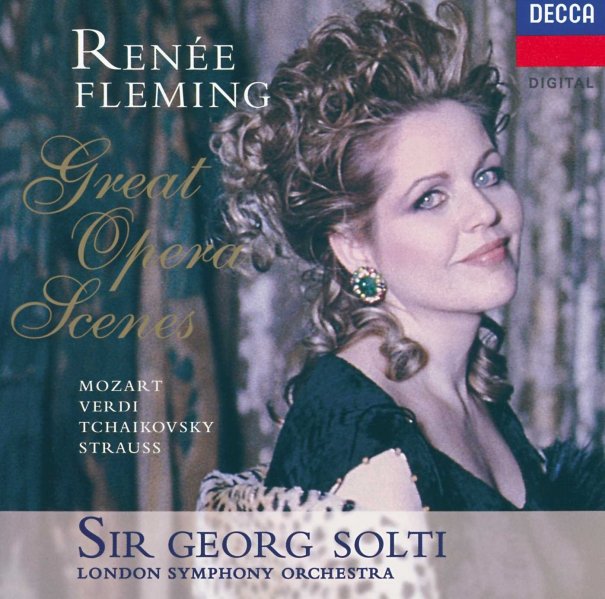
Renée Fleming – Great Opera Scenes


If we are to say goodbye to Renée Fleming the opera singer, then now might be a good time to be reminded of this, one of her most successful recital discs, recorded in 1996, when Fleming was at the height of her powers, and before the tendency to indulge in jazzy slides and swoops had become too pronounced.

All but one of the roles represented here were part of her stage repertoire at the time, and she would in fact go on to sing Strauss’s Daphne in 2005.

The programme is both varied and interesting. We start with both of Countess Almavivas arias from Le Nozze di Figaro, sung with ideal poise and beauty of tone, before plunging into the romantic imaginings of Tchaikovsky’s lovelorn Tatyana. Fleming plays the ardently impulsive young girl to the life. She yearns indwardly In Rusalka’s Song to the Moon, and I doubt I have ever heard Ellen’s Embroidery Aria from Peter Grimes sung with such superb control and feeling. Desdemona’s Willow Song and Ave Maria crops up on many recitals, but Fleming does not suffer at all by comparison with such well known interpreters as Rethberg, Ponselle or Tebaldi.

I suppose the two cornerstones of Fleming’s repertoire have been Mozart and Strauss, so it is fitting that, having started with Mozart, we should finish with Struass, a suitably ecsatic version of the closing scene from Daphne.

The recital is beautifully presented with Larissa Diadkova contributing as Filipyevna and Emilia and Jonathan Summers as Balstrode. The London Symphony Orchestra under Solti provide excellent support.

The voice itself is stunningly beautiful, but Fleming doesn’t rely solely on beauty of voice. Her interpretations are intelligent and musical, and she presents us with five very different characters. The only criticism I would have is that her diction is not always as good as it might be, but in all other respects this is a classic recital disc.