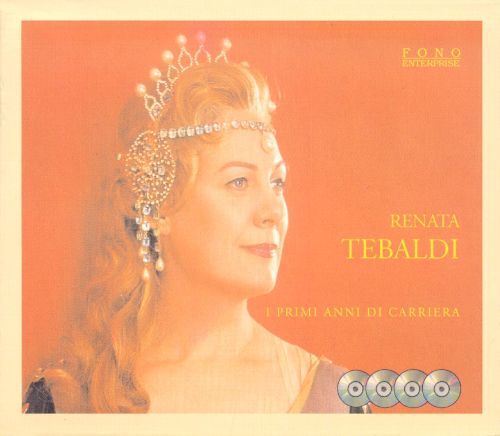
Renata Tebaldi – I Primi Anni di Carriere

mi0001083604

This four disc set is of recordings made in the 1940s and early 1950s, when Tebaldi was in her twenties. It is a mixture of live and studio recordings, so sound quality varies quite a bit. It is also a convenient grouping together of four different discs issued by Fonit Cetra in 2002, which no doubt explains why we get so many different performances of the same aria. Given that there is little difference between them, you may decide you don’t need to listen to four different performances of La mamma morta and of Desdemona’s Willow Song.

And of course the first thing we need to say is that it was an extraordnarily beautiful voice, even throughout its range, firm and rich, her diction admirably clear, though, even at the beginning the very top could sound strained and off pitch. The top C climax to her 1950 Cetra studio recording of Aida’s O patria mia is hard won and slightly under the note and the voice’s greatest beauty lies in the middle register, though many of today’s sopranos would also kill for the richness down below. Nor is she an unfeeling performer, though, at this stage in her career, it can tempt her into excess, especially when singing live, and she tends to sound lacrymose rather than truly moving. She goes way over the top in Desdemona’s Willow Song, and she is much more restrained, and consequently more moving, in the Decca Karajan recording. The other thing to say about Tebaldi is that, however beautiful the voice, however firm the delivery, however musical her singing, her performances rarely stay in the memory, nor does she ever really light up a phrase or a line the way others can. Performances of some of this same music, by such as Muzio, Callas, Caballé, De Los Angeles and Schwarzkopf resonate in my mind’s ear, and I can often recall individual details. With Tebaldi I never can. I can recall the sound of the voice, but little that is specific to the music she is singing. In these early performances, I found that she often over-characterises the music, introducing sobs and emphases which detract from the beauty of the sound, rather than make it more dramatic. It is somewhat akin to watching a hammy actor.

A few specifics then about the discs themselves. I got muddled and listened to them in reverse order. Disc 4 is entitled Gli Inediti, and is presumably of previously unissued recordings. In concert she sings the Countess’s Porgi amor but, though more suited to the character than she is to Susanna, who puts in an appearance on Disc 3, Mozart is not really her métier. The excerpts from a 1949 performance of Andrea Chénier wih Del Monaco are prime examples of that hamminess I alluded to, though all the singers go way over the top. The audience lap it up, so they no doubt give them what they want. A poised 1949 performance of the Ave Maria from Otello is ruined by a surfeit of little sobs, but she gives us a lovely performance of Louise’s Depuis le jour (in Italian). It lacks Callas’s quiet intensity and mounting rapture, but is much more securely sung and works well on its own terms. The disc closes with a small piece of history; a 1945 performance of the love duet from Otello, with the then almost sixty year old Francesco Merli, though recording here is at its dimmest. Nevertheless it affords us a glimpse of the great tenor in one of his most famous roles.

Disc 3 covers studio recordings made for Decca and Fonit Cetra in 1949 and 1950, arias from Aida, Madama Butterfly, Faust, Manon Lescaut, Tosca, Il Trovatore, La Traviata, Otello, La Boheme, Mefistofele, La Wally, Andrea Chénier and, most surprisingly Susanna’s Deh vieni from Le Nozze di Figaro, though she makes a very heavyweight Susanna, and this is the least successful item on the first disc. Recorded sound here is fine and there is no doubt that this is an extraordinary voice the like of which we don’t hear anymore, and perhaps haven’t since. Her legato is mostly superb as is her diction. On the other hand, as one aria follows another, we don’t really get a gallery of different characters. Her Aida isn’t really very different from her Butterfly, her Manon no different from her Mimi, and, in an attempt to be dramatic, she often over-emotes. The reading of the letter before Addio del passato is hopelessly melodramatic and she ends the aria forte rather than in the fil di voce Verdi asks for.

The prize of Disc 2, entitled La nascita d’una leggenda, is some extended excerpts from a 1951 concert performance of Verdi’s Giovanna d’Arco with Carlo Bergonzi and Rolando Panerai. Though she is taxed by some of the coloratura, and she tends to aspirate when the music asks her to move a little faster, the role suits her well. Also excellent are the two extracts from a 1950 performance of the Verdi Requiem under Toscanini, with Giacinto Pradelli, Cloe Elmo and Cesare Siepi. It is somewhat dimly recorded, but you can hear how fine she was in this work. Why Decca never recorded her in it is a mystery to me. A welcome surprise is Elisabeth’s Dich, teure Halle (in Italian) from Tannhäuser. It is also good to hear the young Di Stefano in a 1950 concert performance of the Act I duet from Madama Butterfly. The concert also included Margherita’s L’altra notte in fondo al mare from Mefistiofele. In both the aria and the duet, Tebaldi oversings and overacts and her singing as Butterfly is so powerful that she sounds more like a Tosca or Minnie to me. Many will respond to the beauty of the voice, but she doesn’t conjure up an image of Butterfly for me at least.

The first disc pits Tebaldi against her teacher, Carmen Melis. Excerpts from Tebaldi’s first recordings of La Boheme and Madama Butterfly under Alberto Erede and arias from Manon Lescaut and Tosca. Many will no doubt revel in the glory of that voice filling out Puccini’s wonderful melodies, but for me she too often oversings and the finale to La Boheme, which is given in its entirety has both Tebaldi and Giacinto Pradelli over-emoting like mad. The love duet from Madama Butterfly with Giuseppe Campora likewise has no sense of the young girl’s gradual awakening to love and sounds as if it could have been lifted from Tosca. Melis is caught in excerpts from Tosca and Massenet’s Manon. She is a singer who is new to me, and I must say I found her very impressive, though the top C at the line Io quella lama gli piantai nel cor is a little precarious, and she takes the upper option on the word cor. The Manon excerpt is Manon’s N’est-ce plus ma main (in Italian) from the duet with Des Grieux, and she is wonderfully seductive and persuasive.

Tebaldi is a central singer in that she demonstrates most of the virtues of good singing. The voice is a beautiful one, the line always firmly held, her legato generally excellent. Her only faults are a lack of a trill and clumsy execution of fast moving music (hardly necessary in most of the music she sang) and a slightly short top. (I remember that in her interview with Luca Rasponi for the book The Last of the Prima Donnas, she bemoans the ever rising pitch of modern orcehstras, which must have been a nightmare for her.) My preferences are well know, and I prefer singers who have something more specific to say about the music they assay, but the set is one I still enjoy dipping into from time to time.
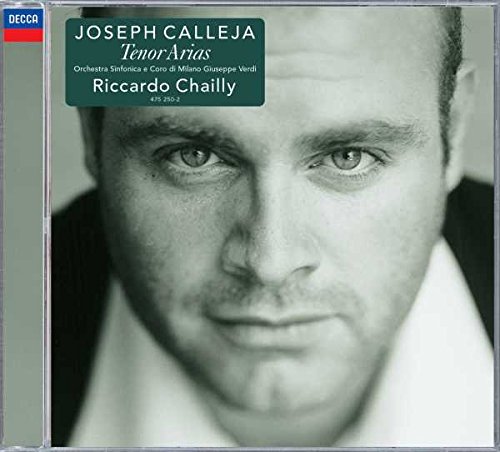
Joseph Calleja – Tenor Arias

51cklkxuoyl

This disc was recorded back in 2003, when Joseph Calleja was a virtually unknown twenty-six year old, and on the threshhold of his career. At that time, the voice was a light lyric tenor with a distinctive fast vibrato, more akin to the sound of tenors like De Lucia and Bonci than what we have become used to since.

Repertoire on the disc is judicially chosen, and I am very surprised to see that in his most recent disc of Verdi arias, he tackles music for Otello, Manrico and Radames (though I don’t think he has sung any of these roles on stage yet). Listening to the performances on this disc, one wouldn’t suspect for a moment that the voice would develop to embrace that repertoire. So far he has taken his career slowly and I do hope he doesn’t push himself too far.

But back to the recital disc in question, and I must say I find it very satisfying. Far from the can belto of so many tenors, there is lighness and grace to his singing, and he refreshingly brings as much attention to recitative as he does to an aria. Take the opening piece, the recitative to Alfredo’s Dei miei bollenti spiriti, which brims with joyful high spirits, softening with a touch of intimacy at Qui presso a lei. The aria itself is sung with a nice buoyancy and affectionate phrasing, switching to a more propulsive manner for the cabeltta.

The Macbeth aria is sung with a deep sense of melancholy, whilst the Duke is all charm and insouciance, though the top D he attempts is a little insecure. Nemorino’s Quanto e bella is delivered with a nice winsome charm, and Edgardo’s final scene is suitably tragic.

I’m not sure the aria from Adrianna Lecouvreur was a good choice for him, as it seems to cry out for a beefier sound. Nevertheless his restraint is most welcome, and it is good to be free of all those sobs and aspirates that used to pass for emotion in some Italian tenors of an earlier generation

In all Riccardo Chailly offers impeccable support, and it is good that scenes are given complete with chorus and interjections from other singers (Linda Easley as Annina and Giovanni Battista Parodi as Raimondo).

All in all a very successful debut recital, and it is good to know that Calleja is still active today, largely fulfilling the promise he showed in this one.

Kiri Te Kanawa – Mozart Arias

51es161ns0l


Zaide: Ruhe sanft, mein holdes Leben
La finta giardinera: Crudeli fermate… A dal pianto
La clemenza di Tito: S’altro che lagrime
Cosí fan tutte: Ei parte…Senti… Per pietà
Il rè pastore: L’amerò,sarò costanze
Lucia Silla: Pupille amate
Idomeneo: Se il padre perdei
Die Zauberflöte: Ach ich fühl’s

Kiri Te Kanawa became known to the world when she sang Let the bright Seraphim at the wedding of Prince Charles and Lady Diana, but opera afficionados had known of her for at least ten years before that. I remember very clearly seeing a TV broadcast frm Glyndebourne of Le Nozze di Figaro, in which Te Kanawa played the Countess, Ileana Cotruas Susanna and Frederica Von Stade Cherubino. It effectively launched all three ladies’ international careers, and it was principally as a Mozart singer that Te Kanawa became known.

Later she sang roles by Verdi (the gentler heroines like Desdemona and Amelia in Simon Boccanegrea), Puccini (Mimi and Manon), Strauss (the Marschallin, Countess Madeleine and Arabella), as well as Gounod’s Margeurite, Tatyana and Barber’s Vanessa, but I still think of her chiefly as a Mozart specialist, and it is in this repertoire that I enjoy her most.

It is good to see so many arias taken from Mozart’s lesser known operas, but the recital tends to concentrate on gracefully flowing arias, and so there is little variety. Of course there is much pleasure to be gained from the beauty of Dame Kiri’s creamy soprano, and her technical command of the music, but she evinces little character and the recital tends to settle back comfortably into its frame. You could of course argue that the music demands no more than it is given, and, for most of the music you’d probably be right, but when it comes to the recitative and aria from Cosí fan tutte, my mind kept going back to a more sharply characterised, but no less scrupulously sung version by Elisabeth Schwarzkopf, and I couldn’t help but wonder what she would have made of a similar collection.

Still, we should be grateful for what we have. It is rare indeed to hear such accomplished singing (and orchestral playing) allied to such a glorious voice. The disc certainly plays to her strengths, that is a voice of creamy beauty, even throughout its range, and maybe it is better experienced piecemeal, rather than in one sitting, when you’d be less inclined to notice the lack of variety in the programme.

Jussi Björling – A collection of Swedish 78s.

These two CDs gather together most of the 78s the young Björling made in his native Sweden between 1933 and 1949, the earliest made when he was a budding tenor of twenty-two.

Most are vocal gems, but one or two (the rather loud and penny plain Je crois entendre encore, and the unpoetic duet from La Boheme with Anna- Lisa Björling on the second disc, for instance) are less than great.

The voice itself was a magnificent one, no doubt about it, with a silvery purity throughout its range, the high notes free and easy; just listen to his joyfully ebullient 1938 performance of Offenbach’s Au mont Ida from La belle Hélène, sung in Swedish, but with terrific swagger, the top notes flying out like lasers. From a few years ealier we have a plaintively sensitive performance of Valdimir’s Cavatina from Borodin’s Prince Igor, the legato line beautifully held, his mezza voce finely spun out. Also from 1938 we have a thrilling performance of the Cujus animam from Rossini’s Stabat mater, with a free and easy top D flat at the end, and it is prinicpall for Italian and French opera that Bjørling will be remembered and there are plenty of examples here of his wonderfully musical performances in that genre.

We find him ideal in Verdi, Donizetti and Puccini alike, in Myerbeer, in Massenet and in Gounod (a glorious rendering of Faust’s Salut, demeure). Some regret the absence of a true Italianate tone in the Italian items, but he will never resort to sobs and aspirates to express emotion, and, personally, I find his comparative restraint very attractive. It is true, he is not always imaginative with his phrasing, and nowhere will you get the kind of psychological introspection you would hear in a performance by someone like Vickers, but his singing is always musical, and of course there is a great deal of pleasure to be had from the voice itself, which Italianate or not, is a thing of great beauty.

Some of the very best of these 78 recordings are included on Volume 1, stand out items for me being the aforementioned Faust aria, his wonderfully musical and sensitive Ah si, ben mio from Il Ttovatore, and his poetic, but thrilling version of Nessun dorma from Turandot.  There is also plenty to treasure in Volume 2, which includes the Offenbach and Borodin, but also a sensitvely prayerful  Ingemisco from the Verdi Requiem, Des Grieux’s lovely Dream from Manon sung with liquid, honeyed tone (his ardent Ah, fuyez is on the first disc), and his  poetic Cielo e mar, from La Gioconda.

The second disc finishes with a couple of unexpected examples of his work in Lieder, a gorgeously lyrical Beethoven Adelaide, and a beautifully restrained and rapt account of Strauss’s Morgen.

Anyone who loves the tenor voice and gloriously musical and sensitive singing (not always the same thing) should have these recordings in their collections.

Dame Janet Baker – Philips & Decca Recordings 1961 – 1979

r-10064800-1491163322-4375.jpeg

Dame Janet Baker is without doubt one of the greatest singers of the latter part of the twentieth century, known throughout the world from her recordings and international recitals. Though her range was quite wide, taking in operatic roles from Monteverdi to Richard Strauss, and even embracing the Verdi Requiem and Schoenberg’s Gurrelieder, she was never tempted to sing outside her fach and retired, first from the operatic stage and then from recital work, whilst still at her peak, so that we never saw the slow vocal decline we often hear from great singers. Her Yorkshire firmness of mind and pragmatism also meant that she refused to join the international operatic circus, and in fact only once sang in opera outside the UK (when the Royal Opera took their hugely successful production of La Clemenza di Tito to La Scala, Milan).

This 5 disc set brings together some of the recordings Dame Janet Baker made for Decca, Argo and Philips during the 1960s and 1970s. Though contracted to EMI (and Warner have a pretty exhaustive twenty disc box set of her work for that label, called The Great Recordings), she made a few recordings for Decca/Argo (including her famous recording of Dido and Aeneas) in the early 60s, and then a tranche of recitals for Philips in the 1970s. The range of material here is not quite as wide as that on the aforementioned Warner set, but takes us from 17th century arie through to Britten.

Disc 1 is a selection of what most vocal students would know as Arie Antiche (called here Arie Amorose), accompanied by the Academy of St Martin in the Fields under Sir Neville Marriner. Whilst the somewhat souped-up arrangements can sound somewhat anachronistic today, Baker’s wonderfully varied singing brings each song winningly to life. The disc is rounded off with a couple of arias from Cavalli’s La Calisto recorded shortly after her great success in the role of Diana/Jove at Glyndebourne.

Some of Baker’s greatest early successes were in Handel and Disc 2 is mostly taken up by a superb 1972 Handel recital she made with the English Chamber Orchestra under Raymond Leppard. How brilliantly she charts the changing emotions in the cantata Lucrezia and also in the arioso-like Where shall I fly from Hercules,but each track displays the specificity of her art, the way she can express, on the one hand, the despair in an aria like Scherza infida and, on the other, the joy in Dopo notte, both from Ariodante. The disc is rounded off by a superb 1966 recording of Bach’s Vergnügte Ruh and her incomparable When I am laid in earth from her 1961 recording of Dido and Aeneas.

Disc 3 has excerpts from a 1973 Mozart/Haydn recital and a 1976 Beethoven/Schubert disc, both made with Raymond Leppard, with the addition of arias from her complete recordings of La Clemenza di Tito and Cosí fan tutte under Sir Colin Davis. The two Haydn cantatas (one with piano and one with orchestra) are very welcome, but we do miss her stunning performance of Sesto’s two big arias from La Clemenza di Tito, and her gently intimate performance of Mozart’s Abendempfindung. Fortunately these have been included in a superb selection taken from the same two recitals on the Pentatone label, which includes all the missing Mozart and Schubert items. This disc also includes her recording of Beethoven’s Ah perfido!, a little smaller in scale than some, but beautifully judged none the less. It doesn’t have Callas’s ferocity, it is true, but it is much more comfortably vocalised.

Disc 4 is of music by Rameau (excerpts from her 1965 recording of Hippolyte et Aricie, which well display her impassioned Phèdre), Gluck (arias for Orfeo and Alceste taken from her 1975 Gluck recital) and Berlioz (1979 performances of Cléopâtre and Herminie and Béatrice’s big scene from Davis’s complete 1977 recording of Béatrice et Bénédict). The biggest loss here is of the majority of the Gluck recital, which included many rare items, though the complete reictal was at one time available on one of Philips’s budget labels. Baker is without doubt one of the greatest Berlioz exponents of all time, and the two scènes lyriques are especially welcome. These are fine examples of her dramatic intensity and the range of expression in both is fully exploited.

Disc 5 is of late nineteenth and twentieth century French song and Benjamin Britten; the whole of a disc of French song made with the Melos Ensmble in 1966, excerpts from the composers own recordings of The Rape of Lucretia and Owen Wingrave and the cantata, Phaedra, which was composed specifically for her. The Melos disc includes Ravel’s Chansons Madécasses and Trois poèmes de Stéphane Mallarmé, Chausson’s Chanson perpétuelle and Delage’s Quatre poèmes hindous and is a fine example of Baker’s felicity in French chanson, particularly ravishing in the wordless melismas of Lahore from Quatre poèmes Hindous. The Britten excerpts remind us of her sympathetic portrayal of Lucretia and her unpleasant Kate in Owen Wingrave. The Britten cantata is a great example of her controlled intensity.

Remarkable throughout is the care and concentration of her interpretations. Nothing is glossed over, nothing taken for granted, and she was one of those artists who could bring the frisson of live performance into the studio. Nor do I think she ever made a bad record. I heard her live on many occasions. Hers was not a big voice, but it was one that coud carry to the furthest recesses of a large hall, even when singing pianissimo. Furthermore there was a concentration, and intensity and a gift of communication, vouchsafed to just a few. One of my all time favourite singers.

Callas as Tosca – Royal Opera House, Covent Garden 1964

812ZMsD1g5L._SL1500_

I’d forgotten that I hadn’t reviewed the final opera in Warner’s Callas Live Remastered, so, rather belatedly, here it is.

This Tosca marked Callas’s triumphant return to the stage after an almost two year hiatus. She had been lured out of semi-retiremet by Zeffirelli who was also to stage Norma for her in Paris, with the two opera houses sharing the two productions, though, in the event, the Paris Norma never made it to London. Paris did however get to see the Covent Garden Tosca. It was also the vehicle for her last ever stage appearance the following year when she agreed to sing, against doctor’s orders, for a Royal Gala. A couple of months before she had collapsed on stage and was unable to complete a performance of Norma.

At this performance, though the voice is not what it was when she made the famous De Sabata recording eleven years earlier , she is in remarkably good form, and her interpretation has deepened even further, no doubt the product of weeks of intensive rehearsal and her deep rapport with Tito Gobbi. John Copley, who was Zeffirelli’s assistant on the production, once told me he had never before or since come across such complete actor/singers. At rehearsals, Callas and Gobbi would improvise their scenes and then discuss what had worked, what hadn’t, before returning to the scene to incorporate any new ideas, just as straight actors do on stage. According to Gobbi, so close was their connection that they were even able to do this during a performance, so that if anything unusual happened, as it did one night when Callas’s hairpiece caught fire in one of the candles, they could incorporate it into their stage business.

The production has gone down in history as one of the greatest opera productions of all time, and those who were alive to see it still talk about it today. Act II has been preserved on film and goes some way to revealing the Callas magic on stage, but why oh why didn’t they record the whole thing? What a missed opportunity. The fame of the Zeffirelli staging, the iconic photos taken from it and the 1953 recording are no doubt the reason Callas is so much associated with the role, though it was not a favourite of hers, and, truth to tell, she rarely sang it after making the recording, and never at La Scala during her glory days there.

The first thing to be said for this release is that Warner have discovered a new sound source for the performance, and it is a lot better than anything we have heard before. There is a good deal of stage noise to be sure, but both voices and orchestra come across very clearly. It almost sounds like stereo, so clear is the acoustic.

The performance largely justifies its reputation, and is absolutely gripping from start to finish. Cioni is its weakest link, the voice a little thin and reedy, and, possibly intimidated by appearing alongside two such dramatic giants, with a tendency for empty overacting. He is certainly no replacement for Di Stefano in the 1953 recording, or Bergonzi in the 1964 studio recording, on which Callas is in less secure voice than she is here. He’s not at all bad, just not outstanding.

As for Callas, the voice lacks the beauty and velvet of her 1953 self, but, histrionically she is more inside the role than ever. Her Tosca is more feminine, more vulnerable, even more volatile, but somehow more endearing, and her singing is peppered throughout with wonderful little details. She is particularly charming (not a word one usually associates with Callas) in the Act III duet with Cavaradossi, girlishly happy in the way she looks forward to her future, which contrasts brilliantly with her utter despair when that future is cruelly snatched away from her.

Gobbi’s voice has also lost some of its velvet since 1953, but he too is wonderfully inside the role, his vocal acting so vivid you can almost taste the words. Actually one of the pleasures of the set is being able to hear the words so clearly, not only from the three principals, but also from all the excellent comprimarii. Cillario conducts an exciting performance, if without the many subtleties and revelations of De Sabata in the studio, which remains a first choice for the opera. That said, this one is highly enjoyable and I would place it above Callas’s second studio performance. It may not be not the essential listening of some of the other operas in Warner’s live box set are, but it is certainly worth hearing, and nicely rounds off the set, which thus covers almost all of her international stage career, from Nabucco in 1949, just two years after her Italian debut in Verona, to this Tosca, recorded the year before she sang for the last time on the operatic stage.


Callas and Corelli in Poliuto _ La Scala, Milan 1960

81cwoavsenl-_sy355_

Paolina in Donizetti’s Poliuto was Callas’s final new role. The opera opened the 1960/1961 season at La Scala, an honour granted to Callas five times since her official debut in I Vespri Siciliani in 1951. It also marked her return to the house since her last performances of Imogene in Il Pirata in 1958. The opera was to have been directed by Luchino Visconti, but he had withdrawn from the project in protest after his film Rocco e suoi fratelli had been censored by the Italian authorities. The sumptuous designs were by Nicola Benois, and Herbert Graf took over from Visconti as director.

The opening gala was attended by Prince Rainier and Princess Grace of Monaco, the Begum Aga Khan, Onassis and what one might call the worldwide glitterati, all of whom had come not for Donizetti, but to see the most famous woman in opera, Maria Callas. Callas herself had had only two other engagements in 1960, singing Norma at the ancient amphitheatre in Epidaurus in Greece (the first time opera had ever been staged there) and making her second recording of the same opera for EMI. Nor did these performances signal a return to her erstwhile busy schedule. Her 1961 schedule was not much busier. She made her first disc of French arias, sang some arias with Sir Malcolm Sargent at the piano at a concert at St James’s Palace in London, and appeared in a new productions of Medea in Epidaurus and at La Scala. After a couple more performances of Medea at La Scala in 1962, she didn’t return to the stage until 1964 for the Covent Garden Tosca and the Paris Norma.

Paolina may seem a strange choice for Callas, considering that she is something of a secondary character to that of her husband, Poliuto, but publicity accompanying her every move was now at such a feverish level, that she no doubt thought it would take some of the pressure off her comeback at La Scala. An example of the hysteria which now surrounded her every move is the prolonged ovation which greets her first entrance, so loud and long that Votto has to stop the introduction to her aria and re-start after the hullabaloo has died down.

The reason I mention all this is that it helps place this performance in context, giving us an insight into Callas’s state of mind and the condition of her voice, and there is no doubting she seems nervous and uncharacteristically tentative at her first entrance. It is evident she is treading with caution, though, characteristically, her phrasing is as eloquent as ever. In Act II she appears to have gained in confidence, and the duet with Severo goes quite well. However she is still cautious in the upper reaches and an attempt at a top D at the end of the act is soon abandoned.

Her most eloquent singing comes in the Act III duet with Poliuto, and though the top of the voice is no more secure here than elsewhere, her singing is reminiscent of some of her best work. I remember a recording of this duet sung by Montserrat Caballé and her husband Bernabé Marti, but, though Caballé’s tone may be more ingratiating, her handling of the music is clumsy in comparison to Callas’s, nor does she make anything of the descending scale passages in Un fulgido lume, which Callas imbues with such significance.

Corelli is a splendid Poliuto, his voice burnished and golden, and less likely to indulge in those annoying sobs he often introduces into his singing of verismo, and the opera is cast from strength, with superb performances from Bastianini and Zaccaria. Votto, though he makes some swathing cuts to the score, is a reliable, if not particularly inspired, leader.

Being from 1960, the sound on this recording has always been quite good, and this new Warner master would appear to be a new transfer of the EMI one, which was also reasonably acceptable. A qualified success then. Not Callas at her best certainly, but definitely worth a listen.


Callas in Il Pirata – Carnegie Hall 1959

1502882448_9029584466

Callas first sang the role of Imogene in Il Pirata in May 1958 at La Scala, Milan, her last appearance there until she returned to the house for Poliuto, the opening opera of the 1960 to 1961 season. It was not a particular happy time for her. Ghiringhelli, the intendant of La Scala, had been increasingly cold to her since the Rome walk out on January 2nd earlier that year. Relations had already cooled after her appearance in La Sonnambula in Edinburgh, after Ghiringhelli announced an extra performance without first getting Callas’s agreement. Ghiringhelli was playing a dangerous game, as he did not tell the Edinburgh Festival management that Callas was only contracted for four performances and let them sell a fifth using her name, presumably thinking that, once it had gone on sale, Callas would cave in and agree to the extra performance. Already unwell, and having fulfilled her contractual duties, she refused to sing the extra performance and left Edinburgh for warmer climes, a much needed rest, and, unwisely as it turned out, a party given by Elsa Maxwell in her honour. The press were merciless, painting Callas as the capricious prima donna, who had cancelled a performance in order to go to a party.

Though she had redeemed herself in the eyes of the La Scala audience the previous month  in a revival of Visconti’s production of Anna Bolena, Ghiringhelli did nothing to squelch rumours that Il Pirata would mark Callas’s last appearance at La Scala, and Callas seized a moment to point out the reason for her departure at her last performance. The word palco in Italian has a dual meaning. In the opera it means scaffold, but it also means theatre box, and when Callas came to sing La! Vedete! Il palco funesto! she strode to the front of the stage and gestured towards Ghiringhelli’s box in the theatre. Her meaning was not lost on the audience and it went wild, but Ghiringhelli had the last word, demanding that the fire curtain be lowered before Callas had been able to accept the ovations raining down on her.

It is a huge cause for regret that none of the La Scala performances appear to have been recorded, for there she was singing with first class support in Franco Corelli and Ettore Bastianini. Pier Miranda Ferraro, who sings Enzo on her second recording of La Gioconda, and Constantin Ego are not in the same class. Callas herself is in variable form, top notes occasionally afflicted with hardness and unsteadiness, but she is still a great Bellinian stylist, and the way she caresses and moulds the phrases shows up the provincial attempts of her colleagues. In the absence of a La Scala recording, we are fortunate that this concert performance was recorded.

There was an enormous amount of excitement attending her arrival in New York, fans having been deprived of seeing her at the Met after Rudolf Bing sacked her for not agreeing to the performance schedule he set out. Callas’s relationship with the Met had always been a tense one, but Bing’s boorish unwillingness to understand that a voice cannot switch to and fro between roles as differing in their vocal demands as Lady Macbeth and Violetta would suggest that the fault lay with his intransigence. His only concession was to offer a substitution of Lucia di Lammermoor for La Traviata, a role even further away from the demands of Lady Macbeth.

Understandably then, a certain amount of tension marks out her singing in her opening scene. Nevertheless, she stamps a Norma-like authority on her first recitative, and the whole scene, which she later recorded in the studio with Antonio Tonini, is a perfect example of how to express conflicting emotions, of carefully differentiating between public and private utterances. However she doesn’t really relax and get into her stride until the first duet with Gualtiero. Throughout this duet she gives a masterclass, unfortunately unheeded by Ferraro,  in how to shape and mould phrases, ensuring that the arc of the melody remains paramount.

Worth noting in the Act I finale is a dazzling four bars of rapid scales, which Callas executes with incredible virtuosity. Rescigno recalls that at the rehearsal, she muffed the scales at the fast speed with which he launched the stretta. He told her he would put the breaks on before her entry, but Callas responded,

“No, don’t do that, I like the tempo very much; it is valid and I don’t want you to help me.” “Well,” I said, “what if you don’t make it in the performance?” “That’s my business, not yours,” she countered. However out of her fantastic will came this superb, astonishing thing at the performance, all in order.”

In the second act duets she achieves marvels of elegance and grace, given the inadequacy of both Ego and Ferraro, neither of whom are in the least bit comfortable with any rapid passagework, and both of whom alter the vocal line to accommodate their weaknesses.

However it is when left alone in the final scene, a scene which she programmed regularly into her concert programmes, that she makes the greatest effect. Apparently at the performance, all the lights were lowered leaving just a spot on Callas. According to Louis Biancolli,

“An eerie glow fell on her face. At this ghostly juncture Miss Callas made the most of her strange and haunting timbres. It was something to be left in the dark with the voice of Maria Meneghini Callas.”

As ever the recitative is a lesson in how to weight and measure phrases, and the cavatina benefits from her deep legato, the filigree drawn out to heavenly lengths, but Rescigno takes it at a slightly faster tempo than both the studio recording of the previous year, and concerts later that year in Hamburg and Amsterdam, where she spins out the phrases to even greater length. The cabaletta too is more propulsive, but this only adds to the excitement, and the audience go wild at its close. As reported in the New York Times

Hundreds debouched down the aisles to the footlights. They applauded and yelled and screamed “Bravo Maria!” Miss Callas returned again and again for curtain calls. Finally a man came out and turned off the lights, and the worshippers departed.

Away from all the attendant excitement, the listener will no doubt realise that the performance, as a whole, is a little lacking in polish, but Callas’s greatness remains, regardless of the fact that she is not in her best voice. I may regret the absence of a recording of the La Scala production, but, as the only example of Callas’s Imogene, this recording is definitely worth having. None of the commercial recordings of the opera quite matches its fire and excitement.

The sound on this Warner issue is a good deal better than that of the old EMI issue, which would suggest that it comes from a different source.


Callas in La Traviata – Lisbon 1958

d81fp3y4vqbl-_sl1500_

First issued in 1980 by EMI, this performance was once considered the holy grail of Callas performances. Rumours always persisted about its existence, but, until its EMI release, nobody had been able to track it down. Terrence McNally even wrote a play called The Lisbon Traviata, in which it symbolises the unattainable and the quest to find it.

So how does it stand up to all the other Callas recorded performances of La Traviata? Well, I’d say it’s one of the best, if not quite the best, an epithet I would reserve for the Covent Garden performance of just a few months later and which I reviewed a few months back.

Callas’s Covent Garden Traviata

She is in marginally fresher voice in Lisbon, but the Covent Garden performance has a veracity and insight that is absolutely overwhelming, and I rather wish Warner had chosen that performance instead.

Presumably, given that Warner now own all EMI’s back catalogue, it was simpler to just go for Lisbon and unfortunately this seems to be a remaster of the awful 1997 Callas edition version, which renders the voices harsh and wiry. I have the 1987 remaster, done, I believe, by Keith Hardwicke, which is much warmer, so I won’t be throwing it away. As it was originally a full price issue, it also comes with full notes, texts and translations, although that reminds me that EMI’s mid-price Callas issues also came with notes, texts and translations. Warner are to be admonished for not even including them on a separate CD, as they did for the studio recordings. Some of the material in the Live box set is quite obscure and it can be difficult to find libretti elsewhere.

But back to the virtues of this Lisbon performance, and they are many. Of all the roles in Callas’s repertoire, it was Violetta which went through the greatest transformation, from those early, vocally resplendent performances in the early 1950s, through the famous La Scala/Visconti/Giulini production  of 1955 to the Covent Garden performances of 1958, her penultimate performances of the opera before Zeffirelli’s Dallas production also in 1958, which marked her farewell to the role, though she still entertained thoughts of singing it again as late as 1969.

As I said, Callas is in marginally fresher  voice here than in London a few months later, though the top Eb at the end of Sempre libera, a note she could easily and justifiably have omitted, is no more secure here than it was there. On the other hand the scale passages and duple descending quavers are wonderfully supple, and note how she differentiates between the two. As always, the singing is full of tiny details, overlooked by most singers, and yet there is never anything fussy about it. She always ensures that a lyrical line is maintained, and, though a great deal of thought and preparation has gone into her portrayal, it always sounds spontaneous, not in the least studied.

Much of her singing is similar to that in Covent Garden, of which I made a far more detailed assessment, when I reviewed it last year. If I continue to prefer that performance, it is mostly because Rescigno, inspired to give of his best, conducts a more flowingly lyrical version of the score than the sometimes pedestrian Ghione. Kraus’s Alfredo is a bonus in Lisbon, but the Schipa taught Valletti in London is at least his equal, and Zanasi slightly preferable to Sereni in Lisbon, good though he is.

Everyone should have at least one Callas Traviata in their collection, and it is a great shame that Legge didn’t wait a year or two for Callas to be free of her contractual obligations to Cetra, before recording it for his La Scala collection. Stella proved to be a poor substitute, and the recording never sold.

I have four Callas recordings in my collection, top of the list being the 1958 Covent Garden performance, recorded on one of those rare nights where everything comes together to create something very special. Second on my list would be the 1955 La Scala/Giulini performance, one of Callas’s greatest nights in the theatre, and one which changed for ever attitudes to Italian opera. The Lisbon performance comes in third for me, with the Cetra studio recording, in which her voice is at its freshest, coming in fourth.

Whichever recording you go for, I have no hesitation in crowning Callas the greatest Violetta we have on disc.

CallasTraviataLisbon

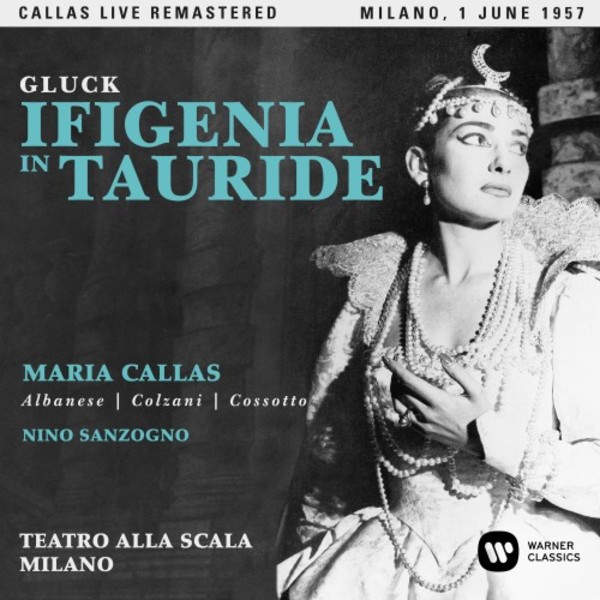
Callas in Ifigenia in Tauride – La Scala 1957

s1502891846_9029584454

After the spectacular success of Anna Bolena, Callas and Visconti plunged straight into rehearsals for her next new production at La Scala, that of Ifigenia in Tauride, an Italian translation of Gluck’s French opera. Though they didn’t know it at the time, this was the last time they were to work together, and they never really agreed about the production at all. Visconti wanted the opera to look like a Tiepolo fresco brought to life, but Callas just couldn’t understand the concept. She would ask him why he was doing it like that, averring that it was a Greek story, that she was a Greek woman and that she wanted to look Greek on stage. Whether she liked the concept or not, there is no doubt she looked magnificent in the costumes designed for her, but the production was at best a succès d’estime and was never seen again after the four performances given that season.

Visconti was to have worked with her on her return to La Scala in Poliuto in 1960, but, shortly before rehearsals began, a play he had staged (L’Aroldo) was censured by the government, and he withdrew in protest, refusing to work in any state-supported theatre. After that he would occasionally suggest projects, but she would always find reasons not to do them. She couldn’t dance like a gypsy for Carmen, she didn’t want to disrobe as Salome, or she didn’t feel sufficiently Viennese for the Marschallin, though, to be honest, I can’t really imagine Callas in Strauss.

As a whole, the La Scala performance of Ifigenia is somewhat lacklustre, which might explain why it was never revived. Sanzogno conducts in respectful, soupy, lugubrious fashion (you only have to listen to conductors like Gardiner and Minkowski to hear how much more vital the music can be), and the supporting cast, save for Cossotto’s Diana, makes very little impression at all.

Callas, however, commands attention from her very first utterance. It’s worth quoting here Visconti’s recollection of the impression she made at her first entrance.

Maria did exactly what I asked. As the curtains lifted, a storm was raging and she had to pace frantically across the stage. She wore a majestic gown with many folds of rich silk brocade and an enormous train, over which she had a large cloak of deep red. Her hair was crowned with huge pearls, and loops of pearls hung from her neck, encompassing her bosom. At a certain moment she ascended a high stair, then raced down the steep steps, her cloak flying wildly in the wind. Every night she hit her high note on the eighth step, so extraordinarily coordinated was her music and movement. She was like a circus horse, conditioned to pull off any theatrical stunt she was taught. Whatever Maria may have thought of our Ifigenia, in my opinion it was the most beautiful production we did together. After this I staged many operas without her – in Spoleto, London, Rome Vienna. But what I did with Maria was always something apart, existing unto itself, created for her alone.

She is in fine voice for this performance, riding the orchestra in that first entrance with power to spare, infinitely expressive in the more reflective moments, like Oh, sventurata Ifigenia. Later in the opera, when she recognises her brother, she somehow manages to impart four simultaneous emotions to the single word fratello; sister-love, sadness at their being parted so long, happiness to have found him and fear for his imminent, sacrificial death. Neither Montague on the Gardiner studio version, nor Delunsch in the Minlowski comes within a mile of her range and specificity of expression.

The sound on this Warner version is similar to the EMI I owned before, Act I enjoying rather better sound than Act II.

Maybe not an essential set, but Callas once again demonstrates her proficiency in Gluck even in less than ideal circumstances. One can only imagine how her performance would have been transformed with some of today’s conductors at the helm, and with a supporting cast more attuned to the needs of the composer.