Callas’s 1964 studio Tosca

91idlbhid5l-_sl1500_

Recored July 1964 and January 1965, Salle Wagram, Paris.

Producer: Michel Glotz, Balance Engineer: Paul Vavaseur


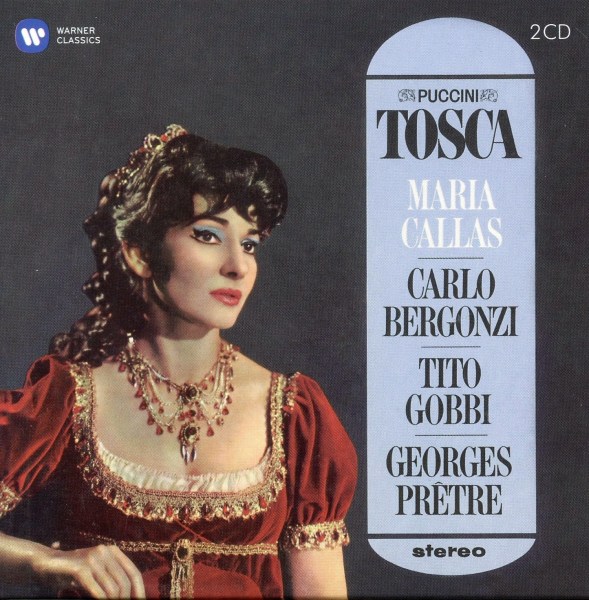
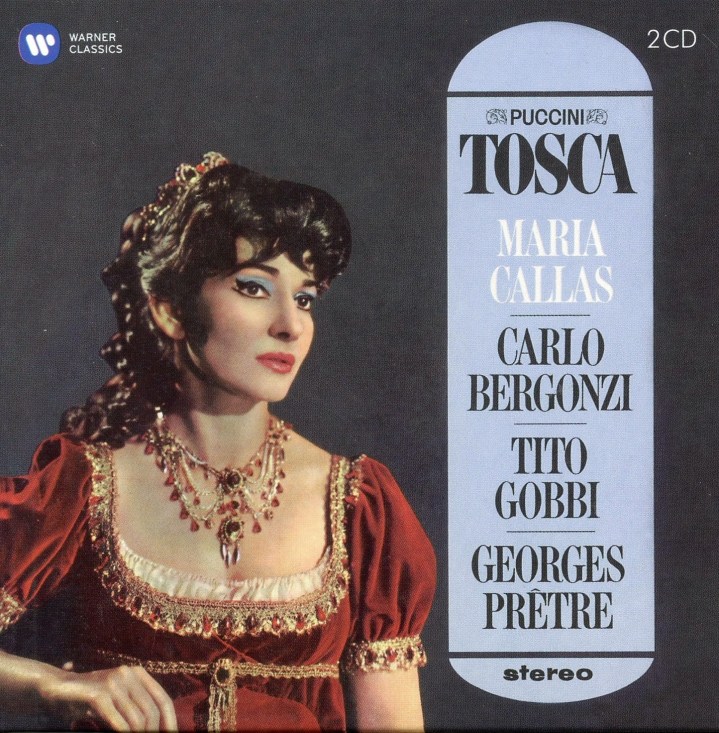
I hadn’t heard this set in maybe 20 years. It was actually one of the first complete opera sets I owned, the renowned 1953 De Sabata recording being unavailable when I first started collecting in the late 1960s. According to Zeffirelli, the recording was originally intended to be the soundtrack of a film, a project that unfortunately fell through, but, in any case, EMI obviously wanted to cash in on the success of Callas and Gobbi’s performances together in 1964 and 1965 in London, Paris and New York. Considering how closely they are associated with their respective roles, it is a surprise to find that before the Zeffirelli production at Covent Garden, they had only once before played opposite each other in the opera, and then only in a performance of Act II at a Paris Opera Gala, and yet they cast their shadows over the opera as no others do.

Let’s first get the caveats out of the way. Pretre doesn’t have De Sabata’s grip on the score, but he has his moments, and the torture scene is particularly thrilling; Callas’s voice is considerably trimmed down from the first recording and some of the top Cs are closer to screams than actual notes, though, in this new pressing, they don’t seem anywhere near as bad as I remember them; Gobbi too has lost some of his vocal sheen, but is as authoritative as ever.

However, we should remember that this recording was made at about the same time as Callas and Gobbi were appearing on stage. Even without seeing them, you sense their deep rapport. The producer John Copley was Zeffirelli’s assistant on the Covent Garden production, and he once told me that rehearsing with Callas and Gobbi was not like rehearsing with opera singers at all. Zeffirelli would let them run a whole scene, improvising their moves as you would with actors. They would then sit down and discuss what had worked, what hadn’t and go back over the scene incorporating any new ideas that came up. In all his career, he said, he has never come across such complete actor-singers. This ability to play off each other comes across in all their scenes on disc.

I do miss Callas’s ability to soar and swell the tone at a line such as Egli vedi ch’io piango, but their are compensations. When she cries Non posso piu in Act II, this is literally the sound of a woman at the end of her tether, and her chest tones in son io che cosi torturata rend the heart. In the last act, her recounting of the murder lacks the power of the De Sabata, though she manages Io quella lama gli piantai nel cor better than expected with an exciting plunge into chest voice. Here too the top C sounds better than I remember; I assume this must be something to do with the improved sound picture. Her Tosca on this set is more feminine, more vulnerable, if you like, with dozens of lovely touches in the love duets, if not the ability to ride the orchestra that she had in the first recording.

Gobbi still sounds superb. I doubt I will ever hear another Scarpia to rival him. His Scarpia is a gentleman and a thug and more interesting because of that. A man of impeccable manners, who never gets his hands dirty, making sure he has minions to do his dirty work for him. His performance, too is full of detail. From the unconcerned way he sings La povera mia cena fu interrotta, cruelly feigning surprise at Tosca’s distress, to the ironic tone he adopts at violenza non ti faro, this is a man completely in control.

Cavaradossi? Well Bergonzi sings beautifully, but I missed Di Stefano’s ardour, his winning personality, and he is in especially good voice in the De Sabata recording. Beside him Bergonzi sounds a bit anonymous.

The orchestra play well for Pretre, but they are not the equal of the La Scala players, and of course this set will never replace the classic De Sabata Tosca, which is considered one of the classic opera recordings of all time. This one isn’t entirely without merit, though, and Callas completists will definitely want to have it in their collection.

Callas sings Verdi Arias III

91sppqa2pml-_sl1500_

There never actually was a Verdi Arias Vol III, though one had been planned. Warner here use the cover of an album issued in 1972, of material which had been sitting around in the vaults, and which Callas eventually agreed to have issued. The original album coupled  the Act I Scena from Il Pirata (now on Rarities) with Amelia’s Act Il Scena from Un Ballo in Maschera, O madre dal cielo from I Lombardi, Arrigo, ah parli a un core from I Vespri Siciliani, Liberamente or piangi from Attila and Aida’s Ritorna vincitor. The Il Corsaro arias, Amelia’s Morro, ma prima in grazia and Leonora’s Tacea la notte placida appeared on a later album called The Legend, coupled to some unissued 1955 arias from La Sonnambula, none of which were cleared for release by Callas.

That 1972 album was actually one of the first Callas LPs I owned. It seems unbelievable now, but in the early 1970s, most of Callas’s back catalogue had been deleted by EMI, who presumably thought that the advent of stereo rendered it obsolete. At that time I had only heard a few of her recordings and I remember sampling a couple of arias from this disc in Windows, the local classical music store in Newcastle-upon-Tyne. Initially alienated by the harsh sounds I heard coming from the listening booth, I left the shop without buying the disc. However somehow those tones carried on resonating in my mind’s ear, and eventually I went back and bought the LP. It was a decision I never regretted, as I learned to listen not just to the voice itself, but what she was doing with it. It also introduced me to some Verdi I’d never heard before, namely the arias from I Lombardi, Attila and I Vespri Siciliani. I knew absolutely then that Verdi was to become one of my favourite composers.

Taking first the arias not on that original LP, we find the arias from Il Corasaro recorded in 1969, really remarkably good. Her legato line is better than both Caballe and Norman on the Philips studio recording of the opera, and she unerringly captures the mood of each aria. The Trovatore has some magical moments, but at no place challenges her superb recording with Karajan. Amelia’s Morro, ma prima in grazia is very good indeed, with a superb, firm top B leading into a perfectly shaped final cadenza.

Swings and roundabouts on the rest. The tone at the beginning of the I Lombardi aria (the first track I listened to in the record shop) is indeed somewhat uningratiating, but once past the opening statement, she is in securer form, and moulds the line beautifully. Both the Attila and I Vespri Siciilani arias go well, the legato line beautifully held, and with Rescigno conjuring up some gorgeous sounds from the orchestra for the Sospendi o rive section of the Attila aria. I’d certainly sooner hear this version than Deutekom’s pallidly voiced one on the Philips complete recording. Amelia’s grand Act II Scena is full of passion, drama and fantasy. Though the ascent to top C is hard won, she grandly phrases on and through the note, so that it does not become the focal point of the aria. Still this does not challenge her performance on the complete set of 1956, nor the superb live performance from 1957.

The one incontrovertibly great performance on the disc is Aida’s Ritorna vincitor. This was not originally planned, but sessions had been getting a bit tense and Callas and the orchestra took a break. During the break Michel Glotz, the recording producer played a performance of Crespin singing the aria, which had been recorded the previous day. Callas was incensed, finding the performance completely antithetical to her sensibilities, lugubrious and slow. “I could hardly get the words out, when I did this with Maestro Serafin.” On learning that the parts were still there, she said, “Come on, Nicola, let’s do it!” and this is what they did – in one take! As always Callas loved a challenge, and this was as if someone had laid down the gauntlet. Somehow she recovers much of her old security, and the aria is brim full of drama and passion. Just listen to the anguish she pours out in Ah! non fu in terra mai da più crudeli angosce un core affranto, the desperation of Ah, sventurata che dissi?, with the final plea to the Gods heart wrenchingly poignant. This is Callas at her best.

New Year, New Blog

Well it’s a new year and I’ve decided it’s time I got some of my jumbled thoughts and ideas down on paper, or rather on line.

Don’t worry, it won’t be too personal. I’m not really prone to public navel gazing, or outpourings of personal angst, which isn’t to say I don’t have my own problems to deal with. I just don’t think the internet is the best place to air them.

So this blog is probably going to be more about music, theatre, movies, places I’ve visited, and (hard to avoid) politics. Well, one has to admit that the world we are living in isn’t quite the one I thought I lived in a few years ago. According to Adam Curtis in his brilliant film Hypernormalisation, we are living in a post-truth world. We know it’s not real, but we accept it as normal. How else can one explain Trump, and Brexit? Liberal is now a dirty word, intellectuals are derided and experts ignored. Anything that departs from the norm is suspect, and creativity, in so many walks of life, at an all time low. If it doesn’t make money it’s worthless, seems to be the message of the present generation.

However to begin with, I’m going to be indulging my passion for opera and, in particular, Maria Callas, with a group of reviews of all her studio recordings, which I will publish one by one over the next few weeks. A few of you may find them interesting, those who don’t know anything of Callas may choose to investigate, or not. I don’t expect everyone to have the same passions as me, so I will have to ask a little forbearance.

Happy New Year.