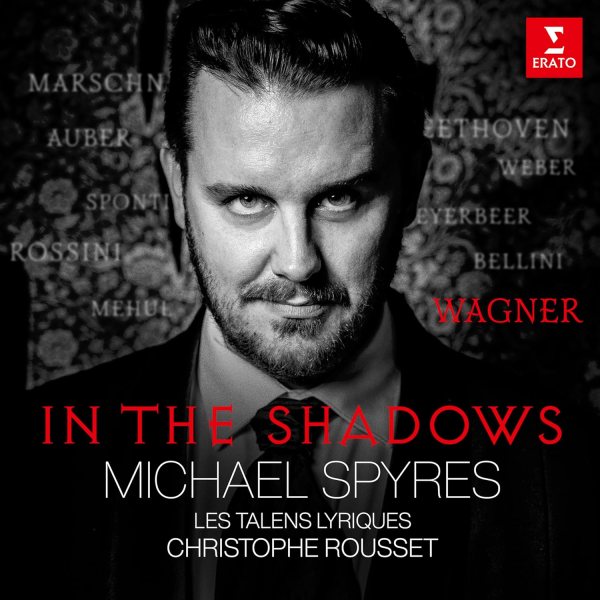

This is a luxury recital indeed. Over 84 minutes, we are presented with twelve operatic scenes, performed complete with chorus when required and another soloist (in the shape of tenor Julien Henric) who plays Flavio in the scene for Pollione from Norma. Furthermore, we are vouchsafed sung texts and translations into English, French and German, which is important as many of the scenes are not exactly familiar. Clearly all concerned have taken their task seriously.
In the accompanying notes, Spyres talks of his journey towards Wagner and states that the album “endeavours to illuminate the composers who languish in Wagner’s shadow: those who formed the foundation of the compositional aesthetic and sculpted the framework of vocal writing that would become the Wagnerian tenor.”
Thus, we start with Joseph Méhul (1763-1817) and work our way forward roughly chronologically via Beethoven, Rossini, Meyerbeer, Weber, Spontini, Bellini and Marschner to Wagner himself in the shape of arias from his early Die Feen and Rienzi, finishing up with Lohengrin. Of the arias chosen, only those from Fidelio, Norma and Lohengrin could be called in any way familiar, so the recital is certainly valuable for introducing us to some little heard music.
The disc has been reviewed in these pages by Göran Forsling (review) and was even a recording of the month back in April, and I largely agree with that review with one or two caveats.
I actually heard Spyres live at a Prom in 2017, in a performance of Berlioz’s La damnation de Faust with the Orchestrre Révolutionnaire et Romantique under Sir John Eliot Gardiner and, whilst impressed with his interpretation and musicality, I didn’t think the voice was particularly large. Now of course this was seven years ago, and there is a good chance that the voice has grown since then, but I’m not so taken with his singing in those roles that require a bit more dramatic thrust, like Florestan and Pollione. I hear a somewhat artificial darkening of the timbre, which results in a rather throaty sound. He sounds as if he is forcing his lyrical voice, and his tone lacks squillo. Comparisons with Vickers in the former and Corelli in the latter find Vickers singing with a deal more intensity and Corelli, whom I had just recently been listening to in the second Callas recording, much freer on top.
When we get to Wagner himself, Mein Lieber Schwann from Lohengrin is sensitively sung, but there is no ring to his tone when he opens out in the more dramatic parts. GF makes comparison with Gedda, who sang Lohengrin a couple of times in his native Sweden. Ultimately Gedda thought it an unsuccessful experiment, and he never sang the role again, evidently thinking the role too heavy for his essentially lyrical voice. However, as can be heard in his recording of the aria, Gedda’s tone had a good deal more squillo. That said, I heard Gedda live in the Verdi Requiem towards the end of his career and his voice had a great deal more cutting power than Spyres.
With his three albums, Batitenor, Contra-Tenor and now In The Shadows, Spyres is showcasing his versatility, but I just wonder how much of that versatility is a product of the gramophone. Given the encomiums he has been receiving of late, I hate to be the one dissenting opinion, but I do wonder if his voice is being forced into places it shouldn’t necessarily go.
Contents
Etienne-Nicolas Méhul (1763 -1817)
1. Joseph en Égypte, « Vainement Pharaon… Champs paternels
Ludwig van Beethoven (1770 – 1827)
2. Fidelio, « Gott! Welch Dunkel hier!… In des Lebens
Gioacchino Rossini (1792 – 1868)
3. Elisabetta, regina d’Inghilterra, « Della cieca fortuna… Sposa amata… Saziati, o sorte ingrata ?
Giacomo Meyerbeer (1791 – 1864)
4. Il crociato in Egitto – « Suona funerea
Carl Maria von Weber (1786 – 1824)
5. Der Freischütz – « Nein, Länger Trag Ich Nicht
Daniel François Esprit Auber (1782 -1871)
6. La muette de Portici- « Spectacle affreux …
Gaspare Spontini (1774 – 1851)
7. Agnes von Hohenstaufen, « Der Strom wälzt ruhig seine dunklen Wogen
Vincenzo Bellini (1801 – 1835)
8. Norma – « Meco all’altar di Venere…Me protegge, me difende (with Julien Henric (tenor))
Heinrich Marschner 1795 – 1861)
9. Hans Heiling op. 80 – “Gonne mir ein wort der Liebe”
Richard Wagner (1813 – 1883)
10. Die Feen WWV 32 – « Wo find ich dich, wo wird mir Trost?
Richard Wagner
11. Rienzi, der letzte der Tribunen WWV 49, « Allmächt’ger Vater, blick herab
Richard Wagner
12. Lohengrin WWV 75, « Mein lieber Schwan

 Philip's Assortment Box