Joyce DiDonato – Stella di Napoli


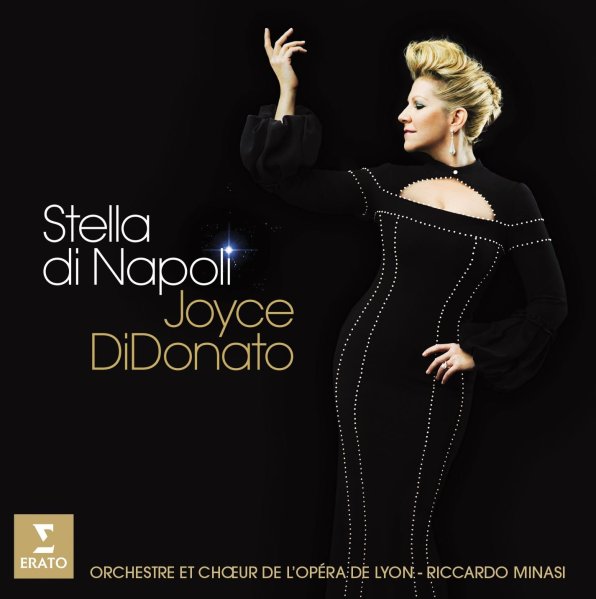
Joyce DiDonato gives us here a collection of largely little known bel canto arias, some by composers such as Pacini, Mercadante, Valentini and Carafa who are hardly household names. It doesn’t get off to the best of starts as the heroine of Pacini’s Stella di Napoli sings a jolly little ditty, in which the heroine berates her lover for not being there to hear her dying breath. It is the sort of aria that gives bel canto opera a bad name and is exactly the thing Gilbert and Sullivan took such delight in parodying.

Happily we are on much stronger ground with the next item, a lovely elegiac piece from Bellini’s Adelson e Salvini, and thereafter things greatly improve, though it is safe to say the best items are those by the more well-known triumvirate of Rossini, Donizetti and Bellini, even if the final item, a fourteen minute excerpt from Pacini’s Saffo does much to exonerate him.

DiDonato’s singing is supremly accomplished with a mastery of coloratura, scales, trills and legato which is second to none. Added to her technical accomplishments, she has a wonderful grasp of the dramatic situations presented and there is no doubt that she is pre-eminent in the field today. If I were nit-picking, I would say that her singing doesn’t quite have the sheer personality of some of her predecessors in this music, and the preghiera from Maria Stuarda doesn’t quite erase memories of Montserrat Caballé or Janet Baker in the same piece. But, that would be unfair and we should be grateful for what we have, which is a great deal; a singer at the height of her powers with a beautiful voice, technically proficient, put at the service of the music.

She is excellently supported by the Orchestre ey Choer de l’Opéra de Lyon under Riccardo Minasi and the disc comes with notes, texts and translations, though a little more information about the dramatic situations would have been welcome. Warmly recommended.

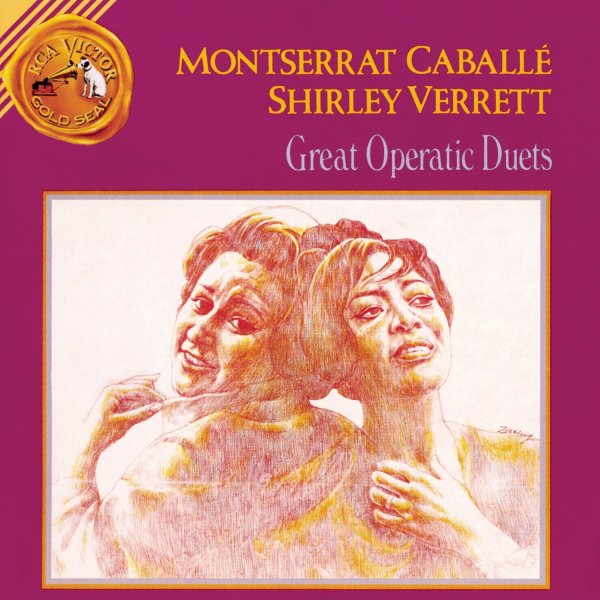
Montserrat Caballé & Shirley Verrett sing Great Operatic Duets

81uwtitniql._sl1500_

Duets from Semiramide (Rossini), Anna Bolena (Donizetti), Norma (Bellini), Les Contes d’Hoffmann (Offenbach), Aida (Verdi), Madama Butterfly (Puccini) and La Gioconda (Ponchielli).

The 1960s and 1970s were halcyon days for opera on disc. New recordings of both repertoire and rediscovered works appeared on an almost monthly basis, alongside recital records by major artists. Duet recitals, though not as frequent, were also a feature of this time, and could sometimes provide more variety in the juxtaposition of two different voices.

This 1969 duet recital finds both singers at the height of their vocal powers and provides a feast of great singing. It doesn’t quite get off to the best of starts however, with a performance of Serbami ognor from Rossini’s Semiramide in which Caballé’s scale passages are less than perfect, and which does not erase memories of Sutherland and Horne in the same music.

Vocally the duet from Anna Bolena is much better, and Caballé is here very touching in the section beginning Va, infelice where Anna forgives Giovanna; maybe not as moving as Callas with Simionato, but then, who is? Their voices blend well in the Norma duet too, and it is good to have the duet from Aida as Verrett never got to record Amneris in a complete recording, but, again neither duet is as thrilling as you’d want.

The principal pleasures of both the Barcarolle from Les Contes d’Hoffmann and the Flower Duet from Madama Butterfly are primarily vocal, and it is certainly wonderful to bask in the sheer beauty of two such gloriously rich voices in full bloom. The disc finishes with the great combative duet from La Gioconda, but yet again it’s a little underpowered and not a patch on Caballé’s recording of it with Baltsa in the complete set under Bartoletti.

This is a good memento of two singers, recorded before Caballé’s top notes started to harden and before she began to overindulge her penchant for floated pianissimi. This is also, to my mind, the best period for Verrett, when she was definitely a mezzo and before the move to soprano roles started to compromise the glorious individuality of that voice. A shame that it’s all a bit low key.

Edit: 24/03/2023

I listened to this duet recital again today and found it just a little dull. The voices are both beautiful, the singing itself accomplished, but somehow nothing really takes off and the emotional temperature is a bit tepid throughout. It got me wondering how much difference a conductor can make. Guadagno, a favourite of Caballé’s, is serviceable, no more. If you compare, say, the duet from Aida with the same duet from the Muti complete recording, where Caballé sings with Cossotto, it is to find that she is much more alive to the drama, much more emtotionally committed, and if you compare the conductng in the Anna Bolena duet to that of Gavazzeni for Callas and Simionato, to Serafin in the Norma, or even Bonynge in Semiramide, it is to find Guadagno rather lacklusre and faccid. He does best in the Barcarolle, where all he has to do is set a nicely flowing tempo and let the two gorgeous voices do their work. Even Verrett, who is usually an exciting and dramatically involved singer seems to be operating at a much lower voltage than usual. I am convinced this disc would have been a lot more satisfactory with a stronger hand at the helm.

Joan Sutherland – Grandi Voci

51sshvna3-l

On 17 February 1959, Joan Sutherland sang her first Lucia di Lammermoor at Covent Garden. She had first been engaged at Covent Garden in 1952, singing small parts, such as Clotilde to Callas’s Norma. That same year she sang her first leading role there (Amelia in Un Ballo in Maschera), but the administration didn’t at first realise her potential and the roles she sang (Agathe, The Countess, Desdemona, Gilda, Eva, Pamina, Lady Rich in Gloriana and Jennifer in Tippett’s The Midsummer Marriage) gave no real indication of the direction her career would take. She herself had thought she would be a Wagnerian soprano, but Richard Bonynge, who married her in 1954, eventually convinced her otherwise, and in 1959 Covent Garden gave her the honour of a new production of Lucia di Lammermoor, directed by Franco Zeffirelli and conducted by Tullio Serafin. Sutherland proved a sensation, and, at the age of 35, she became a star, in demand all over the world for dramatic coloratura roles.

This disc adds to her debut recital, made shortly after the Covent Garden Lucia, two arias from one of her most successful sets The Art of the Prima Donna (Casta diva and the I Puritani Mad Scene), recorded in 1960 and Santo di patria, lifted from another set The Age of Bel Canto, recorded in 1963.

Those who know me will know I am not much of a Sutherland fan. The mannerisms (the mushy diction especially, the droopy portamenti, the weak lower register) that crept in as early as the 1960s irritate me so much I find it hard to listen, and the beauty of the voice is no compensation.

It is good to be reminded, then, that it was not always so, and she sounds quite different here, the voice much more forwardly produced, and, even if she rarely uses the words to suddenly bring a phrase into sharp relief, there is nothing much wrong with her diction in these discs. Maybe this has something to do with the conductors she was working with then, all Italians, Nello Santi for the debut recital, Francesco Molinari-Pradelli for The Art of the Prima Donna, Tullio Serafin at Covent Garden. Interestingly Serafin advised her to study the role of Lady Macbeth, but Bonynge obviously thought otherwise.

The main meat of the disc, however, is that first ever recital made with the Paris Conservatoire Orchestra under Nello Santi. Lucia’s two big solos were an obvious choice, to which are added Merce, dilette amiche from Verdi’s I Vespri Siciliani, Ernani! Ernani involami from Ernani and O luce di quest’anima from Donizetti’s Linda di Chamounix.

Throughout the technical command is stunning, as is the beauty of voice, the top notes, of which there are many, one of its greatest glories. Nor is she just a technical machine. Though there is little attempt at vocal characterisation (Norma doesn’t sound much different from Lucia), she is not an unfeeling singer. There is command in Norma’s Sediziose voce, poetic feeling in the recitative to the Ernani aria, breezy grace in the aria from I Vespri Siciliani.

Fresh from the success of the Covent Garden performances, the Lucia arias are predictably best of all. Here not only is the execution vocally stunning, but she is the very epitome of the young Romantic heroine, driven mad by despair. Like Callas, she is a far cry from the piping, doll-like sopranos who had made Lucia something of a laughing stock among opera cognoscenti. Unfortunately already by her first complete recording of the opera made in 1961, the tone has become more occluded, the diction less precise, the vowels begin to be rounded and dulled, and the vitality and immediacy heard here starts to droop.

Though vital and alive in the scene from Verdi’s Attila, conducted by Richard Bonynge, the diction is not as clear as it is on that frst recital, though the recording here does give some indication as to the size and fullness of the voice. Even with that small niggle about the diction, this is still a stunning performance, thrilliingly dramatic, and I’ve never heard it better sung. Deutekom on the Philips complete set is pallid by comparison.

This disc, along with The Art of the Prima Donna, is, I would suggest, essential Sutherland, and remain permanent parts of my collection. The rest, personally, I can live without.

Montserrat Caballé sings Bellini and Donizetti

The lion’s share of this CD is a reissue of what, I believe, was Caballé’s first recital disc for RCA, recorded in 1965 when the voice was at its freshest, and at around the same time as her sensational international debut in Lucrezia Borgia at Carnegie Hall, when she was a last minute replacement for Marilyn Horne. Up until then her repertoire had focused on Mozart and Strauss, plus Massenet’s Manon, and in fact she made her Glyndeboure debut later the same year as the Marschallin. However it was as a bel canto specialist that she would eventually become known, and she was one of the sopranos (along with Sutherland and Sills) who spearheaded the bel canto revival, set in motion by the legendary La Scala Visconti production of Anna Bolena with Callas.

The voice itself was rich and velvety, even throughout its range, her breath control exemplary, with the ability to float the most incredible pianissimi, an effect she perhaps overused in later years. There were a few chinks in her armour, especially for a bel canto specialiste; her trills were somewhat ill defined, and though the voice had flexibility and negotiated florid music well, there was the occasional hint of an aspirate, never encountered in the singing of Callas or Sutherland.

The tendency to aspirate, noticeable in the very first phrase of Casta diva, mars the beauty of the performance and the aria is not as mesmerising as it can be, despite the gorgeous sound. But this is nit picking and hers is still one of the most ravishing performances of the piece you will hear. Better I think is the Mad Scene from Il Pirata, which is sung with deep feeling and a true appreciation of the dramatic situation. The cabaletta does not have the lacerating effect of Callas in the same music, but works well within Caballé’s gentler conception.

All three Donizetti roles which follow became Caballé staples in the next few years, and she fulfils all their demands for vocal gandeur and personality. Always evident is the sincerity of her art, but she is not one of the world’s character actors. It has to be admitted that all these Donizetti and Bellini heroines sound much the same, the characters pretty interchangeable. Does that matter? Well I suppose that depends on one’s personal preferences, and mine are well known. That said, I am grateful for what she has, and Caballé is certainly not unfeeling, in fact often most affecting. Where Sutherland’s dazzling performances often leave me cold, I find Caballé’s dramatic commitment, albeit rather generalised, satisfies me more. We would be privileged to hear singing of such beauty and accomplishment now.

RCA have here added a Mira o Norma recorded in 1972 (I assume this is from the complete set with Fiorenza Cossotto, though she is not credited) and the first part of the closing scene from Anna Bolena, recorded in a somewhat boomy acoustic in 1970. Already there is just a very occasional hint of the hardness that would later affict her loud high notes and result in the over-exploitation of those floated high pianissimi, but there is still much that is very beautiful. Befittingly, the disc ends with the quite close to the cavatina from Anna Bolena, the final phrase spun out and floated through the air on a pure thread of glorious sound. It is for moments such as these that the art of Montserrat Caballé will most be remembered.

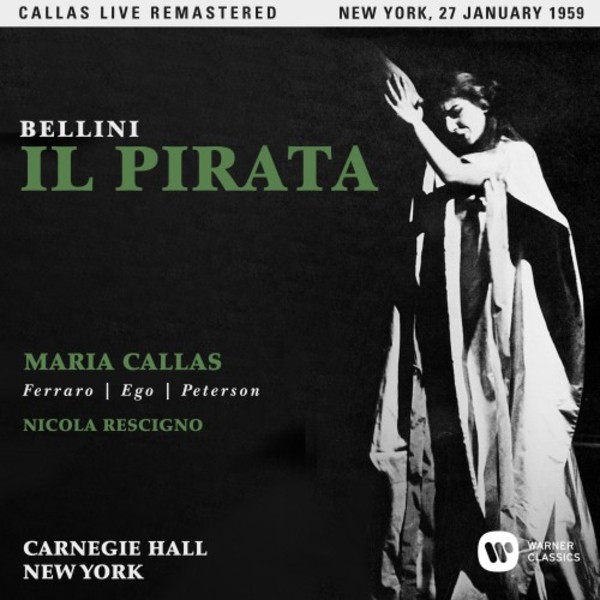
Callas in Il Pirata – Carnegie Hall 1959

1502882448_9029584466

Callas first sang the role of Imogene in Il Pirata in May 1958 at La Scala, Milan, her last appearance there until she returned to the house for Poliuto, the opening opera of the 1960 to 1961 season. It was not a particular happy time for her. Ghiringhelli, the intendant of La Scala, had been increasingly cold to her since the Rome walk out on January 2nd earlier that year. Relations had already cooled after her appearance in La Sonnambula in Edinburgh, after Ghiringhelli announced an extra performance without first getting Callas’s agreement. Ghiringhelli was playing a dangerous game, as he did not tell the Edinburgh Festival management that Callas was only contracted for four performances and let them sell a fifth using her name, presumably thinking that, once it had gone on sale, Callas would cave in and agree to the extra performance. Already unwell, and having fulfilled her contractual duties, she refused to sing the extra performance and left Edinburgh for warmer climes, a much needed rest, and, unwisely as it turned out, a party given by Elsa Maxwell in her honour. The press were merciless, painting Callas as the capricious prima donna, who had cancelled a performance in order to go to a party.

Though she had redeemed herself in the eyes of the La Scala audience the previous month  in a revival of Visconti’s production of Anna Bolena, Ghiringhelli did nothing to squelch rumours that Il Pirata would mark Callas’s last appearance at La Scala, and Callas seized a moment to point out the reason for her departure at her last performance. The word palco in Italian has a dual meaning. In the opera it means scaffold, but it also means theatre box, and when Callas came to sing La! Vedete! Il palco funesto! she strode to the front of the stage and gestured towards Ghiringhelli’s box in the theatre. Her meaning was not lost on the audience and it went wild, but Ghiringhelli had the last word, demanding that the fire curtain be lowered before Callas had been able to accept the ovations raining down on her.

It is a huge cause for regret that none of the La Scala performances appear to have been recorded, for there she was singing with first class support in Franco Corelli and Ettore Bastianini. Pier Miranda Ferraro, who sings Enzo on her second recording of La Gioconda, and Constantin Ego are not in the same class. Callas herself is in variable form, top notes occasionally afflicted with hardness and unsteadiness, but she is still a great Bellinian stylist, and the way she caresses and moulds the phrases shows up the provincial attempts of her colleagues. In the absence of a La Scala recording, we are fortunate that this concert performance was recorded.

There was an enormous amount of excitement attending her arrival in New York, fans having been deprived of seeing her at the Met after Rudolf Bing sacked her for not agreeing to the performance schedule he set out. Callas’s relationship with the Met had always been a tense one, but Bing’s boorish unwillingness to understand that a voice cannot switch to and fro between roles as differing in their vocal demands as Lady Macbeth and Violetta would suggest that the fault lay with his intransigence. His only concession was to offer a substitution of Lucia di Lammermoor for La Traviata, a role even further away from the demands of Lady Macbeth.

Understandably then, a certain amount of tension marks out her singing in her opening scene. Nevertheless, she stamps a Norma-like authority on her first recitative, and the whole scene, which she later recorded in the studio with Antonio Tonini, is a perfect example of how to express conflicting emotions, of carefully differentiating between public and private utterances. However she doesn’t really relax and get into her stride until the first duet with Gualtiero. Throughout this duet she gives a masterclass, unfortunately unheeded by Ferraro,  in how to shape and mould phrases, ensuring that the arc of the melody remains paramount.

Worth noting in the Act I finale is a dazzling four bars of rapid scales, which Callas executes with incredible virtuosity. Rescigno recalls that at the rehearsal, she muffed the scales at the fast speed with which he launched the stretta. He told her he would put the breaks on before her entry, but Callas responded,

“No, don’t do that, I like the tempo very much; it is valid and I don’t want you to help me.” “Well,” I said, “what if you don’t make it in the performance?” “That’s my business, not yours,” she countered. However out of her fantastic will came this superb, astonishing thing at the performance, all in order.”

In the second act duets she achieves marvels of elegance and grace, given the inadequacy of both Ego and Ferraro, neither of whom are in the least bit comfortable with any rapid passagework, and both of whom alter the vocal line to accommodate their weaknesses.

However it is when left alone in the final scene, a scene which she programmed regularly into her concert programmes, that she makes the greatest effect. Apparently at the performance, all the lights were lowered leaving just a spot on Callas. According to Louis Biancolli,

“An eerie glow fell on her face. At this ghostly juncture Miss Callas made the most of her strange and haunting timbres. It was something to be left in the dark with the voice of Maria Meneghini Callas.”

As ever the recitative is a lesson in how to weight and measure phrases, and the cavatina benefits from her deep legato, the filigree drawn out to heavenly lengths, but Rescigno takes it at a slightly faster tempo than both the studio recording of the previous year, and concerts later that year in Hamburg and Amsterdam, where she spins out the phrases to even greater length. The cabaletta too is more propulsive, but this only adds to the excitement, and the audience go wild at its close. As reported in the New York Times

Hundreds debouched down the aisles to the footlights. They applauded and yelled and screamed “Bravo Maria!” Miss Callas returned again and again for curtain calls. Finally a man came out and turned off the lights, and the worshippers departed.

Away from all the attendant excitement, the listener will no doubt realise that the performance, as a whole, is a little lacking in polish, but Callas’s greatness remains, regardless of the fact that she is not in her best voice. I may regret the absence of a recording of the La Scala production, but, as the only example of Callas’s Imogene, this recording is definitely worth having. None of the commercial recordings of the opera quite matches its fire and excitement.

The sound on this Warner issue is a good deal better than that of the old EMI issue, which would suggest that it comes from a different source.


The Callas Bernstein La Sonnambula – La Scala 1955

1502883093_9029584465

Having got Andrea Chenier out of the way, and after singing four performances of Medea in Rome, Callas started work on what might have seemed a surprising role for her, that of the sweet ingénue Amina in La Sonnambula; surprising, that is, until one recalls that Bellini wrote the opera for the very same singer who created Norma, Giuditta Pasta. Bellini’s favourite Amina was evidently Maria Malibran, who was also a great Norma, but where Norma had become the property of large voiced, dramatic sopranos, who often couldn’t cope with the florid demands of the role, Amina had gone to light voiced, bird-like soubrettes, who rarely brought any depth to the character. Like Donizetti’s Lucia di LammemoorLa Sonnambula had become a vehicle for vocal display, nothing else, though this is clearly not what Bellini or his librettist, Romani, had in mind.

According to Romani,

The role of Amina, even though at first glance it may seem very easy to interpret, is perhaps more difficult than many others which are deemed more important. It requires an actress who is playful, ingenuous and innocent, and at the same time passionate, sensitive and amorous; who has a cry for joy and also a cry for sorrow, an accent for reproach and another for entreaty… This was the role created by Bellini’s intellect.

Used to the doll-like pipings of so many light voiced sopranos, Callas’s performances no doubt came as a revelation. She performed the role 22 times, always in the same La Scala Visconti production, which was revived in 1957, the same year she made her commercial recording of the opera, and travelled to Cologne and Edinburgh that same year too, though, by that time, Votto had replaced Bernstein as conductor and Nicola Monti had taken over from Cesare Valletti. Live recordings exist of both Cologne and Edinburgh, and my personal favourite has always been Cologne, where Callas, with slightly more limited resources, sings a more poetic, a gentler Amina; a portrait in pastels rather than oil.

However, I would never want to be without this thrilling La Scala recording, and to appreciate it fully, maybe a little background on the production would be helpful. Visconti, with his designer Piero Tosi, had sought to create a picture-book, dreamlike depiction of a nineteenth century village that never existed, the villagers dressed like ladies and gentlemen, the women in shades of pink, pearl and grey, and the men in black and white. Visconti’s vision of Amina was no village girl, but the evocation of a bejewelled nineteenth-century prima donna performing the role. She was costumed to look like the nineteenth century ballerina Maria Taglioni, and PIero Tosi recalls that when she made her entrance in the first sleepwalking scene, the impression she created was of “a sylphide tripping on the moonlight.”

Though one can see what Visconti was driving at, Callas’s genius ensures that at no point does she seem to be performing the role, so completely does she inhabit the character of sweet, trusting Amina, but it does explain some of the intricate variations Bernstein created for her, flung out to the Milanese audience with insouciant ease. Later performances under Votto would find some of the vocal display trimmed away. Bernstein also opens up some of the cuts reinstated by Votto, possibly because he had a tenor, Cesare Valletti, more capable of singing the music. Valletti is, in every way, far superior to Nicola Monti, who appears on the commercial recording and in the Cologne and Edinburgh performances.

Visconti undoubtedly built the production around Callas dramatically, just as Bernstein does musically. A trifle impatient with the choruses, he is wonderfully expansive in Amina’s solos, giving Callas time to shape and mould the phrases, their musical rapport absolutely as one.

From her first entry, Callas’s voice has a pearly softness, Come per me sereno exuding an inner happiness and fullness of heart that is at the core of her conception of Amina. For the cabaletta, Bernstein has given her some supremely ambitious embellishments, which she executes with staggering ease and agility, and the audience unsurprisingly give her a rousing reception.

But, as always with Callas, it is not just in the big set pieces that she excels. She is as inclined to make her mark in a word or line of recitative. I am thinking here of the way she imbues the words Il cor soltanto, when the Notary asks what she is bringing as dowry, with such love and trust and warmth. One should also note that Valletti is a worthy and distinguished partner, and, though he eschews some of the high notes written for the great Rubini, he proves himself to have been the perfect choice for the role. He makes a wonderfully sympathetic partner for Callas in the duet that ends the scene. A simple soul, his duping by the scheming Lisa becomes entirely believable,

Note also how Callas adopts a more veiled tone for the scenes in which she is sleepwalking, her confusion and terror when she wakes in the count’s bedroom palpably real. When Elvino rejects her, the pain she evinces is almost unbearable, her moulding of the phrases which launch the great ensemble, D’un pensiero e d’un accento couched in a legato which is meltingly poignant. In the allegro that follows, she lets out her full voice for the first time, as Amina’s desperation mounts, and caps the act with a ringing Eb in alt.

She has little to do in the opening scene of the last act, which belongs principally to the tenor, but she does much with what little she has, movingly concerned for Elvino even in the depths of her own pain.

It is in the final scene, though, where her gifts as a singing actress of the highest order are paramount. The range of colours she employs in the recitative is wide indeed, but she never destroys the dreamlike mood she has created. Certain phrases stand out in relief, like the pathos in her cry of Ah! Il mio anello and the heart-break in Questa d’un cor che more e l’ultima preghiera. The aria that follows, Ah non credea is a locus classicus of Callas’s art, couched in an almost seamless legato, its phrases spun out to prodigious lengths. The audience sit in rapt silence, totally drawn in and when, at its close, Elvino sings Ah piu non reggo, we too feel we can bear no more. This section worked well for Callas even as late as 1964 when she sang it on French TV. Elegantly coiffed and gowned though she is, and scarcely moving a muscle, she simply becomes the broken-hearted village girl Amina. This is the art that conceals art.

When Amina is awoken and the mood is broken, Callas breaks into the sparkling cabaletta, Ah non giunge with glittering abandon, executing the coloratura flourishes with coruscating brilliance. Some might feel that her singing here is too forceful, but again it is good to be reminded of what happened in Visconti’s production. He brought up all the lights, including La Scala’s huge central chandelier to full brilliance, and had Callas come down to the footlights, singing directly out into the audience, no longer Amina, but the great prima donna acknowledging her public. If there were still any doubt about the matter, this is the night that Callas was unequivocally crowned Regina della Scala.

As for the sound, I only have the old EMI version to hand for comparison, and can state that this Warner transfer is a good deal better than that. There are occasional moments of distortion and overload, but in general it is very listenable. Having listened to it again for the first time in several years, I now find it hard to chose between this one and the Cologne performance of 1957. How lucky we are to have both.
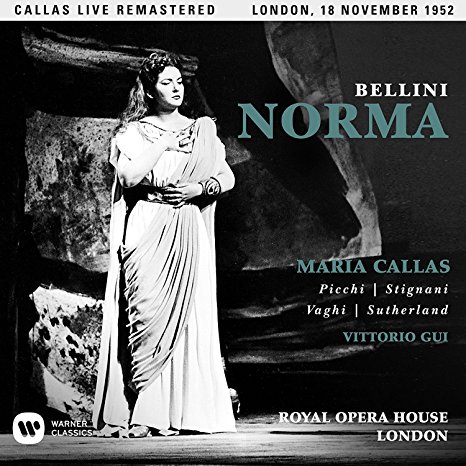
Callas sings Norma at Covent Garden 1952

81vXfqdoUFL._SX466_

This recording captures Callas’s debut before one of her most loyal audiences. She returned the following Coronation season, reprising the role of Norma and adding Aida and Leonora in Il Trovatore. She was back for Norma in 1957, then La Traviata in 1958,  Medea in 1959, and finally the legendary Zeffirelli production of Tosca in 1964 and 1965, her last ever performance on stage.

Callas sang Norma more than any other role, and is particularly associated with it and there are quite a few extant recordings of her singing it.. Aside from the studio recordings of 1954 and 1960, we have live performances from Mexico in 1950, Covent Garden in 1952, Trieste in 1953, Rome and La Scala 1955, Rome in 1958 (the infamous walk out), and also of her final performances in the role in Paris in 1965.

Though this Covent Garden performance is very good, I would have preferred it if Warner had chosen the La Scala performance of 1955 with Simionato and Del Monaco, a performance in which art and voice find their truest equilibrium, and without doubt the greatest performance of the opera I have ever heard. In its Divina incarnation it is also, apart from some radio interference during the opening of Act II, in much clearer sound than this Covent Garden performance. It is the recording  I turn to most often when I want to hear Norma.

That said, it is a long time since I heard this 1952 set, and I certainly enjoyed listening to it. The sound is not too bad, but not great, and a bit boomy in places, though the solo voices come across reasonably well. The chorus sound a bit muffled. I don’t have any other version I can compare it to though, so can’t tell you if it’s any worse or better than others.

To deal with elements other than Callas first, Vittorio Gui has an excellent grasp of the score, and has the merit of not conducting it as if it were Verdi. His tempi are, for the most part, judicially chosen, and he supports his singers admirably, though very occasionally I felt he hurried things along a little too much.  There are one or two lapses between stage and pit, but, in general, the performance is well prepared and executed.

Giacomo Vaghi is a sonorous, firm voiced Oroveso, and Mirto Picchi, who sings Giasone on Callas’s studio recording of Medea a welcome surprise as Pollione. He doesn’t have Del Monaco’s or Corelli’s heroic sound, nor their clarion top Cs, but he is a good deal more stylish than Mario Filippeschi, the Pollione of Callas’s 1954 studio recording.

The Adalgisa is Ebe Stignani, one of the most acclaimed mezzos of her age, who was much praised at the time. She has a voice that is seamless from top to bottom, firm and beautifully produced, but she was twenty years Callas’s senior, and to my ears at least, doesn’t sound in the least the giovinetta Norma refers to. We should remember that, though Adalgisa takes the lower line in the duets, the role was originally created by the soprano Giulia Grisi, who, by all accounts, had a lighter voice than Giuditta Pasta, who created the role of Norma. Also, though reasonably flexible, she doesn’t execute the florid music with quite Callas’s accuracy. In the duets (both sung down a tone) it is only when Callas sings that you can hear when Bellini separates descending scales into duplets. Stignani also ducks some of her high notes. The downward transpositions were presumably made to accommodate her, as they are not used when Simionato plays Adalgisa to Callas’s Norma. Apparently it used to annoy Callas that critics never noticed that Simionato sang them in the right keys.

Clotilde is sung by a young Joan Sutherland, and it is interesting to hear what she had to say about what it was like to appear alongside Callas in these performances.

[Hearing Callas in Norma in 1952] was a shock, a wonderful shock. You just got shivers up and down the spine. It was a bigger sound in those earlier performances, before she lost weight … It was thrilling. I don’t think that anyone who heard Callas after 1955 really heard the Callas voice.

Callas’s voice does indeed sound huge in these performances (“colossal” Sutherland referred to it elsewhere), but, maybe because of that, her Norma here is more the warrior, whereas at La Scala 1955, her singing is more subtle, with more of the woman emerging. What is remarkable is how this large voice gets round the notes, the fastest of coloratura passages holding no terrors for her whatsoever. The top of the voice is also absolutely solid and the top D that ends Act I, held ringingly and freely for several bars, is an absolute stunner.

Her Norma here is vocally stunning, her voice flashing out in anger with scalpel-like attack in the Act I finale, powerful and commanding in her public scenes with the Druids, but in 1955 at La Scala she is infinitely more moving in the private scenes and in the finale. Furthermore in 1955 her voice still had power and security at the top.

This Covent Garden performance is a great memento of her London debut, but it is still the 1955 La Scala performance I will listen to most often. The cast (Simionato, Del Monaco and Zaccaria) is just about as good as you could get at the time. Votto, who conducts, is not Gui’s equal, but he does at least understand the score and knows how to support his singers. I’d say it’s one of those rare occasions in the opera house where everything went right.


Callas’s First Recordings

51fvbzc5ijl

Recorded 8-10 September 1949, Auditorium RAI, Turin

Producer & Balance Engineer unknown

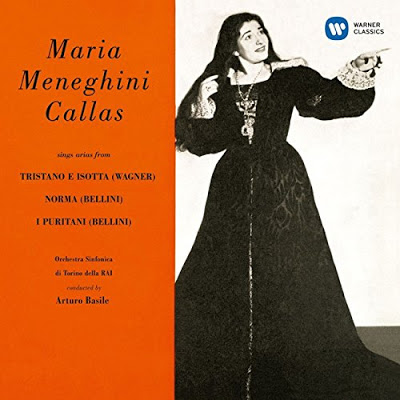
So finally I come to the end and find myself, after many hours of fantastic listening, at the beginning, Callas’s first commercial recordings and the 78s that introduced the world to the voice of Maria Callas. The recordings followed a radio concert of the same material (plus Aida’s O patria mia) and were obviously intended to showcase Callas’s versatility, a pattern which was to follow in some of her EMI recitals, like Lyric and Coloratura and the first French recital.

Callas was only 25 when these recordings were made, but they display an artistic and vocal maturity far beyond her years. She first sang the role of Isolde under Serafin in 1947 in Venice, literally sight singing the role at her audition. Serafin, who had conducted her in her Italian debut as Gioconda, was suitably impressed and hired her immediately.

The Liebestod is of course sung in Italian, but it is more than just a curiosity. This is a warm, womanly Isolde who rides the orchestra with power to spare. Note too how easily she articulates the little turns towards the end of the aria. Her legato is, as usual, impeccable, and the final note floats out over the postlude without a hint of wobble.

Norma’s Casta diva and Ah bello a me are sung without the opening and linking recitatives, but the long breathed cavatina is quite possibly the most beautiful she ever committed to disc, and the cabaletta, though it lacks some of the light and shade she would later bring to it, is breath taking in its accuracy and sweep.

But what caused the biggest sensation at the time was the Mad Scene from I Puritani. What was considered a canary fancier’s showpiece suddenly took on a tragic power nobody suspected was there. Qui la voce is sung with a deep legato, the long phrases spun out to extraordinary lengths, but with an intensity that never disturbs the vocal line. Vien diletto almost defies belief. No lighter voiced soprano has ever sung the scale passages with such dazzling accuracy, nor invested them with such pathos, emerging, as they do, as the sighs of a wounded soul. And to cap it all, this large lyric-dramatic voice rises with ease to a ringing top Eb in alt. I have played this to doubting vocal students before now, and they have sat in open-mouthed disbelief. I remember one opera producer friend of mine once telling me that listening to it made him profoundly sad. “I know I will never hear live singing of that greatness in my lifetime,” he confided to me. If ever confirmation were needed of the greatness, the genius of Maria Callas, it is here in these, her very first recordings, and especially in this astonishing recording of the Mad Scene from I Puritani.

For my part, I have enjoyed every moment of my journey from those late recordings, where the genius would flash through to offset the evident vocal problems to these earlier ones where the voice had an ease and beauty that deserted her all too soon. Callas is and remains the pre-eminent soprano of the twentieth century. I know of no other singer who has made music live the way she did. A post on Talk Classical recently discussed underrated singers. I’d be tempted to add the name of Maria Callas, because, to my mind, her genius was inestimable. None of the accolades she has received seem eloquent enough, and I certainly can’t add to them.

50 years after she last sang on the operatic stage, she is still causing controversy, and no doubt always will. Her career may have been short, but was it Beverly Sills who once said, “Better 10 years like Callas than 20 like anyone else?”

Callas in I Puritani

r-12800357-1542200837-6181.jpeg

Recorded 24-30 March 1953, Basilica di Sant’Eufemia Milan

Producer: Dino Olivieri, Balance Engineer: Osvaldo Varesca

I Puritani, Callas’s second opera for EMI was the first recorded under the imprimatur of La Scala, an association which would result in eighteen further opera sets over a period of seven years.

No doubt because of the circumstances surrounding her first Elvira (she learned it in 3 days to replace an ailing Margherita Carosio whilst still singing Brunnhilde in Die Walkure) and because of her famed recording of the Mad Scene, one would expect the role to have played a greater part in her career, but in fact after those first performances in Venice in 1949, it figured rarely in her repertoire.

She sang it again in Florence, in  Rome and  in Mexico in 1952, and in her second season in Chicago in 1955, then never again, though the Mad Scene did occasionally appear in her concert programmes, even as late as 1958 at  a Covent Garden Gala. A recording of her rehearsing the scene for her Dallas inaugural concert in 1957 exists, and shows her still singing an easy, secure and full-throated high Eb.

Maybe the reason she sang it so little is that Elvira offers less dramatic meat than Lucia or even Amina. The libretto is something of a muddle and Elvira seems to spend the opera drifting in and out of madness. Of course she gets some wonderful music to sing, and Callas certainly breathes a lot more life into her than most singers are able to do. She also gives us some of her best work on disc, her voice wonderfully limpid and responsive, the top register free and open. No doubt this is the reason it has remained one of the top choices for the opera since its release over 6o years ago.

We first hear her in the offstage prayer in Act I Scene I, and straight away there is that thrill of recognition as her voice dominates the ensemble. Then in the scene with Giorgio, she finds a wide range of colour, a weight of character, that we don’t normally hear. Her voice, laden with sadness for her first utterances, then defiant when she thinks she is to be wed to someone she doesn’t love, is fused with utter joy when she realises that it is Arturo she is going to marry. She skips through the florid writing with lightness and ease, but invests it with a significance that eludes most others. One moment that stood out in relief for me was her cry of Ah padre mio when Arturo arrives, which bespeaks the fullness of heart that is the main characteristic of this Elvira. Son vergin vezzosa is a miracle of lightness and grace, Ah vieni al tempio heartbreakingly real, though her voice does turn a little harsh when she doubles the orchestral line an octave up.

The Mad Scene needs little introduction. It is one of the most well-known examples of her art out there, the cavatina moulded on a seemingly endless breath; and where have you ever heard such scales in the cabaletta? Like the sighs of a dying soul. The top Eb at its climax is one of the most stunning notes even Callas ever committed to disc, held ringingly and freely without a hint of strain. Words fail me.

She has less to do in the last act, which mostly belongs to the tenor, and this is where I have a problem with the set. Di Stefano is nowhere near stylish enough in a role that was written for the great Rubini, and he lurches at every top note as if his life depended on it. Sometimes the notes sound reasonably free, at others he almost sounds as if he’s holding onto them with his teeth. Mind you, who else was there around to sing it any better at that time? The recording was made too early for Kraus, though Gedda might have been a good idea. After all, he was already singing for EMI by then, and would sing Narciso on Callas’s recording of Il Turco in Italia, which was recorded the following year..

Rossi-Lemeni  is less woolly-toned than I remember him and sings with authority, especially good in the first act duet with Callas; Panerai is a virile presence as Riccardo. Serafin conducts with his usual sense of style, but also invests some drama into the proceedings.

The orchestra and voices sound really good, but the recording of the chorus is a bit muddy. Presumably that was also the case on the original LPs.

I do have a few problems with I Puritani. To my mind the libretto is plain silly, and even Callas’s wonderful singing can’t quite rescue it. That said, as singing qua singing, it’s some of the most amazing work she ever committed to disc, and for that reason it will always be a permanent part of gramophone history. I would never be without it.


Callas’s 1954 Studio Norma

91q5ogwsokl-_sl1458_

Recorded 23 April & 3 May 1954, Cinema Metropol, Milan

Producer: Walter Legge, Balance Engineer: Robert Beckett

Callas’s greatest role was Norma, the one that she sang more than any other, and one of three operas she recorded twice.

Though I did have this version on LP (when it was reissued in the 1970s), I never had it on CD. The 1960 version was one of the first LP opera sets I ever owned, and, not surprisingly, became one of the first I owned on CD. Later I acquired an Arkadia issue  of the live 1955 La Scala, which I eventually replaced with the Divina Edition one of the same performance. As this was the Norma I most often pulled down off the shelf, I decided I didn’t really need another, so never got round to getting this 1954 recording on CD.

First impression on this set was the sheer presence of the voice. When Callas commandingly sings Sediziose voce she could almost be in the room with you and in fact the sound all round, orchestra and voices, is a lot better than some of the later operas; much less boxy with a real sense of presence. The second (in stereo) is better still of course, but the difference is relatively slight.

So how else does this compare to the second set, which I have already lavished such praise on? Well let’s start with the rest of the cast. Fillipeschi is, let’s face it, second-rate, and nowhere near as good as Corelli, his basic tone is thin and whiney and anything that requires any rapid movement finds him lacking, not that Corelli is much better in this respect, mind you, but there is the clarion compensation of his actual voice. Also I’m afraid I find it hard to join in the general round of praise for Stignani. Though the voice retains its firmness, she sounds too mature by this stage in her career, more like Callas’s mother than the innocent, young priestess she is supposed to be. Considering she was 20 years Callas’s senior at the time, it’s hardly surprising. Nor is her voice anywhere near as responsive as Callas’s, or as accurate, but then whose is? Not Ludwig’s, certainly, but I much prefer her more youthful timbre and her voice blends remarkably well with that of Callas; an unlikely piece of casting that paid off. Rossi-Lemeni’s tone tends to be woolly, but he is an authoritative Oroveso, more so than Zaccaria, whose tones are, however, more buttery.

As for Callas, there is no doubt that she is much more able to encompass the role’s vocal demands in this recording than the later one. I do miss certain more tender moments in the 1960 recording. Her entrance into Mira o Norma (Ah perche, perche), beautifully and touchingly understated is more moving than it is here, and in fact the whole duet works better with Ludwig, but when clarion strength and security are required then this set wins hands down. One might say we get more of the warrior in this one and more of the woman in the second. Given the security and power she evinces here, it seems strange that she does not take the high D at the end of Act I, as she did at previously preserved live performances, and as she would do again the following year in both Rome (also under Serafin) and Milan. It might seem a relief that she doesn’t attempt the note in 1960, but here I missed it.

Both recordings are essential of course. No other Norma in recorded history has come within a mile of her mastery of this role, the most difficult in the repertory according to Lilli Lehmann, and the one she sang more than any other. I am willing to believe that Pasta and Malibran were every bit as great, but I cannot believe they would have been better. I am indebted to John Steane yet again for putting things in a nutshell when he suggested that for Norma with Callas, one should go for the second recording, but for Callas as Norma, the first. Personally I’d want both, as the second, for all its vocal fallibility, searches deeper. I would also add the live 1955 from La Scala, the one in which voice and art find their purest equilibrium, and the one I would no doubt  be clinging to if ever shipwrecked on that proverbial desert island.