Crespin’s Shéhérazade

513oqn2fqcl._sx425_

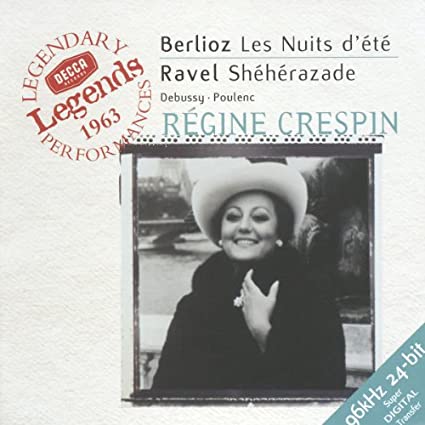
Crespin’s recording with Ansermet of Ravel’s Shéhérazade and Berlioz’s Les Nuits d’été is now so famous, so universally acclaimed that there can surely be no more to say about it. Even today, almost 60 years since they were recorded, the performances are still cited by many as a first choice in both works and for many they were no doubt their first exposure to the works, so maybe that is all that needs to be said about them, but is it really so simple?

Both Shéhérazade and, especially, Les nuits d’été are great favourites of mine and I now have ten different recordings of the Berlioz, six of the Ravel. Let us then start with the Ravel. From the thrice repeated call of Asie at the beginning, the third sung with the equivalent of a flirtatiously arched eyebrow, we are in her thrall. She makes a bewitching storyteller, drawing us in with her thrillingly colourful descriptions of the Orient. As I often feel with Crespin, there is a slight air of detachment but here it suits the narrative superbly. She is suitably languid in La flûte enchantée and deliciously ambiguous in L’indifférent. There have been finer versions of the orchestral score (not least the New Philharmonia under Barbirolli for Janet Baker), but Crespin at her best is still a prime recommendation. There is something just so inevitably right about her singing and it places her (just) ahead of the other versions I own, (Teyte, Baker, De Los Angeles, Berganza and Hendricks).

That air of detachment I mentioned also makes her an ideal interpreter of the songs of Poulenc and also Debussy’s Trois chansons de Bilitis with John Wustman on the piano, from a 1967 recording, which are here included as a makeweight, and very welcome they are too. However it works against her in the Berlioz, which requires a degree of involvement and passion that I find lacking in Crespin’s delivery. However musical and tasteful her singing, however elegant her phrasing, she remains aloof and uninvolved. There is no sense of mounting rapture at the arrival of the rose from paradise, no sense of longing in Absence. She is at her best in the final song, L’île inconnue which is blithely insouciant and responds better to her air of suave sophistication. I have no idea why she decided to place Sur les lagunes after Absence but it upsets the balance of the work too.

No, for the Berlioz my prime recommendations would be Baker either with Barbirolli or live with Giulini, Hunt Lieberson with McGegan, Steber with Mitropoulos or De Los Angeles with Munch, Crespin trailing quite a way in their wake.

Essential I would say for Shéhérazade and the Debussy and Poulenc, but look elsewhere for the Berlioz.

Janet Baker – Chausson, Berlioz and Schoenberg

r-9879493-1487856491-9833.jpeg

These are all live performances of material Baker recorded in the studio (twice in the case of Les Nuits d’Eté, so one might wonder if they are really essential listening.

Well, though Baker was a superb recording artist, who never really made a bad record, she was also a great communicator and collaborator and these performances, all with different conductors from the studio ones, bring with them the added frisson that comes with a live event, and the sound, though not as clear as in her studio performances, is more than acceptable.

It starts with a 1975 performance of Chausson’s almost Wagnerian Poème del’amour et de la mer, which she recorded two years later under André Previn. This one has, somehwat suprisingly you might think, Evgeni Svetlanov at the helm, who takes great care over dynamics and shapes the work beautifully. Baker’s range of expression, her concenration, her breath control and command of the long line are exemplary, filling its pages with rapt expression. A marvelous performance.

Baker’s recording of Les Nuits d’Eté with Barbirolli, recorded in 1967 is justly famous and has hardly been out of the catalogue. She recorded it again under Richard Hickox in 1990, but by this time her voice was beginning to show signs of wear (more noticeable in a recording than when I heard them perform the work together in concert at around the same time) and the second recording has never enjoyed the acclaim of the first. This performance under Giulini was taped at the Royal Festival Hall a month after the Chausson and it is good to hear how Baker’s interpretation changed depending on whom she was singing with. Giulini’s speeds are expansive (Le spectre de la rose at 8’29” must be one of the slowest on disc) and would tax most singers beyond their limits, but here they never flag and Baker luxuriates in the extra room she is given to make her interpretive points. As in the Chausson, her breath control is astonishing and the range of expression wide. My notes are peppered with words like searing, delicate, passionate abandon, yearning. Though it doesn’t entirely supplant the Barbirolli in my affections, it is nonetheless a performance I would never want to be without.

The earliest performance here is a 1963 recording of the Song of the Wood Dove from Schoenberg’s Gurrelieder, a work she recorded five years later under Janos Ferencsik. Baker was not yet 30 when she gave this performance and, superbly supported by Norman Del Mar, her singing is urgently free and impassioned, even better than that on the Ferencsik.

Essential listening then? Absolutely and unequivocally, yes.

Jill Gomez – A Recital of French Songs

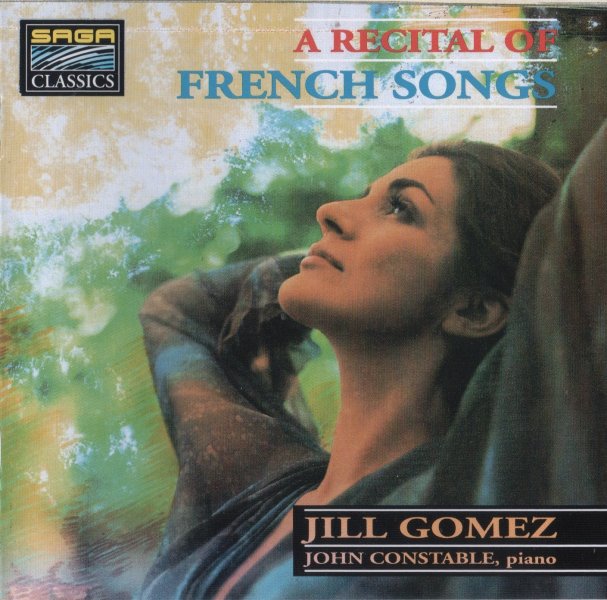
The Trinidadian/British soprano Jill Gomez was a mainstay of my early opera going life, and I heard her on more than one occasion. I particularly remember seeing her as the Countess in Le Nozze di Figaro and Elizabeth in Henze’s Elegy for Young Lovers with Scottish Opera, as Ilia in Idomeneo and the Governess in the The Turn of the Screw with English Opera Group and as Tytania in A Midsummer Night’s Dream at the Royal Opera House, Covent Garden. The voice was not large, but she was a strikingly good looking woman with a great stage presence and also a good actress. She is probably best known for creating the role of Duchess of Argyll in Thomas Adès’s Powder Her Face and singing the title role in William Alwyn’s Miss Julie.

I have known and loved this recital since I bought the original LP soon after it was first released in 1974, and was delighted to find that it had been reissued on CD. The programme is attractive and Gomez has a lovely voice, which she uses imaginatively and musically. Indeed one wonders why such accomplished singing has received so little attention.

We start with a group of songs by Bizet, possibly of slight musical value but direct and charming in their appeal. Gomez is delectably light and airy but also delivers a deliciously sensuous and coquettish Adieux de l’hôtesse arabe, which is probably the most well known of the group. The Berlioz items, especially La belle voyageuse, are also sung with distinction and charm.

The Debussy Proses lyriques are not performed as often as some Debussy songs, and they are quite hard to bring off. Gomez is fascinating and vividly personal, superbly seconded by John Constable’s realisation of the tricky piano part. In many places I was reminded of Mélisande’s music in Pelléas et Mélisande. A superbly characterised Noël des enfants qui non plus de maisons brings this excellent recital to a close.

Gomez brings something personal to all that she does and John Constable provides estimable support throughout. Highly recommended if you can get hold of a copy.

Eleanor Steber sing Les Nuits d’Eté

51xnjtg5rpl

Berlioz’s Les Nuis d’Eté has always been a favourite work of mine. I have ten recordings and have heard quite a few more and this famous recording, one of the earliest, made in 1954, has always rightly been considered one of the best.

The voice itself is a beautiful one, firm and even throughout its range,and she is thoroughly in control of its resources. There is a great deal of pleasure to be had merely from the sound of the voice and the way she weights and measures phrases, but she is also keenly responsive to the poetry, ideally melding the needs of the musical line to the meaning of the words.

True, Villanelle has always seemed a tad too slow to me, a little lacking in gaiety, but it is close to the metronome marking of crotchet = 96, so perhaps the fault lies with Mitropoulos, who fails to make the woodwind light enough. Elsewhere he provides excellent support and speeds are judiciously chosen.

The rest of the disc is taken up with more Berlioz (beautifully sung performances of La Captive, Le jeune pâtre breton and Zaïde conducted by Jean Morel) and orotorio arias by Bach, Handel, Haydn and Mendelssohn. True, these latter, conducted by Max Rudolf, have a slightly old-fashioned, somewhat Victorian air about them, but they are impeccably sung and her diction is exemplary. These were recorded a few years earlier, in 1951, and the voice is at its freshest and most beautiful.

The disc comes with copious notes and photos, but, regrettably, no texts and translations.

Maggie Teyte – Mélodies Françaises

41lhudrbaxl

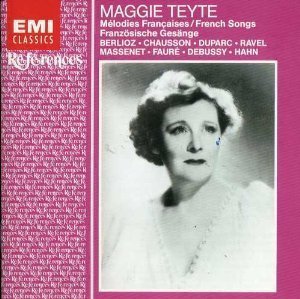
The first time I heard Maggie Teyte was when I was just starting to enjoy French song. I was learning Duparc’s Chanson triste and a friend played me her recording of the song with Gerald Moore at the piano. I was absolutely entranced and it has remained my yardstick ever since. First of all the flowing tempo they adopt is aboslutely right (so many take it too slowly) and she responds perfectly to all Duparc’s markings – floating the tone beautifully on the mon of mon amour (it is marked doux by Duparc) an effect I have tried, not too successfully, to emulate myself. Her high A is clear, clean and true, but she takes the lower option on the words de tes bras, dipping down into that gloriously rich lower register she had. As you listen, you feel the song is addressed to you personally and you want to just lie back in the warm embrace of her comforting words. The French christened her L’Exquise Maggie Teyte, and the adjective suits her perfectly.

She was born in 1888 in Woverhampton, but went to Paris in 1903 to study with the famous tenor Jean De Reszke. She made her first public appearanc in 1906, singing Cherubino and Zerlina under Reynaldo Hahn, making her first professional appearance in Monte Carlo the following year. She then joined the company at the Opéra-Comique in Paris and was shortly after chosen to replace Mary Garden in the role of Mélisande, for which she was coached by Debussy himself. She is the only singer ever to have been accompanied in public by Debussy himself, and she is an invaluable link to so many musicians of the past. Despite her early success however, she didn’t really establish herself with the main opera houses, and went into semi-retirement after her second marriage (to Canadian millionaire Walter Sherwin Cottingham) in 1921.

In 1930 she tried to resuscitate her career, but ended up singing in variety and music hall (24 performances a week!) until, in 1930, she made some recordings of Debussy songs with Alfred Cortot, which were so successful that she then became known as the leading French song interpreter of her time. She also sang at Covent Garden in such roles as Butterfly, Hänsel and Eurydice in Gluck’s opera, as well as Manon in English (with Heddle Nash).

The present set concentrates on recordings of French song with orchestra and piano made between 1940 and 1948, making her 60 when she recorded Ravel’s Schéhérazade, not that you would ever suspect it. The voice is still absolutely firm with no trace of wobble or excessive vibrato, top notes pure and true (a thrilling top B flat in Asie), the inimitable lower register gloriously rich.

It starts with a rather hectic recording of Berlioz’s Le spectre de la rose. The fast tempo was presumably adopted so that they could fit the song onto a single 78, but it does remind us that it is in waltz time and she brings a peculiarly intimate touch to the closing lines,which are sung with an ineffable sadness. Absence is sweetly touching.

Occasionally her attention to the meaning of the words can get in the way of the music, and the tempo fluctuations in Fauré’s Après un rêve are just too much, rather too slow at the beginning, with an unwritten accelerando on Reviens, reviens. I’d also suggest that Duparc’s Extase is taken far too slowly throughout. On the other hand the tempo for Fauré’s Clair de lune is absolutely spot on with a moment of pure magic as she infuses her tone with warmth at Au calme clair de lune and Gerald Moore switches to a more free flowing style in the accompaniment.

Over the two discs there is scarcely a performance that doesn’t warrant attention, but I single out for special consideration Duparc’s gorgeous Phidylé, which is lazily erotic as it should be (note her telling observation of the diminuendo on baiser – most singers miss it completely) and the aforementioned Chanson triste, the former with the LSO under Leslie Heward, the latter with Gerald Moore on the piano. Also on disc 1 is a superb performance of Chausson’s Chanson perpétuelle, whilst she breathes new life into Hahn’s popular Si me vers avaient des ailes on Disc 2.

In all she remains inimitable and individual, though, it seems these days, only known to connoisseurs. This set is no longer available, nor are the Debussy songs she recorded with Cortot. John Steane says in his wonderful book The Grand Tradition,

But basically the point about Maggie Teyte is the very simple one, that her singing is so good: that is, her voice is so clear, its production so even, its intonation so faultless, its movement in big upward leaps so clean and athletic, and its excellence was so well preserved for so long.

Not only is her actual singing so good, but she has something personal to say in all she does, and voice and style are instantly recognisable.

There are other examples of her art more readily available on other lablels but this old EMI set is a treasure and I urge Warner to reissue it along with the Debussy songs with Cortot. It should be in the collection of anyone who is interested in French song.

Jennie Tourel – The Singers

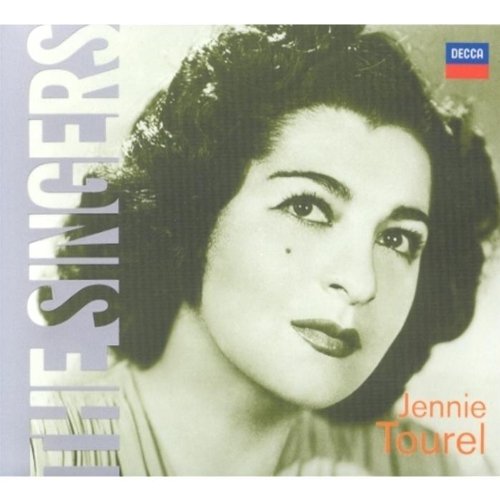
Jennie Tourel was born in Russia in 1900 of Jewish parents, but she and her family left just after the Revolution, temporarly settling in Danzig before moving to Paris. She fled to Lisbon just before the Nazis occupied France and from there to the USA, becoming a naturalised Amercian in 1946.

She had an illustrious career both in the opera house and on the recital stage, and was the creator of the role of Baba the Turk in Stravinsky’s The Rake’s Progress. She was still active when death ended her career in 1973, in fact in the middle of performances of Donizetti’s La Fille du Régiment in Chicago. The longevity of her career is testament to her sound technique, but if the years were kind to her voice, she was also careful never to overtax it. She knew what suited her and stuck to it.

The dates of the recordings on this disc are unknown, but the Italian and French items are stereo, which would place them at least from the early to mid 1950s. Her voice is still admirably firm, with no trace of wobble or excessive vibrato. Her legato isn’t always perfect, and her runs can be lightly aspirated, which mars her performance of the Rossini items, and also of Bizet’s Adieux de l’hotesse arabe, though she sings it with more personality and drama than many.

Berlioz’s Absence is sung with piano, and is notable for the firmness of the line, though personally I prefer a more inward display of longing. Tourel is too loud in places and she rushes the pharse la fleur de ma vie. Much better are Poulenc’s Violon and Liszt’s Oh! Quand je dors and I particularly enjoyed Ravel’s Kaddish, which exploits her rich lower register.

The Russian items are all worth hearing, beginning with a mournful Tchaikovsky None but the lonley heart, the cello obligato adding to the pervading sense of melancholia. As befits the general mood of the Russian items, she uses a bigger, more dramatic sound, but she can also be lightly high-spirited in a song like Dargomizhsky’s Look darling girls. In all she displays a strong personality and superb musicianship.

Song texts and translations are provided on the disc itself, which doubles as a CD-ROM, though, annoyingy, if you want to read them at the same time as listening to the disc, you will have to print them out before playing the disc on a CD player.


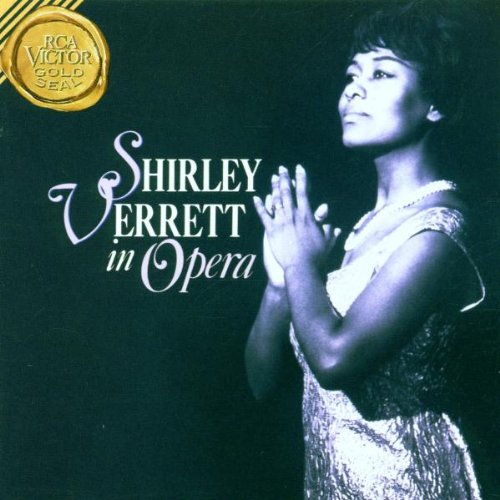
Shirley Verrett In Opera

51ajzxt2szl51wmswrrusl

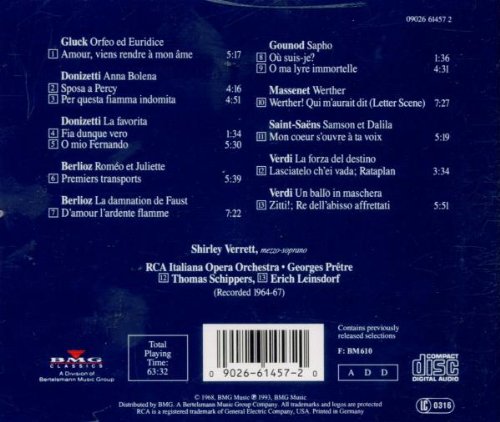
This is a wonderful recital disc and a great example of the art of Shirley Verrett, dating from 1967, before she ventured into soprano territory.

It starts with a stunningly virtuosic rendering of Orphée’s Amour, viens rendre à mon âme from the Berlioz edition of Gluck’s Orfeo ed Euridice. Verrett maintains a true appreciation of the classical style, the chest voice used more sparingly than in Verdi, vibrato kept to a minimum. She also gives the piece a properly heroic dimension. Orpheus is after all srengthening his resolve at this point.

The two Donizetti items showcase her facility in bel canto, though with so many French items in the recital, it’s a shame she sings the aria from La Favorite in Italian. The short scene between Giovanna and Enrico from Anna Bolena gives us the chance to hear her engagement with the text in recitative, her legato line in the cavatina and her felxibility in the cabaletta. The aria from La Favorita also goes well, again displaying her deep legato in O mio Fernando, and her thrilling dramatic thrust in the cabaletta.

She is even better in the French items, giving us a beautifully restrained performance of Premiers transports from Berlioz’s Roméo et Juliette, and one of the best versions I have heard of Margeurite’s D’amour l’ardente flamme, one of the composers greatest inspirations. Verrett’s responses to the text are just that bit more vivid than those of Von Stade, whose eary French recital I listened to recently, with a much greater range of colour. Only Callas surpasses her in creating an atmosphere of utter forlorness and longing, though it has to be admitted that by the time she recorded it her actual tone couldl sound somewhat frayed and thin, where Verrett is firm and rich throughout.

She is grandly eloquent in the aria from Sapho, and wonderfully alive to the many changes of emoton in the Letter Scene from Werther, briliantly charting Charlotte’s mounting anxiety. This too is one of the greatest performances you will ever hear of the scene, and it is a great pity she never recorded the complete role.

It is also nothing short of tragic that she never recorded the role of Dalila, one of her greatest stage successes, and her beautiful reading of the famous Mon coeur s’ouvre à ta voix closes the recital proper. Disappointingly she follows regular performance practice, by splitting the phrase in Ah, réponds à ma tendresse in order to snatch an extra breath. It is so much more effective when sung, as Saint-Saëns indicated, in one long breath, though Callas is one of the only singers to do it that way. Aside from that one slight cavil, her comparative restraint is welcome and all the more seductive for letting the music speak for itself.

The Verdi pieces at the end are taken from complete recordings of the two operas. She is wonderfully vivid as Preziosilla and darkly commanding as Ulrica.

In all Verrett’s superb musicality is evident, and I often wonder why she recorded comparatively little, given the flurry of opera recordings made in the 1970s. That her superb Carmen was never committed to disc is little short of criminal.

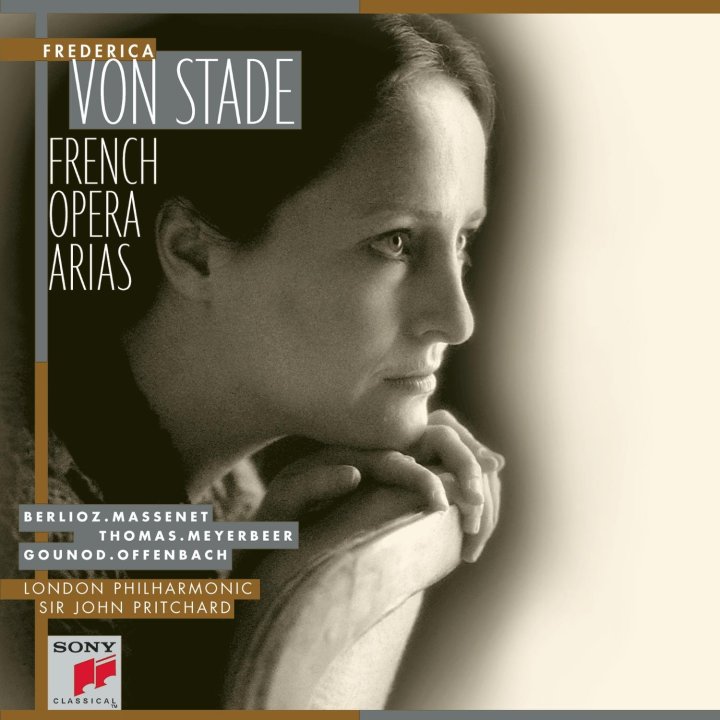
Frederica Von Stade – French Opera Arias

710yvtzhbil._sl1500_

This 1976 recital was, I believe, Von Stade’s first recital disc. In 1970, at the age of 25 she had secured a comprimario contract at the Met, debuting there as one of the Three Boys in Die Zauberflöte, and international acclaim followed in 1973, when she appeared as Cherubino at Glyndbourne in a Peter Hall production that was also televised. Von Stade’s winningly boyish Cherubino catapulted her to stardom alongside Kiri Te Kanawa and Ileana Cotrubas, who played the Countess and Susanna. I remember seeing it on TV, and the impression they all made.

Though American born, Von Stade spent a good deal of her youth in Europe, and later spent some years in France, and so is completely at home in the French language. Indeed French opera and song became a staple of her repertoire though, at this early stage of her career, she doesn’t always use the words to her advantage, and some of the arias could be more clearly characterised. That said, the voice itself, a clear lyric mezzo, is always beautiful and her use of it unfailingly musical. She is best at winning charm and bittersweet sadness, and the least successful item here is Charlotte’s Va, laisse couler mes larmes from Werther, which doesn’t compare to what she achieves in the complete recording under Davis (recorded in 1980).

My favourite performances are of Mignon’s Connais- tu le pays?, which captures to perfection Mignon’s wistful longing for her homeland (I always think it a pity that Von Stade wasn’t the Mignon on the Almeida recording, on which she plays Frédéric) and the aria from Cendrillon, and it is no surprise to find that she went on to have a great success in the complete role. Her natural charm also comes across well in the Offenbach arias and in Urbain’s aria from Les Huguenots.

The aria from Berlioz’s Béatrice et Bénédict for the most part goes well, though her responses are a little less vivid than Janet Baker’s on the complete Davis recording, and the Allegro lacks a little in joyfulness. Her natural plaintiveness is more suited to Marguerite’s D’amour l’ardente flamme, though, here too, there is a sameness of vocal colour which misses the urgency of the middle section.

A very enjoyable recital disc then, the beauty of the voice and her winning personality well caught, if with the proviso that she doesn’t yet quite convey the complete range of emotions required by the music. Nevertheless it always a pleasure to hear such beautiful and musical singing.

Dame Janet Baker – Philips & Decca Recordings 1961 – 1979

r-10064800-1491163322-4375.jpeg

Dame Janet Baker is without doubt one of the greatest singers of the latter part of the twentieth century, known throughout the world from her recordings and international recitals. Though her range was quite wide, taking in operatic roles from Monteverdi to Richard Strauss, and even embracing the Verdi Requiem and Schoenberg’s Gurrelieder, she was never tempted to sing outside her fach and retired, first from the operatic stage and then from recital work, whilst still at her peak, so that we never saw the slow vocal decline we often hear from great singers. Her Yorkshire firmness of mind and pragmatism also meant that she refused to join the international operatic circus, and in fact only once sang in opera outside the UK (when the Royal Opera took their hugely successful production of La Clemenza di Tito to La Scala, Milan).

This 5 disc set brings together some of the recordings Dame Janet Baker made for Decca, Argo and Philips during the 1960s and 1970s. Though contracted to EMI (and Warner have a pretty exhaustive twenty disc box set of her work for that label, called The Great Recordings), she made a few recordings for Decca/Argo (including her famous recording of Dido and Aeneas) in the early 60s, and then a tranche of recitals for Philips in the 1970s. The range of material here is not quite as wide as that on the aforementioned Warner set, but takes us from 17th century arie through to Britten.

Disc 1 is a selection of what most vocal students would know as Arie Antiche (called here Arie Amorose), accompanied by the Academy of St Martin in the Fields under Sir Neville Marriner. Whilst the somewhat souped-up arrangements can sound somewhat anachronistic today, Baker’s wonderfully varied singing brings each song winningly to life. The disc is rounded off with a couple of arias from Cavalli’s La Calisto recorded shortly after her great success in the role of Diana/Jove at Glyndebourne.

Some of Baker’s greatest early successes were in Handel and Disc 2 is mostly taken up by a superb 1972 Handel recital she made with the English Chamber Orchestra under Raymond Leppard. How brilliantly she charts the changing emotions in the cantata Lucrezia and also in the arioso-like Where shall I fly from Hercules,but each track displays the specificity of her art, the way she can express, on the one hand, the despair in an aria like Scherza infida and, on the other, the joy in Dopo notte, both from Ariodante. The disc is rounded off by a superb 1966 recording of Bach’s Vergnügte Ruh and her incomparable When I am laid in earth from her 1961 recording of Dido and Aeneas.

Disc 3 has excerpts from a 1973 Mozart/Haydn recital and a 1976 Beethoven/Schubert disc, both made with Raymond Leppard, with the addition of arias from her complete recordings of La Clemenza di Tito and Cosí fan tutte under Sir Colin Davis. The two Haydn cantatas (one with piano and one with orchestra) are very welcome, but we do miss her stunning performance of Sesto’s two big arias from La Clemenza di Tito, and her gently intimate performance of Mozart’s Abendempfindung. Fortunately these have been included in a superb selection taken from the same two recitals on the Pentatone label, which includes all the missing Mozart and Schubert items. This disc also includes her recording of Beethoven’s Ah perfido!, a little smaller in scale than some, but beautifully judged none the less. It doesn’t have Callas’s ferocity, it is true, but it is much more comfortably vocalised.

Disc 4 is of music by Rameau (excerpts from her 1965 recording of Hippolyte et Aricie, which well display her impassioned Phèdre), Gluck (arias for Orfeo and Alceste taken from her 1975 Gluck recital) and Berlioz (1979 performances of Cléopâtre and Herminie and Béatrice’s big scene from Davis’s complete 1977 recording of Béatrice et Bénédict). The biggest loss here is of the majority of the Gluck recital, which included many rare items, though the complete reictal was at one time available on one of Philips’s budget labels. Baker is without doubt one of the greatest Berlioz exponents of all time, and the two scènes lyriques are especially welcome. These are fine examples of her dramatic intensity and the range of expression in both is fully exploited.

Disc 5 is of late nineteenth and twentieth century French song and Benjamin Britten; the whole of a disc of French song made with the Melos Ensmble in 1966, excerpts from the composers own recordings of The Rape of Lucretia and Owen Wingrave and the cantata, Phaedra, which was composed specifically for her. The Melos disc includes Ravel’s Chansons Madécasses and Trois poèmes de Stéphane Mallarmé, Chausson’s Chanson perpétuelle and Delage’s Quatre poèmes hindous and is a fine example of Baker’s felicity in French chanson, particularly ravishing in the wordless melismas of Lahore from Quatre poèmes Hindous. The Britten excerpts remind us of her sympathetic portrayal of Lucretia and her unpleasant Kate in Owen Wingrave. The Britten cantata is a great example of her controlled intensity.

Remarkable throughout is the care and concentration of her interpretations. Nothing is glossed over, nothing taken for granted, and she was one of those artists who could bring the frisson of live performance into the studio. Nor do I think she ever made a bad record. I heard her live on many occasions. Hers was not a big voice, but it was one that coud carry to the furthest recesses of a large hall, even when singing pianissimo. Furthermore there was a concentration, and intensity and a gift of communication, vouchsafed to just a few. One of my all time favourite singers.

Callas a Paris

Callas never sang a role in French on stage, and only one complete role (Carmen) on record, but as can be heard on these two discs, she had a natural affinity for the language. She spoke it fluently (though tellingly refused the role of Carmen in the Beecham recording, “because my French isn’t good enough yet”) and of course made Paris her home in her last years. Previously she had sung only Ophelia’s Mad Scene in French on the Mad Scenes recital disc and Louise’s Depuis le jour in recital in 1954.

Two years separate the recording of these two discs, and it is alarming to hear the marked deterioration in Callas’s voice in such a short period of time, a voice that was already showing signs of stress in the first recital recorded in 1961. These were also the last records of hers to be produced by Walter Legge.
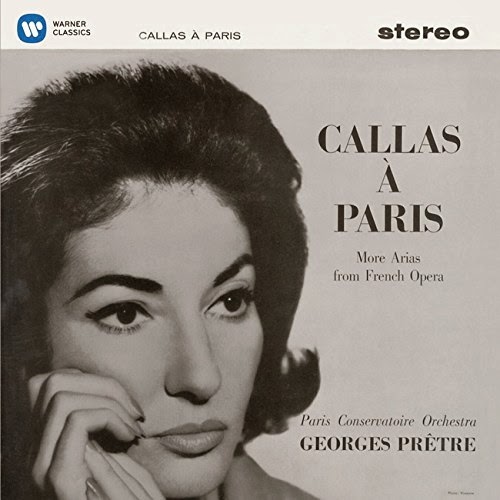
51nmk20cjwl

Recorded May 1963, Salle Wagram, Paris

Producer: Walter Legge, Balance Engineer: Francis Dillnutt

Despite her vocal problems, and despite the fact that she is evidently having to tread carefully, there are, however, still treasures on the second disc. She sounds strained to the limits by the Gluck, and it can make for uncomfortable listening. Even so her grasp of the classic style and her command of legato never falters. There are also signs of strain in Leila’s Comme autrefois, (though her phrasing is exemplary) and  Manon’s Je marche sur tous les chemins, shorn of the ensuing gavotte, ends somewhat inconclusively. Manon’s Adieu, notre petite table, though, is a different matter; maybe a tad too serious, but the sadness she gets into this little solo is most touching, and she makes the aria work supremely well out of its context.

For the rest, we are vouchsafed three great performances. Gounod’s Margeurite comes as a total surprise, Callas finding here a lightness of touch that one might have thought was beyond her by this time. In the Ballade she meticulously differentiates between Marguerite’s thoughts and the strophic song she sings, carefully placing Marguerite’s simplicity before us. Her innocent rapture when she opens the casket of jewels is brilliantly caught. There is charm here (a trait which often eluded her in the past) and femininity, the text clearly enunciated, the runs deftly executed. She is defeated only by a watery top B at the end, which detracts from, rather than caps, what had been a beautiful performance.

Berlioz’s Margeurite is superb. Alongside Janet Baker’s performance on the Prëtre recording, this is one of the greatest performances of the piece put down on record. At the beginning of the aria, Callas perfectly mirrors the tone of the cor anglais with her first words, then beautifully lightens her tone, putting a smile in the voice for Sa marche que j’admire (and note how we hear the separation of the duple quavers in de sa main, de sa main la caresse, without once disturbing her impeccable legato). Her mounting rapture at Je suis a ma fenetre, where she uses the rests brilliantly to illustrate the recollection of Margeurite’s breathless excitement at Faust’s arrival, finds its release in a cathartic O caresses de flamme, which she achieves again without once upsetting the long musical line. “Who would not wither in the flame of her genius?” asked the Berlioz scholar, David Cairns. Who indeed? I can only imagine what she might have done with the roles of Cassandre and Didon, and why not Les Nuits d’Ete too? Can you not imagine Callas singing the words O grands desirs inapaisees? If only Callas had sung more Berlioz. It was a natch made in heaven.

And finally I turn to Charlotte’s great Letter Scene, arguably the most dramatic piece on the album, which brings out the best in her. How brilliantly she differentiates between Charlotte’s thoughts and Werther’s own words, particularly noticeable when she repeats the phrase Ne m’accuse moi, pleure moi, as their significance dawns on her. Unerringly, she captures Charlotte’s mounting panic as she reads the letters. So vividly does she bring this scene to life, that I can now just read through the text, and Callas’s voice and inflections come to my mind’s ear. Like many of her performances, it spoils me for all others.
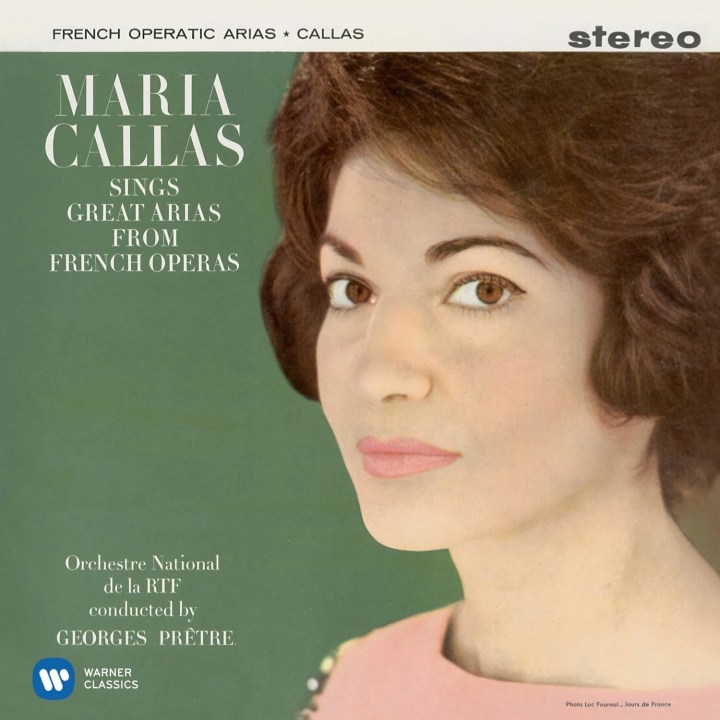
81slgnandkl-_sl1500_

Recorded March & April 1961, Salle Wagram, Paris

Producer: Walter Legge, Balance Engineer: Francis Dillnutt

Though there are still a few wild and insecure notes, the first disc is one of the classic recital discs of all time, and one I would never be without. Whole tomes could be written about Callas’s psychological insights, her realisation of the composer’s intentions; every aria is like a new discovery. There isn’t a single dud on the recital, though the rather empty coloratura of Philine’s Je suis Titania would hardly seem worth her effort. She manages it remarkably well, the filigree beautifully executed, with a lovely lightness of touch, magically lightening her tone. She sounds a different singer from the Carmen and Dalila, which precede it, but it’s still my least favourite piece on the disc.

Everything else is pure Callas Gold. The Gluck arias sung with passion, but retaining their classic contours, Orphee’s J’ai perdu mon Eurydice emerging as a true lament. Note the appeal in the voice at the words C’est ton epoux, ton epoux fidele, the blank, despairing tone at Mortel silence and the suffering that truly tears at the heart (dechire mon coeur). Alceste’s great entreaty to the gods is hardly less affecting. Though the top notes are driven here, they are not intrusive, and Callas again finds a wealth of colour for each intercession, for each recurring statement of Divinites du Styx, with a lovely softening of her tone at Mourir pur ce qu’on aime.

Carmen’s arias are best seen as a preparation for the complete set, but the Habanera is seductive and playful, and the Segeudille full of humour, lightly and playfully sung. Dallila’s arias are even better. When it comes to Printemps qui commence I can do no better than to quote Ronald Crichton in an issue of Covent Garden’s About The House.

Callas, in her matchlessly intelligent and instinctive record, is like an elegant young tigress stretching her limbs in the spring sunshine.

The danger lurking under that seductive surface is unleashed in Amour viens aider ma faiblesse, and then she gives us a real siren, when she sings the famous Mon coeur s’ouvre a ta voix. Incidentally, always a stickler for the composer’s intentions, Callas here sings exactly what Saint-Saens wrote, which is that Ah reponds a ma tendresse should be sung in one breath. Most singers add an extra Reponds, which gives them a chance to snatch an extra one. In the second statement, she does indeed take a (perfectly justifiable) breath at Verse moi, verse moi l’ivresse (there is a comma here after all), but this might have been the reason why she refused to allow the aria to be released when the record first came out. It wasn’t issued until the disc was reissued after her death. In any case I doubt any of these arias has ever been done better, and they are enough for Alan Blyth to name Callas as Dalila in his dream cast for Samson et Dalila in his comparative review in Opera on Record.

Juliette’s Waltz Song is a miracle of lightness and elegance. Though the tone is mature, Callas suggests better than anyone the joy of the young girl, but note too the change of colour, when a veil of sadness comes over her voice at Loin de l’hiver morose. Callas gets more meaning out of this seemingly innocent tune than any other singer I know. Chimene’s glorious Pleurez, mes yeux has a dark, tragic beauty, her chest tones uniquely telling, her legato superbly eloquent.

Finally we come to Louise’s apostrophe to love and life. There are some alarming flaps on high notes here, and we note that even in 1954 the aria never quite worked for her in toto, but the quiet intensity of her intent is never in doubt. Has any other singer, before or since, captured quite so unerringly Louise’s mounting rapture, or sung quite so erotically the words je tremble delicieusement? So her voice doesn’t always do quite what she asks of it. Who cares, when she realises the fundamental truth at the root of this aria, which is actually about a young girl’s sexual awakening? When this recital was first reissued, Richard Osborne wrote, “Records like this change people’s lives.” It certainly changed mine