Singers Who Changed My Life

This is an expanded version of something I wrote a few years ago. 
LETTERBOX COLLAGE OF SINGERS

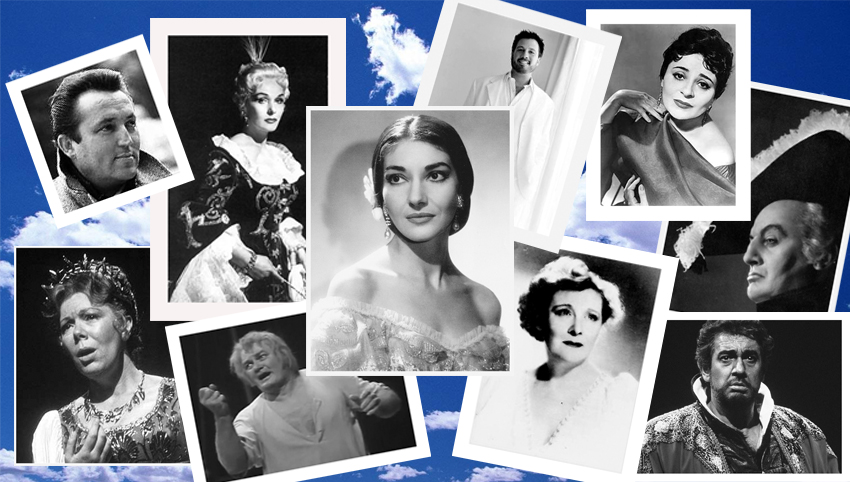
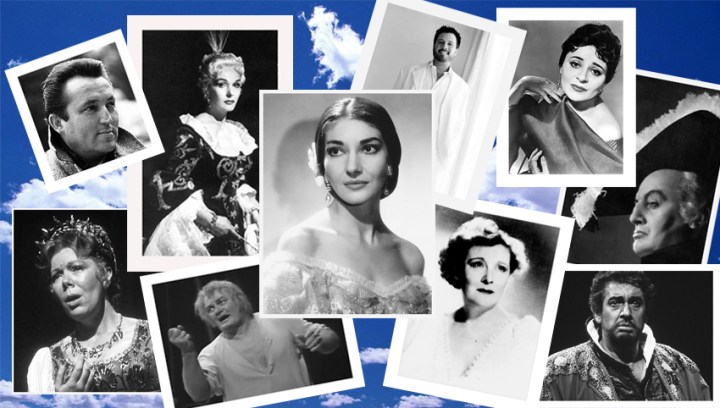
Back in 2011,  John Steane, an expert on voices and an eminent critic, died at the age of 83. He had his favourites of course (who doesn’t?), but I learned a lot from JBS over the years, and I do miss his wonderfully constructive musical criticism. When he was still active at Gramophone Magazine, the editor asked him to write an article detailing the twelve singers who had changed his life, the one injunction being that one of them should still be active as a singer. For someone who knew his writing, his choices didn’t come as much of a surprise. I recently re-read this article and it got me to thinking of who mine would be. I’ve stuck to just ten, but  these are all singers, who have said something personal to me, the voices that have spoken to me down the years, from when I first started to enjoy opera and lieder as an impressionable teenager, up until now. 
 

m65-page-042-2
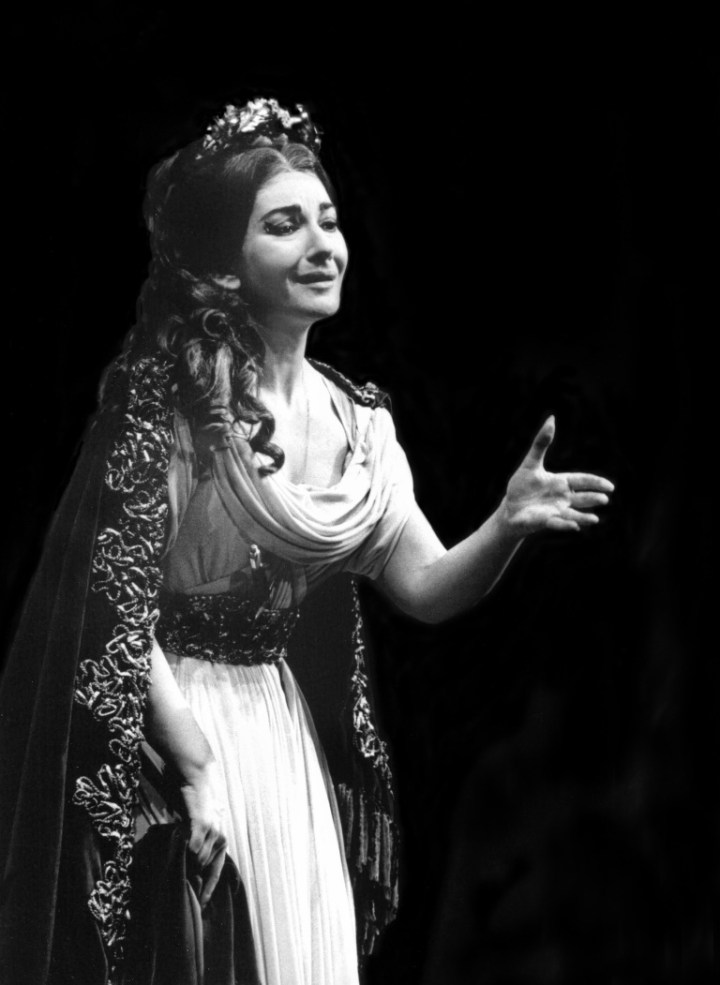
Callas as Norma

Anyone who knows me won’t be in the least surprised by my first choice.  I first heard the voice of Maria Callas on an LP reissue of her first recordings, originally issued on 78s. The Mad Scene from Bellini’s I Puritani was coupled with the Liebestod (in Italian) from Wagner’s Tristan und Isolde and excerpts from her early Cetra recordings of La Traviata and La Gioconda. This was a voice like none I’d ever heard. It was a large voice, with dazzling flexibility, a rarity in itself, but what struck me most was the way that voice penetrated your very soul. It was a voice bursting with emotion. I may not have appreciated then her amazing musicality, but I certainly recognised the work of a genius. Callas made you feel that the music sprang from her throat newly minted, that she meant every word, every note. More than that, it was the way the voice could change from the sweet innocent Elvra to the womanly Isolde, from the passion of the courtesan Violetta, to the almost primeval sounds of her Gioconda. It hardly seems believable now, given that Callas’s recordings have formed the backbone of EMI’s (now Warner’s) Italian opera catalogue for years, but most of them were unavailable at the time. I slowly built up my collection by scouring second hand shops and pouncing on any imported issues that made their way into specialist record shops.  As I slowly built up my collection, it was Callas who introduced me to the world of Italian opera. Nowadays I can be aware of some of the vocal failings, especially in the later recordings, but nobody has ever come within a mile of her fantastic musicality, and up until at least the mid 1950s, the voice was an amazingly responsive instrument. For evidence of her musical skills, no better example could exist than her Leonora in Il Trovatore, full of aristocratic phrasing and almost Mozartian delicacy. Though a little strained by some of the high lying passages on the  Karajan recording of 1956, she still phrases like a master violinist, her sense of line and rubato unparalleled, the trills and cadenzas beautifully bound into the musical fabric of the whole.

She was also an amazing vocal actor, and though she has a voice that is instantly recognisable, she continually changes the weight of that voice to suit the character she is portraying. The woman who sings Lady Macbeth and Medea with such demonic force is hardly recognisable from the one who sings such a virginal and innocent Gilda, and though she may use the same lightness of touch for Amina in La Sonnambula as she does for, say, Rosina in Il Barbiere di Siviglia, they are still two completely different voice characters, and she can make us see that happiness is quite a different thing for Amina from what it is for Rosina.

Callas is still my touchstone for all the roles she sang (I can almost hear her in my mind’s ear in some of the ones she didn’t), and, though I recognise that some have made prettier sounds, there will always be a moment, maybe a single word, where Callas’s unique colouration will suddenly do something to nail the character as no other singer does. I regret that Walter Legge, excellent producer though he was, did not have the foresight to record her in much of the repertoire for which she was famous, and though I treasure all her studio recordings, it is a great pity that she didn’t get to record some of her greatest stage creations, like Lady Macbeth, Anna Bolena, Armida, Imogene in Il Pirata, and perhaps even Alceste and Ifigenia. Legge wouldn’t even touch Medea and Callas only got to record the opera by exercising a get out in her contract with EMI, though EMI did eventually release the recording, which had been made for Ricordi. I might also regret that Legge was so chary of stereo and that Callas was not accorded the kind of good stereo sound Tebaldi was accorded in her early 1950s recordings.

There is no doubt that Callas’s glamour and tempestuous personal life has done much to maintain her popularity, but she has been dead for 40 years now, the dust has settled, and it is surely her musical gifts for which she should be remembered; for Callas was not only a great singer, she was also one of the greatest musicians of the twentieth century. The great conductor Victor De Sabata once said to Walter Legge, her recording producer, “If the public could understand, as we do, how deeply and utterly musical Callas is, they would be stunned.” I have known her recordings now for the best part of fifty years and I continue to be newly stunned each time I listen.
 

71583250
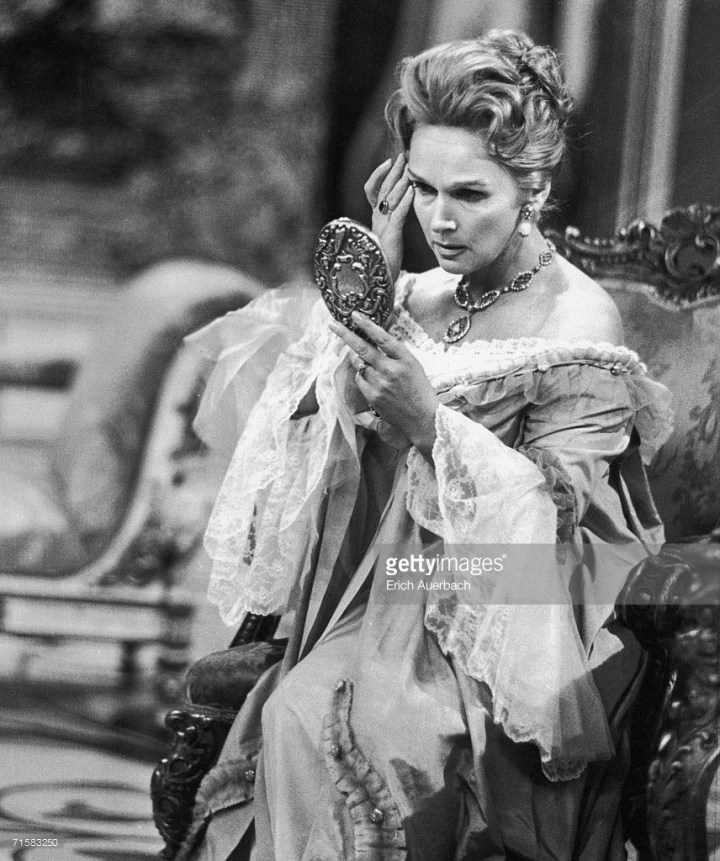
Schwarzkopf as the Marschallin

My next choice might seem a little more surprising, a singer as far away from Callas as it would seem possible to be, though I often think of them as flip sides of the same coin. Elisabeth Schwarzkopf is the singer who introduced me to Mozart, Richard Strauss and lieder. Her recordings of the Marschallin in Der Rosenkavalier, and of the Vier letzte Lieder were my first exposure to these works, and have remained in my collection ever since. Hers was a voice shot  through with laughter, and she also made many great recordings of lighter works. Her album of Operetta Arias can lighten the spirits like no other. She and Callas admired each other enormously (their repertoires were very different of course), and though they only made one recording together (Puccini’s Turandot), they met often, as Schwarzkopf was the wife of Callas’s record producer, Walter Legge, on one occasion Schwarzkopf giving Callas an impromptu singing lesson in the middle of the restaurant at Biffi Scala. Schwarzkopf was a good person to ask. She rarely put a foot wrong, and it is this attention to detail, that some find gets in the way of the music. There can be a lack of spontaneity, it is true, and, where Callas is able to conceal the huge amount of work that goes into each of her musical recreations, Schwarzkopf can occasionally be accused of artifice. Her Liu in the above mentioned Turandot may not sound for one moment like a slave girl, but I love her singing of the role, so beautiful and so richly nuanced.  

Still, when it comes to opera, I treasure her most in Mozart (an incomparable Donna Elvira, Countess and Fiordiligi) and Strauss (an unbeatable Marschallin and Countess Madeleine) and (in recital) in Agathe’s arias from Weber’s Der Freischütz, though I also prize her delightfully high spirited Alice in Karajan’s recording of Verdi’s Falstaff. In Lieder some find her singing too detailed, and she is often accused of being mannered. Well, I’d aver that all great singers have their mannerisms. It’s one of the things that makes them instantly recognisable, and I prefer to think of them as idiosyncrasies. Warner recently reissued all her EMI recital records in their original programmes, and though it means each disc is rather short for CD, it shows the care that would go into creating these recitals, the same care that would go into her programming of material for her recital programmes. Each of them makes eminently satisfying listening.

I remember many years ago attending one of Schwarzkopf’s Master Classes at the Wigmore Hall with my singing teacher, the late Ian Adam, who adored her incidentally. She was a very hard task master, rarely letting a student sing more than a few bars before stopping them, and watching the classes was a peculiarly frustrating experience. It must have been even more so for the students. But that was the way she studied and rehearsed herself. She was actually severely self critical, as is shown in the book Elisabeth Schwarzkopf: A Career on Record, in which she listens to some of her recorded performances with John Steane. On many occasions she dismisses performances of her own that Steane admires, pointing out faults that none of us can hear. Though Schwarzkopf herself had refrained from singing at the classes, at one point she did sing out for just a few bars, in an attempt to show the student how to bring moonlight into the sound of their voice. Well, as Ian said, to me “You can’t teach that. Either you can do it, or you can’t.”
 

2006ag8766_janet_baker
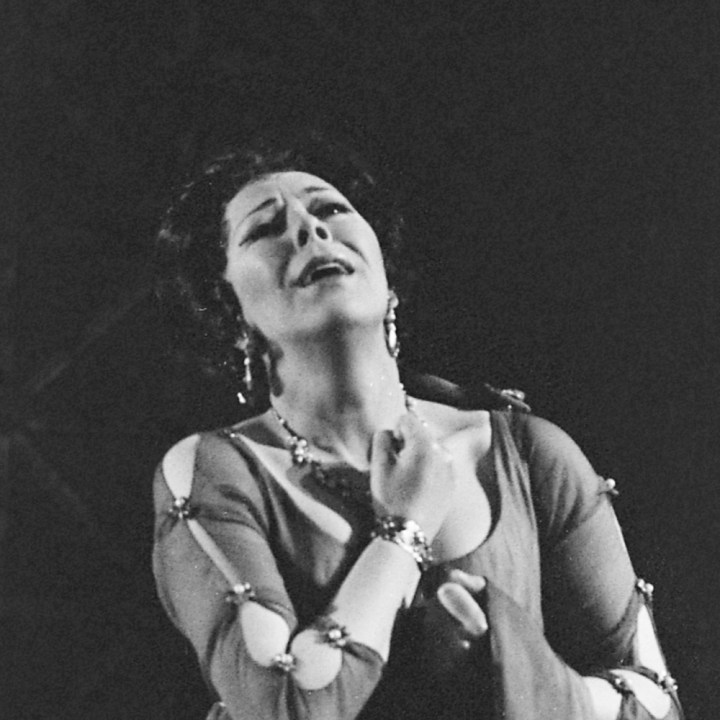
Janet Baker as Vitellia


Unfortunately I never got to hear Callas or Schwarzkopf live, but I did hear  Dame Janet Baker quite a few times, though only in concert, never on the operatic stage, where she was equally at home. The first time was in a performance of Mahler’s Das Lied von der Erde at the Royal Festival Hall, whilst I was at college, a performance that has remained in my memory ever since. In a very different repertoire, she had an almost Callas like intensity and an ability to sing pianissimi  that somehow reached the furthest recesses of the hall. Dame Janet introduced me to the music of Monteverdi and Handel, Bach and of course Elgar’s Sea Pictures (memorably coupled to Jacqueline Du Pre’s seminal recording of the Cello Concerto). She was also a great Berlioz singer. I actually prefer her Barbirolli recording of Les Nuits d’Ete (and a live one under Giulini) to Crespin’s famous one, and I doubt her recording of the closing scenes of Les Troyens has ever been bettered. 

She recorded extensively for EMI, then Philips and, towards the end of her career, for such independents as Hyperion, Collins Classics and Virgin Classics, singing a vast range of repertoire that took her from the music of Monteverdi and Cavalli to Respighi, Britten and even Schoenberg, taking in Donizetti, Verdi, Schubert, Schumann, Liszt, Wagner and Mahler along the way. Some of her greatest recordings are those she made with Sir John Barbirolli, with whom she had a great rapport, The Dream of Gerontius, Sea Pictures, Les Nuits d’Eté, Shéhérazade and, maybe the greatest of them all, the orchestral Lieder of Mahler, particularly her wonderfully sensitive and inward performance of Ich bin der Welt abhanden gekommen. She was also world renowned for her singing of the lower part in Mahler’s Das Lied von der Erde, which I twice heard her sing live. She recorded it in the studio with Haitink, and there are at least three live recordings knocking around. Best of all of these is a Bavarian Radio broadcast under Rafael Kubelik, in which her singing of the final song, has a quiet intensity , which is almost too much to bear. So palpable is her emotional commitment to the music that I save this performance for rare occasions. Like Callas’s shattering performance of Violetta at Covent Garden in 1958, it reduces me to a quivering wreck.
 

2cab532b00000578-3245955-image-a-4_1443000293420
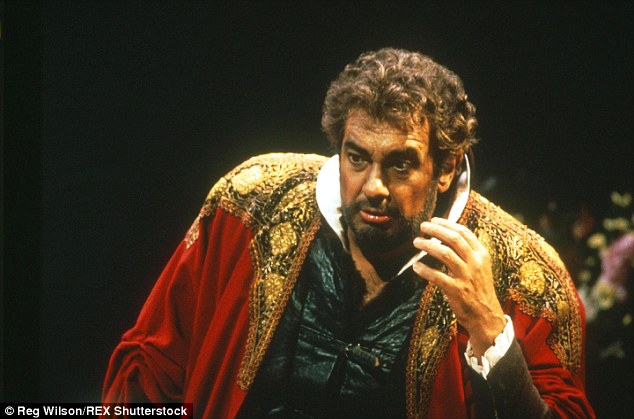
Domingo as Otello

Placido Domingo’s was a voice I first heard on record in an early recital of arias, but I will never forget the thrill of first hearing him live at the Royal Opera House, in La Fanciulla del West, if memory serves me rightly. Domingo certainly had presence and a glamorous voice to go with it. A real singing actor, he seemed to improve as a performer every time I saw him. Incredibly, he is still singing today, though he has moved over to the baritone repertoire recently, taking on such roles as Simon Boccanegra and Rigoletto. True, it is remarkable that a singer, and a tenor at that, can continue to sing into his seventies, but, great stage performer though he is, I am not sure that his excursions into the baritone repertoire have been entirely successful, and I prefer to remember him in the great days of his tenor glory.

In his early days, beautiful though his singing was, he could be accused of a somewhat generalised attitude to characterisation, but, over the years, he became more and more of a committed performer. Some of his roles he recorded several times, and one can hear how he progressed. The voice always had a dark, burnished quality, and the very top of the voice was never as easy as some, but, paradoxically, it sounds freer to me in his middle period than when he was young. Still, he wasn’t ashamed to admit that his top Cs were hard won,  and I actually applauded his decision to omit the unwritten ones, in Il Trovatore at Covent Garden, rather than doing what so many do and attempting to trick the audience by transposing Di quella pira down.  His Otello is a towering achievement, and, for many years, there was no one around who could challenge his hegemony in the role. He made three recordings of the role at different stages of his career, and there are quite a lot of visual documents of his portrayal, including the controversial Zeffirelli film.
 

fritz-wunderlich-540x304
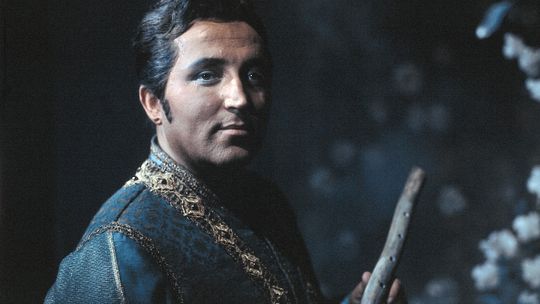
Wunderlich as Tamino


Free, ringing top Cs were never a problem for Fritz Wunderlich, who had a voice of overwhelming heady beauty. He died just before his 36th birthday, at a time when his interpretative artistry would have been reaching its maturity, his final concert in Edinburgh being testament to that. However if you ever want to hear someone just revelling in the sheer joy of singing, then listen to his DG performance of Lara’s Granada. Admittedly it is in German and the splashy arrangement is pretty vulgar, but he sings with a freedom and passion that would be the envy of any Latin tenor. For me, Wunderlich’s singing always conveys a sheer joy in the act of singing itself. Though he died young, he made many recordings, and it is this sense of joy that I most prize.

Interpretively, his recordings of Lieder don’t probe as deeply as some no doubt, but he was still young when he made them and unfortunately hadn’t reached his interpretive maturity before he died. For instance, the Dichteriebe he sings at his final concert in Edinburgh is a great deal more interesting than the recording he made for DG a year or so earlier. He did leave us arguably the greatest Tamino on disc, on Böhm’s Die Zauberflöte, which for once has a truly heroic dimension, a superb rendition of the tenor songs in Mahler’s Das Lied von der Erde (both in the studio under Klemperer and live under Krips), and of the tenor arias in Karajan’s recording of Die Schöpfung. Most of his Italian and French repertoire was sung in German, but still has a golden, Italianate warmth, and we do have at least one recording of him singing Verdi in Italian, a live performance of La Traviata from Munich with the young Teresa Stratas as Violetta. His early death was a tragedy beyond reckoning, as one wonders what he might have gone on to achieve. His Steersman on the Konwitschny recording of Der fliegende Holländer gives notice that he could have gone on to sing Lohengrin at least, and, in Verdi, what a wonderful Duke, Don Carlo or Riccardo he would have made.
 

7b7e4b7114700ace42a1f6aa0c212bb7
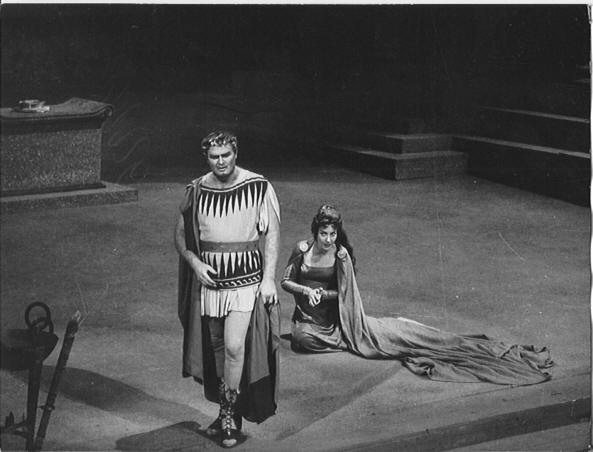
Vickers as Giasone with Callas as Medea


Staying with tenors for the moment, I turn to Jon Vickers, who had a voice and manner of startling individuality, and an intensity of performance that could almost be too painful to listen to. Though well known for his Tristan, his Siegmund, his Florestan and his Grimes, he first came to prominence singing in Italian opera. In 1958 he sang Giasone to Callas’s Medea in Dallas, and then also in London, at La Scala and at the ancient Greek theatre at Epidaurus. He had enormous respect for Callas and named her as one of the two people to have the most profound effect on opera in the post World War II period (the other being Wieland Wagner).  He was also Don Carlo in Covent Garden’s legendary Visconti production of Don Carlo, conducted by Giulini, which also had Gobbi and Christoff in the cast. With a voice of such power and penetration he naturally progressed to Wagner, singing towering performances of Tristan and Siegmund. His Otello suffered like no other and his Peter Grimes, mercifully preserved on film, is one of the greatest creations of all time. Like all the singers in this survey, his voice is instantly recognisable, his style somewhat idiosyncratic, but intensely musical. There is always something monumental about a Vickers performance. On disc, I find his Aeneas (in Berlioz’s Les Troyens), his Florestan, his Tristan and his Otello unequalled by any who have followed, and his Grimes, so totally different from Pears, utterly convincing.
 

a_teytemelisande
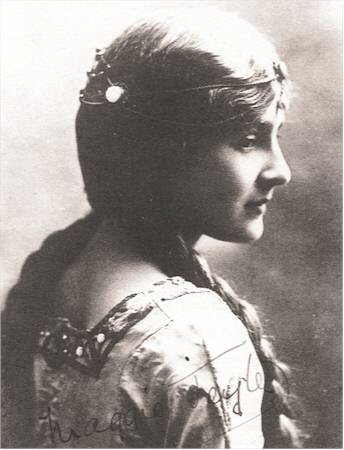
Teyte as Melisande

Next on my list are two more sopranos, one from well before my time and one who died only recently. I first heard the voice of Maggie Teyte in a performance of Duparc’s Chanson Triste and was totally captivated. Her performance of the song remains my yardstick to this day. Born in 1888, she was cast in the role of Mélisande by Debussy himself, replacing the creator of the role, Mary Garden.  She prepared the role by studying with Debussy, and is the only singer ever to be accompanied in public by the composer (in a performance of his song Beau soir). She married twice and went into semi-retirement after her second marriage in 1921. Like her first marriage, this ended in divorce and Teyte had some difficulty reviving her career afterwards. For some time she appeared in music hall and variety, which explains much of the lighter repertoire she sang and recorded. However the recordings of Debussy songs she made with Alfred Cortot in 1936 attracted a lot of attention, helping her to gain a reputation as one of the leading interpreters of French song, The voice remained pure, without a hint of excessive vibrato even into her sixties, and she made her final concert appearance at the Royal Festival Hall at the age of 68.

I would recommend any and all of her recordings of French song, as well as her wondrous rendering of ‘Tu n’es pas beau’ from La Périchole, which shows off to advantage her gloriously individual chest tones, and a twinkle in the eye. A private recording of her singing bits of Salome (to a piano accompaniment) show that she might even have been an ideal Salome, the silvery purity of the voice being close to Strauss’s ideal, and it is a great pity that plans for her to sing the role at Covent Garden never came to fruition.
 

victoriadelosangeles
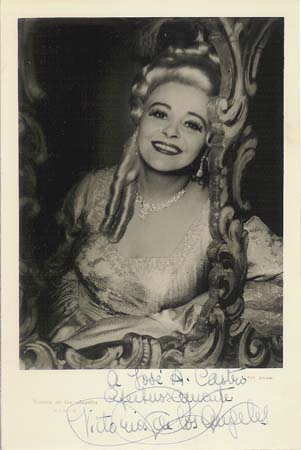
De Los Angeles as Manon

Truth to tell, I hadn’t much liked Victoria De Los Angeles when I first heard her (as a rather insecure and out of sorts Hoffmann Antonia) and I think it was probably her record of the Canteloube Chants d’Auvergne that first led me to investigate further. She had a particularly wide song repertoire, which took in early and late Spanish composers, as well as Lieder by Schubert, Schumann and Brahms and French song. One of her greatest quality was her charm and that quality the Italians refer to as morbidezza, meaning that, on the operatic stage, she was most at home playing gentler heroines. That Antonia was misleading and later I discovered she could be the perfect Marguerite (Faust), Butterfly, Rosina and Mimi displaying a golden voice allied to a winning personality. Best of all perhaps is her Manon in Massenet’s opera.  Where some make the character too knowing, De Los Angeles emphasises the childlike innocence and delight in pleasure that is at the heart of Manon’s downfall. She was also a superb Desdemona (in a live broadcast from the Met) and it’s a great pity she never got to record the role commercially.

Her Carmen on the Beecham recording has been much praised, but here I find her less convincing, though, as usual, her singing is unfailingly musical. I just can’t imagine De Los Angeles’s Carmen pulling a knife on a fellow worker. She is altogether far too ladylike. She is on record as saying that she based her Carmen on the Andalusian gypsies, who were known for their charm, a quality De Los Angeles had in abundance, but my Carmen is dangereuse est belle (Micaela’s description) and De Los Angeles, charming and adorable as she was, never sounds dangerous to me.
 

with-gobbi
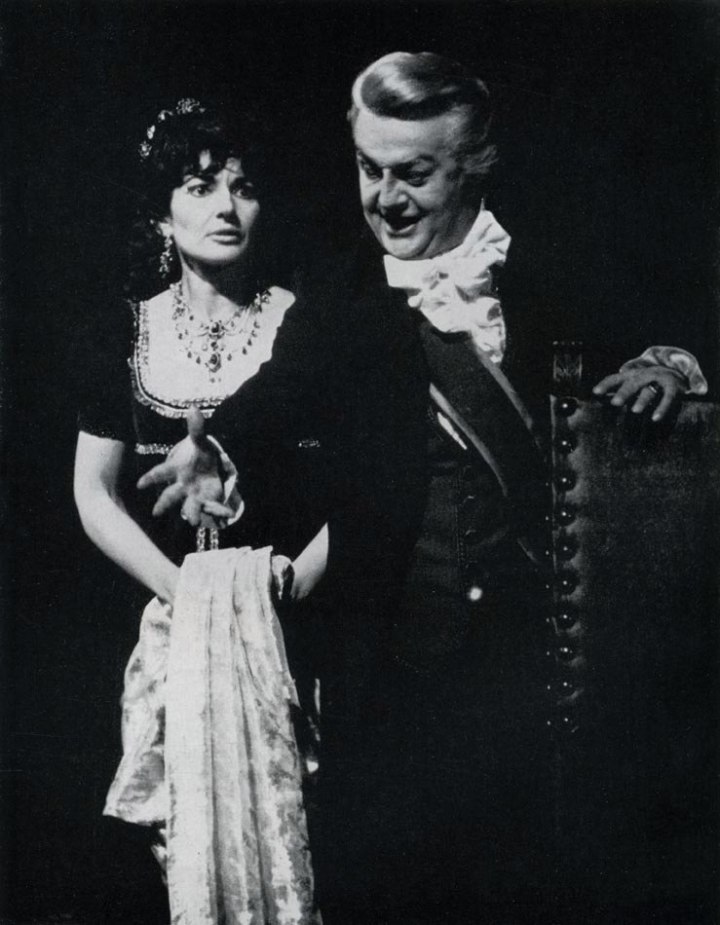
Gobbi as Scarpia with Callas as Tosca

So far the list is rather top heavy with high voices, so I am happy to include as my next choice a baritone, colleague of Callas’s and one who encompassed many of her qualities. Like Callas, Tito Gobbi had an immediately recognisable voice and always sang with a wealth of colour and understanding. I can still remember the shattering effect of my first listen through Rigoletto, actually the first ever time I’d heard the opera. His cries of “Gilda” at the end of Act 2 after she has been abducted went straight to the heart. He may not have had the most beautiful baritone voice in the world, but, like Callas’s, it had a myriad of different colours. And like her, though always recognizably himself, he was always able to change his timbre to suit the role he was playing. 

We are fortunate indeed that, though they sang rarely on stage together (most famously in Zeffirelli’s renowned Covent Garden production of Tosca), they made many recordings together; two recordings of Tosca, Lucia di Lammermoor, Aida, Un Ballo in Maschera and Il Barbiere di Siviglia, their collaboration possibly reaching its apogee in Rigoletto, with its long series of duets for father and daughter. Again, like Callas, he could put more meaning into a line of recitative, even into a word, than bars of singing by less dramatically attuned singers. The way he utters the single word Amelia in Verdi’s Un Ballo in Maschera, when he discovers the identity of Riccardo’s midnight tryst, resonates in my mind’s ear even now. Some would aver that he didn’t have a true Verdi baritone voice, but, as I think now of the parade of Verdi roles he sang – Rigoletto, Amonasro, Posa, Simon Boccanegra, Renato, Iago, Germont, Falstaff, Nabucco – they all emerge as distinct and different characters. Of how many other singers can you say that? Scarpia in Puccini’s Tosca might be his most famous creation (a repulsively reptilian character, who is both a gentleman and a thug) but it is in Verdi that his musical skill is most evident. What a tragedy that Walter Legge never had the foresight to record Macbeth with him and Callas as the murderous couple.
 

cesare-1
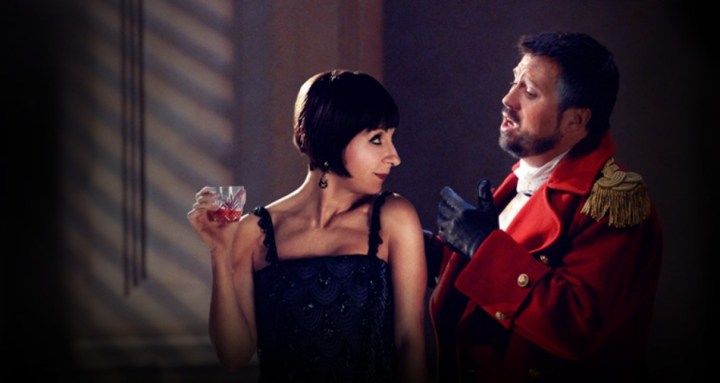
David Daniels as Caesar with Natalie Dessay as Cleopatra

Looking back at this list of singers, I realise that they all have certain things in common; the individuality of their voices (you only have to hear a few notes to know who it is) and their ability to make the listener see as well as hear. This is no less true of countertenor, David Daniels, a singer still very much before the public today. Some years ago, I was more or less dragged to a concert of Vivaldi sung by Daniels and accompanied by Europa Galante conducted by Fabio Biondi. Till then, apart from the Four Seasons and the Gloria, I had had little enthusiasm for Vivaldi’s music and had a total antipathy for countertenors in general. Daniels changed all that. Here was a voice of surpassing beauty, coupled to a marvellously natural personality. It was a total conversion and Daniels has now opened the door on a whole world of music I had previously ignored, which shows it is never too late to expand one’s horizons. I have hardly missed any of his appearances in this country, and, like all the singers on this list, he has a gift for communication vouchsafed to just a few.

He has also expanded the repertoire for countertenors, embracing American song, Lieder, French song and even Broadway. Sometimes the experiments don’t quite work. For instance, though his singing is, as ever, unfailingly musical and filled with meaning, the countertenor voice, even one as mellifluous and beautiful as his, just doesn’t have the range of colour required for a piece like Les Nuits d’Eté, and though I appreciate and enjoy his excursions into nineteenth century and modern repertoire, it is for the music of the baroque, and especially Handel, that I turn to him. In his early days his coloratura singing was sensational, but I treasure most his deeply felt singing of some of Handel’s slower arias. In an aria like Scherza infida he holds the line beautifully and firmly, but evinces a pain that is almost palpable. No other singer I have come across quite makes the same effect in this music. I am guessing that he will be coming towards the end of his career now, and I count myself fortunate indeed to have been able to experience his singing live whilst he was in his prime. I saw him so many times, that I swear he actually spotted me in the audience on several occasions, and acknowledged my applause with a nod in my direction.

Of course, apart from these singers, there have been many memorable performances. I recall the excitement of the first time I heard a really world class singer, Helga Dernesch in Fidelio and as the Marschallin (still the best I’ve seen live on stage); Agnes Baltsa’s Carmen with the no less memorable Don Jose of Jose Carreras; ditto Baltsa’s thrilling Eboli; the superb Dejanira of Joyce Di Donato; Angela Gheorgiu’s first Violetta, and Ileana Cotrubas‘s Violetta too;  Roberto Alagna’s first Romeo (in the Gounod opera); Kiri Te Kanawa’s exquisitely, if placidly, sung Fiordiligi (with Baltsa again, as an adorably funny Dorabella); Renee Fleming in Previn’s A Streetcar Named Desire; Margaret Price and Lucia Popp in concert. I also regret never seeing live the wonderful Lorraine Hunt Lieberson, who was taken from us far too early and at the height of her artistic maturity, and whom I first remember in a Proms concert on TV, at which she was the radiant soloist in a performance of Elgar’s The Music Makers. These too will always stay in the memory, but I send my gratitude to the ten on my original list, for through them I have discovered a whole world of great music. They may not necessarily be the ten greatest singers of all time but they have enriched and enlightened and can truly be called singers who have changed my life.

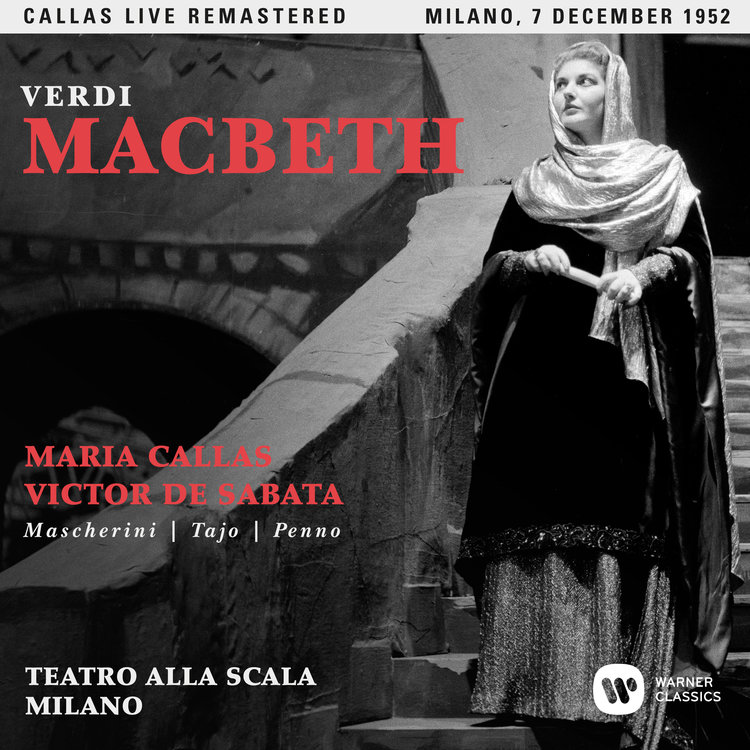


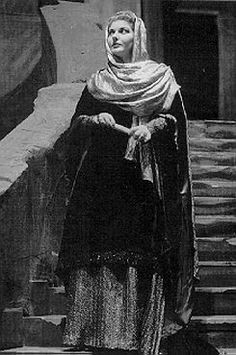
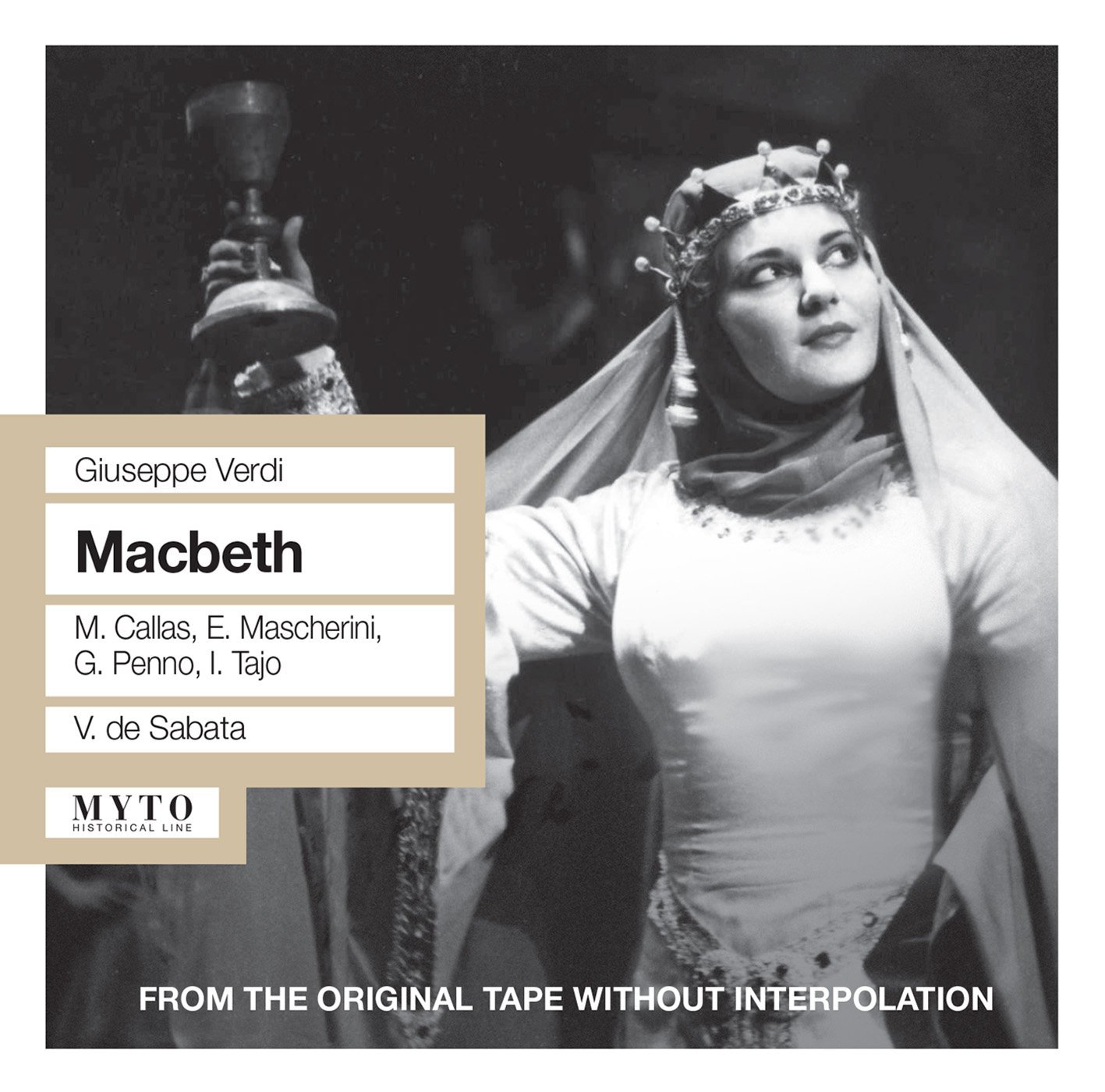
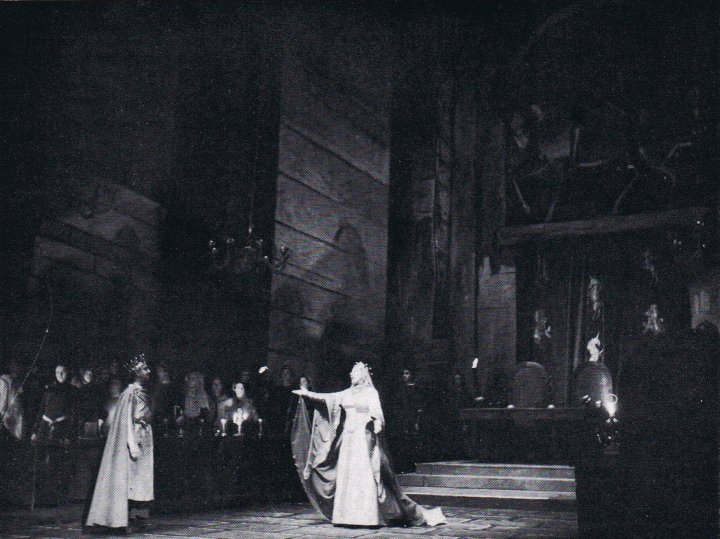
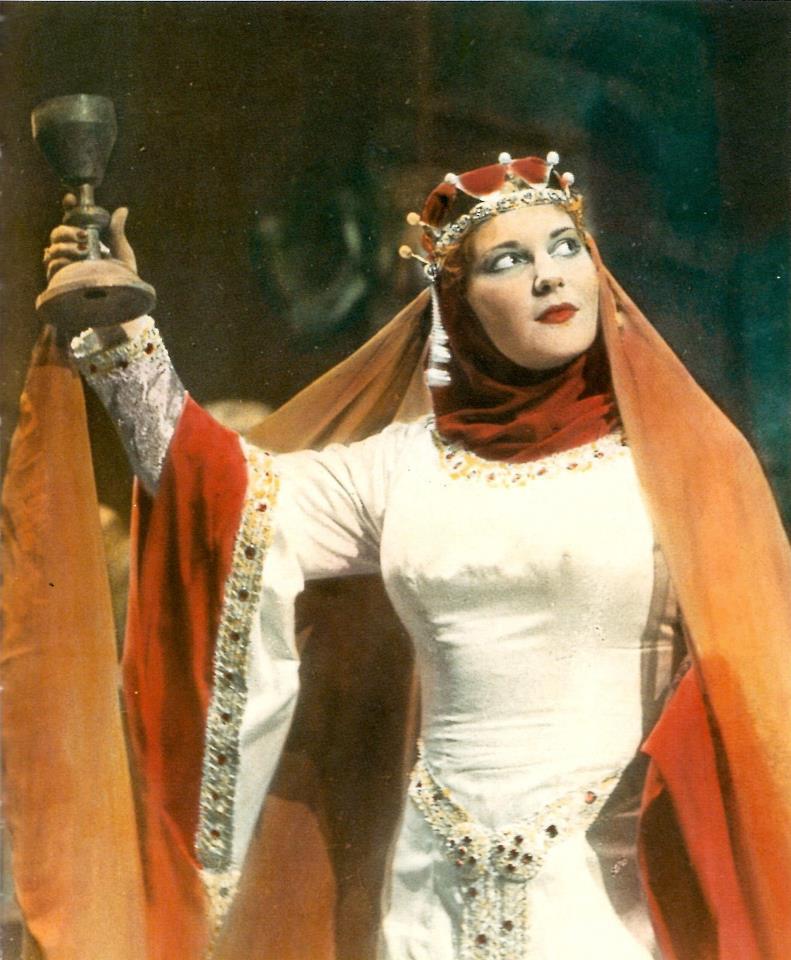
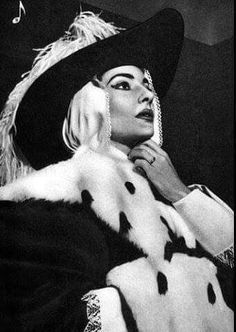
Callas’s Lady Macbeth

IuVTSA1

UPDATED NOVEMBER 2017

As I reviewed this performance only recently, I thought I would just re-post with a word or two about the sound of the Warner edition.

Thankfully, Warner seem not to have used the awful EMI version, itself a clone of another release. EMI failed to notice that the version they used had spliced into the Act I finale a few bars of a performance with Gencer, done to cover what was thought a loss of tranmission. This new version, and the Myto detailed below, has found the missing bars and included them, though the sound here is more muffled than elsewhere in the ensemble. Comparing Warner to Myto, I eventually came down in favour of Warner, which sounds a little cleaner to me, though there is not a great deal in it. I haven’t heard the Ars Vocalis version, so can’t comment on it. The main thing to take into account is that both Warner and Myto are a substantial improvement on EMI, which was practically unlistenable.

*****

b820427bc82e3229a55b7d8d85128144

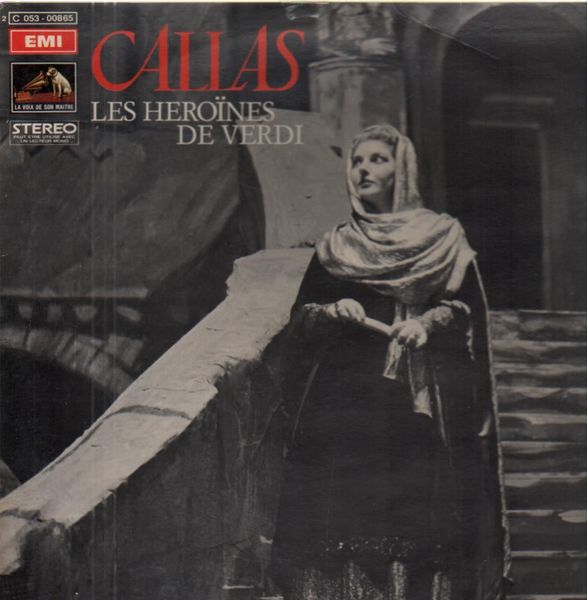
One of the yawning gaps in EMI’s catalogue of Callas recordings has always been a studio recording of Macbeth with Callas and Gobbi as the murderous pair. With Di Stefano as Macduff and Zaccaria as Banquo and Serafin, or even Karajan, at the helm, EMI would no doubt have had a winner, but Walter Legge deemed the opera not popular enough and so Callas got to record Mimi, Manon and Nedda instead, roles which she was never to sing on stage, but no doubt seemed more commercially viable. It is also easy to forget that back in the 1950s, Macbeth didn’t have the same high regard it has now. Ultimately, all Callas got to record of the role were Lady Macbeth’s three great solos for her Verdi Heroines recital of 1958. Nevertheless, so successful are her interpretations that they have become the standard for all Lady Macbeths who followed, and Callas has become indelibly associated with the role, though in fact these La Scala performances were the only occasion she ever sang it.

This performance, which opened the 1952 La Scala season, was certainly a starry affair. It was directed by Carl Ebert, with designs by Nicola Benois, and conducted by Victor De Sabata, and though the rest of the cast were hardly in Callas’s class (who was?) they are all a good deal better than adequate.

As can be heard in Myto’s most recent transfer of the performance, much clearer than any I have heard before (and a good deal better than EMI’s shoddy presentation), De Sabata has a terrific grip on the score, his conception symphonically conceived, and the La Scala orchestra play brilliantly for him, his tempi, with one glaring exception, which I will come to shortly, judiciously chosen. We are vouchsafed all of the ballet music, which is brilliantly played.

719v-j8siyl-_sl1417_

Mascherini’s Macbeth has been criticised for being a relatively muted presence, and he’s certainly no Gobbi, but I think his performance works in context. Macbeth, after all, is a weak character. It is Lady Macbeth who drives the narrative, both in Shakespeare and in Verdi. Sure, Mascherini is not particularly imaginative in his phrasing, but he makes an excellent foil to Callas in the duets, which she dominates, as she should.

14e042b

The opera belongs to the protagonists and both tenor and bass roles are relatively minor. Whilst Penno as Macduff and Tajo as Banquo are not in the first rank, neither of them is bad, and both are much better than adequate.

But, certainly in this performance, the opera belongs to Lady Macbeth and Callas is astonishing. So complete is her mastery of the role’s complexities, that one would have thought that she had been singing it for years, whereas this was in fact the first time she was singing it in public. She doesn’t get off to the greatest of starts, with her peculiar voicing of the spoken letter before her first recitative, but once she launches into Ambizioso spirto, she never misses a trick. Her voice was in prime condition at the time, securely gleaming on high, dark and richly powerful down below. No other Lady Macbeth has so acutely observed  Verdi’s meticulous markings; no other Lady Macbeth has sung with such power and force, and yet with such a range of colour and expression; no other Lady Macbeth has executed the fiendishly difficult fioriture with such uncanny accuracy. This is the stuff of genius, no doubt about it, and anyone who has ever doubted Callas’s pre-eminence in the field should listen to the performance, preferably with score in hand.

2v9oxnk

As usual with Callas, she is apt to make her mark in a line, a word of recitative, as in one of the big set pieces, and her portrayal, full of incidental details, is all of a piece. Amongst the many revelations, I would mention the way she sings Vergogna, Signor after Macbeth has broken down before the ghost of Banquo in the banquet scene. The peculiar inflection she gives it, somehow suggests the deep love that exists between the couple, for without it, how does one explain why Macbeth is so much in thrall to his wife.

When Callas came to record Lady Macbeth’s three big scenes for her Verdi Heroines recital disc, her voice had lost some of the power and security on top, and consequently, good though they are, both Vieni t’affretta and La luce langue reach their fullest expression in the live La Scala version. However I do have a problem with the very fast speed De Sabata adopts for the Sleepwalking Scene. At so fast a tempo, Callas is less able to make her points, and it has always seemed to me something of a miscalculation. By the end of the scene, he has slowed down a bit, so maybe he thought so too, and we don’t know what happened in subsequent performances.

By contrast, the version on the recital disc is one of the greatest examples on disc of Callas’s deep psychological penetration into the psyche of a character. In interview she retells how she had felt in pretty good voice on the day of the recording, and emerged from the studio feeling quite pleased with herself. However , she was a little taken aback when Legge said she would have to do it again. Once she listened to the playback, though, she knew exactly what he meant. She had done a great piece of singing, but had not done her job as an interpreter. She then goes into a detailed analysis of the scene, of Lady Macbeth’s fluctuating thoughts, her fractured mental state, and how this should be expressed through the voice. Though much of Callas’s art was instinctive, there was evidently much also that was intellectual.

mariacallas-lesheroinesdeverdi2

Callas only sang Lady Macbeth for one series of performances, at La Scala in 1952, but her achievement in the role has never been bettered, and it is a great shame that the role did not remain part of her active repertoire.

Callas’s Two Recordings of Un Ballo in Maschera

Amelia is a role that should probably have figured more in Callas’s career. She sang excerpts as a student, almost got to sing it at La Scala under Toscanini, but actually didn’t tackle the whole role until the recording she made under Antonino Votto in 1956, and after singing it in a lavish new production at La Scala the following year, never sang it again, though she returned to Amelia’s two big solos in the studio in the mid to late 1960s.

We are fortunate that the La Scala live performance was captured in sound, and, though sonically it is not as clear as that on the studio recording, it is one of the best preserved La Scala broadcasts. Common to both the studio and live sets are the La Scala forces, Eugenia Ratti’s Oscar, Callas and Di Stefano. Everything else is different, so which is best?

8f825371ac535bc78eff94d1e53e830c

First off we note that Gianandrea Gavazzeni on the live set is a much more positive presence than the somewhat prosaic Anotonino Votto. It is testament to his soloists that the Votto recording remains one of the most recommendable of studio sets 60 odd years after its release, but Gavazzeni’s performance is definitely more alive to the drama, and, from that point of view at least, the live performance is preferable. One should also note that the audience is a palpable (and vocal) presence, which some may find distracting. Personally I find it all part of the fun. Though one of the best of Callas’s La Scala broadcasts, it still tends to overload at climaxes. The studio set is in good mono sound.

2bc503e04787e8c5dbe1effaa7e42991

Let’s now take the other differences. What I miss most on the live recording is Gobbi’s Renato. Bastianini on the live set was a fine singer, and probably had what we consider more of a Verdi baritone sound, but he is not nearly as imaginative as Gobbi. Bastianini has the more beautiful voice. Gobbi creates the more interesting character. When Gobbi sings the single word “Amelia” at the moment his wife is revealed to be the Duke’s paramour, he invests it with a wealth of conflicting emotions far beyond the scope of the more forthright Bastianini, so, in this respect at least the studio version is preferable. The conspirators on the studio set are also slightly better at vocal word painting than their live counterparts, but the difference is marginal.

Both the Ulricas are excellent, and if I prefer the magnificent Simionato on the live set, my preference is again only marginal. Barbieri is also excellent on the studio set. Eugenia Ratti is a trifle shrill for my liking on both the studio and live sets.

As for Callas and Di Stefano, I’d find it hard to choose between their performances, as they are both in terrific voice on both sets. Di Stefano is not the most aristocratic of Riccardos, but he has bags of personality. In the live set, he can be guilty of playing to the gallery somewhat, but the audience give him a rapturous reception, so who can blame him?

Callas is in magnificent form on both sets, her singing full of incidental details most singers miss, her command of the role’s difficulties staggering. I often wonder why her voice sounds so much fuller and richer in this role than it does on the studio Aida, which was recorded in 1955, the year before the studio set and two years before the live version. Possibly because Amelia is a transitional role, requiring a full compliment of trills and vocal graces of which Callas was a mistress. However it also requires quite a large voice, which is why the vocal niceties of the role are usually glossed over or ignored. Listen to Callas sing in her first scene the arching phrase Consentimi o signore with a pure legato and refulgent tone, whilst perfectly executing the little turn at the end of the phrase that signifies Amelia’s nervous state. Note also that when Amelia mirrors Oscar’s trills in the Oath Scene, it is Callas, not Ratti, who demonstrates perfect trills. It is moments such as these that make Callas stand out from all others.

callas_amelia

A month after the La Scala prima, she was to sing Norma at the Rome Opera at a gala attended by the Italian president. She was unwell and tried to cancel, but, against her better instincts allowed herself to be persuaded by the management to do the performance, as, incredibly, they had not bothered to engage an understudy. During the performance, she felt her voice slipping away from her, and refused to carry on after Act I. This created one of the biggest scandals of her career. The Rome Opera refused to make any announcement on her behalf, and then compounded the problem by cancelling the rest of her contract, even though she had representations from doctors confirming her illness. The press had a field day, even fabricating footage of her supposedly rehearsing in good voice, though the footage was actually from a radio broadcast in 1955. She eventually sued the Rome Opera, a case that was settled entirely in her favour, but the case dragged on for years, and by the time she won the case, the damage done to her personally was irrevocable.

When she returned to La Scala later that year in a revival of Anna Bolena, the La Scala audience greeted her with icy silence, though, as was her wont, by the end of the first performance, she had scored a personal triumph even greater than at the prima the previous year. Unfortunately, when she returned to her villa with Meneghini, it was to find the walls and gates covered and daubed with dog excrement. Is it any wonder she began to doubt whether devoting her life to her art was really worth the trouble? Is it any wonder that the world of the glitterati, empty though it would turn out to be, should suddenly seem so attractive?

After the live La Scala Un Ballo in Maschera, there are of course some stupendous performances to come, the Dallas Medea, the London and Lisbon La Traviatas for instance, but we rarely hear her sing again with such security, and ease. Pure conjecture on my part of course, but I often wonder if that Rome cancellation, and the fall out from it, was when the pressure of performing, of always having to be the best really started to get to her.

Verdi’s Aida – a comparative review of 5 different recordings

I’m not quite sure how I’ve ended up with five different recordings of Verdi’s Aida. It’s not my favourite Verdi opera by a long chalk. Though it has magnificent music, the characters always seem more like human archetypes than flesh and blood people and I admire it rather than love it. Three of my recordings feature Callas, and, though I never think of Aida as a Callas role, she brings more meaning to it than most. Two of the Callas recordings (the ones that find her in the best voice) are live, but the sound on both is, at best tolerable, so the studio one is also a necessity, though the 1955 mono sound on that can’t hope to compare with the fabulous sound accorded the new Pappano set that was recorded in 2015.

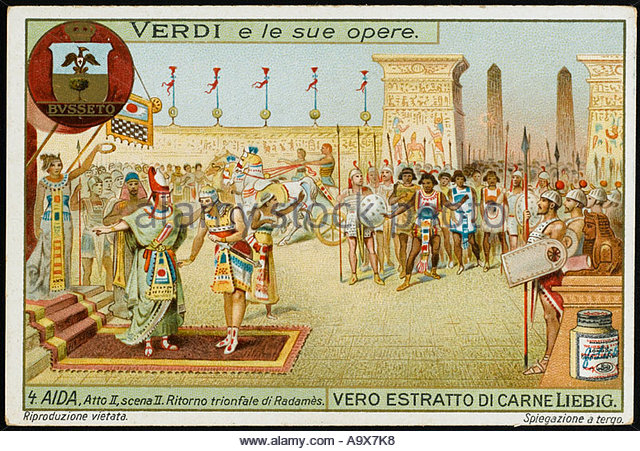
Aida is of course the quintessential grand opera, famed throughout the world for extravagant stagings at the Arena di Verona, but actually, aside from the great Triumphal Scene, many of its scenes are played out in private, behind closed doors.

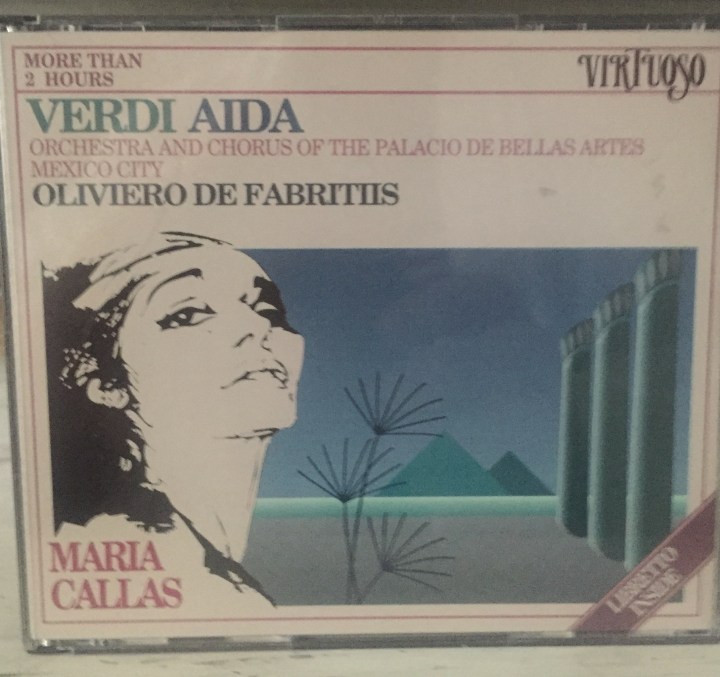
I started my journey with the famous live 1951 performance from Mexico, with Callas, Del Monaco, Dominguez and Taddei, conducted by Oliviero de Fabritiis.

20170209_120338515_iOS

Well let’s get over the caveats. The sound is pretty atrocious; it crumbles and distorts and the balances are all over the place. The voices come through reasonably well, but you do have to listen through the sound, as it were. But what a performance! And a memento of what was undoubtedly a thrilling evening in the theatre.

Callas is in superb voice throughout, and makes more of the somewhat placid character of Aida than any other singer I have come across. The power she was able to summon at this point in her career has to be heard to be believed, a power that goes right up to that unwritten, but absolutely stunning top Eb in alt in the Triumphal Scene, a phenomenal sound, that excites the Mexicans so much you can almost hear them rip the seats apart. Ritorna vincitor is absolutely thrilling, the duet with Dominguez’s Amneris also superb, but, as always with Callas, it is the Nile Scene that provokes her most moving singing.

O patria mia is not her best moment. She seems momentarily preoccupied with the exposed top C at the end, a solid if not exactly dolce as marked note, but once past the aria, she is on more congenial ground, and, with Taddei a worthy partner, alternately stentorian, implacable, insinuating and relentless, runs the gamut of emotions in an exciting Nile Scene. In the ensuing duet with Radames, she finds a wealth of colour as she seduces and cajoles him.

Del Monaco, as usual, is not particularly subtle, but there is the clarion compensation of the voice itself, and, like all the Radames Callas sings with in the three recordings, makes a better hero than lover.

Dominguez is very impressive. This was her debut in the role, and occasionally she overplays her hand, but her singing is very exciting and the Mexicans give her a rousing reception.

De Fabritiis conducts a dramatic, but not particularly subtle, version of the score. Nowhere does he find the delicacy of Karajan or Pappano, or even Serafin, but subtlety is not really what this performance is about.

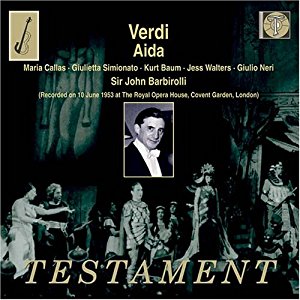
I next moved onto another live Callas performance; this one from Covent Garden in 1953, with Kurt Baum, Giulietta Simionato and Jess Walters, conducted by Sir John Barbirolli.

51M08G0ND7L._SY300_

Unfortunately Barbirolli turned out to be something of a disappointment. More subtle than De Fabritiis in Mexico admittedly, the performance lacks excitement and many of his tempi are unaccountably slow. Maybe his approach was more suited to the reserved Londoners than the excitable Mexicans, but the latter has a thrilling vitality completely missing in London.

There is no thrilling Eb in the Triumphal Scene, but Callas is still in superb voice. However Barbirolli’s slow tempi vitiate against some of her more dramatic moments. The I sacri numi section of Ritorna vincitor lacks the bite Callas usually brings to it, though she is able to spin out the final Numi pieta to even more heavenly lengths at Barbirolli’s slower tempo.

Baum is not quite as bad as his reputation, but he hardly ever phrases with distinction and he sobs and aspirates in what he evidently thought was the Italian manner. He also has a tendency to hold on to every top note as if his life depended on it, so that his duets, both with Callas and Simionato, become somewhat combative. That Callas manages to sing the final duet with the grace and delicacy she does is little short of miraculous, given Baum’s determination to bawl his way to his death.

Simionato, a more experienced Amneris than Dominguez, is magnificent and Barbirolli does finally wake up for her final scene, though you sense Simionato propelling the music forward and they almost become unstuck. Am I being picky, though, when I wonder if a little too much of Azucena creeps into Simionato’s interpretation? Amneris is after all a young princess, but more on that subject later.

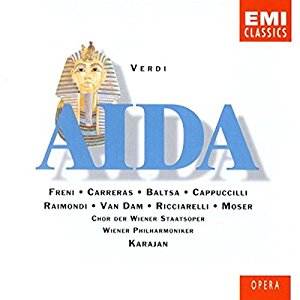
Somewhat disappointed with Barbirolli, I moved on to the second Karajan recording, recorded in Vienna with Mirella Freni, Jose Carreras, Agnes Baltsa and Piero Cappuccilli.

41V5vkkW6hL._SY300_

Karajan’s speeds in this, his second recording, of the opera are also spacious but much more vital. I’ve always found his first effort, with Tebaldi and Bergonzi, a little too self-consciously beautiful. This one is far more alive to the drama. It goes without saying that the Vienna Philharmonic Orchestra play superbly and the sound is excellent analogue stereo, though the voices are a little too recessed for my liking, and are often submerged by the orchestra. Given that Karajan uses lighter, more lyrical voices than we have become used to, this does seem a somewhat perverse decision.

If singers of  Radames tend to break down into the heroic and poetic, Carreras is more in the latter camp. His voice is doubtless a notch too small for the part, but it was still a beautiful instrument at that time, and his is the most attractive Celeste Aida we have heard so far, though he doesn’t manage the pianissimo top B at the end. He is at his best in the final duet, his piano singing a welcome relief from the overloud Del Monaco and Baum.

Freni is very attractive, if a little lacking in personality. Her voice might also be considered a little light for the role, but she never forces and sings within her means, phrasing sensitively and singing cleanly off the text. She does nothing wrong, but set next to Callas, she just isn’t that interesting.

The best of the soloists is, without doubt, Agnes Baltsa. Here at last we have a believably young, spoiled princess, a plausible rival for Aida. Seductively sexy and driven to distraction by jealousy, she is convincingly remorseful at the end of the opera, nor does she sound like an Azucena in disguise. She is superbly effective in her duets with Radames and Aida, and gorgeous in the first scene of Act II. She is my favourite of all the Amnerises.

Cappuccilli I find efficient rather than inspired. He doesn’t stamp his authority on the role of Amonasro the way Taddei and Gobbi do, though, as usual, his breath control is exemplary. In a star studded cast, both Ramfis and the King (Ruggero Raimondi and Jose Van Dam) are excellent and we even get the silken voiced Katia Ricciarelli in the role of the Priestess.

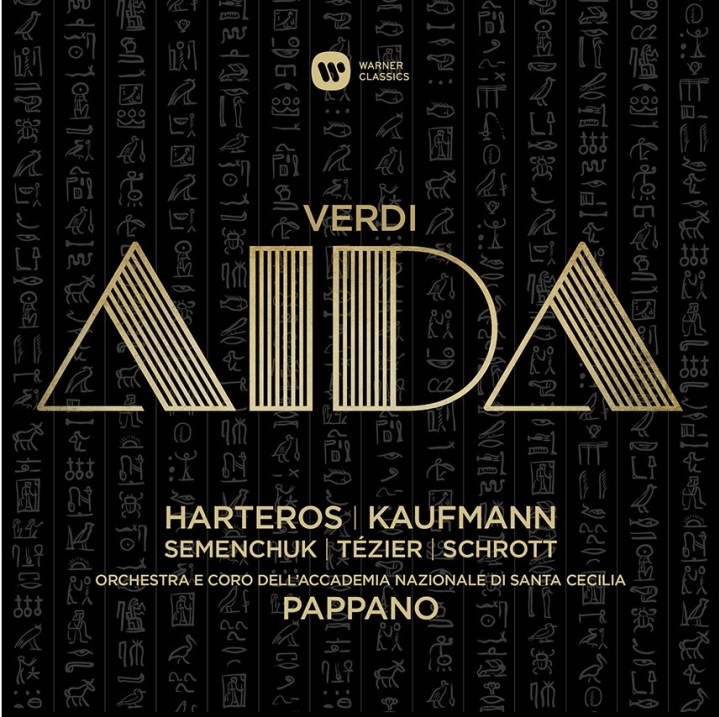
From Karajan I turned to the latest addition to the Aida discography. Recorded in the studio, a rarity for opera recordings these days, it is conducted by Antonio Pappano, and stars Anya Harteros, Jonas Kaufmann, Ekaterina Semenchuk and Ludovic Tezier with Orchestra and Chorus of the Saint Cecilia Academy.

cd-ver_kauf_pappano_2

As one might expect, the sound in this new digital recording is superb, much more naturally balanced than the Karajan, with the voices coming through beautifully. Pappano exerts a superb grip on the opera, and his might just be the best conducted version of the lot, in the best lyric Italian tradition of conductors like Serafin, more of whom below.

Best of the soloists is definitely Jonas Kaufmann, who might just be the best Radames ever to be recorded. He has both the heroics and the poetry (a deliciously ppp close to Celeste Aida) and is vocally the equal of all that Verdi throws at him. Throughout he phrases with sensitivity and imagination, and achieves miracles of grace in the final duet, with some genuine dolce singing. This is a great performance.

Harteros is in the Freni mould, vocally not quite as secure, but a little more interesting. She goes for a dolce top C in O patria mia, but it is a little shaky. She does not erase memories of Caballe (on the Muti recording) in the same music, but hers is nevertheless an attractive performance.

Semenchuk I don’t like at all. She has a typically vibrant Eastern European voice, with a tendency to be squally. She reminded me most of Elena Obrasztsova and sounds a good deal older than she looks in the photographs accompanying the recording. All the other Amnerises under consideration bring something more specific to the role, where she is more generalised, and consequently the big Act IV scene lacks tension.

If not quite in the Gobbi or Taddei class, when it comes to verbal acuity, Ludovic Tezier is a fine Amonasro and together he and Harteros, with Pappano’s inestimable help, deliver a fine Nile Duet. The basses are not quite in the same class as those on Karajan and Serafin.

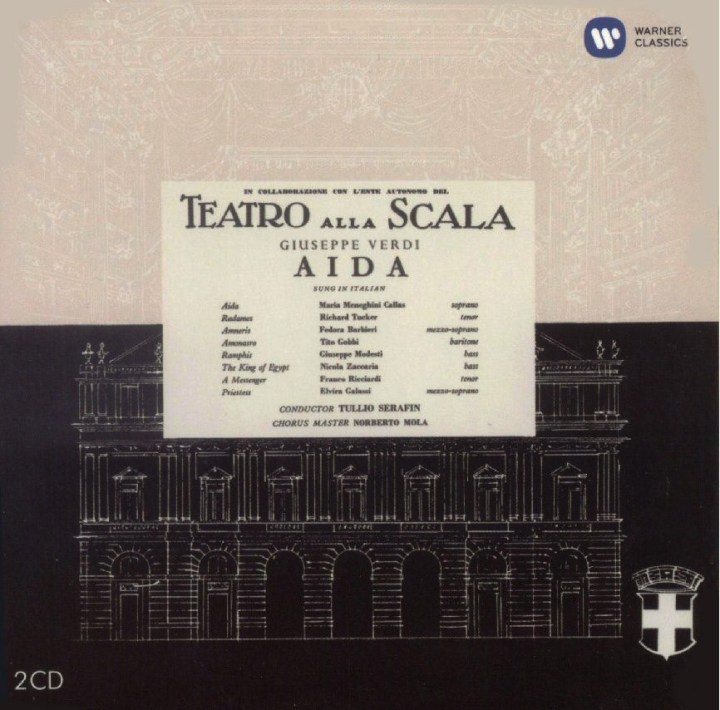
Which brings me to Serafin and Callas’s studio recording of the opera.

cd_callas_aida_1_1

By the time this recording was made in 1955, Callas had given up the role of Aida, singing her last performances in Verona just a few months after the 1953 Covent Garden performances under Barbirolli.

Callas’s voice has thinned out quite a bit, and she sings a much more refined performance of the role, perhaps more in line with conventional interpretations, except of course that Callas can never be conventional. When Tebaldi sings Numi pieta at the end of Ritorna vincitor, she sings a pure lyrical line and it’s very pretty, but Callas reminds us that she is asking the Gods to take pity on her suffering. Time and time again she will illuminate a phrase here, a word there. The duet with Amneris abounds with contrast as the two women play off against each other, but it is the duet with Amonasro in the Nile Scene that holds the heart of this performance, the scene where Aida must choose country before love. Gobbi is at his incisive best as Amonasro, and I doubt I will ever hear this duet done better. Note too how eloquently Serafin makes the strings weep when Aida finally gives in, first with the climbing phrase on the cellos and then in the way he accentuates those stabbing violin figures, when Callas sings O patria, patria quanto mi costi. This is the real stuff of drama.

Tucker isn’t in Callas and Gobbi’s class I’m afraid. He has the right sound for the role, virile and forthright, but for every phrase delivered with just the right degree of slancio, there is another ruined by his tendency to aspirate and sob.

Barbieri is very fine, in the Simionato mould, and, with Serafin letting go a veritable storm in the orchestra, produces a thrillingly dramatic Act IV scena.

Both basses (Giuseppe Modesti as Ramfis, and especially Nicola Zaccaria as the King) are splendid, and Serafin, as you might have gathered, conducts a wonderfully dramatic version of the score, in the best Italian tradition.

So conclusions then. No doubt there will be some wondering why I didn’t include Solti and Muti. Well, Solti I’ve never taken to. I just can’t stand his bombastic, un-Italianate, unlyrical conducting, good though his cast is (though I’ve never quite joined in the general enthusiasm for Gorr’s Amneris). I know the Muti but don’t own it. Until Pappano came along I usually used to recommend it as the safest bet, and Caballe gives one of her finest performances as Aida, and it is still, if memory serves me correctly, worth considering.

From the five under consideration then, I’d say De Fabritiis in Mexico is essential listening, if only as a memento of a historical occasion and a truly thrilling evening in the theatre. It could never be a library version though because of the intransigent sound. From the point of view of a library choice, then the new Pappano would probably be the safest bet, even though it has the weakest Amneris. Forced to choose but one recording, though, I’d go for Serafin, with a rather regretful glance over my shoulder towards Baltsa’s Amneris. The mono sound is sometimes a bit boxy and not a patch on either Karajan or Pappano, but its studio acoustic is a good deal better than either De Fabritiis or Barbirolli, who, in any case, surprisingly trails in last place in this survey, despite the presence of both Callas and Simionato.

Callas’s vocal splendour is best caught in Mexico in 1951, but, the sound is a problem, so it’s Serafin for me, if only for the Amonasro/Aida Nile duet, the most thrilling on all these sets.


Callas’s First Recordings

51fvbzc5ijl

Recorded 8-10 September 1949, Auditorium RAI, Turin

Producer & Balance Engineer unknown

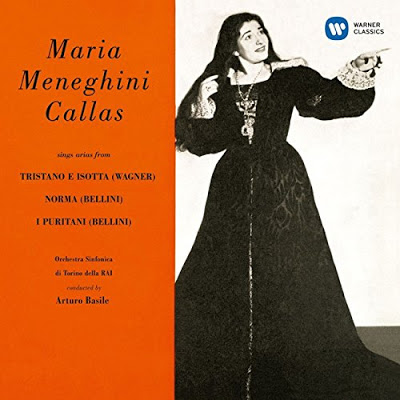
So finally I come to the end and find myself, after many hours of fantastic listening, at the beginning, Callas’s first commercial recordings and the 78s that introduced the world to the voice of Maria Callas. The recordings followed a radio concert of the same material (plus Aida’s O patria mia) and were obviously intended to showcase Callas’s versatility, a pattern which was to follow in some of her EMI recitals, like Lyric and Coloratura and the first French recital.

Callas was only 25 when these recordings were made, but they display an artistic and vocal maturity far beyond her years. She first sang the role of Isolde under Serafin in 1947 in Venice, literally sight singing the role at her audition. Serafin, who had conducted her in her Italian debut as Gioconda, was suitably impressed and hired her immediately.

The Liebestod is of course sung in Italian, but it is more than just a curiosity. This is a warm, womanly Isolde who rides the orchestra with power to spare. Note too how easily she articulates the little turns towards the end of the aria. Her legato is, as usual, impeccable, and the final note floats out over the postlude without a hint of wobble.

Norma’s Casta diva and Ah bello a me are sung without the opening and linking recitatives, but the long breathed cavatina is quite possibly the most beautiful she ever committed to disc, and the cabaletta, though it lacks some of the light and shade she would later bring to it, is breath taking in its accuracy and sweep.

But what caused the biggest sensation at the time was the Mad Scene from I Puritani. What was considered a canary fancier’s showpiece suddenly took on a tragic power nobody suspected was there. Qui la voce is sung with a deep legato, the long phrases spun out to extraordinary lengths, but with an intensity that never disturbs the vocal line. Vien diletto almost defies belief. No lighter voiced soprano has ever sung the scale passages with such dazzling accuracy, nor invested them with such pathos, emerging, as they do, as the sighs of a wounded soul. And to cap it all, this large lyric-dramatic voice rises with ease to a ringing top Eb in alt. I have played this to doubting vocal students before now, and they have sat in open-mouthed disbelief. I remember one opera producer friend of mine once telling me that listening to it made him profoundly sad. “I know I will never hear live singing of that greatness in my lifetime,” he confided to me. If ever confirmation were needed of the greatness, the genius of Maria Callas, it is here in these, her very first recordings, and especially in this astonishing recording of the Mad Scene from I Puritani.

For my part, I have enjoyed every moment of my journey from those late recordings, where the genius would flash through to offset the evident vocal problems to these earlier ones where the voice had an ease and beauty that deserted her all too soon. Callas is and remains the pre-eminent soprano of the twentieth century. I know of no other singer who has made music live the way she did. A post on Talk Classical recently discussed underrated singers. I’d be tempted to add the name of Maria Callas, because, to my mind, her genius was inestimable. None of the accolades she has received seem eloquent enough, and I certainly can’t add to them.

50 years after she last sang on the operatic stage, she is still causing controversy, and no doubt always will. Her career may have been short, but was it Beverly Sills who once said, “Better 10 years like Callas than 20 like anyone else?”

Callas’s 1952 La Gioconda

71rm8ukuydl-_sl1500_

Recorded 6-10 September 1952, Auditorium RAI, Turin

Producer & Balance Engineer unknown

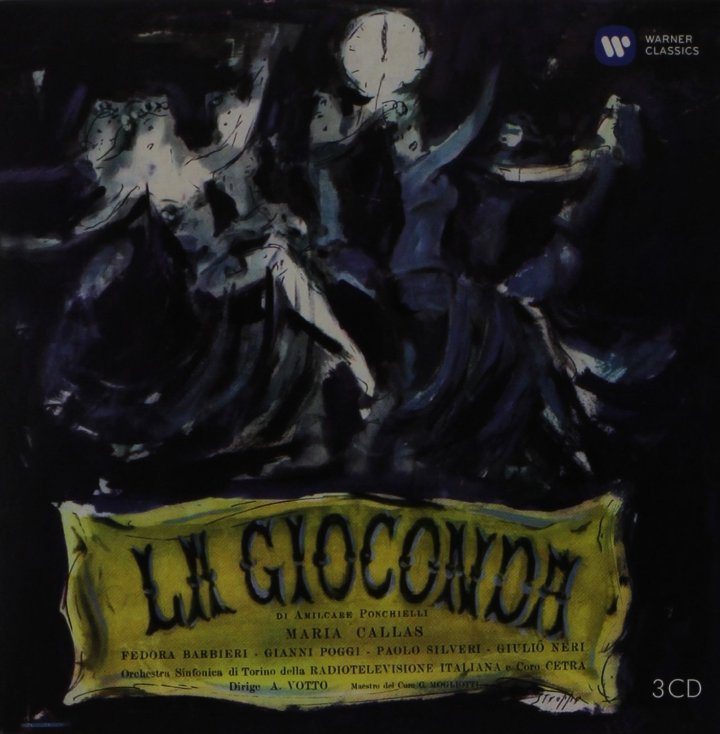
Callas’s first ever complete studio recording was made for the Italian firm Cetra in 1952, before she had signed with EMI. The role of Gioconda had furnished her with her Italian debut in 1947, and was the occasion she met two of the most important men in her life, her mentor Tullio Serafin and her future husband Battista Meneghini. Paradoxically she would make her second recording of the opera at the time of her affair with Onassis, and when she was separating from Meneghini.

When Callas recorded La Gioconda for Cetra she was still a large lady and at her vocal peak. It was recorded just a couple of months before she made her spectacular debut at Covent Garden in Norma and shortly before her only series of performances as Lady Macbeth at La Scala, a role one wishes had figured more in her career. She then went on to sing Gioconda at La Scala, her last performances in the role until the EMI recording in 1959.

Given the sheer animal power and massive, freewheeling brilliance she could command at this stage in her career, you would think this Cetra recording would, in all but matters of sound, win hands down over the later one, recorded seven years after when her vocal powers were failing, but I’m not sure it’s that simple, and, whilst listening to this one, there were quite a few passages where I found myself hankering after the later recording. True, the singing is often magnificent, and it is easy to be swept away by the coruscating force of her delivery, but I find myself missing some of the refinements she has made by the time of the second recording. This may be a controversial opinion, but this one seems to me to be a series of thrilling highlights, whereas the characterisation on the EMI set feels more of a piece, with a cumulative power I don’t get here, for all the added security of her voice; and actually there are certain, purely vocal moments, she manages better on EMI than she does on Cetra (the pitfalls of Ah come t’amo, the E un di leggiadre section from Suicidio, the whole of the section after she gives Laura the sleeping draught, for instance).

As against that, I should also state that her performance of Suicidio here completely floored me when I first heard it. I had no idea a female voice, a soprano at that, could sing with such passion, could have such powerful chest notes. It was absolutely staggering and one of the things that first turned me on to the genius of Callas in the first place. If I later got to know the opera better from the EMI recording and place that at a slightly higher level of achievement, it is none the less  a close-run thing.

The Warner engineers have done a great job of the re-mastering and it sounds much better than I remember it from my previous CDs, though obviously not so good as the stereo EMI set. One also misses the greater refinement of the La Scala orchestra and chorus.

As for her colleagues, it is largely a case of swings and roundabouts. Barbieri is a much more positive presence than the young Cossotto as Laura, but none of the men on either of the sets are particularly good. Ferraro on EMI isn’t very subtle, but he certainly makes a pleasanter sound than the awful Poggi. Honours are about equal between Silveri and Cappuccilli, Neri and Vinco. Votto’s conducting isn’t much different in the two sets, and remains some of his best work on disc.

One thing is for sure, Callas as Gioconda is an absolute must, and, regardless of any reservations surrounding her colleagues or recording quality, eclipses every other performance of the role on disc.

Callas’s 1953 Studio Lucia di Lammermoor

51252bkyvtf8al

Recorded 29-30 January, 3, 4 & 6 February 1953, Teatro Comunale, Florence

Producer: Dino Olivieri, Balance Engineer: Osvaldo Varesca

Of all the roles Callas sang, it was probably Lucia which created the biggest furore. Back in the early 1950s, nobody took the opera very seriously. It was considered a silly Italian opera in which a doll-like coloratura soprano ran around the stage showing off her high notes and flexibility. There is a hilarious description of the characters in E.M. Forster’s Where Angels Fear To Tread attending a provincial performance of Lucia di Lammermoor. Here he describes the prima donna’s first entrance.

Lucia began to sing, and there was a moment’s silence. She was stout and ugly; but her voice was still beautiful, and as she sang the theatre murmured like a hive of happy bees. All through the coloratura she was accompanied by sighs, and its top note was drowned in a shout of universal joy.

For anyone who loves opera or Italy, I heartily recommend this self-mocking tale of the English abroad.

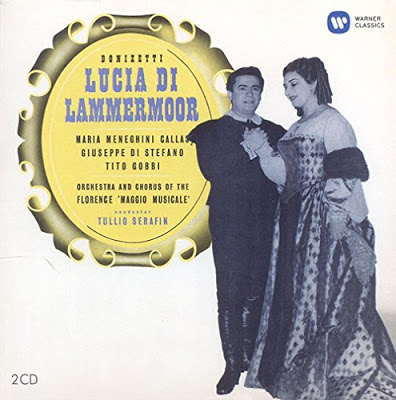
But back to Callas, who first sang the role of Lucia on stage in Mexico  in 1952. A few months earlier she had sung the first part of the Mad Scene at a concert in Rome. After Mexico, she would sing it in Florence, Genoa, Catania and in Rome before appearing in Karajan’s legendary production at La Scala at the beginning of 1954, a production that subsequently travelled to Berlin (one of her most famous recorded live performances) and Vienna.  It was also one of the roles she chose for her U.S. debut in 1954 in Chicago and at the Met in 1956. Her last performances of the role were in Dallas in 1959 (in the same Zefirelli production that made Sutherland a star at Covent Garden) and she made two recordings of the opera;  this one in 1953 in Florence, shortly after stage performances there and the second in 1959 in London. After Norma, Violetta and Tosca it is the role she sang most often, so it is hardly surprising that she is so much associated with it.

Back in the 1950s it must have seemed unthinkable that such a large voice could tackle the role, and not only sing it, but sing it with such accuracy and musicality, giving the opera back a tragic intensity that people had forgotten, or didn’t even know,  was there.  There is a touching story of Toti Dal Monte, an erstwhile famous Lucia herself, visiting Callas in her dressing room after a performance, tears streaming down her face, and confessing she had sung the role for years without really understanding its dramatic potential.

From Callas’s very first notes, she presents a highly-strung, nervous character, but sings with impeccable legato, all the scales and fioriture bound into the vocal line, the tone dark, but plangent, expressive but infinitely subtle. Regnava nel silenzio is a model of grace, but she still manages to invest the words di sangue roseggio with a kind of horror, whilst never resorting to glottal stops or other verismo tricks. She understands that with bel canto it is the arc of the melody, of the musical line that is paramount.

And so it continues, with her consolatory Deh ti placa in the duet with Di Stefano’s Edgardo, a duet of musical contrasts, in which Callas’s Lucia is at its most feminine. The duet with Gobbi, their first encounter on disc together, is also full of contrasts, and Gobbi makes a much more interesting villain than Cappuccilli in her second recording, finding a range of insinuating colour that his younger colleague doesn’t even hint at.

The Mad Scene is a miracle of long breathed phrases, with such lines as Alfin son tua heartbreakingly expressed, and of course here there are none of the problems with the top Ebs that we get in the second recording.

Di Stefano is more suited to Edgardo than he would be to Arturo in I Puritani, which was recorded soon after, and he is much to be preferred to the over-the-hill Tagliavini on the second recording. Serafin conducts a tautly dramatic version of the score.

The sound on this Warner issue still tends to distort and crumble in places. I guess that must be on the master, but the voices ring out with a little more truth.

Of course both Callas and Di Stefano can be heard together in the famous 1955 Berlin performances under Karajan, in sound which is not much worse than this, and that recording would still be my first choice amongst Callas’s Lucias, for all that she eschews the first Eb in the Mad Scene. Under Karajan’s baton and in a live situation she sings with effortless spontaneity, almost as if she is extemporising on the spot.

Still this first Callas studio recording is the one that got people talking and the one that quite possibly changed opinions about bel canto for many years to come. As such it has a historical significance which should never be forgotten.

Callas in I Puritani

r-12800357-1542200837-6181.jpeg

Recorded 24-30 March 1953, Basilica di Sant’Eufemia Milan

Producer: Dino Olivieri, Balance Engineer: Osvaldo Varesca

I Puritani, Callas’s second opera for EMI was the first recorded under the imprimatur of La Scala, an association which would result in eighteen further opera sets over a period of seven years.

No doubt because of the circumstances surrounding her first Elvira (she learned it in 3 days to replace an ailing Margherita Carosio whilst still singing Brunnhilde in Die Walkure) and because of her famed recording of the Mad Scene, one would expect the role to have played a greater part in her career, but in fact after those first performances in Venice in 1949, it figured rarely in her repertoire.

She sang it again in Florence, in  Rome and  in Mexico in 1952, and in her second season in Chicago in 1955, then never again, though the Mad Scene did occasionally appear in her concert programmes, even as late as 1958 at  a Covent Garden Gala. A recording of her rehearsing the scene for her Dallas inaugural concert in 1957 exists, and shows her still singing an easy, secure and full-throated high Eb.

Maybe the reason she sang it so little is that Elvira offers less dramatic meat than Lucia or even Amina. The libretto is something of a muddle and Elvira seems to spend the opera drifting in and out of madness. Of course she gets some wonderful music to sing, and Callas certainly breathes a lot more life into her than most singers are able to do. She also gives us some of her best work on disc, her voice wonderfully limpid and responsive, the top register free and open. No doubt this is the reason it has remained one of the top choices for the opera since its release over 6o years ago.

We first hear her in the offstage prayer in Act I Scene I, and straight away there is that thrill of recognition as her voice dominates the ensemble. Then in the scene with Giorgio, she finds a wide range of colour, a weight of character, that we don’t normally hear. Her voice, laden with sadness for her first utterances, then defiant when she thinks she is to be wed to someone she doesn’t love, is fused with utter joy when she realises that it is Arturo she is going to marry. She skips through the florid writing with lightness and ease, but invests it with a significance that eludes most others. One moment that stood out in relief for me was her cry of Ah padre mio when Arturo arrives, which bespeaks the fullness of heart that is the main characteristic of this Elvira. Son vergin vezzosa is a miracle of lightness and grace, Ah vieni al tempio heartbreakingly real, though her voice does turn a little harsh when she doubles the orchestral line an octave up.

The Mad Scene needs little introduction. It is one of the most well-known examples of her art out there, the cavatina moulded on a seemingly endless breath; and where have you ever heard such scales in the cabaletta? Like the sighs of a dying soul. The top Eb at its climax is one of the most stunning notes even Callas ever committed to disc, held ringingly and freely without a hint of strain. Words fail me.

She has less to do in the last act, which mostly belongs to the tenor, and this is where I have a problem with the set. Di Stefano is nowhere near stylish enough in a role that was written for the great Rubini, and he lurches at every top note as if his life depended on it. Sometimes the notes sound reasonably free, at others he almost sounds as if he’s holding onto them with his teeth. Mind you, who else was there around to sing it any better at that time? The recording was made too early for Kraus, though Gedda might have been a good idea. After all, he was already singing for EMI by then, and would sing Narciso on Callas’s recording of Il Turco in Italia, which was recorded the following year..

Rossi-Lemeni  is less woolly-toned than I remember him and sings with authority, especially good in the first act duet with Callas; Panerai is a virile presence as Riccardo. Serafin conducts with his usual sense of style, but also invests some drama into the proceedings.

The orchestra and voices sound really good, but the recording of the chorus is a bit muddy. Presumably that was also the case on the original LPs.

I do have a few problems with I Puritani. To my mind the libretto is plain silly, and even Callas’s wonderful singing can’t quite rescue it. That said, as singing qua singing, it’s some of the most amazing work she ever committed to disc, and for that reason it will always be a permanent part of gramophone history. I would never be without it.


Callas in Cavalleria Rusticana

81rypabsull-_sl1500_

Recorded 16-25 June, 3-4 August 1953, Basilica di Sant’ Eufemia, Milan

Producer: Dino Olivieri, Balance Engineer: Osvaldo Varesca

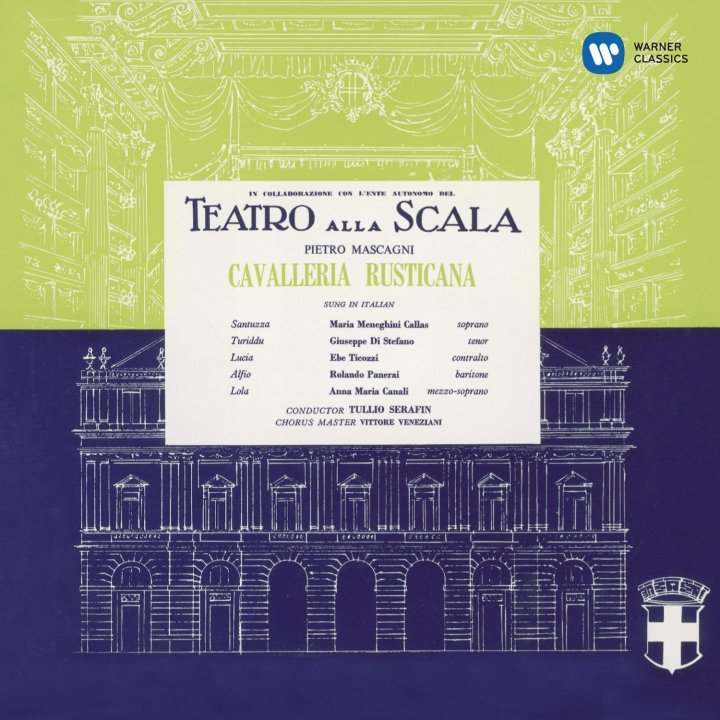
According to the notes accompanying this recording, Callas actually replaced the scheduled singer for it, a famous mezzo who was having trouble with her top notes. Does anyone know who this might have been? Could it have been Stignani? She ducks some of the top notes in Callas’s Norma the following year, and she was getting on a bit by this time, so it’s possible I suppose.

Whoever it was, we should be pleased that Callas was around to fill the breach, because her Santuzza is superb. Unbelievably she had only previously sung the role in her student days, when only 15 and also a couple of times with the Athens Opera, but, apart from this recording, never again, and yet, in fabulous voice, she inhabits the role of poor, hapless Santuzza as no other.

At this stage in her career her voice was as responsive in verismo as it was only a few weeks before, when she was recording Bellini (I Puritani). She uses none of the tricks of the verismo soprano, no glottal stops, no aspirates, no sobs, but sings with a pure musical line. When she sings io piango at the end of Voi lo sapete, she is able to suggest tears without actually sobbing.

Furthermore her characterisation has been thoroughly thought out. This is a young woman at the end of her tether with nothing left to lose. Her very first utterances are full of weariness and hopelessness, that first little dialogue with Mamma Lucia full of despair. Quale spina ho in core, she sings, and her singing of those few words rends the heart, as do her thrice repeated cries of O Signor in the Easter Hymn. Left alone with Mamma Lucia, she pours out her sad story.  Voi lo sapete is not only heartrendingly poignant, but beautifully sung, and we note how economically she uses her chest voice. Intensity is not achieved at the expense of musical line.

Nor is it in the duet with Turiddu, which bristles with contrast and drama. Here it is not just a stock operatic duet, but a full scale Sicilian row between a young couple. Callas pleads, rails, cajoles and, finally, when she can take no more, hurls her curse at Turiddu. Alfio serendipitously turning up at just that moment gives her the opportunity to vent her spleen, but, yet again, her singing is full of subtle little details and the solo that leads into the duet is sung with a sustained, if tragic beauty. Note how skilfully she shades the line at the end when she takes the pressure off the voice, moving from chest to head and ending quietly on lui rapiva a me. The closing section has both Panerai and Callas pulling out all the stops. It is absolutely thrilling.

A few words then about the rest of the cast. Di Stefano  sings with his own brand of slancio and presents a caddish, if ultimately remorseful Turiddu. Panerai is a splendidly virile Alfio, and Anna Maria Canali a sexy, minx-like Lola, superbly bitchy in her short exchange with Callas’s Santuzza. Serafin’s speeds are sometimes a bit slow in the choruses, but he paces the meat of the drama really well.

The recording still overloads occasionally at climaxes, so I assume that is a problem that exists on the master, but otherwise the sound is quite open and Callas’s voice fairly leaps out of the speakers.

Not for nothing has this remained one of the top recommendations for Cavalleria Rusticana for over 50 years, and I don’t see that changing any time soon. For first-rate recorded sound and orchestral splendour one would go to Karajan, for characterful full-throated singing to Serafin.

Callas’s 1953 Studio Tosca

91ntirq8gdl-_sl1500_

Recorded 10-21 August, 1953, Teatro alla Scala, Milan

Producer: Walter Legge, Balance Engineer: Robert Beckett

What can one say about this famous recording of Tosca that hasn’t been said before? It regularly appears in lists of the greatest recordings ever made, and it seems now that its legendary status is confirmed.

Because of it, Tosca has often been considered the quintessential Callas role, but, though she sang it a fair amount in her early career, she pretty much ignored the role after this recording, until it became the vehicle for her operatic comeback in London in 1964. Indeed she never sang it, or any other Puccini role, at La Scala, which was her cultural home at the height of her career. A few months after making this recording she sang the role at a couple of performances in Genoa, then promptly ignored it, except for her two seasons at the Met in 1956 and 1958. In 1964, Zeffirelli managed to get her to choose it as the vehicle for her comeback, but, typically for her, she would only agree if they could do Norma as well, which he staged for her in Paris.

The Zeffirelli production, which was shared by Paris and London, became one of the most famous in operatic history (and in fact Covent Garden only retired it a few years ago). Indeed one could say the photos of Callas in that red velvet dress she wore in Act II have since become iconic, even though Callas herself often voiced her disdain for both the opera and the role.

True, it may not have offered her the vocal challenges of Norma or Medea, of Violetta or Lady Macbeth, but in 1953 her voice was an amazingly limpid and responsive instrument, enabling her to easily encompass its demands, whilst rendering the score with an accuracy the likes of Tebaldi and Milanov could only dream of. Take, for instance, the lightness and grace with which she sings a line like le voce delle cose in Non la sospiri la nostra casetta. Most Toscas are clumsy here, but Callas sings it with elegant ease. Furthermore at this stage in her career, she can swell the tone to a refulgent climax at Arde in Tosca un folle amor, which she can’t quite manage by the time of the second recording, which was recorded around the same time as the London and Paris performances.

Interestingly, though, in terms of interpretation, there are not that many differences between Callas’s Tosca of 1953 and 1964; a few minor details here and there, but for the most part the character of Tosca is as musically finished here as it was to be histrionically in Covent Garden. Though Zeffirelli may have helped her with odd bits of stage business, it seems sure that her conception of the character had changed little in the intervening years. The main differences are vocal, and here she rides the orchestra with power to spare, the top Cs, that emerged as little more than shrieks in 1964, full throated and solid as a rock. Vissi d’arte (which Callas used to say should be cut as it held up the action) is both beautiful and heart-rending. So it is in 1964, but the ending taxes her to the limit there, whereas here it is full throated and easy.

Of course there are other reasons why this set has retained its place as the best of all Tosca recordings. Gobbi is also in fuller, securer voice here than he was in 1964, and his loathsome, reptilian Scarpia is a towering achievement. As usual, he and Callas strike sparks off each other, their confrontations bristling with tension. Di Stefano, who also appears on the first Karajan recording, is here in his best voice, an ardent, youthful and passionate Cavaradossi. Both duets with Callas are erotically charged affairs, as they should be.

Then of course, there is De Sabata on one of his rare excursions to the studio. The La Scala orchestra play superbly for him, and he unerringly paces the score just perfectly, with a sure sense of the work’s inner impetus, his use of rubato  brilliantly controlled. In a performance such as this, the one true winner is Puccini.

Sonically it is surely the best of all Callas’s studio mono sets from La Scala. One hardly notices the lack of stereo; voices are perfectly placed and the orchestra sounds richer and more full-bodied than was often the case. This transfer has also corrected some of the errors that crept into previous CD incarnations, not least the terrible GROC version.

Still the Tosca to have, and blow stereo digital sound.