Pristine’s Re-master of Björling’s Cav and Pag.

paco209_fdbcae84-e953-4879-bd72-570e6effee64_530x

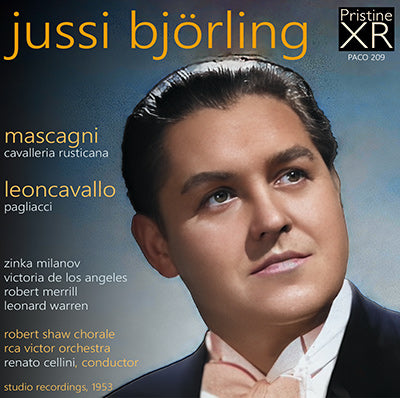
A photo of Jussi Björling graces the cover of this Pristine issue, and he is without doubt the main reason to hear these recordings. It is always a pleasure to hear his beautiful voice, musical phrasing and ringing top notes, though I’m not sure he would ever have been perfectly cast in either role. But before coming to Björling himself, it might be instructive to consider other elements of the recordings.

Both operas were recorded in 1953 in New York with the RCA Victor Orchestra and the Robert Shaw Chorale under Renato Cellini and sound remarkably good in these Pristine transfers, so good, I almost thought they were in stereo. I hadn’t heard either performance before, so I have nothing to compare the Pristine transfers to, but they are admirably clear and spacious and a good deal better than the contemporaneous Serafin recordings with Di Stefano and Callas. The Serafin Pagliacci is in reasonable mono sound, but unfortunately the Cavalleria Rusticana suffers from overload and distortion, which no amount of re-mastering would seem to be able to overcome. Still, I wish that these Cellini performances were half as exciting.

Cellini’s conducting is at least idiomatic, his tempi well chosen, but neither opera really catches fire and they both remain somewhat studio bound. The professional Robert Shaw Chorale sing in both operas. They are faultless in execution, but I couldn’t help picturing them all in prim white shirts and blouses, standing, score in hand, in choir banks. They don’t for one second conjure up the sound of lusty Sicilian peasants or excited Italian village folk. The La Scala Chorus on the Serafin set, may not be so polished, but they have this music in their blood and are much more convincing.

I suppose I should preface my discussion of the solo singers with a confession that I have never much liked Zinka Milanov, or at least not on any of the recordings I have heard, which were all made quite late in her career. From the outset she sounds far too mature, almost indistinguishable from Mamma Lucia in her initial exchanges and completely uninvolved in poor Santuzza’s plight. Björling, who could sometimes be accused of being a little cool, is at his most impassioned in their duet, but she remains phlegmatic and stolid. She is no better in the duet with Robert Merrill’s Alfio, who, in any case, is a bit too jovial and avuncular. Björling’s Turiddu is beautifully sung and, as I mentioned, he does try to inject some passion into his exchanges with Santuzza, but there is something about the inherent nobility in his tone that makes him not quite right for the caddish Turiddu. As always, his singing gives great pleasure, but I can’t quite believe in him.

That said, I find his Turiddu more convincing than his Canio. Yet again, the role is beautifully sung, Vesti la giubba heart-breaking and deeply felt, but can anyone really believe that this is a man who would be driven to double murder? I certainly can’t. I have much the same problem with the Nedda of Victoria De Los Angeles. She is in her best voice, warm and feminine and, like Björling, has the virtue of always being supremely musical. She sings quite beautifully, especially in her Ballatella, but, as with her Carmen, she sounds altogether too ladylike. I don’t necessarily want Nedda to be portrayed as a heartless minx, as was often the case in days gone by, but I need to believe that she has the mettle to defy a bully of a husband and have an affair behind his back.

Nor is there any menace in the Tonio of Leonard Warren, who, in the prologue, could be singing about anything at all really. Gobbi, on the Serafin set, does not have such a beautiful voice, nor such easy top notes, but he makes every word tell. Merrill has here been given the secondary role of Silvio, but his Silvio doesn’t sound much different from his Alfio. Compare Panerai, who sings both roles on the Serafin recordings, utterly menacing as Alfio and ardently seductive as Silvio.

Jussi Björling was, without doubt, one of the greatest tenors of the last century and I always take pleasure in the sheer beauty of his voice, his musical phrasing and his wonderfully free and ringing top notes, so it was a pleasure to hear him here, even if these two roles are not ones to which I think he was really suited. For the rest I derived the most pleasure from De Los Angeles’s beautiful and musical singing as Nedda, even if she too is caught in a role that was not particularly suited to her gifts.

Not a top choice for either of these two operas then. For all that they are in better sound than Serafin’s recordings of the two operas, I would still place the Serafin performances ahead of them. Di Stefano can be a bit wayward, but he is better at expressing the caddish side to Turiddu and the unhinged side of Canio that turns him into a killer. Callas is, as usual, hors concours, both as a wonderfully impassioned Santuzza and a free-spirited and mettlesome Nedda, and she is in fine voice on both recordings. Gobbi is equally brilliant as Tonio and their confrontation bristles with drama. There are also better choices amongst more recent recordings, such as Karajan’s sumptuously recorded La Scala set for DG, which no doubt remains a first choice for many.

As always, Pristine should be commended for including with the CDs a package of downloadable items, which includes a copy of the same recording as an MP3 download, together with full scores, both piano and orchestral, and a full libretto in PDF format. Most major companies these days don’t even include an online link to a libretto.

Pietro Mascagni (1863-1945)
Cavalleria Rusticana (1890)
Turiddu: Jussi Björling (tenor)
Santuzza: Zinka Milanov (soprano)
Alfio: Robert Merrill
Mamma Lucia: Margaret Roggero (mezzo)
Lola: Carol Smith (mezzo)

Ruggero Leoncavallo (1857-1919)
Pagliacci (1892)
Canio: Jussi Björling (tenor)
Nedda: Victoria De Los Angeles (soprano)
Tonio: Leonard Warren (baritone)
Silvio: Robert Merrill (baritone)
Beppe: Paul Franke (tenor

Robert Shaw Chorale
RCA Victor Orchestra/Renato Cellini
Rec. 1953, Manhattan Centre, New York
Full scores and libretto included as downloads
Pristine Audio PACO209 (2 CDs 141)
 

Renata Scotto – Italian Opera Arias


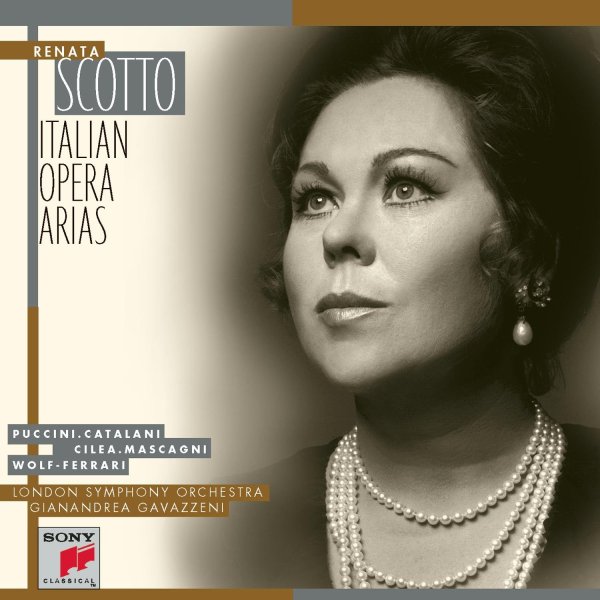
The majority of this disc is taken up with Scotto’s first recital for CBS, recorded in 1974, a recording that might be considered the one which spearheaded the second stage of her career, when she became a mainstay of the Metropolitan Opera in New York. Having been absent from the catalogues for some time, an intense recording schedule followed. There would be another recital (of Verdi arias) for CBS, and throughout the seventies and early eighties she features on many complete opera recordings for CBS, EMI and RCA, often alongside Domingo, with whom she also recorded a recital of duets.

Scotto’s voice always had a slight tang to it. Admirably clean, it would never charm with the full rich tones of a Caballé, a Moffo or a Te Kanawa. The top of the voice, even in her earliest recordings, could glare and it was never the most comfortable part of her range. Nor was it ever a sensual voice, though she could sound sensual enough if necessary (not the same thing), but her command of line, impeccable diction and range of colour are most attractive. She may not quite ravish the ear in the high lying phrases of, for instance, Ch’il bel sogno di Doretta from La Rondine as does Te Kanawa in the famous recording which was used for the movie of A Room with a View, but she shades the line most beautifully and her control of her pianissimo is quite gorgeous. She characterises well too, so that each of these verismo heroines emerge as quite different characters. Occasionally intellect gets in the way and the interpretations can sound too studied, as they never do with Callas, but it would be true to say that, though she has absorbed the lessons of her predecessor in some of this material, she never copies her. Her interpretations are all her own.

In the 1974 items she is wonderfully supported by the London Symphony Orchestra under Gianandrea Gavazzeni and it is good to have some less well known items such as the Mascagni arias and the aria from Le Villi, as it is to have the excerpts from the complete recording of Wolf-Ferrari’s Il segreto di Susanna and Puccini’s Edgar. Her Butterfly is better served by the Barbirolli recording and the duet with Obraztsova from Adrianna Lecouvreur makes very little sense out of context.

Nonetheless one of Scotto’s best recordings, and one that is worth returning to quite often.

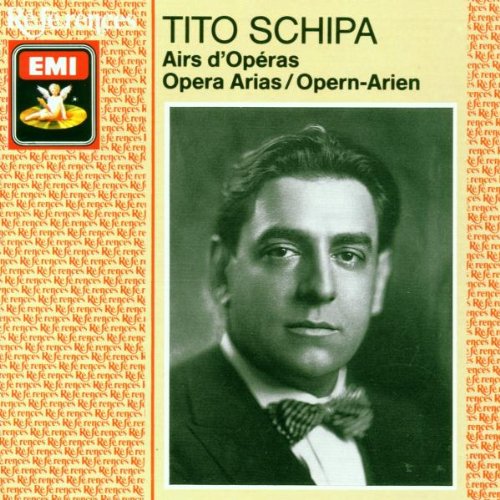
Tito Schipa – Opera Arias

61gglfv2dfl

This EMI disc collects together recordings from Tito Schipa’s first recording sessions in 1913, recordings made in the 1920s and 1930s and one (Werther’s O, nature) recorded in 1942, when Schipa was 54.

The name of Schipa is most associated with style, elegance and grace (not for him the over-emotional sobbing excesses of Gigli), though the first aria included on the disc (Che faro from Orfeo ed Euridice) is hardly a model in that respect. The unstylish playing of the orchestra is certainly no help, but Schipa too has some lapses in style, with occasional aspiarates marring his legato.

The 1913 recordings tell a different story and reveal a surprising amount of power and squillo, not qualities one normally associates with the singing of Tito Schipa. They also offer so much more in the elegance of the phrasing, the firm line and his wonderful legato, as well as a proper appreciation of character and the dramatic situation. The prizes here are the Duke’s Ella mi fu rapita…Parmi veder le lagrime, from Rigoletto, Tu che a dio spiegasti l’ali from Lucia di Lammermoor and the Siciliana from Cavalleria Rusticana.

There are treasures too amongst some of the later recordings, even the 1942 Werther aria, which is wonderfully poetic, but the 1934 aria from Manon is also superb.

However I think I derived the most pleasure from the duets. WIth Toti Dal Monti we get a lovely Prendi l’anel to dono from La Sonnambula, and, even better, a gorgeous Tornami a dir from Don Pasquale, which is just about ideal in every way, the two singers blending thier voices and playing with the musical line in perfect synchronicity. Then, probably best of all is the famous Cherry Duet from Mascagani’s L’Amico Fritz, with the charming Mafalda Favero. Throughout he caresses and moulds the line and there is a moment of pure magic when he sings the words sei pur bella on a delciate thread of sound which perfectly expresses Fritz’s shy awakening to love. It is moments such as these which make us turn to these old recordings.

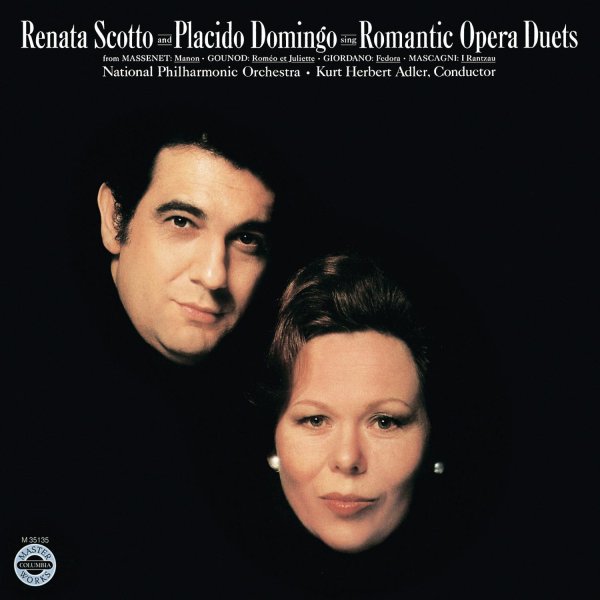
Romantic Opera Duets – Placido Domingo & Renata Scotto

Domingo recorded quite a few duet recitals in the 1970s, with Sherrill Milnes (1970), with Katia Ricciarelli (1972), with LeontynePrice (1974) and this one, with Renata Scotto, in 1978, which is, in many ways, the most successful.  For a start, the material is refreshingly unhackneyed, and, although we are vouchsafed only four excerpts, they are quite long (the shortest 8’52”), which makes for a more satisfying listening experience than lots of shorter pieces. The original LP had the French items, which are no doubt better known on the first side and the Italian ones on the second.

Scotto was at the high watermark of what was often referred to as her second career. In the 1960s she had recorded for EMI and DG, but signed to CBS/Sony in the 1970s appearing on many complete sets and recording recitals of Verdi and verismo. The voice was never a conventionally beautiful one and by this time could turn squally and shrill on top notes, but the compensations were many and included her superb musicality, her dramatic involvement, her attention to the text and her natural, unforced, excellent diction. As you can hear here, her French was less idiomatic than her Italian but you can at least hear the words clearly, and it is the French items I enjoyed most on this recital, though that could possibly reflect my preference for the material in question. I’ve never been a big fan of verismo.

Domingo is his reliable self, the voice in good shape, but at this time in his career his performances could seem a little generic, and there is not much difference between his Roméo and his Des Grieux, his Loris and his Giorgio, however musical his actual singing.

Both singers are attentive to the different styles required of the composers in question, but it is Scotto who is better at vocal characterisation, adopting an appropriately more seductive tone for Manon than she does for the girlishly innocent Juliette.  Her Fedora also sounds more mature and commanding than her Luisa in the Mascagni opera, which is a sort of verismo mirror piece to Gounod’s Roméo et Juliette.

All in all, this is a very enjoyable duet recital, both in terms of the singing and the music tackled, and it is an excellent showcase for both singers.

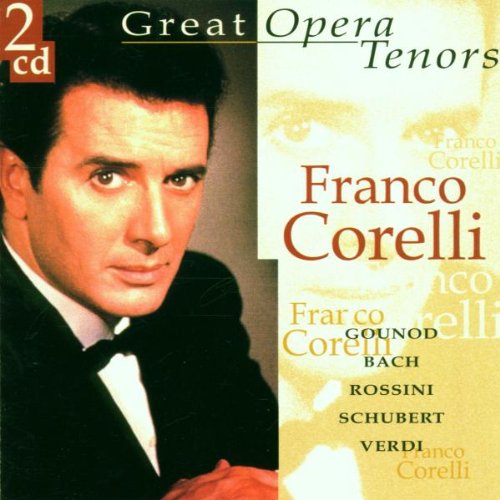
Franco Corelli – Great Operatic Tenors

This two-disc compilation is drawn from the EMI catalogue and includes arias taken both from complete sets and recital discs.

People often go misty-eyed at the mere mention of Franco Corelli and he still inspires a huge following among opera lovers. For many he can do no wrong, and certianly the voice was a magnificent one, unique and no doubt a God-given gift. For me it’s more often a case of (to paraphrase the song from A Chorus Line) voice ten, artistry three. Not always, I hasten to add, and, if the performances on this set are anything to go by, he did respond to a strong hand at the helm. Predictably the best of them tend to be taken from complete sets, particularly those conducted by Zubin Mehta (Celeste Aida), Lovro von Matacic (Vesti la giubba) and Tullio Serafin (Pollione’s Meco all’altar di Venere from the second Callas Norma), which is arguably the best of all).

These are all on Disc One, where elsewhere there is just too much can belto sobbing. Manrico’s Ah si, ben mio, from the Schippers complete set, is delivered at a relentless forte (why not his stunning Di qella pira, I wonder?), as are the excerpts from the Santini recording of Andrea Chénier. Worst of all is the graceless, over-loud version of Roméo’s Ah, lève-toi, soleil, sung in execrable French. Listen to this and then to Bjørling, Kraus, Gedda or Alagna to hear how beautifully poetic the aria can sound.

Disc 2 has even less to commend it, I’m afraid. The best performances are taken from a recital record with an unknown orchestra under one, Franco Ferraris. Cavaradossi’s Recondita armonia lacks poetry, but E lucevan le stelle is much better, though he rather ruins the final measures with an excess of sobbing. Cielo e mar is also a fine, sensitive performance, with the added bonus of those gloriously free and ringing top notes.
The less said about some of the other items though, the better. After the operatic arias, we are treated (I’m not sure that is the correct word) to a selection from, presumably, a record of sacred arias, all in absolutey ghastly arrangements. Handel’s ubiquitous Largo from Semele is mangled almost beyond recognition, the Schubert and Bach/Gounod Ave Marias sung through a sort of treacle soup, and Rossini’s Domine Deus from the Petite Messe Solenelle bludgeoned to death. Franck’s Panis angelicus, taken, by the looks of things, from another album, doesn’t fare much better, nor, surprisngly does Lara’s Granada from the same album. Not entirely Corelli’s fault, as the arrangement is quite possibly the most ghastly I’ve ever heard, the tempo pulled around so much the piece loses any sense of flow. What price Wunderlich’s gloriously ebullient and sunny version for DG? Corelli sounds plain angry, but who can blame him when the accompanment is so awful?.

Fortunately the final two items somewhat redeem this sorry mess. The arrangements might not be much better, but in Cardillo’s Core ‘ngrato and De Curtis’s Torna a Sorriento, one just basks in the Mediterranean warmth of Corelli’s glorious tenor. It is moments like these that remind us of why we listen to him.

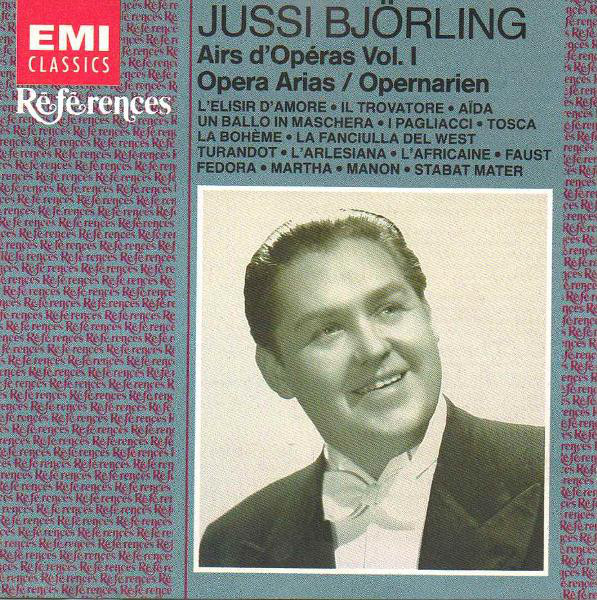
Jussi Björling – A collection of Swedish 78s.

These two CDs gather together most of the 78s the young Björling made in his native Sweden between 1933 and 1949, the earliest made when he was a budding tenor of twenty-two.

Most are vocal gems, but one or two (the rather loud and penny plain Je crois entendre encore, and the unpoetic duet from La Boheme with Anna- Lisa Björling on the second disc, for instance) are less than great.

The voice itself was a magnificent one, no doubt about it, with a silvery purity throughout its range, the high notes free and easy; just listen to his joyfully ebullient 1938 performance of Offenbach’s Au mont Ida from La belle Hélène, sung in Swedish, but with terrific swagger, the top notes flying out like lasers. From a few years ealier we have a plaintively sensitive performance of Valdimir’s Cavatina from Borodin’s Prince Igor, the legato line beautifully held, his mezza voce finely spun out. Also from 1938 we have a thrilling performance of the Cujus animam from Rossini’s Stabat mater, with a free and easy top D flat at the end, and it is prinicpall for Italian and French opera that Bjørling will be remembered and there are plenty of examples here of his wonderfully musical performances in that genre.

We find him ideal in Verdi, Donizetti and Puccini alike, in Myerbeer, in Massenet and in Gounod (a glorious rendering of Faust’s Salut, demeure). Some regret the absence of a true Italianate tone in the Italian items, but he will never resort to sobs and aspirates to express emotion, and, personally, I find his comparative restraint very attractive. It is true, he is not always imaginative with his phrasing, and nowhere will you get the kind of psychological introspection you would hear in a performance by someone like Vickers, but his singing is always musical, and of course there is a great deal of pleasure to be had from the voice itself, which Italianate or not, is a thing of great beauty.

Some of the very best of these 78 recordings are included on Volume 1, stand out items for me being the aforementioned Faust aria, his wonderfully musical and sensitive Ah si, ben mio from Il Ttovatore, and his poetic, but thrilling version of Nessun dorma from Turandot.  There is also plenty to treasure in Volume 2, which includes the Offenbach and Borodin, but also a sensitvely prayerful  Ingemisco from the Verdi Requiem, Des Grieux’s lovely Dream from Manon sung with liquid, honeyed tone (his ardent Ah, fuyez is on the first disc), and his  poetic Cielo e mar, from La Gioconda.

The second disc finishes with a couple of unexpected examples of his work in Lieder, a gorgeously lyrical Beethoven Adelaide, and a beautifully restrained and rapt account of Strauss’s Morgen.

Anyone who loves the tenor voice and gloriously musical and sensitive singing (not always the same thing) should have these recordings in their collections.

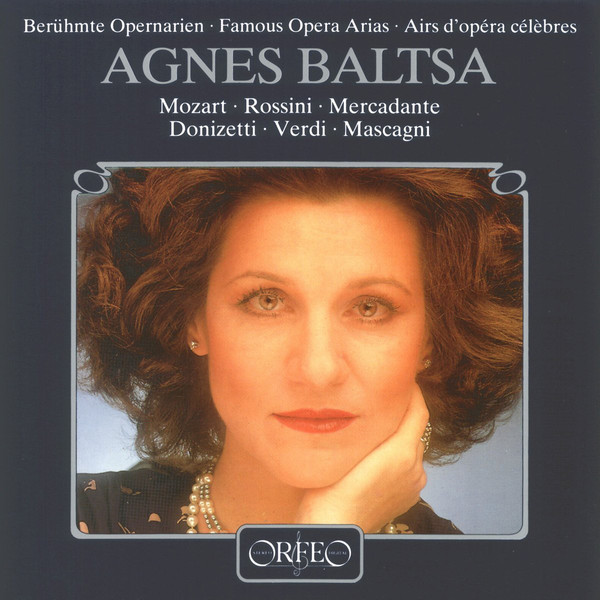
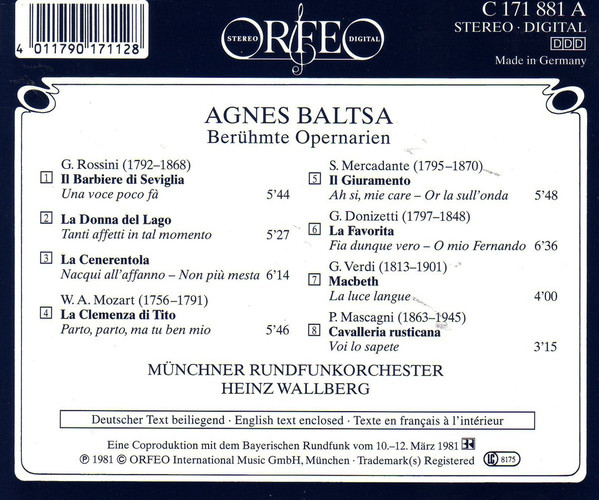
Agnes Baltsa – Famous Opera Arias

r-10771805-1504032686-5609.jpegr-10771805-1504032692-5381.jpeg

Good to be reminded of Baltsa’s pre-eminence as a lyric/dramatic mezzo at the beginning of the 1980s, when this recital was recorded.

The recital shows off to advantage her keen dramatic instinct, a tangily individual timbre, and a voice that was, at this time at least, absolutely seamless from top to bottom. Though she had already recorded Eboli and Amneris for Karajan, this recital concentrates for the most part on her work in the field of bel canto.

Baltsa was an exciting stage performer, as I can attest, having seen her live on many occasions and a great deal of that excitement comes through on disc, the climaxes of the arias from La Favorita and Il Giuamento being particularly thrilling. She has a strong vocal personality, which comes across stunningly on disc, and she realises the different demands of classical, Romantic and verismo music. If there is a limitation, it is that she rarely colours or weights the voice to suit the character she is playing, something more noticeable in a recital disc than it would be in a complete performance.

Stand out tracks for me were the aria from La Donna del Lago, where she gently caresses the opening cavatina, and the aforementioned arias from Il Giuramento and La Favorita. Indeed, on this showing it is a great pity that nobody thought to make a complete recording of the Donizetti opera with her, though preferably in the original French rather than Italian as it is here.

To sum up, this is a great memento of an important singer recorded when the voice was at its peak. I seem to remember that it was issued in the UK originally on EMI, but the recording was made by Orfeo, and it is that issue I have.