Callas in La Forza del Destino

813aggbmzzl-_sl1500_

Recorded 19-21, 23-25, 27 August 1954, Teatro alla Scala, Milan

Producer: Walter Legge, Balance Engineer: Robert Beckett

Oh my, oh my, oh my! Having spent an afternoon with this recording, I emerged thinking it was the greatest, most moving of Verdi’s operas, that this was its greatest recording, and that Leonora was Callas’s greatest Verdi role, to paraphrase the late John Steane’s review of the Callas Madama Butterfly.

Having now slightly recovered from its emotional impact, I am of course reminded of Callas’s Violetta, the Trovatore Leonora and Amelia, but, I would still place this recording very high in the Callas canon.

Leonora was actually Callas’s first Verdi role. She sang it in 1948 in Trieste, then in Ravenna in 1954 a few months before making this recording, but no more after that.

Verdi’s two Leonoras have some marked similarities and a singer who is successful in one will often be successful in the other (Leontyne Price springs to mind). On the other hand, the Forza role lies quite a bit lower, which is no doubt why Tebaldi is more comfortable in it than she is in Il Trovatore, which she never sang on stage, only on record. If the Trovatore Leonora’s bel canto roots are often glossed over, they are usually completely ignored in La Forza Del Destino, particularly in Act I, which requires a lot more vocal dexterity than it usually gets.

Listen to the aria Me pellegrina ed orfana and note how Callas marks the semi-quaver rests at Ti lascia ahime whilst still maintaining her impeccable legato, observing the downward portamento on the word sorte, the whole phrase sung in a single sweep. As usual the music is rendered with uncanny accuracy, as it is when she brilliantly articulates dotted notes in the cabaletta of the following duet with Alvaro (only too noticeable when Tucker comes galumphing after her, aspirating and puffing in an attempt to keep up).

But, as usual with Callas, she goes beyond accurate observation of the score to reveal the meaning behind the notes. Her very first words (oh angosica) tell us of the conflict in Leonora’s heart, her voice suffused with melancholy. Other sopranos may have given us a more beautifully poised sustained pianissimo top Bb in Pace pace, or drawn a firmer line in La vergine degli angeli, and those for whom such vocal niceties are paramount should probably look elsewhere, but that would be a pity for they would miss, according to Lord Harewood in Opera on Record,

an unparalleled musical sensibility and imagination, subtle changes of tonal weight through the wonderfully shaped set-pieces, and a grasp of the musico-dramatic picture which is unique.

Central to the role, and the opera, is the monastery scene, starting with the glorious Madre, pietosa vergine and finishing with La vergine degli angeli. This whole section, with Rossi-Lemeni a wonderfully sympathetic, if woolly-voiced Padre Guardiano, is a locus classicus of Callas’s art, her voice responsive to every conflicting emotion in Leonora’s heart, her darkly plangent tone absolutely perfect for the character. I doubt you will ever hear it more movingly or truthfully conveyed.

For the rest, Tucker is a strong, virile presence, but often mars his singing with unstylish aspirates and sobs, as if he is trying to do an impression of an Italian tenor. Tagliabue was in his late 50s and sounds it, but Capecchi makes an excellent Melitone and Clabassi a firm voiced (far firmer than Rossi-Lemeni) Calatrava. Elena Nicolai makes little of the somewhat thankless character of Preziosilla, but she is at least more than adequate.

And Serafin is at his very best, dramatically incisive (just listen to those stabbing chords when Leonora is mortally wounded in the last act) and sweepingly lyrical in the best Italian tradition.

The Warner reissue sounds very good to me, and gains on my previous version in containing the whole of Acts I and II on the first disc, which means there is no break in Leonora’s great Act II scena, leaving Act III and IV with a disc each.

A superb set, and one of Callas’s greatest recordings. Too bad she never sang the role again.

The Callas Karajan Madama Butterfly

81sict7avdl-_sl1500_

Recorded 1-6 August 1955, Teatro alla Scala, Milan

Producer: Walter Legge, Balance Engineer: Robert Beckett

Well I’m a mess! To quote John Steane in his Gramophone review of the first CD issue of this set,

Still feeling the impact of that devastating final chord in the opera, I believe devoutly that Madama Butterfly is the most moving of all works for the stage, that this is the best recording of it, and that it is Callas’s greatest achievement on records. 

I may not go quite that far, but it does remind me how many times I think exactly that after listening to almost every one of Callas’s complete opera sets, so completely does she identify with each role that she sings.

Callas recorded the role of Butterfly a few months before her only stage appearances in the role in Chicago, in November 1955. It was also the occasion of one of the first major scandals of her career, when a process server tried to stuff a court summons into the belt of her kimono just after she exited the stage. Callas exploded, cameramen just happened to be there to record the exact moment she lost her temper, and the rest is history.

This recording also marked one of the three occasions on which Callas worked with Karajan, a powerful combination which also produced those famous La Scala Lucias, which were repeated in Berlin and Vienna, and the studio recording of Il Trovatore.

Now if you’re idea of a perfect Madama Butterfly  is one in which some gorgeous voices sing some beautiful tunes, bathed in lush orchestral sounds, which incidentally happen to accompany  the sad little story of a Japanese girl who ends up committing hari kari, then this recording is probably not for you. There have certainly been more beautifully sung Butterflies, but few that elevate it to the level of real tragedy on a par with those of Shakespeare and Euripides. Here we are treated to a cautionary tale, a moral tale if you like, of how even nice people can do terrible things unthinkingly, and how one thoughtless act can set in motion a whole chain of tragic events. It doesn’t always make for comfortable listening, but who said great art was meant to be comfortable?

Callas’s portrayal is full of miraculous detail, phrases, even single words given a significance you won’t hear in other performances. Take, for instance, the way she manages to suggest all Butterfly’s trust in Pinkerton at Ieri son salita, the final Amore mio sung with a conviction that makes it easy to understand her utter faith in his return. In the love duet she is all shyness until gradually her voice is flooded with warmth and passion, as she succumbs to Pinkerton’s ardour. Here, maybe, I should add a word about Gedda’s Pinkerton, which some have found too uncaddish. But surely that is to miss the point. That nice people can, and do, perpetrate unkind things is surely the crux of the plot. Gedda sounds like his music; a nice, charming young man, who gives no thought to the consequences of his actions. He is not some dreadful villain, just a normal young American jock. His sort are two a penny on most American college campuses. His remorse in the last act is real enough.

But back to Callas, who finds in Butterfly “not the frailty of childhood, but its strength”. According to John Steane in the Gramophone review quoted above,

The keynote is firmness of mind; a simple factuality which sees right and wrong with the clarity of that miraculously rinsed and lightened voice.

She sings Un bel di not as some big soprano show piece, but integrates it into the drama, a simple reiteration of Butterfly’s faith, the details of Pinkerton’s return sung in wistful fashion as something she has gone over and over again in her mind. Che tua madre, with its cries of Morta! Morta!, is almost unbearably intense, Sotto il gran ponte dal cielo unbearably moving. Only in the final scene, when left alone, does she let her full voice out, and the effect is overwhelming, Puccini’s final chords shatteringly played by the orchestra under Karajan, who conducts a tautly dramatic performance of the opera, less inclined to wallow than in his later recording.

Danieli is excellent as Suzuki, Borriello a sympathetic Sharpless, but this, of all Puccini operas, is all about the heroine; even Pinkerton is a supporting role, and Callas, with Karajan’s help, makes sure that all our attention is concentrated on Butterfly.

The sound is a trifle boxy but sounds a lot better here than it did in the 1997 Callas Edition. Still it mystifies me that it is not up to the quality of the Tosca that was recorded two years earlier.

No the real problem with this recording is that it brings us face to face with real life in all its raw pain and tragedy. Listening to it is a deeply unsettling experience, and one I can’t subject myself to too often.

Essential nevertheless, for Callas, for Karajan, and for all those who think Puccini’s opera is more than a sentimental pot boiler.

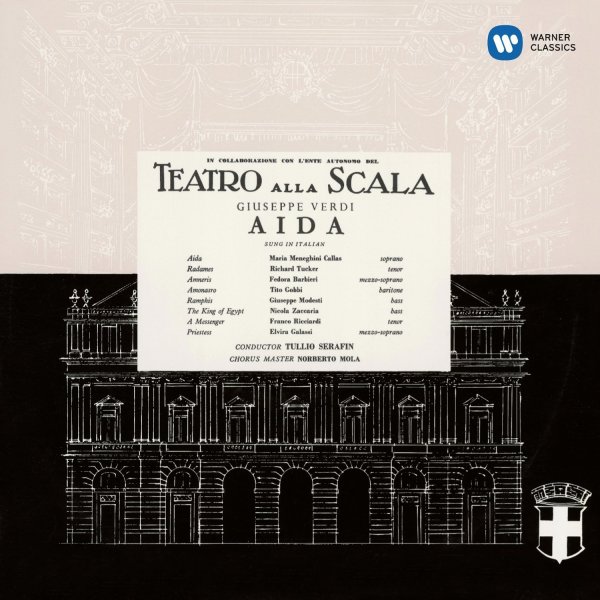
Callas’s Studio Aida

81eycwhmfol-_sl1500_

Recorded 10-12, 16-20, 23-24 August 1955, Teatro alla Scala, Milan

Producer: Walter Legge, Balance Engineer: Robert Beckett

I’m going to make a confession. Aida is not my favourite Verdi opera. I find it hard to identify with any of the characters, and they usually emerge as representatives rather than real people. It is full of great music, but I have to admit I admire it rather than love it. Nor would the role of Aida be considered a natural for Callas, though she sang it, with a great deal of success, quite often between her debut in the role in 1948 and her last stage appearances in it in 1953, this 1955 recording being the last time she would ever sing the complete role, though she returned to the aria Ritorna vincitor and the Nile duet with Radames (with Corelli) late in her career in the mid 1960s. Interestingly enough, though one doesn’t think of Aida as a Callas role, when the now defunct International Opera Collector magazine conducted a poll of its readers to assemble the ideal Aida cast, Callas was one of the favourites, alongside such famous Aidas as Ponselle and Leontyne Price.

The reason for this can only be that she brings the rather placid character of Aida to life like no other. Though she may not have the sweetness of timbre one might ideally want from an Aida, there are plenty of other rewards. She takes a little while to settle down in the first trio, but Ritorna vincitor is alive with meaning and contrast. Just listen to the way she spits out her hatred for del egizii coorti, the power with which she exhorts her compatriots to destroy the legions, with particular emphasis on the word struggete, the complete change of colour at Ah! Sventurata che dissi, the tenderness with which she sings of her love for Radames and the pain and desperation in her voice at Da piu crudeli angosce un core affranto; the last imprecation to the Gods sung with her tone drenched in sorrow, her legato as usual impeccable. Aida’s cruel predicament is set before us in this one aria with a psychological penetration second to none.

There are wondrous little details in the ensuing duet with Amneris too, like the touch of pride that enters her tone at Mia rivale! Ebben sia pure, quickly withdrawn when she realises she could easily give away her true identity.

But it is the Nile Scene that makes the greatest impression in this set. It starts with Aida’s O patria mia, which some commentators have found to be the weak link in her portrayal, but she yearns most wistfully, floating the tone wonderfully at O freschi valli. She always had problems with the ascent to top C, but it is a lot more solid here than she is often given credit for. It may not be dolce as marked by Verdi, but I don’t hear the wobble that so many commentators claim to have problems with. The following duet is magnificent music and magnificently sung by both Callas and Gobbi, and the finest realisation of it on disc. I doubt any singers have come close to them in the way they create drama in sound, and Serafin is at his very best in this scene too. I found it impossible to hold back the tears as Callas launched into that glorious tune at O patria, patria, quanto mi costi, and how brilliantly Serafin makes the violins weep with her.

The duet with Radames is hardly less fine, though Tucker can be a bit graceless at times. Yet again, Callas brings out a wealth of detail, like the insinuating way she sings Pur, se tu m’ami with that slight portamento on the word m’ami. She plays Radames brilliantly here, wonderfully seductive when she sings La tra foreste vergini. This is operatic singing on the highest level. In the last act too, she has something to offer, singing with grace and accuracy the difficult fioriture of Vedi? Di morte l’angelo.

As already mentioned Gobbi is superb as the implacable Amonasro, masculine and forthright of tone,  though still able to inject some tenderness into his duet with Aida. Tucker has the right heroic timbre for the role of Radames, but he can be a bit lachrymose, and tends to aspirate and sob, as if mimicking the mannerisms of a true Italian tenor. Barbieri is more subtle than I remember her, and provides a barnstorming Amneris, though I have come to prefer Baltsa on Karajan’s second recording, who reminds us that Amneris is a young princess and a valid rival for Aida.

Serafin is on top form, conducting in the best Italian tradition, lyrical and dramatic in equal measure. There may not be any great surprises or revelations, but his deep understanding of the music and its style is its own reward.

All in all, it was a great surprise to re-discover this set, to enjoy the opera more than I thought I would, and to find myself appreciating Callas’s very individual take on the role

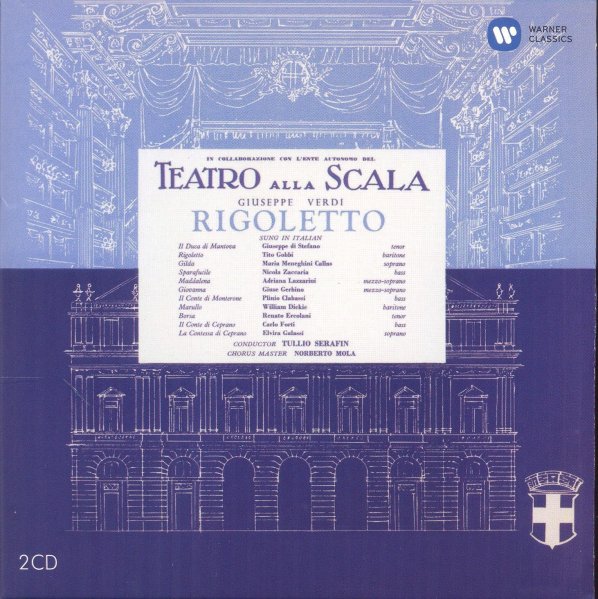
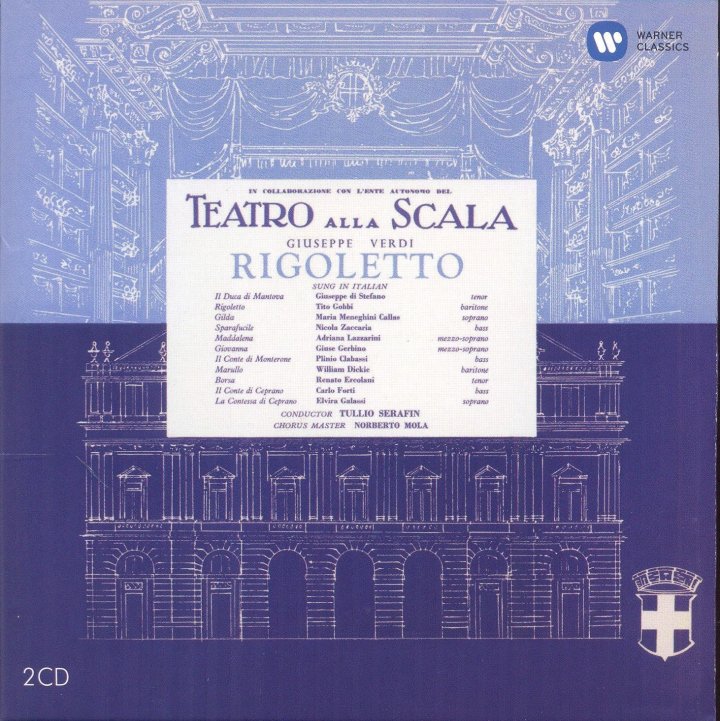
Callas and Gobbi in Rigoletto

91km0olq4ul-_sl1466_

Recorded 3-16 September, 1955, Teatro alla Scala, Milan

Producer: Walter Legge, Balance Engineer: Robert Beckett

Gilda is another role one would not readily associate with Callas. She did sing it on stage for two performances in Mexico in 1952, but, unhappy with her performance, never sang it again except for this recording made in 1955. The Mexico performances are a bit of a mess and sound under-rehearsed, but Callas is superb, and one notes how it is often she who keeps the ensemble together, even though she was so blind on stage she could never see the conductor. It is actually something of a tragedy that she didn’t sing the role more often. If she had, then people may have rethought the role of Gilda, as they did that of Lucia. It is usually sung by a light voiced lyric coloratura, who manages Caro nome well enough, but can’t really muster the power to dominate the ensembles in the last two acts, as she should. It’s something I’ve noticed myself. Not so long ago I saw the opera at Covent Garden with Aleksandra Kurzak as Gilda. She looked ideal, convincingly acted the ingénue, sang a wonderful Caro nome, but tended to be drowned out in the final act, especially in the storm scene.

No problem there for Callas of course, but the miracle is not that she can sing out with a but more power when needed, but that she remains in vocal character when she does. She doesn’t suddenly sound like Norma or Tosca, but continues to think upwards in a voice somehow cleansed of all those heavier associations.

I often think it odd that when people talk about Verdi sopranos, it is the voices of Tebaldi and Leontyne Price they have in mind, but could either of those sopranos have sung Gilda, or Lady Macbeth, or any of Verdi’s early roles? Tebaldi may have sung Violetta, but it wasn’t a natural for her, the coloratura in Sempre libera smudged (and transposed down in live performances). Nor did Tebaldi sing the Trovatore Leonora on stage, as the role lay too high for her. Price did of course, and she was an appreciable Leonora, though she doesn’t sing with the same degree of accuracy as Callas. Callas, on the other hand, sang with equal success Gilda and Lady Macbeth, Abigaille and Elisabeth de Valois, Elena and Aida, both Leonoras, Amelia and Violetta, all on stage not just in the studio, and one regrets that she didn’t get the chance to sing more of Verdi’s early operas. What a superb Luisa Miller she might have made, or Odabella in Attila, Griselda in I Lombardi, or virtually any of those early Verdi heroines. Maybe, after all, it is Callas who is the ideal Verdi soprano.

But back to this Rigoletto, in which Callas yet again completely inhabits an uncharacteristic role. In the first two acts, she presents a shy, innocent young girl, with a touch of wilfulness that explains her disobedience to her father. In the duet with Rigoletto, we feel the warmth of her love for him, and in the one with the Duke, the shy young girl awakening to passion. You can almost see her blushes when the Duke first appears to her. She was asked once why the single word uscitene resounded with such a strange colour. “Because Gilda says go, but wants to say stay,” was her simple answer. Actors might be used to such psychoogical distinctions but it is rare indeed to find it in singers. Caro nome is not just a coloratura showpiece, but a dreamy reverie, and ends on a perfect rapturous trill as she exits the stage. In Act III her voice takes on more colour (Ah, l’onta, padre mio) and it is Tutte le feste that becomes the focal point of her performance, her voice rising with power to the climax (nell’ansia piu crudel) as  she describes the horror of what happened, and note how at the opening she matches her tone to that of the cor anglais introduction. She has the power to ride the orchestra in the storm scene in the last act, and the final duet with Gobbi is unbelievably touching. As usual her legato is superb, phrases prodigious in length, shaped and spun out like a master violinist. It is a great pity she didn’t sing Gilda more often, for it is a considerable achievement.

There are other reasons to treasure this performance of course, chief among them being Gobbi’s superbly characterful, endlessly fascinating and heartrending performance of the title role. Gobbi and Callas always had a striking empathy, and the three duets for father and daughter in this opera, gave that relationship full rein. Some have remarked that Gobbi’s voice was not a true Verdi baritone (whatever that means), but, like Callas, he was successful in a range of different Verdi baritone roles, his most famous probably being Rigoletto. Who has ever matched Gobbi in tonal variety and vocal colour, and psychological complexity? None that I can think of. Pari siamo is superbly introspective and then in Cortigiani! he lashes out like a wounded animal, before breaking down in accents that are pathetically heartrending. To those who say he could not sing with beauty of tone, I would say there are plenty of moments in the score which refute that assertion,  the Piangi section of the Act II duet, where he spins out a pure legato which is both musical and shatteringly moving, being a case in point.

Di Stefano may not be quite in their class, and there are certainly more elegant Dukes on record, but he sings with enormous face and charm. One can imagine why Gilda would be captivated by this Duke. He can be musically inexact (some of the tricky rhythms in Act I go a bit awry), but his voice is in fine shape, and he sounds both charming and sexy, which is as it should be. Nor does he play down the casual cruelty that lies at the heart of his character. I’d say it’s one of his best recordings.

Serafin’s conducting is in the best Italian tradition, both lyrical and dramatically incisive. He is totally at one with Callas and Gobbi in the duets, giving them ample time to make their dramatic points, but whips up quite a storm in the finale to Act II.

The sound is truthful and clear, the voices wonderfully present, and, as in all the Warner sets so far, sounds excellent on my system.

Years ago I remember an acquaintance, not really a voice fan (or a major opera fan, for that matter), asking me which recording of Rigoletto I recommended. He had the Giulini, and quite enjoyed it, but thought there was something missing. I warned him that some were allergic to Callas’s voice, but lent him my set anyway. A couple of days later he excitedly returned it to me, having ordered the recording for himself. “Fantastic,” he said, “Exactly what I was looking for. Suddenly the whole opera came to life.” Well you can’t ask for much more than that.

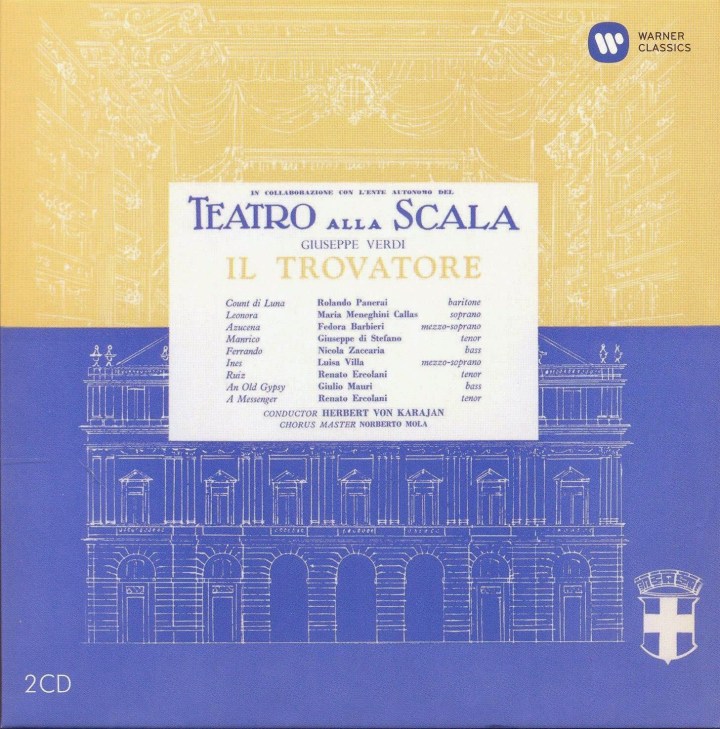
The Callas Karajan Il Trovatore

91l6fuq3isl-_sl1500_

Recorded 3-4, 6-9 August 1956, Teatro alla Scala, Milan

Producer: Walter Legge, Balance Engineer: Robert Beckett

Though Callas, even in her early days, often courted controversy, there was very little disagreement about her Leonora, which seems to have been universally acclaimed from day one. Schwarzkopf called it “a miracle”, Bjoerling “perfection” and Lauri- Volpi “glorious”. Il Trovatore was of course a staple of the repertoire, but years of lazy singing by less technically accomplished sopranos had removed much of Leonora’s filigree. When Callas sang the role, critics said it was as if an old master had lovingly been restored to its original glory. Writing of her performance of the role in London in 1953, Cecil Smith in Opera wrote,

For once we heard the trills fully executed the scales and arpeggios tonally full-bodied but rhythmically bouncing and alert, the portamentos and long-breathed phrases fully supported and exquisitely inflected.

Used to enlisting Serafin’s support with a new role, she had had to prepare it alone for her first Leonoras in Mexico,  as she would be singing it under a different conductor (Guido Picco). A recording of that performance in 1950 shows that most of Callas’s ideas on the role were her own, and her singing is wonderfully accomplished, though she would eschew some of the interpolated high notes in later performances of the opera. She subsequently sang the role in Naples (under Serafin), at La Scala, in London, in Verona, in Rome and in Chicago (with Bjoerling), and finally for this recording in 1956.

By 1956 Callas’s voice is not what it was even in 1953, when she sang the role at La Scala, and high notes can be strident, but her voice in the middle and lower registers still has a dark beauty absolutely apt for the role. Her breath control is prodigious, her legato superb and throughout she phrases like a violinist rather than a vocalist.  Not only are the trills, scales and arpeggios fully executed, as Cecil Smith points out, but they are bound into the vocal line, becoming expression marks rather than just trills or scales. Even with a great singer, like Ponselle, the cadenza at the end of D’amor sul’ali rosee can seem as if it is just tacked on. With Callas, it becomes the natural conclusion of the aria, a musical expression of Leonora’s voice flying out to Manrico. In this recording we are also vouchsafed the cabaletta after the Miserere, (Tu vedrai) which was usually cut before then, presumably because most lyric-dramatic sopranos would find it beyond their capabilities. Callas is magnificent. Musically, I have no doubt that Leonora was one of her greatest achievements.

The rest of the cast are probably as good as could be assembled at the time. Di Stefano almost convinces his voice is right for the role, though, truth to tell, it’s a notch too small. He doesn’t really have the heroics for Di quella pira, but he is always alive to the drama, always sings off the words. Barbieri is a terrific Azucena, Panerai an intensely obsessive Di Luna, and Zaccaria a sonorous Ferrando.

But if Callas is the star vocalist, then Karajan is the second star of the recording. I’d even go so far as to say this is one of his very best opera recordings. His conducting is thrilling and one is constantly amazed at the many felicities he brings out in the orchestral colour, like the sighing two note violin phrases in Condotta ell’era in ceppi, or the beautifully elegant string tune that underscores Ferrando’s questioning of Azucena in Act III, cleverly noting its kinship with Condotta ell’era in ceppi. His pacing is brilliant, rhythms always alert and beautifully sprung, but suitably spacious and long-breathed in Leonora’s glorious arias. Nor does he shy away from the score’s occasional rude vigour. It is a considerable achievement.

My LP pressing was in the fake stereo re-issue, and I had the 1997 Callas Edition on CD. This Warner re-mastering sounds a good deal better than both, with plenty of space round the voices and plenty of detail coming through from the orchestra.

A classic Il Trovatore then, which has stood the test of time, and has held its place amongst the best. In all but recorded sound, I would prefer it to both the Mehta with Leontyne Price and Domingo and the Giulini with Plowright and Domingo again, though Giulini does have possibly the most interesting Azucena of them all in Brigitte Fassbaender. Callas and Karajan, on those rare occasions they worked together, are a hard act to follow.

Callas in La Boheme

91olgtzbaol-_sl1473_

Recorded 20-25 August, 3-4 September 1956, Teatro alla Scala, Milan

Producers: Walter Legge & Walter Jellinek: Balance Engineer: Robert Beckett

Mimi is a role one would not associate with Callas, and indeed it is one of four roles she learned for the gramophone but never sang on stage. The opera itself makes its effect easily and can withstand even a mediocre performance, the role of Mimi being probably one of the least demanding in the soprano repertoire. Great Normas may always have been thin on the ground; effective Mimis have been, and still are, plentiful. The role’s requirements are slight; sweetness, charm, and a capacity for what the Italians call morbidezza; qualities that come naturally to a De Los Angeles or a Freni, less so, one would have thought, to a Callas.

But of course the miracle of Callas is that she not only scales down her voice and personality to suit the demands of the role, but also finds within it a deeper vein of tragedy one hardly suspected was there, her singing full of little incidental details often overlooked by others. Her first utterances have a weariness that presages her illness, and she fades the voice away most effectively as she faints. The duet with Rodolfo is light and charming, but more of this Mimi’s capacity for love emerges in her aria. Starting shyly, she gradually suffuses her tone with warmth at the section beginning Ma quando vien lo sgelo, not lingering too long on the top As and thereby ruining the shape of the aria, as so many do, and I love the way the last section, from altro di me non saprei narare, is delivered with a slight touch of embarrassment as if Mimi suddenly realises she has revealed too much too soon.

It is in the last two acts, though, that Callas’s Mimi is at its most moving. Never before has Mimi’s despair been so heart-rendingly expressed, but also note how, with a single word (dorme? ) in the duet with Marcello, she conjures up all Mimi’s warmth and tender love for Rodolfo, with the gentlest of upward portamenti. Act IV is almost fail safe, but here too she is wonderfully effective, finding the palest of colours as the pallor of death takes over.

She has a good cast around her; Di Stefano in one of his best roles, Panerai a splendid Marcello, Moffo a sympathetic Musetta, and something of a relief from the sparky soubrettes we so often end up with. Zaccaria and Spatafora are an excellent pair of Bohemians.

Votto doesn’t do anything wrong, but such a cast would have benefited from a stronger hand at the helm. He accompanies well, but it’s a shame, given that Serafin was not an option at the time, Legge couldn’t have persuaded Karajan to stick around after recording Il Trovatore with her.

The sound of this La Boheme has always been good for its period. I owned the original Columbia LPs, which I played to death. These Warner CDs also sound pretty good to me.

There are so many good recordings of La Boheme in the catalogue, that choosing the best one is well-nigh impossible, and choice will no doubt come down to preference for certain singers. However this recording, made 60 years ago now, still holds its place amongst the top recommendations.

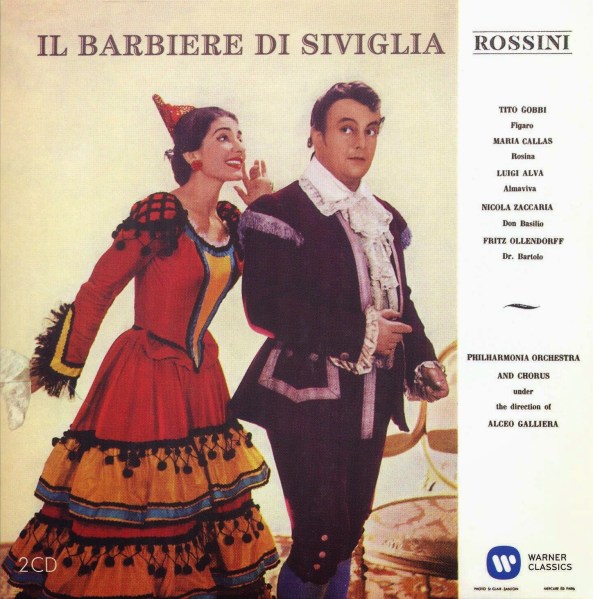
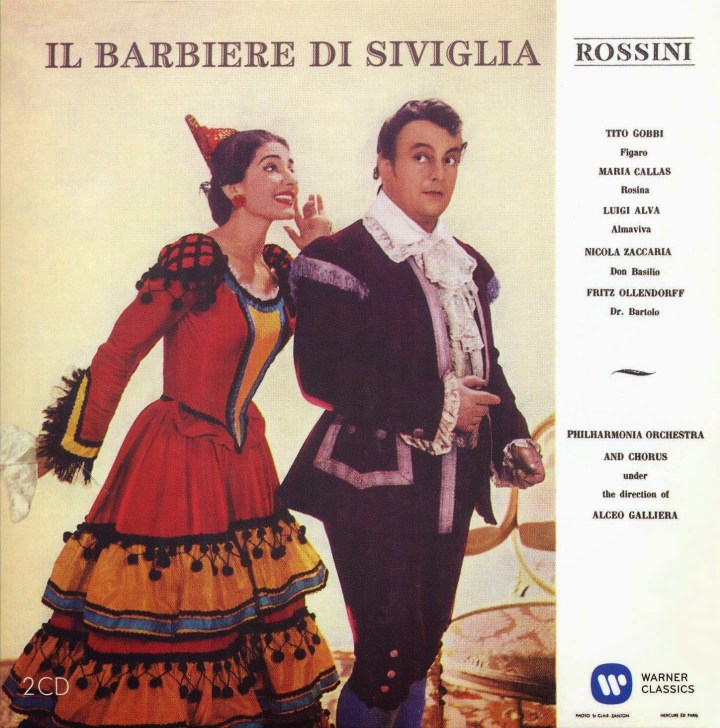
Callas’s Studio Il Barbiere di Siviglia

91be3bm7phl-_sl1465_

Recorded 7-14 February 1957, Kingsway Hall, London

Producer: Walter Legge, Balance Engineer: Robert Gooch

Callas only once sang Rosina on stage, in 1956 in an antiquated production at La Scala, which was, by all accounts, the one big flop of her career. People opined that comedy was obviously not her metier, though they must have had short memories and forgotten all about her success in the Zefirelli production of Il Turco in Italia the previous year, an opera she had originally sung back in 1950 and also recorded.

Giulini, who conducted the La Scala production, recalls the production as the worst memory of his life in the theatre.

I don’t feel it was a fiasco for Maria alone, but for all of us concerned with the performance. It was an artistic mistake, utterly routine, thrown together, with nothing given deep study or preparation.

It was also the last time Giulini ever conducted an opera at La Scala, and in fact he rarely conducted opera at all after that.

Whatever the problems at La Scala, though, the studio recording made the following year in London, with Gobbi and Alva joining Callas from the La Scala cast, is a joyous affair, and still one of the most recommendable recordings of Il Barbiere di Siviglia in the catalogue. The edition used wouldn’t bear scrutiny today, but at least Callas sings in the mezzo keys, though she does sing upward derivatives when the line takes her too low, interpolating a secure top D at the end of her duet with Figaro.

I am reminded that when an opera producer friend of mine was asked to produce the opera in Russia, he acquired a modern recording of the opera, no doubt in some urtext edition, but found the whole thing completely dispiriting. Having very little enthusiasm for his task, he was about to cancel, when he decided he would have a listen to the Callas recording. His ideas were absolutely transformed. Swept away by the sheer exuberance of the recording, he set about his assignment with renewed enthusiasm.

Callas’s Rosina is a mettlesome minx, defiant with Bartolo, flirtatious and seductive with Almaviva, and playfully scheming with Figaro. The whole character is laid out for us in her singing of Una voce poco fa, sweet docile and gentle, but (and just listen to the explosive way she sings that one word ma) a little devil when crossed. Some find her Rosina lacks charm. Well maybe she misses a touch of the coquettish, but, one thing’s for sure, this Rosina would be a lot of fun. Her technical proficiency in the role’s florid writing is little short of staggering, her voice infinitely responsive.

However Callas is no prima donna in this opera, and is very much part of a team, and one of the delights of this recording is in the many duets and ensembles with which the score abounds. You sense that this team of singers really enjoyed working together; there is a real sense of ensemble about it. Individually, they are an excellent bunch, led by Gobbi’s jovial Figaro. Alva is on more than one recording of Il Barbiere di Siviglia and he too works wonderfully well in duet with Gobbi, and also sings with some of the grace one associates with singers of an earlier generation. Zaccaria and Ollendorff are also well in the picture, and don’t overdo the slapstick. The Buona sera ensemble had me chuckling out loud. Gabriella Carturan contributes a nice cameo as Berta too. Alceo Galliera is an unexpected choice of conductor. Known mostly for his role as an accompanist, he conducts a sprightly, fleet and sparkling version of the score.

For all its textual inaccuracies, this Barbiere has held its place as one of the best recordings around, its sense of fun and ensemble almost unrivalled. A joyfully theatrical set, so full of character, that one hardly needs visual aid, so vivid is its storytelling, it fizzes and sparkles like a good champagne.

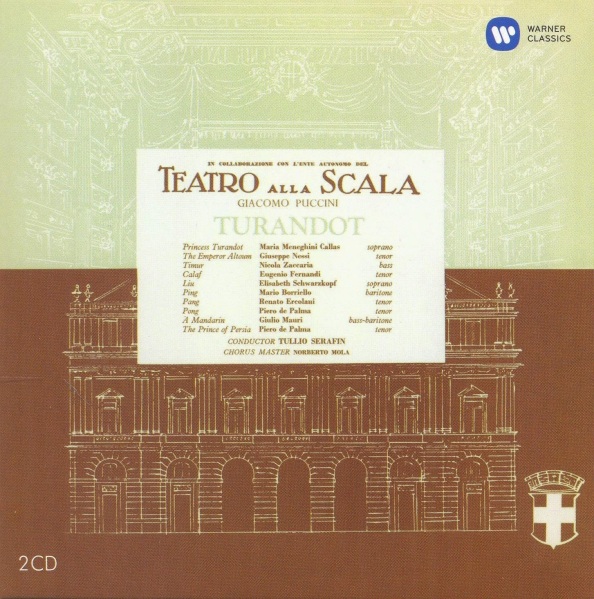
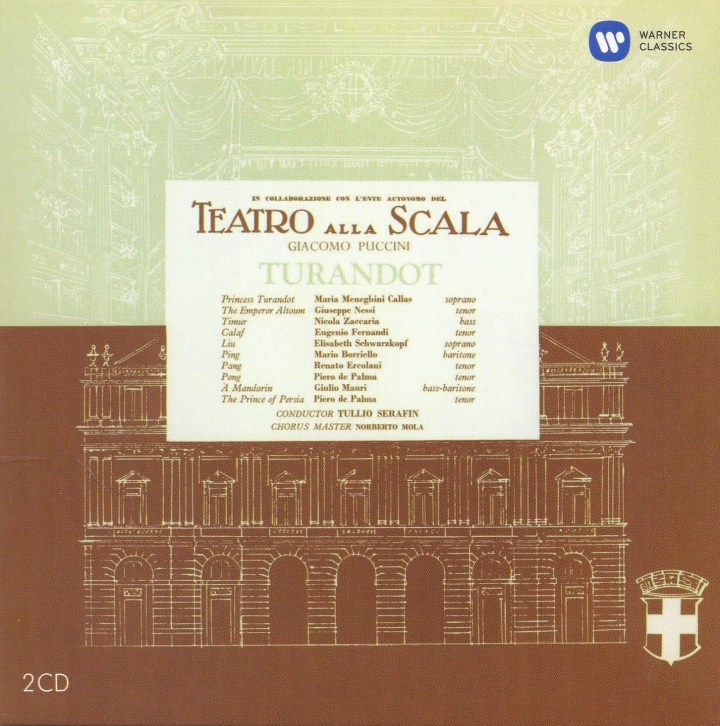
Callas as Turandot

9172j0czwml-_sl1467_

Recorded 9-13, 15 July 1957, Teatro alla Scala, Milan

Producers: Walter Legge and Walter Jellinek, Balance Engineer: Robert Beckett

1957 started well for Callas. She made two of her best recordings (Il Barbiere di Siviglia and La Sonnambula) and had a huge success as Anna in Anna Bolena at La Scala. The Iphigenie en Taurdie which followed may have been more of a succès d’estime but, though her colleagues were decidedly under par, she was superb and in good voice, as she was when La Scala took their production of La Sonnambula to Cologne in Germany.

She then records two operas far less suited to her gifts (Turandot and Manon Lescaut), goes on to sing a concert in Athens, when she is decidedly not in her best voice, sings Amina again with the La Scala company in Edinburgh, where she sounds thoroughly exhausted, and then  compounds the problem by recording Medea. The cracks are definitely beginning to show. After a few week’s rest, she is back on form for a Dallas Opera Inaugural concert (or appears to be on a recording of the rehearsal), and finishes the year well with a stupendous performance of Amelia in Un Ballo in Maschera at La Scala.

Turandot figured quite heavily in Callas’s early career. In 1948 and 1949 she sang it in Venice, Rome Caracalla, Genoa, Verona, Naples and Buenos Aires. She once said in interview that she dropped it as soon as she could, “because it’s not really good for the voice, you know.” All that exists from any of these performances are a couple of short extracts from the Buenos Aires performance, in which her voice is massive and free-wheeling, as far as one can tell through the execrable sound. By 1957 her voice has considerably pared down, and one might wish that she had recorded the role even a few years earlier when she sings a vocally secure and thoroughly commanding version of In questa reggia on the Puccini recital of 1954.

That said, I find the voice less wobbly and ill-supported than I do in the Manon Lescaut, which followed, on which, to my ears, she sounds exhausted, for all her customary musical imagination and insights. She is more secure in this Turandot but she doesn’t really disguise the effort it costs her. Where Nilsson and Sutherland, and Eva Turner before them, soar, Callas is more earth bound. That said, she makes a psychologically more complex heroine than any of them, her singing more subtly layered than we have come to expect from a Turandot. Hear how she vocally points the finger at Calaf in In questa reggia when she sings Un uomo come te, the almost mystical recounting of the story of Lou-u-ling. The first signs of Turandot’s vulnerability come in the Riddle Scene, anxiety creeping into her voice at Si la speranza che delude sempre, and her pleading to her father is almost in the voice of Butterfly, suddenly a daughter trying to get round her father. There are signs of her vulnerability too in the brief scene with Liu, when she asks,  Che posa tanta forza nel tuo core, mirroring Liu’s response with her repetition of the word L’amore. Even the last scene is less of an anti-climax than it usually is. When she sings Che e mai di me? Perduta, we know that she is conquered, and her final aria Del primo pianto is sung with a wealth of detail. For all the evident strain the role makes on her resources, it is a great performance, and she is far less stressed by its demands than Ricciarelli is on Karajan’s recording.

The rest of the cast is interesting. Many have opined that Schwarzkopf sounds as if she had wandered in from the wrong opera, but I like her finely nuanced and beautifully shaded Liu. She is particularly impressive in her exchanges with Turandot and in the mini aria Tanto amore, effecting a wonderful diminuendo on the line Ah come offerta suprema del mio amore. What a pity this is the only time the two most intelligent sopranos of the post war period ever sang together. Fernandi, a strange choice considering he was very little known at the time, and hardly at all since, is rather better than his lack of reputation suggests. Not as exciting as a Corelli (why on earth was he not engaged?) he nevertheless sings a valid Calaf, often phrasing with distinction. Not the best Calaf on record certainly, but not the worst either. Zaccaria is a sympathetic presence as Timur, Ping, Pang and Pong all characterful. There is also a connection with the first ever performance as Nessi, who sings the Emperor, created the role of Pang.

Serafin’s conducting is excellent, urgent and well-paced. What a pity that he doesn’t have the benefit of modern stereo sound, which this of all operas really cries out for. The sound here is, to my ears anyway, less boxy than the sound for Manon Lescaut, though it is not as open as, say, the De Sabata Tosca, which was recorded four years earlier. This Warner pressing sounds a good deal better than my 1997 Callas Edition, with Callas’s voice far less shrill in the upper reaches. It may never be anyone’s library choice for the opera, but I would not want to be without the insights Callas brings to the role. It is, in many respects, a more thoughtful rendering of the score than we often hear.

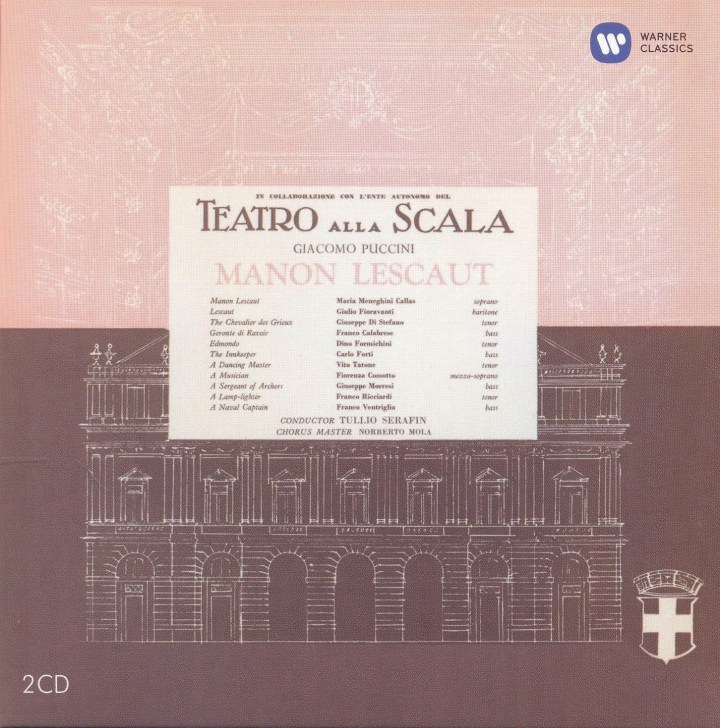
Callas in Manon Lescaut

91nkir4mq2bl-_sl1470_

Recorded 18-27 July 1957, Teatro alla Scala, Milan

Producer: Walter Legge, Balance Engineer: Robert Beckett

Manon Lescaut has never been a favourite opera of mine, and to my mind pales in comparison to Massenet’s work, which is a truer representation of L’Abbe Prevost’s novel, for all that he ends the opera in Le Havre rather than America; nor does this recording rank particularly high in my roll call of Callas recordings. Though recorded in 1957, it waited 3 years before it was released, so presumably Legge and Callas had their doubts too.

For much of the first two acts, the recording itself has a curiously flat sound to it, and though we hear a fair amount of orchestral detail, both strings and voices sound undernourished. I don’t know whether it was me becoming more involved, but things do seem to improve in the last two acts, where Callas also sounds more comfortable vocally.

To my ears, she has always sounded utterly exhausted in this set. It was recorded shortly after Turandot, which she really ought not to have been singing at that stage in her career anyway. She manages Turandot surprisingly well, but the effort it must have cost her shows in the parlous state of her top in much of this Manon Lescaut. She is actually in much better voice in the later complete recordings of La Gioconda, Lucia di Lammermoor and Norma, even the Medea, which followed it, but then in all those she was singing repertoire more suited to her gifts. I’m not sure it was ever the right voice for Puccini, for all her success in the role of Tosca. Not long after this, she sang Amina in Edinburgh and made the studio recording of Medea, neither of which find her in her best form, and it is not until the Dallas Inaugural Recital in November that she recovers form. She is also in stupendous voice for the live La Scala Un Ballo in Maschera in December, so presumably she had benefited from some rest. Even in the middle and lower registers here, much of the velvet is missing from the voice, and even in quieter passages she doesn’t seem to have sufficient energy to support the voice.

Of course, there are, as always, musical compensations aplenty. In the first act, Callas sings with a lightness and purity that mirrors Puccini’s con semplicita markings. Later, her In quelle trine morbide is even more finely nuanced than on the recital disc of 1954, sung more as a reflection to herself than to Lescaut; and the trills and grace notes in L’ora o Tirsi are sung with a lightness and accuracy that eludes most singers of the role; the duet with Des Grieux is full of restrained passion. In Act III she has less to do, but her few exchanges have a weariness and dull despair that is most affecting. However it is in the often anti-climactic final act, where vocally and dramatically she is at her best, with a harrowing Sola perduta and a chillingly moving death scene.

Di Stefano’s singing is variable, occasionally disturbingly tight on top and at other times admirably free, but he does bring personality and face to his singing. Full of youthful joie de vivre in Act I, he becomes a man consumed with love and literally at the end of his tether for Guardate, pazzo son. It’s an appreciable performance, if not the best sung Des Grieux you’ll ever here.

No complaints about the rest of the cast. Fioravanti I have never come across before or since, but he makes an excellent Lescaut and we also get a nice cameo from Fiorenza Cossotto as the madrigal singer.

Serafin, as so often, gets the pacing just right. So much about his conducting is just so unobtrusively right, and in Act III he builds the ensemble leading up to Des Grieux’s outpouring at Guardate, pazzo son in masterly fashion.

Not an opera or a recording that I want to listen to that often, (why oh why didn’t Legge record her in more of the repertoire for which she became famous?) but it certainly has its moments.

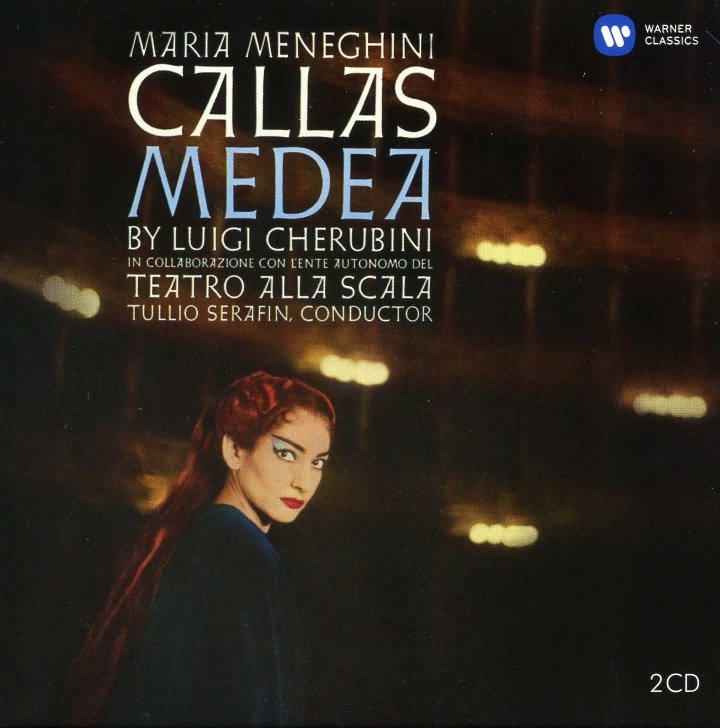
Callas’s Studio Medea

81xwlszwrml-_sl1456_

Recorded 12-19 September 1957, Teatro alla Scala, Milan

Producer: Wilma Cozart. Balance Engineer: Robert Fine

This recording of Medea has an unusual history. Medea had become a seminal Callas role, and she desperately wanted to record it. The opera was revived specially for her first in Florence in 1953, and she subsequently sang it in new productions in Milan (under Bernstein), Rome, Dallas, London, Epidaurus in Greece, and again at La Scala for the last time in 1961. Like much of her stage repertoire, Legge had little interest in it and agreed to release her from her contract, when Ricordi, who were launching a new label, approached her about recording it. EMI, no doubt finally realising its importance in the Callas canon, did eventually release it, but it has also been released by Mercury, Everest, and no doubt others.

However she was probably unwise to record it when she did, right after the Edinburgh performances of La Sonnambula when she was in ill health. Her voice isn’t exactly wobbly above the stave here, but it does lack power, a power that she recovers when she sings the role in Dallas the following year.

That said, when I first got to know this opera, and this recording, I had no other point of reference, and it seemed pretty good to me. It was only later, when I heard those barnstorming performances from Florence, La Scala and Dallas, that I found anything lacking, and it is only in comparison with herself that she fails. She is still a good deal better in the part than any other who attempted it, certainly a lot better than Gwyneth Jones and Sylvia Sass, who also made studio recordings of this Italian version. In other hands, Cherubini’s music can seem staid and formulaic. Callas breathes life into it like no other.

The version of Medea that Callas sang is actually a hybrid. Medée was originally an opera-comique in French with spoken dialogue. It was later translated into Italian, then recitatives were written by Franz Lachner for a German production. The version Callas performed was an Italian translation of the Lachner version, premiered at La Scala in 1909, over a hundred years after its first performance and 60 years after Cherubini’s death. Even so, each conductor Callas worked with (Gui, Bernstein, Rescigno, Serafin, Schippers) prepared their own version of the score, and made their own cuts. Consequently no two Callas performances are the same.

Serafin’s conception is essentially Classical, but his conducting varies from the somnolent to the dramatic. After a tautly conceived overture, the first scene up to Medea’s entrance drags on interminably. I understand the necessity to establish a pastoral air of peace and calm, into which the Colchian Medea bursts, but, quite frankly, at this pace it just becomes a bore. On LP I used to miss out the first side completely, and set the needle down part way through the second LP, when Medea makes her entrance.

Without foreknowledge of other performances by Callas, this is still a great performance of a difficult role. We lose some of the power and ferocity, but there are gains too. Ricordi il giorni tu la prima volta quando m’hai veduta? is couched in the most melting tones, her duplicity in the scene with Creon, and the following duet with Jason brilliantly charted, and her scene with the children movingly intense. Vocally, for all that she is not in her best voice, she manages its angular lines and wide leaps with consummate skill, her legato still wondrously intact. Note also how, in this Classical role, her use of portamento is more sparing.

When it comes to the supporting cast, Scotto is less of an advantage than you might expect, Pirazzini rather more (though not quite a match for Barbieri in Florence and at La Scala or Berganza in Dallas). Picchi, who sang Pollione to Callas’s Norma in London in 1952, is rather good, though Vickers is even better in Dallas. Modesti makes a good Creon too, though I would prefer Zaccaria in Dallas.

So, all in all, still probably the best studio Medea you’re likely to hear, and the sound (stereo, but still rather boxy) is a lot better than what you will hear in Florence, Milan or Dallas. Nevertheless all three of those performances are preferable, regardless of sound quality, for the white hot intensity Callas brings to the role.