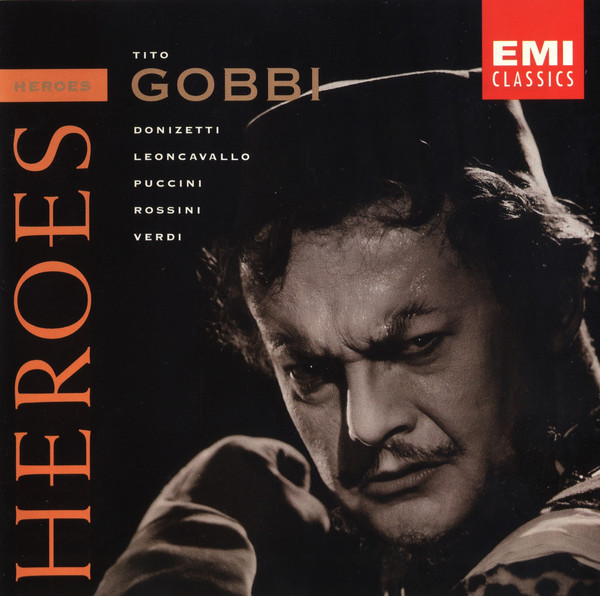
Tito Gobbi – Heroes

r-9369810-1479391843-9224.jpeg

“Heroes”, the title of this disc proclaims, though in honesty only two of the characters represented here (the Marquis de Posa and Simon Boccanegra) might be considered to fall into that category. The rest (Figaro, Enrico, Rigoletto, Germont, Renato, Tonio, Scarpia, Iago and Falstaff) hardly qualify, and some of them are downright villains.

What we do get however (and this is not always evident in compilation or recital records) is eleven sharply differentiated voice characters. Like Callas, Gobbi, though his voice is always recognisable, was adept at the art of vocal make-up and there is a world of difference between his genial, but venal Figaro and his blackly evil Ernesto, which follows. Gobbi’s may not always be the most beautiful voice you will hear in his chosen repertoire, nor the most graceful (though he could indeed sing with both beauty and grace) but it is the one I often hear in my mind’s ear in the roles I have heard him sing. To the characters included here, I could add his Amonasro, his Michele and Schicchi, his Don Giovanni and his Nabucco.

All but Iago’s Credo on this compilation are taken from complete recordings of the operas, and we also hear the voices of Victoria De Los Angeles in the duet from Simon Boccanegra and Callas in part of the Act II duet from Tosca from La povera mia scena fu interrotta, both a locus classicus of Gobbi’s art.

The last item here is Falstaff’s Honour monologue, and I can do no better than quote here John Steane in The Record of Singing

Play, for example Falstaff’s Honour Monologue in a succession of recordings (Scotti, Ruffo, Stabile, Fischer-Dieskau, Gobbi) and Gobbi’s is quite markedly the most satisfying, partly because he attends to what Verdi has written and sees the point of it. The phrase ‘voi coi vostri cenci’ is marked with a crescendo on the first word, followed by three staccato syllables. Scotti takes no notice, Ruffo and Stabile take little; Fischer-Dieskau observes the markings, as ever, but it is Gobbi who sees the pictorial force, the crescendo carrying a comical menace and the staccatos punching or flapping at the despised company as with a broom handle.

Steane’s prose is as ever quite pictorial itself, but he also understands that, as with Callas, Gobbi’s genius is not just to execute the notes, but to understand the point of [them].

That said, isolated excerpts don’t really represent Gobbi at his best, and really one needs the complete sets from which these excerpts are taken.
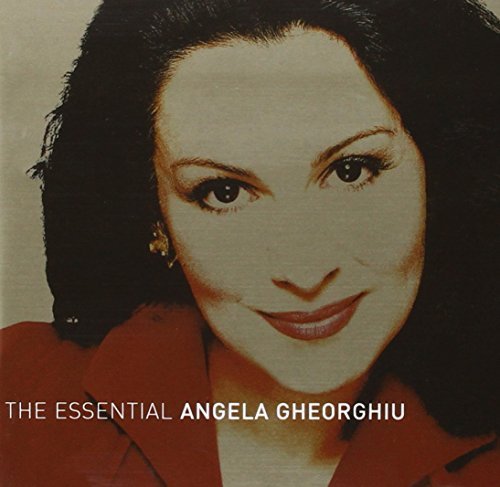
The Essential Angela Gheorghiu

51cj4h3nbtl

Is it churlish to point out that, though this collection includes much that is desirable, there is also a great deal of material one might consider “essential” on EMI, for whom Gheorghiu recorded for the lion’s share of her career? First contracted to Decca, she soon switched to EMI in order to be with the same label as her husband, Roberto Alagna, with whom she made many now well known complete opera sets. However it was Decca who first signed her up after her sensational debut as Violetta at the Royal Opera House, Covent Garden, and here they pay tribute to her with a well filled disc of excerpts from the few recordings she made for the label before she left them.

There are two excerpts from that 1994 Covent Garden La Traviata, a reflective Ah, fors è lui, technically assured Sempre libera and an affecting Addio del passato. Solti’s conducting is, as always in Verdi, a bit rigid but it is easy to understand why Gheorghiu had such a success in the role.

Next chronologically are five arias from her first recital disc made in 1995; Wally’s Ebben? Ne andro lontana, Marguerite’s Jewel Song from Faust, Il est doux, il est bon from Massenet’s Hérodiade and Vive amour qui rêve from his Chérubin. The Wally piece is beautifully sung, though she doesn’t quite capture its aching loneliness and the Jewel Song sparkles lightly as it should. The Aubade from Chérubin is also lovely, and I am reminded that I first saw her in the secondary role of Nina in the production of the opera which the Royal Opera, Covent Garden mounted with Susan Graham in the title role. She made quite an impression too. Probably the best of all these selections is the aria from Hérodiade, which is both gorgeous and gorgeously sung.

From the 1996 Lyon production of L’Elisir d’Amore we have Adina and Nemorino’s Chiedi all’aura lusinghietta, in which I find her, as I did in the theatre, just a mite too sophisticated.

There are so many good recordings of La Boheme that Chailly’s 1999 recording with Gheorghiu and Alagna is quite often forgotten, which is a pity as it’s actually very good indeed. From this set we have Gheorghiu’s touchingly sincere Si, mi chiamano Mimi through to the end of the act, and also her moving rendition of Donde lieta usci.

Perhaps most impressive of all are the items taken from her Verdi recital with Chailly. She might not quite match the breezy insouciance of Callas or Sutherland in Elena’s Merce, dilette amiche, but she seems almost perfectly cast as Amelia in her Come in quet’ora bruna. Both Leonoras are beautifully sung too, and there is a dark loveliness to her tone, which reminds me, surprisingly perhaps, of Leontyne Price.

The disc finishes, fittingly enough, with the fifth take from her first album, a piece from Romanian composer George Grigoriu’s Muzika, slight in musical value, but charmingly delivered.

The Young Domingo


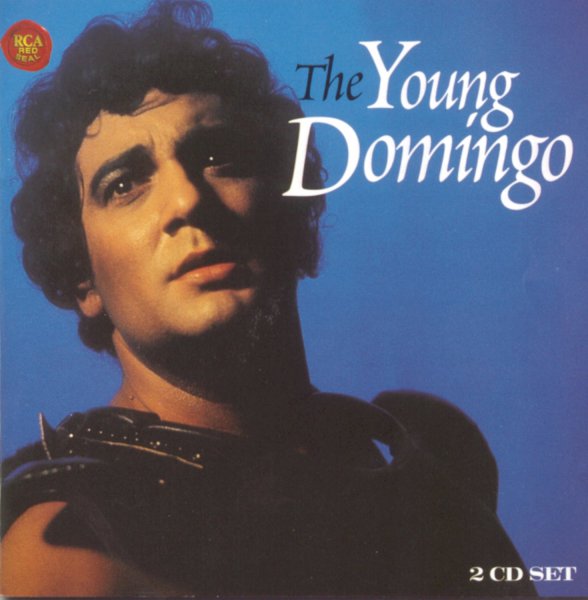
These days, with Domingo’s sometimes less successful forays into the baritone repertoire, it is easy to forget just how amazing his career was, not to mention how long it has lasted. This two disc set is a composite of three recitals made in 1968, 1971 and 1972 when Domingo (27 at the time of the first disc) was already an experienced artist, having first appeared on stage at the age of sixteen and singing his first major role (Alfredo) in 1961 at the age of 20.

The earliest of these recitals, which was given the title Romantic Arias heralded the arrival of a major artist, not only a tenor but a musician. The repertoire is wide ranging, taking in music from Handel to Mascagni and he sings in Italian, French, German and Russian. I can’t think of many tenors, even from the golden age of 78s, who could sing Puccini and Mascagni with so much passion and yet give us a wonderfully accomplished Il mio tesoro from Don Giovanni, the longest run sung cleanly and accurately and not only spun out in a single breath but phrased through into the next statement of the opening tune. The only other tenor I’ve come across who manages it as well is John McCormack. In all, whether it be in Lohengrin’s Narration or Lensky’s aria, sung in Russian, his singing is musical and immaginative. If we were to nitpick, it might be to note that, especially in the Italian items, there is a lack of excitement, of real intensity. Both are qualities he later added, along with his fine acting that served to make him the best Otello to be heard for many years. So he may not thrill in the manner of a Franco Corelli, but could Corelli have ever embraced such a wide range of differing music styles with such musicality and sensibility? I dount it very much. So let’s be grateful for what we have.

The second disc entitled Domingo sings Caruso is less wide ranging, most of the arias more well known, though it does include an aria for Marcello from Leoncavallo’s version of La Bohème, and the third La Voce d’Oro, an apt description of the golden tone that pours forth. Again one might note that his singing can be a little generic, but his musical sensibilities are always evident. Nor does he ever indulge in the vulgar mannerisms of some who preceded him. His singing is always tasteful, his musical manners impeccable.

To the three recitals, BMG have added two Leoncavallo arias (another from La Bohème and one from Chatterton) which were originally included as fill-ups for his recording of I Pagliacci under Nello Santi. Both are attractive pieces, wonderfully sung by Domingo.

Looking at Domingo’s website I see his calendar is still pretty full, with engagements, both singing and conducting, booked up to November next year. It is a remarkable achievement for a man approaching his eighties. There is no doubt the promise of these early recitals has been not only fulfilled but surpassed. Now that we have said goodbye to Domingo the tenor, now might be a good time to go backto these early recitals and remember just how good he was.

Sylvia Sass – The Decca Recitals


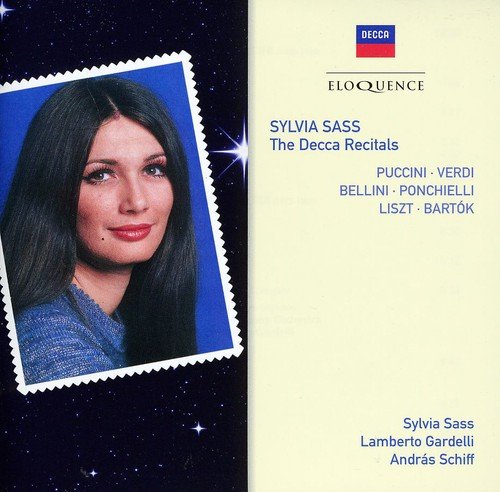
Sylvia Sass shot to stardom at the age of 25 after singing the role of Griselda in a 1975 Covent Garden production of Verdi’s I Lombardi which also starred José Carreras. Decca were quick to sign her up and her first recital LP (one side of Puccini, one of Verdi) followed in 1977. A further opera recital followed in 1979 and finally in 1981 a recital of songs by Liszt and Bartók, in which she got to sing in her native Hungarian. She also appeared on Solti’s recordings of Don Giovanni (as Donna Elvira) and Bluebeard’s Castle and on the Philips recording of Stiffelio. She was hailed as the new Callas and, like others saddled with the epithet before her, her international stardom was short-lived, though she continued to sing in opera (though mostly in Hungary) until 1995 and made many records for Hungaraton.

From the very first notes of Turandot’s In questa reggia it is clear that this is a singer with a personality, always aware of the dramatic possibilities of the music. The voice can caress, but equally it has bite and power and the top can glare when singing at full tilt. The four Puccini heroines given here (Turandot, Tosca, Manon and Butterfly) emerge as distintinctively different characters, which isn’t always the case in a Puccini recital. There is also much that is fine in the Verdi items, the Sleepwalking Scene from Macbeth being particularly good, but here we notice a tendency, also evident in the Puccini items, for there to be too great a gap between her loud and soft singing, where the loud singing can take on a strident, squally edge that contrasts too greatly with the almost disembodied purity of her soft singing.

By the time of the second recital this tendency to veer from ultra soft to ultra loud has become more pronounced, even more noticeable when singing live. I remember seeing her as Norma at Covent Garden in 1980 and you could hardly hear her when she was singing quietly. Not that the second recital doesn’t have its attractions. Lady Macbeth continues to be impressive, and there are some lovely moments in the Il Trovatore aria, with its spectacularly floated high D.

The 1981recital of Liszt and Bartók songs, with András Schiff at the piano, is rather impressive. Sass brings vivid personality to and drama to a song like Liszt’s Die Loreley, as well as a beautiful, comforting quality to Kling leise, mein Lied. She also makes musical sense of Bartók’s sometimes angular vocal lines, brilliantly supported by Schiff’s superb playing of the difficult piano accompaniments.

It is a great shame Sass never really fulfilled the promise of her early successes, but these discs serve to remind us why people found her so exciting when she first burst onto the scene and receive a qualified recommendation from me.

Tito Schipa – Opera Arias

61gglfv2dfl

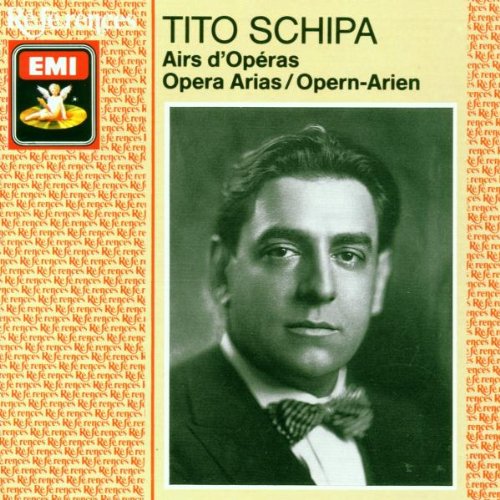
This EMI disc collects together recordings from Tito Schipa’s first recording sessions in 1913, recordings made in the 1920s and 1930s and one (Werther’s O, nature) recorded in 1942, when Schipa was 54.

The name of Schipa is most associated with style, elegance and grace (not for him the over-emotional sobbing excesses of Gigli), though the first aria included on the disc (Che faro from Orfeo ed Euridice) is hardly a model in that respect. The unstylish playing of the orchestra is certainly no help, but Schipa too has some lapses in style, with occasional aspiarates marring his legato.

The 1913 recordings tell a different story and reveal a surprising amount of power and squillo, not qualities one normally associates with the singing of Tito Schipa. They also offer so much more in the elegance of the phrasing, the firm line and his wonderful legato, as well as a proper appreciation of character and the dramatic situation. The prizes here are the Duke’s Ella mi fu rapita…Parmi veder le lagrime, from Rigoletto, Tu che a dio spiegasti l’ali from Lucia di Lammermoor and the Siciliana from Cavalleria Rusticana.

There are treasures too amongst some of the later recordings, even the 1942 Werther aria, which is wonderfully poetic, but the 1934 aria from Manon is also superb.

However I think I derived the most pleasure from the duets. WIth Toti Dal Monti we get a lovely Prendi l’anel to dono from La Sonnambula, and, even better, a gorgeous Tornami a dir from Don Pasquale, which is just about ideal in every way, the two singers blending thier voices and playing with the musical line in perfect synchronicity. Then, probably best of all is the famous Cherry Duet from Mascagani’s L’Amico Fritz, with the charming Mafalda Favero. Throughout he caresses and moulds the line and there is a moment of pure magic when he sings the words sei pur bella on a delciate thread of sound which perfectly expresses Fritz’s shy awakening to love. It is moments such as these which make us turn to these old recordings.

Elisabeth Schwarzkopf – Live broadcasts

517hffpxcml._sx425_

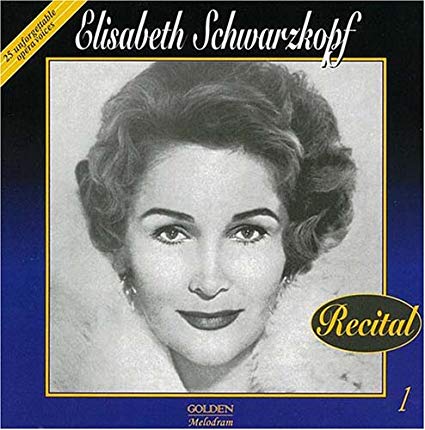
This is not a recital as such, but a collection of off the air recordings made by Schwarzkopf between the years 1941 and 1952. We get the opening of a Berlin Das Rheingold, conducted by Artur Rother (Schwarzkopf as Woglinde), Nie werd ich deine Hulde verkennen from a Vienna performance of Die Entführung aus dem Serail, conducted by Rudolf Moralt (with Emmy Loose, Anton Dermota, Peter Klein and Herbert Alsen), a duet from Weber’s Abu Hassan from 1942, with Michael Bohnen, and part of the Act II finale of Le Nozze di Figaro from La Scala in 1948, with Imrgard Seefried and W Hoefermeyer (who he?) under Karajan. We also get a couple of excerpts from the 1950 Salzburg Festival, both conducted by Furtwängler; Mi tradi from Don Giovanni (on which unusually she takes an unwritten upward ending, presumably sanctioned by Furtwängler though absent from all other versions by her) and Marzelline’s opening duet and aria from the famous performance of Fidelio at which Flagstad sang Leonore. In all Schwarzkopf displays her familiar virtues of pure, firm tone, excellent legato and elegant phrasing, the voice shot through with laughter in the lighter pieces. Marzelline’s aria is sung with a fuller tone than we often hear in this music, but captures perfectly her wistful charm. Ilia’s Zeffiretti lusinghieri is taken from a 1951 Turin Radio Mario Rossi broadcast, but it is not quite so accomplished as the one on her studio recital of the following year.

The rest is is given over to a Hamburg broadcast from 1952, beginning with a lovely performance of He shall feed his flock, from Handel’s Messiah (sung in German). The Act I monologue from Der Rosenkavalier is perhaps less detailed than the one on the complete set under Karajan and no doubt some might prefer it for that reason, though I wouldn’t necessarily be one of them. It’s a lovely performance nonetheless. Schwarzkopf’s Countess is also justly well known, and Porgi amor is sung with creamy tone and matchless legato, but the excerpts from Madama Butterfly (sung in German) don’t really work for her, and indeed Schwarzkopf herself, when she heard them in later years, thought them “rather screechy on top”. She did however approve the aria from Korngold’s Die tote Stadt (the soprano version of the duet Glück das mir verblieb) and rightly so, as this is without doubt the prize of the whole disc. I have never heard it sung better, not by Te Kanawa, not by Fleming, not even by Lehmann, who recorded the duet with Richard Tauber. The pianissimi on the top notes, the diminuendi, the way she fades the tone are absolutely miraculous, no other word for it. Everyone needs to hear this, but getting the recital on disc is quite difficult these days. Fortunately you can hear it on youtube.

The whole disc is a fitting repost to all those who think Schwarzkopf was a studio creation, catching her live and on the wing, but treasured mostly for that sensational and unfortunately unrepeated performance of the Korngold.

Montserrat Caballé & Shirley Verrett sing Great Operatic Duets

81uwtitniql._sl1500_

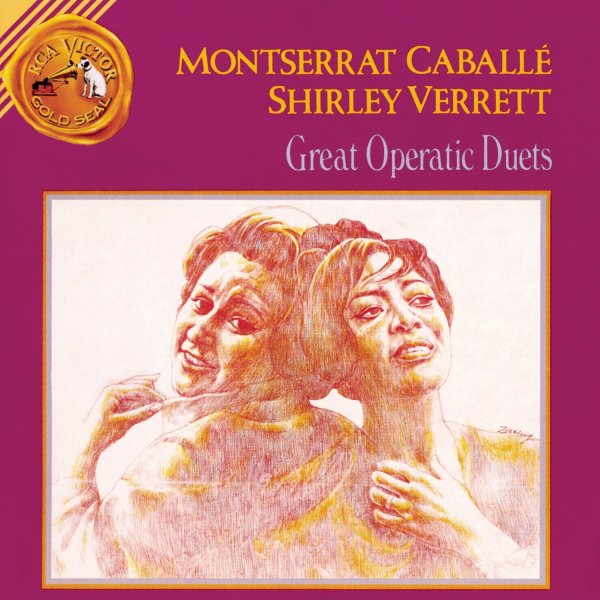
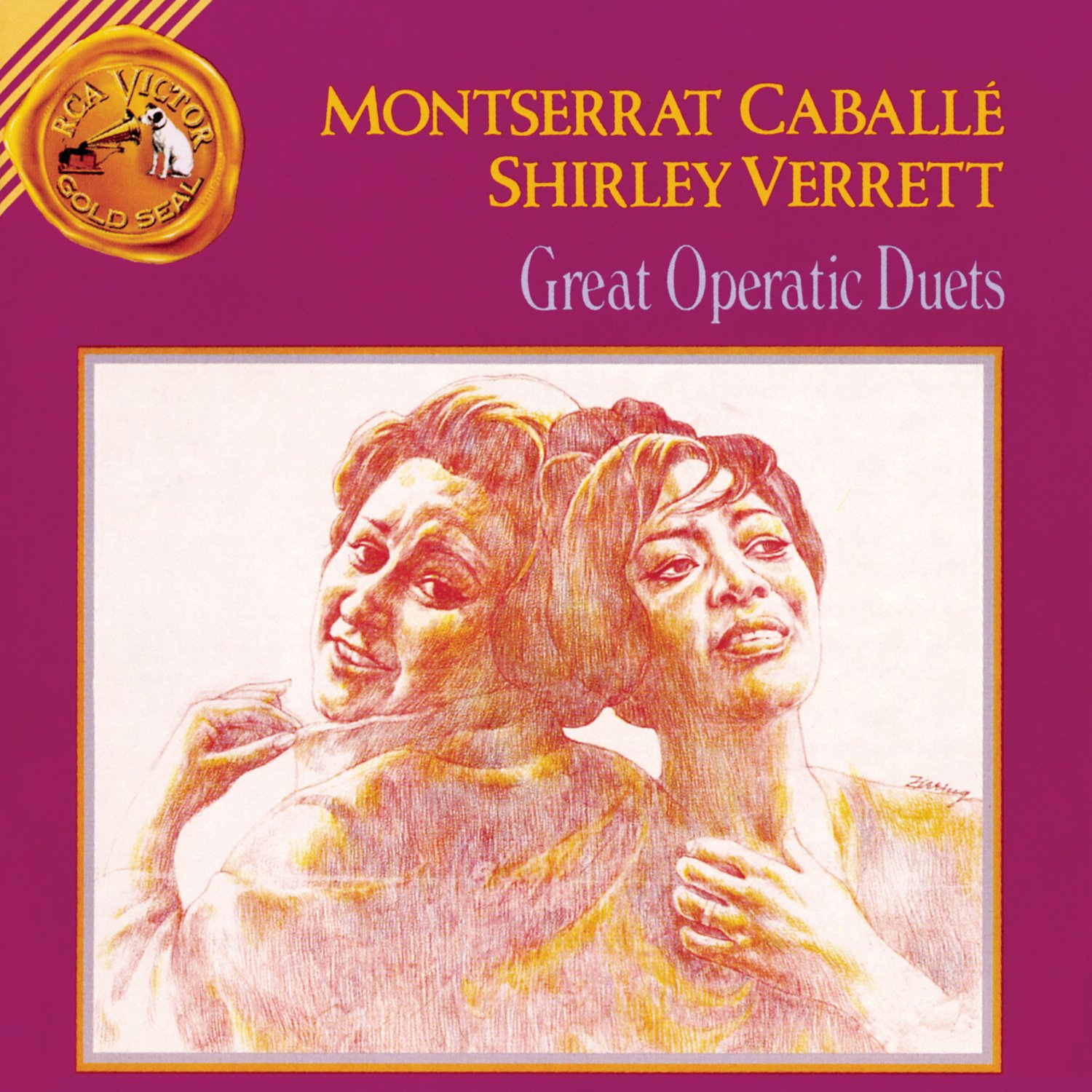
Duets from Semiramide (Rossini), Anna Bolena (Donizetti), Norma (Bellini), Les Contes d’Hoffmann (Offenbach), Aida (Verdi), Madama Butterfly (Puccini) and La Gioconda (Ponchielli).

The 1960s and 1970s were halcyon days for opera on disc. New recordings of both repertoire and rediscovered works appeared on an almost monthly basis, alongside recital records by major artists. Duet recitals, though not as frequent, were also a feature of this time, and could sometimes provide more variety in the juxtaposition of two different voices.

This 1969 duet recital finds both singers at the height of their vocal powers and provides a feast of great singing. It doesn’t quite get off to the best of starts however, with a performance of Serbami ognor from Rossini’s Semiramide in which Caballé’s scale passages are less than perfect, and which does not erase memories of Sutherland and Horne in the same music.

Vocally the duet from Anna Bolena is much better, and Caballé is here very touching in the section beginning Va, infelice where Anna forgives Giovanna; maybe not as moving as Callas with Simionato, but then, who is? Their voices blend well in the Norma duet too, and it is good to have the duet from Aida as Verrett never got to record Amneris in a complete recording, but, again neither duet is as thrilling as you’d want.

The principal pleasures of both the Barcarolle from Les Contes d’Hoffmann and the Flower Duet from Madama Butterfly are primarily vocal, and it is certainly wonderful to bask in the sheer beauty of two such gloriously rich voices in full bloom. The disc finishes with the great combative duet from La Gioconda, but yet again it’s a little underpowered and not a patch on Caballé’s recording of it with Baltsa in the complete set under Bartoletti.

This is a good memento of two singers, recorded before Caballé’s top notes started to harden and before she began to overindulge her penchant for floated pianissimi. This is also, to my mind, the best period for Verrett, when she was definitely a mezzo and before the move to soprano roles started to compromise the glorious individuality of that voice. A shame that it’s all a bit low key.

Edit: 24/03/2023

I listened to this duet recital again today and found it just a little dull. The voices are both beautiful, the singing itself accomplished, but somehow nothing really takes off and the emotional temperature is a bit tepid throughout. It got me wondering how much difference a conductor can make. Guadagno, a favourite of Caballé’s, is serviceable, no more. If you compare, say, the duet from Aida with the same duet from the Muti complete recording, where Caballé sings with Cossotto, it is to find that she is much more alive to the drama, much more emtotionally committed, and if you compare the conductng in the Anna Bolena duet to that of Gavazzeni for Callas and Simionato, to Serafin in the Norma, or even Bonynge in Semiramide, it is to find Guadagno rather lacklusre and faccid. He does best in the Barcarolle, where all he has to do is set a nicely flowing tempo and let the two gorgeous voices do their work. Even Verrett, who is usually an exciting and dramatically involved singer seems to be operating at a much lower voltage than usual. I am convinced this disc would have been a lot more satisfactory with a stronger hand at the helm.

Cotrubas sings Famous Opera Arias

51wbqsfxw6l


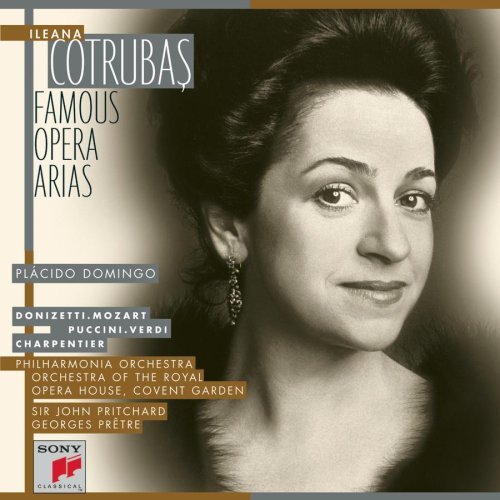
Recorded in 1976, when she was already 35, this was Ileana Cotrubas’s first and only recital disc. The playing time of the original disc being somewhat short, Sony have here added excerpts from the excellent complete recording of L’Elisir d’Amore also under Sir John Pritchard, Depuis le jour, from the complete Prêtre recording of Louise and O mio babino caro from Maazel’s Gianni Schicchi.

As Cotrubas herself says in the notes, Leonora’s Pace, pace was somewhat unexpected, a role that Cotrubas was never likely to sing on stage, and it really does need a fuller tone. I’m not sure if she ever sang Liu or Magda, but she could well have done and the other arias are all from her active repertoire.

It opens with a charming performance of Norina’s Quel gaurdo il cavaliere from Don Pasquale, a role she sang at Covent Garden at around the same time. She was a highly successful Susanna at Glyndebourne in 1973 (alongside Te Kanawa’s beautiful Countess and Freredica Von Stade’s radiantly ebullient Cherubino, performances which catapulted all three to stardom) and she is quite delightful in her Deh vieni.

The other side of her personality is captured in a deeply felt Ach ich fühl’s, and the natural morbidezza (an Italian word without any direct translation) which suited her to roles like Mimi and Violetta, is here displayed in her singing of the Puccini arias (Si, mi chiamano Mimi, Liu’s Tu, che di gel sei cinto, and Ch’il bel sogno di Doretta from La Rondine.) Though there is a hint of strain in the upper reaches of Gilda’s Caro nome, the aria also suits her well, and it here emerges as a dreamy reverie rather than the coloratura showpiece it often is.

The L’Elisir d’Amore excerpts are lovely in every way, as is Lauretta’s O mio babino caro, and Depuis le jour well captures Louise’s quiet intensity and mounting rapture.

A lovely memento of a well-loved artist.

Franco Corelli – Great Operatic Tenors

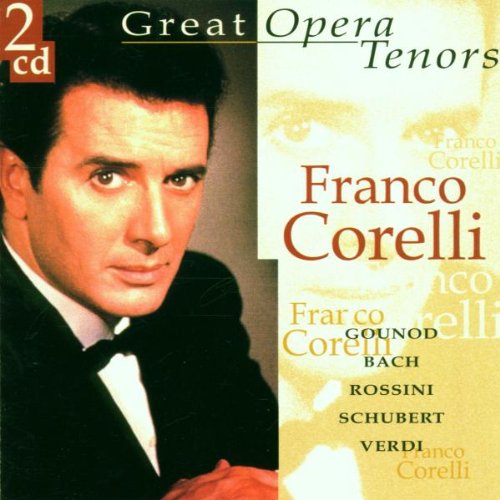
This two-disc compilation is drawn from the EMI catalogue and includes arias taken both from complete sets and recital discs.

People often go misty-eyed at the mere mention of Franco Corelli and he still inspires a huge following among opera lovers. For many he can do no wrong, and certianly the voice was a magnificent one, unique and no doubt a God-given gift. For me it’s more often a case of (to paraphrase the song from A Chorus Line) voice ten, artistry three. Not always, I hasten to add, and, if the performances on this set are anything to go by, he did respond to a strong hand at the helm. Predictably the best of them tend to be taken from complete sets, particularly those conducted by Zubin Mehta (Celeste Aida), Lovro von Matacic (Vesti la giubba) and Tullio Serafin (Pollione’s Meco all’altar di Venere from the second Callas Norma), which is arguably the best of all).

These are all on Disc One, where elsewhere there is just too much can belto sobbing. Manrico’s Ah si, ben mio, from the Schippers complete set, is delivered at a relentless forte (why not his stunning Di qella pira, I wonder?), as are the excerpts from the Santini recording of Andrea Chénier. Worst of all is the graceless, over-loud version of Roméo’s Ah, lève-toi, soleil, sung in execrable French. Listen to this and then to Bjørling, Kraus, Gedda or Alagna to hear how beautifully poetic the aria can sound.

Disc 2 has even less to commend it, I’m afraid. The best performances are taken from a recital record with an unknown orchestra under one, Franco Ferraris. Cavaradossi’s Recondita armonia lacks poetry, but E lucevan le stelle is much better, though he rather ruins the final measures with an excess of sobbing. Cielo e mar is also a fine, sensitive performance, with the added bonus of those gloriously free and ringing top notes.
The less said about some of the other items though, the better. After the operatic arias, we are treated (I’m not sure that is the correct word) to a selection from, presumably, a record of sacred arias, all in absolutey ghastly arrangements. Handel’s ubiquitous Largo from Semele is mangled almost beyond recognition, the Schubert and Bach/Gounod Ave Marias sung through a sort of treacle soup, and Rossini’s Domine Deus from the Petite Messe Solenelle bludgeoned to death. Franck’s Panis angelicus, taken, by the looks of things, from another album, doesn’t fare much better, nor, surprisngly does Lara’s Granada from the same album. Not entirely Corelli’s fault, as the arrangement is quite possibly the most ghastly I’ve ever heard, the tempo pulled around so much the piece loses any sense of flow. What price Wunderlich’s gloriously ebullient and sunny version for DG? Corelli sounds plain angry, but who can blame him when the accompanment is so awful?.

Fortunately the final two items somewhat redeem this sorry mess. The arrangements might not be much better, but in Cardillo’s Core ‘ngrato and De Curtis’s Torna a Sorriento, one just basks in the Mediterranean warmth of Corelli’s glorious tenor. It is moments like these that remind us of why we listen to him.

José Carreras – My Barcelona

Well this is something of a hotch potch, no doubt explained by its provenance – music included in the 1991 documentary film made after his recovery from leukemia My Barcelona, a celebration of the unique relationship between the man and the city of his birth.

What we get is a mixture of operatic arias, popular song and excerpts from Ramirez’s Navidad Nuestra and Misa Criola, which, surprisingly perhaps, makes for a pleasantly varied disc.

No great revelations, I suppose. Carreras is at his honeyed best in Cavaradossi’s E lucevan le stelle from the 1976 Davis recording of Tosca, a performance of poetic beauty, made before some of the heavier repertoire he essayed took a toll on his essentially lyric tenor, but most of the selections give pleasure. I particularly enjoy his version with piano of Mompou’s haunting Damunt de tu només los flors and the Ramirez pieces are also great fun.

An undemanding but enjoyable disc.