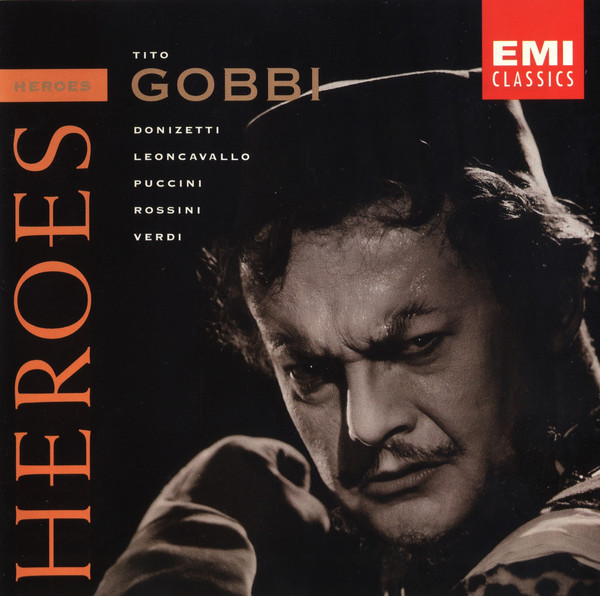
Tito Gobbi – Heroes

r-9369810-1479391843-9224.jpeg

“Heroes”, the title of this disc proclaims, though in honesty only two of the characters represented here (the Marquis de Posa and Simon Boccanegra) might be considered to fall into that category. The rest (Figaro, Enrico, Rigoletto, Germont, Renato, Tonio, Scarpia, Iago and Falstaff) hardly qualify, and some of them are downright villains.

What we do get however (and this is not always evident in compilation or recital records) is eleven sharply differentiated voice characters. Like Callas, Gobbi, though his voice is always recognisable, was adept at the art of vocal make-up and there is a world of difference between his genial, but venal Figaro and his blackly evil Ernesto, which follows. Gobbi’s may not always be the most beautiful voice you will hear in his chosen repertoire, nor the most graceful (though he could indeed sing with both beauty and grace) but it is the one I often hear in my mind’s ear in the roles I have heard him sing. To the characters included here, I could add his Amonasro, his Michele and Schicchi, his Don Giovanni and his Nabucco.

All but Iago’s Credo on this compilation are taken from complete recordings of the operas, and we also hear the voices of Victoria De Los Angeles in the duet from Simon Boccanegra and Callas in part of the Act II duet from Tosca from La povera mia scena fu interrotta, both a locus classicus of Gobbi’s art.

The last item here is Falstaff’s Honour monologue, and I can do no better than quote here John Steane in The Record of Singing

Play, for example Falstaff’s Honour Monologue in a succession of recordings (Scotti, Ruffo, Stabile, Fischer-Dieskau, Gobbi) and Gobbi’s is quite markedly the most satisfying, partly because he attends to what Verdi has written and sees the point of it. The phrase ‘voi coi vostri cenci’ is marked with a crescendo on the first word, followed by three staccato syllables. Scotti takes no notice, Ruffo and Stabile take little; Fischer-Dieskau observes the markings, as ever, but it is Gobbi who sees the pictorial force, the crescendo carrying a comical menace and the staccatos punching or flapping at the despised company as with a broom handle.

Steane’s prose is as ever quite pictorial itself, but he also understands that, as with Callas, Gobbi’s genius is not just to execute the notes, but to understand the point of [them].

That said, isolated excerpts don’t really represent Gobbi at his best, and really one needs the complete sets from which these excerpts are taken.

Charles Panzéra – The Master of French Song

41hz08b4rwl

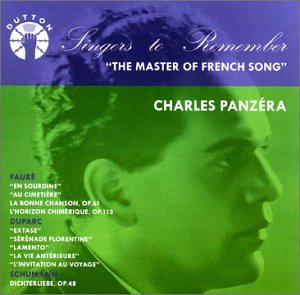
One of the greatest interpreters of French song, Chalres Panzéra was actually Swiss, born in Geneva in 1896. Although he did perform in opera and was particularly renowned for his Pelléas, he became ever more in demand as a recitalist, especially for his performances of French song, and Fauré dedicated his last song cycle, L’horizon chimérique to him. His repertoire extended to Monteverdi, Lully, Schubert and Schumann and, included here is his recording of Dichterliebe with Alfred Cortot a highly individual accompanist at the piano. Panzéra was married to the pianist Magdaleine Baillot, and they had a long and fruitful partnership, all of the French songs on this disc beng accompanied by her.  Aside from the Dichterliebe, this disc includes complete performances of Fauré’s La bonne chanson, L’horizon chimérique and a selection of songs by Duparc.

After World War II, he taught at the Juilliard School in New York and at the Paris Conservatoire, and wrote invaluable works on the interpretation of French song.

He had a voice of great beauty, admirably firm and seamless from top to bottom, allied to a wonderful sensitivity and refinement of style, and many of his performances are deservedly considered classics. Everything he does sounds totally spontaneous and yet one knows the amount of care that has gone into each interpretion. This is surely the art that conceals art.

Both the Fauré cycles are superbly sung, as are the Duparc songs, though his wife’s spreading of the chords in Lamento won’t be to everyone’s taste. He totally avoids the tendency to over-sentimentalise a song like the Wagnerian inspired Extase and delivers a marvellously detailed but unselfconscious L’Invitation au voyage.

Panzéra’s German sounds as natural as his French and his recording of Duchterliebe has long been considered a classic, though Cortot’s playing is highly idiosycratic. It may not delve as deeply as some more recent versions by the likes of Fischer-Dieskau or Schreier, but it captures beautifully something of the essence of Schumann.

A wonderful disc well worth seeking out.

The Essential Angela Gheorghiu

51cj4h3nbtl

Is it churlish to point out that, though this collection includes much that is desirable, there is also a great deal of material one might consider “essential” on EMI, for whom Gheorghiu recorded for the lion’s share of her career? First contracted to Decca, she soon switched to EMI in order to be with the same label as her husband, Roberto Alagna, with whom she made many now well known complete opera sets. However it was Decca who first signed her up after her sensational debut as Violetta at the Royal Opera House, Covent Garden, and here they pay tribute to her with a well filled disc of excerpts from the few recordings she made for the label before she left them.

There are two excerpts from that 1994 Covent Garden La Traviata, a reflective Ah, fors è lui, technically assured Sempre libera and an affecting Addio del passato. Solti’s conducting is, as always in Verdi, a bit rigid but it is easy to understand why Gheorghiu had such a success in the role.

Next chronologically are five arias from her first recital disc made in 1995; Wally’s Ebben? Ne andro lontana, Marguerite’s Jewel Song from Faust, Il est doux, il est bon from Massenet’s Hérodiade and Vive amour qui rêve from his Chérubin. The Wally piece is beautifully sung, though she doesn’t quite capture its aching loneliness and the Jewel Song sparkles lightly as it should. The Aubade from Chérubin is also lovely, and I am reminded that I first saw her in the secondary role of Nina in the production of the opera which the Royal Opera, Covent Garden mounted with Susan Graham in the title role. She made quite an impression too. Probably the best of all these selections is the aria from Hérodiade, which is both gorgeous and gorgeously sung.

From the 1996 Lyon production of L’Elisir d’Amore we have Adina and Nemorino’s Chiedi all’aura lusinghietta, in which I find her, as I did in the theatre, just a mite too sophisticated.

There are so many good recordings of La Boheme that Chailly’s 1999 recording with Gheorghiu and Alagna is quite often forgotten, which is a pity as it’s actually very good indeed. From this set we have Gheorghiu’s touchingly sincere Si, mi chiamano Mimi through to the end of the act, and also her moving rendition of Donde lieta usci.

Perhaps most impressive of all are the items taken from her Verdi recital with Chailly. She might not quite match the breezy insouciance of Callas or Sutherland in Elena’s Merce, dilette amiche, but she seems almost perfectly cast as Amelia in her Come in quet’ora bruna. Both Leonoras are beautifully sung too, and there is a dark loveliness to her tone, which reminds me, surprisingly perhaps, of Leontyne Price.

The disc finishes, fittingly enough, with the fifth take from her first album, a piece from Romanian composer George Grigoriu’s Muzika, slight in musical value, but charmingly delivered.

Sandrine Piau – Handel Opera Seria

r-13865292-1562864332-2077.jpeg

Although we may seem to be suffering a dearth of great Verdi and Wagner singers in recent years, Handel singing has gone from strength to strength over the last twenty years or so. However, even amongst the wealth of excellent Handel recital discs that have appeared, this one, recorded in 2004, stands out.

The programme itself is varied, with a nice sprinkling of arias from lesser known works amongst the more well known excerpts from such as Giulio Cesare in Egitto, Rodelinda and Orlando, whilst there is a good selection of different moods represented.

Sandrine Piau is the equal of everything Handel throws at her. The needle-fine precision with which she executes the florid music is breathtaking, as she tosses off stratospheric pyrotechnics with insouciant ease, but she is also adept at sustaining the long lyrical line. Furthermore she encompasses the full range of mood from quiet introspection to dramatic declamation. This is a real tour de force of Handel singing.

She is wonderfully supported by Christophe Rousset and Les Talens Lyriques and the recording cannot be faulted.

Warmy recommended.

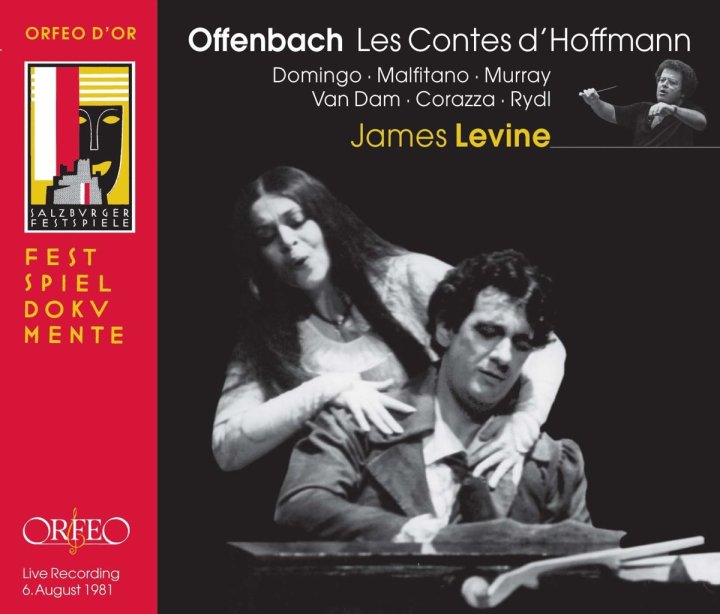
Les Contes d’Hoffmann from the Salzburg Festival 1981

71svq0cjidl._sl1200_

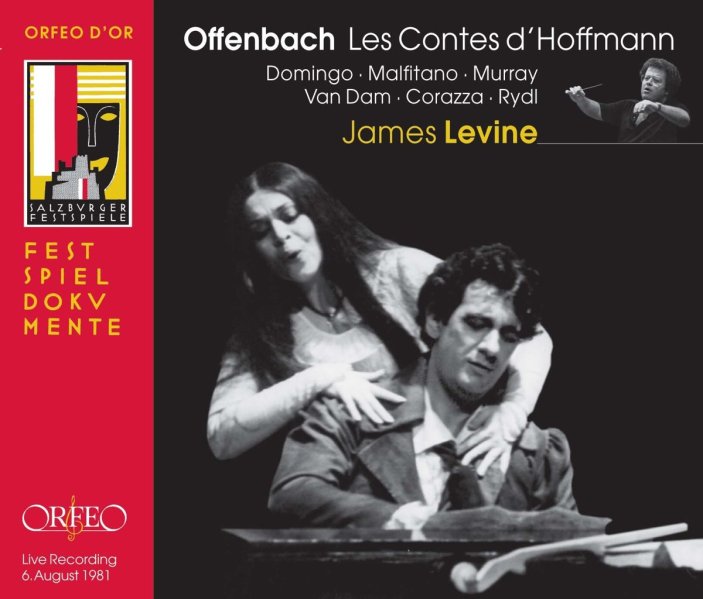
I was keen to hear this set after it was the reviewer’s first choice for the opera in BBC’s Building a Library programme, and it is very good indeed, though the sound of this live recording, made at the Salzburg Festival in 1981, rather lets it down. The solo voices are well recorded, but the sounds becomes boomy and congested when orchestra and chorus are at full tilt. Furthermore there are quite a few bangs and thuds associated with live performance.

That said the performance itself is thrilling with Domingo in superb voice and even more inside the role than he is on the Bonynge set. That of course has Sutherland in the female roles and it has to be said that Malfitano doesn’t command her beauty of tone. On the other hand, she is a much more convincing vocal actress. For all that Offenbach intended the roles to be sung by the same singer, the demands of each are quite different, and I often prefer to hear them sung by different singers as they are in the superb John Schlesinger Covent Garden production with Domingo again as Hoffmann, but with Luciana Serra as Olympia, Ileana Cotrubas as Antonia and Agnes Baltsa (a mezzo) as Giulietta. Malfitano rises to the challenge superbly however and reconciles me to the casting of the same singer.

The rest of the cast is also excellent with Ann Murray superb in the dual role of Niklausse/The Muse and Van Dam perfection in the roles of the four villains, vocally more resplendent than Bacquier on the Bonynge recording. Rémy Corazza is also excellent in the comic roles, if not quite erasing memories of Hugues Cuénod on the Bonynge set.

James Levine, whom I sometimes find too bombastic in Verdi, surprised me, his conducting both exciting and lyrical and the Vienna Philharmonic play superbly.

The Bonynge profits from superb Decca sound of course, but, in all other respects, I think I prefer this one.

Great Moments of Nicolai Gedda

“Great Moments” is the title of this three disc compilation, issued in 2000, and EMI certainly had a great deal to choose from. Nicolai Gedda must be one of the most recorded tenors in history. I suppose one should point out that the “moments” here are all purely operatic. To get a more rounded view of Gedda’s output, both as to range and repertoire, one would have to include his work in orotorio and song, embracing music from Bach to the present day, as well as some operetta. But this is a sensible conflation of music from the eighteenth and nineteenth centuries, covering twenty years of recording from 1952 to 1974.

Gedda was a keen linguist and sang virtually without accent in French, German, Italian, Spanish, Russian, English and his native Swedish. This linguistic ability no doubt also informed the vast range of music and styles he was able to embrace. It certainly makes for a pleasingly varied selection of excerpts.

Disc one is made up, mostly, of the earliest material, hence we have excerpts from his splendid Dimitri on the 1952 Dobrowen recording of Boris Godunov (with Eugenia Zareska) and the whole of his first recital for EMI, recorded in 1953. A further excerpt from Boris Godunov from a 1969 recital is included, along with an aria from Rimsky-Korsakov’s May Night which shows the voice virtually unchanged in seventeen years, though the style is possibly a little more assertive.

The 1953 recital is a real treasure-trove of delights, opening with a version of Lensky’s Act II aria, which is so beautiful that it bears comparison with Sobinov. He sings it as an inner monologue, the pianissimo reprise spun out in mastery fashion. Also wonderful are his honeyed performance of Du pauvre seul ami fidèle from Auber’s La Muette de Portici and the glorious mezza voce legato of Nadir’s Je crois entendre encore. The other French items are just as desirable, but he also delivers an ardently poetic Cielo e mar from Ponchielli’s La Gioconda and his sad, restrained performance of Federico’s Lament from Cilea’s L’Arlesiana. Some may prefer a more overtly passionate rendering in the manner of Corelli, but personally I find Gedda’s vocal restraint quite refreshing and not in the least bit unemotional. This first disc ends with a joyfully ebullient version of Mes amis, écoutez l’histoire from Adam’s Le postillon de Lonjumeau, sung in Swedish and recorded live in 1952.

Disc 2 is also wide ranging, starting with music by Rousseau, Gluck (Gedda coping superbly with the high tessitura of Gluck’s tenor version of Orphée et Eurydice) and Mozart, before moving on to the German Romantic repertoire. Taken from a 1957 recital disc, Don Ottavio’s arias and Tamino’s Dies Bildnis ist bezaubernd schön are much better than on the complete Klemperer recordings, with a lovely smile in the tone for Tamino’s aria. Belmonte’s Ich baue ganz, recorded in 1967 with the Bath Festival Orchestra under Sir Yehudi Menuhin and sung in impeccable English, is brilliantly done. Exciting performances of Huon’s arias from Oberon lead us into the German Romantics. Gedda only once sang Lohengrin on stage, but decided that Wagner wasn’t for him. His lyrical approach to In fernem Land and Mein lieber Schwann is very beautfiful nonetheless.

Best of all on this second disc is a magical performance of Magische Töne, sung in a ravishing mezza voce of ineffable sweetness, the long legato line beautifully and firmly held. This is great singing, no doubt about it.

Disc 3 is of French and Italian arias and duets. It starts with a superb performance of La gloire était ma seule idole from Berlioz’s Benvenuto Cellini, a role Gedda made very much his own and of course later recorded complete under Sir Colin Davis. Next comes a dramatic version of Un autre est son époux from Werther, the joyful Aubade from Lalo’s Le Roi d’Ys, and the Raoul/Marguerite duet from Les Huguenots (with Mady Mesplé). Arnold’s Asil hérèditaire from Rossini’s Guillaume Tell, with its fabulously ringing top notes, leads us into the Italian bel canto items.

Mirella Freni joins him for duets from La Sonnambula, Lucia di Lammermoor and Don Pasquale whilst alone he sings Edgardo’s Tombe degli avi miei and Ernesto’s Cercherò lontana terra. The Bellini had me wishing he had been engaged for Callas’s studio recording of La Sonnambula rather than the ineffectual Monti. After all he had already sung Narciso in her recording of Il Turco in Italia.

Freni, who had yet to venture into more dramatic repertoire, blends well with Gedda in the duets, but back in 1966 she had yet to learn how to project personality in a recording. Her singing is lovely but a little anonymous. Both the solo items could be considered models of bel canto style but are also sung with appreciation of the dramatic situation, the recitatives vividly delivered.

To finish we have a clutch of encores, including Lara’s Granada and the lovely Berceuse from Godard’s Jocelyn, which give us a glimpse of Gedda’s prowess in lighter fare and remind us of that Gedda also recorded a lot of operetta.

Given Gedda was such a prolific recording artist, there was a lot to choose from when compiling a set of Great Moments, and no doubt the set could have extended to many more discs. There is no doubt, though, that EMI have chosen some plums from his discography and there isn’t a dud performance on the whole set. Extravagantly recommended.
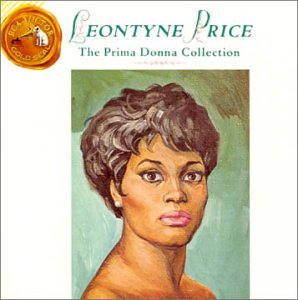
Leontyne Price – The Prima Donna Collection


This four disc set gathers together the five recital albums Leontyne Price made under the title Prima Donna. Each one followed a similar pattern, starting with an aria from the Baroque and finishing with something from the twentieth century. Volumes one, two three and five are presented in the order they were originally released, but, inexplicably, volume four is broken up and its contents scattered randomly amongst the others.  The LPs were recorded in 1966 (volumes one and two), 1970 (volume three), 1978 (volume four) and 1980 (volume five), by which time Price would have been fifty-three. The voice changed quite a bit over this fourteen year period, and the first three discs make for much more comfortable listening than the last two, by which time the voice had thickened, with the middle range more occluded, diction smudged and top notes beginning to sound strained. Having so many of the arias from volume four placed side by side with arias from the first three only serves to accentuate this fact. Having a strained performance of Turandot’s In questa reggia from 1978 follow hot on the heels of her 1966 recording of Depuis le jour, which is lovely, if not particularly idiomatic, only goes to empahasise the point.

It goes without saying that there is some glorious singing in this set. At its peak, which is when the first three volumes were made, the voice was an absolutely gorgeous instrument, secure throughout its range and flexible in fast moving music. The selection of music is also interesting, with well known arias rubbing shoulders with some heard less often, especially in recital.

Price once said,

It’s terrible but you know I just love the sound of my own voice. Sometimes I simply move myself to tears. I suppose I must be my own best fan. I don’t care if that sounds immodest – l feel that all singers must enjoy the sound they make if they’re to have others enjoy it too.

Well it’s an interesting point. Callas famously was the opposite. She hated listening to her own records, because she could only hear the faults. She was always striving for the impossible. Price, on the other hand, sometimes gives the impression that she went into the studio, poured out the glorious sounds, declared herself satisfied and left it at that. There is little that is specific to the music she is singing. Though the musical range is vast the interpretive range is not. There isn’t really that much difference between the way she approaches Purcell and Puccini, Handel and Verdi. This is even more pronounced in the final volume, which is, in any case, the least recommendable of the five. Gilda’s Caro nome is placed next to Isolde’s Liebestod, but Caro nome is laboured with no sense of the young girl’s first awakening to love and the Liebstod has no transfiguring rapture. They have the same voice character and just sound as if the singer had strayed into the wrong repetoire, which indeed she had. This final volume also has on it an ill-advised Casta diva, an aria which, in isolation, she might have made a good stab at in 1966, but which, by 1980, is beyond her. The most successful, and surprising, item on volume five is Queen Elizabeth’s Act I Scene and Prayer from Britten’s Gloriana, on which Price certainly has the requisite regal grandeur, but there is nothing else on volume 5, that I would really care to listen to again.

The first three volumes are a different matter and, if few of the performances are particularly revelatory, there is much to admire in both the singing and the voice we hear here, with volume three to my mind being the most successful.

Highlights would include Selika’s Sur mes genoux, fils du soleil from Meyerbeer’s L’Africaine and Do not  utter a word from Barber’s Vanessa from volume 1, Paolo, datemi pace from Zandonai’s Francesca da Rimini and La mamma morta from Andrea Chénier from volume 2, Se vano il pregare from I Lombardi, Dis-moi que je suis belle from Thaïs and Mes filles, voilà s’achève fom Les Dialogues des Carmélites, from volume 3.

Though she was known for her Fiordiligi and Donna Anna, Mozart fares less well. Or sai chi l’onore certainly brims with outrage and drama, but, though Non mi dir is beautifully poised, the fast section is laboured and the voice, even in 1970 sounds an unwiledly instrument for this music. Elettra’s D’Oreste d’Ajace, from volume 4 recorded in 1978, suffers even more from a lack of mobility.

Still, we should be thankful for what we have. The first three discs showcase one of the most ravishing voices to have ever graced the operatic age. I used to own volume 3 on LP, which had always been one of my favourite opera recitals, and I was very excited to hear the complete set. If my expectations were not quite fulfilled, I am nonetheless happy to have it in my collection.


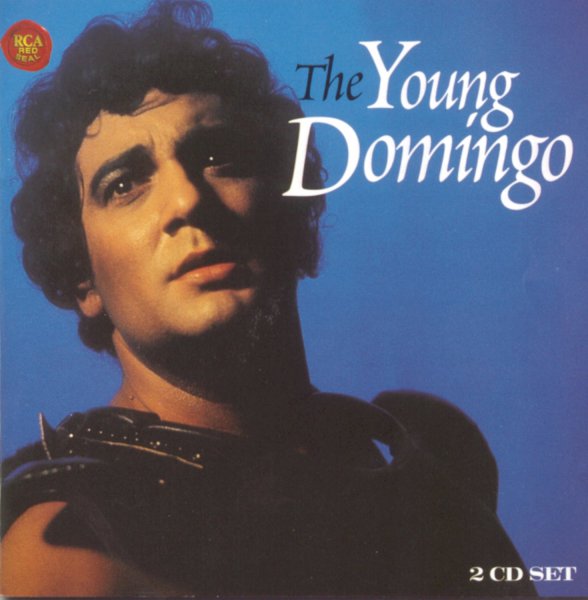
The Young Domingo


These days, with Domingo’s sometimes less successful forays into the baritone repertoire, it is easy to forget just how amazing his career was, not to mention how long it has lasted. This two disc set is a composite of three recitals made in 1968, 1971 and 1972 when Domingo (27 at the time of the first disc) was already an experienced artist, having first appeared on stage at the age of sixteen and singing his first major role (Alfredo) in 1961 at the age of 20.

The earliest of these recitals, which was given the title Romantic Arias heralded the arrival of a major artist, not only a tenor but a musician. The repertoire is wide ranging, taking in music from Handel to Mascagni and he sings in Italian, French, German and Russian. I can’t think of many tenors, even from the golden age of 78s, who could sing Puccini and Mascagni with so much passion and yet give us a wonderfully accomplished Il mio tesoro from Don Giovanni, the longest run sung cleanly and accurately and not only spun out in a single breath but phrased through into the next statement of the opening tune. The only other tenor I’ve come across who manages it as well is John McCormack. In all, whether it be in Lohengrin’s Narration or Lensky’s aria, sung in Russian, his singing is musical and immaginative. If we were to nitpick, it might be to note that, especially in the Italian items, there is a lack of excitement, of real intensity. Both are qualities he later added, along with his fine acting that served to make him the best Otello to be heard for many years. So he may not thrill in the manner of a Franco Corelli, but could Corelli have ever embraced such a wide range of differing music styles with such musicality and sensibility? I dount it very much. So let’s be grateful for what we have.

The second disc entitled Domingo sings Caruso is less wide ranging, most of the arias more well known, though it does include an aria for Marcello from Leoncavallo’s version of La Bohème, and the third La Voce d’Oro, an apt description of the golden tone that pours forth. Again one might note that his singing can be a little generic, but his musical sensibilities are always evident. Nor does he ever indulge in the vulgar mannerisms of some who preceded him. His singing is always tasteful, his musical manners impeccable.

To the three recitals, BMG have added two Leoncavallo arias (another from La Bohème and one from Chatterton) which were originally included as fill-ups for his recording of I Pagliacci under Nello Santi. Both are attractive pieces, wonderfully sung by Domingo.

Looking at Domingo’s website I see his calendar is still pretty full, with engagements, both singing and conducting, booked up to November next year. It is a remarkable achievement for a man approaching his eighties. There is no doubt the promise of these early recitals has been not only fulfilled but surpassed. Now that we have said goodbye to Domingo the tenor, now might be a good time to go backto these early recitals and remember just how good he was.

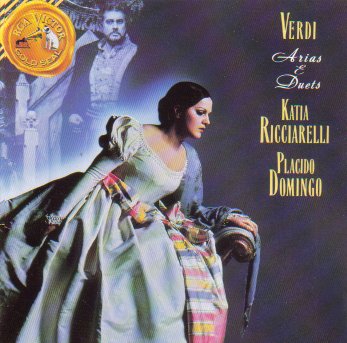
Katia Ricciarelli – Verdi Arias & Duets

51gj2be3g2b-l

This was Katia Ricciarelli’s debut recital, released in 1972 when she would have been 26. For this 1991 CD release, BMG added two items from a duet recital with Domingo, made at the same time.

Ricciarelli had an illustrious career and prolific recording career, but, it always seems to me, has never enjoyed the acclaim of her slightly older Italian contemporaries, Mirella Freni and Renata Scotto. She perhaps asked a little more of her essentially lyrical voice than it would deliver but, unlike singers like Sass and Souliotis, she was intelligent enough to later drop some of her dramatic roles in favour of more lyric fare. Her Turandot might have been ill advised but, like Sutherland’s, it was confined to the studio.

This Verdi disc catches her at her peak singing, for the most part, a selection of unfamiliar arias from Giovanna d’Arco, I Masnadieri, Jérusalem, Il Corsaro and I Vespri Siciliani as well as arias from Otello, Il Trovatore and Don Carlo, plus duets from Un Ballo in Maschera and Otello with Domingo.

The voice is a beautiful one and she is an imaginative singer, responsive to mood and text, but there are occasions when her legato is not as good as one might wish. If one were to compare her performance here of Medora’s Non so le tetre immagini with a late one by Callas, made in 1969, it is to find that, despite Callas’s by this time waning resources, the long line is maintained, the wide intervals bound more closely together, where Ricciarelli can be a little angular. Nor is Ricciarelli’s coloratura technique as clean as Callas’s. One is grateful for the beauty of the tone and her dramatic involvement, nonetheless.

Ricciarelli is a singer I have come to appreciate more with the passing of the years. I heard her live a few times, on the last occasion at a concert at the Barbican when her voice was probably past its best. The programe consisted mainly of bel canto arias, and I remember well her outstanding singing of Giulietta’s Oh quante volte, so good that it held the audience in rapt silence. She was forced to repeat the aria as an encore at the end of the night.

She is always musical, always alert to the drama, always imaginative and this Verdi disc is a good reminder of her excellence in the field. There are very few sopranos singing today who could touch her in this repertoire.

Karajan’s second recording of Aida

41v5vkkw6hl

Karajan’s second recording of Aida was recorded, like the first one, in Vienna in 1979 exactly twenty years later. For some reason, it is usually passed over in favour of the first, which starred the more obvious Aida cast of Tebaldi, Bergonzi, Simionato and MacNeil. Personally, I’ve always preferred this later one with a cast which, on paper, might seem lightweight, but actually works in practice very well.

Roughly contemporaneous with Karajan’s Berlin recording of Don Carlo this Vienna recording, though still wide ranging, is much better, more natural, putting the voices in a more natural acoustic, and Karajan in so many places brings out the beauty and lyricism of the score. He paces the score brilliantly and is most attentive to his singers. Not that this is an undramatic reading. Far from it. Though tempi can be measured, Karajan is an experienced Verdian and still infuses them with energy. The orchestral climaxes are stunning and all the singers relish the text and sing off the words. It hardly needs be said that the Vienna Philharmonic play magnificently.

Freni is a little taxed in places, nor does she command the sheer beauty of sound Caballé does on the Muti recording, but what pleasure it is to hear the text so well enunciated, so clearly communicated. Her Aida is lyrically vulnerable and I actually prefer it to many whom one might consider more vocally entitled. Carreras is likewise a lyrical Radames, and his voice was still very beautiful at this phase of his career. He too sings well off the text. I like, for instance, the reflective way he sings Se quel guerrier io fossi, becoming more forceful in the second part of the recitative when he sings about the applause of all Memphis, before softening his tone again when he sings about Aida. How much of this is Carreras, how much Karajan I don’t know, but it makes for a more thoughtful reading than we often get.

Baltsa was also at her absolute vocal peak, though she is no barnstorming Amneris. She reminds us that Amneris is a young spoiled princess, used to getting her own way but also vulnerably feminine and a vaild rival for Aida. It is a very convincing portrayal and she is absolutely thrilling in the judgement scene. Cappuccilli is maybe not so implacable an Amonasro as Gobbi, but he also sings well off the words, and Raimondi and Van Dam are nicely contrasted as Ramfis and the King. The silken voiced Ricciarelli is luxury casting as the Priestess.

An excellent set, well worth investigating and, in my opinion, much more dramatically alive than the 1959 set, which has always seemed a little too self-consciously beautiful for my taste.