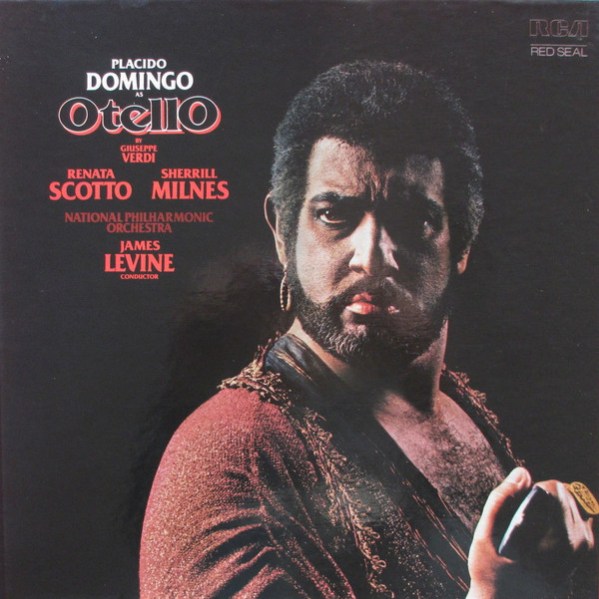
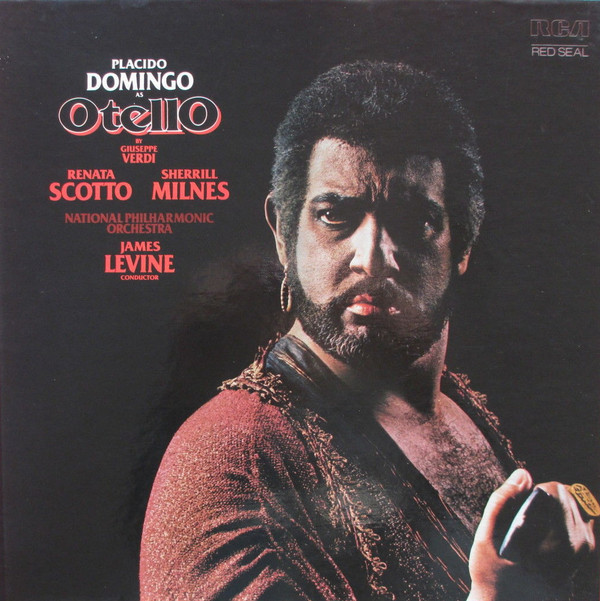
Domingo’s first recording of Otello

r-7473810-1513790477-2803.jpeg

Quite aside from the recent sexual misconduct revelations, Domingo seems to come in for a lot of flak these days, but it is salutary to remember that this, his first recording of a role he became particularly associated with, was made over forty years ago. Towards the end of his career he turned to baritone roles (with qualified success, admittedly), but, by any standards, the man has had a long and illustrious career.

He made two further studio recordings of the role (one of them used for the soundtrack to the Zeffirelli film), and their are at least three official videos of him performing the role on stage, and a number of unofficial live accounts. This recording finds him early in his conquest of this signature role, but it is already well sung in. Records cannot of course capture his superb acting and powerful stage presence, but his Otello is still, even at this early stage of his career, a great performance. Some, and I am probably one of them, would prefer a voice with a bit more squillo on top. My favourite Otello remains Vickers, who has musicality, dramatic intensity and squillo, but I prefer Domingo to Del Monaco, whose singing can indeed be thrilling, but who tends to let volume compensate for a lack of real dramatic awareness.

There are other reasons to enjoy this recording. Levine’s conductiing, which derives from long stage acquaintance with the opera, is definitely one of his best Verdi recordings (though the recording itself is a tad congested in the climaxes) and Milnes is also caught at something close to his best, a suave, guileful and conniving Iago. Scotto, though she may not have Tebaldi’s beauty of tone, is a much more communicative and moving Desdemona, and this is one of her most succesful performances on disc. The voice occasionally spreads on top when under pressure, but her pianissimo singing is exquisite and her phrasing wonderfully musical.

Despite reservations about Rysanek’s Desdemona, the Serafin set with Vickers and Gobbi remains my favourite studio recording. That said, I would always want one of Domingo’s studio recordings as well. Though Domingo himself may be even more moving in his later two recordings and many, I know, would go for his last recording under Chung, with Studer and Leiferkus, I still prefer this early one. I’ve never been a big fan of Studer and Leiferkus sounds unidiomatic to me, for all his intelligence and dramatic acumen. The Maazel is let down by some weird recording balances and Diaz’s well sung but anonymous Iago, though Ricciarelli is also an affectingly touching Desdemona. So the Levine emerges as the winner for me.
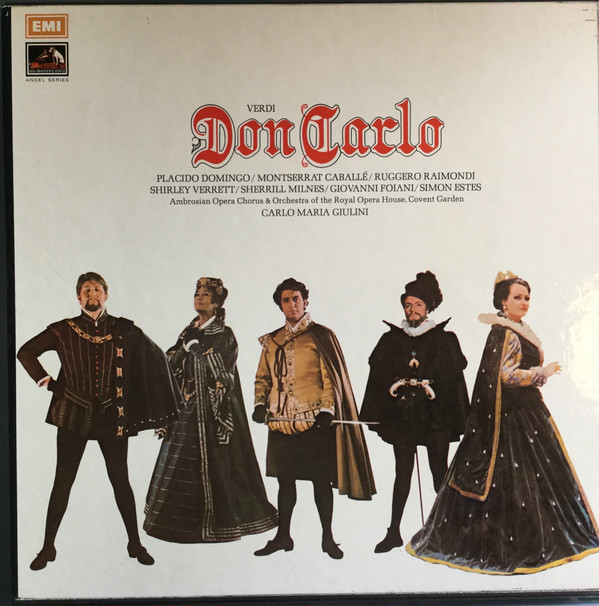
Giulini’s Studio Don Carlos

r-7809186-1492090586-6586.jpeg

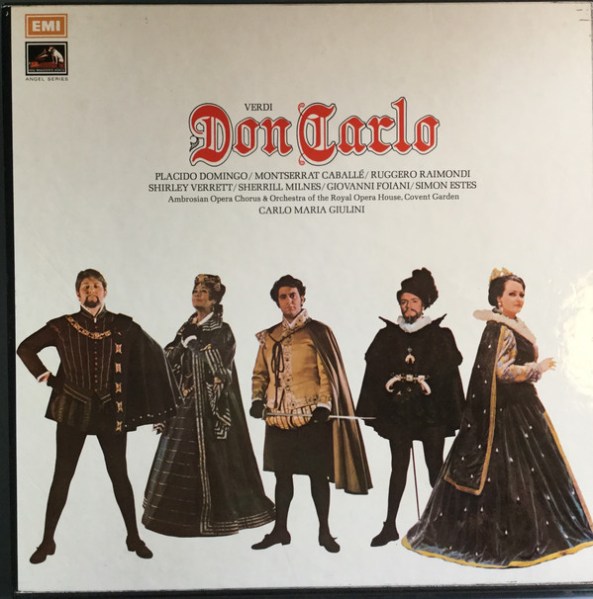
Don Carlos has always been one of my favourite Verdi operas. It’s a flawed masterpiece no doubt, but the characters are so beautifully drawn and the music displays Verdi at his most humane.

This Giulini recording can now be considered a classic, and remains, on balance, the best recording available. Not that it’s that simple of course, for Don Carlos exists (and has been recorded) in a bewildering varierty of different editions. The Giulini represents Verdi’s final revision, in Italian, of the five act version. I have three different recordings of the opera, all of different versions. In addition to this one, I have Karajan’s four act Italian version and Abbado’s five act French version, with appendices of music either cut or added for different performances.

Giulini’s conducting is by turns magisterial and warmly sympathetic to his singers, though occasionally perhaps a tad too spacious. I’d have preferred a more propulsive tempo for Eboli’s O don fatale, for instance, but all in all his is one of the best conducted sets you wil hear. The sound is excellent analogue stereo too.

His cast is excellent, Domingo at his golden toned best is more involved, less generic than was often the case in the many recordings he made in the 1970s, though he is even more inside the role by the time he recorded it in French with Abbado. I also slightly prefer Carreras on the Karajan in one of his very best recordings. Carlo is one of Verdi’s most complex tenor roles, a weak young man with a distant father, forever in the shadow of his friend Posa and Carreras is better at expressing the slightly unhinged character of the man. Caballé is in gloriously rich voice for Elisabetta and is also caught at her career best. There is no better Elisabetta on any of the studio recordings. Verrett is thrillingly vibrant as Eboli, that smoky lower register of hers used to great effect. Milnes is also at his best as the inherently noble Posa, but Raimondi is a little light of voice for the King, a role which really requires a darker, deeper bass sound. Still he contrasts nicely with the black-voiced Inquiistor of Giovanni Foiani. Simon Estes makes a strong impression as the Monk.

What a great opera this is, and how lucky we are to have this wonderful performance on disc.

Wunderlich in La Traviata

91b3-3eyhsl._ss500_

This recording was taped at a performance in Munich in March 1965. It was a new production by August Everding, and, judging by the audience reaction, it was a tremendous success.

Teresa Stratas’s shattering Violetta  is of course well known from the Zeffirelli film, brilliantly acted, if vocally stressed. Here she is  just a few months short of her twenty-seventh birthday and making her debut in the role, and, if the photos in the booklet are anything to go by, she looked absolutely stunning. Vocally though, and divorced from her powerful stage presence, she has her problems, especially in the first act. She has to transpose down Sempre libera and, even then, it taxes her to the limit. There are other places too where her voice doesn’t quite do what she wants it to, though, in intention at least, it has the seeds of a great performance. For instance the moments leading up to Violetta’s outpouring of love at Amami, Alfredo are urgently and sincerely felt, though she can’t quite swell the tone at Amami, Alfredo itself. In the last act she delivers a telling letter reading and a moving Addio del passato, but the performance doesn’t yet add up to a complete whole.

No challenge then for Callas, whose Violetta is hors councours, and whose 1958 Covent Garden performance remains my all time favourite. In Zeffirelli’s film, though vocally not much more comfortable, Stratas surpasses what she does here, where we are also able to see her touchingly vulnerable acting.

Hermann Prey, 36 at the time and only a year older than Wunderlich, sounds too young and tends to oversing, possibly in an attempt to sound more Italianate. Though there is pleasure to be derived from the voice itself, I don’t get any sense of a real character.

No, the chief reason for hearing this set is the chance to hear Wunderlich sing a complete role in Italian. The language suits him well and he is an ardently lyrical Alfredo, singing with honeyed tone, but with plenty of heft in the outburst at Flora’s party. Very very occasionally he overplays his hand (mostly in recitative) but there is much that is treasurable; Dei miei bollenti spiriti has a lovely lilt and he and Stratas make a wonderfully touching moment out of their brief moment of happiness in the last act,  Parigi, o cara. Later perhaps he would have played down slightly the histrionics in his contribution to Gran Dio, morir si giovane, but it is already a treasurable performance and reason enough to hear this live recording.

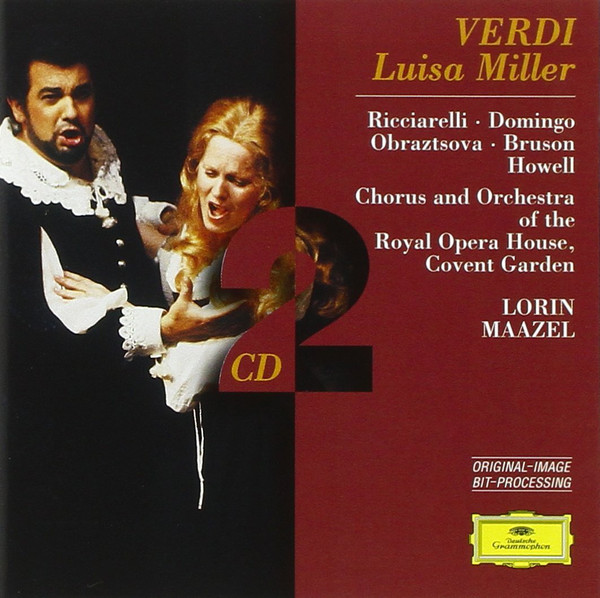
Ricciarelli in Luisa Miller

r-9910923-1488394480-3768.jpeg

The front runners for this opera are probably Maag with Caballé and Pavarotti and Cleva with Moffo and Bergonzi, but this one has its attractions too, not least the affecting Luisa of Katia Ricciarelli. Vocally she is a little more fallible than either Caballé or Moffo, but she is very much inside the character and makes a vulneraby moving Luisa, no doubt helped by the fact that this recording was made during a highly successful run of performances at Covent Garden (actually a revival of a production that had been new the previous year). Much as I admire the two aforementioned ladies, I think ultimately I’d prefer Ricciarelli.

For the rest, honours are about even. Of the conductors, Maag is often revelatory and Cleva, whilst less imaginative, in the best Italian lyric tradition, but Maazel can be somehwat brash and vulgar. All three tenors are excellent and in their best form, as are the three baritones, Milnes, MacNeil and Bruson, so choice will depend on personal preference.

Federica was sung by Elizabeth Connell in the Covent Garden performances, but for some reason it was deemed necessary to bring in Obraztsova for the recording, who oversings and overpowers the role. The best Federica is Verrett on the Cleva; Reynolds on the Maag is completelyel anonymous. Richard Van Allan was Wurm in the stage performances but he is replaced by Ganzarolli, presumably because he had already recorded the role for Maag.

Still, for the three principals, this is a recommendable version of the opera and I’d be hard pressed to make a choice between it, Maag and Cleva.

De Los Angeles in La Traviata

51ust0qa2nl._ac_

Victoria De Los Angeles has long been a favourite singer of mine and her Violetta satisfies on so many levels. She is a little strained by the tessitura of the first act, but the voice is generally clear and beautiful, her singing always musical and deeply felt. As in everything she did, the sensitivity and sincerity of the performance are most affecting and she is without doubt one of the best Violettas on disc. What I miss is that sense of desperation and impulsiveness inherent in the character. Her Violetta is touching, but not overwhelmingly tragic as it is with Callas, who does tend to spoil me for all comers.

She has a good supporting cast with Carlo Del Monte a manly and forthright Alfredo and Sereni a sympathetic Germont, as he is in Callas’s Lisbon performance.

I sometimes feel Serafin’s virtues are rather underestimated. He paces the score brilliantly, particularly good in the choruses, which can sometimes outstay their welcome. If I’m honest, I rather prefer his approach to the more interventionist Kleiber. The cuts traditional at the time are observed, so no cabalettas to Alfredo’s and Germont’s arias.

If Callas, particularly in London, remains my yardstick for this opera, this is nevertheless one of my favourite studio sets and I might even place it just above Cotrubas/Kleiber.

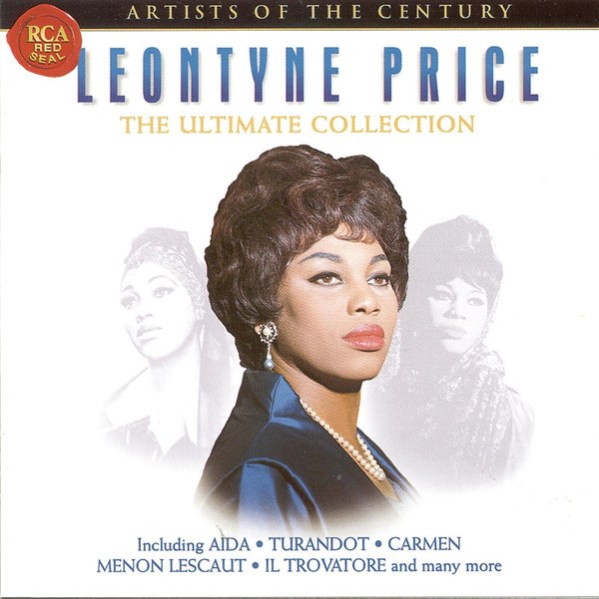
Leontyne Price – The Ultimate Collection

In many ways this is an infuriating compilation, not because of anything to do with Mme Price herself, but because of the shoddy presentation, which does her, and her colleagues on this disc, no service whatsoever. The skimpy booklet lists the arias on the discs, bit not one word about their provenance, who is conducting, what year the record was made or indeed anything at all to place them in context. Even Manon Lescaut is spelled wrongly on the front cover. All we get is a puff about her career and the unhelpful information on the back of the disc that the compilation was issued in 1999. Texts and translations are hardly to be expected these days, but I do like to at least know a bit about the date of the recording, the orchestra, conductor and other singers who appear.

There is a good chance of course that I am not the target audience. Maybe most people who buy the set are happy just to put the discs on, sit back and let the gorgeous voice pour out some familiar tunes, which, for the most part, is what we get, the least well known piece here being the excerpt from Barber’s Antony and Cleopatra.

At least the selection concentrates mostly on her strengths, so we get fine examples of her Aida, both the Leonoras, her Carmen and a liberal sprinkling of Puccini arias, which are beautifully sung if not particularly specific in character. The weakest items here are the Mozart arias and Dido’s Lament, regally voiced but impassively emotionless. However there are some very impressive performances here, particularly those taken, I assume, from complete performances of Il Trovatore, La Forza del Destino and Aida, roles for which she was well suited. The voice was certainly one of the glories of its age, with a dark plangency particularly suited to the melancholy of characters like Aida and Leonora.

That said, I would have to say that, personally, I find this hotchpotch kind of compilation, which concentrates on the singer rather than the music, completely unsatisfactory. As it happens, I am, at the moment, also working my way through the Janet Baker twenty disc Great Recordings box, which I suppose one could also legitimally call a hotchpotch. If I am finding this a much more rewarding listening experience, it presumably has something to do with the better, more logical programming, and also the greater specificity of Baker’s art.

Dipping in and extracting arias here and there from this set will proabably afford the most pleasure and maybe that is what one is supposed to do with a compilation like this.

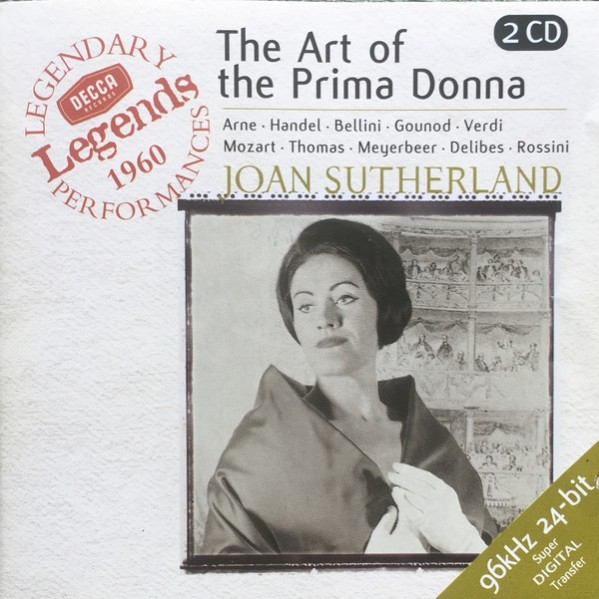
Joan Sutherland – The Art of the Prima Donna

r-10886939-1505963132-9869.jpeg

So what more can one say about this famous two disc recital? It was recorded in 1960, not long after Dame Joan had enjoyed a spectacular success in Lucia di Lammermoor, in 1959, at the Royal Opera House, Covent Garden. She was already 33 and had been a member of the company since 1952, when she had sung Clotilde to Callas’s Norma and the Priestess in Aida. She had sung a wide number of roles there, including Agathe, the Countess, Gilda, Pamina, Eva and even Lady Rich in Gloriana and Jennifer in Tippett’s The Midsummer Marriage, but none of these undertakings had prepared anyone for the spectacular success she would have as Lucia, with Serafin, Callas’s mentor, in the pit. The role became her calling card and shortly afterwards she sang it in Paris, at La Scala and at the Met, performances that put her firmly on the map and paved the way for the direction her career would take. Thereafter she concentrated almost exclusively on the bel canto repertoire and many operas were resurrected specifically for her.

Let us try and listen now with fresh ears, as if, for instance, this was the work of a singer new to us today. First impressions would be of the beauty of the voice, the fullness of tone, the ease on high and the way those top notes ring out with brilliance but without a hint of shrillness. We would also notice the rocketing virtuosity and the stunningly accurate coloratura. She also sings with feeling, but the first impressions are definitely vocal. This is an exceptional instrument used with great technical accomplishment. What I don’t think we quite get is a true impression of the size of the voice, which, according to all who heard her in the theatre, was quite exceptional.

Some of the arias (particularly the opening track, Arne’s The soldier tir’d, Handel’s Let the bright Seraphim and Semiramide’s Bel raggio) have become yardsticks against which all subsequent comers might be judged, and almost all the others would no doubt be considered amongst the best versions available. Vocally she has few limitations, though these might include a relative weakness in the lower register. Nor is she ever likely to suddenly throw into relief a word or a phrase and her diction, though a lot better than it was later to become is not particularly clear. We might also note that characterisation is not her strong point. As one aria follows another there is little to distinguish one character from another. We do not get a gallery of different people, as one would with a Callas or a Schwarzkopf.

For many these reservations will not be a problem and of course there is a great deal of pleasure to be had from the purely visceral experience of hearing such a beautiful voice in full bloom tackling with accomplishment a wide range of music. For others, and I would count myself among them, that certain sameness of interpretaion will be a problem and I for one prefer to listen to the recital piecemeal rather than all in one sitting. When listening in sequence, I start out being stunned by the singing but, after a while, my mind starts to wander as one interpretation emerges much the same as the one before. The best arias are, as I intimated above, those in which Sutherland can display her amazing vocal dexterity.

Going back to first impressions, though. There is, as far as I’m aware, nobody singing today who can even approach the accomplishment of what Sutherland achieves here. This two disc set stands as testament to her greatness, before the mannerisms (the poor diction, the mushy middle voice, the droopy partamenti) became apparent and should be in the collection of all those interested in singers and singing.

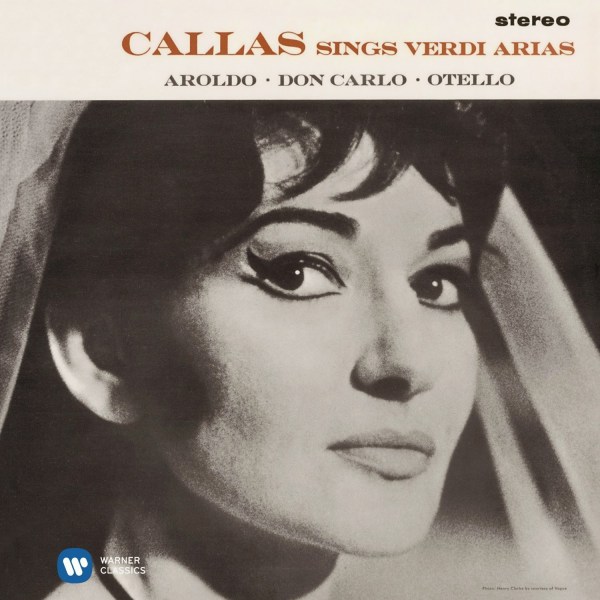
Callas sings Verdi Arias (Revisited)


By 1964 Callas had all but retired from musical life. In 1961 she recorded her first disc of French arias, sang in performances of Medea at Epidaurus in Greece and at La Scala and made a single concert appearance in London. In 1962, she did even less; a short concert tour, taking in London and cities in Germany, plus a couple of arias for a BBC TV appearance. 1963 saw more concerts in Berlin, Dusseldorf, Stuttgart, London, Copenhagen and Paris, plus more recording sessions of French arias at the beginning of the year. At the end of the year and at the beginning of 1964 she embarked on more intensive recording activity, possibly in preparation for her upcoming return to the operatic stage in Tosca and Norma. Three discs were issued in 1964, one of classical arias by Mozart, Beethoven and Weber, one of arias by Rossini and Donizetti, and one of Verdi arias, with more of the Verdi sessions being released in 1972, shortly after she emerged from self-imposed exile to teach a series of masterclasses at the Juilliard School in New York. Though more of these sessions, plus some made in 1969, were eventually released after her death, these were the only ones she agreed to.

Though all three of the discs issued in 1964 revealed some pronounced vocal problems, the Verdi disc is by far the most successful. She seems less preoccupied with her vocal problems, more engaged with the material and consequently the singing has a freedom that is lacking in the other two discs, though this does mean we also get quite a few squally notes above the stave.

Desdemona’s Willow Song and Ave Maria might be considered an uncharacteristic piece for Callas, but she is alive to every shift of mood. As it rarely strays above the stave it also presents her with the least problems vocally. It is a great pity EMI didn’t think to employ someone to sing Emilia’s lines, but Callas skillfully uses a different tone for the comments to Emilia from the one she uses for Barbara’s song. Throughout one feels Desdemona’s anxiety, which erupts with a sudden passionate outburst when she bids Emilia goodbye. The Ave Maria profits from her deep legato, the final Ab spun out in the best tradition.

Both of the Aroldo arias are thrilling, especially Mina’s Act III solo, a superb piece which Callas fills with drama and significance, bringing the cabaletta to a rousing conclusion.

Elisabetta’s Non pianger mia compagna from Don Carlo doesn’t really come off. Though her legato is still excellent, she sounds strained here and she can’t float the climactic phrases as she should. Eboli’s O don fatale, though, is another matter entirely. The whole aria brims with contrast and drama, and one registers each change of expression. She vehemently launches into the opening section, spitting out the words ti maledico, but then moulds rather than sings the o mia regina section, her legato line superb, her rich lower register digging deep into its melancholy. Finally as she realises she still has time to save Carlo, she brings the aria to an ecstatic close. OK, so there are a couple of off centre high notes, but they fade into insignifance next to the thrilling commitment of the singing.

When I reviewed all three of these 1963 recitals here back in January 2017, I mentioned that my wobble tolerance could vary from listen to listen. Sometimes I find the acidulous tone and stridency hard to take; on others I barely notice them as I get wrapped up in the musical imagination. It’s safe to say that on this occasion the latter reaction was in play.

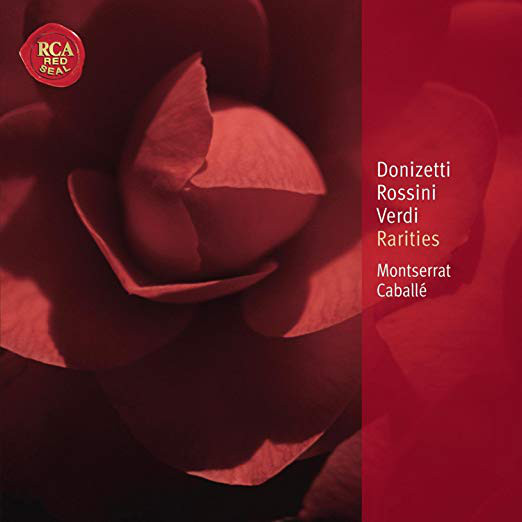
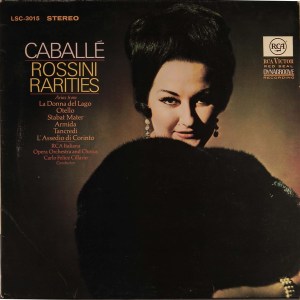
Montserrat Caballé – Rossini, Donizetti and Verdi Rarities

r-14007043-1565960472-8916.jpeg

Rossini: Arias from La Donna Del Lago, Otello, Stabat Mater, Armida, Tancredi and L’assedio di Corinto
Donizetti: Arias from Belisario, Parisina d’Este. Torquato Tasso, Gemma di Vergy
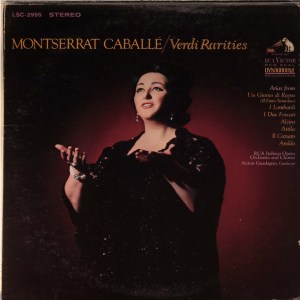
Verdi: Arias from Un Giorno di Regno, I Lombardi, I due Foscari, Alzira, Attila, Il Corsaro and Aroldo

These two discs bring together the three LPs of bel canto Rarities Montserrat Caballé recorded shortly after she rocketed to stardom singing Lucrezia in Lucrezia Borgia at Carnegie Hall in 1965, a last minute replacement for an ailing Marilyn Horne. Each record was devoted to a different composer. The first two, Rossini and early Verdi, were recorded in Italy in 1967 with the RCA Italiana Chorus and Orchestra and the Donizetti with the London Symphony Orchestra and Ambrosian Opera Chorus in 1969. Carlo Felice Cillario was the conductor for the Rossini and Donizetti, Anton Guadagno for the Verdi and the luxury presentation included other singers in the various comprimario roles.

The material was even rarer back then than it is now as vary few of the works represented had ever been recorded, Caballé herself being one of the singers who spearheaded the bel canto revival that occurred after Callas had opened the doors to this repertoire in the previous decade.

These were the years of Caballé’s absolute peak and the voice is in superb condition, without a trace of the hardness that coud afflict her loud high notes in later years. Her breath control is prodigious, but she doesn’t over-exploit her fabulous high pianissimi, which she tended to do in later years, and her singing has an energy and attack which you might find surprising if you only know her from her later recordings, when she tended to slow everything down until it practically came to a halt. If she has a fault, it is that her trills are a little sketchy and occasionally one hears the slight suspicion of an aspirate, but the singing is surpassingly beautiful throughout its range, her legato excellent and the voice even from top to bottom. Characterisation might not be her strong point, but she is always alive to the dramatic situation and her singing is both involved and involving.

The arias on each disc are well chosen and the whole enterprise exudes class. I really can’t think of any singer today who could match her in this repertoire, maybe DiDonato in the Rossini and Donizetti, though she lacks Caballé’s arrestingly beautiful sound. As for Verdi, well we do seem to be experiencing a dearth of good Verdi singers today.

These two discs are a superb memento of a great singer at the height of her powers and should be in the collection of any vocal connoisseur. This particular release comes with full notes, texts and translations which are hardly to be taken for granted these days. Highly recommended.