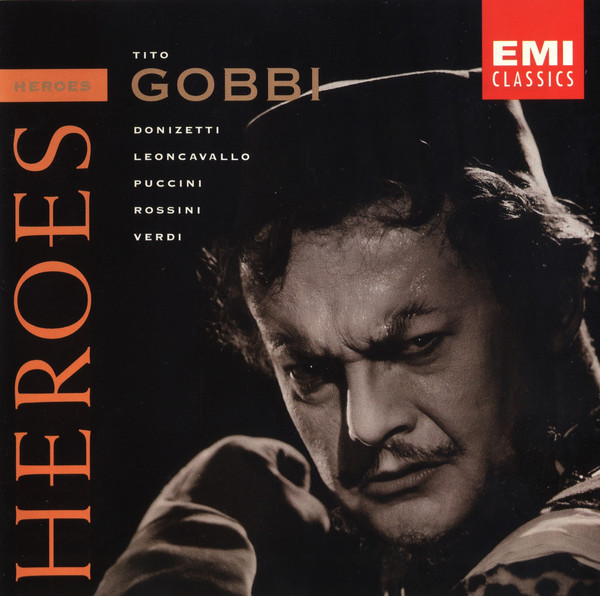
Tito Gobbi – Heroes

r-9369810-1479391843-9224.jpeg

“Heroes”, the title of this disc proclaims, though in honesty only two of the characters represented here (the Marquis de Posa and Simon Boccanegra) might be considered to fall into that category. The rest (Figaro, Enrico, Rigoletto, Germont, Renato, Tonio, Scarpia, Iago and Falstaff) hardly qualify, and some of them are downright villains.

What we do get however (and this is not always evident in compilation or recital records) is eleven sharply differentiated voice characters. Like Callas, Gobbi, though his voice is always recognisable, was adept at the art of vocal make-up and there is a world of difference between his genial, but venal Figaro and his blackly evil Ernesto, which follows. Gobbi’s may not always be the most beautiful voice you will hear in his chosen repertoire, nor the most graceful (though he could indeed sing with both beauty and grace) but it is the one I often hear in my mind’s ear in the roles I have heard him sing. To the characters included here, I could add his Amonasro, his Michele and Schicchi, his Don Giovanni and his Nabucco.

All but Iago’s Credo on this compilation are taken from complete recordings of the operas, and we also hear the voices of Victoria De Los Angeles in the duet from Simon Boccanegra and Callas in part of the Act II duet from Tosca from La povera mia scena fu interrotta, both a locus classicus of Gobbi’s art.

The last item here is Falstaff’s Honour monologue, and I can do no better than quote here John Steane in The Record of Singing

Play, for example Falstaff’s Honour Monologue in a succession of recordings (Scotti, Ruffo, Stabile, Fischer-Dieskau, Gobbi) and Gobbi’s is quite markedly the most satisfying, partly because he attends to what Verdi has written and sees the point of it. The phrase ‘voi coi vostri cenci’ is marked with a crescendo on the first word, followed by three staccato syllables. Scotti takes no notice, Ruffo and Stabile take little; Fischer-Dieskau observes the markings, as ever, but it is Gobbi who sees the pictorial force, the crescendo carrying a comical menace and the staccatos punching or flapping at the despised company as with a broom handle.

Steane’s prose is as ever quite pictorial itself, but he also understands that, as with Callas, Gobbi’s genius is not just to execute the notes, but to understand the point of [them].

That said, isolated excerpts don’t really represent Gobbi at his best, and really one needs the complete sets from which these excerpts are taken.

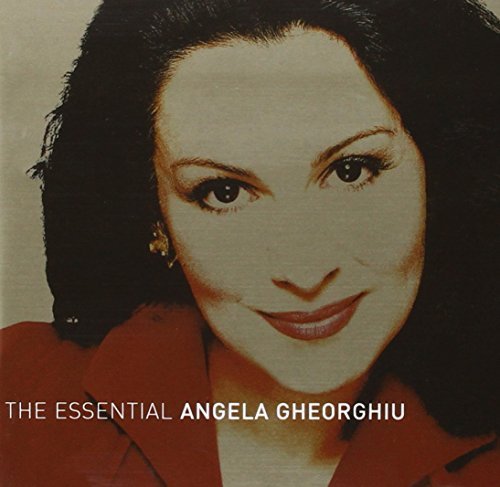
The Essential Angela Gheorghiu

51cj4h3nbtl

Is it churlish to point out that, though this collection includes much that is desirable, there is also a great deal of material one might consider “essential” on EMI, for whom Gheorghiu recorded for the lion’s share of her career? First contracted to Decca, she soon switched to EMI in order to be with the same label as her husband, Roberto Alagna, with whom she made many now well known complete opera sets. However it was Decca who first signed her up after her sensational debut as Violetta at the Royal Opera House, Covent Garden, and here they pay tribute to her with a well filled disc of excerpts from the few recordings she made for the label before she left them.

There are two excerpts from that 1994 Covent Garden La Traviata, a reflective Ah, fors è lui, technically assured Sempre libera and an affecting Addio del passato. Solti’s conducting is, as always in Verdi, a bit rigid but it is easy to understand why Gheorghiu had such a success in the role.

Next chronologically are five arias from her first recital disc made in 1995; Wally’s Ebben? Ne andro lontana, Marguerite’s Jewel Song from Faust, Il est doux, il est bon from Massenet’s Hérodiade and Vive amour qui rêve from his Chérubin. The Wally piece is beautifully sung, though she doesn’t quite capture its aching loneliness and the Jewel Song sparkles lightly as it should. The Aubade from Chérubin is also lovely, and I am reminded that I first saw her in the secondary role of Nina in the production of the opera which the Royal Opera, Covent Garden mounted with Susan Graham in the title role. She made quite an impression too. Probably the best of all these selections is the aria from Hérodiade, which is both gorgeous and gorgeously sung.

From the 1996 Lyon production of L’Elisir d’Amore we have Adina and Nemorino’s Chiedi all’aura lusinghietta, in which I find her, as I did in the theatre, just a mite too sophisticated.

There are so many good recordings of La Boheme that Chailly’s 1999 recording with Gheorghiu and Alagna is quite often forgotten, which is a pity as it’s actually very good indeed. From this set we have Gheorghiu’s touchingly sincere Si, mi chiamano Mimi through to the end of the act, and also her moving rendition of Donde lieta usci.

Perhaps most impressive of all are the items taken from her Verdi recital with Chailly. She might not quite match the breezy insouciance of Callas or Sutherland in Elena’s Merce, dilette amiche, but she seems almost perfectly cast as Amelia in her Come in quet’ora bruna. Both Leonoras are beautifully sung too, and there is a dark loveliness to her tone, which reminds me, surprisingly perhaps, of Leontyne Price.

The disc finishes, fittingly enough, with the fifth take from her first album, a piece from Romanian composer George Grigoriu’s Muzika, slight in musical value, but charmingly delivered.

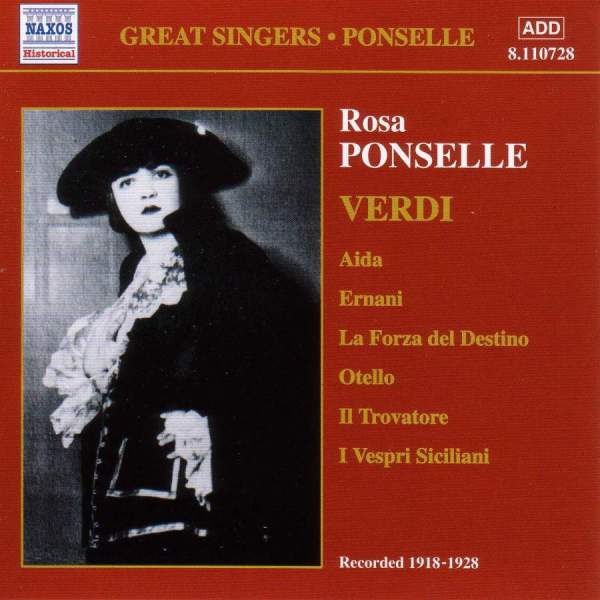
Rosa Ponselle sings Verdi

636943172827

Rosa Ponselle is known for having one of the most extraordinary voices ever to be recorded. Along with Caruso and Ruffo, she was one of Serafin’s “three miracles” and had a voice of unparalleled richness and power. According to Walter Legge, the voice was “majestic, enormously rich in overtones. Her legato was perfect with a breath control that only makes the listener breathless with amazement.”

Her career was not long, and she retired relatively early at the age of 40. Some say her withdrawal from the stage was precipitated by adverse criticisms for her Carmen, but it could just as well have been put down to her shrinking top register. The rest of the voice remained admirably secure and rich however, and recordings made at her villa in the 1950s reveal it still to be firm as a rock, though she hadn’t sung in public for many years.

Her first recordings were acoustics made for Columbia, but she switched to Victor in 1923, when from 1925, her recordings were made using the electrical process, and all the recordings here have been produced by Ward Marston. The collection gathers together just one recording of every Verdi extract Ponselle recorded, so there are no duplications and, where she did record an extract twice, Marston has chosen whichever he considered to be the best, regardless of whether it was acoustic or electrical.

If we are to think of the ideal Verdi soprano, then Ponselle is undoubtedly the voice to which one would turn, its timbre rich and velvety with ample reserves of power, admirably firm but flexible, limpid and responsive. If there are any faults, they tend to be attributable to the recording process and the strictures of side lengths, thus the recitative to the Ernani aria is somehwat perfunctory and rushed where Callas is incredibly detailed with a much greater range of tone colour. There is also a rather unseemly dash to the end of the Siciliana from I Vespri Siciliani and there are other times when the rushed tempi seem more dictated by the length of a 78 side than from any artistic decision.

I wonder too about pitch. Ponselle was known to occasionally employ downward transpositions, so would D’amor sull’ali rosee (recorded acoustically in 1918) be sung at pitch, gven the fact she opts for the optional high Db? It is a lovely performance, the high notes poised and beautifully integrated into the line, so maybe questions of pitch don’t really matter, though they would affect the sound of the voice itself.

I am not a totally devout worshipper at the Ponselle shrine and there are times when I miss Callas’s absolute mastery of Verdian style and innate musicality. Her voice may have been a more unwieldy instrument, but I never question her artistic choices, where sometimes I find Ponselle wanting. Still, these are all treasurable recordings, not only the arias, but the duets with Martinelli, Pinza and Stracciari and the final trio from La Forza del Destino with both Martinelli and Pinza, surely one of the greatest versions of ths scene ever committed to disc. The Miserere (with Martinelli) suffers from being taken too fast, but it does exploit her gloriously rich lower register, but La vergine degli angeli from La Forza del Destino, is a locus classicus of Ponselle’s masterly control, her legato perfect and the line spun out on a pure, firm thread of sound the likes of which you will not hear from any other singer.

Of course Ponselle was much more than a Verdi soprano, as we know from recordings of excerpts from Norma, La Gioconda and L’Africaine, as well as songs, but it is good to have here a collection of Verdi arias sug by arguably the greatest Verdi soprano of the pre WWII era.

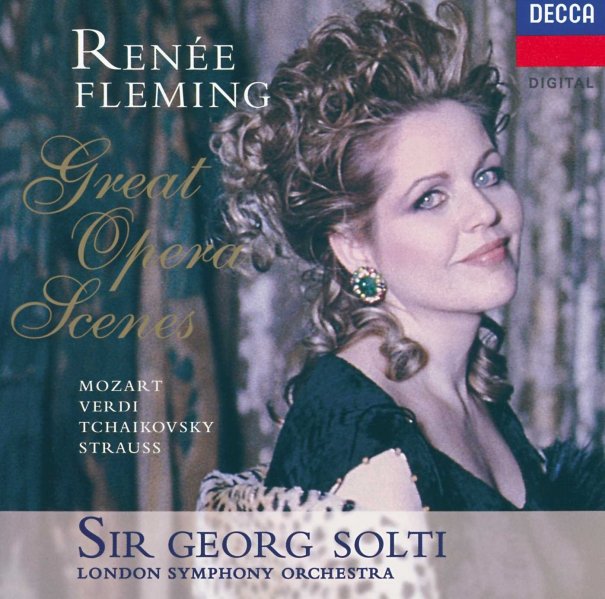
Renée Fleming – Great Opera Scenes


If we are to say goodbye to Renée Fleming the opera singer, then now might be a good time to be reminded of this, one of her most successful recital discs, recorded in 1996, when Fleming was at the height of her powers, and before the tendency to indulge in jazzy slides and swoops had become too pronounced.

All but one of the roles represented here were part of her stage repertoire at the time, and she would in fact go on to sing Strauss’s Daphne in 2005.

The programme is both varied and interesting. We start with both of Countess Almavivas arias from Le Nozze di Figaro, sung with ideal poise and beauty of tone, before plunging into the romantic imaginings of Tchaikovsky’s lovelorn Tatyana. Fleming plays the ardently impulsive young girl to the life. She yearns indwardly In Rusalka’s Song to the Moon, and I doubt I have ever heard Ellen’s Embroidery Aria from Peter Grimes sung with such superb control and feeling. Desdemona’s Willow Song and Ave Maria crops up on many recitals, but Fleming does not suffer at all by comparison with such well known interpreters as Rethberg, Ponselle or Tebaldi.

I suppose the two cornerstones of Fleming’s repertoire have been Mozart and Strauss, so it is fitting that, having started with Mozart, we should finish with Struass, a suitably ecsatic version of the closing scene from Daphne.

The recital is beautifully presented with Larissa Diadkova contributing as Filipyevna and Emilia and Jonathan Summers as Balstrode. The London Symphony Orchestra under Solti provide excellent support.

The voice itself is stunningly beautiful, but Fleming doesn’t rely solely on beauty of voice. Her interpretations are intelligent and musical, and she presents us with five very different characters. The only criticism I would have is that her diction is not always as good as it might be, but in all other respects this is a classic recital disc.


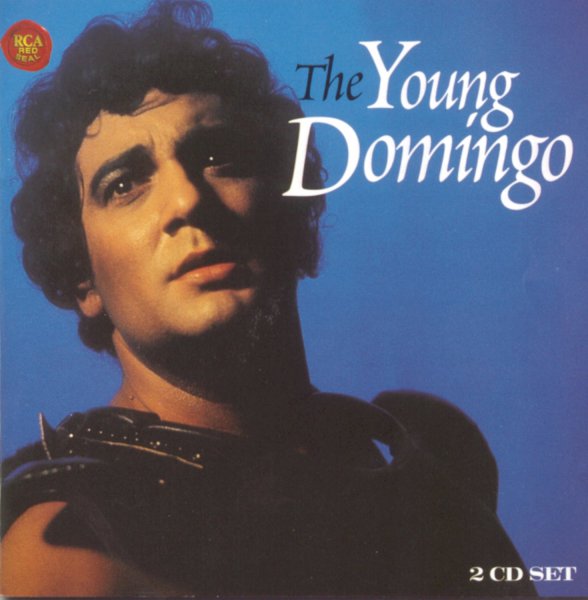
The Young Domingo


These days, with Domingo’s sometimes less successful forays into the baritone repertoire, it is easy to forget just how amazing his career was, not to mention how long it has lasted. This two disc set is a composite of three recitals made in 1968, 1971 and 1972 when Domingo (27 at the time of the first disc) was already an experienced artist, having first appeared on stage at the age of sixteen and singing his first major role (Alfredo) in 1961 at the age of 20.

The earliest of these recitals, which was given the title Romantic Arias heralded the arrival of a major artist, not only a tenor but a musician. The repertoire is wide ranging, taking in music from Handel to Mascagni and he sings in Italian, French, German and Russian. I can’t think of many tenors, even from the golden age of 78s, who could sing Puccini and Mascagni with so much passion and yet give us a wonderfully accomplished Il mio tesoro from Don Giovanni, the longest run sung cleanly and accurately and not only spun out in a single breath but phrased through into the next statement of the opening tune. The only other tenor I’ve come across who manages it as well is John McCormack. In all, whether it be in Lohengrin’s Narration or Lensky’s aria, sung in Russian, his singing is musical and immaginative. If we were to nitpick, it might be to note that, especially in the Italian items, there is a lack of excitement, of real intensity. Both are qualities he later added, along with his fine acting that served to make him the best Otello to be heard for many years. So he may not thrill in the manner of a Franco Corelli, but could Corelli have ever embraced such a wide range of differing music styles with such musicality and sensibility? I dount it very much. So let’s be grateful for what we have.

The second disc entitled Domingo sings Caruso is less wide ranging, most of the arias more well known, though it does include an aria for Marcello from Leoncavallo’s version of La Bohème, and the third La Voce d’Oro, an apt description of the golden tone that pours forth. Again one might note that his singing can be a little generic, but his musical sensibilities are always evident. Nor does he ever indulge in the vulgar mannerisms of some who preceded him. His singing is always tasteful, his musical manners impeccable.

To the three recitals, BMG have added two Leoncavallo arias (another from La Bohème and one from Chatterton) which were originally included as fill-ups for his recording of I Pagliacci under Nello Santi. Both are attractive pieces, wonderfully sung by Domingo.

Looking at Domingo’s website I see his calendar is still pretty full, with engagements, both singing and conducting, booked up to November next year. It is a remarkable achievement for a man approaching his eighties. There is no doubt the promise of these early recitals has been not only fulfilled but surpassed. Now that we have said goodbye to Domingo the tenor, now might be a good time to go backto these early recitals and remember just how good he was.

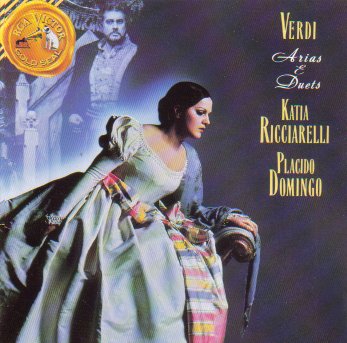
Katia Ricciarelli – Verdi Arias & Duets

51gj2be3g2b-l

This was Katia Ricciarelli’s debut recital, released in 1972 when she would have been 26. For this 1991 CD release, BMG added two items from a duet recital with Domingo, made at the same time.

Ricciarelli had an illustrious career and prolific recording career, but, it always seems to me, has never enjoyed the acclaim of her slightly older Italian contemporaries, Mirella Freni and Renata Scotto. She perhaps asked a little more of her essentially lyrical voice than it would deliver but, unlike singers like Sass and Souliotis, she was intelligent enough to later drop some of her dramatic roles in favour of more lyric fare. Her Turandot might have been ill advised but, like Sutherland’s, it was confined to the studio.

This Verdi disc catches her at her peak singing, for the most part, a selection of unfamiliar arias from Giovanna d’Arco, I Masnadieri, Jérusalem, Il Corsaro and I Vespri Siciliani as well as arias from Otello, Il Trovatore and Don Carlo, plus duets from Un Ballo in Maschera and Otello with Domingo.

The voice is a beautiful one and she is an imaginative singer, responsive to mood and text, but there are occasions when her legato is not as good as one might wish. If one were to compare her performance here of Medora’s Non so le tetre immagini with a late one by Callas, made in 1969, it is to find that, despite Callas’s by this time waning resources, the long line is maintained, the wide intervals bound more closely together, where Ricciarelli can be a little angular. Nor is Ricciarelli’s coloratura technique as clean as Callas’s. One is grateful for the beauty of the tone and her dramatic involvement, nonetheless.

Ricciarelli is a singer I have come to appreciate more with the passing of the years. I heard her live a few times, on the last occasion at a concert at the Barbican when her voice was probably past its best. The programe consisted mainly of bel canto arias, and I remember well her outstanding singing of Giulietta’s Oh quante volte, so good that it held the audience in rapt silence. She was forced to repeat the aria as an encore at the end of the night.

She is always musical, always alert to the drama, always imaginative and this Verdi disc is a good reminder of her excellence in the field. There are very few sopranos singing today who could touch her in this repertoire.

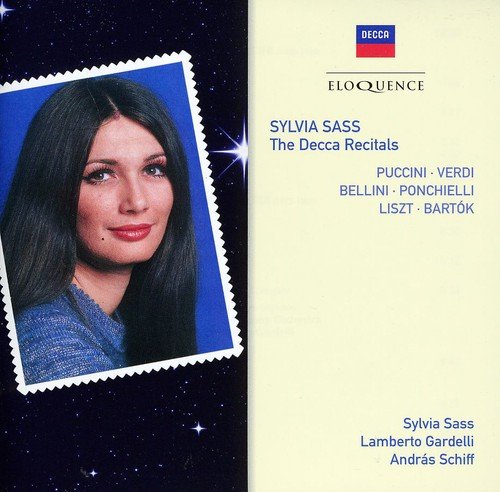
Sylvia Sass – The Decca Recitals


Sylvia Sass shot to stardom at the age of 25 after singing the role of Griselda in a 1975 Covent Garden production of Verdi’s I Lombardi which also starred José Carreras. Decca were quick to sign her up and her first recital LP (one side of Puccini, one of Verdi) followed in 1977. A further opera recital followed in 1979 and finally in 1981 a recital of songs by Liszt and Bartók, in which she got to sing in her native Hungarian. She also appeared on Solti’s recordings of Don Giovanni (as Donna Elvira) and Bluebeard’s Castle and on the Philips recording of Stiffelio. She was hailed as the new Callas and, like others saddled with the epithet before her, her international stardom was short-lived, though she continued to sing in opera (though mostly in Hungary) until 1995 and made many records for Hungaraton.

From the very first notes of Turandot’s In questa reggia it is clear that this is a singer with a personality, always aware of the dramatic possibilities of the music. The voice can caress, but equally it has bite and power and the top can glare when singing at full tilt. The four Puccini heroines given here (Turandot, Tosca, Manon and Butterfly) emerge as distintinctively different characters, which isn’t always the case in a Puccini recital. There is also much that is fine in the Verdi items, the Sleepwalking Scene from Macbeth being particularly good, but here we notice a tendency, also evident in the Puccini items, for there to be too great a gap between her loud and soft singing, where the loud singing can take on a strident, squally edge that contrasts too greatly with the almost disembodied purity of her soft singing.

By the time of the second recital this tendency to veer from ultra soft to ultra loud has become more pronounced, even more noticeable when singing live. I remember seeing her as Norma at Covent Garden in 1980 and you could hardly hear her when she was singing quietly. Not that the second recital doesn’t have its attractions. Lady Macbeth continues to be impressive, and there are some lovely moments in the Il Trovatore aria, with its spectacularly floated high D.

The 1981recital of Liszt and Bartók songs, with András Schiff at the piano, is rather impressive. Sass brings vivid personality to and drama to a song like Liszt’s Die Loreley, as well as a beautiful, comforting quality to Kling leise, mein Lied. She also makes musical sense of Bartók’s sometimes angular vocal lines, brilliantly supported by Schiff’s superb playing of the difficult piano accompaniments.

It is a great shame Sass never really fulfilled the promise of her early successes, but these discs serve to remind us why people found her so exciting when she first burst onto the scene and receive a qualified recommendation from me.

Karajan’s second recording of Aida

41v5vkkw6hl

Karajan’s second recording of Aida was recorded, like the first one, in Vienna in 1979 exactly twenty years later. For some reason, it is usually passed over in favour of the first, which starred the more obvious Aida cast of Tebaldi, Bergonzi, Simionato and MacNeil. Personally, I’ve always preferred this later one with a cast which, on paper, might seem lightweight, but actually works in practice very well.

Roughly contemporaneous with Karajan’s Berlin recording of Don Carlo this Vienna recording, though still wide ranging, is much better, more natural, putting the voices in a more natural acoustic, and Karajan in so many places brings out the beauty and lyricism of the score. He paces the score brilliantly and is most attentive to his singers. Not that this is an undramatic reading. Far from it. Though tempi can be measured, Karajan is an experienced Verdian and still infuses them with energy. The orchestral climaxes are stunning and all the singers relish the text and sing off the words. It hardly needs be said that the Vienna Philharmonic play magnificently.

Freni is a little taxed in places, nor does she command the sheer beauty of sound Caballé does on the Muti recording, but what pleasure it is to hear the text so well enunciated, so clearly communicated. Her Aida is lyrically vulnerable and I actually prefer it to many whom one might consider more vocally entitled. Carreras is likewise a lyrical Radames, and his voice was still very beautiful at this phase of his career. He too sings well off the text. I like, for instance, the reflective way he sings Se quel guerrier io fossi, becoming more forceful in the second part of the recitative when he sings about the applause of all Memphis, before softening his tone again when he sings about Aida. How much of this is Carreras, how much Karajan I don’t know, but it makes for a more thoughtful reading than we often get.

Baltsa was also at her absolute vocal peak, though she is no barnstorming Amneris. She reminds us that Amneris is a young spoiled princess, used to getting her own way but also vulnerably feminine and a vaild rival for Aida. It is a very convincing portrayal and she is absolutely thrilling in the judgement scene. Cappuccilli is maybe not so implacable an Amonasro as Gobbi, but he also sings well off the words, and Raimondi and Van Dam are nicely contrasted as Ramfis and the King. The silken voiced Ricciarelli is luxury casting as the Priestess.

An excellent set, well worth investigating and, in my opinion, much more dramatically alive than the 1959 set, which has always seemed a little too self-consciously beautiful for my taste.

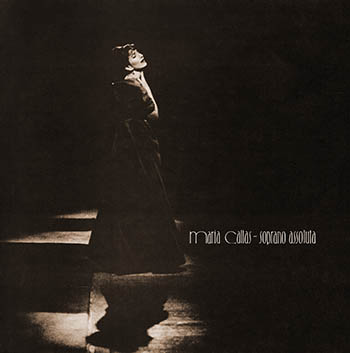
Maria Callas- Soprano Assoluta

bjr143_l

This is a superb compendium of recordings taken from live concerts given by Callas between 1949 and 1959. It is being offered as a FREE download (yes, you read that right, free) from Divina Records, so surely there can be no reason not to snap it up while you still can. The sound, while hardly state of the art, is not bad for the period, all of the performances having been taken from radio broadcasts. Taken from BJR LPs, transfers are up to Divina’s usual high standards and the download comes with an excellent pdf of the booklet which accompanied the original release.

The first track is actually her first 78 recording, made for Cetra in 1949, a beautiful performance of Casta diva and Ah bello a me ritorna, though without the opening and linking recitatives in which Callas always excelled. The aria is ideally floated, the scales and coloratura in the cabaletta stunning in their accuracy. We next turn to a radio concert recorded for Turin radio in 1952, with Oliviero de Fabritiis conducting. Callas was obviously out to demonstrate her versatility, and was also trying out for size a couple of roles she would sing later that year, Lady Macbeth and Lucia. To Lady Macbeth’s Letter Scene and the first part of Lucia’s Mad Scene, she adds Abigaille’s Ben io t’invenne from Nabucco and the Bell Song from Lakmé. She is in stupendous voice in all, the high E in the Bell Song ringing out here much more freely than it does in the 1954 recording. Not only is the singing technically stunning, but the contrasts she affords as she switches from the powerfully ambtious Lady Macbeth, to the sweet and maidenly Lucia, from the demonically triumphal Abigaille to the improvisatory story-telling of Lakmé are simply out of this world. You really don’t hear singing like this nowadays.

Next we move to a 1954 Milan concert, starting with her justly famous and technically brilliant recording of Constanze’s Martern aller Arten from Die Entführung aus dem Serail (sung here in Italian as Tutte le torture), her one Mozart stage role. Not only does she execute the difficulties with ease, she sounds properly defiant. It is a thrilling performance. Louise’s Depuis le jour (sung in French) suits her less well, and the performance is marred by occasional unsteadiness. Nonetheless it is hard to resist the quiet intensity of her intent. Armida’s D’amore al dolce impero from Rossini’s opera is, like the Mozart, stunningly accomplished, even if some of the more daring variations from the Florence complete performances have been trimmed down. The bravura of the singing is still unparalleled. The last item from this concert is Ombra leggiera from Meyerbeer’s Dinorah, a rather empty piece, which is hardy worth her trouble, though it improves on the studio recording with the addition of the opening recitative and the contribution of a chorus. Her singing is wonderfully accomplished, the echo effects brilliantly done, but it is not a piece I enjoy.

Another Milan concert, this time from 1956, brings us her best ever performance of Bel raggio lusinghier from Semiramide, though she adds little in the way of embellishment and the effect is less thrilling than her singing of the Armida aria. We get her first version of Ophélie’s Mad Scene from Hamlet (sung here in Italian rather than the original French of the studio recording), which is superb, it’s disparate elements brilliantly bound together. We also have a beautiful performance of Giulia’s Tu che invoco from La Vestale, which seques into a rousing performance of the cabaletta, and she revisits the role of Elvira in I Puritani with a lovely performance, with chorus and soloists, of Vieni al tempio.

From Athens in 1957, there is a dramatically exciting performance of Leonora’s Pace, Pace from La Forza del Destino, in which she manages the pitfalls of the piano top B on invan la pace better than you would expect for post diet Callas. Her performance of Isolde’s Liebestod (again in Italian) is very similar to the Cetra recording, warm and feminine, passionately yearning.

From the 1958 Paris Gala we have her minxish Una voce poco fa from Il Barbiere di Siviglia, with its explosive ma, as Rosina warns us she is not to be messed with. She sings in the mezzo key with added higher embellishments. This is followed by a couple of lesser known performances from a UK TV special, conducted by Sir Malcolm Sargent. Mimi’s Si mi chiamano Mimi is similar to the performance on the complete recording, charming and disarming, whilst Margarita’s L’altra notte from Mefistofele is a touch more vivid, a little less subtle than the studio recording.

Just one item from the 1957 rehearsal for the Dallas Opera inaugural concert, the Mad Scene from I Puritani. Though, by this time, Callas’s voice had been showing signs of deterioration, Bellini’s music still suits her admirably, and she sounds in easy, secure voice here up to a ringing top Eb at its close. The scale work is as supple as ever, and she executes its intricacies with ease even when singing at half voice.

To finish off we have the Mad Scene from the 1959 Carnegie Hall concert performance of Il Pirata. It had been a variable evening, with Callas’s colleagues hardly in her class, but here, left alone on the stage, Callas responds to the challenges of the final scene superbly, the cavatina, in which she spins out the cantilena to incredible lengths, becomes a moving lament to her son, and the dramatic cabaletta is then thrillingly flung out into the auditorium. The audience unsurprisingly go berserk.

How lucky we are to have these wonderful live performances preserved in sound, and how grateful we are to Divina Records for offering them to us free of charge. Nobody need hesitate.


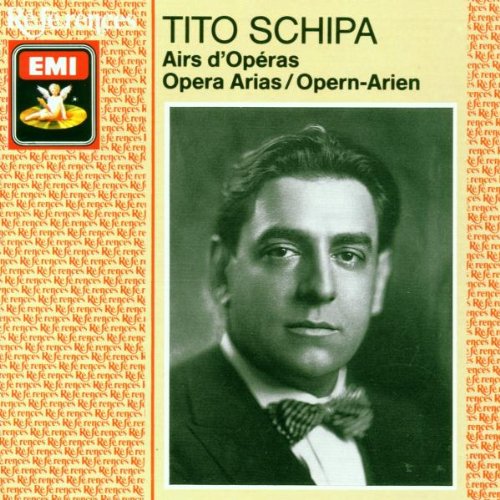
Tito Schipa – Opera Arias

61gglfv2dfl

This EMI disc collects together recordings from Tito Schipa’s first recording sessions in 1913, recordings made in the 1920s and 1930s and one (Werther’s O, nature) recorded in 1942, when Schipa was 54.

The name of Schipa is most associated with style, elegance and grace (not for him the over-emotional sobbing excesses of Gigli), though the first aria included on the disc (Che faro from Orfeo ed Euridice) is hardly a model in that respect. The unstylish playing of the orchestra is certainly no help, but Schipa too has some lapses in style, with occasional aspiarates marring his legato.

The 1913 recordings tell a different story and reveal a surprising amount of power and squillo, not qualities one normally associates with the singing of Tito Schipa. They also offer so much more in the elegance of the phrasing, the firm line and his wonderful legato, as well as a proper appreciation of character and the dramatic situation. The prizes here are the Duke’s Ella mi fu rapita…Parmi veder le lagrime, from Rigoletto, Tu che a dio spiegasti l’ali from Lucia di Lammermoor and the Siciliana from Cavalleria Rusticana.

There are treasures too amongst some of the later recordings, even the 1942 Werther aria, which is wonderfully poetic, but the 1934 aria from Manon is also superb.

However I think I derived the most pleasure from the duets. WIth Toti Dal Monti we get a lovely Prendi l’anel to dono from La Sonnambula, and, even better, a gorgeous Tornami a dir from Don Pasquale, which is just about ideal in every way, the two singers blending thier voices and playing with the musical line in perfect synchronicity. Then, probably best of all is the famous Cherry Duet from Mascagani’s L’Amico Fritz, with the charming Mafalda Favero. Throughout he caresses and moulds the line and there is a moment of pure magic when he sings the words sei pur bella on a delciate thread of sound which perfectly expresses Fritz’s shy awakening to love. It is moments such as these which make us turn to these old recordings.