A Most Marvellous Party

81wftltatgl._ac_sl1450_

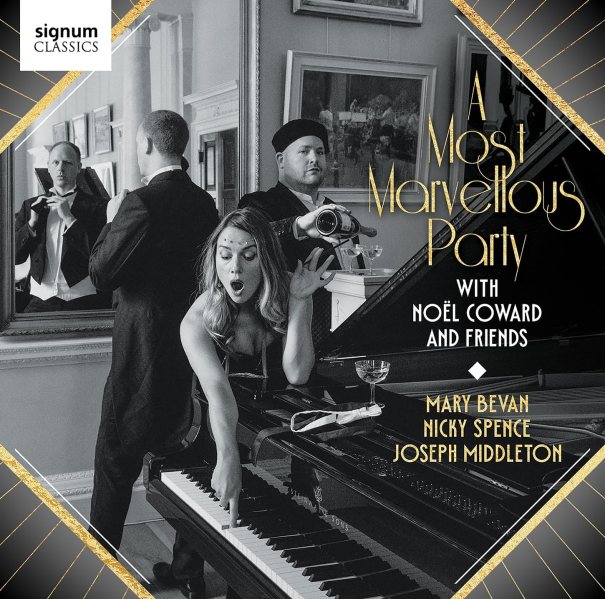
This highly entertaining programme is the sort of thing that would go down well at a country house or in a small hall, and indeed I see that these artists performed it at the Leeds Conservatoire in March this year, shortly before making this recording. Mary Bevan should not be confused with her sister, Sophie, also a soprano with quite a career herself, nor Nicky Spence with tenor Toby Spence, to whom he is not related. Both singers are active on the operatic stage as well as on the concert platform and here let their hair down in some lighter music.

The “party” seeks to place Noel Coward among other contemporary composers, all of whom have a connection with Coward, however slight. Thus, the other guests turn out to be Ned Rorem, who claimed to have once had a one-night stand with Coward, Poulenc for whom Coward once did the narration on a recording of his Babar, the elephant and Stravinsky, who apparently once asked Coward to collaborate with him. Gershwin’s music Coward had known for some time and even played snatches of it on stage in the first production of his play, The Vortex. The connections with Satie, Messager, Britten and Walton would seem to be a little more tenuous, but I’m nonetheless delighted that they came along. It’s also good to encounter some songs by Roger Quilter and Liza Lehmann, especially given Bevan’s rapturous account of Lehmann’s gorgeous Love, If You Knew The Light, and Spence’s lovely singing of Quilter’s famous setting of Tennyson’s Now Sleeps The Crimson Petal, which is nicely contrasted to Ned Rorem’s sparer, but equally valid setting of the same poem sung by Bevan, a song that was new to me. It slightly reminded me of Britten’s version, which he eventually cut from the Serenade for Tenor, Horn and Strings.

Both Bevan and Spence are rather better in the more lyrical songs by Coward than they are at the patter songs, and there are a couple of misses in the sequence. Spence can’t resist the temptation to overplay the comedy in Don’t Put Your Daughter on The Stage, Mrs Worthington and I have a feeling this rendition would become rather triresome on repeated listening. One only has to compare the Master, with his brilliantly understated and clipped delivery to hear how it should be done. Nor can Bevan quite cast off the slightly jolly-hockey-sticks quality she has adopted in the opening Coward medley when she turns to Kurt Weill’s Complainte de la Seine, a song which is absolutely harrowing when sung by Teresa Stratas. I also rather wish that Spence, rather than Bevan, had been allowed to sing Mad About The Boy, given that we now know the song was written by Coward about a man he had fallen in love with. However, Spence does get to sing If Love Were All, a song that was originally written for the character of Manon in Coward’s operetta Bitter Sweet, but which Coward himself later made very much his own.

Britten is represented by two early W, H, Auden settings, one of which, As it is, plenty, sounded strangely like something by Stephen Sondheim, though it was written only a few years after Sondheim was born. I wonder if he knew it. I rather wish room had been found for Bevan to sing Coward’s Zigeuner from Bitter Sweet and that perhaps it would have been better to close the recital with the gently wistful The party’s over now rather than the slightly over-rumbustious I went to a marvellous party, but apart from these and a few other minor reservations expressed above, the two singers acquit themselves very well and the pianist, Joseph Middleton is a wonderful collaborator, both as accompanist and when playing solo in pieces by Poulenc, Satie, Stravinsky and Gershwin.

All in all, this is a highly enjoyable disc and one which I will definitely be returning to from time to time.

Full programme

  1. Coward Medley (all three artists)
  2. Coward: Mad about the boy (Bevan)
  3. Rorem: Early in the morning (Spence)
  4. Rorem: For Poulenc (Spence)
  5. Poulenc: Pastorale calme et mystérieux (Middleton)
  6. Poulenc: Hotel (Bevan)
  7. Coward: Parisian Pierrot (Spence)
  8. Weill: Complainte de la Seine (Bevan)
  9. Messager: De ci, de là (Bevan and Spence)
  10. Satie: Gnossiene No. 1 (Middleton)
  11. Coward: Any little fish ((spence and Bevan)
  12. Stravinsky: Valse pour les enfants (Middleton)
  13. Coward: Something to do with Spring (Spence and Bevan)
  14. Quilter: Love calls through the summer night (Bevan and Spence)
  15. Quilter: Now sleeps the crimson petal (Spence)
  16. Rorem: Now sleeps the crimson petal (Bevan)
  17. Coward: World weary/Twentieth century blues (Bevan and Spence)
  18. Gershwin: The man I love (Middleton)
  19. Coward: If love were all (Spence)
  20. Gershwin: By Strauss (Bevan)
  21. Coward: Don’t put your daughter on the stage, Mrs Worthington (Spence)
  22. Britten: When you’re feeling like expressing your affection (Bevan)
  23. Walton: Popular Song (Spence)
  24. Britten: As it is, plenty (Bevan)
  25. Lehmann: Love, if you knew the light (Bevan)
  26. Coward: The party’s over now (Bevan and Spence)
  27. I went to a marvellous party (Bevan and Spence)

Dawn Upshaw – The World So Wide

r-2563268-1290619230.jpeg

A few weeks ago I reviewed Renée Fleming’s excellent disc of American opera arias and today I turn to Dawn Upshaw’s disc, which takes its title, The World So Wide, from the first item in the recital, Laurie’s Song from Aaron Copland’s The Tender Land. It makes a lovely opener and Upshaw is perfectly cast as the young girl who yearns to escape and see the world.

At about 45 minutes, the disc is quite short measure, however, and not everything is as good as the first track. The piece from Tanía León’s Scourge of Hyacinths is tediously declamatory and afforded me the least enjoyment on the disc. I’d also suggest that Upshaw’s is not the right voice for Barber’s Cleopatra, a role that was written for the much more opulent voice of Leontyne Price. Upshaw’s lighter, brighter sounds do not conjure up the woman of whom Enobarbus says,

Age cannot wither her, nor custom stale
Her infinite variety. Other women cloy
The appetites they feed, but she makes hungry
Where most she satisfies, for vilest things
Become themselves in her, that the holy priests
Bless her when she is riggish.

I enjoyed the excerpt from John Adams Nixon in China rather more than the Gramophone reviewer, who found it “tediously protracted”, and I suppose you either like Adams’s style or you don’t. Whatever your feelings, Upshaw delivers Pat Nixon’s This is prophetic brilliantly. She is also superb in the more Broadway influenced What a movie from Bernstein’s Trouble in Tahiti, but I thought her singing of Lonely house (an aria sung by the male character of Sam Kaplan in Street Scene) just a little too overtly operatic. Teresa Stratas manages it better on her second disc of Weill songs and arias.

After the Copland and Benstein, the most successful item on the disc is Willow Song from Douglas Moore’s The Ballad of Baby Doe, which responds well to her charming, uncomplicated manner. So too, one would think, does the final item (and the only item she shares with Fleming on her disc), Ain’t it a pretty night from Carlisle Floyd’s Susannah, but here I have to admit I prefer the rather more sensuos tones of Fleming, who suggests a far more highly charged eroticism behind the apparent simplicity of the music.

A mixed bag, then, and not so successful as her disc of Broadway songs entitled I Wish It So, but worth a listen for the unusual repertoire and for some excellent performances.

Dawn Upshaw – I Wish It So

r-6310834-1416165621-3533.jpeg

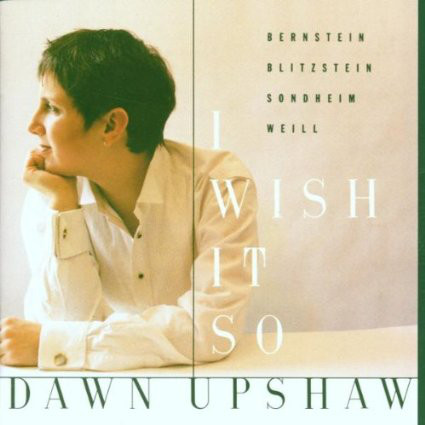
This collection of Broadway songs by Bernstein, Blitztein, Sondheim and Weil is an absolute delight from beginning to end.

Aside from Bernstein’s I feel pretty and, to a lesser extent, his Glitter and be gay none of the items here could be considered well-known and the choice of this particular quartet of composers, all of whom are connected in some way, is felicitous. Furthermore Upshaw’s clear, bright soprano and natural, unforced diction make her the ideal interpreter.

It is rare indeed for classical singers to embrace the idiom of Broadway without sounding self-conscious, but if you didn’t know better, (and I mean this in a positive way) you would never know that Upshaw was also an operatic artist of the first order. Many opera singers have tackled Bernstein’s Glitter and be gay, but none have ever, to my mind, challenged the original performer Barbara Cook, who not only manages to get round the notes, but really puts across the humour in the lyrics; none, that is, except Dawn Upshaw, who actually manages the coloratura with greater ease and beauty, but also points the lyrics with such ironic brilliance.

It is just one of the highlights in an album of sheer delights and I’d be hard pressed to find a favourite but there were many wonderful discoveries, among them Sondheim’s The girls of summer (1956) and the opening track, sung to just piano, Blitztein’s I wish it so from Juno (1959).

Only Glitter and be gay uses the original orchestration, but all the other arrangements are well done and the orchestra play excellently under Eric Stern, who himself was responsible for some of the orchestrations and provides the solo piano accompaniment on I wish it so.

I can’t recommend this disc too highly.

Modify message

Teresa Stratas singing Weill

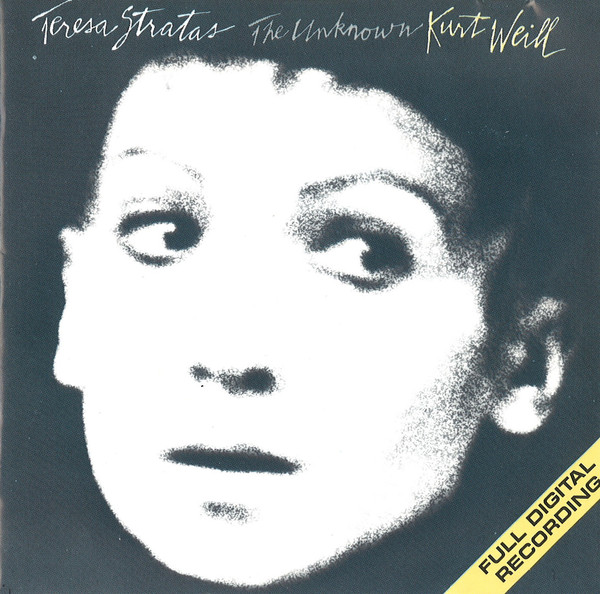
It was in 1979 that Kurt Weill’s widow, Lotte Lenya, saw Stratas singing the role of Jenny in The Rise and Fall of the City of Mahoganny. Knocked out by Stratas’s performance, she called her her “dream Jenny”, and afterwards she wrote to her, “nobody can sing Weill’s music better than you do,” and offered her a number of unpublished songs that she had closely guarded since Weill’s death in 1950.

The result was the first of these two discs, recorded in 1981, in which Stratas sings a collection of songs to piano accompaniment by Richard Woitach. Unfortunately, for the CD release, Nonesuch omitted the lyrics and translations that were included with the original LP, and what notes that remain are in minuscule print, almost too small to read without a magnifying glass. This seems little short of a crime, given Stratas’s vividly dramatic performances. Even without the aid of translations you can get a gist of their meaning, but how much more satisfying the disc would be be if we knew exactly what she was singing.You might be able to find texts and translations of some of them by scouring the internet, but it’s a long and arduous task.

Most people had no doubt got used to Lenya singing Weill’s songs in her gravelly baritone, but, as Lenya herself pointed out, her voice dropped over the years, and Stratas was performing them in the original keys. That said, most of these originally written for cabaret, had hardly ever been performed since and were here receiving their first recordings, though they are much better known now, and Weill selections have appeared from artists as diverse as Anne-Sophie von Otter and Ute Lemper.

Teresa Stratas was 54 at the time of the first recording. She had made her professional debut at the age of 20, joining the Met company the following year (1959), becoming a Met favourite until her final performance there in 1995 (in the role of Jenny in The Rise and Fall of the City of Mahoganny). The voice can be termed useful rather than beautiful, and, though a diminutive figure, she had a powerful stage presence, great personal beauty and was a superb actress. This might explain why she made comparatively few recordings, the most famous probably being Pierre Boulez’s recording of the completed Lulu, a role she had made her own in the Paris premiere. Beautiful or not, it was the perfect instrument for Weill’s songs, which rely on expression rather than beauty of tone.

Favourites for me here are the two settings of the same melody, one French, one German Wie lange noch and Je ne t’aime pas, the two Propaganda Songs Buddy on the Night Shift and Schikelgruber, and the glorious Youkali. Though the second disc is enlivened by the orchestral accompaniments, I have a special affection for the more intimate piano settings.

This second disc appeared four years later, and is more far reaching, though much of the material was more well known. The Y Chamber Orchestra under Gerard Schwarz has an undeniable whiff of a theatre orchestra about it, which is perfect for the material. The songs are taken from Broadway musicals, and both German and French theatre works. Texts and translations are at least included, though print is again minuscule.

Stratas’s range is formidable. Though capable of the “Brechtian bark” we are probably more used to, it is bound into the fabric of her performance, as is the full operatic soprano at key moments. Consequently not only do we get the full meaning of the lyrics, but the lyricism of Weill’s writing is revealed to a much greater extent. Take the most famous song on the album, Surabaya Johnny, which emerges almost as a mini psycho-drama for solo performer. Her French and German are both impeccable, her command of the Broadway idiom just about perfect (a few years later she was to record the role of Julie in John McGlinn’s first ever complete recording of Jerome Kern’s Showboat). One of the most glorious performances is of Lonely house from Street Scene, which is swirlingly lyrical with an aching loneliness.

Both discs are an absolute must.