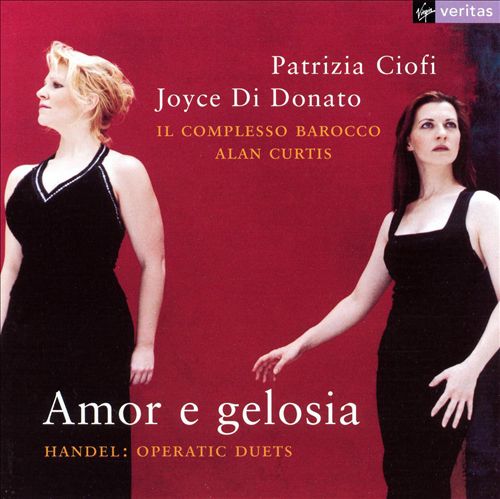
Amor e gelosia – Handel Operatic Duets

image

Looking through my collection I note that the majority of fairly recent recital acquisitions seem to be mostly of music of Handel and the baroque. I’m not sure whether this has more to do with a change in my taste, the general change in taste or the dearth of decent singers of Verdi, Wagner and nineteenth century muisc in general. Whatever the reason, I think it’s safe to say there are far more excellent Handel singers around these days than there used to and the performers on this disc are certainly fine examples.

Handel’s operatic duets are rare delights, usually either expressing sadness at lovers’ parting or delight in reunion, and there is a good cross-section of both types in this recital. That said, I am not a Handel specialist and I personally find less variety here than I would in a programme of duets from the bel canto period or Verdi. The programme is drawn from well-known works, such as Rinaldo, Serse and Rodelinda, as well as lesser known works like Silla and Teseo, with no less than five excerpts (including the Act III Sinfonia) from Poro, and certainly no fault can be found with the performances.

We hear two very fine voices in prime condition, DiDonato’s darker, straighter mezzo contrasting and blending nicely with Ciofi’s bright, clear soprano. Both are expressive artists with a fine legato and superb technical proficiency in the florid music. They also repond well to the dramatic elements in the music, and are superbly supported by Alan Curtis and Il Complesso Barocco. The disc can be recommended unreseverdly to all lovers of Handel and the baroque, even if on this occasion, and I realise this has no relevance to the present disc, I found myself wishing I was listening to, say, Caballé and Verrett in their disc of Romantic opera duets. Maybe my tastes haven’t changed that much.

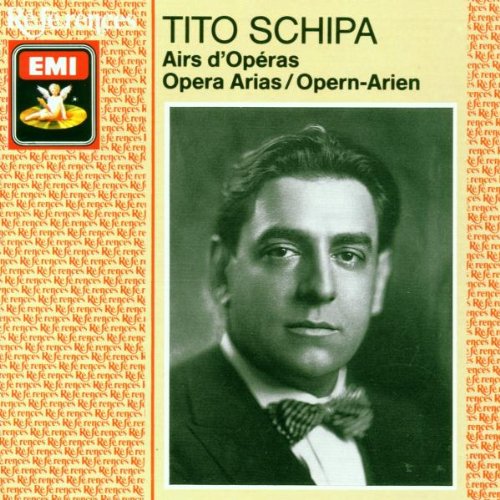
Tito Schipa – Opera Arias

61gglfv2dfl

This EMI disc collects together recordings from Tito Schipa’s first recording sessions in 1913, recordings made in the 1920s and 1930s and one (Werther’s O, nature) recorded in 1942, when Schipa was 54.

The name of Schipa is most associated with style, elegance and grace (not for him the over-emotional sobbing excesses of Gigli), though the first aria included on the disc (Che faro from Orfeo ed Euridice) is hardly a model in that respect. The unstylish playing of the orchestra is certainly no help, but Schipa too has some lapses in style, with occasional aspiarates marring his legato.

The 1913 recordings tell a different story and reveal a surprising amount of power and squillo, not qualities one normally associates with the singing of Tito Schipa. They also offer so much more in the elegance of the phrasing, the firm line and his wonderful legato, as well as a proper appreciation of character and the dramatic situation. The prizes here are the Duke’s Ella mi fu rapita…Parmi veder le lagrime, from Rigoletto, Tu che a dio spiegasti l’ali from Lucia di Lammermoor and the Siciliana from Cavalleria Rusticana.

There are treasures too amongst some of the later recordings, even the 1942 Werther aria, which is wonderfully poetic, but the 1934 aria from Manon is also superb.

However I think I derived the most pleasure from the duets. WIth Toti Dal Monti we get a lovely Prendi l’anel to dono from La Sonnambula, and, even better, a gorgeous Tornami a dir from Don Pasquale, which is just about ideal in every way, the two singers blending thier voices and playing with the musical line in perfect synchronicity. Then, probably best of all is the famous Cherry Duet from Mascagani’s L’Amico Fritz, with the charming Mafalda Favero. Throughout he caresses and moulds the line and there is a moment of pure magic when he sings the words sei pur bella on a delciate thread of sound which perfectly expresses Fritz’s shy awakening to love. It is moments such as these which make us turn to these old recordings.

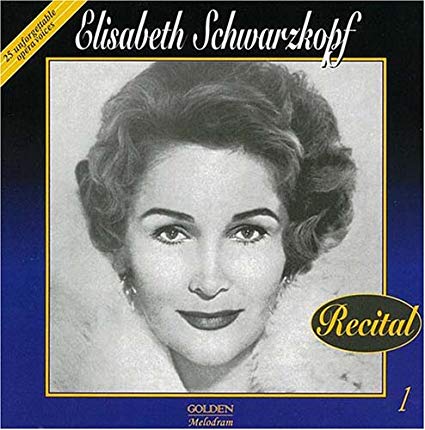
Elisabeth Schwarzkopf – Live broadcasts

517hffpxcml._sx425_

This is not a recital as such, but a collection of off the air recordings made by Schwarzkopf between the years 1941 and 1952. We get the opening of a Berlin Das Rheingold, conducted by Artur Rother (Schwarzkopf as Woglinde), Nie werd ich deine Hulde verkennen from a Vienna performance of Die Entführung aus dem Serail, conducted by Rudolf Moralt (with Emmy Loose, Anton Dermota, Peter Klein and Herbert Alsen), a duet from Weber’s Abu Hassan from 1942, with Michael Bohnen, and part of the Act II finale of Le Nozze di Figaro from La Scala in 1948, with Imrgard Seefried and W Hoefermeyer (who he?) under Karajan. We also get a couple of excerpts from the 1950 Salzburg Festival, both conducted by Furtwängler; Mi tradi from Don Giovanni (on which unusually she takes an unwritten upward ending, presumably sanctioned by Furtwängler though absent from all other versions by her) and Marzelline’s opening duet and aria from the famous performance of Fidelio at which Flagstad sang Leonore. In all Schwarzkopf displays her familiar virtues of pure, firm tone, excellent legato and elegant phrasing, the voice shot through with laughter in the lighter pieces. Marzelline’s aria is sung with a fuller tone than we often hear in this music, but captures perfectly her wistful charm. Ilia’s Zeffiretti lusinghieri is taken from a 1951 Turin Radio Mario Rossi broadcast, but it is not quite so accomplished as the one on her studio recital of the following year.

The rest is is given over to a Hamburg broadcast from 1952, beginning with a lovely performance of He shall feed his flock, from Handel’s Messiah (sung in German). The Act I monologue from Der Rosenkavalier is perhaps less detailed than the one on the complete set under Karajan and no doubt some might prefer it for that reason, though I wouldn’t necessarily be one of them. It’s a lovely performance nonetheless. Schwarzkopf’s Countess is also justly well known, and Porgi amor is sung with creamy tone and matchless legato, but the excerpts from Madama Butterfly (sung in German) don’t really work for her, and indeed Schwarzkopf herself, when she heard them in later years, thought them “rather screechy on top”. She did however approve the aria from Korngold’s Die tote Stadt (the soprano version of the duet Glück das mir verblieb) and rightly so, as this is without doubt the prize of the whole disc. I have never heard it sung better, not by Te Kanawa, not by Fleming, not even by Lehmann, who recorded the duet with Richard Tauber. The pianissimi on the top notes, the diminuendi, the way she fades the tone are absolutely miraculous, no other word for it. Everyone needs to hear this, but getting the recital on disc is quite difficult these days. Fortunately you can hear it on youtube.

The whole disc is a fitting repost to all those who think Schwarzkopf was a studio creation, catching her live and on the wing, but treasured mostly for that sensational and unfortunately unrepeated performance of the Korngold.

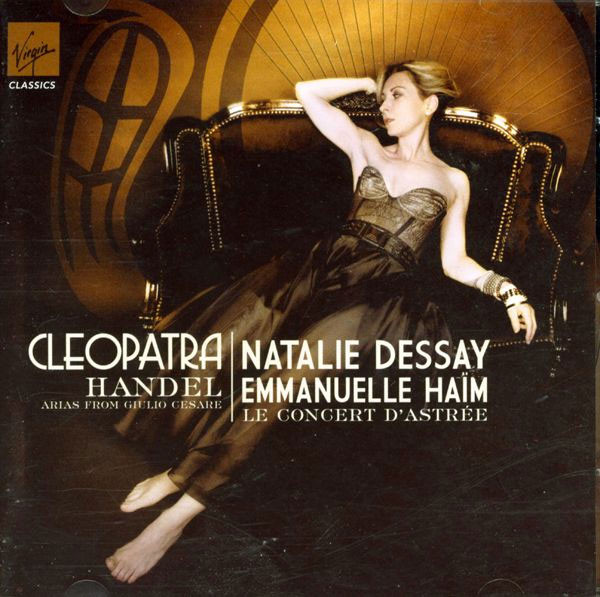
Natalie Dessay – Cleopatra

r-6913684-1429386276-1161.jpeg

This Handel recital, which showcases the talents of Natalie Dessay, concentrates solely on the music Handel wrote for Cleopatra in his Giulio Cesare, and even includes music he wrote but later cut from the full opera. Variety is provided, by the orchestra (the excellent Le Concert d’Astrée under Emmanuelle Haïm) contributing a couple of orchestral interludes, and by Sonia Prina as Caesar, whose contributions, however, are restricted to a few lines of recitative and the final duet.

It is quite interesting to hear side by side, as we do here, Handel’s first and final thoughts on certain scenes, so the heroic Per dar vita all’idol mio gave way to the grieving Se pietà di me non senti, whilst the lilting siciliano of Troppo crudele siete was dropped in favour of the intensely moving, and justly famous Piangerò.

Dessay is on top form, stunningly agile in the florid music such as Da tempeste il legno infrante, playfully seductive in V’adoro pupille, movingly heartfelt in Piangerò.

Le Concert d’Astrée under Emmanuelle Haïm, offer superb support. This is no replacement for a performance of the complete opera, of course, but nonetheless a wonderful distillation of Dessay’s Cleopatra, a role she performed with great success at the Palais Garnier in Paris, shortly after making this record.

Elisabeth Schwarzkopf – The Complete Recitals 1952 – 1974

81szngqwkwl._sl1500_

Issued to mark the one hundredth anniversary of Schwarzkopf’s birth in 2015, this fantastic 31 disc set brings together all the recital discs Schwarzkopf made in the LP age with her husband Walter Legge between the years 1952 and 1974, adding the live 1953 Wolf recital from Salzburg, with Furtwängler and the farewell to Gerlald Moore at the Royal Festival Hall in 1967, in which she shares the platform with Victoria De Los Angeles and Dietrich Fischer-Dieskau. It is a considerable achievement, covering operatic excerpts and a huge range of Lieder and song, both with orchestra and piano. It is not quite the full story, for their was to be one further recital to come, made for Decca in 1977 and 1979, and simply called To My Friends.

Schwarzkopf started out as a coloratura, singing roles such as Zerbinetta, Blonde and Sophie, but the voice was never entirely comfortable in the stratospheres, and she soon graduated from Sophie to the Marschallin, from Susanna to the Countess. A serious and dedicated artist, over the years she wittled down her operatic roles to a mere five (Mozart’s Countess, Donna Elvira and Fiordiligi and Strauss’s Marschallin and Countess Madeleine) so that she could concentrate on her recital work, which was her first love. The voice was not particularly large, but a warm, lyric soprano, shot through with laughter, her technique faultless and, though it lost something of its bloom in later years, it was always firm and true with no trace of excessive vibrato or wobble. She has been saddled for many years with the adjective ‘mannered’, but, listening to these CDs now, what I hear is incredible intelligence and specificity, a voice put at the service of the composer, not the other way round. People love to make fun of the fact that, when invited onto Desert Island Discs she picked all her own records, but, if you listen to the porgramme now, she uses them as illustrations of key points in her life. She was actually severely self-critical and those few records represented the best of herself and her collaborators, for she was quick to give credit to the conductors and accompanists she had worked with, and of course to her husband Walter Legge, who produced all her records. John Steane, who loved Schwarzkopf unreservedly, spent some time listening with her to her records in her retirement, and was surprised at how rarely a recording got her full stamp of approval. Listening sessions were interrupted by continuous cries of  “too much of this, too little of that. Intonation, missy” and so on, and just the occasional “ah yes, missy, that’s good”. In other words she was as hard on herself as she famously was on her students, who could find working with her frustrating, as she barely let them get a few bars out; but this was the only way she knew how to work herself, and what do teachers do other than pass on their experience to others?

There is a lot of music to get through here, though most of the CDs are rather short in length, being exact reissues of the LPs as they appeared, each in its own sleeve with the original artwork. The only cause for regret has nothing to do with the music or the music making, but with the fact that no texts and translations are included. This is a criminal omission with an artist like Scwharzkopf, who paid such attention to the words, colouring her voice to get the maximum amount of meaning from them. These days it should be easy to produce a weblink or CD-Rom with them all, and I’m guessing that most collectors wouldn’t mind paying a little extra just to have them. As it is, I am having to hang on to all my previous issuse of this material, simply to keep the texts.

So on to the actual discs and a potted review of each one.

Disc I. Schubert Song Recital with Edwin Fischer

r-2628987-1330502065.jpeg

This is a classic recital, with Schwarzkopf’s voice at its freshest and loveliest, the lighter songs delivered with a delightful smile in the voice, the darker ones with an arresting sense of their dramatic potential. For instance, in Gretchen am Spinnrade the words sein Kuss are sung almost in horror, as Gretchen recalls the moment which sealed her destiny. Though always alert to the mood and meaning of the songs, however, there is also much that is admirable as pure singing, the legato superb, the line firmly held. Fischer is an estimable partner rather than just an accompanist. I particularly love the way he makes the piano accomaniment in Auf dem Wasser zu singen conjure up the image of moonlight bouncing off the water. A delight from beginning to end.

Disc 2. Mozart Operatic Arias

r-2628957-1519128396-8605.jpeg

Here accompanied by the Philharmonia Orchestra under John Pritchard (no Sir back then), Schwarzkopf sings a collection of arias from roles she did sang on stage as well as some she didn’t. Not many sopranos would attempt in the same recital arias for the Countess, Susanna and Cherubino or for Zerlina and Donna Anna, but, rare in Mozart, she brings a different voice character to each, all boyish eagerness as Cherubino, sensuous charm as Susanna, girlish seduction as Zerlina, who in turn sounds quite different from her Susanna,  and patrician elegance as the Countess. Her Donna Anna is not quite so successful, and of course we are reminded that her stage role was that of Donna Elvira, a role which she made very much her own, but Non mi dir is nonetheless delivered with a resigned sadness and the closing coloratura section rings out with real conviction. Illia’s Zeffiretti lusinghieri is altogether lovely.

Disc 3. Strauss Four Last Songs and Capriccio Closing Scene

r-5864796-1551371617-6728.jpeg

Through her two recordings , Schwarzkopf has always been associated with Strauss’s ever popular Vier letzte Lieder, though very few people can agree on which of the two recordings is the better. I tend to prefer the later one with Szell, both for the improved sound picture and Schwarzkopf’s more mature thoughts on the work, but both are superb, and this one benefits from her greater ease in the upper register. The closing scene from Capriccio, made before she had recorded the full opera under Sawallisch, is lovely in every way with the character superbly delineated and  the voice soaring out over the orchestra.

Disc 4. Strauss – Scenes from Arabella

byub9vljxmgqdj2cpnxicihrgxuq8ikj

Staying with Strauss, these excerpts were recorded in 1954 and it always seems a pity to me that Legge didn’t record the whole opera. That said, the opera has its longeurs, for me anyway, and perhaps this is all that I really need. Schwarzkopf is perfectly cast as Arabella and is well contrasted with Annie Felbermeyer, who plays Zdenka here. Josef Metternich is a superb Mandryka, none better on disc, and the cast is fleshed out with such names as Nicolai Gedda as Matteo, Walter Berry as Lamoral and Murray Dickie as Elemer. Lovro von Matacic is much more in tune with Strauss’s medium than Solti on the roughly contemporaneous set with Lisa Della Casa, and, who knows, if this had been recorded complete, it may well have become the touchstone recording for all time.

Disc 5. A Lieder Recital

r-6257908-1414952376-6290.jpeg

Schwarzkopf returned to Lieder with piano for her next record, a mixed recital with Gerald Moore at the piano. It opens with Bist du bei mir (once attributed to Bach), and continues with mostly popular fare by Mozart, Beethoven, Schubert, Schumann, Brahms, Wolf and Strauss, with Schwarzkopf unerringly catching the mood of each song, whether it be the joyfully youthful exuberance of Schubert’s Ungeduld, or the wistful bliss of Schumann’s Der Nussbaum.

Disc 6. A Mozart Song Recital

r-5424298-1469949413-9765.jpeg

This Mozart recital with the great Walter Gieseking at the piano has deservedly achieved the classic status of the Schwarzkopf/Fischer Schubert recital. Recorded in 1955, it was recorded in stereo, and I put this down to the fact that Christopher Parker, who oversaw the stereo version of Der Rosenkavalier was the balance engineer. It was first issued in mono, and the stereo version emerged several years later.

It certainly deserves its classic status, as Schwarzkopf and Gieseking between them bring these simple songs to life as no other. I hear absolutely no artifice in the way Schwarzkopf characterises the songs, or in the way Gieseking mirrors his playing to her tone, making much more of the sometimes plain accompaniments than you would think was possible. They also manage to vary the approach to individual verses in strophic songs in a way which sounds completely natural. This is a wonderful disc.

Disc 7. A Recital of Duets by Monteverdi, Carissimi and Dvorak.

r-6487756-1420396182-9470.jpeg

Okay, so the Monteverdi and Carissimi duets are hardly authentic, but I can’t imagine anyone other than the most ascetic HIP advocate complaining when the singing is so beautiful, the voices charmingly intertwining and blending in delicious pleasure.

Schwarzkopf and Seefried had sung together on many occasions, and had already made duet recordings of the Presentation of the Silver Rose from Der Rosenkavalier (Schwarzkopf as Sophie, Seefried as Octavian) and excerpts from Hänsel und Gretel. Schwarzkopf was a huge admirer of Seefried, at one time stating that Seefried had naturally what others, including herself, had to work hard to achieve. Seefried’s slightly darker, more mezzoish timbre blended perfectly with Schwarzkopf’s brighter tone. The result is a winning combination, not only in the Dvorak duets that you would expect would suit them, but in the baroque items too, with Gerald Moore providing alert, lively support on the piano.

Disc 8. Walton – Scenes from Troilus and Cressida

640x640

Walton didn’t have much luck with casting for his opera Troilus and Cressida. He had originally wanted Callas for the role of Cressida, but Callas had no interest in contemporary opera and so he offered the role to Schwarzkopf, who was slated to sing in the UK premiere, but she too decided against it, and the role finally went to the Hungarian Magda Laszlo, who spoke no English at all. Scwharzkopf did however record these excerpts with Richard Lewis, the Troilus of the original production, a few months after its premiere.

It is a great pity that she decided not to sing the role, for she fills its soaringly lyrical vocal line with glorious refulgent tone. Her English is clear, if slightly accented, and the recording is a fine memento of what might have been.

Disc 9. Songs You Love

r-6611659-1423069567-5089.jpeg

This 1956 recital is a collection of popular songs of the type that might normally crop up as encores in a recital programme, starting with Quilter’s arrangement of Drink to me only with thine eyes, and continuing with pops by Hahn, Dvorak, Tchaikovsky and Grieg, all much more well known back then than they are now, no doubt. Singing in English, French and German, Schwarzkopf brings as much care to them as she does to the Lieder of Wolf. A lovely disc.

Disc 10. More Songs You Love

r-4554092-1368203657-8221.jpeg

This disc turns out to be the one more commonly known as The Elisabeth Schwarzkopf Christmas Album. This time she is accompanied by the Ambrosian Singers and the Philharmonia Orchestra under Sir Charles Mackerras in often gorgeously over the top arrangements of traditional Chiristmas carols and songs, though the disc starts gently with the original arrangement of Gruber’s popular Stille Nacht, on which Schwarzkopf is double tracked to duet with herself. Some might find it all a bit too sugary, but I love it and it has been a permanent part of my Christmas playlist for many years now.

Disc 11. Elisabeth Schwarzkopf Sings Operetta

r-6932366-1429810098-2485.jpeg

And so to one of the first Schwarzkopf discs I owned, arguably the greatest disc of operetta arias ever recorded, and pure unalloyed joy from beginning to end. Schwarzkopf may have been born in what is now part of Poland and brought up in Germany, but there is something absolutely echt Viennese about her singing of operetta, and her recordings of operettas by Strauss and Lehár remain touchstones against which all others are judged. Schwarzkopf makes no concessions to the material and sings with her customary attention to detail, but there is absolutely no suspician of artifice or over-inflection and the disc is guaranteed to lift the spirits of all but the most curmudgeonly.

Disc 12, 13 & 14. Hugo Wolf – Goethe Lieder, From the Italian Song Book, From the Romantic Poets

Schwarzkopf followed three discs of lighter fare with three discs of Wolf Lieder. The discs are quite short and all the material was reissued at one time on a two disc set in EMI’s Great Recordings of the Century series, and deservedly so. I would urge anyone who gets the present box set to also acquire the GRC release, as that comes with fuill notes, texts and translations, absolutely essential when listening to Wolf, especially in performances as finely nuanced and detailed as these. Schwarzkopf’s name, along with that of Fischer-Dieskau, has been indelibly associated with the songs of Hugo Wolf, and they, more than any other singers, were responsible for bringing Wolf’s name to prominence after the Second World War.

Schwarzkopf’s ability to sing with a sparkling eye and a smile in the voice is particularly suited to Wolf’s lighter songs, but she also has the pathos for the Mignon songs, and her yearningly intense performance of Kennst du das Land is arguably the greatest performance of a Wolf song committed to disc. At almost seven minutes it is the longest song on these three discs, and Schwarzkopf and Gerald Moore build the intensity in masterly fashion, using every colour at her disposal to convey every shade of meaning. Some might say that this attention to detail robs the performances of spontaneity, but I’d disagree. Though obviously thoroughly worked out in rehearsal, Schwarzkopf still experiences the song as it happens. Never have the words “mannered” and “arty” been so off the mark. Would that more singers today could sing with such attention to detail.

Disc 15. Schwarzkopf portrays Romantic Heroines

r-5197163-1441420871-6018.jpeg

Schwarzkopf sang Elsa at La Scala in 1953, but it didn’t appear much in her repertoire after that. These two excerpts from Lohengrin are quite superb, the duet with Christa Ludwig’s Ortrud (well known from the complete Kempe recording) absolutely thrilling. Elsa is sung on that recording by the wonderful Elisabeth Grümmer, and there can be higher praise than stating Schwarzkopf is her equal in every way. She makes a superb Elisabeth too, greeting the Hall of Song in joyful radiance, sincerely sorrowful in the prayer, the tone pure and ideally floated. The arias from Der Freischütz are also qukte wonderful and have a beauty and poise rarely achieved by others.  This is a glorious disc, one of Schwarzkopf’s very best..

Disc 16. Favourite Scenes and Arias

r-5407311-1392733108-8590.jpeg

Though Schwarzkopf sang Mimi early in her career, she didn’t sing any of the other roles featured on this disc. We don’t really associate her with Italian opera, though she made two excellent recordings of the Verdi Requiem and was an infectiously high spirited Alice in Falstaff. She might have made an excellent Desdemona too, if this scene is anything to go by, floating the tone ideally in the Ave Maria and alive to Desdemona’s anxiety and foreboding in the Willow Song. Her Lauretta is all youthful charm and her Mimi lovely in every way. The Smetana and Tchaikovsky are both sung in German. She is radiant in Marenka’s solo and, if Tatyana’s Letter Scene misses something of the girl’s impetuosity, the slow section has a satisfyingly inward quality.

Disc 17. Strauss – Four Last Songs and Five Other Songs with Orchestra

r-8053714-1454257966-6070.jpeg

This is one of the most famous records Schwarzkopf ever made and has remained a best seller ever since its first release. I’ve had it in one form or another since my teens, and, though I’ve listened to countless other versions of the Four Last Songs, and come to love quite a few of them, it is still the one I hear in my mind’s ear whenever I think of Strauss’s great apotheosis to the soprano voice. Schwarzkopf and Szell remind us that these are, after all, Lieder and not merely vocalises. They probe more deeply into the valedictory nature of the songs than any other I know, and the recording has a rich autumnal glow, eminently suited to their approach. In the last song, when Schwarzkopf sings So tief im Abendrot the effect is of a cathartic release, as if the whole cycle had been leading up to that moment. I don’t hear that in any other performance, and for this reason, Schwarzkopf/Szell still, for me, eclipse all competition. The other five songs are hardly less fine. A desert island disc if ever there were one.

Disc 18. Concert Arias and Lieder

r-6912111-1429369809-6057.jpeg

No doubt the success of their Berlin recording of the Four Last Songs prompted Szell to take Schwarzkopf and Szell back into the studio, this time in London with the London Symphony Orchestra. The first side of the LP was devoted to Mozart concert arias and the second to Strauss Lieder, the two cornerstones of Schwarzkopf’s work with orchestra. For Ch’io mi scordi di te she is joined by Alfred Brendel for the piano obbligato, the two artists intertwining their voices deliciously in duet, and she brings her familiar virtues of aristocratic phrasing and dramatic involvement to each aria. Schwarzkopf had her misgivings about the Mozart items, feeling that, though they are musicaly fine, the voice had darkened too much for Mozart. Maybe she has a point, but I’ll put up with the less youthful voice for the dramatic insights she brings to them. The Strauss songs are all gorgeous and wonderfully characterised, the turbulence of Ruhe, meine Seele contrasting immediately with the gently lulling tone of Meinem Kinde, and so on. For Morgen, she is joined by Edith Peinemann on the violin.

Disc 19. Mahler – Des Knaben Wunderhorn

r-6596266-1422781218-3112.jpeg

This was recorded and released before the Mozart/Strauss disc, which made me realise the discs aren’t numbered chronologically. No matter, it has been considered a classic since its release in 1968. Like the Four Last Songs, I’ve owned it since my college days, and it brings back memories of listening in my tiny room in student digs all those years ago. Some feel that the interpretations are too sophisticated for the essential folk-nature of the songs, but I’d argue that Mahler’s wonderful orchestrations, superbly rendered here by Szell and the London Symphony Orchestra, already take them quite a few steps from their folk song roots.

Personally, I marvel at the intelligence, the detail and the sheer beauty of the singing. In comparison others sound just too penny plain. Is it interventionist interpretation? Well, I suppose it depends on how you look at it, but everything these superb artists find is there in the music, if you take the time to look for it. It’s also a real collaboration between all three artists, the duet songs being some of the highlights of the set.

Disc 20. Wolf – Italienisches Liederbuch

r-9854022-1490010992-4657.jpeg

This was originally a two disc set, recorded at sessions in Berlin in 1965, 1966 and 1967, Schwarzkopf re-recording all the songs she had recorded back in 1959. With the two foremost Wolf interpeters of the day accompanied by Gerald Moore it is self-recommending, and remains the set by which all others are judged.

The songs are presented in the order they appear in the book, which really is the best way of doing them, and are mined for every shade of meaning by these two great artists, with the inestimable aid of Gerald Moore at the piano.

Discs 21 & 22 – Brahms – Deutsche Volkslieder

r-6745397-1505306295-7267.jpeg

Before anyone starts complaining of too much sophistication, one should point out that these are not really folk songs at all. Many were inventions of nineteenth century composers, and, in any case, Brahms’s accompaniments turn them into songs by himself. That said, the songs are probably best listened to piecemeal, rather than at one sitting, when they could be said to outstay their welcome.

Schwarzkopf and Fischer-Dieskau bring their familiar virtues of dramatic involvement and characterisation to the songs, and, though some may find their interventionist approach “mannered”, I prefer it to the somewhat penny plain singing we get from so many interpreters these days.

Discs 23 – 26 The Elisabeth Schwarzkopf Songbook Vols 1 – 4

The first of these discs collected together recordings made in 1957, 1958 and 1962 and was issued in 1966. Presumably the intention was to find a home for performances that had not otherwise found their way onto disc, and no doubt the success of the record prompted Legge and Schwarzkopf to put together three more discs in the same manner. It should be noted that Gerald Moore retired from the public platform in 1967 and, aside from a few tracks that were recorded before then, Geoffrey Parsons is the accompanist on volumes 2-4.

The programmes ranged wide. In addition to the more regularly encountered Schubert, Schumann and Wolf, they take in songs by Mozart, Mahler, Brahms, Strauss and Loewe, Debussy, Chopin and Liszt, Rachmaninov, Tchaikovsky, Mussorgsky and Stravinsky, Grieg and Wolf-Ferrari, though the Russian songs are sung in English or German translation.

Disc 27. Songs I Love

r-5425558-1393058255-1618.jpeg

Recorded at sessions in 1970 and 1973, with Geoffrey Parsons at the piano, this was, in all but name, another addition to the Songbook series, though this time concentrating on the two cornerstones of Schwarzkopf’s Lieder repertoire, Schubert and Wolf, with the addition of Schumann’s Der Nussbaum, revisiting material that she had recorded before. Though her artistry remains undimmed, we begin to be aware that this is no longer the voice of a young woman. Still there are rewards to be had in hearing how Schwarzkopf’s ideas on certain songs changed over the years, and we note that each new version is a re-thinking of what she had done before. There is never any suspicion of routine.

Disc 28.  Schumann – Frauenliebe und Leben & LIederkreis, Op.39

r-12878421-1543695515-6808.jpeg

This was Schwarzkopf’s last record for EMI, and she herself had her doubts. Ever the realist and her own strictest critic, she was well aware of the diminution of her vocal powers. In fact, had it not been for Legge urging her on, she would probably have retired sooner. “My voice was on the waning side, and all kinds of muscular powers had gone, and the breathing had gone. You can hear that the voice was getting old, surely. And one doesn’t like that and one tries to make do with all kinds of funny vowels, and oh dear it is really an awful thing.” She was particularly unhappy with Frauenliebe und Leben, which she felt should, in any case, be sung by a mezzo. “I made up by darkening the colour and all sorts of things.”

Of the two cycles, the Liederkreis is the more successful, but no amount of intelligent interpretation can disguise the fact that the voice is not what it was. Her final record was made for Decca a couple of years later, Legge’s rift with EMI being by this time complete. Legge died in 1979, and Schwarzkopf abruptly cancelled all further engagements. Without Legge’s constant encouragement, she was unprepared to continue. “He thought there woud be some moments which would be more memorable. But if you don’t have the voice you cannot put over what you would like to – you make ways round it technically, and by that time it has already vanished.”

Disc 29. A Hugo Wolf Recital

r-11472686-1516950984-6659.jpeg

For Disc 29 we go back almost to the beginning – a recording of a live all Wolf recital given in Salzburg in 1953, which was first released in 1968.

This was quite an occasion and something that Furtwängler himself had suggested. Wolf’s piano parts can be fiendishly difficult, and he apparently practiced hard for the occasion. There are some wrong notes, and some wrong entries here and there, “but it doesn’t matter. Furtwängler accompanying was an event, and so one had to do what one could to make it possibe. It was a service to Wolf, and to music, and a labour of love, that recital. With any other accompanist it matters if he cannot achieve the right tempi, but with Furtwängler it didn’t matter.”

Discs 30 & 31 – Homage to Gerald Moore

r-11272597-1515587597-4715.jpeg

The final two discs in the box are given over to the concert in February 1967, at which the musical world, with the aid of his three most regular collaborators, said goodbye to Gerald Moore. There are duets and trios, and each of the singers gets their solo spot, for Fischer-Dieskau a group of Schubert songs, for De Los Angeles a group of Brahms, and for Schwarzkopf, inevitably, a group of Wolf songs, starting with the song she made so much her own, Kennst du das Land. It is a joyous occasion, and the audience evidently enjoyed themselves enormously. It ends with Moore’s own solo arrangement of Schubert’s An die Musik, which is also a fitting end to this whole enterprise. However Warner have tacked on Schwarzkopf’s renditions of Abscheulicher! from Fidelio and Ah, perfido, which originally appeared as fill-ups for Karajan’s Philharmonia set of the Beethoven symphonies. Leonore may not have been a role for Schwarzkopf but her rendition of the big scena is surprisingly successful, the slow section having a wonderful innigkeit. She is immeasurably helped by Dennis Brain’s superb horn playing.

What a joy it has been listening to these thirty-one discs, all of such  consistent high quality. The word “mannered” has been overused to describe the art of Elisabeth Schwarzkopf, but, having listened to her almost exclusively over the last few weeks, it seems a long way short of the mark. I hear a singer who characterises, who makes choices based on the music and the text, who is never bland or merely pretty, though she can also make ravishing sounds, and these records represent an incredible achievement by one of the greatest singers of the twentieth century.
Renata Scotto sings Verdi


When this recital first appeared in 1975, Scotto had been absent from the catalogues for some time. She was principally known on record for her Butterfly under Barbirolli (recorded for EMI in 1966) and for Mimi, Violetta, Gilda and Lucia (all recorded in the early 1960s for DG).

Butterfly was her calling card for many years, and the recording has remained one of the most recommendable (though, save for Liu in the Molinari-Pradelli Turandot, recorded in 1961, she appears not to have made any further complete opera recordings for EMI until she recorded Abigaille under Muti in 1977).

She first made her mark deputising as Amina in Edinburgh for Callas, who, in poor vocal health at the time, had refused to sing an extra uncontracted performance that La Scala had tried to thurst upon her. That was in 1957 and it would appear that, though she had considerable success on stage, recording companies were not so quick on the uptake. She herself has admitted that she could be a bit prima donna-ish in a “my way or no way” sort of manner, until she met her husband, Lorenzo Anselmi, who, according to Scotto, helped her to become more professional, and think more about the music.

She was at first known as a coloratura, but even in the early 1960s, John Steane notes that her high notes did not seem to come easily and could have a hard and pinched quality. She also had a great success as Butterfly, the role in which she had made her Met debut, but it soon became clear that this was the only repertoire Bing would call on her for. He refused to offer her anything else so she was absent from their schedules for a long time, returning in 1974 to sing Elena in I Vespri Siciliani, under Levine who became her champion. For many years, she was the Met’s house soprano, singing a completely new repertoire, which included Verdi roles like Leonora in Il Trovatore, Desdemona, Luisa Miller and Lady Macbeth.

This Verdi recital also marked the beginning of a new, fairly intensive recording schedule for her. In the ten years since her recording of Madama Butterfly the hardness on top has become more noticeable, and many of the louder notes above the stave are quite strident. There are however compensations in her musicality, her dramatic awareness, her deep legato and the firmness of the line. Then there is the added attraction of her attention to detail and her intelligent use of the words, though occasionally there is a lack of spontaneity. Art does not always conceal art.

There is a good mixture here of the familiar and the not so well known. In the former camp would be Lida’s aria and cabaletta from La Battaglia di Legnano, a fairly conventional piece whose cabaletta is nonetheless energetically exciting, and which Scotto attacks head on. There is a slight suspicion that the voice is a little small for the other early works here (Nabucco and I Lombardi), but she has an innate feeling for Verdian style and the cavatinas of both are beautifully moulded, the cabalettas propulsive and exciting. The voice takes on a lovely melancholy tinta for Elena’s Arrigo, ah parli a un core, which lies mostly in the middle register, though she eschews the written low F# in the cadenza, taking a higher alternative, and sings a bright and breezy Merce, dilette amiche. Best of all, probably because neither takes he much above the stave, are Violetta’s Addio, del passato, the reading of the letter absolutely heart-wrenching, and Desdemona’s Willow Song and Ave Maria, which is alive to every dramatic contrast, her singing full of anxious foreboding. Soon after this she would make a most touching Desdemona both on stage at the Met and on record in Domingo’s first recording.

Some may prefer a richer voice for this music, but few who are more vocally endowed sing with such specificity, such attention to the meaning of the text, such musicality and appreciation of Verdian style. Where other sopranos, like Souliotis and Sass, can be accused of being copycat Callases, Scotto can be said to have absorbed the lessons of Callas without losing her own individuality. This is a very good recital.

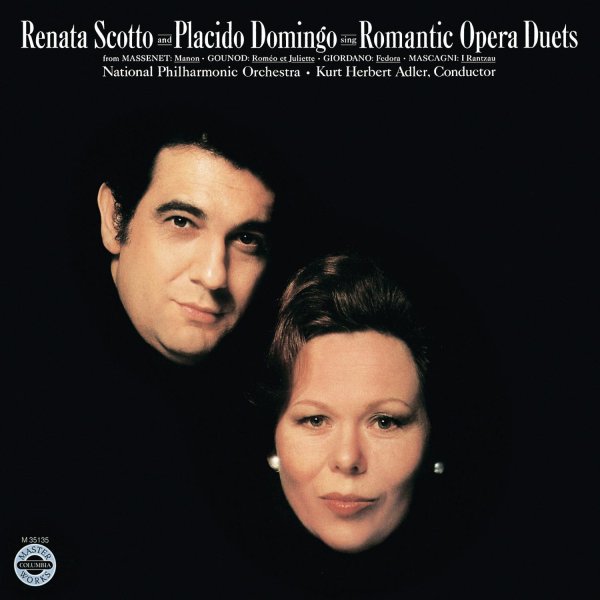
Romantic Opera Duets – Placido Domingo & Renata Scotto

Domingo recorded quite a few duet recitals in the 1970s, with Sherrill Milnes (1970), with Katia Ricciarelli (1972), with LeontynePrice (1974) and this one, with Renata Scotto, in 1978, which is, in many ways, the most successful.  For a start, the material is refreshingly unhackneyed, and, although we are vouchsafed only four excerpts, they are quite long (the shortest 8’52”), which makes for a more satisfying listening experience than lots of shorter pieces. The original LP had the French items, which are no doubt better known on the first side and the Italian ones on the second.

Scotto was at the high watermark of what was often referred to as her second career. In the 1960s she had recorded for EMI and DG, but signed to CBS/Sony in the 1970s appearing on many complete sets and recording recitals of Verdi and verismo. The voice was never a conventionally beautiful one and by this time could turn squally and shrill on top notes, but the compensations were many and included her superb musicality, her dramatic involvement, her attention to the text and her natural, unforced, excellent diction. As you can hear here, her French was less idiomatic than her Italian but you can at least hear the words clearly, and it is the French items I enjoyed most on this recital, though that could possibly reflect my preference for the material in question. I’ve never been a big fan of verismo.

Domingo is his reliable self, the voice in good shape, but at this time in his career his performances could seem a little generic, and there is not much difference between his Roméo and his Des Grieux, his Loris and his Giorgio, however musical his actual singing.

Both singers are attentive to the different styles required of the composers in question, but it is Scotto who is better at vocal characterisation, adopting an appropriately more seductive tone for Manon than she does for the girlishly innocent Juliette.  Her Fedora also sounds more mature and commanding than her Luisa in the Mascagni opera, which is a sort of verismo mirror piece to Gounod’s Roméo et Juliette.

All in all, this is a very enjoyable duet recital, both in terms of the singing and the music tackled, and it is an excellent showcase for both singers.

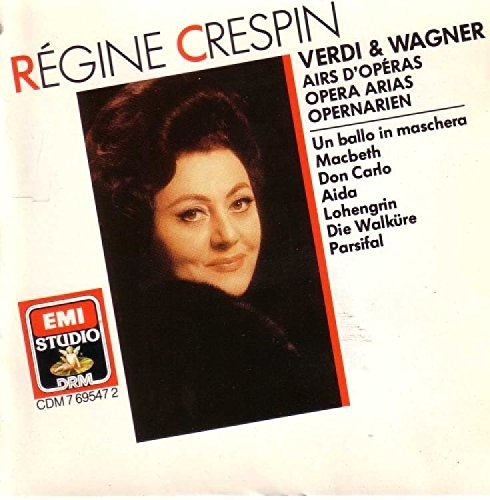
Régine Crespin – Opera Arias

515e7rsmu3l

When I think of Régine Crespin I tend to think of suave sophistication, intelligence and cool reserve, qualities that make her the perfect interpreter of the songs of Debussy and, especially, Poulenc and Ravel. But of course it was a large, refulgent voice and not one to be confined to the recital platform. The operatic stage would also seem to be its natural home.

Unfortunately too much of this French sang froid creeps into her performances of Verdi here. This Amelia is only slightly perturbed to find herself at the gallows at midnight, this Aida only mildly conflicted between loyalty to her lover and her fatherland. One feels that she wouldn’t want to get too upset in case she mussed her dress and beautifully coiffed hair, so just shrugs and walks away. In this she is the very antithesis of Callas who, famously, listened to this performance of Ritorna vincitor in a break during tense recording sessions of her final Verdi disc. Callas was so insensed at a performance that went against every grain of her dramatic being that she decided to sing it there and then, though the aria hadn’t been planned, and the result was a performance of blazing intensity a million miles from what we get here. Aside from being far too slow, Crespin never really gets to grips with Aida’s torment and anguish.

Of course Crespin’s singing is always musical, intelligent and well considered, the voice firm and well supported, but, for me, there is a lack of passion, a sense of detachment that doesn’t go well with Verdi. There are quite a lot (a surfeit?) of interpretive ideas in Lady Macbeth’s Sleepwalking Scene, but it is taken unconscionably slowly, and though her tone well captures the feel of a woman  walking and talking in her sleep, the whole scene falls apart at such a slow tempo. The music is over-inflected and conseqently unoconvincing.  She takes a lower option at the end rather than attempt the top D fil di voce, and we note that the top of the voice can be unwieldy, steely and just under the note, as it is at the climax of Amelia’s Ecco l’orrido campo from Un Ballo in Maschera. In that respect Eboli’s O don fatale suits her better, and she does at last inject a bit more passion here, but the aria should be thrilling and it just isn’t.

Paradoxically Elisabetta’s great Act V aria from Don Carlo is taken rather too fast, and I also wonder why she didn’t sing it in French. In consequence the grand opening statement feels rushed, as does the end, and the aria loses its shape. This might have more to do with Prêtre than Crespin, whose speeds can be a bit hit and miss, and nowhere does he seem the right conductor for Verdi. It is interesting to note that, though he was a great favourite of Callas, she retained the services of Nicola Rescigno for her 1960s Italian recitals, using Prêtre only for the French recitals and her Carmen and second Tosca.

In general the Wagner items suit her better, though here too I would prefer to hear Schwarzkopf or Grümmer in the Lohengrin arias. Crespin convincingly conveys Elsa’s deam-like state, but she is far less personal with the text. There is no quickening of the pulse at the approach of the knight, and, yet again, it feels as if she were on the outside looking in. Her singing is tasteful, intelligent, musical and yet I don’t feel she is truly involved.

We get more propulsive singing for Sieglinde’s Eine Waffe lass’ mich dir weisen, and of course she recorded the role in Solti’s Ring. She also makes a suitably seductive Kundry in the short extract from Parsifal.

That said, none of this is material I would choose to hear her in. For that I would turn to her superb performance of Ravel’s Shéhérazade with Ansermet (though not her Nuits d’Eté which also suffers from a lack of passion), to her singing of songs by Poulenc, Debussy and Satie and to some of the operettas of Offenbach that she recorded, music that responds better to her equivalent of the arched eyebrow.

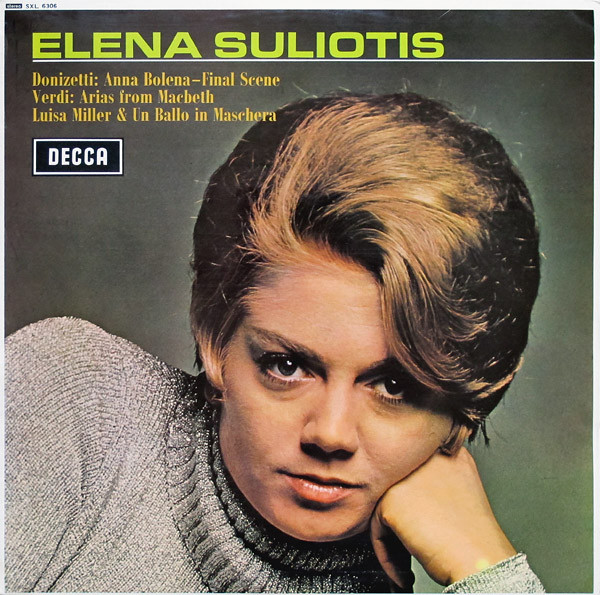
Elena Souliotis Opera Recital

r-5556117-1396449633-1748.jpeg

In 1965 Elena Souliotis burst into the operatic firmament like a shooting star. The star’s trajectory was swift and by 1971 it had pretty much burned itself out. In fact the recordings she made for Decca pretty much sum up the path of Souliotis’s career. The best of them are the 1965 recording of Nabucco under Gardelli, made when she was only twenty-two, and this recital disc made the followiing year. By the time of the recording of Macbeth, made in 1971, she was sung out, and it is salutory to compare the recording of Lady Macbeth’s opening aria heard here to the one on the complete set. The problems hinted at in the recital (the occasionally unsupported middle voice, the chest voice and upper registers not properly integrated) have now become major issues. Her voice aged twenty years in five. Macbeth was the last major recording she made for Decca, though she did pop up again in 1991, singing the Zia Principessa to Mirella Freni’s Suor Angelica. Hearing the two singers together, you would never for a minute think that Freni was the older singer.

But back to the recital in question, and listening to it now, even with the benefit of hindsight, it is easy to understand why she created such a stir at the time. It was becoming obvious that Callas was leaving the stage (indeed she made her last ever stage appearance in 1965) and people were looking for a singer of comparable dramatic flair. Souliotis, spelled Suliotis back then, certainly seemed to fit the bill. It was not a plush voice, but had a penetrating thrust and power, good flexibility and she sang with real dramatic conviction.

The first item, and the first side of the orignal LP, is the closing scene from Anna Bolena, a Callas speciality, and one would have to admit that there are times that she sounds as if she is ghosting the performance by the older singer. On the debit side also is her lack of a trill. The cabaletta is famous for a rising series of trills, delivered with incredible accuracy and tremendous force by Callas, but Souliotis doesn’t even attempt them. Aside from these flaws, though, the performance is alive to the drama, the melismas in the cavatina beautifully spun out, and the cabaletta thrilling in its rhythmic thrust. Callas may still reign supreme, but I’d still rate this performance more highly than those by Sills, Sutherland, Caballé and Gruberova.

Next up is Lady Macbeth’s entrance aria, which is thrilling, if a little vulgar. Comparisons with Callas are again inevitable, and it has to be said that in Callas’s performance, particularly in the complete live recording under De Sabata, we get a greater sense of Lady Macbeth’s vaulting ambition. Her chest voice is also better integrated, whereas with Souliotis it tends to be a feature unto itself. I like the Luisa Miller aria, though a little too mich of Lady Macbeth creeps in and she tends again to overdo the chest voice. On the other hand, Morro, ma prima in grazia from Un Ballo in Maschera is feelingly sung and actually quite beautiful.

Still, there is the overriding sense that, though there is enormous potential here, this is a voice that is as yet unformed. Singing so many performances of Abigaille at the tender age of twenty-two can’t have been good for her. Callas sang the role only once, at the age of twenty-six, but never touched it again, calling it a voice-wrecker. Maybe she was right. The role’s creator, Giuseppina Strepponi, who became Verdi’s mistress and later his wife, also sang the role a great deal and she was also sung out by the time she was thirty-one.

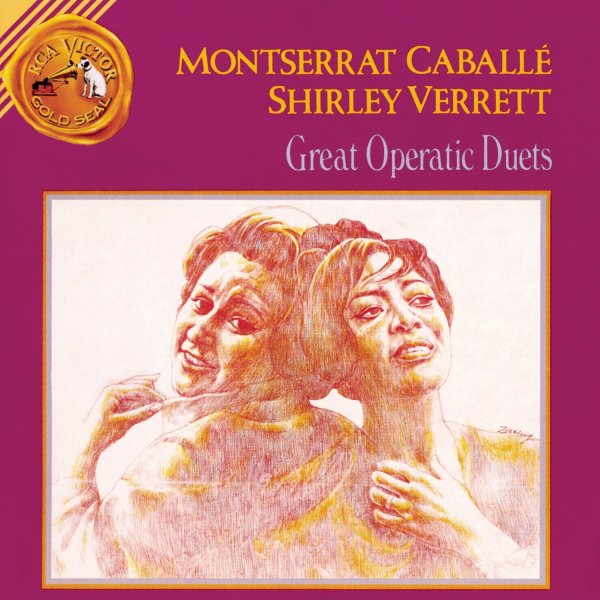
Montserrat Caballé & Shirley Verrett sing Great Operatic Duets

81uwtitniql._sl1500_

Duets from Semiramide (Rossini), Anna Bolena (Donizetti), Norma (Bellini), Les Contes d’Hoffmann (Offenbach), Aida (Verdi), Madama Butterfly (Puccini) and La Gioconda (Ponchielli).

The 1960s and 1970s were halcyon days for opera on disc. New recordings of both repertoire and rediscovered works appeared on an almost monthly basis, alongside recital records by major artists. Duet recitals, though not as frequent, were also a feature of this time, and could sometimes provide more variety in the juxtaposition of two different voices.

This 1969 duet recital finds both singers at the height of their vocal powers and provides a feast of great singing. It doesn’t quite get off to the best of starts however, with a performance of Serbami ognor from Rossini’s Semiramide in which Caballé’s scale passages are less than perfect, and which does not erase memories of Sutherland and Horne in the same music.

Vocally the duet from Anna Bolena is much better, and Caballé is here very touching in the section beginning Va, infelice where Anna forgives Giovanna; maybe not as moving as Callas with Simionato, but then, who is? Their voices blend well in the Norma duet too, and it is good to have the duet from Aida as Verrett never got to record Amneris in a complete recording, but, again neither duet is as thrilling as you’d want.

The principal pleasures of both the Barcarolle from Les Contes d’Hoffmann and the Flower Duet from Madama Butterfly are primarily vocal, and it is certainly wonderful to bask in the sheer beauty of two such gloriously rich voices in full bloom. The disc finishes with the great combative duet from La Gioconda, but yet again it’s a little underpowered and not a patch on Caballé’s recording of it with Baltsa in the complete set under Bartoletti.

This is a good memento of two singers, recorded before Caballé’s top notes started to harden and before she began to overindulge her penchant for floated pianissimi. This is also, to my mind, the best period for Verrett, when she was definitely a mezzo and before the move to soprano roles started to compromise the glorious individuality of that voice. A shame that it’s all a bit low key.

Edit: 24/03/2023

I listened to this duet recital again today and found it just a little dull. The voices are both beautiful, the singing itself accomplished, but somehow nothing really takes off and the emotional temperature is a bit tepid throughout. It got me wondering how much difference a conductor can make. Guadagno, a favourite of Caballé’s, is serviceable, no more. If you compare, say, the duet from Aida with the same duet from the Muti complete recording, where Caballé sings with Cossotto, it is to find that she is much more alive to the drama, much more emtotionally committed, and if you compare the conductng in the Anna Bolena duet to that of Gavazzeni for Callas and Simionato, to Serafin in the Norma, or even Bonynge in Semiramide, it is to find Guadagno rather lacklusre and faccid. He does best in the Barcarolle, where all he has to do is set a nicely flowing tempo and let the two gorgeous voices do their work. Even Verrett, who is usually an exciting and dramatically involved singer seems to be operating at a much lower voltage than usual. I am convinced this disc would have been a lot more satisfactory with a stronger hand at the helm.