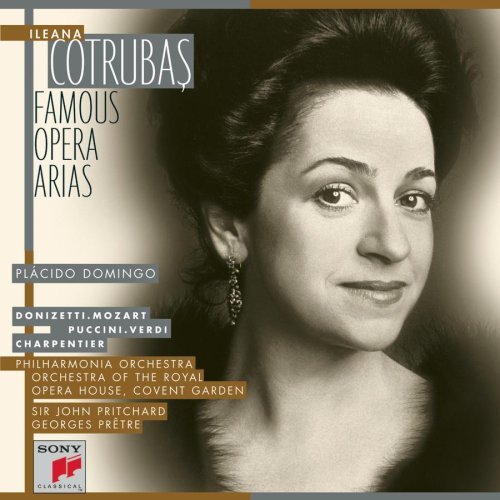
Recorded in 1976, when she was already 35, this was Ileana Cotrubas’s first and only recital disc. The playing time of the original disc being somewhat short, Sony have here added excerpts from the excellent complete recording of L’Elisir d’Amore also under Sir John Pritchard, Depuis le jour, from the complete Prêtre recording of Louise and O mio babino caro from Maazel’s Gianni Schicchi.
As Cotrubas herself says in the notes, Leonora’s Pace, pace was somewhat unexpected, a role that Cotrubas was never likely to sing on stage, and it really does need a fuller tone. I’m not sure if she ever sang Liu or Magda, but she could well have done and the other arias are all from her active repertoire.
It opens with a charming performance of Norina’s Quel gaurdo il cavaliere from Don Pasquale, a role she sang at Covent Garden at around the same time. She was a highly successful Susanna at Glyndebourne in 1973 (alongside Te Kanawa’s beautiful Countess and Freredica Von Stade’s radiantly ebullient Cherubino, performances which catapulted all three to stardom) and she is quite delightful in her Deh vieni.
The other side of her personality is captured in a deeply felt Ach ich fühl’s, and the natural morbidezza (an Italian word without any direct translation) which suited her to roles like Mimi and Violetta, is here displayed in her singing of the Puccini arias (Si, mi chiamano Mimi, Liu’s Tu, che di gel sei cinto, and Ch’il bel sogno di Doretta from La Rondine.) Though there is a hint of strain in the upper reaches of Gilda’s Caro nome, the aria also suits her well, and it here emerges as a dreamy reverie rather than the coloratura showpiece it often is.
The L’Elisir d’Amore excerpts are lovely in every way, as is Lauretta’s O mio babino caro, and Depuis le jour well captures Louise’s quiet intensity and mounting rapture.
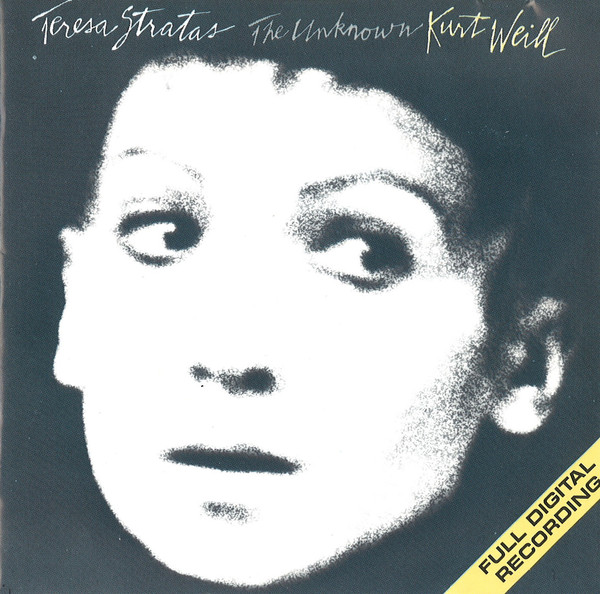
It was in 1979 that Kurt Weill’s widow, Lotte Lenya, saw Stratas singing the role of Jenny in The Rise and Fall of the City of Mahoganny. Knocked out by Stratas’s performance, she called her her “dream Jenny”, and afterwards she wrote to her, “nobody can sing Weill’s music better than you do,” and offered her a number of unpublished songs that she had closely guarded since Weill’s death in 1950.
The result was the first of these two discs, recorded in 1981, in which Stratas sings a collection of songs to piano accompaniment by Richard Woitach. Unfortunately, for the CD release, Nonesuch omitted the lyrics and translations that were included with the original LP, and what notes that remain are in minuscule print, almost too small to read without a magnifying glass. This seems little short of a crime, given Stratas’s vividly dramatic performances. Even without the aid of translations you can get a gist of their meaning, but how much more satisfying the disc would be be if we knew exactly what she was singing.You might be able to find texts and translations of some of them by scouring the internet, but it’s a long and arduous task.
Most people had no doubt got used to Lenya singing Weill’s songs in her gravelly baritone, but, as Lenya herself pointed out, her voice dropped over the years, and Stratas was performing them in the original keys. That said, most of these originally written for cabaret, had hardly ever been performed since and were here receiving their first recordings, though they are much better known now, and Weill selections have appeared from artists as diverse as Anne-Sophie von Otter and Ute Lemper.
Teresa Stratas was 54 at the time of the first recording. She had made her professional debut at the age of 20, joining the Met company the following year (1959), becoming a Met favourite until her final performance there in 1995 (in the role of Jenny in The Rise and Fall of the City of Mahoganny). The voice can be termed useful rather than beautiful, and, though a diminutive figure, she had a powerful stage presence, great personal beauty and was a superb actress. This might explain why she made comparatively few recordings, the most famous probably being Pierre Boulez’s recording of the completed Lulu, a role she had made her own in the Paris premiere. Beautiful or not, it was the perfect instrument for Weill’s songs, which rely on expression rather than beauty of tone.
Favourites for me here are the two settings of the same melody, one French, one German Wie lange noch and Je ne t’aime pas, the two Propaganda Songs Buddy on the Night Shift and Schikelgruber, and the glorious Youkali. Though the second disc is enlivened by the orchestral accompaniments, I have a special affection for the more intimate piano settings.
This second disc appeared four years later, and is more far reaching, though much of the material was more well known. The Y Chamber Orchestra under Gerard Schwarz has an undeniable whiff of a theatre orchestra about it, which is perfect for the material. The songs are taken from Broadway musicals, and both German and French theatre works. Texts and translations are at least included, though print is again minuscule.
Stratas’s range is formidable. Though capable of the “Brechtian bark” we are probably more used to, it is bound into the fabric of her performance, as is the full operatic soprano at key moments. Consequently not only do we get the full meaning of the lyrics, but the lyricism of Weill’s writing is revealed to a much greater extent. Take the most famous song on the album, Surabaya Johnny, which emerges almost as a mini psycho-drama for solo performer. Her French and German are both impeccable, her command of the Broadway idiom just about perfect (a few years later she was to record the role of Julie in John McGlinn’s first ever complete recording of Jerome Kern’s Showboat). One of the most glorious performances is of Lonely house from Street Scene, which is swirlingly lyrical with an aching loneliness.
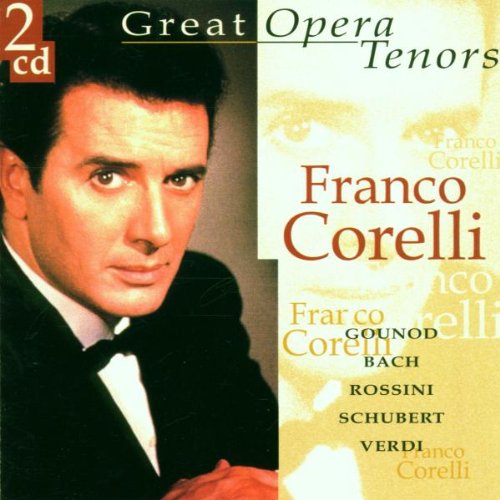
This two-disc compilation is drawn from the EMI catalogue and includes arias taken both from complete sets and recital discs.
People often go misty-eyed at the mere mention of Franco Corelli and he still inspires a huge following among opera lovers. For many he can do no wrong, and certianly the voice was a magnificent one, unique and no doubt a God-given gift. For me it’s more often a case of (to paraphrase the song from A Chorus Line) voice ten, artistry three. Not always, I hasten to add, and, if the performances on this set are anything to go by, he did respond to a strong hand at the helm. Predictably the best of them tend to be taken from complete sets, particularly those conducted by Zubin Mehta (Celeste Aida), Lovro von Matacic (Vesti la giubba) and Tullio Serafin (Pollione’s Meco all’altar di Venere from the second Callas Norma), which is arguably the best of all).
These are all on Disc One, where elsewhere there is just too much can belto sobbing. Manrico’s Ah si, ben mio, from the Schippers complete set, is delivered at a relentless forte (why not his stunning Di qella pira, I wonder?), as are the excerpts from the Santini recording of Andrea Chénier. Worst of all is the graceless, over-loud version of Roméo’s Ah, lève-toi, soleil, sung in execrable French. Listen to this and then to Bjørling, Kraus, Gedda or Alagna to hear how beautifully poetic the aria can sound.
Disc 2 has even less to commend it, I’m afraid. The best performances are taken from a recital record with an unknown orchestra under one, Franco Ferraris. Cavaradossi’s Recondita armonia lacks poetry, but E lucevan le stelle is much better, though he rather ruins the final measures with an excess of sobbing. Cielo e mar is also a fine, sensitive performance, with the added bonus of those gloriously free and ringing top notes.
The less said about some of the other items though, the better. After the operatic arias, we are treated (I’m not sure that is the correct word) to a selection from, presumably, a record of sacred arias, all in absolutey ghastly arrangements. Handel’s ubiquitous Largo from Semele is mangled almost beyond recognition, the Schubert and Bach/Gounod Ave Marias sung through a sort of treacle soup, and Rossini’s Domine Deus from the Petite Messe Solenelle bludgeoned to death. Franck’s Panis angelicus, taken, by the looks of things, from another album, doesn’t fare much better, nor, surprisngly does Lara’s Granada from the same album. Not entirely Corelli’s fault, as the arrangement is quite possibly the most ghastly I’ve ever heard, the tempo pulled around so much the piece loses any sense of flow. What price Wunderlich’s gloriously ebullient and sunny version for DG? Corelli sounds plain angry, but who can blame him when the accompanment is so awful?.
Fortunately the final two items somewhat redeem this sorry mess. The arrangements might not be much better, but in Cardillo’s Core ‘ngrato and De Curtis’s Torna a Sorriento, one just basks in the Mediterranean warmth of Corelli’s glorious tenor. It is moments like these that remind us of why we listen to him.
On 17 February 1959, Joan Sutherland sang her first Lucia di Lammermoor at Covent Garden. She had first been engaged at Covent Garden in 1952, singing small parts, such as Clotilde to Callas’s Norma. That same year she sang her first leading role there (Amelia in Un Ballo in Maschera), but the administration didn’t at first realise her potential and the roles she sang (Agathe, The Countess, Desdemona, Gilda, Eva, Pamina, Lady Rich in Gloriana and Jennifer in Tippett’s The Midsummer Marriage) gave no real indication of the direction her career would take. She herself had thought she would be a Wagnerian soprano, but Richard Bonynge, who married her in 1954, eventually convinced her otherwise, and in 1959 Covent Garden gave her the honour of a new production of Lucia di Lammermoor, directed by Franco Zeffirelli and conducted by Tullio Serafin. Sutherland proved a sensation, and, at the age of 35, she became a star, in demand all over the world for dramatic coloratura roles.
This disc adds to her debut recital, made shortly after the Covent Garden Lucia, two arias from one of her most successful sets The Art of the Prima Donna (Casta diva and the I Puritani Mad Scene), recorded in 1960 and Santo di patria, lifted from another set The Age of Bel Canto, recorded in 1963.
Those who know me will know I am not much of a Sutherland fan. The mannerisms (the mushy diction especially, the droopy portamenti, the weak lower register) that crept in as early as the 1960s irritate me so much I find it hard to listen, and the beauty of the voice is no compensation.
It is good to be reminded, then, that it was not always so, and she sounds quite different here, the voice much more forwardly produced, and, even if she rarely uses the words to suddenly bring a phrase into sharp relief, there is nothing much wrong with her diction in these discs. Maybe this has something to do with the conductors she was working with then, all Italians, Nello Santi for the debut recital, Francesco Molinari-Pradelli for The Art of the Prima Donna, Tullio Serafin at Covent Garden. Interestingly Serafin advised her to study the role of Lady Macbeth, but Bonynge obviously thought otherwise.
The main meat of the disc, however, is that first ever recital made with the Paris Conservatoire Orchestra under Nello Santi. Lucia’s two big solos were an obvious choice, to which are added Merce, dilette amiche from Verdi’s I Vespri Siciliani, Ernani! Ernani involami from Ernani and O luce di quest’anima from Donizetti’s Linda di Chamounix.
Throughout the technical command is stunning, as is the beauty of voice, the top notes, of which there are many, one of its greatest glories. Nor is she just a technical machine. Though there is little attempt at vocal characterisation (Norma doesn’t sound much different from Lucia), she is not an unfeeling singer. There is command in Norma’s Sediziose voce, poetic feeling in the recitative to the Ernani aria, breezy grace in the aria from I Vespri Siciliani.
Fresh from the success of the Covent Garden performances, the Lucia arias are predictably best of all. Here not only is the execution vocally stunning, but she is the very epitome of the young Romantic heroine, driven mad by despair. Like Callas, she is a far cry from the piping, doll-like sopranos who had made Lucia something of a laughing stock among opera cognoscenti. Unfortunately already by her first complete recording of the opera made in 1961, the tone has become more occluded, the diction less precise, the vowels begin to be rounded and dulled, and the vitality and immediacy heard here starts to droop.
Though vital and alive in the scene from Verdi’s Attila, conducted by Richard Bonynge, the diction is not as clear as it is on that frst recital, though the recording here does give some indication as to the size and fullness of the voice. Even with that small niggle about the diction, this is still a stunning performance, thrilliingly dramatic, and I’ve never heard it better sung. Deutekom on the Philips complete set is pallid by comparison.
This disc, along with The Art of the Prima Donna, is, I would suggest, essential Sutherland, and remain permanent parts of my collection. The rest, personally, I can live without.
Well this is something of a hotch potch, no doubt explained by its provenance – music included in the 1991 documentary film made after his recovery from leukemia My Barcelona, a celebration of the unique relationship between the man and the city of his birth.
What we get is a mixture of operatic arias, popular song and excerpts from Ramirez’s Navidad Nuestra and Misa Criola, which, surprisingly perhaps, makes for a pleasantly varied disc.
No great revelations, I suppose. Carreras is at his honeyed best in Cavaradossi’s E lucevan le stelle from the 1976 Davis recording of Tosca, a performance of poetic beauty, made before some of the heavier repertoire he essayed took a toll on his essentially lyric tenor, but most of the selections give pleasure. I particularly enjoy his version with piano of Mompou’s haunting Damunt de tu només los flors and the Ramirez pieces are also great fun.
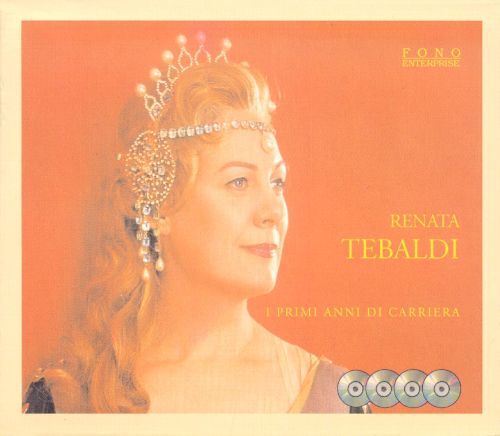
This four disc set is of recordings made in the 1940s and early 1950s, when Tebaldi was in her twenties. It is a mixture of live and studio recordings, so sound quality varies quite a bit. It is also a convenient grouping together of four different discs issued by Fonit Cetra in 2002, which no doubt explains why we get so many different performances of the same aria. Given that there is little difference between them, you may decide you don’t need to listen to four different performances of La mamma morta and of Desdemona’s Willow Song.
And of course the first thing we need to say is that it was an extraordnarily beautiful voice, even throughout its range, firm and rich, her diction admirably clear, though, even at the beginning the very top could sound strained and off pitch. The top C climax to her 1950 Cetra studio recording of Aida’s O patria mia is hard won and slightly under the note and the voice’s greatest beauty lies in the middle register, though many of today’s sopranos would also kill for the richness down below. Nor is she an unfeeling performer, though, at this stage in her career, it can tempt her into excess, especially when singing live, and she tends to sound lacrymose rather than truly moving. She goes way over the top in Desdemona’s Willow Song, and she is much more restrained, and consequently more moving, in the Decca Karajan recording. The other thing to say about Tebaldi is that, however beautiful the voice, however firm the delivery, however musical her singing, her performances rarely stay in the memory, nor does she ever really light up a phrase or a line the way others can. Performances of some of this same music, by such as Muzio, Callas, Caballé, De Los Angeles and Schwarzkopf resonate in my mind’s ear, and I can often recall individual details. With Tebaldi I never can. I can recall the sound of the voice, but little that is specific to the music she is singing. In these early performances, I found that she often over-characterises the music, introducing sobs and emphases which detract from the beauty of the sound, rather than make it more dramatic. It is somewhat akin to watching a hammy actor.
A few specifics then about the discs themselves. I got muddled and listened to them in reverse order. Disc 4 is entitled Gli Inediti, and is presumably of previously unissued recordings. In concert she sings the Countess’s Porgi amor but, though more suited to the character than she is to Susanna, who puts in an appearance on Disc 3, Mozart is not really her métier. The excerpts from a 1949 performance of Andrea Chénier wih Del Monaco are prime examples of that hamminess I alluded to, though all the singers go way over the top. The audience lap it up, so they no doubt give them what they want. A poised 1949 performance of the Ave Maria from Otello is ruined by a surfeit of little sobs, but she gives us a lovely performance of Louise’s Depuis le jour (in Italian). It lacks Callas’s quiet intensity and mounting rapture, but is much more securely sung and works well on its own terms. The disc closes with a small piece of history; a 1945 performance of the love duet from Otello, with the then almost sixty year old Francesco Merli, though recording here is at its dimmest. Nevertheless it affords us a glimpse of the great tenor in one of his most famous roles.
Disc 3 covers studio recordings made for Decca and Fonit Cetra in 1949 and 1950, arias from Aida, Madama Butterfly, Faust, Manon Lescaut, Tosca, Il Trovatore, La Traviata, Otello, La Boheme, Mefistofele, La Wally, Andrea Chénier and, most surprisingly Susanna’s Deh vieni from Le Nozze di Figaro, though she makes a very heavyweight Susanna, and this is the least successful item on the first disc. Recorded sound here is fine and there is no doubt that this is an extraordinary voice the like of which we don’t hear anymore, and perhaps haven’t since. Her legato is mostly superb as is her diction. On the other hand, as one aria follows another, we don’t really get a gallery of different characters. Her Aida isn’t really very different from her Butterfly, her Manon no different from her Mimi, and, in an attempt to be dramatic, she often over-emotes. The reading of the letter before Addio del passato is hopelessly melodramatic and she ends the aria forte rather than in the fil di voce Verdi asks for.
The prize of Disc 2, entitled La nascita d’una leggenda, is some extended excerpts from a 1951 concert performance of Verdi’s Giovanna d’Arco with Carlo Bergonzi and Rolando Panerai. Though she is taxed by some of the coloratura, and she tends to aspirate when the music asks her to move a little faster, the role suits her well. Also excellent are the two extracts from a 1950 performance of the Verdi Requiem under Toscanini, with Giacinto Pradelli, Cloe Elmo and Cesare Siepi. It is somewhat dimly recorded, but you can hear how fine she was in this work. Why Decca never recorded her in it is a mystery to me. A welcome surprise is Elisabeth’s Dich, teure Halle (in Italian) from Tannhäuser. It is also good to hear the young Di Stefano in a 1950 concert performance of the Act I duet from Madama Butterfly. The concert also included Margherita’s L’altra notte in fondo al mare from Mefistiofele. In both the aria and the duet, Tebaldi oversings and overacts and her singing as Butterfly is so powerful that she sounds more like a Tosca or Minnie to me. Many will respond to the beauty of the voice, but she doesn’t conjure up an image of Butterfly for me at least.
The first disc pits Tebaldi against her teacher, Carmen Melis. Excerpts from Tebaldi’s first recordings of La Boheme and Madama Butterfly under Alberto Erede and arias from Manon Lescaut and Tosca. Many will no doubt revel in the glory of that voice filling out Puccini’s wonderful melodies, but for me she too often oversings and the finale to La Boheme, which is given in its entirety has both Tebaldi and Giacinto Pradelli over-emoting like mad. The love duet from Madama Butterfly with Giuseppe Campora likewise has no sense of the young girl’s gradual awakening to love and sounds as if it could have been lifted from Tosca. Melis is caught in excerpts from Tosca and Massenet’s Manon. She is a singer who is new to me, and I must say I found her very impressive, though the top C at the line Io quella lama gli piantai nel cor is a little precarious, and she takes the upper option on the word cor. The Manon excerpt is Manon’s N’est-ce plus ma main (in Italian) from the duet with Des Grieux, and she is wonderfully seductive and persuasive.
Tebaldi is a central singer in that she demonstrates most of the virtues of good singing. The voice is a beautiful one, the line always firmly held, her legato generally excellent. Her only faults are a lack of a trill and clumsy execution of fast moving music (hardly necessary in most of the music she sang) and a slightly short top. (I remember that in her interview with Luca Rasponi for the book The Last of the Prima Donnas, she bemoans the ever rising pitch of modern orcehstras, which must have been a nightmare for her.) My preferences are well know, and I prefer singers who have something more specific to say about the music they assay, but the set is one I still enjoy dipping into from time to time.
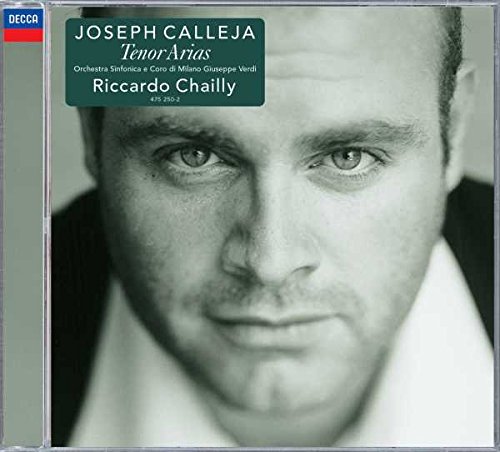
This disc was recorded back in 2003, when Joseph Calleja was a virtually unknown twenty-six year old, and on the threshhold of his career. At that time, the voice was a light lyric tenor with a distinctive fast vibrato, more akin to the sound of tenors like De Lucia and Bonci than what we have become used to since.
Repertoire on the disc is judicially chosen, and I am very surprised to see that in his most recent disc of Verdi arias, he tackles music for Otello, Manrico and Radames (though I don’t think he has sung any of these roles on stage yet). Listening to the performances on this disc, one wouldn’t suspect for a moment that the voice would develop to embrace that repertoire. So far he has taken his career slowly and I do hope he doesn’t push himself too far.
But back to the recital disc in question, and I must say I find it very satisfying. Far from the can belto of so many tenors, there is lighness and grace to his singing, and he refreshingly brings as much attention to recitative as he does to an aria. Take the opening piece, the recitative to Alfredo’s Dei miei bollenti spiriti, which brims with joyful high spirits, softening with a touch of intimacy at Qui presso a lei. The aria itself is sung with a nice buoyancy and affectionate phrasing, switching to a more propulsive manner for the cabeltta.
The Macbeth aria is sung with a deep sense of melancholy, whilst the Duke is all charm and insouciance, though the top D he attempts is a little insecure. Nemorino’s Quanto e bella is delivered with a nice winsome charm, and Edgardo’s final scene is suitably tragic.
I’m not sure the aria from Adrianna Lecouvreur was a good choice for him, as it seems to cry out for a beefier sound. Nevertheless his restraint is most welcome, and it is good to be free of all those sobs and aspirates that used to pass for emotion in some Italian tenors of an earlier generation
In all Riccardo Chailly offers impeccable support, and it is good that scenes are given complete with chorus and interjections from other singers (Linda Easley as Annina and Giovanni Battista Parodi as Raimondo).
All in all a very successful debut recital, and it is good to know that Calleja is still active today, largely fulfilling the promise he showed in this one.
Zaide: Ruhe sanft, mein holdes Leben
La finta giardinera: Crudeli fermate… A dal pianto
La clemenza di Tito: S’altro che lagrime
Cosí fan tutte: Ei parte…Senti… Per pietà
Il rè pastore: L’amerò,sarò costanze
Lucia Silla: Pupille amate
Idomeneo: Se il padre perdei
Die Zauberflöte: Ach ich fühl’s
Kiri Te Kanawa became known to the world when she sang Let the bright Seraphim at the wedding of Prince Charles and Lady Diana, but opera afficionados had known of her for at least ten years before that. I remember very clearly seeing a TV broadcast frm Glyndebourne of Le Nozze di Figaro, in which Te Kanawa played the Countess, Ileana Cotruas Susanna and Frederica Von Stade Cherubino. It effectively launched all three ladies’ international careers, and it was principally as a Mozart singer that Te Kanawa became known.
Later she sang roles by Verdi (the gentler heroines like Desdemona and Amelia in Simon Boccanegrea), Puccini (Mimi and Manon), Strauss (the Marschallin, Countess Madeleine and Arabella), as well as Gounod’s Margeurite, Tatyana and Barber’s Vanessa, but I still think of her chiefly as a Mozart specialist, and it is in this repertoire that I enjoy her most.
It is good to see so many arias taken from Mozart’s lesser known operas, but the recital tends to concentrate on gracefully flowing arias, and so there is little variety. Of course there is much pleasure to be gained from the beauty of Dame Kiri’s creamy soprano, and her technical command of the music, but she evinces little character and the recital tends to settle back comfortably into its frame. You could of course argue that the music demands no more than it is given, and, for most of the music you’d probably be right, but when it comes to the recitative and aria from Cosí fan tutte, my mind kept going back to a more sharply characterised, but no less scrupulously sung version by Elisabeth Schwarzkopf, and I couldn’t help but wonder what she would have made of a similar collection.
Still, we should be grateful for what we have. It is rare indeed to hear such accomplished singing (and orchestral playing) allied to such a glorious voice. The disc certainly plays to her strengths, that is a voice of creamy beauty, even throughout its range, and maybe it is better experienced piecemeal, rather than in one sitting, when you’d be less inclined to notice the lack of variety in the programme.
The lion’s share of this CD is a reissue of what, I believe, was Caballé’s first recital disc for RCA, recorded in 1965 when the voice was at its freshest, and at around the same time as her sensational international debut in Lucrezia Borgia at Carnegie Hall, when she was a last minute replacement for Marilyn Horne. Up until then her repertoire had focused on Mozart and Strauss, plus Massenet’s Manon, and in fact she made her Glyndeboure debut later the same year as the Marschallin. However it was as a bel canto specialist that she would eventually become known, and she was one of the sopranos (along with Sutherland and Sills) who spearheaded the bel canto revival, set in motion by the legendary La Scala Visconti production of Anna Bolena with Callas.
The voice itself was rich and velvety, even throughout its range, her breath control exemplary, with the ability to float the most incredible pianissimi, an effect she perhaps overused in later years. There were a few chinks in her armour, especially for a bel canto specialiste; her trills were somewhat ill defined, and though the voice had flexibility and negotiated florid music well, there was the occasional hint of an aspirate, never encountered in the singing of Callas or Sutherland.
The tendency to aspirate, noticeable in the very first phrase of Casta diva, mars the beauty of the performance and the aria is not as mesmerising as it can be, despite the gorgeous sound. But this is nit picking and hers is still one of the most ravishing performances of the piece you will hear. Better I think is the Mad Scene from Il Pirata, which is sung with deep feeling and a true appreciation of the dramatic situation. The cabaletta does not have the lacerating effect of Callas in the same music, but works well within Caballé’s gentler conception.
All three Donizetti roles which follow became Caballé staples in the next few years, and she fulfils all their demands for vocal gandeur and personality. Always evident is the sincerity of her art, but she is not one of the world’s character actors. It has to be admitted that all these Donizetti and Bellini heroines sound much the same, the characters pretty interchangeable. Does that matter? Well I suppose that depends on one’s personal preferences, and mine are well known. That said, I am grateful for what she has, and Caballé is certainly not unfeeling, in fact often most affecting. Where Sutherland’s dazzling performances often leave me cold, I find Caballé’s dramatic commitment, albeit rather generalised, satisfies me more. We would be privileged to hear singing of such beauty and accomplishment now.
RCA have here added a Mira o Norma recorded in 1972 (I assume this is from the complete set with Fiorenza Cossotto, though she is not credited) and the first part of the closing scene from Anna Bolena, recorded in a somewhat boomy acoustic in 1970. Already there is just a very occasional hint of the hardness that would later affict her loud high notes and result in the over-exploitation of those floated high pianissimi, but there is still much that is very beautiful. Befittingly, the disc ends with the quite close to the cavatina from Anna Bolena, the final phrase spun out and floated through the air on a pure thread of glorious sound. It is for moments such as these that the art of Montserrat Caballé will most be remembered.
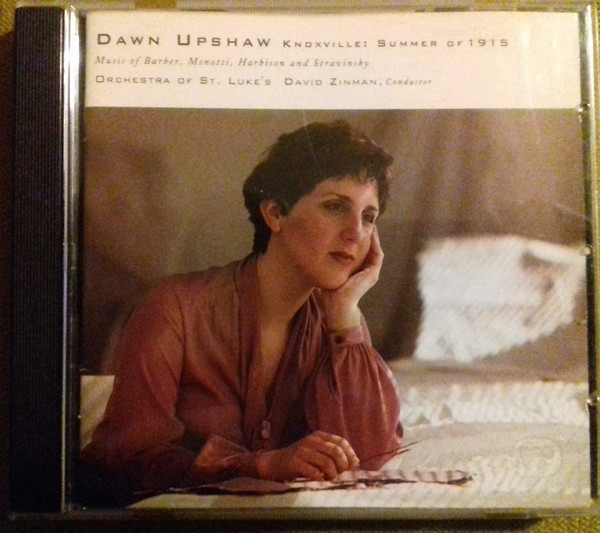
It seems incredible now that this disc was released over 30 years ago, but there it is, clearly written in the insert, “Recorded August 1988 at Manhattan Center Studios, New york”, though, IIRC, it had a different cover on its first release.
Barber’s wonderfully nostalgic Knoxville, Summer of 1915, a setting of James Agee’s prose-poem has now, it would seem, become quite popular. It was first recorded by its dedicatee, Eleanor Steber in 1950, a couple of years after its premiere, but had to wait another eighteen years before being recorded again, though very successfully by Leontyne Price. It had to wait a further twenty years for this version by Dawn Upshaw, but its success has led to a spate of others by the likes of Barbara Hendricks, Sylvia McNair, Roberta Alexander, Kathleen Battle, Jill Gomez, Karina Gauvin and, most recently, Renee Fleming.
Steber was a wonderful singer, and her version is very fine, but for me it misses the essential childlike quality of the piece and she can sound a bit mature, even a trifle prim. Price, on the other hand, is surprisingly successful at scaling down her rich velvety voice to the needs of the writing, and her version is deservedly well known. Dawn Upshaw, on the other hand, has by nature what Price had to strive for. She has exactly the light voice and direct manner the piece needs and there is no need for her to characterise; she simply has to be herself, her diction natural and unforced. David Zinman’s tempi are also just right, and it is no surprise to find that this version has been a top recommendation since it was first issued.
The rest of the programme is also attractive, its centrepiece being John Harbison’s Mirabai Songs, originally written for piano, but here given in his chamber orchestra version. The songs are settings of 16th century devotional Indian poems by Mirabai, who, after her husband died, devoted her life to the God Krishna. The texts are alternatively erotic, ecstatic and devotional, the orchestrations colourful, the vocal range wide and Upshaw is fully up to their demands.
The interesting but quite short programme is rounded off with a couple of operatic pieces, a short extract from Menotti’s radio opera The Old Maid and the Thief, and Anne Trulove’s No word from Tom from Sravinsky’s The Rake’s Progress, and Upshaw would seem perfectly cast in both.
Like most of Upshaw’s records the material chosen is refreshingly different and well worth investigating.






 Philip's Assortment Box