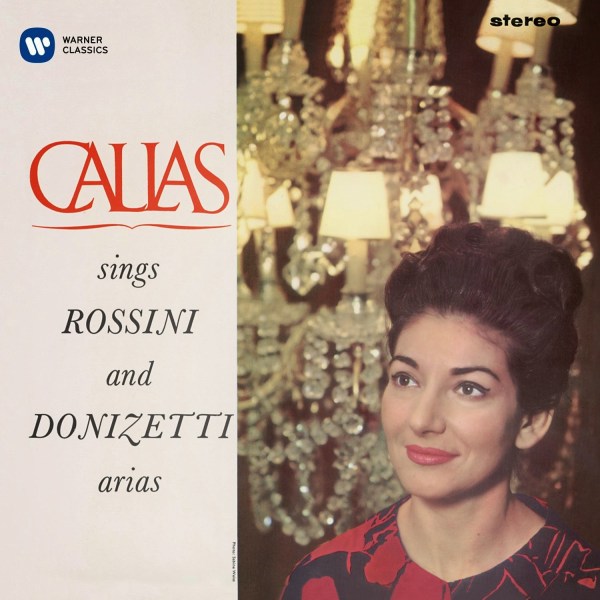
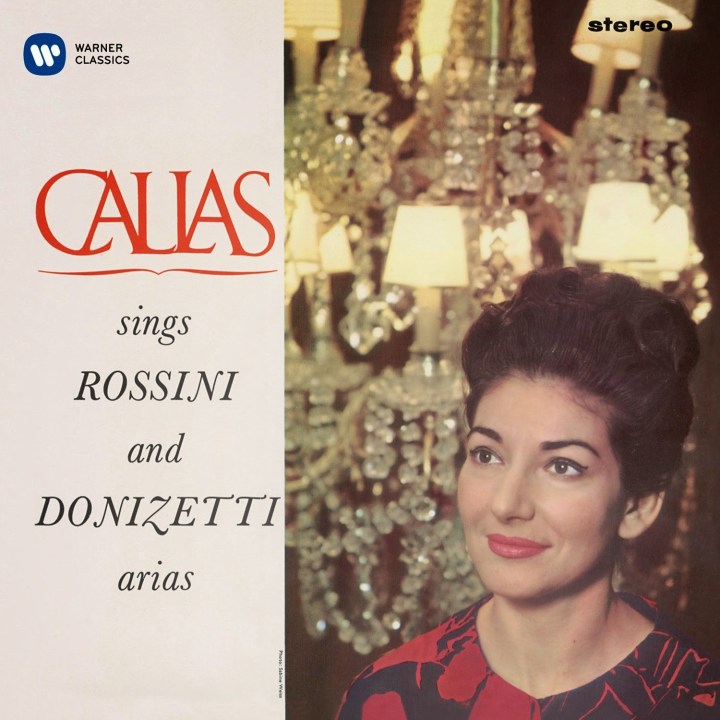
Callas sings Rossini & Donizetti – Revisited

81mslzncryl-_sl1500_

I confess that when it comes to some of these late Callas recitals I have equivocal feelings and my reactions to them can vary from one listen to another.

On the one hand it cannot be denied that this is a voice under stress. Notes above the stave often emerge stridently, or she will tread so carefully that they seem just touched in rather than sung with confidence. This diffidence is more evident here than in the contemporaneous Verdi recital I reviewed a couple of months ago, possibly because Rossini’s and Donizetti’s orchestra offers her less solid support than Verdi’s. Whatever the reason there is a pervading air of caution throughout this short disc. She is more comfortable in her middle and lower range, though even here vowels are sometimes discoloured. There is a world of difference between her defiantly triumphant singing of Rossini’s Armida in 1952 and what we hear in these discs, though only thirteen years separates them.

Taking all these problems into consideration, what is left? Well, her superb musicality, her unparalled sense of style and her ability to get to the heart of all these various arias, not least the way she finds a different voice character for each one, though she never sang any of these roles on stage.

The recital starts with Cenerentola’s final aria, which suits her quite well, the tessitura being a little bit lower. Aside from a couple of strident top notes at the end, it is also vocally quite fine, the scale passages sung smoothly and accurately (no sign of an aspirate here). Though the aria is the summation of the subtitle of the opera (la bonta in trionfo), Callas does not let us forget she was born to “sorrow and weeping”. Is is just my imagination that I hear in her figlia, sorella, amica, tutto trovate in me a reproof to her sisters at the way they treated her.? Those who like their Cenerentolas to be more charming and coquettish might find her wanting, but there is sound dramatic justification for Callas’s more serious interpretation.

There are more pronounced vocal problems in Matilde’s Selva opaca, which follows (what a pity she didn’t sing it in French), but the recitative is brillianty done and she captures a sort of sighing loneliness that is most attractive. I can’t really imagine Callas as the tomboyish Marie in La Fille du Régiment (again I wish she had sung this in French), but convien partir has a lovely, gentle sadness about it. The tessitura bothers her more here, but again her phrasing is exemplary.

Semiramide is a role Callas should probably have sung when she was in her prime and she is suitably imperious and grand from the start of Bel raggio. What is lacking here is the dazzling freedom we hear from Sutherland (especially in her version from The Art of the Prima Donna album) and indeed from Callas herself when she sang Armida. Ornamentaion is altogether too chastely applied and one misses the addition of a cadenza between the two verses of dolce pensiero.

Lucrezia is another role that would have suited her well a few years earlier and, yet again she can’t hide the strain in high lying passages, but the aria has a poignancy and poetry heard in few others. According to Max Loppert in Opera on Record 3, despite her vocal difficulties,

she manages to explore, in the lingering, legato shaping of the semiquaver tracery, a vein of expression, a range of timbres, unknown to other recorded Lucrezias.

The final piece is Adina’s Prendi, per me sei libero from L’Elisir d’Amore,an aria she sings without artifice, her manner direct, simple and charming.

Ultimately, I feel, I am prepared to put up with the parlous state of the voice at this time in her career for the undimmed musical immagination and interpretive detail, but I accept that this will not be true for many and I would advise those people to steer clear.

Victoria De Los Angeles sings Chants D’Auvergne


Many of my generation will no doubt have got to know Canteloube’s gorgeous arrangements of Auvergne folk songs through the recordings of Victoria De Los Angeles. On LP I only had the first album recorded in 1969, which had a selection of songs on one side and her recording of Chausson’s Poème de l’amour et de la mer on the other, but this reissue couples only the Canteloube songs to the second all Canteloube album entitled Pastorale and recorded in 1974. Some might also remember that famous Dubonnet advert which used an arrangement of the gorgeous Baïlèro, lazily and yearningly sensuous in the performance under review. I can’t now think of this song without the De Los Angeles version coming into my mind’s ear.

De Los Angeles is in many ways the songs’ ideal interpreter, steering a sort of midway course between the more abrasive style of Madeleine Grey and the senusality of Anna Moffo. She has great fun with the colourful language and folk elements, exuding the bright eyed charm for which she is famous, but is also wonderfully expressive in the more melancholy songs, and the Lamoureux Orchestra under Jean-Pierre Jacquillat provide excellent support, all bathed in a warm acoustic.

There are now a lot of recordings of these songs out there (when the first album was released, I’m pretty sure there were only the early recordings of the aforementioned Madeleine Grey, a small selection by Anna Moffo and a couple of discs on the Vanguard label by Netania Davrath) and there are now a lot more sets out there by the likes of Kiri Te Kanawa, Jill Gomez, Dawn Upshaw, Véroniqe Gens, Frederica Von Stade and others, and all of them have their attractions, but these performances by De Los Angeles will always have a special place in my heart.

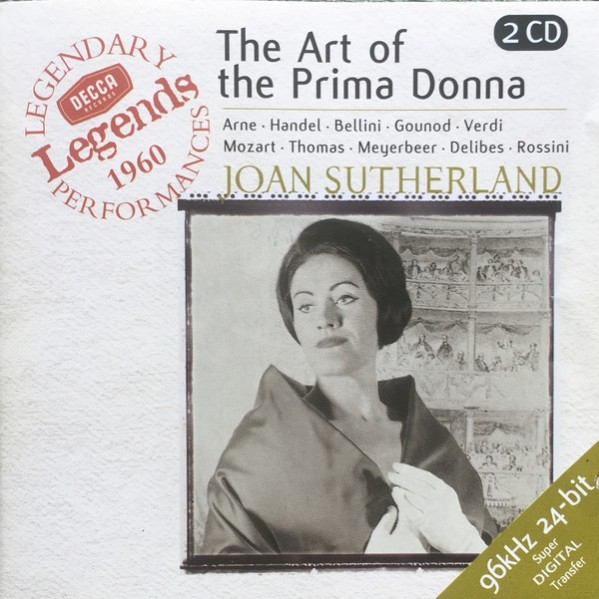
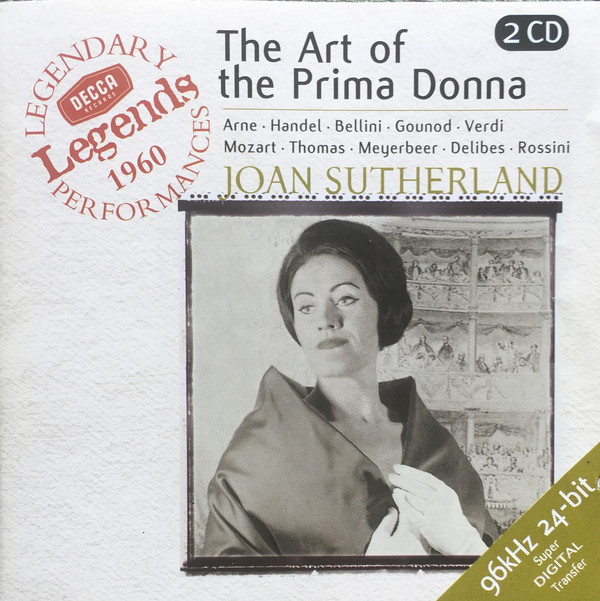
Joan Sutherland – The Art of the Prima Donna

r-10886939-1505963132-9869.jpeg

So what more can one say about this famous two disc recital? It was recorded in 1960, not long after Dame Joan had enjoyed a spectacular success in Lucia di Lammermoor, in 1959, at the Royal Opera House, Covent Garden. She was already 33 and had been a member of the company since 1952, when she had sung Clotilde to Callas’s Norma and the Priestess in Aida. She had sung a wide number of roles there, including Agathe, the Countess, Gilda, Pamina, Eva and even Lady Rich in Gloriana and Jennifer in Tippett’s The Midsummer Marriage, but none of these undertakings had prepared anyone for the spectacular success she would have as Lucia, with Serafin, Callas’s mentor, in the pit. The role became her calling card and shortly afterwards she sang it in Paris, at La Scala and at the Met, performances that put her firmly on the map and paved the way for the direction her career would take. Thereafter she concentrated almost exclusively on the bel canto repertoire and many operas were resurrected specifically for her.

Let us try and listen now with fresh ears, as if, for instance, this was the work of a singer new to us today. First impressions would be of the beauty of the voice, the fullness of tone, the ease on high and the way those top notes ring out with brilliance but without a hint of shrillness. We would also notice the rocketing virtuosity and the stunningly accurate coloratura. She also sings with feeling, but the first impressions are definitely vocal. This is an exceptional instrument used with great technical accomplishment. What I don’t think we quite get is a true impression of the size of the voice, which, according to all who heard her in the theatre, was quite exceptional.

Some of the arias (particularly the opening track, Arne’s The soldier tir’d, Handel’s Let the bright Seraphim and Semiramide’s Bel raggio) have become yardsticks against which all subsequent comers might be judged, and almost all the others would no doubt be considered amongst the best versions available. Vocally she has few limitations, though these might include a relative weakness in the lower register. Nor is she ever likely to suddenly throw into relief a word or a phrase and her diction, though a lot better than it was later to become is not particularly clear. We might also note that characterisation is not her strong point. As one aria follows another there is little to distinguish one character from another. We do not get a gallery of different people, as one would with a Callas or a Schwarzkopf.

For many these reservations will not be a problem and of course there is a great deal of pleasure to be had from the purely visceral experience of hearing such a beautiful voice in full bloom tackling with accomplishment a wide range of music. For others, and I would count myself among them, that certain sameness of interpretaion will be a problem and I for one prefer to listen to the recital piecemeal rather than all in one sitting. When listening in sequence, I start out being stunned by the singing but, after a while, my mind starts to wander as one interpretation emerges much the same as the one before. The best arias are, as I intimated above, those in which Sutherland can display her amazing vocal dexterity.

Going back to first impressions, though. There is, as far as I’m aware, nobody singing today who can even approach the accomplishment of what Sutherland achieves here. This two disc set stands as testament to her greatness, before the mannerisms (the poor diction, the mushy middle voice, the droopy partamenti) became apparent and should be in the collection of all those interested in singers and singing.

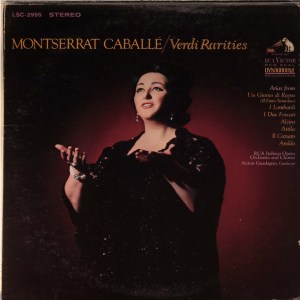
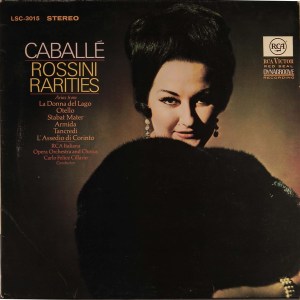
Montserrat Caballé – Rossini, Donizetti and Verdi Rarities

r-14007043-1565960472-8916.jpeg

Rossini: Arias from La Donna Del Lago, Otello, Stabat Mater, Armida, Tancredi and L’assedio di Corinto
Donizetti: Arias from Belisario, Parisina d’Este. Torquato Tasso, Gemma di Vergy
Verdi: Arias from Un Giorno di Regno, I Lombardi, I due Foscari, Alzira, Attila, Il Corsaro and Aroldo

These two discs bring together the three LPs of bel canto Rarities Montserrat Caballé recorded shortly after she rocketed to stardom singing Lucrezia in Lucrezia Borgia at Carnegie Hall in 1965, a last minute replacement for an ailing Marilyn Horne. Each record was devoted to a different composer. The first two, Rossini and early Verdi, were recorded in Italy in 1967 with the RCA Italiana Chorus and Orchestra and the Donizetti with the London Symphony Orchestra and Ambrosian Opera Chorus in 1969. Carlo Felice Cillario was the conductor for the Rossini and Donizetti, Anton Guadagno for the Verdi and the luxury presentation included other singers in the various comprimario roles.

The material was even rarer back then than it is now as vary few of the works represented had ever been recorded, Caballé herself being one of the singers who spearheaded the bel canto revival that occurred after Callas had opened the doors to this repertoire in the previous decade.

These were the years of Caballé’s absolute peak and the voice is in superb condition, without a trace of the hardness that coud afflict her loud high notes in later years. Her breath control is prodigious, but she doesn’t over-exploit her fabulous high pianissimi, which she tended to do in later years, and her singing has an energy and attack which you might find surprising if you only know her from her later recordings, when she tended to slow everything down until it practically came to a halt. If she has a fault, it is that her trills are a little sketchy and occasionally one hears the slight suspicion of an aspirate, but the singing is surpassingly beautiful throughout its range, her legato excellent and the voice even from top to bottom. Characterisation might not be her strong point, but she is always alive to the dramatic situation and her singing is both involved and involving.

The arias on each disc are well chosen and the whole enterprise exudes class. I really can’t think of any singer today who could match her in this repertoire, maybe DiDonato in the Rossini and Donizetti, though she lacks Caballé’s arrestingly beautiful sound. As for Verdi, well we do seem to be experiencing a dearth of good Verdi singers today.

These two discs are a superb memento of a great singer at the height of her powers and should be in the collection of any vocal connoisseur. This particular release comes with full notes, texts and translations which are hardly to be taken for granted these days. Highly recommended.


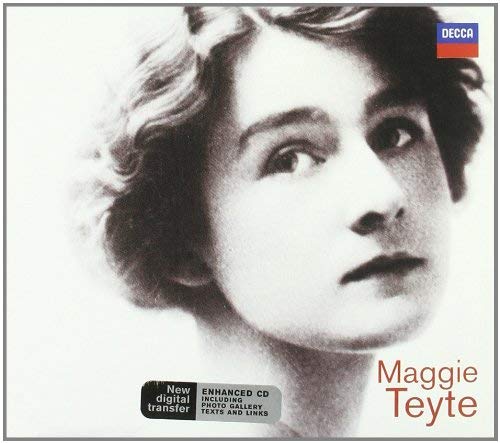
Maggie Teyte – The Singers

These recordings were all made in the 1930s and so pre-date the two disc set of French song I reviewed a few months ago here, with the second part of the disc being taken from a 1937 radio broadcast. One of the songs (Armstrong Gibbs’ The fields are full of summer still) was newly discovered in 2001 and first published on this CD.

We start with one of Dame Maggie’s most famous performances, that of Périchole’s Tu n’es pas beau, sung with great affection, a twinkle in the eye and with that wonderful dip into her inimitably glorious chest voice. Though a light soprano with pure, firm top notes, Teyte’s lower register was admirably rich and full in a manner we rarely hear today, more’s the pity. The orchestra here sounds like a palm court orchestra at a tea dance, but the singing is another matter entirely and alone well worth the price of the disc. The two excerpts from Messager’s Véronique, which follow are almost as good.

Teyte was particularly renowned for her interpretations of French song, but we are vouchsafed only two (very well known) songs from that field, Fauré’s Après un rêve and Hahn’s Si mes vers avaient des ailes. The Fauré is much better than the one on the French song disc mentioned above, where I felt she fussed with the song too much making it lose its natural flow, and the Hahn is as lovely as the later recording with Gerald Moore. These are followed by two Dvorak songs, Christina’s Lament, which turns out to be his Humoresque arranged for voice and piano, and the ubiquitous Songs my mother taught me, both beautifully sung.

These are followed by a group of songs from light musicals, mementoes of her days spent in British Music Hall. They may be musically slight, but Deep in my heart, dear from Romberg’s The Student Prince was actually one of Dame Maggie’s favourite recordings. It crests with a high B, which she thought the most beautiful note she had ever recorded. Certainly the note rings out clear and clean as a bell.

The lion’s share of the disc, however, is given over to a 1937 BBC broadcast recital, which couples popular songs by Schumann and Brahms to a group of English songs by turn of the century composers Quilter, Bridge, Delius, Armstrong Gibbs and (completely new to me) Amherst Webber and Graham Peel. As ever, the voice is bright and pure, her manner direct and disarming, her diction and intonation well-nigh perfect. Admittedly, there are aspects of her singing which some might find quaint and old fashioned today, but her technique is superb and her voice remained firm and clear well into her sixties.

Perhaps because of some of the material, this is not quite so recommendable as the EMI two disc set of French songs, but I would never want to be without it, if only for the wonderful aria from La Périchole.

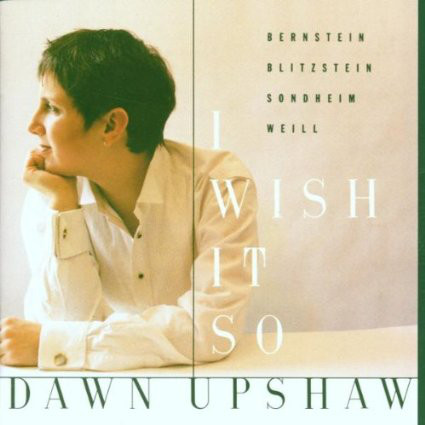
Dawn Upshaw – I Wish It So

r-6310834-1416165621-3533.jpeg

This collection of Broadway songs by Bernstein, Blitztein, Sondheim and Weil is an absolute delight from beginning to end.

Aside from Bernstein’s I feel pretty and, to a lesser extent, his Glitter and be gay none of the items here could be considered well-known and the choice of this particular quartet of composers, all of whom are connected in some way, is felicitous. Furthermore Upshaw’s clear, bright soprano and natural, unforced diction make her the ideal interpreter.

It is rare indeed for classical singers to embrace the idiom of Broadway without sounding self-conscious, but if you didn’t know better, (and I mean this in a positive way) you would never know that Upshaw was also an operatic artist of the first order. Many opera singers have tackled Bernstein’s Glitter and be gay, but none have ever, to my mind, challenged the original performer Barbara Cook, who not only manages to get round the notes, but really puts across the humour in the lyrics; none, that is, except Dawn Upshaw, who actually manages the coloratura with greater ease and beauty, but also points the lyrics with such ironic brilliance.

It is just one of the highlights in an album of sheer delights and I’d be hard pressed to find a favourite but there were many wonderful discoveries, among them Sondheim’s The girls of summer (1956) and the opening track, sung to just piano, Blitztein’s I wish it so from Juno (1959).

Only Glitter and be gay uses the original orchestration, but all the other arrangements are well done and the orchestra play excellently under Eric Stern, who himself was responsible for some of the orchestrations and provides the solo piano accompaniment on I wish it so.

I can’t recommend this disc too highly.

Modify message

Ljuba Welitsch – Complete Columbia Recordings

Ljuba Welitsch, for the short time her star was in the ascendant, was undoubtedly a star, glamorous both of voice and personality. Renowned the world over for her Salome, a role in which Strauss himself had coached her, she was also known for her Tosca and Donna Anna. Unfortunately she had developed nodules by 1953 and thereafter, though she didn’t retire completely, confined herself to character roles, like the Duenna in the Schwarzkopf/Karajan recording of Der Rosenkavalier.

This two disc set showcases her Salome, Donna Anna and Tosca, as well as Johann Strauss (the Czardas from Die Fledermaus and Saffi’s Gypsy Song from Der Zigeunerbaron). The rest is devoted to Lieder and songs by Brahms, Schubert, Schumann, Darogmizhsky, Mussorgsky, Marx, Mahler and Strauss, all with piano accompaniment, even the Vier letzte Lieder.

Whilst we get a good impression of the glamour and the silvery purity on high, the recordings do also rather show up her limitations. Best of the items is the 1949 recording of the Final Scene from Salome under Reiner, though, even here, I prefer the earlier performance she made under Lovro von Matacic in 1944, which, to my mind, has a greater degree of specificity. There is just the suspicion here that she had sung the role too many times; there is a touch of sloppiness in the delivery, which is complelely absent from the earlier recording.

She makes an appreciable Tosca, and something of her stage personality comes across here, but, I hear little of Callas’s detail or Price’s or Tebaldi’s vocal opulence and Tucker makes an unseductive Cavaradossi in the Act I Love Duet. A tendency to be careless of note values is even more evident in the Donna Anna excerpts, where we also become aware of an unwillingness to vary the volume or colour of her singing. She also has an annoying tendency to rush the beat. John Steane also had some misgivings in his book The Grand Tradition.

It is hard to think of a voice with a brighter shine to it, or of a singer with greater energy and more sense of joy in that sheer act of producing these glorious sounds. Even here, however, one notes that subtlety is hardly in question; there is little of the lithe seductiveness which Schwarzkopf and Güden bring to the [Fledermaus] Czardas, for instance. And this limits much of her best work, even the Salome in which she made such an exciting impression on her audiences.

We also note the complete absence of a trill in both Donna Anna’s Non mi dir and the Czardas from Die Fledermaus.

These limitations are even more evident in the songs with piano, and, though there is still much to enjoy in disc one, I found much of disc two something of a trial to listen to, the voice just too bright and unrelentingly mezza voce. The Strauss Vier letzte Lieder can work with piano, as witness a recording by Barbara Bonney, but here I just longed for the greater subtlety and range of expression of Schwarzkopf or Popp, of Norman or Fleming. The Mahler had me thinking of the shattering Lorraine Hunt Lieberson in the piano accompanied version, and the Schubert and Schumann songs hardly begin to challenge versions by a range of different sopranos from Welitsch’s time onwards.

If I were to choose but one representation of Welitsch’s art, it would absolutely be the 1949 live recording from the Met of Salome under Reiner, but, for a recital I’d go for EMI’s old LP and CD transfer of the 1944 Salome Final Scene, which also has on it a glorious version of Tatyana’s Letter Scene from Eugene Onegin, a disc I reviewed a couple of months back here. This present two disc set is, I’m afraid, a mite disappointing.

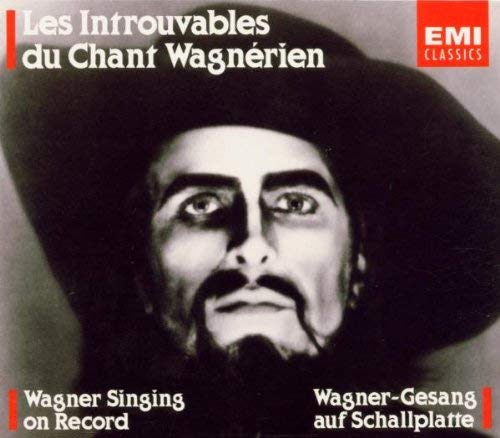
Les Introuvables du Chant Wagnérien

51uikdgjmsl._ac_

What a treasure trove of great singing this is! Indeed four well filled discs of absolutely amazing singing.

The layout pretty much makes sense too. Disc one is given over to Der fliegende Holländer and Die Meisteringer von Nürnberg, disc two to Tannhäuser and Lohengrin, disc three to Tristan und Isolde, Parsifal, Das Rheingold and Die Walküre and disc four to more from Die Walküre, plus Siegfried and Götterdämmerung. No texts and translations, but detailed information on the recordings and biographical notes on all the singers.

With a few exceptions (Birgit Nilsson and Hans Hotter in Wie aus der Ferne from Der fliegende Holländer recorded in 1957, Lotte Lehmann singing Euch Lüften from Lohengrin in 1948) all these Wagnerian excerpts were recorded in a relatively short period of time between 1927 and 1942; a mere fifteen years, with the majority taken from the 1930s. It rather puts paid to the lie that, when comparing singers of today to those of the past, people are drawing from a much greater time period. How many singers active between 2004 and today can compare with the illustrious voices we hear on these discs?

Only Marta Fuchs, singing Senta’s ballad in 1940 gave me limited pleasure, especially when set next to ELisabeth Rethberg’s 1930 account which follows. There are some famous names here of course, like Frida Leider, Kirsten Flagstad, Lauritz Melchior, Friedrich Schorr, Alexander Kipnis, Meta Seinemeyer and Elisabeth Rethberg, but some of the less well known names are still startlingly good, for instance Florence Easton and Walter Widdop gloriously ringing and firm toned as Brünnhlide and Siegfried in the Prelude from Götterämmerung. The warm voiced Marjorie Lawrence’s career was mostly confined to France and it is in French that she sings a wonderfully malevolent Ortrud, with Martial Singher as Telramund. Though she also sang other mezzo roles, like Brangäne, she is a superb Brünnhilde in both Die Walküre and Götterdämmerung, again in French, singing with rich, beautiful, unforced splendour throughout her range. Her Immolation scene is quite one of the best I have heard.

There are other fine examples of Wagner in the vernacular. Again in French we have Arthur Endrèze as the Dutchman, Georges Thill and Germaine Martinelli as Walther and Eva and Germaine Lubin as Brünnhilde, and in Italian we have Aureliano Pertile (Lohengrin’s Nun sei bedankt) and Hina Spani (Elsa’s Euch Lüften).

There are some well known names among the conductors too, like Leopold Ludwig, Albert Coates, Sir John Barbirolli, Sir Thomas Beecham, Eugène Bigot, Rudolf Moralt and Leo Blech etc and indeed there is hardly a track that doesn’t have some interest.

Only the 1957 Holländer duet is in good stereo sound (Nilsson’s top notes bursting forth from the speakers like laser beams) but few allowances need to be made for the recorded sound, and one’s ears quickly adust.

Anyone with an interest in Wagner and/or singing needs to have this set in their collection. Both as a historic document and a source of great listening pleasure, it is absolutely essential.

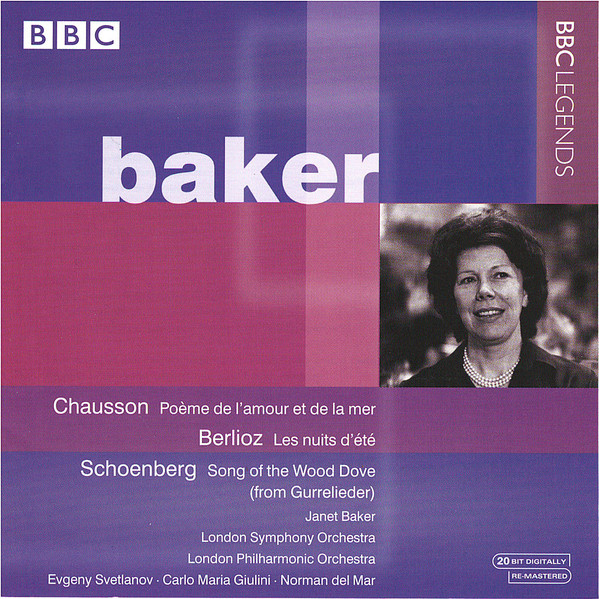
Janet Baker – Chausson, Berlioz and Schoenberg

r-9879493-1487856491-9833.jpeg

These are all live performances of material Baker recorded in the studio (twice in the case of Les Nuits d’Eté, so one might wonder if they are really essential listening.

Well, though Baker was a superb recording artist, who never really made a bad record, she was also a great communicator and collaborator and these performances, all with different conductors from the studio ones, bring with them the added frisson that comes with a live event, and the sound, though not as clear as in her studio performances, is more than acceptable.

It starts with a 1975 performance of Chausson’s almost Wagnerian Poème del’amour et de la mer, which she recorded two years later under André Previn. This one has, somehwat suprisingly you might think, Evgeni Svetlanov at the helm, who takes great care over dynamics and shapes the work beautifully. Baker’s range of expression, her concenration, her breath control and command of the long line are exemplary, filling its pages with rapt expression. A marvelous performance.

Baker’s recording of Les Nuits d’Eté with Barbirolli, recorded in 1967 is justly famous and has hardly been out of the catalogue. She recorded it again under Richard Hickox in 1990, but by this time her voice was beginning to show signs of wear (more noticeable in a recording than when I heard them perform the work together in concert at around the same time) and the second recording has never enjoyed the acclaim of the first. This performance under Giulini was taped at the Royal Festival Hall a month after the Chausson and it is good to hear how Baker’s interpretation changed depending on whom she was singing with. Giulini’s speeds are expansive (Le spectre de la rose at 8’29” must be one of the slowest on disc) and would tax most singers beyond their limits, but here they never flag and Baker luxuriates in the extra room she is given to make her interpretive points. As in the Chausson, her breath control is astonishing and the range of expression wide. My notes are peppered with words like searing, delicate, passionate abandon, yearning. Though it doesn’t entirely supplant the Barbirolli in my affections, it is nonetheless a performance I would never want to be without.

The earliest performance here is a 1963 recording of the Song of the Wood Dove from Schoenberg’s Gurrelieder, a work she recorded five years later under Janos Ferencsik. Baker was not yet 30 when she gave this performance and, superbly supported by Norman Del Mar, her singing is urgently free and impassioned, even better than that on the Ferencsik.

Essential listening then? Absolutely and unequivocally, yes.

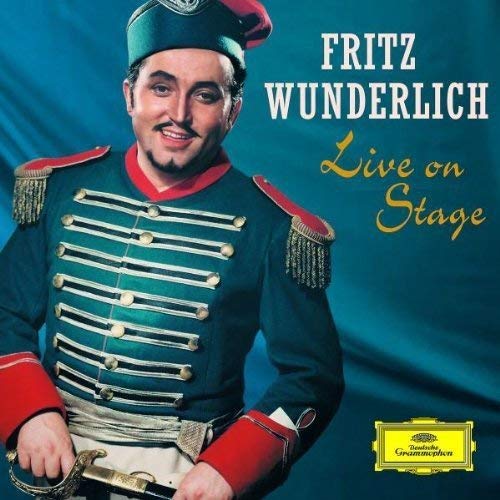
Fritz Wunderlich -Live on Stage

51o63rchccl._ac_

This issue passed me by when it was first released in 2010, but what a treasure it is. Always a pleasure to hear Wunderlich’s glorious tenor, here we have the added frisson of hearing him live in the opera house.

His Tamino is well known from the Böhm recording. These excerpts are taken from a 1964 Munich performance, where he is joined by Anneliese Rothenberger as Pamina and Karl-Christian Kohn as Sarastro under the baton of Fritz Reiger. As on the Böhm recording, he is an ardently lyrical but also heroic Tamino and remains my touchstone for the role. Don Ottavio’s two arias from a performance of Don Giovanni, conducted by Karajan in 1963 are also superb and Ottavio emerges as a more positive character than he often does, benefiting from Wunderlich’s golden tone, his superb breath control and ease of movement. Not surprisingly his singing of Il mio tesoro is given a fabulous reception. As in the Jochum recording he is also an ideal Belmonte in Die Entführung aus dem Serail.

The excerpts from Il Barbiere di Siviglia, with Eberhard Wächter as Figaro, are unfortunately sung in German, but the language does not impede Wunderlich’s superb legato, nor the warmth of his tone, and we get to hear his wonderfully light touch in comedy. He is notably more fluid in fast moving music than Wächter, but the two singers play well off each other.

For me, though, the Strauss items are the biggest eye opener. I feel sure that, had Strauss heard them, it would have reconciled him to the sound of the tenor voice. The duet for the Italian Singers in Capriccio (with Lucia Popp, no less) has probably never sounded more gloriously, well, italianate, so beautiful that it elicits a spontaneous round of applause from the Vienna audience. The same could be said for his singing of Di rigori armato from Der Rosenkavalier, which is sung with burnished tone. I doubt any Italian tenor could sing it better. So too, in the excerpts from Daphne and Die schweigsame Frau his liquid legato stays in tact, however tough the going. Did Wunderlich ever make an ugly sound? Somehow I doubt it. Truly he was a prince among tenors.