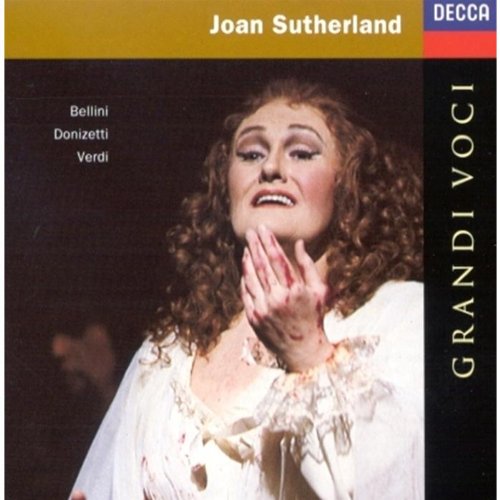
Renata Scotto sings Verdi


When this recital first appeared in 1975, Scotto had been absent from the catalogues for some time. She was principally known on record for her Butterfly under Barbirolli (recorded for EMI in 1966) and for Mimi, Violetta, Gilda and Lucia (all recorded in the early 1960s for DG).

Butterfly was her calling card for many years, and the recording has remained one of the most recommendable (though, save for Liu in the Molinari-Pradelli Turandot, recorded in 1961, she appears not to have made any further complete opera recordings for EMI until she recorded Abigaille under Muti in 1977).

She first made her mark deputising as Amina in Edinburgh for Callas, who, in poor vocal health at the time, had refused to sing an extra uncontracted performance that La Scala had tried to thurst upon her. That was in 1957 and it would appear that, though she had considerable success on stage, recording companies were not so quick on the uptake. She herself has admitted that she could be a bit prima donna-ish in a “my way or no way” sort of manner, until she met her husband, Lorenzo Anselmi, who, according to Scotto, helped her to become more professional, and think more about the music.

She was at first known as a coloratura, but even in the early 1960s, John Steane notes that her high notes did not seem to come easily and could have a hard and pinched quality. She also had a great success as Butterfly, the role in which she had made her Met debut, but it soon became clear that this was the only repertoire Bing would call on her for. He refused to offer her anything else so she was absent from their schedules for a long time, returning in 1974 to sing Elena in I Vespri Siciliani, under Levine who became her champion. For many years, she was the Met’s house soprano, singing a completely new repertoire, which included Verdi roles like Leonora in Il Trovatore, Desdemona, Luisa Miller and Lady Macbeth.

This Verdi recital also marked the beginning of a new, fairly intensive recording schedule for her. In the ten years since her recording of Madama Butterfly the hardness on top has become more noticeable, and many of the louder notes above the stave are quite strident. There are however compensations in her musicality, her dramatic awareness, her deep legato and the firmness of the line. Then there is the added attraction of her attention to detail and her intelligent use of the words, though occasionally there is a lack of spontaneity. Art does not always conceal art.

There is a good mixture here of the familiar and the not so well known. In the former camp would be Lida’s aria and cabaletta from La Battaglia di Legnano, a fairly conventional piece whose cabaletta is nonetheless energetically exciting, and which Scotto attacks head on. There is a slight suspicion that the voice is a little small for the other early works here (Nabucco and I Lombardi), but she has an innate feeling for Verdian style and the cavatinas of both are beautifully moulded, the cabalettas propulsive and exciting. The voice takes on a lovely melancholy tinta for Elena’s Arrigo, ah parli a un core, which lies mostly in the middle register, though she eschews the written low F# in the cadenza, taking a higher alternative, and sings a bright and breezy Merce, dilette amiche. Best of all, probably because neither takes he much above the stave, are Violetta’s Addio, del passato, the reading of the letter absolutely heart-wrenching, and Desdemona’s Willow Song and Ave Maria, which is alive to every dramatic contrast, her singing full of anxious foreboding. Soon after this she would make a most touching Desdemona both on stage at the Met and on record in Domingo’s first recording.

Some may prefer a richer voice for this music, but few who are more vocally endowed sing with such specificity, such attention to the meaning of the text, such musicality and appreciation of Verdian style. Where other sopranos, like Souliotis and Sass, can be accused of being copycat Callases, Scotto can be said to have absorbed the lessons of Callas without losing her own individuality. This is a very good recital.
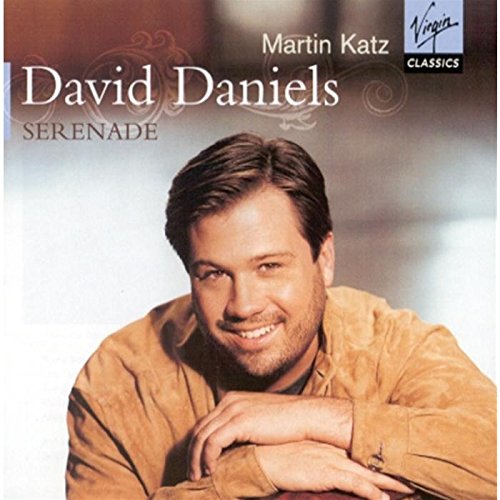
David Daniels – Serenade

Quite aside from David Daniels’s pre-eminence as a Handel singer, he could also be credited with treading where few countertenors dare to go. In this mixed recital he adds to the more usual countertenor repertoire of seventeenth and eighteenth century song, Lieder by Beethoven and Schubert, French chanson by Gounod and Poulenc and English song by Vaughan Williams. Other recitals will see him venturing out into American song and Broadway, and he even made a recording of Berlioz’s Les Nuits d’Eté. He has never been one to cofine himself to the usual areas of countertenor repertory.

To all he brings great beauty of voice, a superb legato and a fullness of tone rare in countertenors, and an innate musicality. This fullness of tone is not a mere fabrication of the gramophone as I saw him live on many occasions and can attest that the voice rang out freely in all the venues I heard him. In addition he has a winning personality with a rare gift of communication, which comes across in all his discs.

Many of the songs here are concerned with night (the disc, after all is called Serenade) and the pervading atmosphere is therefore one of quiet reflection, but gaiety puts in an appearance too, and we note the singers facility in fast moving music, without a hint of an aspirate. We also note how the singer’s expression changes from one song to another, making us feel we can see as well as hear.

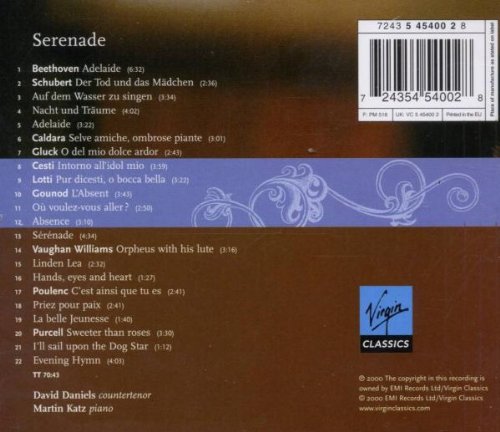
We start with a group of Lieder framed by Beethoven’s and Schubert’s setting of Adelaide, both beautifully sung. He gives the girl’s voice a suitable urgency and death a darker more consolatory tone in Der Tod und das Mädchen, but the prize of this group is his wonderful performance of Nacht und Träume, his legato impeccable , the long line firmly held. This is beautifully ccomplished singing and absolutely no allowances need to be made for the limitations of the countertenor voice.

From here we move to a group of songs by Caldara, Gluck, Cesti and Lotti, the more usual repertoire for this type of voice. Caldara’s Selve amiche soothes the soul, whilst Lotti’s Pur dicesti, o bocca bella is irresistibly light and charming. The Gounod and Poulenc items are all superb, the Vaughan Williams beautifully characterised, finishing with a movingly heartfelt Hands, eyes and heart.

The final items bring us back to more familiar countertenor territory, with joyful performances of Sweeter than roses and I’ll sail upon the Dog Star, followed by an eloquently comforting Evening Hymn, which brings to a close an eminently satisfying recital. Martin Katz is throughout a worthy partner.

As I said earlier, I saw Daniels live on many occasion, and this recital replicates to perfection what it was like to hear him in the concert hall. There was never any difficulty hearing him and he had the rare ability of drawing the audience in, of making each person feel he was singing just for them.

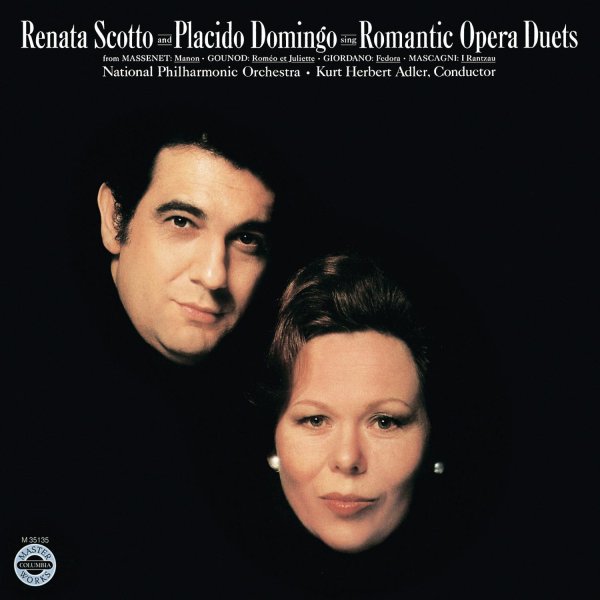
Romantic Opera Duets – Placido Domingo & Renata Scotto

Domingo recorded quite a few duet recitals in the 1970s, with Sherrill Milnes (1970), with Katia Ricciarelli (1972), with LeontynePrice (1974) and this one, with Renata Scotto, in 1978, which is, in many ways, the most successful.  For a start, the material is refreshingly unhackneyed, and, although we are vouchsafed only four excerpts, they are quite long (the shortest 8’52”), which makes for a more satisfying listening experience than lots of shorter pieces. The original LP had the French items, which are no doubt better known on the first side and the Italian ones on the second.

Scotto was at the high watermark of what was often referred to as her second career. In the 1960s she had recorded for EMI and DG, but signed to CBS/Sony in the 1970s appearing on many complete sets and recording recitals of Verdi and verismo. The voice was never a conventionally beautiful one and by this time could turn squally and shrill on top notes, but the compensations were many and included her superb musicality, her dramatic involvement, her attention to the text and her natural, unforced, excellent diction. As you can hear here, her French was less idiomatic than her Italian but you can at least hear the words clearly, and it is the French items I enjoyed most on this recital, though that could possibly reflect my preference for the material in question. I’ve never been a big fan of verismo.

Domingo is his reliable self, the voice in good shape, but at this time in his career his performances could seem a little generic, and there is not much difference between his Roméo and his Des Grieux, his Loris and his Giorgio, however musical his actual singing.

Both singers are attentive to the different styles required of the composers in question, but it is Scotto who is better at vocal characterisation, adopting an appropriately more seductive tone for Manon than she does for the girlishly innocent Juliette.  Her Fedora also sounds more mature and commanding than her Luisa in the Mascagni opera, which is a sort of verismo mirror piece to Gounod’s Roméo et Juliette.

All in all, this is a very enjoyable duet recital, both in terms of the singing and the music tackled, and it is an excellent showcase for both singers.

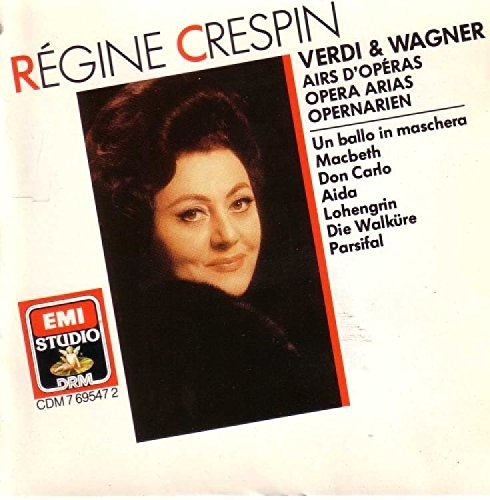
Régine Crespin – Opera Arias

515e7rsmu3l

When I think of Régine Crespin I tend to think of suave sophistication, intelligence and cool reserve, qualities that make her the perfect interpreter of the songs of Debussy and, especially, Poulenc and Ravel. But of course it was a large, refulgent voice and not one to be confined to the recital platform. The operatic stage would also seem to be its natural home.

Unfortunately too much of this French sang froid creeps into her performances of Verdi here. This Amelia is only slightly perturbed to find herself at the gallows at midnight, this Aida only mildly conflicted between loyalty to her lover and her fatherland. One feels that she wouldn’t want to get too upset in case she mussed her dress and beautifully coiffed hair, so just shrugs and walks away. In this she is the very antithesis of Callas who, famously, listened to this performance of Ritorna vincitor in a break during tense recording sessions of her final Verdi disc. Callas was so insensed at a performance that went against every grain of her dramatic being that she decided to sing it there and then, though the aria hadn’t been planned, and the result was a performance of blazing intensity a million miles from what we get here. Aside from being far too slow, Crespin never really gets to grips with Aida’s torment and anguish.

Of course Crespin’s singing is always musical, intelligent and well considered, the voice firm and well supported, but, for me, there is a lack of passion, a sense of detachment that doesn’t go well with Verdi. There are quite a lot (a surfeit?) of interpretive ideas in Lady Macbeth’s Sleepwalking Scene, but it is taken unconscionably slowly, and though her tone well captures the feel of a woman  walking and talking in her sleep, the whole scene falls apart at such a slow tempo. The music is over-inflected and conseqently unoconvincing.  She takes a lower option at the end rather than attempt the top D fil di voce, and we note that the top of the voice can be unwieldy, steely and just under the note, as it is at the climax of Amelia’s Ecco l’orrido campo from Un Ballo in Maschera. In that respect Eboli’s O don fatale suits her better, and she does at last inject a bit more passion here, but the aria should be thrilling and it just isn’t.

Paradoxically Elisabetta’s great Act V aria from Don Carlo is taken rather too fast, and I also wonder why she didn’t sing it in French. In consequence the grand opening statement feels rushed, as does the end, and the aria loses its shape. This might have more to do with Prêtre than Crespin, whose speeds can be a bit hit and miss, and nowhere does he seem the right conductor for Verdi. It is interesting to note that, though he was a great favourite of Callas, she retained the services of Nicola Rescigno for her 1960s Italian recitals, using Prêtre only for the French recitals and her Carmen and second Tosca.

In general the Wagner items suit her better, though here too I would prefer to hear Schwarzkopf or Grümmer in the Lohengrin arias. Crespin convincingly conveys Elsa’s deam-like state, but she is far less personal with the text. There is no quickening of the pulse at the approach of the knight, and, yet again, it feels as if she were on the outside looking in. Her singing is tasteful, intelligent, musical and yet I don’t feel she is truly involved.

We get more propulsive singing for Sieglinde’s Eine Waffe lass’ mich dir weisen, and of course she recorded the role in Solti’s Ring. She also makes a suitably seductive Kundry in the short extract from Parsifal.

That said, none of this is material I would choose to hear her in. For that I would turn to her superb performance of Ravel’s Shéhérazade with Ansermet (though not her Nuits d’Eté which also suffers from a lack of passion), to her singing of songs by Poulenc, Debussy and Satie and to some of the operettas of Offenbach that she recorded, music that responds better to her equivalent of the arched eyebrow.

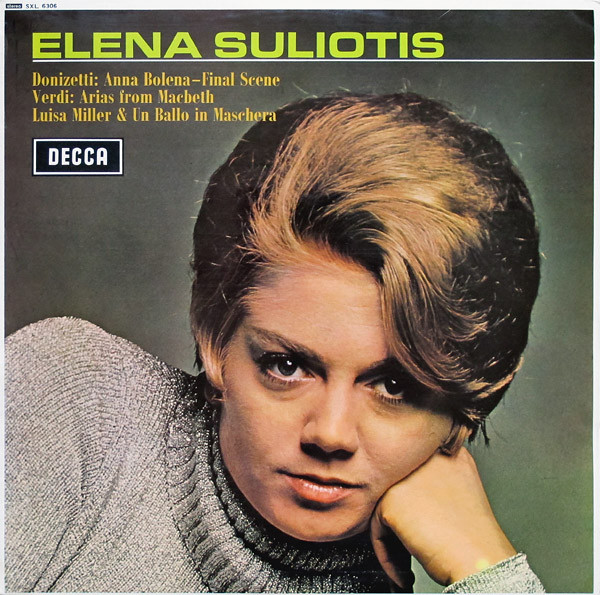
Elena Souliotis Opera Recital

r-5556117-1396449633-1748.jpeg

In 1965 Elena Souliotis burst into the operatic firmament like a shooting star. The star’s trajectory was swift and by 1971 it had pretty much burned itself out. In fact the recordings she made for Decca pretty much sum up the path of Souliotis’s career. The best of them are the 1965 recording of Nabucco under Gardelli, made when she was only twenty-two, and this recital disc made the followiing year. By the time of the recording of Macbeth, made in 1971, she was sung out, and it is salutory to compare the recording of Lady Macbeth’s opening aria heard here to the one on the complete set. The problems hinted at in the recital (the occasionally unsupported middle voice, the chest voice and upper registers not properly integrated) have now become major issues. Her voice aged twenty years in five. Macbeth was the last major recording she made for Decca, though she did pop up again in 1991, singing the Zia Principessa to Mirella Freni’s Suor Angelica. Hearing the two singers together, you would never for a minute think that Freni was the older singer.

But back to the recital in question, and listening to it now, even with the benefit of hindsight, it is easy to understand why she created such a stir at the time. It was becoming obvious that Callas was leaving the stage (indeed she made her last ever stage appearance in 1965) and people were looking for a singer of comparable dramatic flair. Souliotis, spelled Suliotis back then, certainly seemed to fit the bill. It was not a plush voice, but had a penetrating thrust and power, good flexibility and she sang with real dramatic conviction.

The first item, and the first side of the orignal LP, is the closing scene from Anna Bolena, a Callas speciality, and one would have to admit that there are times that she sounds as if she is ghosting the performance by the older singer. On the debit side also is her lack of a trill. The cabaletta is famous for a rising series of trills, delivered with incredible accuracy and tremendous force by Callas, but Souliotis doesn’t even attempt them. Aside from these flaws, though, the performance is alive to the drama, the melismas in the cavatina beautifully spun out, and the cabaletta thrilling in its rhythmic thrust. Callas may still reign supreme, but I’d still rate this performance more highly than those by Sills, Sutherland, Caballé and Gruberova.

Next up is Lady Macbeth’s entrance aria, which is thrilling, if a little vulgar. Comparisons with Callas are again inevitable, and it has to be said that in Callas’s performance, particularly in the complete live recording under De Sabata, we get a greater sense of Lady Macbeth’s vaulting ambition. Her chest voice is also better integrated, whereas with Souliotis it tends to be a feature unto itself. I like the Luisa Miller aria, though a little too mich of Lady Macbeth creeps in and she tends again to overdo the chest voice. On the other hand, Morro, ma prima in grazia from Un Ballo in Maschera is feelingly sung and actually quite beautiful.

Still, there is the overriding sense that, though there is enormous potential here, this is a voice that is as yet unformed. Singing so many performances of Abigaille at the tender age of twenty-two can’t have been good for her. Callas sang the role only once, at the age of twenty-six, but never touched it again, calling it a voice-wrecker. Maybe she was right. The role’s creator, Giuseppina Strepponi, who became Verdi’s mistress and later his wife, also sang the role a great deal and she was also sung out by the time she was thirty-one.

Eleanor Steber sing Les Nuits d’Eté

51xnjtg5rpl

Berlioz’s Les Nuis d’Eté has always been a favourite work of mine. I have ten recordings and have heard quite a few more and this famous recording, one of the earliest, made in 1954, has always rightly been considered one of the best.

The voice itself is a beautiful one, firm and even throughout its range,and she is thoroughly in control of its resources. There is a great deal of pleasure to be had merely from the sound of the voice and the way she weights and measures phrases, but she is also keenly responsive to the poetry, ideally melding the needs of the musical line to the meaning of the words.

True, Villanelle has always seemed a tad too slow to me, a little lacking in gaiety, but it is close to the metronome marking of crotchet = 96, so perhaps the fault lies with Mitropoulos, who fails to make the woodwind light enough. Elsewhere he provides excellent support and speeds are judiciously chosen.

The rest of the disc is taken up with more Berlioz (beautifully sung performances of La Captive, Le jeune pâtre breton and Zaïde conducted by Jean Morel) and orotorio arias by Bach, Handel, Haydn and Mendelssohn. True, these latter, conducted by Max Rudolf, have a slightly old-fashioned, somewhat Victorian air about them, but they are impeccably sung and her diction is exemplary. These were recorded a few years earlier, in 1951, and the voice is at its freshest and most beautiful.

The disc comes with copious notes and photos, but, regrettably, no texts and translations.

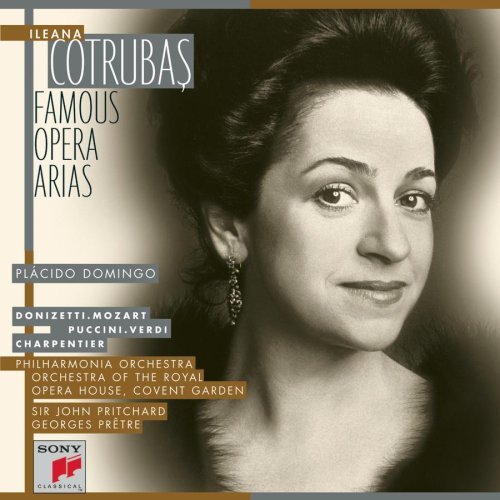
Cotrubas sings Famous Opera Arias

51wbqsfxw6l


Recorded in 1976, when she was already 35, this was Ileana Cotrubas’s first and only recital disc. The playing time of the original disc being somewhat short, Sony have here added excerpts from the excellent complete recording of L’Elisir d’Amore also under Sir John Pritchard, Depuis le jour, from the complete Prêtre recording of Louise and O mio babino caro from Maazel’s Gianni Schicchi.

As Cotrubas herself says in the notes, Leonora’s Pace, pace was somewhat unexpected, a role that Cotrubas was never likely to sing on stage, and it really does need a fuller tone. I’m not sure if she ever sang Liu or Magda, but she could well have done and the other arias are all from her active repertoire.

It opens with a charming performance of Norina’s Quel gaurdo il cavaliere from Don Pasquale, a role she sang at Covent Garden at around the same time. She was a highly successful Susanna at Glyndebourne in 1973 (alongside Te Kanawa’s beautiful Countess and Freredica Von Stade’s radiantly ebullient Cherubino, performances which catapulted all three to stardom) and she is quite delightful in her Deh vieni.

The other side of her personality is captured in a deeply felt Ach ich fühl’s, and the natural morbidezza (an Italian word without any direct translation) which suited her to roles like Mimi and Violetta, is here displayed in her singing of the Puccini arias (Si, mi chiamano Mimi, Liu’s Tu, che di gel sei cinto, and Ch’il bel sogno di Doretta from La Rondine.) Though there is a hint of strain in the upper reaches of Gilda’s Caro nome, the aria also suits her well, and it here emerges as a dreamy reverie rather than the coloratura showpiece it often is.

The L’Elisir d’Amore excerpts are lovely in every way, as is Lauretta’s O mio babino caro, and Depuis le jour well captures Louise’s quiet intensity and mounting rapture.

A lovely memento of a well-loved artist.

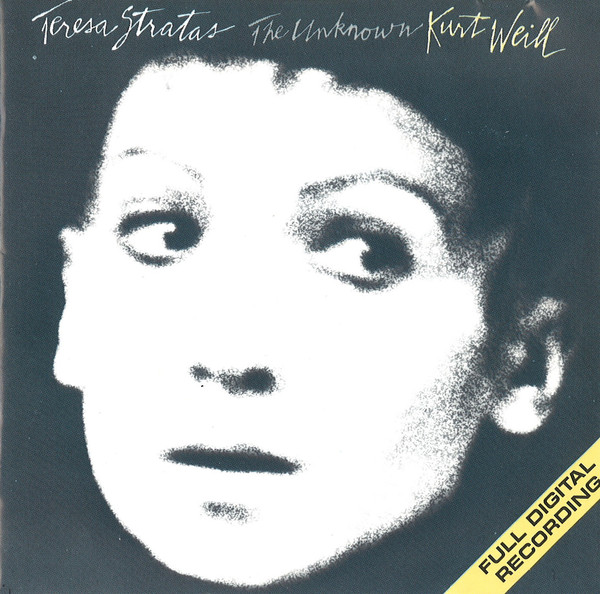
Teresa Stratas singing Weill

It was in 1979 that Kurt Weill’s widow, Lotte Lenya, saw Stratas singing the role of Jenny in The Rise and Fall of the City of Mahoganny. Knocked out by Stratas’s performance, she called her her “dream Jenny”, and afterwards she wrote to her, “nobody can sing Weill’s music better than you do,” and offered her a number of unpublished songs that she had closely guarded since Weill’s death in 1950.

The result was the first of these two discs, recorded in 1981, in which Stratas sings a collection of songs to piano accompaniment by Richard Woitach. Unfortunately, for the CD release, Nonesuch omitted the lyrics and translations that were included with the original LP, and what notes that remain are in minuscule print, almost too small to read without a magnifying glass. This seems little short of a crime, given Stratas’s vividly dramatic performances. Even without the aid of translations you can get a gist of their meaning, but how much more satisfying the disc would be be if we knew exactly what she was singing.You might be able to find texts and translations of some of them by scouring the internet, but it’s a long and arduous task.

Most people had no doubt got used to Lenya singing Weill’s songs in her gravelly baritone, but, as Lenya herself pointed out, her voice dropped over the years, and Stratas was performing them in the original keys. That said, most of these originally written for cabaret, had hardly ever been performed since and were here receiving their first recordings, though they are much better known now, and Weill selections have appeared from artists as diverse as Anne-Sophie von Otter and Ute Lemper.

Teresa Stratas was 54 at the time of the first recording. She had made her professional debut at the age of 20, joining the Met company the following year (1959), becoming a Met favourite until her final performance there in 1995 (in the role of Jenny in The Rise and Fall of the City of Mahoganny). The voice can be termed useful rather than beautiful, and, though a diminutive figure, she had a powerful stage presence, great personal beauty and was a superb actress. This might explain why she made comparatively few recordings, the most famous probably being Pierre Boulez’s recording of the completed Lulu, a role she had made her own in the Paris premiere. Beautiful or not, it was the perfect instrument for Weill’s songs, which rely on expression rather than beauty of tone.

Favourites for me here are the two settings of the same melody, one French, one German Wie lange noch and Je ne t’aime pas, the two Propaganda Songs Buddy on the Night Shift and Schikelgruber, and the glorious Youkali. Though the second disc is enlivened by the orchestral accompaniments, I have a special affection for the more intimate piano settings.

This second disc appeared four years later, and is more far reaching, though much of the material was more well known. The Y Chamber Orchestra under Gerard Schwarz has an undeniable whiff of a theatre orchestra about it, which is perfect for the material. The songs are taken from Broadway musicals, and both German and French theatre works. Texts and translations are at least included, though print is again minuscule.

Stratas’s range is formidable. Though capable of the “Brechtian bark” we are probably more used to, it is bound into the fabric of her performance, as is the full operatic soprano at key moments. Consequently not only do we get the full meaning of the lyrics, but the lyricism of Weill’s writing is revealed to a much greater extent. Take the most famous song on the album, Surabaya Johnny, which emerges almost as a mini psycho-drama for solo performer. Her French and German are both impeccable, her command of the Broadway idiom just about perfect (a few years later she was to record the role of Julie in John McGlinn’s first ever complete recording of Jerome Kern’s Showboat). One of the most glorious performances is of Lonely house from Street Scene, which is swirlingly lyrical with an aching loneliness.

Both discs are an absolute must.

Joan Sutherland – Grandi Voci

51sshvna3-l

On 17 February 1959, Joan Sutherland sang her first Lucia di Lammermoor at Covent Garden. She had first been engaged at Covent Garden in 1952, singing small parts, such as Clotilde to Callas’s Norma. That same year she sang her first leading role there (Amelia in Un Ballo in Maschera), but the administration didn’t at first realise her potential and the roles she sang (Agathe, The Countess, Desdemona, Gilda, Eva, Pamina, Lady Rich in Gloriana and Jennifer in Tippett’s The Midsummer Marriage) gave no real indication of the direction her career would take. She herself had thought she would be a Wagnerian soprano, but Richard Bonynge, who married her in 1954, eventually convinced her otherwise, and in 1959 Covent Garden gave her the honour of a new production of Lucia di Lammermoor, directed by Franco Zeffirelli and conducted by Tullio Serafin. Sutherland proved a sensation, and, at the age of 35, she became a star, in demand all over the world for dramatic coloratura roles.

This disc adds to her debut recital, made shortly after the Covent Garden Lucia, two arias from one of her most successful sets The Art of the Prima Donna (Casta diva and the I Puritani Mad Scene), recorded in 1960 and Santo di patria, lifted from another set The Age of Bel Canto, recorded in 1963.

Those who know me will know I am not much of a Sutherland fan. The mannerisms (the mushy diction especially, the droopy portamenti, the weak lower register) that crept in as early as the 1960s irritate me so much I find it hard to listen, and the beauty of the voice is no compensation.

It is good to be reminded, then, that it was not always so, and she sounds quite different here, the voice much more forwardly produced, and, even if she rarely uses the words to suddenly bring a phrase into sharp relief, there is nothing much wrong with her diction in these discs. Maybe this has something to do with the conductors she was working with then, all Italians, Nello Santi for the debut recital, Francesco Molinari-Pradelli for The Art of the Prima Donna, Tullio Serafin at Covent Garden. Interestingly Serafin advised her to study the role of Lady Macbeth, but Bonynge obviously thought otherwise.

The main meat of the disc, however, is that first ever recital made with the Paris Conservatoire Orchestra under Nello Santi. Lucia’s two big solos were an obvious choice, to which are added Merce, dilette amiche from Verdi’s I Vespri Siciliani, Ernani! Ernani involami from Ernani and O luce di quest’anima from Donizetti’s Linda di Chamounix.

Throughout the technical command is stunning, as is the beauty of voice, the top notes, of which there are many, one of its greatest glories. Nor is she just a technical machine. Though there is little attempt at vocal characterisation (Norma doesn’t sound much different from Lucia), she is not an unfeeling singer. There is command in Norma’s Sediziose voce, poetic feeling in the recitative to the Ernani aria, breezy grace in the aria from I Vespri Siciliani.

Fresh from the success of the Covent Garden performances, the Lucia arias are predictably best of all. Here not only is the execution vocally stunning, but she is the very epitome of the young Romantic heroine, driven mad by despair. Like Callas, she is a far cry from the piping, doll-like sopranos who had made Lucia something of a laughing stock among opera cognoscenti. Unfortunately already by her first complete recording of the opera made in 1961, the tone has become more occluded, the diction less precise, the vowels begin to be rounded and dulled, and the vitality and immediacy heard here starts to droop.

Though vital and alive in the scene from Verdi’s Attila, conducted by Richard Bonynge, the diction is not as clear as it is on that frst recital, though the recording here does give some indication as to the size and fullness of the voice. Even with that small niggle about the diction, this is still a stunning performance, thrilliingly dramatic, and I’ve never heard it better sung. Deutekom on the Philips complete set is pallid by comparison.

This disc, along with The Art of the Prima Donna, is, I would suggest, essential Sutherland, and remain permanent parts of my collection. The rest, personally, I can live without.

José Carreras – My Barcelona

Well this is something of a hotch potch, no doubt explained by its provenance – music included in the 1991 documentary film made after his recovery from leukemia My Barcelona, a celebration of the unique relationship between the man and the city of his birth.

What we get is a mixture of operatic arias, popular song and excerpts from Ramirez’s Navidad Nuestra and Misa Criola, which, surprisingly perhaps, makes for a pleasantly varied disc.

No great revelations, I suppose. Carreras is at his honeyed best in Cavaradossi’s E lucevan le stelle from the 1976 Davis recording of Tosca, a performance of poetic beauty, made before some of the heavier repertoire he essayed took a toll on his essentially lyric tenor, but most of the selections give pleasure. I particularly enjoy his version with piano of Mompou’s haunting Damunt de tu només los flors and the Ramirez pieces are also great fun.

An undemanding but enjoyable disc.