Reflet – Sandrine Piau sings French orchestral songs

81uc3fhnuwl._ac_sl1500_

I know Sandrine Piau principally as a singer of Baroque and Classical music, but she has recently been venturing into the nineteenth and twentieth centuries and this is the second disc in a series, which began with a disc of orchestral songs by Strauss, Berg and Zemlinsky entitled Clair-Obscur. The notes accompanying the disc tell us that that earlier disc sought to explore “the confrontation between shadow and light,” whilst this one “evokes the nuances and transparencies of the French mélodie.”

Essentially what we have here is a nicely put together programme of French orchestral song, starting with Berlioz and taking us through to Britten’s early Ravelian Quatre chansons Françaises via Duparc, Koechlin, Debussy and Ravel himself. The programme is not long (under an hour) and is fleshed out with André Caplet’s orchestration of Debussy’s Clair de lune and Ernest Ansermet’s of the sixth of his 6 Epigraphes antiques. Admirably as the orchestra plays throughout under Verdier, these add very little to the programme and I would have welcomed more songs, maybe something by Chausson, Delage or Canteloube, or more by Koechlin, who is not so well represented in the catalogue. If I’m honest, I prefer the Debussy items in their original piano guise. Unlike Ravel’s orchestrations of his own piano pieces, the arrangements don’t really improve on the originals.

The Koechlin songs were new to me, and I rather wish Piau had explored more than the three we have here. If they pique your curiosity, as they did mind, then they are available sung by Juliane Banse, along with a lot more of Koechlin’s vocal works with orchestra, in a two disc set in Hänssler’s Koechlin edition. What we have here is two songs from his early 4 poèmes d’Edmond Haraucourt. Op.7, and one from the slightly later 3 mélodies, Op. 17. If they lack some of Duparc’s natural melodic gift, they are nonetheless lushly orchestrated and rather beautiful  and make an excellent partner for the two Duparc songs.

If the Koechlin songs afforded me the most pleasure, that could be because I didn’t know them before and therefore had no point of comparison, whereas I know all the other material rather well. I’ve loved the Britten songs since they were first recorded in the 1980s. Admittedly one can hear the influence of Ravel, particularly of Shéhérazade, but they are remarkably assured from a boy of fourteen and they do not feel out of place here, whilst the sparer textures of Ravel’s Mallarmé settings, written for two clarinets, two flutes, piano and string quartet, provide a nice contrast to the lush orchestrations of the rest.

Piau is now in her fifties and the voice has lost a little of its bloom on high. She also uses what the late John Steane once referred to as a squeeze-box method of vocal production, a tendency to move note by note rather than in a long line, which, once noticed, is hard to ignore. I also hear a slight sense of strain in the Britten songs, particularly at the close of the final song, which is not as radiant as it should be, and as it is in the performances of Jill Gomez, who made the first recording of them for EMI under Simon Rattle, and Felicity Lott, who recorded them for Chandos under Bryden Thomson.

The opening Berlioz Le spectre de la rose is taken a mite too fast for my taste and is a little on the cool side, but it does rather set the general tone of the recital. If you like it, then you will no doubt like the whole disc, but I found Piau a little lacking in involvement, a little detached.

I don’t want to belabour the point too much, because this is a very enjoyable programme, well considered and well put together and, for the most part, Piau’s singing is quite lovely, but, in the Berlioz, Duparc, Ravel and Britten, I found myself inwardly hearing the voices of some of those who have preceded her. Still, if you’re looking for a mixed programme of nineteenth and early twentieth century French orchestral song, then this disc will provide a lot of enjoyment.


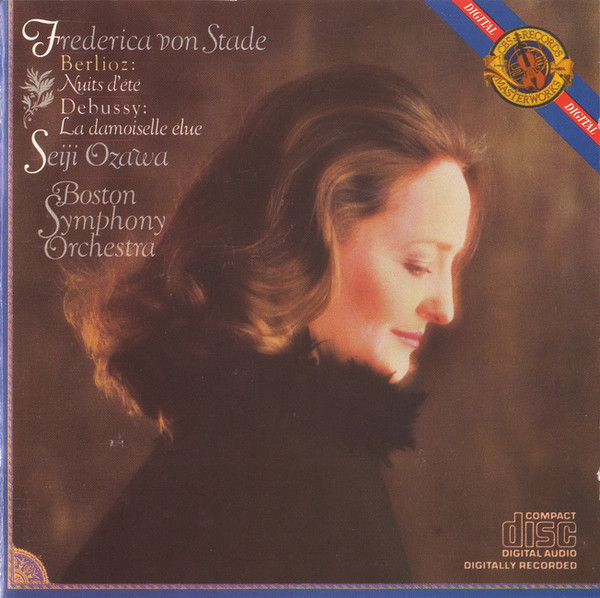
Frederica Von Stade sings Berlioz and Debussy

odqtodm0os5qcgvn

This is a wonderful disc and if it had been in my collection when I did my mini survey of recordings of the Berlioz (Berlioz’s Les Nuits d’Eté – a comparative review of ten recordings) it would no doubt have jostled for top position with my top three of Baker/Barbirolli, Hunt Lieberson/McGegan and Steber/Mitropoulos. My personal favourite would still be the Baker and, like Baker, I would suggest that Von Stade has the perfect voice for this group of songs. Though Berlioz had originally wanted the songs to be sung by different voices, a single voice does bring a certain homogeneity to the cycle, even if few can encompass its demands. Von Stade’s mezzo, with its soprano-ish top and firm lower register (down to a beautifully sounded low F# in Sur les lagunes) seems to me to be the perfect instrument for it. Furthermore she captures the gaiety of the outher songs as easily as she does the deeper emotions of the middle songs. There is a real sense of yearning in Absence, profound despair in Sur les lagunes and a resigned sadness in Au cimetière. Le spectre de la rose is very beautiful, rising to a gorgeous climax before sinking back gently to its bittersweet ending.

The Boston Symphony Orchestra play beautifully for Ozawa, much better than, say, the Suisse- Romande for Crespin and Ansermet or the Philharmonia Baroque for Hunt Lieberson and McGegan and, all in all, this is for me one of the very best versions in the catalogue.

The coupling of Debussy’s La damoiselle élue is equally fine, though I find the timbre of Susanne Mentzer’s Récitant a little too similar to Von Stade’s. Still, Von Stade captures a sort of visionary faith in her singing which is most attractive. Orchestra and chorus are likewise superb and, though the work is not the best of Debussy, it almost seems so in a performance as fine as this one.

A lovely disc.

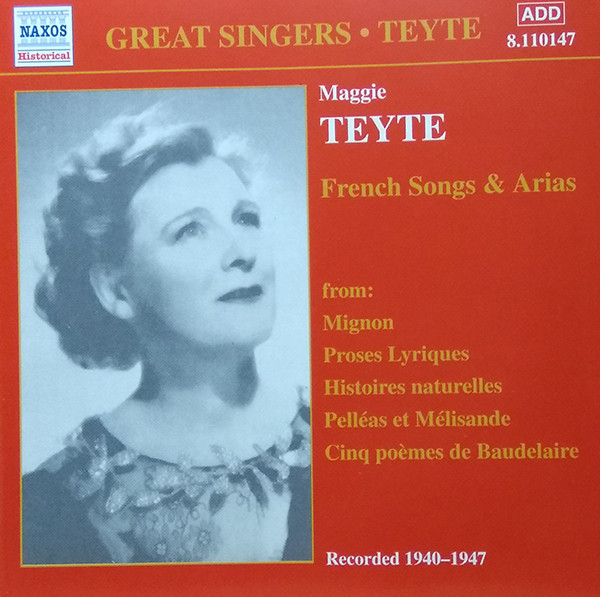
Maggie Teyte sings French Songs and Arias

ni00mzuxlmpwzwc

This compilation is of recordings made bewteen 1940 and 1947, when Teyte was approaching 60. Three tracks (Mignon’s Connais-tu le pays?, one of two versions of Duparc’s L’invitation au voyage and the bonus track, Cherubino’s Voi lo sapete) are from a 1947 radio broadcast with the San Francisco Symphony Orchestra under Pierre Monteux, and the rest are of studio recordings made for EMI, some of which were unpublished at the time. Most are with Gerald Moore on the piano, but the second recording of L’invitation au voyage is with the London Philharmonic Orchestra under Leslie Heward. I’d suggest that this is the better of the two recordings. By the time of the second one with Monteux she has to take more breaths, though the tempi are virtually identical. Even so, even in 1947 the voice remains incredibly firm and totally free of wobble or excessive vibrato. Her singing throughout in fact is wonderfully clean and precise and her intonation is perfect.

So too, of course is her French, though we shouldn’t be surprised when we remember that she spent a good deal of her early career in Paris, was coached by Debussy himself for her début as Mélisande and worked with Chausson, Duparc and Reynaldo Hahn, who evidently had a great deal of affection for her. When she said to Hahn once about the tempo of one of his songs. ‘ You play it quicker than I thought,’ he replied, ‘ma chère, any way you sing it will always be right.’

This is a valuable collection and includes recordings that were either not published or had only a limited circulation in their 78 format, though some of them also appear on EMI’s two disc set entitled, Mélodies françaises . The excerpts from Hahn’s Mozart and Ciboulette are absolutely charming, and we get to hear her speak in perfectly accented French too. The other songs are by Debussy, Chausson and Duparc. Debussy was always a particualr speciality and she somehow makes the three songs she sings here from Debussy’s rather obscure Proses lyriques (she had already recorded the fourth with Cortot) come across as quite simple and direct. She also sings a couple of extracts from Pelléas et Mélisande with piano, which gives us a direct link to Debussy himself.

Teyte should be better known than she is these days. She was one of the greatest ever interpreters of the French song repertoire.

A list of my preferred opera recordings

I hesitate to call this a list of recommended opera recordings, because people’s tastes are so different, but it is a list of my preferred recordings and, as such, it is obviously influenced by my liking for certain artists. It is also derived from over 50 years of listening to and collecting opera recordings and includes recordings that are or were once available on LP and CD, because, despite the current trend for everything to be downloaded onto a computer, I still prefer to listen to CDs. In some cases I have included more than one recording of a piece, usually because I can’t decide which one I like best. I’m also pretty sure that, with a couple of exceptions. all my chosen recordings date from the LP era onwards.

A word about Wagner. I am not really a Wagnerite. I enjoy Wagner from time to time, but I find that, more than with other composers, the sound of the orchestra takes precedence for me, which is why all the recordings I have chosen are studio recordings in decent stereo sound, which thererore excludes the names of many great Wagnerians of the past, such as Flagstad, Leider, Melchior, Furtwängler etc.

No doubt many of my readers will disagree with some of my choices, but I think it’s a pretty sound list. Peruse at your leisure.

Barber: Vanessa – Steber, Elias, Resnik, Gedda, Tozzi; Mitropoulos

Bartók: Bluebeard’s Castle – Ludwig, Berry; Kertesz

Beethoven: Fidelio Dernesch, Donath, Vickers, Kéléman, Ridderbusch; Karajan

Bellini: I Capuleti e I Montecchi – Sills, Baker, Gedda, Herincx, Lloyd; Patané

Bellini: NormaCallas, Simionato, Del Monaco, Zaccaria; Votto La Scala 1955 (live) or Callas. Ludwig, Corelli, Zaccaria; Serafin (studio)

Bellini: Il PirataCallas, Ferraro, Ego; Rescigno New York 1959 (live) -or- Caballé, Martí, Cappuccili; Gavazzeni (studio)

Bellini: I PuritaniCallas, Di Stefano, Panerai, Rossi-Lemeni; Serafin

Bellini: La SonnambulaCallas, Valletti, Modesti; Bernstein la Scala 1955 (live) or Callas, Monti, Zaccaria; Votto/Cologne 1957 (live) or Callas, Monti, Zaccaria; Votto (studio)

Berlioz: Béatrice et Bénedict – Eda-Pierre, Baker, Watts, Tear, Allen, Lloyd, Bastin; Davis

Berlioz: Benvenuto Cellini – Eda-Pierre, Berbié, Gedda, Massard, Bastin, Soyer; Davis

Berlioz: La damnation de FaustVeasey, Gedda, Bastin, Van Allan; Davis

Berlioz: Les Troyens – Lindholm, Veasey, Vickers, Glossop; Davis

Bizet: CarmenCallas, Guiot, Gedda, Massard; Prêtre

Bizet: Les pêcheurs de perles – Cotrubas, Vanzo, Sarabia; Prêtre

Britten: Billy Budd – Langridge, Keenlyside, Tomlinson; Hickox

Britten: Gloriana – Barstow, Kenny, Jones, Langridge, Opie, Summers; Mackerras

Britten: A Midsummer Night’s Dream – Watson, Gomez, Jones, Bowman, Hall, Herford, Maxwell; Hickox

Britten: Peter Grimes – Watson, Pears, Pease; Britten and Harper, Vickers, Summers; Davis

Britten: The Rape of Lucretia – Harper, Baker, Pears, Drake, Luxon, Shirley-Quirk; Britten

Britten: The Turn of the Screw – Vyvyan, Cross, Pears, Mardikian; Britten

Charpentier: Louise – Cotrubas, Berbié, Domingo, Bacquier; Prêtre and Vallin, Lecouvreur, Thill, Pernet; Bigot (abridged)

Chausson: Le roi Arthus – Zylis-Gara, Winbergh, Quilico; Jordan

Cherubini: MedeaCallas, Carron, Berganza, Vickers, Zaccaria; Rescigno, Dallas 1958 (live) or- Callas, Nache, Barbieri, Penno, Modesti; Bernstein, La Scala 1953 (live). If studio/stereo is a must then Callas, Scotto, Pirazzini, Picchi, Modesti; Serafin

Cilea: Adriana Lecouvreur – Scotto, Obrasztsova, Domingo, Milnes; Levine

Debussy: Pelléas et Mélisande – Joachim, Cernay, Jansen, Etchverry, Cabanet; Désormiére (mono) and Von Stade, Denize, Stilwell, Van Dam, Raimondi; Karajan (stereo)

Délibes: Lakmé – Mesplé, Burles, Soyer; Lombard

Delius: A Village Romeo and Juliet – Field, Davies, Hampson; Mackerras

Donizetti: Anna BolenaCallas. Simionato, Raimondi, Rossi-Lemeni; Gavazzeni, La Scala 1957 (live) (Divina transfer, avoid Warner and EMI) It’s cut of course, but no other performance satisfies me.

Donizetti: Don Pasquale – Saraceni, Schipa, Poli, Badini; Sabajno (mono). If stereo is a must then Freni, Winbergh, Nucci; Bruscantini; Muti

Donizetti: L’Elisir d’amore – Cotrubas, Domingo, Wixell, Evans; Pritchard

Donizetti: La fille du régimentSutherland, Sinclair, Pavarotti, Malas; Bonynge

Donizetti: Lucia di LammermoorCallas. Di Stefano, Panerai, Zaccaria; Karajan, Berlin 1955 (live) and Callas, Tagliavini, Cappuccilli, Ladysz; Serafin (studio stereo/Pristine remaster).

Donizetti: Lucrezia Borgia – Caballé, Berbié, Vanzo, Paskalis; Perlea, New York 1965 (live) No studio recording.

Donizetti: Maria StuardaTinsley, Baker, Erwen, Garrard, Du Plessis; Mackerras, ENO 1973 (live in English) or Caballé, Verrett, Garaventa, Arié, Fioravanti; Cillario, La Scala 1971 (live). No studio recording.

Donizetti: Roberto Devereux – Caballé, Marsee, Carreras, Sardinero, Furlanetto; Rudel, Aix-en-Provence, 1977 (live)

Dvořák: Rusalka – Fleming, Zajick, Heppner, Havlata; Mackerras

Enescu: Oedipe – Hendricks, Lipovšek, Gedda, Van Dam; Foster

Fauré: Pénélope – Norman, Taillon, Vanzo, Huttenlocher, Van Dam; Dutoit

Giordano: Andrea Chenier – Scotto, Domingo, Milnes; Levine

Gluck: Orfeo – Baker, Speiser, Gale; Leppard

Gounod: Faust – De Los Angeles, Gorr, Gedda, Blanc, Christoff; Cluytens 1958 (stereo)

Gounod: Roméo et JulietteGheorghiu, Alagna, Keenlyside, Van Dam, Fondary; Plasson

Handel: Hercules – Dawson, Otter, Daniels, Croft, Saks: Minkowski

Handel: Giulio Cesare – Masterson, Baker, Jones, Walker, Bowman, Tomlinson: Mackerras (in English)

Handel: Rinaldo – Organasova, Bartoli, Fink, Daniels, Taylor, Finley; Hogwood

Handel: Theodora – Upshaw, Hunt Lieberson, Daniels, Croft: Christie

Humperdinck: Hänsel und Gretel – Schwarzkopf. Grümmer, Von Islovay, Schürhoff, Metternich: Karajan

Janáček: The Cunning Little Vixen – Popp, Randova, Jedlicka; Mackerras

Janáček: Jenůfa, – Söderström, Popp, Randova, Ochmann, Dvorsky; Mackerras

Janáček: Kat’a Kabanova – Söderström, Kniplova, Dvorsky; Mackerras

Janáček: Vĕc Makropulos – Söderström, Dvorsky, Blachut; Mackerras

Korngold; Die tote Stadt – Neblett, Kollo, Prey, Luxon; Leinsdorf

Lehár: Das Land des Lächelns – Schwarzkopf, Loose, Gedda, Kunz: Ackermann

Lehár: Die lustige Witwe Schwarzkopf, Steffek, Gedda, Wächter, Knapp; von Matačić

Leoncavallo: PagliacciCallas, Di Stefano, Monti, Gobbi, Panerai; Serafin

Mascagni: L’Amico Fritz – Freni, Pavarotti, Sardinero; Gavazzeni

Mascagni: Cavalleria RusticanaCallas, Di Stefano, Panerai; Serafin

Massenet: Cendrillon – Welting, Von Stade, Berbié,  Gedda, Bastin; Rudel

Massenet: ManonDe Los Angeles, Legay, Dens; Monteux

Massenet: Thaîs – Fleming, Sabbatini, Hampson; Abel

Massenet: Werther – Gheorghiu, Pétibon, Alagna, Hampson; Pappano or Von Stade, Buchanan, Carreras, Allen; Davis and Vallin, Féraldy, Thill, Rogue; Cohen

Motemezzi: L’Amore Dei Tre Re – Moffo, Domingo, Elvira. Siepi; Santi

Monteverdi: L’incoronazione di Poppea – Galli, Meijer, Marmeli; Cavina

Monteverdi: L’Orfeo – Cioffi, Gens, Dessay, Bostridge; Haîm

Mozart: La Clemenza di Tito – Baker, Popp, Minton, Von Stade, Burrows; Davis

Mozart: Cosi fan TutteSchwarzkopf, Steffek, Ludwig, Kraus, Taddei, Berry; Böhm

Mozart; Don Giovanni – Sutherland, Schwarzkopf, Sciutti, Alva, Wächter, Taddei, Cappuccilli, Frick; Giulini

Mozart: Die Entführung aus dem Serail – Köth. Schädle, Wunderlich, Lenz, Böhme; Jochum

Mozart: Le Nozze di Figaro – Schwarzkopf, Moffo, Cossotto, Taddei, Wächter, Cappucilli; Giulini

Mozart: Die ZauberfloteLear, Peters, Wunderlich, Fischer-Dieskau, Crass; Böhm or for HIP – Mannion, Dessay, Blochwitz, Scharinger, Hagen; Christie

Mussorgsky: Boris Godunov – Borodina, Vaneev, Galouzine; Gergiev

Offenbach: Les Contes D’Hoffman – Sutherland, Tourangeau, Domingo, Bacquier; Bonynge (studio) or Malfitano, Murray, Domingo, Van Dam; Levine (live)

Offenbach: Orphée aux Enfers – Mesplé, Rhodes, Sénéchal, Burles, Trempont; Plasson

Offenbach: La vie Parisienne – Mesplé, Crespin, Sénéchal, Bénoit, Trempont; Plasson

Ponchielli: La Gioconda Callas, Barbieri, Amadini, Poggi, Silveri, Neri: Votto (mono) or Callas, Cossotto, Companeez, Ferraro, Cappuccilli, Vinco: Votto (stereo)

Poulenc: Dialogues des Carmélites – Duval, Crespin, Berton. Scharley, Gorr, Depraz, Finel; Dervaux

Puccini: La Boheme – De Los Angeles, Amara, Björling, Merrill, Tozzi: Beecham or Callas, Moffo, Di Stefano, Panerai, Zaccaria: Votto

Puccini: La Fanciulla del WestNeblett, Domngo, Milnes; Mehta

Puccini: Gianni Schicchi De Los Angeles, Del Monte, Gobbi: Santini

Puccini: Madama Butterfly Callas, Danieli, Gedda, Borriello; Karajan or De Los Angeles, Canali, Di Stefano, Gobbi: Gavazzeni or Scotto, Di Stasio, Bergonzi, Panerai: Barbirolli

Puccini: Manon Lescaut Callas, Di Stefano, Fioravanti: Serafin

Puccini: La Rondine Gheorghiu, Mula, Alagna, Mateuzzi, Rinaldi: Pappano

Puccini: Suor Angelica De Los Angeles, Marimpietri, Barbieri: Serafin or Scotto, Cotrubas, Horne; Maazel

Puccini: Il Tabarro Mas, Prevedi, Gobbi: Bellezza

Puccini: Tosca Callas, Di Stefano, Gobbi: De Sabata

Puccini: Turandot Callas, Schwarzkopf, Fernandi, Zaccaria: Serafin (mono) or Sutherland, Caballé, Pavarotti, Ghiaurov: Mehta (stereo)

Purcell: Dido and Aeneas – Clark, Baker, Sinclair, Herincx; Lewis

Ravel: L’enfant et les sortileges –  Ogéas, Gilma, Collard, Berbié, Sénéchal, Rehfuss, Maurane; Maazel

Ravel: L’heure espahnole – Berbié, Sénéchal, Gireaudeau, Bacquier, Van Dam; Maazel

Rossini: Armida Callas, Filippeschi, Albanese, Raimondi; Serafin (in atrocious sound, but essential for some of the most incredible dramatic coloratura singing you will ever hear)

Rossini: Il Barbiere di Siviglia Callas, Alva, Gobbi, Ollendorff, Zaccaria: Galliera

Rossini: La Cenerentola – Baltsa, Araiza, Alaimo, Raimondi; Marriner

Rossini: Le comte Ory – Barabas, Sinclair, Oncina, Wallace: Gui

Rossini: Elisabetta, Regina, d’Inghilterra – Caballé, Masterson, Carreras, Benelli: Masini

Rossini: Guillaume Tell – Caballé, Mesplé, Taillon, Gedda, Cassinelli, Bacquier, Howell, Kovats; Gardelli

Rossini: L’Italiana in Algeri – Pace, Baltsa, Lopardo, Corbelli, Dara, Raimondi; Abbado

Rossini: Semiramide – Penda, Pizzolato, Osborne, Regazzo: Fogliani (complete) or Sutherland, Horne, Serge, Malas; Bonynge (abridged)

Rossini: Il Turco in Italia – Callas, Gardino, Gedda, Stabile, Calabrese, Rossi-Lemeni; Gavazzeni

Saint-Saens: Samson et Dalila – Baltsa, Carreras, Summers, Estes, Burchaladze; Davis

Shostakovich: Lady Macbeth of Mtsensk – Vishnevskaya, Gedda, Petkov; Rostropovich

J Strauss: Die FledermausSchwarzkopf, Streich, Gedda, Krebs, Christ, Kunz; Dönch; Karajan

J Strauss: Eine Nacht in Venedig – Schwarzkopf, Loose, Gedda, Kunz; Ackermann

J Strauss: Wiener Blut – Schwarzkopf, Köth, Loose, Gedda, Kunz; Ackermann

J Strauss: Der Zigeunerbaron – Schwarzkopf, Köth, Burgsthaler-Schuster, Gedda, Prey, Kunz: Ackermann

R Strauss: Arabella Varady, Donath, Dallapozza, Fischer-Dieskau; Sawallisch and Schwarzkopf, Felbermeyer, Gedda, Metternich; von Matacic (highlights)

R Strauss: Ariadne auf NaxosSchwarzkopf, Streich, Seefried, Schock; Karajan

R Strauss: Capriccio Schwarzkopf, Ludwig, Gedda, Wächter, Fischer-Dieskau, Hotter; Sawallisch

R Strauss: Elektra – Marton, Studer, Lipovsek, Winkler, Weikl; Sawallisch

R. Strauss: Die Frau ohne Schatten – Studer, Vintzing, Schwarz, Kollo, Muff: Sawallisch

R Strauss: Der Rosenkavalier – Schwarzkopf, Stich-Randall, Ludwig Wächter, Edelmann; Karajan

R Strauss: Salome – Welitsch, Thorborg, Jagel, Janssen; Reiner (live mono) and Behrens, Baltsa, Schmitt-Walter, Van Dam; Karajan (studio stereo)

Szymanowski: Król Roger – Szmytka, Langridge, Hampson; Rattle

Tchaikovsky: Eugene OneginVishnevskaya, Avdeyeva, Lemeshev, Belov, Petrov; Khaikin

Tchaikovsky: Mazeppa – Gorchakova, Dyadkova, Larin, Leiferkus, Kotcherga; Järvi

Tchaikovsky: Queen of Spades – Guleghina, Borodina, Arkhipova, Grigorian, Chernov, Putilin; Gergiev

Verdi: AidaCallas, Dominguez, Del Monaco, Taddei; de Fabritiis (live) and Callas, Barbieri, Tucker, Gobbi; Serafin (studio mono) or Caballé, Cossotto, Domingo, Cappuccilli; Muti (studio stereo) or Freni, Baltsa, Carreras, Cappuccilli; Karajan (studio stereo)

Verdi: Alzira – Cotrubas, Araiza, Bruson; Gardelli

Verdi: Aroldo – Caballé, Cecchele, Pons, Lebherz; Queler

Verdi: Attila – Deutekom, Bergonzi, Milnes, Raimondi; Gardelli

Verdi: Un Ballo in Maschera Callas, Barbieri, Di Stefano, Gobbi; Votto (studio) and Callas, Simionato, Di Stefano, Bastianini; Gavazzeni (live)

Verdi: La Battaglia di Legnano – Ricciarelli, Carreras, Manuguerra, Ghiuselev; Gardelli

Verdi: Il Corsaro – Caballé, Norman, Carreras, Mastremei; Gardelli

Verdi: Don Carlo Freni, Baltsa, Carreras, Cappuciolli, Ghiaurov, Raimondi; Karajan (4 acts in Italian), Caballé, Verrett, Domingo, Milnes, Raimondi, Giaotti; Giulini (5 acts in Italian) and Ricciarelli, Valentini-Terrani, Domingo, Nucci, Raimondi, Ghiaurov; Abbado (5 acts in French)

Verdi: I due Foscari – Ricciarelli, Carreras, Cappuccilli, Ramey; Gardelli

Verdi: Ernani – Price, Bergonzi, Sereni, Flagello; Schipeers

Verdi: Falstaff – Schwarzkopf, Moffo, Merriman, Barbieri, Alva, Panerai, Gobbi; Zaccaria; Karajan

Verdi: La Forza del Destino Callas, Nicolai, Tucker, Tagliabue, Rossi-Lemeni; Serafin

Verdi: Un Giorno di Regno Pagliughi, Cozzi, Oncina, Bruscantini, Capecchi, Dalmangas; Simonetto

Verdi: Giovanna d’Arco – Caballé, Domingo, Milnes; Levine

Verdi: I Lombardi – Sass, Lamberti, Di Cesare, Kovats; Gardelli

Verdi: Luisa Miller – Moffo, Verrett, Bergonzi, MacNeil, Tozzi, Flagello; Cleva or Caballé, Reynolds, Pavarotti, Milnes, Giaotti, Van Allan; Maag or Ricciarelli, Obraztsova, Domingo, Bruson, Howell, Ganzarolli; Maazel

Verdi; Macbeth Callas, Penno, Mascherini, Tajo; De Sabata (live) and Verrett, Domingo, Cappuccilli, Ghiurov; Abbado (studio)

Verdi: I Masnadiert – Caballé, Bergonzi, Cappucilli, Raimondi; Gardelli

Verdi; Nabucco – Souliotis, Carral, Prevedi, Gobbi, Cava; Gardelli and (essential supplement, but awful sound) Callas, Pini, Sinimbergi, Bechi, Neroni; Gui

Verdi: Otello – Rysanek, Vickers, Gobbi; Serafin and Scotto, Domingo, Milnes; Levine

Verdi: Rigoletto Callas, Lazzarini, di Stefano, Gobbi, Zaccaria; Serafin

Verdi: Simon Boccanegra – Freni, Carreras, Cappucilli, Ghiaurov, Van Dam; Abbado and De Los Angeles, Campora, Gobbi, Christoff, Monachesi; Santini

Verdi: Stiffelio – Sass, Carreras, Manugeurra, Ganzarolli; Gardelli

Verdi; La Traviata Callas, Valletti, Zanasi; Rescigno, Covent Garden 1958 (live) and Cotrubas, Domingo, Milnes; Kleiber (istereo studio)

Verdi: Il Trovatore – Callas, Barbieri, Di Stefano, Panerai, Zaccaria; Karajan

Verdi: I Vespri Siciliani – Callas, Kokolis-Bardi, Mascherini, Christoff; Kleiber (live) and Arroyo, Domingo, Milnes, Raimondi; Levine

Wagner: Der Fliegende Holländer – Silja, Kozub, Unger, Adam, Talvela; Klemperer or Schech, Schock, Wunderlich, Fischer-Dieskau; Konwitschny

Wagner: Lohengrin – Grümmer, Ludwig, Thomas, Fischer-Dieskau, Frick; Kempe

Wagner: Die Meistersinger von Nürnberg – Janowitz, Fassbänder, Konya, Unger, Stewart, Hemsley, Crass; Kubelik

Wagner: Parsifal – Vejzovic, Hoffmann, Nimsgern, Van Dam, Moll; Karajan

Wagner: Der Ring des Nibelungen – Crespin, Dernesch, Janowitz, Veasey, Ludwig, Dominguez, Stolze, Vickers, Stewart, Brilioth, Fischer-Dieskau, Stewart, Kéeléman, Ridderbusch, Talvela; Karajan

Wagner: Tannhäuser – Dernesch, Ludwig, Kollo, Braun, Sotin; Solti

Wagner: Tristan und Isolde – Dernesch, Ludwig, Vickers, Berry, Ridderbusch; Karajan and Gray, Wilkens, Mitchinson, Joll, Howell; Goodall

Weber: Der Freischutz – Grümmer, Otto, Schock, Prey, Kohn, Frick; Keilberth

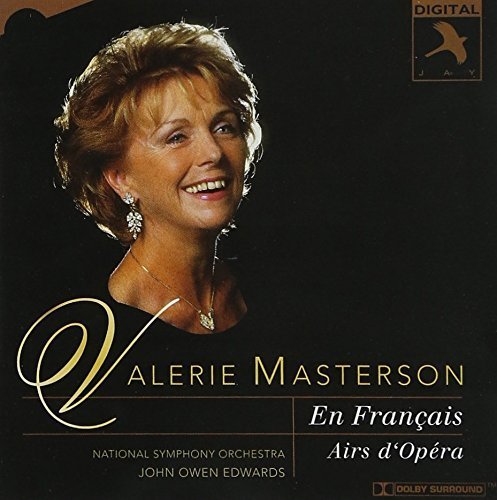
Valerie Masterson – En Français

51jboyyne-l

This is something of an exercise in nostalgia. Valerie Masterson was a mainstay of my opera going in my early days and I saw her quite a few times on stage and in some of the roles she sings on this disc. She was a very beautiful woman with a lovely voice and a charming stage presence and it would have been hard not to fall under her spell. She first came to prominence singing Gilbert and Sullivan with the D’Oyly Carte company, but was soon snapped up by English National Opera, where she sang many of these roles in English. However the French also took her to their heart and she appeared regularly over there too, as well as at the Royal Opera, Covent Garden, where she would have been singing in French and she sings the language very well.

This recital was recorded at three separate sessions in 1991 and 1993 when Masterson would have been in her mid fifties and, though the voice is still beautiful, it is no longer the fresh voice of youth. What a shame she didn’t get to record this material, say, around fifteen years earlier when she sang Matilde to Caballé’s Elisabetta in Rossini’s Elisabetta, Regina d’Inghilterra both in Aix-en-Provence and on record. Two years is a long time when one is nearing the end of one’s career, and it is notable that the arias recorded in 1991 find her in better voice than those recorded in 1993. Still, there is much to enjoy, especially in those roles that Masterson had made very much her own, Manon, Juliette, Marguerite, Louise and Micaëla. The vibrations may have loosened somewhat, but she is mercifullly free of wobble.

Favourite tracks for me were Micaëla’s Je dis que rien m’épouvante, Louise’s Depuis le jour, the brief excerpt from the Saint Sulpice scene in Manon, Margeurite’s Jewel Song and L’Ensoleillad’s lovely little Vive amour qui rêve from Chérubin. To be honest, only in Thaïs’s Mirror Aria, which was recorded at the last sessions, does the beat in the voice start to become distracting and it is notable that she doesn’t take the higher option at the end, whereas a few years before this would have been easily within her voice. Throughout she pays due attention to the text and the mood of each aria, and her voice has its own individual character that I’ve always found instantly recognisable.

The sound is superb, the orchestral conributions under John Owen Edwards excellent, and the booklet comes with texts and translations, an interview with Masterson and stage photos of her looking absolutelty gorgeous as Margeurite, Manon, Juliette and Louise.

So, as I said, a little late for comfort, but still a disc worth hearing for any of us who fell under Masteron’s spell when she was regularly appearing on our stages.


Two Contrasting Vocal Recitals

71mojlgie4l._ac_sl1073_

Dame Maggie Teyte in concert, at the age of sixty no less! Teyte, a famous Mélisande who studied the role with Debussy himself, sings extended excerpts from the opera with piano accompaniment, singing all the roles. It shouldn’t work, but somehow it does. It takes her the first song in the recital (Grétry’s Rose chérie) to warm up, but thereafter you would never believe this was the voice of a sixty year old woman. The disc also includes privately recorded excerpts from Strauss’s Salome also with piano, from when Teyte was preparing the role for Covent Garden about fifteen years earlier, a project that unofrtunately never came to fruition. Her bright, slivery soprano might just have been the voice Strauss imagined.

She also sings Britten’s Les Illuminations in a version for piano, making me wish she had recorded the orchestral version, although preferably a few years earlier. Just occasionally there is a flicker of frailty in the middle voice, although the top register remains firm and clear as a bell. The encores include a lovely performance of Hahn’s popular Si mes vers avaient des ailes.

r-2563085-1290611066.jpeg

Another enterprising disc from Dawn Upshaw, who seems to have disappeared from the scene now. The centrepiece is Earl Kim’s Where grief slumbers written in 1982 for voice, harp and string orchestra, but here presented in a 1990 arrangement for voice, double string quartet and harp, and Upshaw is an ideal interpreter. She is equally at home in the rest of the programme; Falla’s Psyché, Ravel’s Trois poèmes de Stéphane Mallarmé, Stravinsky’s Two poems of Konstantin Bel’mont and Three Japanese Lyrics and Delage’s Quatre poèmes hindous, though here I slightly prefer the warmer tones of Dame Janet Baker, who is much more languidly erotic in the worldess vocalise of Lahore. Nevertheless a thoroughly absorbing disc.

As with so many of these Nonsuch discs, documentation is slight, and, though we do get lyrics and translations, the layout is confusing and a little more information about the provenance of these songs, especially the less famous Kim cycle, would have been much appreciated.

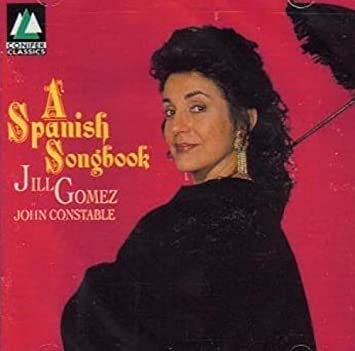
A Spanish Songbook – Jill Gomez

516xghgdgjl._sx355_

What an utterly charmng and delightful disc this is, cleverly planned and beautifully executed.

With her distinctive timbre and wonderfully expressive voice, Gomez’s personality fairly bursts through the speakers and she is superbly supported here by John Constable on the piano, who unerringly captures the mood of the songs. You feel as if these two artists really enjoy making music together, and indeed their association is a long one, having first appeared on disc together twenty years earlier. Gomez would have been in her early fifties when the present disc was recorded but the voice has hardly changed in the intervening years.

What we have here is a compendium of Spanish inflluenced songs by German, French and English composers, as well as songs by Spanish composers, covering a wide range of styles and eras. The programming is eminently sensible and makes for very satisfying listening.

We start with a group of sixteenth century Villancios from the courts of Charles V and Philip II in piano arrangements by Graciano Tarragó, which encourage the kind of decoration and improvisation of the 16th century vilancico. Fuenllana’s De los alamos vengo, madre is no doubt better known from Rodrigo’s orchestral arrangement, but Gomez sparkles quite as much here.

From thence we turn to a group of Spanish influenced songs by Wolf and Schumann, in which Gomez captures perfectly the deep melancholy of Schumann’s Tief im Herzen trag’ ich Pein as well as the girlish coquettishness of Wolf’s In dem Schatten meiner Locken. Spain has always provided a deep vein of inspiration for French composers, so we are next treated to a group of songs by Bizet, Ravel, Saint-Saëns and Délibes in which Gomez’s sense of style is impeccable.

Next come the three Granados Tornadillas, in which we are probably more used to hearing the fuller, chestier sound of someone like Conchita Supervia. Gomez intelligently, rather than copy her style, is more languorous. I might prefer Supervia’s vibrancy, but Gomez’s way is just as valid.

The two Walton songs, both taken from Façade, find Gomez pointing Edith Sitwell’s lyrics deliciously and lead us into the final group, which Gomez calls “Seven Other Popular Songs”. The first three songs are by Roberto Gerhard, who, as an exile from Franco’s Spain, had relocated to Cambridge in the UK in 1942, where he lived until his death in 1970. These are his versions of folk-songs collected by his teacher, Felipe Pedrell. bittersweet souvenirs of a composer in exile. The others are by Tarrago, Rodrigo, Guridi and Obradors. Gomez is yet again a wonderful guide through this musical journey of Spain, brilliantly capturing the mood of each song.

An excellent recital that should be a lot better known than it is.

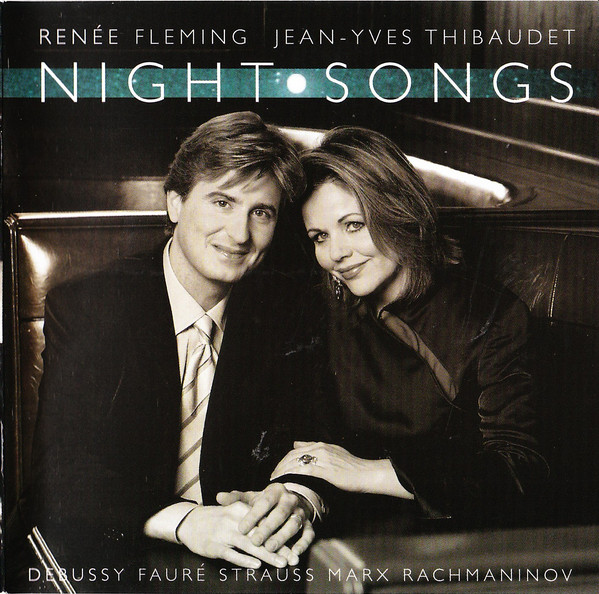
Renée Fleming – Night Songs

r-4527951-1426190336-3065.jpeg

Where does the time go? I can’t believe it is almost twenty years since I worked with Renée Fleming when the London Symphony Orchestra put on a semi-staged production of Previn’s A Streetcar Named Desire at the Barbican Hall with Previn himself conducting. I only had a very minor role, but I found Fleming to be a very gracious lady, an arch professional and a conscientious artist. The rehearsals and performances are amongst my fondest memories and I will never forget the experience of hearing that voice close to, with her literally singing into my ear on occasion. The final Korngold-like aria Blanche sings before being taken away to the asylum was possibly one of the most beautiful things I have ever heard.

I mention this to put into context my reactions to listening to this recital, which I wanted to like much more than I did. The recording was made in 2001 when the voice had acquired a new richness in the middle and lower ranges whilst retaining its beauty and ease up on high, even throughout its compass and admirably firm, with no trace of hardness when singing at full tilt. As it seems now we have said goodbye to Fleming, the classical arists it is good to be reminded that this was one of the most ravishing instruments of the last thirty years or so. She has always had a fairly eclectic repertoire which embraced both opera and song, covering a wide range of different composers and styles, but I’ve always thought her best suited to the music of Mozart and Strauss.

Hence it is the songs by Strauss and Joseph Marx which make the stongest impression, especially Cäcilie, its radiant close easily and ravishingly voiced. The Marx songs suit her well too, their sensuous expressivity responding well to the heady beauty of Fleming’s voice. Thibaudet is also superb in the tricky accompaniments, tossing off their difficulties as if they are the easiest things in the world.

Elsewhere I am not so sure this operatic vocal effulgence is what I want to hear. I found myself longing for the greater simplicity and cleaner vocal production of a Victoria De Los Angeles in the Fauré, the slight touch of irony and cool detachment brought to Debussy’s Chansons de Bilitis by a Régine Crespin. The Rachmaninov, with their heavier accompaniments, perhaps respond better to this operatic treatment, but I find it just too sophisticated and even here I prefer a slightly simpler, more direct approach.

However enjoyable it is to hear one of the most beautiful voices of recent times whatever the circumstances, ultimately there are other discs I would pull out first when wanting to sample Fleming at her best.

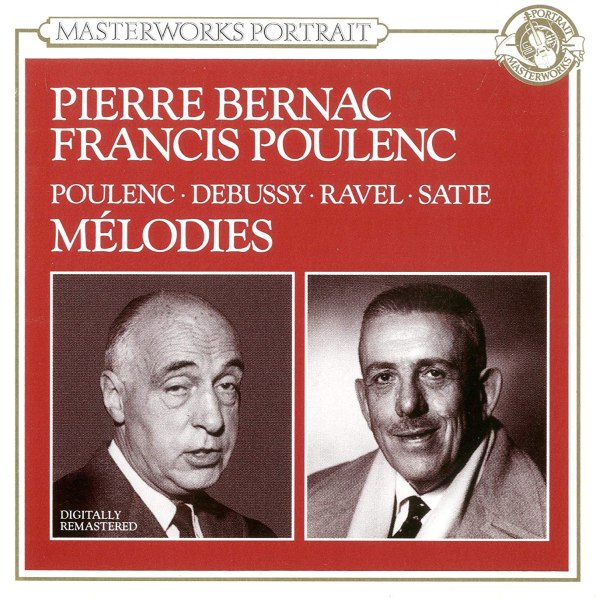
Pierre Bernac & Francis Poulenc – Mélodies

91khamjrtvl._sl1500_

Poulenc:
Banalités
Chansons villageoises
Quatre poèmes de Guillaume Apollinaire
Tu vois le feu du soir
Main dominée par le coeur

Debussy:
Beau soir
L’écheonnement des haies
Le Promenoir des deux amantes

Ravel:
Histoires naturelles
Mélodies hébraïques

Satie:
Trois mélodies

Pierre Bernac and Francis Poulenc had a long and fruitful working relationship, going back to 1926 when Bernac gave the first performance of Poulenc’s Chansons gaillardes (not included on this disc). They first appeared in recital together in 1934 and continued to do so until Bernac retired from public performing in 1960. In fact the majority of Poulenc’s songs were written for Bernac and I suppose one could say that they enjoyed a similar relationship to that of Britten and Pears, without the emotional attachment, apparently always using the polite ‘vous’ with each other at all times.

Bernac’s voice was evidently not large but he had an enormously varied tonal palette which enabled him to capture every shift in mood, every emotion, implied or overt, in each song. Though the voice was not of itself of great natural beauty, its range was wide and Poulenc exploited this to great effect. Bernac was also a great teacher, numbering Gérard Souzay, Elly Ameling and Jessye Norman among his pupils, and he wrote with great insight about the art of singing. His The Interpretation of French Song is an absolute must for anyone interested in performing this repertoire.

Bernac and Poulenc left behind quite a legacy of recordings, most of them recorded for EMI and RCA in 1947. However these Columbia sessions took place in 1950. The Poulenc selection is self recommending, but he is equally at home in the songs of Debussy, Ravel and Satie, embracing the lyricism of Debussy’s Beau soir, the slightly detached irony of Ravel’s Histoires naturelles or the parodic wit of the Satie songs.

Anyone who enjoys the subtle art of French song should definitely hear them.

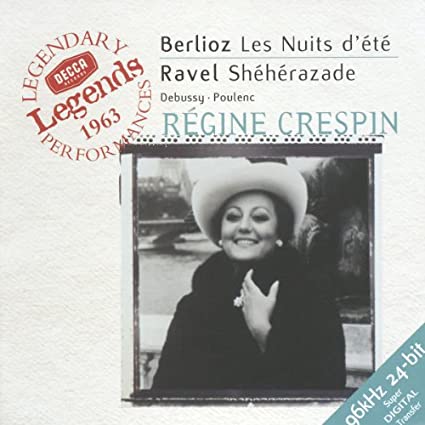
Crespin’s Shéhérazade

513oqn2fqcl._sx425_

Crespin’s recording with Ansermet of Ravel’s Shéhérazade and Berlioz’s Les Nuits d’été is now so famous, so universally acclaimed that there can surely be no more to say about it. Even today, almost 60 years since they were recorded, the performances are still cited by many as a first choice in both works and for many they were no doubt their first exposure to the works, so maybe that is all that needs to be said about them, but is it really so simple?

Both Shéhérazade and, especially, Les nuits d’été are great favourites of mine and I now have ten different recordings of the Berlioz, six of the Ravel. Let us then start with the Ravel. From the thrice repeated call of Asie at the beginning, the third sung with the equivalent of a flirtatiously arched eyebrow, we are in her thrall. She makes a bewitching storyteller, drawing us in with her thrillingly colourful descriptions of the Orient. As I often feel with Crespin, there is a slight air of detachment but here it suits the narrative superbly. She is suitably languid in La flûte enchantée and deliciously ambiguous in L’indifférent. There have been finer versions of the orchestral score (not least the New Philharmonia under Barbirolli for Janet Baker), but Crespin at her best is still a prime recommendation. There is something just so inevitably right about her singing and it places her (just) ahead of the other versions I own, (Teyte, Baker, De Los Angeles, Berganza and Hendricks).

That air of detachment I mentioned also makes her an ideal interpreter of the songs of Poulenc and also Debussy’s Trois chansons de Bilitis with John Wustman on the piano, from a 1967 recording, which are here included as a makeweight, and very welcome they are too. However it works against her in the Berlioz, which requires a degree of involvement and passion that I find lacking in Crespin’s delivery. However musical and tasteful her singing, however elegant her phrasing, she remains aloof and uninvolved. There is no sense of mounting rapture at the arrival of the rose from paradise, no sense of longing in Absence. She is at her best in the final song, L’île inconnue which is blithely insouciant and responds better to her air of suave sophistication. I have no idea why she decided to place Sur les lagunes after Absence but it upsets the balance of the work too.

No, for the Berlioz my prime recommendations would be Baker either with Barbirolli or live with Giulini, Hunt Lieberson with McGegan, Steber with Mitropoulos or De Los Angeles with Munch, Crespin trailing quite a way in their wake.

Essential I would say for Shéhérazade and the Debussy and Poulenc, but look elsewhere for the Berlioz.