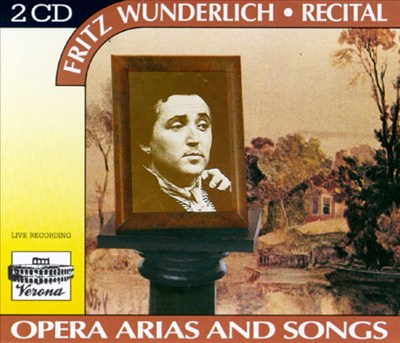
Fritz Wunderlich – Opera Arias and Songs

image

I doubt this two disc set is available any longer, but it offers some interesting live performances and unusual repertoire spanning twelve years of Wunderlich’s career, the earliest performance being from 1954, when he would have been just 23 and the last from his final concert in Edinburgh in 1966, recorded shortly before the accident which claimed his life. The insert is missing in my copy and the track listing on the back isn’t quite accurate, for instance it credits Hilde Güden as the Violetta in the excerpts from the 1965 Munich La Traviata under Patané, when the role was actually taken by Teresa Stratas. (I have the complete performance on the Orfeo label.)

Disc 1 starts off with Handel. First we have a couple of excerpts from a 1959 performance of Messiah in German. Comfort ye is nicely done, but a tendency to aspirate his runs is notable in the ensuing Every valley. He must have been aware of this fault, because by the time he sings in Judas Maccabeus, conducted by Rafael Kubelik in 1963, that tendency has virtually vanished. Although this is also sung in German, he is now a much more confident singer and his rendition of Sound an alarm is absolutely stunning. Next we have a couple of excerpts from a 1965 radio performance of Iphigénie en Tauride (also in German) again under Kubelik, with brief contributions from Hermann Prey and Sena Jurinac. More and more of the assured artist is emerging.

Next comes Mozart, and we again go back in time, first to some delightful excerpts from Zaïde from 1956, followed by a performance of the short concert aria Con ossequio, con rispetto. The listing gives no indication of the date, but a little digging reveals that it was probably from 1963 and, again, the mature artist is beginning to emerge. This is followed by six extracts from a 1959 performance of Schubert’s Fierrabras. The other soloists were unknown to me. They are all competent enough but Wunderlich’s superior voice and musicianship are immediately apparent. The disc finishes with three songs from his final concert in Edinburgh in 1966, to which I will return at the end of this review.

Another rarity begins the second disc; Cherubini’s comic opera Les deux journées, sung in German and given the title Der Wasserträger. Wunderlich sings two duets with Hildegard Hillebrecht. The music reminds me rather of Weber’s Abu Hassan, charming and lightweight and Wunderlich is perfectly attuned to its style. Next he makes a perfect Alfredo in the 1965 performance of La Traviata, mentioned above. All Wunderlich’s recordings of Italian opera excerpts were in German and it is amazing how he can still make the music sound italilanate even in the wrong language. Here in the right language, his legato is superb and he is the ardent young Alfredo to the life. He is not quite so impressive in a 1960 performance of Verdi’s Requiem. He tends to slightly oversing, maybe in what he thought was the Italianate method. There is the merest hint of a sob and the occasional aspirate, but I do wonder what he might have made of the part had he been engaged for the 1964 Giulini recording with Schwarzkopf. With Legge and Giulini to guide him, he might just have been the perfect tenor for that enterprise, however good Gedda is in it.

A 1959 exceprt from Strauss’s Die schweigsame Frau would surely have reconciled Strauss to the tenor voice. Strauss’s tenor writing can sound quite torturous, but Wunderlich sings with great beauty, soaring over the orchestra. Unexpected items follow with an exceprt from The Cunning Little Vixen (in German), one from Pfitzner’s Von Deutscher Seele and a short extract from Franz Schmidt’s Das Buch mit Sieben Sieglen, conducted by Dimitri Mitropoulos in 1959, both pieces completely new to me.

The final item is a 1954 recording of hin singing an aria from Robert Stolz’s Venus in Seide. Wunderlich would have been just 23 and, though a little diffident, the golden voice is imediately recognisable. It is instructive, then, to return to the final items on the first disc, the last recordings we have of Wunderlich’s voice, made at a concert in Edinburgh shortly before his untimely death. Before a live audience, he sings Schumann’s Die Lotusblume and Schubert’s Ungeduld with greater senisitivity and freedom than he does on his DG Studio recitals, recorded the previous year, and when it comes to his final encore, Schubert’s An die Musik, he delivers a beautiful, heartfelt rendering, vastly superior to the rather stiff one we hear in the studio. Nobody knew it at the time of course, but this touching tribute to music was the last song he ever sang in public. Two weeks later he tripped on loosely tied shoelaces and fell down the stone staircase at a friend’s hunting lodge in Oberderdingen. He had been due to make his Metropolitan Opera debut in Don Giovanni a few weeks later.

Wunderlich left behind a vast catalogue of studio recordings, of operetta, of opera and of Lieder. He was obviously still developing as an artist. How sad to think that he was only really beginning his international career.
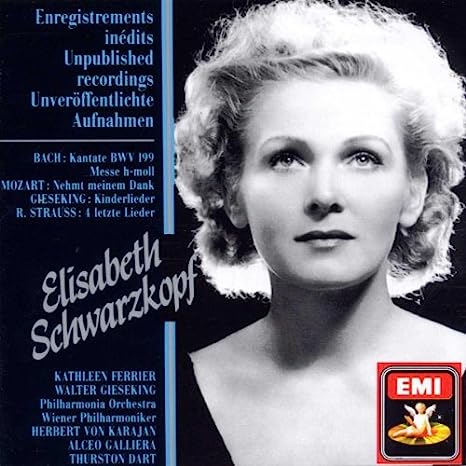
Elisabeth Schwarzkopf – Unpublished Recordings


51zdj0yf6wl._ac_sx466_

An interesting release of material discovered in the EMI vaults and released in 1990.

We start with a really lovely performance of Bach’s Cantata, Mein Herze schwimmt im Blut, which is followed by surviving excerpts from a rehearsal for a performance of Bach’s Mass in B Minor under Karajan, with Ferrier partnering Schwarzkopf in the Christe eleison and Et in unum Dominum. Schwarzkopf sings the Laudamus te.

A charming performance of Mozart’s Nehmt meinen Dank comes next, recorded in 1955 with the Philharmonia under Alceo Galliera.

The Gieseking Kinderlieder were recorded as a favour to the great pianist, recorded at the same time they made their album of Mozart Lieder. Undemanding music perhaps, but Schwarzkopf characterises them brilliantly. I’m sure Gieseking was delighted.

Finally we have a live performance of Strauss’s Vier lerzte Lieder with the Philharmonia under Karajan at the Royal Festival Hall in 1956. It is certainly interesting to hear Schwarzkopf singing them live, but I wouldn’t place this above either of her two studio recordings under Ackermann and Szell. Inexplicably, Karajan places September last, which makes a less satifactory end, especially given the rather fast tempo he takes it at, though it has slowed down a bit by the end. (I assume the wonderful horn playing is by Dennis Brain.) Im Abendrot also starts out rather fast, but again has slowed down towards the end of the song. Schwarzkopf is in wonderful voice and has no trouble riding the orchestra, but it doesn’t replace the recording she made ten years later with George Szell. For me it catches the autumnal glow of these songs like no other. The prize of this version would be Frühling, with Schwarzkopf’s voice soaring out over the orchestra with a bit more ease than it does in 1965.


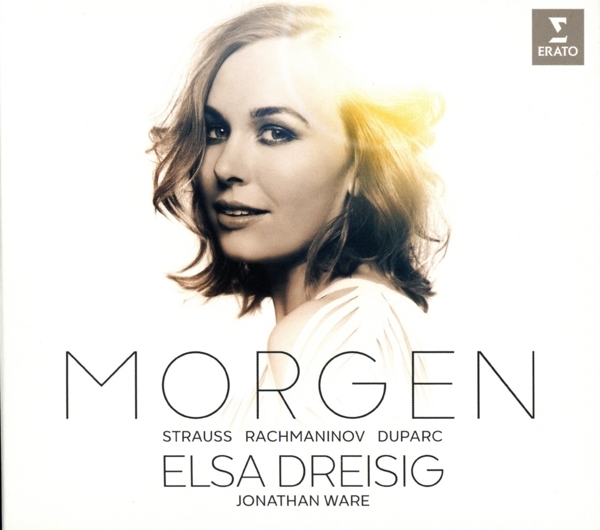
Elsa Dreisig’s Morgen

morgen

Now this is rather special. The young French/Danish soprano Elsa Dreisig follows up her excellent debut album of operatic excerpts with this beautifully compiled recital of songs for voice and piano, showing that she is equally at home in the more intimate surroundings of the recital room. The programme is an interesting one with the piano accompanied versions of Strauss’s Vier letzte Lieder (plus his final ever song Malven) split up and inserted into different points of the recital. The songs weren’t orginally planned as a cycle in any case, and this makes for some fascinating juxtapositions. The rest of the programme is made up of songs by Rachmaninov and Duparc and leads us on a most satisfying journey, “an inner journey across the seasons of the soul,” as Dreisig writes in the accompanying notes.

The North Star, our guide, is Strauss with these Four Last Songs (or five if we count Malven, his final song), in conversation with Duparc and Rachmaninov. Starting at the dawn of Spring and of youth, we visit Summer and its passions then, by way of Autumn nights and the dreamlike world of sleep, we come face to face with the unknown and with passing time. A journey of initiation, one that allows us to contemplate loss and death, thinking all the while of tomorrow: morgen.

Save for Rachmaninov’s The Pied Piper the mood is generally dreamy and Dresig and her accompanist, the superb Jonathan Ware, create spell bindng magic, drawing us in to their carefully crafted programme. Dreisig’s voice is a lovely, lyric soprano with a pearly, opalescent radiance that suits all these songs perfectly, but she is much more than a lovely voice. What is unusual is her rare gift for communication, her innate musicality and the specificity of her response to all these songs.

The highlights for me are her languidly dreamy and erotic rendition of Duparc’s Phidylé and Extase, Rachmaninov’s At Night In My Garden, and all the Strauss items gorgeously sung, yet with due attention to the text. I do hope Dresig will soon get to record the orchestral version of his Vier letzte Lieder. Ware plays magnificently, probably the best version of the piano accompaniment I have ever heard, but I do miss Strauss’s glorious orchestration. A total contrast is afforded  when she follows it with her superbly suggestive singing of Rachmaninov’s The Pied Piper, which shows off admirably her brilliant gift for characterisation, but really there isn’t a dud in the whole recitial

This is a wonderful disc and one of the best soprano song recitals I have heard in a very long time. Start the disc from the beginning and allow these artists to take you along on their journey. One listen quickly became two. Dreisig turns thirty this year. Let us hope that the pandemic has not stimmied a career that was just starting to get going. Warmly recommended.

Sawallisch’s Capriccio

51nttj-dujl

Richard Strauss’ final opera can sometimes seem wordy and long-winded, but in a performance such as this it is anything but boring.

This luxury cast is just about as perfect as any you are likely to hear, all the singers giving due attention to the words. The Countess Madeleine was always one of Schwarzkopf’s best roles, and she steers a perfect course between sophistication and elegance, between playfulness and tender affection. It is one of her greatest achievements for the gramophone, her radiant singing of the gorgeous closing scene a perfect rounding up of the whole opera. If the opera asks the question, “which should come first, words or music,” there is no doubt which side Strauss himself comes down on. The male voices – Gedda as the dreaming composer Flamand, Fischer-Dieskau as the more impulsive poet Olivier, Wächter as the flirtatious Count, and, last but not least, Hotter as the harassed theatre director La Roche are all wonderfully characterised. Ludwig is a superb Clairon and we even have the young Moffo as the Italian Singer. Sawallisch is a marvellously experienced Strauss conductor and presides over a recording that has become a classic of the gramophone.

The recording was apparently planned in stereo, but technical problems meant it ended up being recorded in mono, which no doubt pleased Walter Legge, as he mistrusted stereo.  Nonetheless it is wonderfully well balanced with the voices as they should be, especially in a conversational piece like this, firmly in the foreground.

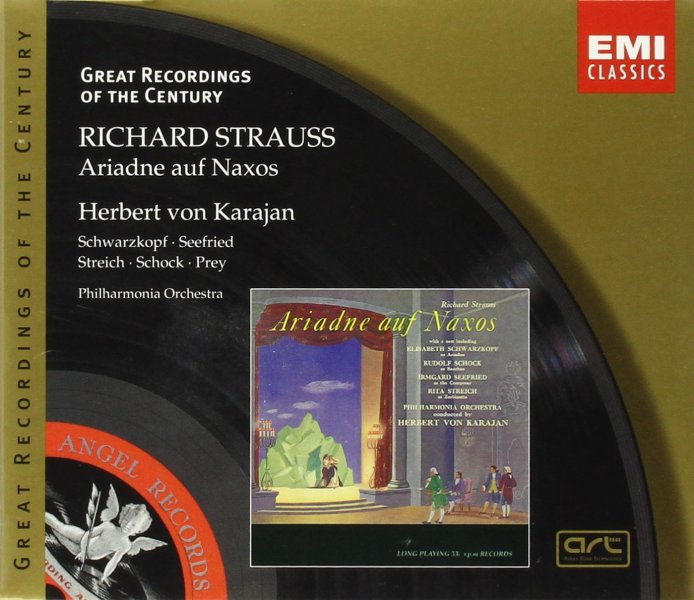
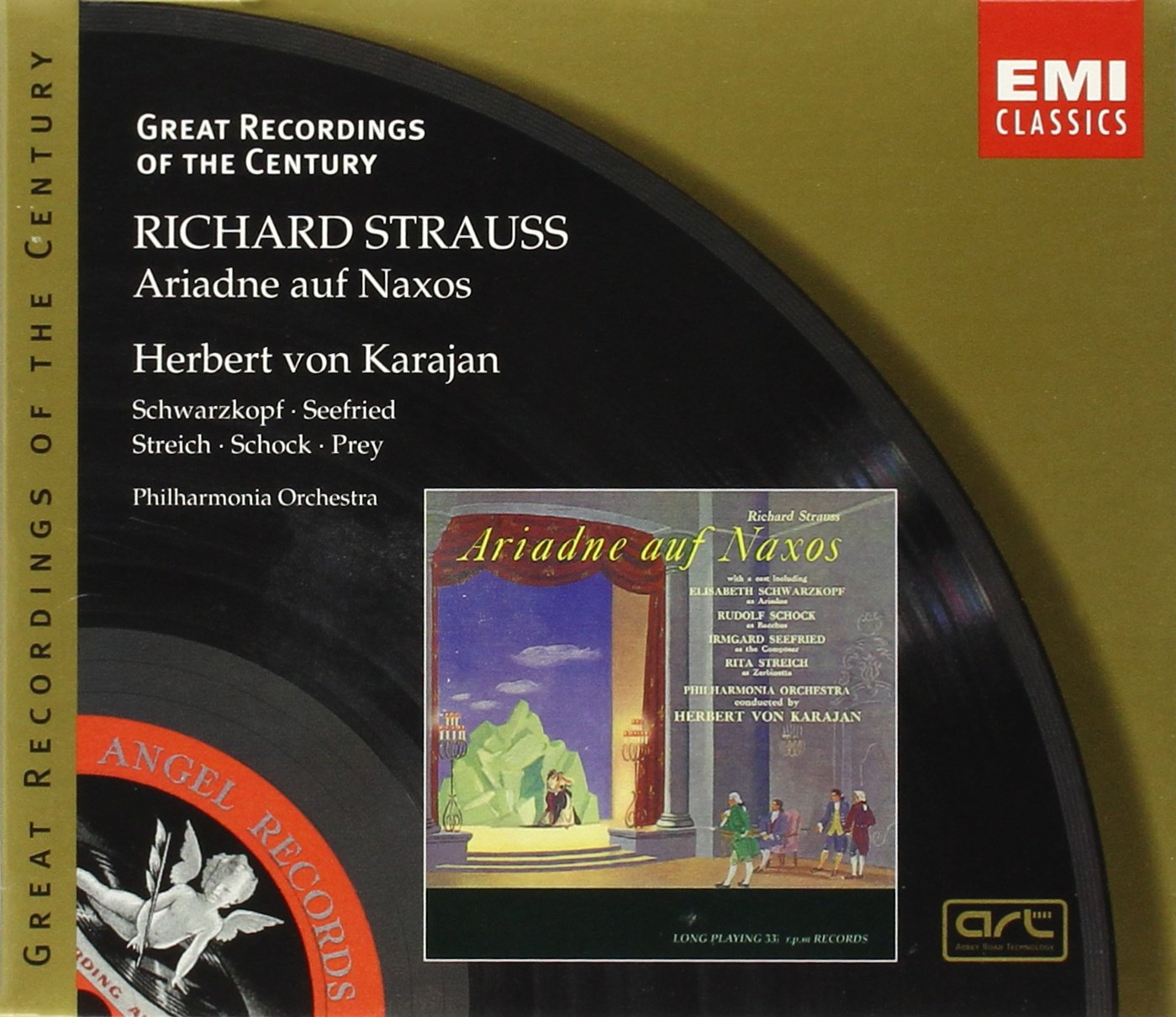
Karajan’s Ariadne auf Naxos

71tw4z8spgl._sl1399_

My first encounter with Ariadne auf Naxos was a scenically splendid Glyndebourne Touring Opera production, which I saw in Newcastle-upon-Tyne in 1971. I’d never heard a note of the music before, but enjoyed it immensely.

However it was quite some time before I bought a recording, and this classic brilliantly cast 1954 recording was my choice. The years haven’t dimmed its lustre and I simply cannot imagine a better all round performance.

Has there ever been a more impetuously ardent Composer than Seefried? I doubt it; and it’s good to hear a soprano in the role, as Strauss indicated. Schwarzkopf’s Ariadne is not only gloriously sung, but, as always with this artist, with due attention to the words, and she does a fine parody of herself in the prologue. Streich’s adorable Zerbinetta manages to be both sparkily flirtatious and sympathetic, and the accuracy of her coloratura is stunning. Rudolf Schock’s dryish tenor might not offer quite the same sensual delights, but he also sings with intelligence and attention to the text.

The supporting roles are all superb too, especially Karl Dönch’s Musicmaster, Hugues Cuénod’s Dancing Master and the young Hermann Prey’s Harlequin. One should also mention Alfred Neugebauer’s laconic Major-Domo.

Karajan has the full measure of the score and the Philharmonia play brilliantly for him. Mono of course, but wonderfully well balanced recording. I’ve never felt the need to look elsewhere.

The Sawallisch Arabella

81q1t0g5c2l._sl1200_

Arabella is one of Strauss’s most performed operas and there are quite a few complete recordings available, the most famous probably being the Decca set with Lisa Della Casa, who, for many years, was renowned for her portrayal of the leading role.

The main problem with that studio recording, though, is Solti’s hard driven, perfunctory conducting. I think I read somewhere it was his first complete opera recording for Decca, and even his greatest fans admit that he sounds as if he had little sympathy for his task, whereas Sawallisch’s conducting on this set is one of its principal glories, as is the wonderfully warm digital sound.

There are other reasons to treasure the performance here however, not least the performances of Julia Varady as Arabella and Helen Donath as Zdenka. Varady’s husband, Fischer-Dieskau was in his mid 50s at the time of the recording, and it has to be admitted that he does sound a bit over the hill at times, with an occasional tendency to bark. Nonetheless he makes a sympathetic Mandryka, without exactly eclipsing memories of Josef Metternich, who sings Mandryka on a superb excerpts disc with Schwarzkopf as Arabella, which I reviewed as part of the Schwarzkopf Recital box in May last year (what a shame they didn’t record the full opera).

The opera still has its problems, it seems to me. Invariably Zdenka emerges as the more sympathetic character, as she does here, despite Varady’s gorgeous, creamy Arabella. I remember that  my first encounter with the opera was the film with Janowitz as Arabella, and my sympathies were all with Matteo! The Fiakermilli music always seems pointless and empty to me too, and there are quite a few places where my attention wanders. Maybe Schwarzkopf was right just to record excerpts.

Still, if you enjoy the opera, this is a very fine recording.

The Schwarzkopf/Karajan Rosenkavalier

190295771560

This recent re-mastering of Karajan’s famous 1956 recording of Der Rosenkavalier, overseen by the producer of the original stereo version, Christopher Parker, really is the best you are ever likely to hear. Parker has slightly adjusted the balance in the big trio and it really makes a big difference, Stich-Randall now not so shrill and blending better with Schwarzkopf and Ludwig.

What a performance it is, with a cast that could hardly be bettered anywhere, Schwarzkopf’s warmly feminine, noble Marschallin dominating the opera, as she should. Her singing is wonderfully detailed, Hofmannsthal’s text superbly brought to life, and at this point it is good to remember the excellence of the libretto, which could almost stand as a straight play. Though the opera is filled with gorgeously soaring melodies, it is also quite wordy in places and it is important that the text is understood. Schwarzkopf is everything a Marschallin should be, tenderly playful with Octavian in the opening scene and philosophically reflective at the end of the act. In the last act, she is respectfully authoratative with the Police Commisioner, imperiously commanding in her dealings with Ochs, all tender solicitude with Sophie and magnanimously forgiving with Octacvian. Even just listening to her you can see every fleeting facial expression, and I smply cannot understand those who bandy about the usual criticisms of over-artfulness and mannerism, especially when the lyrical moments are also filled with such gloriously refulgent tone. This might just be Schwarzkopf’s greatest achievement on disc and is one of the greatest operatic characterisations ever committed to disc.

Ludwig’s ardently impetuous Octavian is the perfect foil for this Marschallin, and if she doesn’t have quite the same matchless control over her resources as Schwarzkopf, the extroverted outpouring of tone suits the character of Octavian to a nicety. Stich-Randall is a  slightly white-voiced Sophie, suitably innocent and naïve, sailing up to those stratospheric notes with a silvery purity second to none, and Edelmann remembers that Ochs may be a boor, but that he is also a nobleman and he too is excellent at putting across the text.

Wonderful support from the likes of Gedda as the Italian tenor, Wächter, a wonderfully fussy Faninal and Welitsch as the Duenna, with a plethora of well known names amongst the supporting cast.

Karajan’s direction is just right in every phrase, beautifully managing the dance elements of the score, whilst giving the many lyrical moments their due. He always knows just how to build to the climaxes and his sense of the structure of the opera is spot on, his pacing both quicksilver and expansive. Just to make our cup runneth over we have the Philharmonia on top form.

The recording may have been made in 1956, but sounds absolutely splendid in this latest remastering. My top recommendation for the opera, as it was for Richard Osborne on a fairly recent BBC Building a Library episode, and I don’t see that changing any time soon.

Two Contrasting Vocal Recitals

71mojlgie4l._ac_sl1073_

Dame Maggie Teyte in concert, at the age of sixty no less! Teyte, a famous Mélisande who studied the role with Debussy himself, sings extended excerpts from the opera with piano accompaniment, singing all the roles. It shouldn’t work, but somehow it does. It takes her the first song in the recital (Grétry’s Rose chérie) to warm up, but thereafter you would never believe this was the voice of a sixty year old woman. The disc also includes privately recorded excerpts from Strauss’s Salome also with piano, from when Teyte was preparing the role for Covent Garden about fifteen years earlier, a project that unofrtunately never came to fruition. Her bright, slivery soprano might just have been the voice Strauss imagined.

She also sings Britten’s Les Illuminations in a version for piano, making me wish she had recorded the orchestral version, although preferably a few years earlier. Just occasionally there is a flicker of frailty in the middle voice, although the top register remains firm and clear as a bell. The encores include a lovely performance of Hahn’s popular Si mes vers avaient des ailes.

r-2563085-1290611066.jpeg

Another enterprising disc from Dawn Upshaw, who seems to have disappeared from the scene now. The centrepiece is Earl Kim’s Where grief slumbers written in 1982 for voice, harp and string orchestra, but here presented in a 1990 arrangement for voice, double string quartet and harp, and Upshaw is an ideal interpreter. She is equally at home in the rest of the programme; Falla’s Psyché, Ravel’s Trois poèmes de Stéphane Mallarmé, Stravinsky’s Two poems of Konstantin Bel’mont and Three Japanese Lyrics and Delage’s Quatre poèmes hindous, though here I slightly prefer the warmer tones of Dame Janet Baker, who is much more languidly erotic in the worldess vocalise of Lahore. Nevertheless a thoroughly absorbing disc.

As with so many of these Nonsuch discs, documentation is slight, and, though we do get lyrics and translations, the layout is confusing and a little more information about the provenance of these songs, especially the less famous Kim cycle, would have been much appreciated.

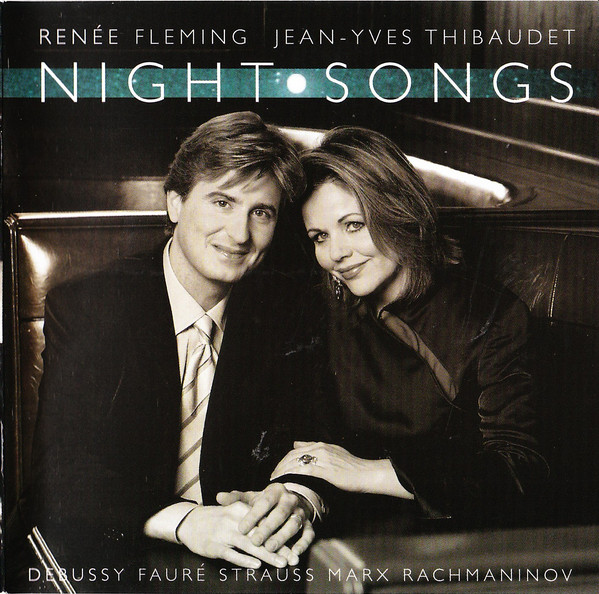
Renée Fleming – Night Songs

r-4527951-1426190336-3065.jpeg

Where does the time go? I can’t believe it is almost twenty years since I worked with Renée Fleming when the London Symphony Orchestra put on a semi-staged production of Previn’s A Streetcar Named Desire at the Barbican Hall with Previn himself conducting. I only had a very minor role, but I found Fleming to be a very gracious lady, an arch professional and a conscientious artist. The rehearsals and performances are amongst my fondest memories and I will never forget the experience of hearing that voice close to, with her literally singing into my ear on occasion. The final Korngold-like aria Blanche sings before being taken away to the asylum was possibly one of the most beautiful things I have ever heard.

I mention this to put into context my reactions to listening to this recital, which I wanted to like much more than I did. The recording was made in 2001 when the voice had acquired a new richness in the middle and lower ranges whilst retaining its beauty and ease up on high, even throughout its compass and admirably firm, with no trace of hardness when singing at full tilt. As it seems now we have said goodbye to Fleming, the classical arists it is good to be reminded that this was one of the most ravishing instruments of the last thirty years or so. She has always had a fairly eclectic repertoire which embraced both opera and song, covering a wide range of different composers and styles, but I’ve always thought her best suited to the music of Mozart and Strauss.

Hence it is the songs by Strauss and Joseph Marx which make the stongest impression, especially Cäcilie, its radiant close easily and ravishingly voiced. The Marx songs suit her well too, their sensuous expressivity responding well to the heady beauty of Fleming’s voice. Thibaudet is also superb in the tricky accompaniments, tossing off their difficulties as if they are the easiest things in the world.

Elsewhere I am not so sure this operatic vocal effulgence is what I want to hear. I found myself longing for the greater simplicity and cleaner vocal production of a Victoria De Los Angeles in the Fauré, the slight touch of irony and cool detachment brought to Debussy’s Chansons de Bilitis by a Régine Crespin. The Rachmaninov, with their heavier accompaniments, perhaps respond better to this operatic treatment, but I find it just too sophisticated and even here I prefer a slightly simpler, more direct approach.

However enjoyable it is to hear one of the most beautiful voices of recent times whatever the circumstances, ultimately there are other discs I would pull out first when wanting to sample Fleming at her best.

Ljuba Welitsch – Complete Columbia Recordings

Ljuba Welitsch, for the short time her star was in the ascendant, was undoubtedly a star, glamorous both of voice and personality. Renowned the world over for her Salome, a role in which Strauss himself had coached her, she was also known for her Tosca and Donna Anna. Unfortunately she had developed nodules by 1953 and thereafter, though she didn’t retire completely, confined herself to character roles, like the Duenna in the Schwarzkopf/Karajan recording of Der Rosenkavalier.

This two disc set showcases her Salome, Donna Anna and Tosca, as well as Johann Strauss (the Czardas from Die Fledermaus and Saffi’s Gypsy Song from Der Zigeunerbaron). The rest is devoted to Lieder and songs by Brahms, Schubert, Schumann, Darogmizhsky, Mussorgsky, Marx, Mahler and Strauss, all with piano accompaniment, even the Vier letzte Lieder.

Whilst we get a good impression of the glamour and the silvery purity on high, the recordings do also rather show up her limitations. Best of the items is the 1949 recording of the Final Scene from Salome under Reiner, though, even here, I prefer the earlier performance she made under Lovro von Matacic in 1944, which, to my mind, has a greater degree of specificity. There is just the suspicion here that she had sung the role too many times; there is a touch of sloppiness in the delivery, which is complelely absent from the earlier recording.

She makes an appreciable Tosca, and something of her stage personality comes across here, but, I hear little of Callas’s detail or Price’s or Tebaldi’s vocal opulence and Tucker makes an unseductive Cavaradossi in the Act I Love Duet. A tendency to be careless of note values is even more evident in the Donna Anna excerpts, where we also become aware of an unwillingness to vary the volume or colour of her singing. She also has an annoying tendency to rush the beat. John Steane also had some misgivings in his book The Grand Tradition.

It is hard to think of a voice with a brighter shine to it, or of a singer with greater energy and more sense of joy in that sheer act of producing these glorious sounds. Even here, however, one notes that subtlety is hardly in question; there is little of the lithe seductiveness which Schwarzkopf and Güden bring to the [Fledermaus] Czardas, for instance. And this limits much of her best work, even the Salome in which she made such an exciting impression on her audiences.

We also note the complete absence of a trill in both Donna Anna’s Non mi dir and the Czardas from Die Fledermaus.

These limitations are even more evident in the songs with piano, and, though there is still much to enjoy in disc one, I found much of disc two something of a trial to listen to, the voice just too bright and unrelentingly mezza voce. The Strauss Vier letzte Lieder can work with piano, as witness a recording by Barbara Bonney, but here I just longed for the greater subtlety and range of expression of Schwarzkopf or Popp, of Norman or Fleming. The Mahler had me thinking of the shattering Lorraine Hunt Lieberson in the piano accompanied version, and the Schubert and Schumann songs hardly begin to challenge versions by a range of different sopranos from Welitsch’s time onwards.

If I were to choose but one representation of Welitsch’s art, it would absolutely be the 1949 live recording from the Met of Salome under Reiner, but, for a recital I’d go for EMI’s old LP and CD transfer of the 1944 Salome Final Scene, which also has on it a glorious version of Tatyana’s Letter Scene from Eugene Onegin, a disc I reviewed a couple of months back here. This present two disc set is, I’m afraid, a mite disappointing.