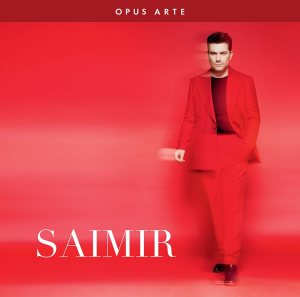
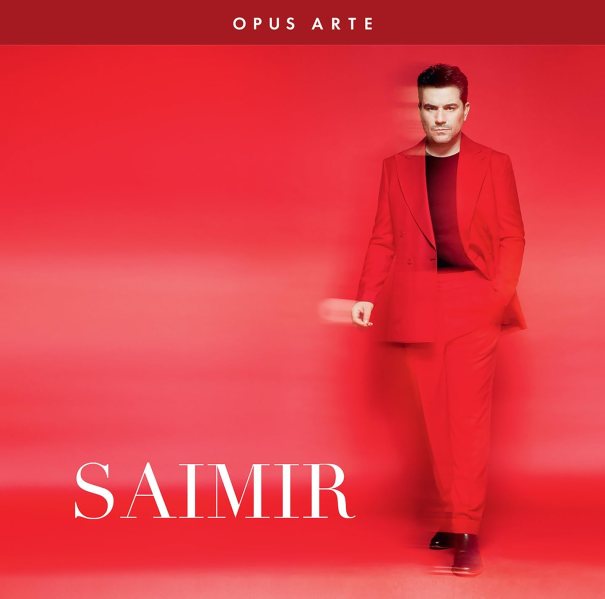
Saimir Pirgu sings operatic arias

Ten years ago I saw Saimir Pirgu as the Duke in the Royal Opera House’s David McVicar production of Rigoletto. Though he looked splendid and dashing, he was utterly charmless and I found his singing stiff and monochromatic. Since then, he seems to have ventured into more dramatic repertoire, and this recital of mostly verismo arias comes as a follow-up to a 2015 album of more lyrical fare, which I haven’t heard.

The present recital was very well received by my colleague, Göran Forsling in October of last year (review) but I’m afraid I can’t join in with his praise. For a start, Pirgu’s basic production is terribly ingolata, so much so that his singing was giving me a sore throat. There is no freedom to the sound and, when I compare him to the greats of the past, from Caruso to Björling to Pavarotti, all I hear is his struggle to get the sound out. There is no ring at the top and the middle voice is forced, resulting in a distressing vibrato. Indeed, he sounds a good deal older than his forty-two years.

Added to that, he doesn’t really do anything with the music and here his conductor, Antonio Fogliani, must take some of the blame, for his conducting is dull and prosaic. Most of the arias on the disc are well known but, with so many other versions out there, this just isn’t competitive.

I tried listening to the recital several times, thinking that maybe it had something to do with my mood, but, no, each time my reactions were the same. I just couldn’t get past Pirgu’s basic vocal production and I found it difficult to relax and enjoy the music. I hate to be so negative, but this is a disc for fans of Pirgu only, if indeed they exist.

Contents.

  1. Puccini: Manon Lescaut – “Indietro!… Guardate, pazzo son” 
    2. Puccini: Tosca – “E lucevan le stelle”
    3. Leoncavallo: Chatterton – “Non saria meglio… Tu sola a me” 
    4. Giordano: Andrea Chénier – “Colpito qui m’avete… Un dì all’azzurro spazio” 
    5. Puccini: Le villi – “Ecco la casa… Torna ai felici dì”
    6. Puccini: Manon Lescaut – “Donna non vidi mai” 
    7. Cilea: Adriana Lecouvreur – “L’anima ho stanca”
    8. Wagner: Lohengrin – “In fernem Land”
    9. Berlioz: La Damnation de Faust – “Nature immense”
    10. Tchaikovsky: Eugene Onegin – “Introduction”
    11. Tchaikovsky: Eugene Onegin – “Kuda, kuda, kuda vi udalilis”
    12. Puccini: Il tabarro –  “Hai ben ragione” 
    13. Bizet: Carmen – “La fleur que tu m’avais jetée”
    14. Puccini: Turandot – “Non piangere, Liù”
    15. Jakova: Skenderbeu – “Kjo zemra ime”
    16. Puccini: Tosca – “Recondita armonia” (with Vito Maria Brunetti (bass))
    17. Giordano: Andrea Chénier – “Come un bel dì di maggio” 
    18. Puccini: Madama Butterfly – “Addio, fiorito asil” 
    19. Giordano: Fedora – “Amor ti vieta”
    20. Sorozábal: La taberna del puerto – “No puede ser”
    21. Puccini: Turandot – “Nessun dorma!”


Reflet – Sandrine Piau sings French orchestral songs

81uc3fhnuwl._ac_sl1500_

I know Sandrine Piau principally as a singer of Baroque and Classical music, but she has recently been venturing into the nineteenth and twentieth centuries and this is the second disc in a series, which began with a disc of orchestral songs by Strauss, Berg and Zemlinsky entitled Clair-Obscur. The notes accompanying the disc tell us that that earlier disc sought to explore “the confrontation between shadow and light,” whilst this one “evokes the nuances and transparencies of the French mélodie.”

Essentially what we have here is a nicely put together programme of French orchestral song, starting with Berlioz and taking us through to Britten’s early Ravelian Quatre chansons Françaises via Duparc, Koechlin, Debussy and Ravel himself. The programme is not long (under an hour) and is fleshed out with André Caplet’s orchestration of Debussy’s Clair de lune and Ernest Ansermet’s of the sixth of his 6 Epigraphes antiques. Admirably as the orchestra plays throughout under Verdier, these add very little to the programme and I would have welcomed more songs, maybe something by Chausson, Delage or Canteloube, or more by Koechlin, who is not so well represented in the catalogue. If I’m honest, I prefer the Debussy items in their original piano guise. Unlike Ravel’s orchestrations of his own piano pieces, the arrangements don’t really improve on the originals.

The Koechlin songs were new to me, and I rather wish Piau had explored more than the three we have here. If they pique your curiosity, as they did mind, then they are available sung by Juliane Banse, along with a lot more of Koechlin’s vocal works with orchestra, in a two disc set in Hänssler’s Koechlin edition. What we have here is two songs from his early 4 poèmes d’Edmond Haraucourt. Op.7, and one from the slightly later 3 mélodies, Op. 17. If they lack some of Duparc’s natural melodic gift, they are nonetheless lushly orchestrated and rather beautiful  and make an excellent partner for the two Duparc songs.

If the Koechlin songs afforded me the most pleasure, that could be because I didn’t know them before and therefore had no point of comparison, whereas I know all the other material rather well. I’ve loved the Britten songs since they were first recorded in the 1980s. Admittedly one can hear the influence of Ravel, particularly of Shéhérazade, but they are remarkably assured from a boy of fourteen and they do not feel out of place here, whilst the sparer textures of Ravel’s Mallarmé settings, written for two clarinets, two flutes, piano and string quartet, provide a nice contrast to the lush orchestrations of the rest.

Piau is now in her fifties and the voice has lost a little of its bloom on high. She also uses what the late John Steane once referred to as a squeeze-box method of vocal production, a tendency to move note by note rather than in a long line, which, once noticed, is hard to ignore. I also hear a slight sense of strain in the Britten songs, particularly at the close of the final song, which is not as radiant as it should be, and as it is in the performances of Jill Gomez, who made the first recording of them for EMI under Simon Rattle, and Felicity Lott, who recorded them for Chandos under Bryden Thomson.

The opening Berlioz Le spectre de la rose is taken a mite too fast for my taste and is a little on the cool side, but it does rather set the general tone of the recital. If you like it, then you will no doubt like the whole disc, but I found Piau a little lacking in involvement, a little detached.

I don’t want to belabour the point too much, because this is a very enjoyable programme, well considered and well put together and, for the most part, Piau’s singing is quite lovely, but, in the Berlioz, Duparc, Ravel and Britten, I found myself inwardly hearing the voices of some of those who have preceded her. Still, if you’re looking for a mixed programme of nineteenth and early twentieth century French orchestral song, then this disc will provide a lot of enjoyment.


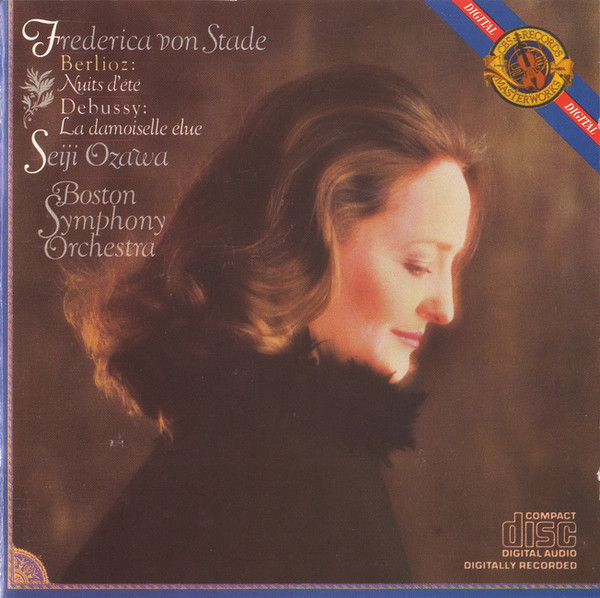
Frederica Von Stade sings Berlioz and Debussy

odqtodm0os5qcgvn

This is a wonderful disc and if it had been in my collection when I did my mini survey of recordings of the Berlioz (Berlioz’s Les Nuits d’Eté – a comparative review of ten recordings) it would no doubt have jostled for top position with my top three of Baker/Barbirolli, Hunt Lieberson/McGegan and Steber/Mitropoulos. My personal favourite would still be the Baker and, like Baker, I would suggest that Von Stade has the perfect voice for this group of songs. Though Berlioz had originally wanted the songs to be sung by different voices, a single voice does bring a certain homogeneity to the cycle, even if few can encompass its demands. Von Stade’s mezzo, with its soprano-ish top and firm lower register (down to a beautifully sounded low F# in Sur les lagunes) seems to me to be the perfect instrument for it. Furthermore she captures the gaiety of the outher songs as easily as she does the deeper emotions of the middle songs. There is a real sense of yearning in Absence, profound despair in Sur les lagunes and a resigned sadness in Au cimetière. Le spectre de la rose is very beautiful, rising to a gorgeous climax before sinking back gently to its bittersweet ending.

The Boston Symphony Orchestra play beautifully for Ozawa, much better than, say, the Suisse- Romande for Crespin and Ansermet or the Philharmonia Baroque for Hunt Lieberson and McGegan and, all in all, this is for me one of the very best versions in the catalogue.

The coupling of Debussy’s La damoiselle élue is equally fine, though I find the timbre of Susanne Mentzer’s Récitant a little too similar to Von Stade’s. Still, Von Stade captures a sort of visionary faith in her singing which is most attractive. Orchestra and chorus are likewise superb and, though the work is not the best of Debussy, it almost seems so in a performance as fine as this one.

A lovely disc.

A list of my preferred opera recordings

I hesitate to call this a list of recommended opera recordings, because people’s tastes are so different, but it is a list of my preferred recordings and, as such, it is obviously influenced by my liking for certain artists. It is also derived from over 50 years of listening to and collecting opera recordings and includes recordings that are or were once available on LP and CD, because, despite the current trend for everything to be downloaded onto a computer, I still prefer to listen to CDs. In some cases I have included more than one recording of a piece, usually because I can’t decide which one I like best. I’m also pretty sure that, with a couple of exceptions. all my chosen recordings date from the LP era onwards.

A word about Wagner. I am not really a Wagnerite. I enjoy Wagner from time to time, but I find that, more than with other composers, the sound of the orchestra takes precedence for me, which is why all the recordings I have chosen are studio recordings in decent stereo sound, which thererore excludes the names of many great Wagnerians of the past, such as Flagstad, Leider, Melchior, Furtwängler etc.

No doubt many of my readers will disagree with some of my choices, but I think it’s a pretty sound list. Peruse at your leisure.

Barber: Vanessa – Steber, Elias, Resnik, Gedda, Tozzi; Mitropoulos

Bartók: Bluebeard’s Castle – Ludwig, Berry; Kertesz

Beethoven: Fidelio Dernesch, Donath, Vickers, Kéléman, Ridderbusch; Karajan

Bellini: I Capuleti e I Montecchi – Sills, Baker, Gedda, Herincx, Lloyd; Patané

Bellini: NormaCallas, Simionato, Del Monaco, Zaccaria; Votto La Scala 1955 (live) or Callas. Ludwig, Corelli, Zaccaria; Serafin (studio)

Bellini: Il PirataCallas, Ferraro, Ego; Rescigno New York 1959 (live) -or- Caballé, Martí, Cappuccili; Gavazzeni (studio)

Bellini: I PuritaniCallas, Di Stefano, Panerai, Rossi-Lemeni; Serafin

Bellini: La SonnambulaCallas, Valletti, Modesti; Bernstein la Scala 1955 (live) or Callas, Monti, Zaccaria; Votto/Cologne 1957 (live) or Callas, Monti, Zaccaria; Votto (studio)

Berlioz: Béatrice et Bénedict – Eda-Pierre, Baker, Watts, Tear, Allen, Lloyd, Bastin; Davis

Berlioz: Benvenuto Cellini – Eda-Pierre, Berbié, Gedda, Massard, Bastin, Soyer; Davis

Berlioz: La damnation de FaustVeasey, Gedda, Bastin, Van Allan; Davis

Berlioz: Les Troyens – Lindholm, Veasey, Vickers, Glossop; Davis

Bizet: CarmenCallas, Guiot, Gedda, Massard; Prêtre

Bizet: Les pêcheurs de perles – Cotrubas, Vanzo, Sarabia; Prêtre

Britten: Billy Budd – Langridge, Keenlyside, Tomlinson; Hickox

Britten: Gloriana – Barstow, Kenny, Jones, Langridge, Opie, Summers; Mackerras

Britten: A Midsummer Night’s Dream – Watson, Gomez, Jones, Bowman, Hall, Herford, Maxwell; Hickox

Britten: Peter Grimes – Watson, Pears, Pease; Britten and Harper, Vickers, Summers; Davis

Britten: The Rape of Lucretia – Harper, Baker, Pears, Drake, Luxon, Shirley-Quirk; Britten

Britten: The Turn of the Screw – Vyvyan, Cross, Pears, Mardikian; Britten

Charpentier: Louise – Cotrubas, Berbié, Domingo, Bacquier; Prêtre and Vallin, Lecouvreur, Thill, Pernet; Bigot (abridged)

Chausson: Le roi Arthus – Zylis-Gara, Winbergh, Quilico; Jordan

Cherubini: MedeaCallas, Carron, Berganza, Vickers, Zaccaria; Rescigno, Dallas 1958 (live) or- Callas, Nache, Barbieri, Penno, Modesti; Bernstein, La Scala 1953 (live). If studio/stereo is a must then Callas, Scotto, Pirazzini, Picchi, Modesti; Serafin

Cilea: Adriana Lecouvreur – Scotto, Obrasztsova, Domingo, Milnes; Levine

Debussy: Pelléas et Mélisande – Joachim, Cernay, Jansen, Etchverry, Cabanet; Désormiére (mono) and Von Stade, Denize, Stilwell, Van Dam, Raimondi; Karajan (stereo)

Délibes: Lakmé – Mesplé, Burles, Soyer; Lombard

Delius: A Village Romeo and Juliet – Field, Davies, Hampson; Mackerras

Donizetti: Anna BolenaCallas. Simionato, Raimondi, Rossi-Lemeni; Gavazzeni, La Scala 1957 (live) (Divina transfer, avoid Warner and EMI) It’s cut of course, but no other performance satisfies me.

Donizetti: Don Pasquale – Saraceni, Schipa, Poli, Badini; Sabajno (mono). If stereo is a must then Freni, Winbergh, Nucci; Bruscantini; Muti

Donizetti: L’Elisir d’amore – Cotrubas, Domingo, Wixell, Evans; Pritchard

Donizetti: La fille du régimentSutherland, Sinclair, Pavarotti, Malas; Bonynge

Donizetti: Lucia di LammermoorCallas. Di Stefano, Panerai, Zaccaria; Karajan, Berlin 1955 (live) and Callas, Tagliavini, Cappuccilli, Ladysz; Serafin (studio stereo/Pristine remaster).

Donizetti: Lucrezia Borgia – Caballé, Berbié, Vanzo, Paskalis; Perlea, New York 1965 (live) No studio recording.

Donizetti: Maria StuardaTinsley, Baker, Erwen, Garrard, Du Plessis; Mackerras, ENO 1973 (live in English) or Caballé, Verrett, Garaventa, Arié, Fioravanti; Cillario, La Scala 1971 (live). No studio recording.

Donizetti: Roberto Devereux – Caballé, Marsee, Carreras, Sardinero, Furlanetto; Rudel, Aix-en-Provence, 1977 (live)

Dvořák: Rusalka – Fleming, Zajick, Heppner, Havlata; Mackerras

Enescu: Oedipe – Hendricks, Lipovšek, Gedda, Van Dam; Foster

Fauré: Pénélope – Norman, Taillon, Vanzo, Huttenlocher, Van Dam; Dutoit

Giordano: Andrea Chenier – Scotto, Domingo, Milnes; Levine

Gluck: Orfeo – Baker, Speiser, Gale; Leppard

Gounod: Faust – De Los Angeles, Gorr, Gedda, Blanc, Christoff; Cluytens 1958 (stereo)

Gounod: Roméo et JulietteGheorghiu, Alagna, Keenlyside, Van Dam, Fondary; Plasson

Handel: Hercules – Dawson, Otter, Daniels, Croft, Saks: Minkowski

Handel: Giulio Cesare – Masterson, Baker, Jones, Walker, Bowman, Tomlinson: Mackerras (in English)

Handel: Rinaldo – Organasova, Bartoli, Fink, Daniels, Taylor, Finley; Hogwood

Handel: Theodora – Upshaw, Hunt Lieberson, Daniels, Croft: Christie

Humperdinck: Hänsel und Gretel – Schwarzkopf. Grümmer, Von Islovay, Schürhoff, Metternich: Karajan

Janáček: The Cunning Little Vixen – Popp, Randova, Jedlicka; Mackerras

Janáček: Jenůfa, – Söderström, Popp, Randova, Ochmann, Dvorsky; Mackerras

Janáček: Kat’a Kabanova – Söderström, Kniplova, Dvorsky; Mackerras

Janáček: Vĕc Makropulos – Söderström, Dvorsky, Blachut; Mackerras

Korngold; Die tote Stadt – Neblett, Kollo, Prey, Luxon; Leinsdorf

Lehár: Das Land des Lächelns – Schwarzkopf, Loose, Gedda, Kunz: Ackermann

Lehár: Die lustige Witwe Schwarzkopf, Steffek, Gedda, Wächter, Knapp; von Matačić

Leoncavallo: PagliacciCallas, Di Stefano, Monti, Gobbi, Panerai; Serafin

Mascagni: L’Amico Fritz – Freni, Pavarotti, Sardinero; Gavazzeni

Mascagni: Cavalleria RusticanaCallas, Di Stefano, Panerai; Serafin

Massenet: Cendrillon – Welting, Von Stade, Berbié,  Gedda, Bastin; Rudel

Massenet: ManonDe Los Angeles, Legay, Dens; Monteux

Massenet: Thaîs – Fleming, Sabbatini, Hampson; Abel

Massenet: Werther – Gheorghiu, Pétibon, Alagna, Hampson; Pappano or Von Stade, Buchanan, Carreras, Allen; Davis and Vallin, Féraldy, Thill, Rogue; Cohen

Motemezzi: L’Amore Dei Tre Re – Moffo, Domingo, Elvira. Siepi; Santi

Monteverdi: L’incoronazione di Poppea – Galli, Meijer, Marmeli; Cavina

Monteverdi: L’Orfeo – Cioffi, Gens, Dessay, Bostridge; Haîm

Mozart: La Clemenza di Tito – Baker, Popp, Minton, Von Stade, Burrows; Davis

Mozart: Cosi fan TutteSchwarzkopf, Steffek, Ludwig, Kraus, Taddei, Berry; Böhm

Mozart; Don Giovanni – Sutherland, Schwarzkopf, Sciutti, Alva, Wächter, Taddei, Cappuccilli, Frick; Giulini

Mozart: Die Entführung aus dem Serail – Köth. Schädle, Wunderlich, Lenz, Böhme; Jochum

Mozart: Le Nozze di Figaro – Schwarzkopf, Moffo, Cossotto, Taddei, Wächter, Cappucilli; Giulini

Mozart: Die ZauberfloteLear, Peters, Wunderlich, Fischer-Dieskau, Crass; Böhm or for HIP – Mannion, Dessay, Blochwitz, Scharinger, Hagen; Christie

Mussorgsky: Boris Godunov – Borodina, Vaneev, Galouzine; Gergiev

Offenbach: Les Contes D’Hoffman – Sutherland, Tourangeau, Domingo, Bacquier; Bonynge (studio) or Malfitano, Murray, Domingo, Van Dam; Levine (live)

Offenbach: Orphée aux Enfers – Mesplé, Rhodes, Sénéchal, Burles, Trempont; Plasson

Offenbach: La vie Parisienne – Mesplé, Crespin, Sénéchal, Bénoit, Trempont; Plasson

Ponchielli: La Gioconda Callas, Barbieri, Amadini, Poggi, Silveri, Neri: Votto (mono) or Callas, Cossotto, Companeez, Ferraro, Cappuccilli, Vinco: Votto (stereo)

Poulenc: Dialogues des Carmélites – Duval, Crespin, Berton. Scharley, Gorr, Depraz, Finel; Dervaux

Puccini: La Boheme – De Los Angeles, Amara, Björling, Merrill, Tozzi: Beecham or Callas, Moffo, Di Stefano, Panerai, Zaccaria: Votto

Puccini: La Fanciulla del WestNeblett, Domngo, Milnes; Mehta

Puccini: Gianni Schicchi De Los Angeles, Del Monte, Gobbi: Santini

Puccini: Madama Butterfly Callas, Danieli, Gedda, Borriello; Karajan or De Los Angeles, Canali, Di Stefano, Gobbi: Gavazzeni or Scotto, Di Stasio, Bergonzi, Panerai: Barbirolli

Puccini: Manon Lescaut Callas, Di Stefano, Fioravanti: Serafin

Puccini: La Rondine Gheorghiu, Mula, Alagna, Mateuzzi, Rinaldi: Pappano

Puccini: Suor Angelica De Los Angeles, Marimpietri, Barbieri: Serafin or Scotto, Cotrubas, Horne; Maazel

Puccini: Il Tabarro Mas, Prevedi, Gobbi: Bellezza

Puccini: Tosca Callas, Di Stefano, Gobbi: De Sabata

Puccini: Turandot Callas, Schwarzkopf, Fernandi, Zaccaria: Serafin (mono) or Sutherland, Caballé, Pavarotti, Ghiaurov: Mehta (stereo)

Purcell: Dido and Aeneas – Clark, Baker, Sinclair, Herincx; Lewis

Ravel: L’enfant et les sortileges –  Ogéas, Gilma, Collard, Berbié, Sénéchal, Rehfuss, Maurane; Maazel

Ravel: L’heure espahnole – Berbié, Sénéchal, Gireaudeau, Bacquier, Van Dam; Maazel

Rossini: Armida Callas, Filippeschi, Albanese, Raimondi; Serafin (in atrocious sound, but essential for some of the most incredible dramatic coloratura singing you will ever hear)

Rossini: Il Barbiere di Siviglia Callas, Alva, Gobbi, Ollendorff, Zaccaria: Galliera

Rossini: La Cenerentola – Baltsa, Araiza, Alaimo, Raimondi; Marriner

Rossini: Le comte Ory – Barabas, Sinclair, Oncina, Wallace: Gui

Rossini: Elisabetta, Regina, d’Inghilterra – Caballé, Masterson, Carreras, Benelli: Masini

Rossini: Guillaume Tell – Caballé, Mesplé, Taillon, Gedda, Cassinelli, Bacquier, Howell, Kovats; Gardelli

Rossini: L’Italiana in Algeri – Pace, Baltsa, Lopardo, Corbelli, Dara, Raimondi; Abbado

Rossini: Semiramide – Penda, Pizzolato, Osborne, Regazzo: Fogliani (complete) or Sutherland, Horne, Serge, Malas; Bonynge (abridged)

Rossini: Il Turco in Italia – Callas, Gardino, Gedda, Stabile, Calabrese, Rossi-Lemeni; Gavazzeni

Saint-Saens: Samson et Dalila – Baltsa, Carreras, Summers, Estes, Burchaladze; Davis

Shostakovich: Lady Macbeth of Mtsensk – Vishnevskaya, Gedda, Petkov; Rostropovich

J Strauss: Die FledermausSchwarzkopf, Streich, Gedda, Krebs, Christ, Kunz; Dönch; Karajan

J Strauss: Eine Nacht in Venedig – Schwarzkopf, Loose, Gedda, Kunz; Ackermann

J Strauss: Wiener Blut – Schwarzkopf, Köth, Loose, Gedda, Kunz; Ackermann

J Strauss: Der Zigeunerbaron – Schwarzkopf, Köth, Burgsthaler-Schuster, Gedda, Prey, Kunz: Ackermann

R Strauss: Arabella Varady, Donath, Dallapozza, Fischer-Dieskau; Sawallisch and Schwarzkopf, Felbermeyer, Gedda, Metternich; von Matacic (highlights)

R Strauss: Ariadne auf NaxosSchwarzkopf, Streich, Seefried, Schock; Karajan

R Strauss: Capriccio Schwarzkopf, Ludwig, Gedda, Wächter, Fischer-Dieskau, Hotter; Sawallisch

R Strauss: Elektra – Marton, Studer, Lipovsek, Winkler, Weikl; Sawallisch

R. Strauss: Die Frau ohne Schatten – Studer, Vintzing, Schwarz, Kollo, Muff: Sawallisch

R Strauss: Der Rosenkavalier – Schwarzkopf, Stich-Randall, Ludwig Wächter, Edelmann; Karajan

R Strauss: Salome – Welitsch, Thorborg, Jagel, Janssen; Reiner (live mono) and Behrens, Baltsa, Schmitt-Walter, Van Dam; Karajan (studio stereo)

Szymanowski: Król Roger – Szmytka, Langridge, Hampson; Rattle

Tchaikovsky: Eugene OneginVishnevskaya, Avdeyeva, Lemeshev, Belov, Petrov; Khaikin

Tchaikovsky: Mazeppa – Gorchakova, Dyadkova, Larin, Leiferkus, Kotcherga; Järvi

Tchaikovsky: Queen of Spades – Guleghina, Borodina, Arkhipova, Grigorian, Chernov, Putilin; Gergiev

Verdi: AidaCallas, Dominguez, Del Monaco, Taddei; de Fabritiis (live) and Callas, Barbieri, Tucker, Gobbi; Serafin (studio mono) or Caballé, Cossotto, Domingo, Cappuccilli; Muti (studio stereo) or Freni, Baltsa, Carreras, Cappuccilli; Karajan (studio stereo)

Verdi: Alzira – Cotrubas, Araiza, Bruson; Gardelli

Verdi: Aroldo – Caballé, Cecchele, Pons, Lebherz; Queler

Verdi: Attila – Deutekom, Bergonzi, Milnes, Raimondi; Gardelli

Verdi: Un Ballo in Maschera Callas, Barbieri, Di Stefano, Gobbi; Votto (studio) and Callas, Simionato, Di Stefano, Bastianini; Gavazzeni (live)

Verdi: La Battaglia di Legnano – Ricciarelli, Carreras, Manuguerra, Ghiuselev; Gardelli

Verdi: Il Corsaro – Caballé, Norman, Carreras, Mastremei; Gardelli

Verdi: Don Carlo Freni, Baltsa, Carreras, Cappuciolli, Ghiaurov, Raimondi; Karajan (4 acts in Italian), Caballé, Verrett, Domingo, Milnes, Raimondi, Giaotti; Giulini (5 acts in Italian) and Ricciarelli, Valentini-Terrani, Domingo, Nucci, Raimondi, Ghiaurov; Abbado (5 acts in French)

Verdi: I due Foscari – Ricciarelli, Carreras, Cappuccilli, Ramey; Gardelli

Verdi: Ernani – Price, Bergonzi, Sereni, Flagello; Schipeers

Verdi: Falstaff – Schwarzkopf, Moffo, Merriman, Barbieri, Alva, Panerai, Gobbi; Zaccaria; Karajan

Verdi: La Forza del Destino Callas, Nicolai, Tucker, Tagliabue, Rossi-Lemeni; Serafin

Verdi: Un Giorno di Regno Pagliughi, Cozzi, Oncina, Bruscantini, Capecchi, Dalmangas; Simonetto

Verdi: Giovanna d’Arco – Caballé, Domingo, Milnes; Levine

Verdi: I Lombardi – Sass, Lamberti, Di Cesare, Kovats; Gardelli

Verdi: Luisa Miller – Moffo, Verrett, Bergonzi, MacNeil, Tozzi, Flagello; Cleva or Caballé, Reynolds, Pavarotti, Milnes, Giaotti, Van Allan; Maag or Ricciarelli, Obraztsova, Domingo, Bruson, Howell, Ganzarolli; Maazel

Verdi; Macbeth Callas, Penno, Mascherini, Tajo; De Sabata (live) and Verrett, Domingo, Cappuccilli, Ghiurov; Abbado (studio)

Verdi: I Masnadiert – Caballé, Bergonzi, Cappucilli, Raimondi; Gardelli

Verdi; Nabucco – Souliotis, Carral, Prevedi, Gobbi, Cava; Gardelli and (essential supplement, but awful sound) Callas, Pini, Sinimbergi, Bechi, Neroni; Gui

Verdi: Otello – Rysanek, Vickers, Gobbi; Serafin and Scotto, Domingo, Milnes; Levine

Verdi: Rigoletto Callas, Lazzarini, di Stefano, Gobbi, Zaccaria; Serafin

Verdi: Simon Boccanegra – Freni, Carreras, Cappucilli, Ghiaurov, Van Dam; Abbado and De Los Angeles, Campora, Gobbi, Christoff, Monachesi; Santini

Verdi: Stiffelio – Sass, Carreras, Manugeurra, Ganzarolli; Gardelli

Verdi; La Traviata Callas, Valletti, Zanasi; Rescigno, Covent Garden 1958 (live) and Cotrubas, Domingo, Milnes; Kleiber (istereo studio)

Verdi: Il Trovatore – Callas, Barbieri, Di Stefano, Panerai, Zaccaria; Karajan

Verdi: I Vespri Siciliani – Callas, Kokolis-Bardi, Mascherini, Christoff; Kleiber (live) and Arroyo, Domingo, Milnes, Raimondi; Levine

Wagner: Der Fliegende Holländer – Silja, Kozub, Unger, Adam, Talvela; Klemperer or Schech, Schock, Wunderlich, Fischer-Dieskau; Konwitschny

Wagner: Lohengrin – Grümmer, Ludwig, Thomas, Fischer-Dieskau, Frick; Kempe

Wagner: Die Meistersinger von Nürnberg – Janowitz, Fassbänder, Konya, Unger, Stewart, Hemsley, Crass; Kubelik

Wagner: Parsifal – Vejzovic, Hoffmann, Nimsgern, Van Dam, Moll; Karajan

Wagner: Der Ring des Nibelungen – Crespin, Dernesch, Janowitz, Veasey, Ludwig, Dominguez, Stolze, Vickers, Stewart, Brilioth, Fischer-Dieskau, Stewart, Kéeléman, Ridderbusch, Talvela; Karajan

Wagner: Tannhäuser – Dernesch, Ludwig, Kollo, Braun, Sotin; Solti

Wagner: Tristan und Isolde – Dernesch, Ludwig, Vickers, Berry, Ridderbusch; Karajan and Gray, Wilkens, Mitchinson, Joll, Howell; Goodall

Weber: Der Freischutz – Grümmer, Otto, Schock, Prey, Kohn, Frick; Keilberth
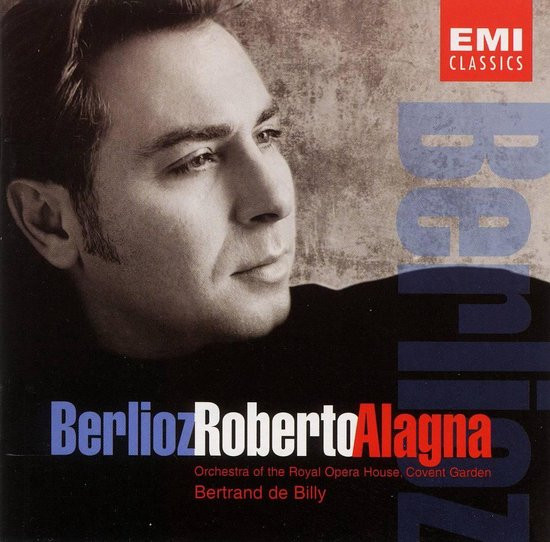
Roberto Alagna sings Berlioz

ndctotk3os5qcgvn
An interesting and enterprising recital recorded in 2003, when Alagna was at the top of his game. It’s certainly a pleasure to hear authentically sung French.

As far as I’m aware, Alagna never attempted any of these roles on stage, but, if these excerpts are anything to go by, he’d have made an excellent Faust and Cellini.

Though he negotiates Iopas’s high-lying tessitura well enough, I rather prefer a lighter lyric tenor in this music, and, conversely, I’m not sure he’d have had the heft for Enée on stage. Admittedly I’ve been brought up on the heroic sound of a Vickers here, but the role has recently been taken by Michael Spyres, a tenor with a lighter voice than Alagna. Having heard both Alagna and Spyres live, I’d have said Alagna would be more suited to the role’s demands than Spyres. The few excerpts included here certainly go very well. The excerpt from L’Enfance du Christ is quite charming and direct in its utterance and the Mab scherzo from Roméo et Juliette is suitably deft and witty.

Next come excerpts from La Damnation de Faust, with the addition of a rarity in the shape of a setting for tenor and guitar of Mephisophélès’s serenade, taken from the earlier Huits Scènes de Faust. Alagna is joined by his then wife, Angela Gheorghiu, for the duet Ange adorée, which is sung most beautifully. What a shame he never attempted Berlioz’s Faust on stage.

Like Iopas. Bénédict also probably needs a slightly less beefy voice, but Alagna manages his short aria well enough.

More convincing are the excerpts from Benvenuto Cellini, another role which I would have thought would have suited him well. He was apparently slated to sing it on the Nelson recording, but pulled out for some reason. He may not quite erase memories of Gedda in one of his greatest roles, but, on the evidence of the two arias recorded here (La gloire était ma seule idole and Sur les monts les plus sauvages, his voice had the ideal weight and penetration, not to mention his perfect diction and attentio to the text.

Charming in every way are the excerpts from Lélio, with the addition of texts spoken by Gérard Dépardieu, but Berlioz’s bombastic and over the top arrangement of La Marseillaise, which ends the disc, rather outstays its welcome and was all a bit much for me.

Bertrand de Billy’s accompaniments are all a little too reticent for my liking, and the disc would no doubt have benefited from the presence of a Colin Davis or John Eliot Gardiner in the pit. Nevertheless, if you like Berlioz, and I do, this is a highly enjoyable disc and an excellent reminder of Alagna at his considerable best.

Berlioz’s Les Nuits d’Eté – a comparative review of ten recordings

Les Nuits d’Eté is one of my favuorite orchestral song cycles and, along with Strauss’s Vier letzte Lieder, must be one of the most recorded works for voice and orchestra. The songs were originally written to a piano accompaniment and we don’t know why Berlioz chose these six particular texts by his contemporary, Théophile Gautier. Though not really conceived as a cycle, they do make a satsifying programme with two lighter songs framing three deeply emotional outpourings. Berlioz orchestrated Absence in 1846 then orchestrated the remaining songs in 1853, suggesting a mezzo-soprano or tenor for Villanelle, contralto for Le spectre de la rose, baritone (or optionally mezzo or contralto) for Sur les lagunes, mezzo or tenor for Absence, tenor for Au cimetière and mezzo or tenor for L’île inconnue, though nowadays it is more regularly sung by one singer, usually a mezzo or a soprano. It has been recorded by tenors, baritones and bass-baritones and even countertenors.

They have been recorded umpteen times and Ralph Moore has done an exhaustive comparison of most of these recordings, which I recommend to anyone who loves the songs. You can view it at http://musicweb-international.com/classrev/2019/Aug/Berlioz_nuits_survey.pdf.

I have ten recordings in my collection and these are the ten I listened to over a period of two days. The songs respond to a variety of different approaches and I enjoyed my task immensely.

r-17739049-1615146774-6216.jpeg

Vctoria De Los Angeles recorded the cycle in 1955 with Charles Munch and the Boston Symphony Orchestra, when she was in superb voice. As always there is a great deal of pleasure to be derived from her singing, her tone suitably plaintive in the middle songs and smilingly bright and playful in the outer songs, which, predictably, is where she is most successful. What I miss is a deeper vein of tragedy, something more grandiloquent in the middle songs, where what we need is a touch of Cassandre and Didon. De Los Angeles reminds me more of a Marguerite. She is in warm, velvety voice, and this is nonetheless one of the most satisfying accounts around. Sonically it can’t measure up to any of the later stereo recordings.

r-4226020-1359064159-2900.jpeg

Nor, unfortunately can the Steber version with Dimitri Mitropoulos and the Columbia Symphomy Orchestra. The first impression when listening to this version is of the sheer security and perfect focus of Steber’s beautiful voice. The cycle doesn’t get off to a very impressive start, with Mitropoulos’s too deliberate tempo for Villanelle. It is actually close to the metronome mark of crotchet = 96, but it seems plodding and Mitropoulos fails to make the woodwind light enough. But Steber is gorgeous. She can expand the tone gloriously at a phrase like et parmi la fête étoilée in Le spectre de la rose and the quality remains wonderfully rich down below. Throughout Steber is keenly responisve to the poetry. Au cimetière, for instance, has a real sense of tragic foreboding. What a superb Cassandre she might have been. Definitely a prime contender. If only it had been in better sound.

517nnfbtual._ac_

Now here is something rather different. The countertenor voice is not one you would expect to hear in this music, but David Daniels has always had a velvety, rich sound and his version comes as something of a pleasant surprise, though, more used to hearing him in the music of the Baroque, I did wonder if this version might be a product of the gramophone. He did however sing it in the concert hall and his is a voice I’ve never had trouble hearing in the hall or theatre, so maybe I’m wrong. Daniels has excellent French, a perfect legato and is ideally steady throughout, with a much greater range of tone colour than you would expect from a countertenor. As always, his phrasing is wonderfully musical and John Nelson provides excellent support with the Ensemble Orchestral de Paris. Ultimately, for all his musicality and way of commuicating the text, I’m not sure the countertenor voice is what the songs require, but it is a very interesting experiment which Daniels almost pulls off.

r-10811227-1504704037-6832.jpeg

It was quite a shock to plunge from Daniels to the darkly pungent tones of Agnes Baltsa. Her French is often questionable and the voice and manner are arrestingly individual, with her varying her tone from song to song. I suppose you’d call her approach quite operatic. She adopts an almost coy sexuality for Villanelle, choosing a more Dalila-like sensuality for Le spectre de la rose, languidly eliding some of the phrases. Some might find her plunges into chest voice jarring, but I rather like it. The singing can be a bit rough round the edges but you could never call her dull. Ralph Moore suggests that she brings more than a touch of her Carmen to the songs, and I’d agree. It’s not how I’d always like to hear them, but it’s certainly a very individual and occasionally thrilling take on them. Jeffrey Tate and the London Symphony Orchestra provide excellent support.

r-5824261-1403705173-5318.jpeg

Régine Crespin is the only version included here by a French singer and it is really good to hear the language enunciated so clearly, especially after the idiosyncratic French of someone like Baltsa.

Now Crespin’s version is so famous that it has been a prime recommendation for the work ever since it was first issued in 1963 and dissenting opinions are likley to be viewed with incredulity, but, unlike its coupling of Ravel’s Shéhérazade, I’m not sure the Berlioz holds up that well. For a start, there is a deal of sloppy orchestral playing from L’Orchestre de la Suisse-Romande under Ernest Ansermet, and, for another, Crespin’s singing often tends to the lugubrious. There is no sense of mounting rapture at the arrival of the rose, no sense of despair in Sur les lagunes, no plaintive yearning in Absence. The singing is altogether too civilised, and, however musical and tasteful her singing , however elegant her phrasing, Crespin remains aloof and uninvolved. She is at the oppoiste pole from Baltsa’s often wild and wayward version, but I miss Baltsa’s dramatic involvement, which I ultmately prefer. I see that I’m not alone in my opinion, which is supported by both Ralph Moore and David Cairns (in Song on Record, Volume II). A controversial opinion, no doubt, but I’m sticking to it. Crespin is most successful in the final song, which responds to her vocal equivalent of the ironically arched eyebrow. Another mark against her is that she unaccountably alters the order of the songs, placing Absence before Sur les lagunes, which destroys the balance of the cycle. Intonation is occasionally suspect too, especially in Au cometière.

r-5925026-1621620398-8177.jpeg

Colin Davis’s multi-singer version is something of an inconclusive experiment. However ineresting it is to hear the songs sung more or less by the voices Berlioz suggested, I think the cycle hangs together better when captured by a single voice. Nor do any of the singers challenge the best of other versions by single singers. Frank Patterson, who has a rather whiny, nasal timbre is granted two songs, Villanelle and Au cimetiére, neither of which he does justice to. Josephine Veasey, an appreciable Berlioz singer, sings a plausible Le spectre de la rose without really illuminating it, and John Shirley-Quirk tends to growl in the lower regions of Sur les lagunes. The most successful of the singers is soprano Sheila Armstrong, who sings in excellent French and turns in a nicely plaintive Absence as well as a charmingly flirtatious L’île inconnue. One would expect Sir Colin and the London Symphony Orchestra to give a brilliant version of the score, but the effect is somewhat somnolent and low key. Interesting but inconclusive.

r-8458350-1462019569-7396.jpeg

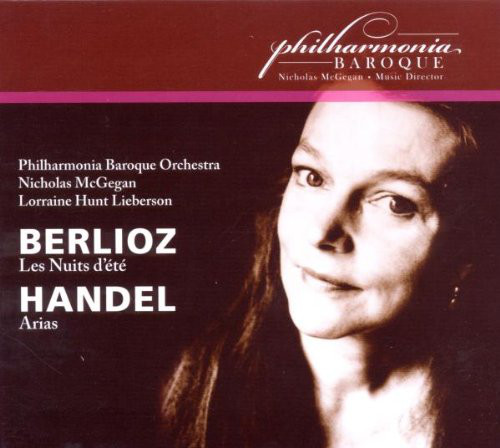
Next we come to the wonderful Lorraine Hunt Lieberson, recorded live at a concert in 1991 or 1995 (the booklet isn’t entirely clear on this point). It has to be said that the Philharmonia Baroque Orchestra under Nicholas McGegan are not quite up to the standard of the ensembles in some of these performances, but they nonetheless provide sensitive accompaniment to Hunt Lieberson’s superbly detailed and deeply heartfelt performances. Throughout she is totally inside the music, her response to the poetry seeming totally spontaneous and natural. Unerringly she captures the mood of each song, certain phrases remaining etched on the memory, for instance the blank, desparing tone at the end of Au cimetière, which, though  she switches to smilingly insouciant joy for L’île inconnue, creeps back into her tone for the closing measures when she reminds us that not all is happy au pays d’amour. The voice is surpassingly beautiful, the singing intensely concentrated and she communicates so much. What a great loss she was to the musical world.

r-15146607-1589535837-3883.jpeg

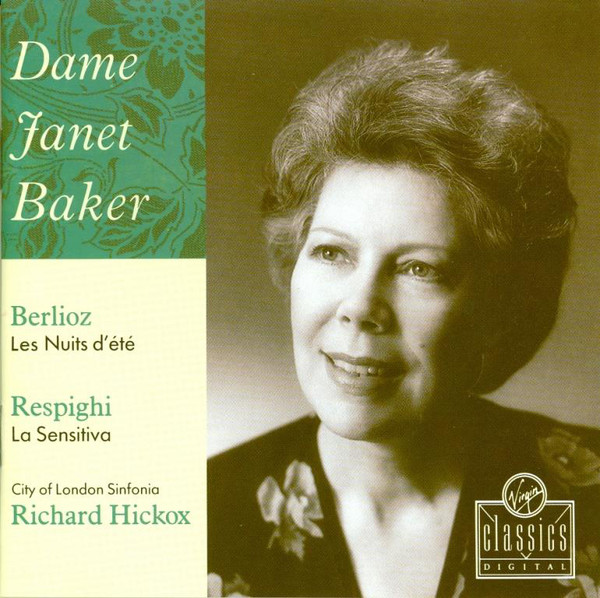
Finally, I come to three versions by the great Dame Janet Baker. The most recent ( recorded in 1990) and the one I will discuss first, was one of her last (maybe her last ever) recording. made shorly after she had retired from the concert platform. By this time her great artistry cannot quite hide the hint of strain in the upper reaches, the discoloration on certain vowels and the loosening of vibrations on sustained high notes. In no way is this competitive with her two other vesions (one live under Giulini and the famous studio one under Barbirolli), so I will only comment by saying I heard Baker and Hickox perform the cycle not long before this recording was made and, live and in the concert hall, it was still an amazing experience.

r-9879493-1487856491-9833.jpeg

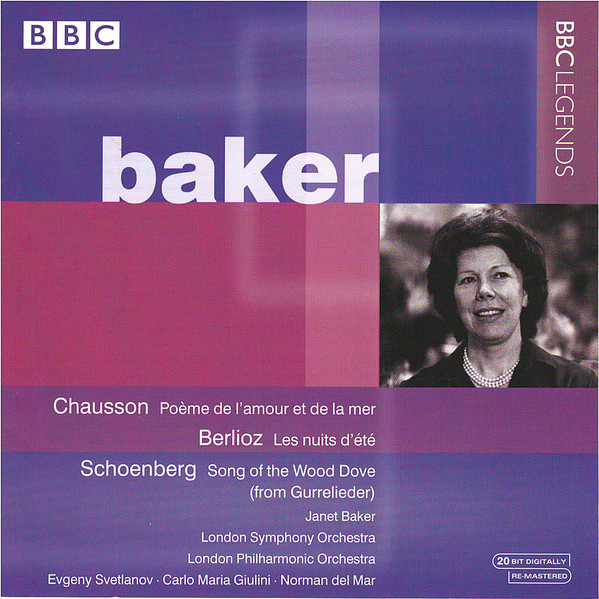
The live Giulini account, taken from a concert at the Royal Festiva Hall in 1975, must be amongst the slowest on disc and it is remarkable that Baker can sustain these speeds; but sustain them she does, luxuriating in the added breadth that Giulini gives her, her breath control quite astonishing. The recorded sound is a trifle muddy and we hear the occasional coughs that go along with live music making, but the specificity of her response to the text is quite extraordinary and there is a concentrated intensity about this performance, which is no doubt enhanced by the presence of a live audience. If I continue to prefer the studio performance, that could be because it is the one by which I got to know the songs and it is no doubt imprinted on my brain. It also, of course enjoys better sound. Both interpretations are absolutely and unequivocally superb. Baker’s stage roles included both Cassandre and Didon and she brings something of the character of their music to these songs too.

r-8436535-1461577724-3437.jpeg

Baker enjoyed a very special relationship with Sir John Barbirolli and of course made a few important recordings with him before he died in 1970.  Apart from the above recording of Ravel and Berlioz they can be heard in famous recordings of Elgar’s Sea Pictures,  Mahler’s three orchestral song cycles and Elgar’s Dream of Gerontius, all very special and irreplaceable.

The New Philharmonia are in fine form and provide some of the best orchestral playing on any of these performances. Villanelle is perhaps a little too determinedly jolly, but after that the performance just gets better and better. Baker starts Le spectre de la rose almost confidingly, as if whispering into the ear of the sleeping girl, swelling into the glorious mini climax at Et parmi le fête étoilée, Tu me promenas tout le soir. Her tone turns both sensual and erotic when the rose arrives from paradise, and then she sings the phrase Mon destin fut digne d’envie in one glorious, long breath. This might just be the most wonderful performance of the song ever put down on record.

From there we are plunged into the blank, desparing tone of Ma belle amie est morte. If she were the Act IV Didon in the previous song here she is Cassandre, singing in stark absolutes. Having reached a desolate climax the song fades away in a whispered close of utter dejection. She yearns sweetly in Absence, the voice taking on a soprano-ish lightness in the upper register, but maintaining its tragic depth for the line Ah, grands désirs inappaisées. Au cimetière is mesmerisingly hypnotic, conjuring up ghostly visions of graveyards at night, until finally gloom is dispelled and a smile enters her voice for L’île inconnue, with a coquettish twinkle on Est-ce dans la Baltique?

After listening to ten different recordings in two days, I find I love the cycle more than ever and all these recordings have something to offer.  I actually enjoyed them all. However if I had to choose but one  on that proverbial desert island, then it would have to be Baker with Barbirolli, though I’d probably find a way to smuggle the Hunt Lieberson with me as well somehow.

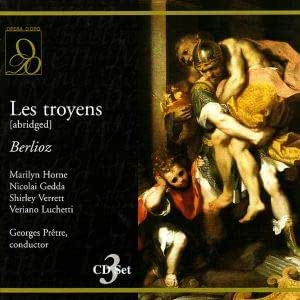
Les Troyens (abridged) conducted by Georges Prêtre

41rdvpg1mzl._ql70_ml2_

This live recording,  seemingly from a radio broadcast of a concert performance, is chiefly interesting for the contributions of  three great singers, Marilyn Horne, Shirley Verrett and Nicolai Gedda.

The score is heavily cut, and Prêtre whizzes through it with unseemly haste with no sense whatsoever of the piece’s structure. I just felt that he lacked any real understanding of the Berlioz idiom, of his originality and individuality, which is a pity because he has some excellent principals, though the supporting roles are less well filled. Veriano Luchetti appears as a rather too muscular Iopas.

Horne has no problems with the difficult tessitura of Cassandre’s role, her voice shining out in the high passages but with plenty of power in the lower regions. However she doesn’t quite convey Cassandre’s crazed zeal, though Prêtre’s fast tempos hardly help. Robert Massard is a fine Chorèbe.

Gedda, a lyric tenor, is surprisingly successful as Enée, a role usually sung by more heroic voices like Vickers and Heppner. His French is, as you might expect, excellent, and he never forces the voice, nor does he have any trouble with the top C in his big aria Inutiles regrets. He doesn’t quite erase memories of Vickers, but his French is much more natural, and this might actually be more like the voice Berlioz would have had in mind. A great performance to set beside his Benvenuto Cellini and Faust, and it is a great shame he never appears to have sung the role again.

As Didon, Verrett is in splendid voice, perhaps one of the most richly endowed singers to have sung the role on disc, and she is, as always, dramatically involved, but again Prêtre tends to rush her, and I find myself wondering what she might have achieved with a Davis at the helm. I’m delighted to have heard her in the role, but I find I actually prefer Veasey on Davis’s first recording, who, in turn, cedes place to Janet Baker, who unfortunately only recorded the final scenes under Sir Alexander Gibson in 1969, shortly after singing the role for Scottish Opera. There exists a complete recording of a performance from Covent Garden at which Baker deputised for an ailing Veasey. Despite the fact that she is singing in English, whilst the rest of the cast sing in French (Scottish Opera were performing the opera in English, and Baker didn’t have time to learn the French text), she makes a profound impression. It is a great pity she wasn’t engaged for the studio recording.

I enjoyed hearing this for the singing of the principals, but Prêtre all but ruins it for me, and both Davis, in either of his two recordings, and Nelson are much more recommendable versions of the opera.

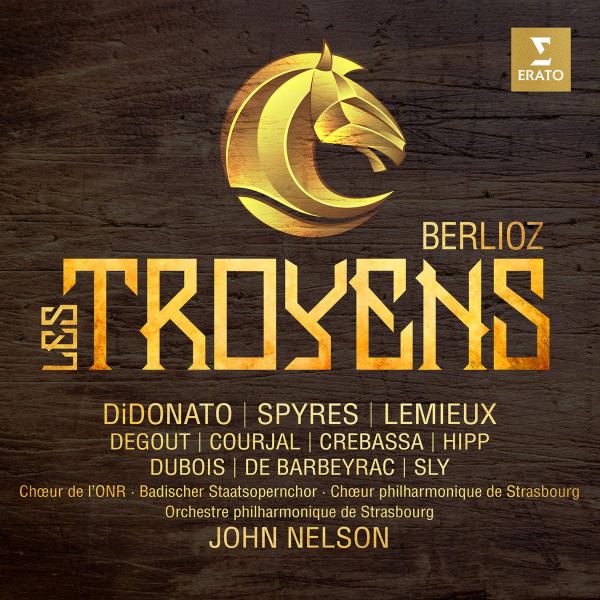
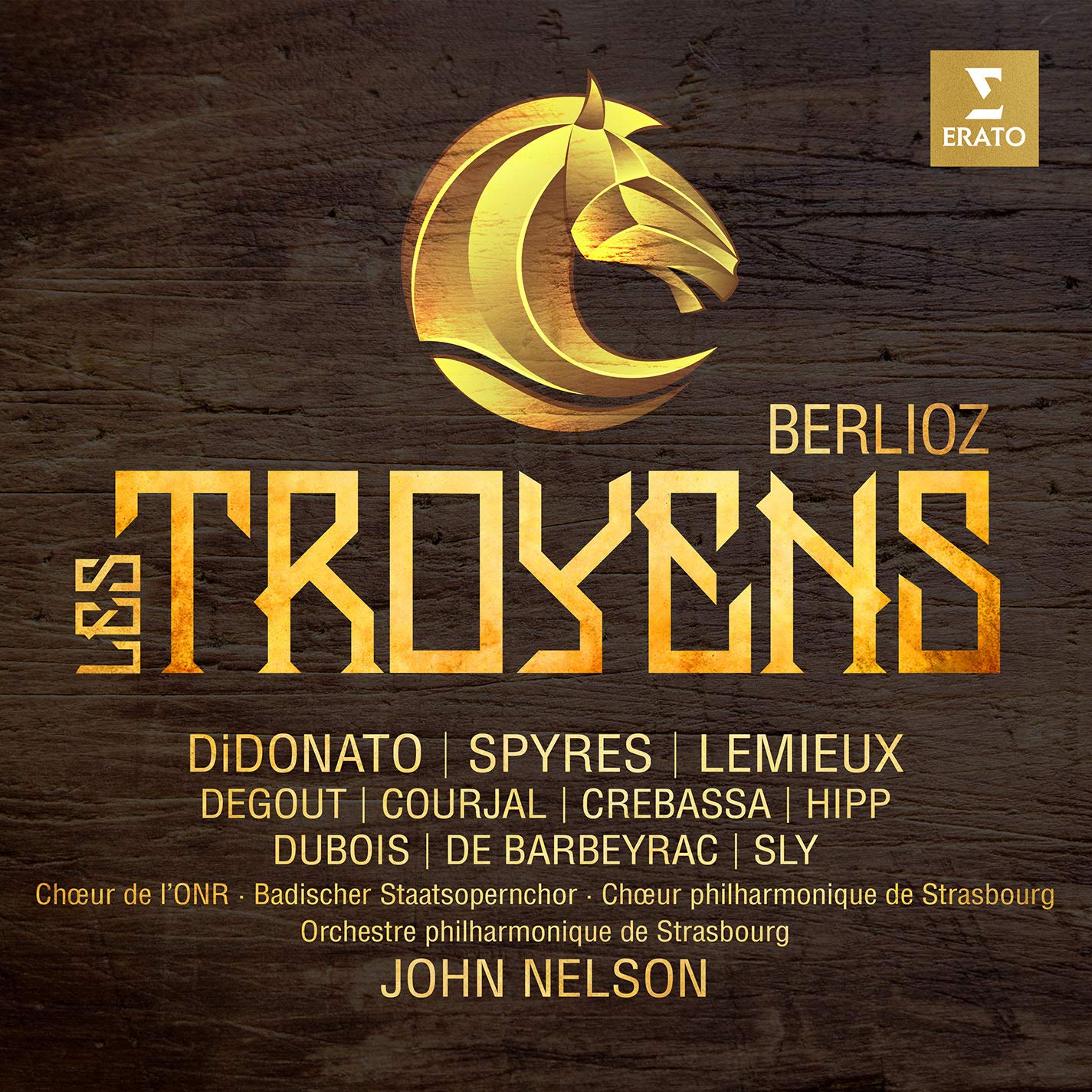
Nelson’s Les Troyens

81768wdtygl._sl1425_

I love this opera, though I’ve never actually seen it staged. The first time I heard it live was in two halves at a couple of Proms concerts in 1982. It was conducted by Gennadi Rozhdestvensky and starred Jessye Norman as Didon, Felicity Palmer as Cassandre and Richard Cassilly as Enée. I didn’t know the opera as well then as I do now, but I remember even then I loved it. People often moan that it is too long, hence why it is often split into two parts, but it’s no longer than some of Wagner’s operas (and shorter than one or two). Subsequently I heard it twice at the Barbican under Sir Colin Davis, for whom Berlioz was something of a lifelong passion. Indeed without him it is quite possible that Berlioz would still be underappreciated today. I’ve also long enjoyed both Davis’s first pioneering recording for Philips, with Josephine Veasey and Jon Vickers, which was based on performances at Covent Garden, as well as his later recording with the London Symphony Orchestra, recorded at concerts at the Barbican, with Ben Heppner, Petra Lang and Michelle DeYoung.

It is a magnificent score, Berlioz’s greatest achievement, and it is a terrible shame he never got to hear it performed in its entirety. According to the Berlioz scholar, David Cairns, it is

an opera of visionary beauty and splendour, compelling in its epic sweep, fascinating in the variety of its musical invention… it recaptures the tragic spirit and climate of the ancient world.

As always with Berlioz, the orchestration is superb and he writes brilliantly for major and minor characters alike, one of the most haunting moments in the score being given to the young sailor Hylas, as he laments for his homeland at the beginning of Act V.

This recent set has garnered some great reviews, so I was keen to hear how it measured up to the Davis recordings. From an orchestral point of view it is certainly very fine, but the singers are all a little light of voice for my taste. I heard Michael Spyres singing Berlioz’s Faust at the Proms not so long ago, and I found him a wonderfully musical and intelligent singer. I wonder though whether his voice might be a tad too small for Aeneas. There were times at the Proms that I thought his lyrical voice a little too small even for Faust. Maybe I’ve become too used to more heroic voices like Vickers and Heppner, but the role of Enée was in the repertoire of the great Georges Thill, who also had a rather more beefy voice than Spyres. Lemieux is also a light voiced Cassandre, though she’s a great improvement on Lindholm, who is on the first Davis recording. I wouldn’t prefer her to Lang on the second Davis recording, nor Deborah Voigt, who sings Cassandre on the less successful Dutoit recording and also on a live Met recording, with Lorraine Hunt Lieberson as Didon.

DiDonato is probably the most successful of the soloists. Some find her vibrato distracting, though it doesn’t bother me unduly, and she is thoroughly inside the role. However she doesn’t evince the sort of innigkeit you find in Janet Baker, who can be heard in incomparable versions of the final scenes conducted by Sir Alexander Gibson, and also in a couple of live performances under Davis, nor of Hunt Lieberson, who can be heard in the live Met performance under Levine, mentioned above. That said, I don’t know of anyone else around today who could sing it better.

Nor do I wish to be too picky about a recording that is a considerable achievement for all concerned. It gets a cautious thumbs up from me; certainly the best since Davis I and II, with my preference still being for Davis I.

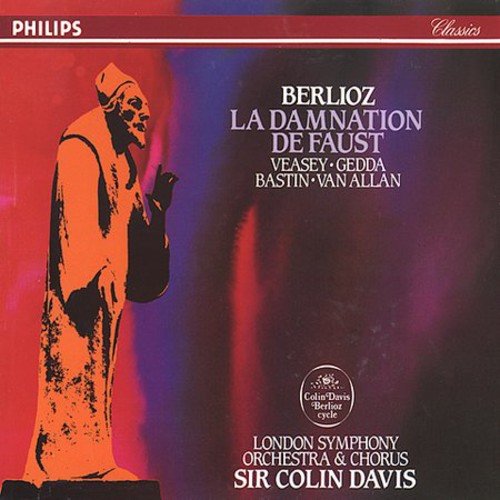
Colin Davis conducts La Damnation de Faust

51uqyihlall

Davis’s classic Philips recording of La Damnation de Faust, better cast I think than his later LSO Live version, is still one of the most recommendable versions of Berlioz’s non-opera. This tragédie-lyrique was never intended to be staged and therefore is particularly well suited to the gramophone, which leaves one’s imagination clear to fill in the stage set and scenery.

Gedda is a great Faust. He may have been just a little past his vocal best but he still manages a gorgeous pianissimo top C sharp in the duet with Marguerite, which no other Faust can quite pull off, added to which his singing is always stylish and intelligently thought through. There are better Margeurite’s on disc than Veasey (Baker, Von Stade and Von Otter come to mind); the difficult Roi de Thulé doesn’t quite come off, but she is better in the duet and sings a fine Romance. Bastin makes a superb Méphistophélès, mercurial, sardonic and ultimately evil and Richard Van Allan puts in one of his best recorded performances as Brander.

Davis, as so often in Berlioz, has a wonderful sense of structure and paces the score just right, and the LSO play brilliantly for him, the brass powerful, woodwind and strings deliciously light in the Menuet des Follets, plus some wonderfully sensitive cor anglais playing in the introduction to D’amour l’ardente flamme.

Every time I listen to this piece, I am struck by its originality. Berlioz was and is unique, with an unmistakable voice. No other composer is remotely like him.

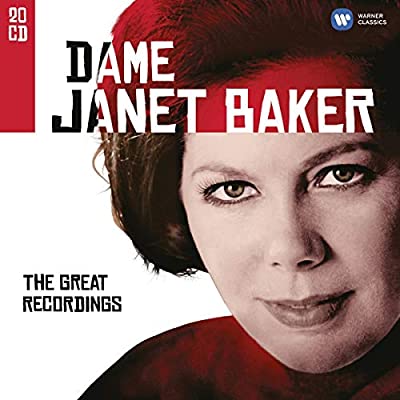
Dame Janet Baker – The Great Recordings

51yyk-hlf7l._sy400_ml2_

This exhaustive twenty disc box was, when it was first released on EMI, more properly called The Great EMI Recordings. The deletion of the word EMI from the title has something to do with the conditions of the sale, of EMI to Warner but the original title is more representative of the contents, as Dame Janet also made “great” recordings  for Decca, Philips and Hyperion. Aside from Ottavia’s Lament and Farewell from Monteverdi’s L’Incoronazione di Poppea, and the final scenes from Berlioz’s Les Troyens, this set includes no opera. Still, the range is wide, covering music from Monteverdi to Schoenberg and, as it also includes excerpts from various complete recordings of orotorios, covers just about everything she ever recorded for EMI and later Virgin Classics. The quality is extrordinarily high and it is safe to say that she never made a bad record and many of them are out and out classics.

The lay out is mostly logical, starting with early music and moving forward in time, but cramming shorter LP recordings onto twenty well-filled CDs has inevetably led to the occasional odd juxtaposition. Most of the recordings cover her vocal prime, from 1966 through the 1970s. Shortly after she retired she made a few recordings with Richard Hickox in 1989 and 1990 and only these show a slight decline in her vocal resources, though the artistry remains undimmed.

Disc one starts with a 1969 recording of music by Monteverdi, Alessandro and Domenico Scarlatti with the English Chamber Orchestra under Raymond Leppard rounded off by excerpts from a duet recital with Dietrich Fischer-Dieskau, recorded live at the Royal Festival Hall in 1970. Leppard’s souped up arrangements of the Monteverdi might seem anachronistic now, but Baker’s impassioned singing of Arianna’s Lament and Ottavia’s Lament and Farewell from L’Incoronazione di Poppea transcends any matters of style. The duet items (music by Schütz, Schein and Lilius) have continuo realisations by George Malcolm, who plays the organ with Kenneth Heath on the cello and are delightful in every way.

Disc two gives us the first side of an LP called A Pageant of English Song, which had songs by Dowland and Campion accompanied on the lute, and by Purcell, Monro (I can’t think of his My lovely Cecilia without having Baker’s smiling tone in my head) Boyce and Arne, with accompaniments by Martin Isepp on harpsichord. More duets with Fischer-Dieskau round off the disc, some of these taken from a 1969 Queen Elizabeth Hall recital with Barenboim on the piano.

From here we move to Bach for the next two discs, the wonderful performance of Ich habe genug under Menuhin being particularly noteworthy. A Bach recital, which she recorded with the Academy of St Martin in the Fields under Neville Marriner is spread over the two discs, which finished with the alto arias from Klemperer’s 1967 recording of the Mass in B minor. What a superb Bach singer she was.

We move onto Handel, a composer with whom Baker was particularly associated. Mackerras’s recording of Messiah was one of the first to make a stab in the direction of HIP. It was also the first one I ever owned, Baker’s contribution being particularly memorable. Her version of He was despised is incredibly moving. The two Handel cantatas are listed as arr. Leppard, but I’m not sure what those ‘arrangements’ involve. Baker is, as always, a superb Handelian.

The Haydn and Beethoven Folk Song Arrangements, which follow on the next disc, rather outstay their welcome, for me anyway, even in performances as special and imaginative as these, which means that the ensuing Schumann and Brahms duets from the QEH concert come as something of a relief.

mi0xnzg4lmpwzwc

Discs seven and eight are all Schubert, taken, for the most part, from a two disc set she recorded with Gerald Moore in 1971, which included quite a few rarities and a 1980 recital with Geofrrey Parsons of more popular fare. Baker’s control of dynamics is extraordinary and her breath control stupendous, her legato line beyond reproach. Amongst so many great performances, it’s hard to name favourites, but I doubt I’ve ever heard a better performance of Du bist die Ruh, which is not only deeply felt but also displays the perfection of her tehcnique and her superb breath control.

A few more Schubert songs start the ninth disc, which then continues with a Mendelssohn recital with Geofrrey Parsons and Schumann’s Frauenliebe und Leben with Daniel Barenboim. One of the first records Janet Baker ever made was of the Schumann cycle, for the Saga label before she was contracted to EMI. It was released to much acclaim, but this one delves that much deeper and is indeed one of the greatest recordings of Schumann’s cycle in the catalogue. The Mendelssohn songs are perhaps not so memorable or so wide ranging as Schubert’s but Baker makes the best case for them, but the Schumann cycle is the real prize of this disc.

The tenth disc gives us the second side of her Schumann LP with Barenboim, a wonderful performance of the Opus 39 Liederkreis, and the whole of an all Brahms programme with Previn at the piano, the two songs for alto and viola (Cecil Aronowitz) and the Vier ernste Gesänge are deeply felt and wonderfully accompanied.

my03otc4lmpwzwc

A Liszt recital (with Geoffrey Parsons) starts disc eleven, an excellent selection of songs, which are not performed as often as they should be. Baker and Parsons make the very best case for them. These are followed by a small selection from Wolf’s Spanisches Liederbuch and a couple of Mahler’s youthful songs.

Disc twelve is something of a mixed bag and brings together recordings from the beginning and end of Dame Janet’s career, a selection of Strauss songs from an early EMI recital disc, the Song of the Wood Dove from Ferencsik’s 1968 recording of Gurrelieder and Respighi’s La Sensitiva from recording sessions made for Virgin Classics in 1990, a gap of some twenty-three years. I suppose you can detect a slight loosening of the vibrations, but the voice is still very firm and the artistry undimmed. Some may hear a slight lack of spontaneity in the 1967 Strauss songs (absent from the 1973 recording of Ständchen) and I’d have to admit I prefer the sound of a soprano in these songs, but I’d still rather too much care than too little. The Schoenberg might seem an unexpected piece for Dame Janet, but she is absoutely superb here, wonderfully intense and dramatically involved and the Respighi, recorded just after she had retired from the concert platform, is a lovely performance, warmly sung and senisitively phrased.

Disc thirteen is all of song with orchestra. The Brahms Alto Rhapsody was originally used as a filler for Boult’s Brahms Symphony cycle, then reissued as a makeweight for Wagner’s Wesendonck Lieder and a selction of Strauss songs Baker and Boult recorded in 1975. The Alto Rhapsody and the Wagner are absolutely superb, indeed among the most recommendable versions of these songs. The Strauss songs suit her less well, but I’m still glad to have them. Then comes the legendary recording of Elgar’s Sea Pictures, which has never been equalled. It was originally issued with Du Pré’s equally legendary recording of Elgar’s Cello Concerto and is one of the best selling classical records of all time. the original LP was an EMI best seller for as long as I remember, and a record we had on permanent weekly order, when I worked at MDC in London.The disc finishes, fittingly enough with Dame Janet’s wonderfully consoling and radiant singing of the closing pages of The Dream of Gerontius.

Now if I were allowed just one Janet Baker record on that proverbial desert island, I’d be hard pressed to choose between her Mahler and her Berlioz and  the next two discs are dedicated to these two composers.

Disc fourteen gathers together all the Mahler recordings she made with Barbirolli and adds Urlicht from Rattle’s acclaimed recording of the Second Symphony. All three cycles are amongst the best recordings of these songs ever made. The Rückert Lieder were originally issued on the fourth side of Barbirolli’s famous recording of the 5th Symphony with the New Philharmonia, the other two cycles having been recorded a couple of years earlier with the Hallé. Ich bin der Welt abhanden gekommen was recorded at the same time and used as a fill-up, which explains why they recorded the song twice. If I were to use one piece of music to illustrate the genius of Janet Baker, then it would undoubtedly be one of these two versions of Ich bin der Welt abhanden gekommen. The song is not so much sung as experienced and you can really feel the connection between singer and conductor. To be honest, there is very little to choose between the two performances; maybe the later one is even more withdrawn, even more self-communing. When I listen to either I feel as if I too am lost to the world.

Disc fifteen is also one of the most desirable discs in this set. Baker was a great Berlioz singer and it has always been a huge cause for regret that she never recorded the role of Didon, making these excerpts more treasurable than ever and these final scenes are devastating in their impact. She recorded La mort de Cléopâtre again for Philips under Davis, another superbly impassioned and dramatic performance, but she is in slightly fresher voice here.

This Barbirolli recording of Les nuits d’été is, I think, her finest and indeed one of the greatest performances of the songs ever committed to disc. In his survey of the then available recordings for Song on Record 2, David Cairns makes it a top recommendation alongside Steber/Mitropoulos. She is possibly a little stiff in Villanelle but all is glorious after that and, with the inestimable help of Barbirolli, she unerringly captures the mood of each of the four middle songs especially. Le spectre de la rose is taken slowly but never drags, and the tempo gives her ample time to fill out the phrases, its climax gorgeously radiant.

Ravel’s Shéhérazade, which opens disc sixteen, was recorded at the same time as Baker’s superb Les nuits d’été and is wonderfully sung, though I’d say she misses that hint of inuendo in the last song that you get from Crespin. Nonetheless this is a beautiful performance of the cycle. The Chausson and Duparc were recorded ten years later, and there is a slight detioration in the quality of the voice, the vibrations have loosened a bit and there is a slight feeling of strain. She sings the Chausson with a greater sense of freedom in a live performance under Svetlanov only a few years earlier, but this is still a great performance with Previn and the LSO offering superb support as they do in the Duparc.

D’amour l’ardent flamme from La Damnation de Faust, which closes the disc, is one of the greatest ever recorded and it’s too bad that it is taken from a not very recommendable performance of the work under Georges Prêtre. If only Baker had been the Marguerite on Davis’s Philips recording of 1973, in which Gedda got to reprise his Faust under much happier circumstances. Baker joins Callas and Verrett as my favourites for this piece.

Baker was also a renowned interpreter of French song with piano and the lion’s share of disc seventeen is given over to A French Song Recital, which she recorded with Gerald Moore in 1969, songs by Duparc, Fauré and Debussy. It was logical to add the French items from a mixed bag recital of a couple of years later. These songs by Hahn, Massenet, Chabrier and Gounod demonstrate Baker’s prowess in a lighter vein. The Berlioz orchestral songs were originally coupled to her final recording of Les nuits d’été, recorded right at the end of her career. The voice is not quite the same as it was twenty years earlier, admittedly, but to be honest, very few allowances have to be made for the passing years.

One of the first discs Baker ever recorded was a recital of British songs, for the Saga label, and English song would often be a part of her concert recitals. This eighteenth disc brings together the second side of A Pageant of English Song (you might remember the first side was included on Disc 2). This time the composers are Parry, Stanford (a superbly impassion performance of La belle dame sans merci), Vaughan Williams, Quilter, Ireland , Gurney and Warlock, and the English items from her Favourites album. She was also much associated with the music of Benjamin Britten, but all her recordings were made for Decca, so it is good to have this one excerpt from Previn’s recording of his Spring Symphony.

When Walton’s Troilus and Cressida was revived at Covent Garden in 1976, Walton re-wrote the role for a mezzo, specifically so that Baker could sing it. The performances were recorded and the disc is filled out with three excerpts from that recording.

The penultimate disc starts with the remaining item from her 1972 Favourites album (Mendlessohn’s Auf Flügeln des Gesanges) and continues with two arias from the 1968 Frühbeck de Burgos recording of Elijah, her singing of O rest in the Lord sung with a sincerity and compassion that enfolds you in its warm embrace.

It was perhaps an unfortunate idea to present the Mendelssohn Psalm of twenty years later straight after, for she sounds uncharacteristically tentative and strained in the solos, which are, in any case, designated for soprano. The concert aria that follows fares a little better as the tessitura lies slightly lower, but these are not performances I would want to listen to often. On the other hand, the Brahms Alto Rhapsody, recorded the same year, is rather wonderful and probably the gem of these late sessions. It lies a lot lower of course, so the sounds a great deal more comfortable, and it is a wonderful memento of the moving performance I heard these same artists give of the work at the Barbican round about the time of this recording and shortly before she retired. As in the live performance, the moment when the music shifts from the minor to the major is a moment of pure magic. This is definitely the prize of these late recording sessions.

It is perhaps unfortunate that the final disc in this wonderful set is the only one I would call dispensable, though I was actually pleasantly surprised by this 1990 performance of Berlioz’s Les nuits d’été. She takes a little less time over the songs now, and this performance comes in around three minutes shorter than the Barbirolli. She still has an innate understanding of Berlioz and the way to shape and mould the phrases, but there is also a slight feeling of her husbanding her resources where the Barbirolli (and the live Giulini) find her in full vocal plenitude. They are still the ones I would reach for when wanting to hear Baker in this work.

The remaning items are from a 1980 disc called Songs for Sunday which will no doubt be more to some people’s taste than to mine. It’s not a record I ever paid much attention to, though I did buy a copy for my mother when it came out. I am not religious, but Dame Janet’s, singing with  with her customary sincerity and generosity of spirit, completely won me over.

ms00mjy5lmpwzwc

These twenty discs have confirmed for me Baker’s place as one of the greatest singers of the latter half of the twentieth century. Her records continue to educate and enthral. There is something so personal about Baker’s art, a sense of total identification with the composer in question and an innate ability to capture the right mood of each song. This goes hand in hand with a gift for communication which is vouchsafed to only a few. Just occasionally one can be aware of the huge amount of thought that has gone into each interpretation, but I’d rather too much intelligence than too little. It has been  interesting too to hear her collaborations with so many different musicians. For me she is the last of the true greats. How lucky we are that she left behind her such a rich and varied legacy.